ignition CHEVROLET COLORADO 2007 1.G User Guide
[x] Cancel search | Manufacturer: CHEVROLET, Model Year: 2007, Model line: COLORADO, Model: CHEVROLET COLORADO 2007 1.GPages: 496, PDF Size: 2.7 MB
Page 113 of 496
Power Windows
{CAUTION:
Leaving children, helpless adults, or pets
in a vehicle with the windows closed is
dangerous. They can be overcome from
extreme heat in warm or hot weather and
suffer permanent injuries or even death
from heat stroke.
Leaving children in a vehicle with the
ignition key is dangerous for many
reasons, children or others could be badly
injured or even killed. They could operate
the power windows or other controls or
even make the vehicle move. The windows
will function with the keys in the ignition
and they could be seriously injured or killed
if caught in the path of a closing window.
Do not leave keys in a vehicle with children.
When there are children in the rear seat
use the window lockout button to prevent
unintentional operation of the windows.The power window
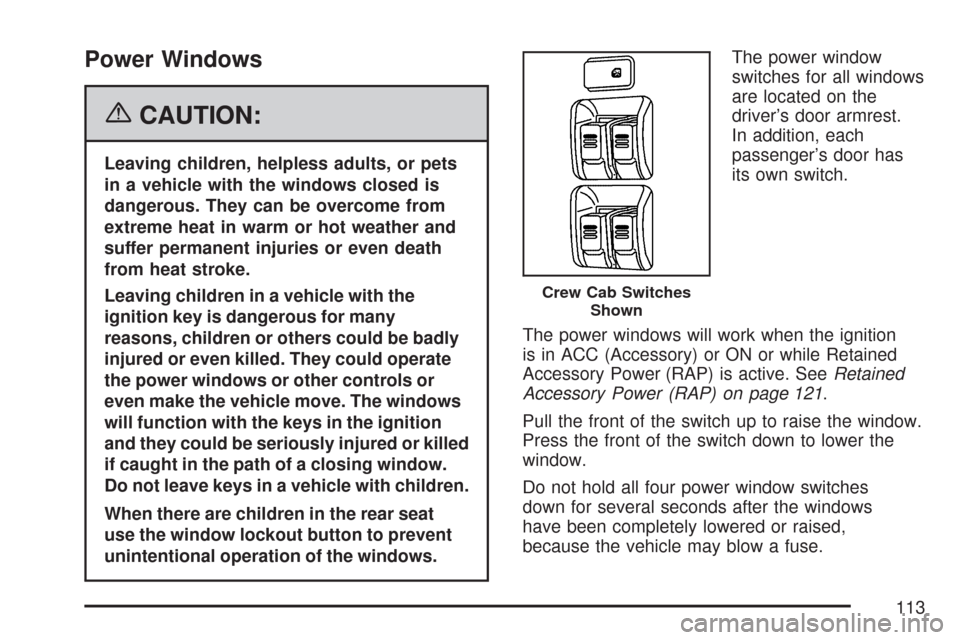
switches for all windows
are located on the
driver’s door armrest.
In addition, each
passenger’s door has
its own switch.
The power windows will work when the ignition
is in ACC (Accessory) or ON or while Retained
Accessory Power (RAP) is active. SeeRetained
Accessory Power (RAP) on page 121.
Pull the front of the switch up to raise the window.
Press the front of the switch down to lower the
window.
Do not hold all four power window switches
down for several seconds after the windows
have been completely lowered or raised,
because the vehicle may blow a fuse.
Crew Cab Switches
Shown
113
Page 116 of 496
If a locked door is not opened using the RKE
transmitter, or by OnStar®, the pre-alarm will
go off. If the engine is not started or unlock not
pressed within 10 seconds, the front turn
signal lamps will ash for two minutes, and the
horn will sound for two minutes, then will turn off
to save the battery power.
Remember, the theft-deterrent system will not
activate if you lock the doors with a key, the
manual door lock, or power door lock switch.
The system can only be activated using the
RKE transmitter, or by OnStar
®. SeeOnStar®
System on page 149for additional information.
You should also remember that you can start your
vehicle with the correct ignition key if the alarm
has been set off.
Here is how to avoid setting off the alarm by
accident:
If you do not want to activate the
theft-deterrent system, the vehicle should be
locked with the door key after the doors
are closed.
Always unlock a door with the RKE transmitter.
Unlocking a door any other way will set off
the alarm.If you set off the alarm by accident, you can turn
off the alarm by pressing unlock on the RKE
transmitter. The alarm will not stop if you try to
unlock a door any other way.
Testing the Alarm
To test the alarm:
1. From inside the vehicle, activate the system
by locking the doors with the RKE transmitter.
2. Unlock the door with the manual door lock and
open the door. This should set off the alarm.
3. To turn the alarm off, press the unlock button
on the RKE transmitter or start the engine.
If the alarm does not sound when it should but
the lights ash, check to see if the horn works.
The horn fuse may be blown. To replace the fuse,
seeFuses and Circuit Breakers on page 433.
If the alarm does not sound or the front turn signal
lamps do not ash, see your dealer/retailer for
service.
116
Page 117 of 496
Passlock®
Your vehicle has the Passlock®theft-deterrent
system.
Passlock
®is a passive theft-deterrent system.
Passlock®enables fuel if the ignition lock cylinder
is turned with a valid key. If an incorrect key is
used or the ignition lock cylinder is tampered with,
the fuel system is disabled and the vehicle will
not start.
During normal operation, the security light will turn
off approximately ve seconds after the engine
is started. SeeSecurity Light on page 196.
If the engine stalls and the security light ashes,
wait about 10 minutes until the light stops
ashing before trying to restart the engine.
Remember to release the key from START as
soon as the engine starts.If the engine does not start after three tries,
the vehicle needs service.
If the engine is running and the security light
comes on, you will be able to restart the engine if
you turn the engine off. However, your Passlock
®
system is not working properly and must be
serviced by your dealer/retailer. Your vehicle is
not protected by Passlock
®at this time. See your
dealer/retailer for service.
In an emergency, call the Roadside Assistance
Center. SeeRoadside Assistance Program
on page 466.
Do not leave the key or device that disarms
or deactivates the theft deterrent system in
the vehicle.
117
Page 119 of 496
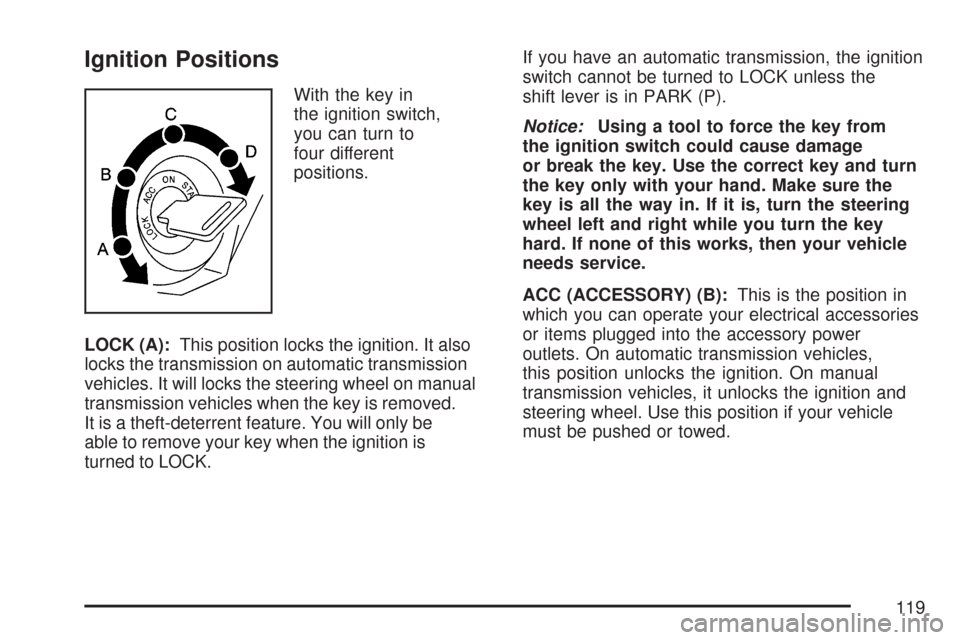
Ignition Positions
With the key in
the ignition switch,
you can turn to
four different
positions.
LOCK (A):This position locks the ignition. It also
locks the transmission on automatic transmission
vehicles. It will locks the steering wheel on manual
transmission vehicles when the key is removed.
It is a theft-deterrent feature. You will only be
able to remove your key when the ignition is
turned to LOCK.If you have an automatic transmission, the ignition
switch cannot be turned to LOCK unless the
shift lever is in PARK (P).
Notice:Using a tool to force the key from
the ignition switch could cause damage
or break the key. Use the correct key and turn
the key only with your hand. Make sure the
key is all the way in. If it is, turn the steering
wheel left and right while you turn the key
hard. If none of this works, then your vehicle
needs service.
ACC (ACCESSORY) (B):This is the position in
which you can operate your electrical accessories
or items plugged into the accessory power
outlets. On automatic transmission vehicles,
this position unlocks the ignition. On manual
transmission vehicles, it unlocks the ignition and
steering wheel. Use this position if your vehicle
must be pushed or towed.
119
Page 120 of 496
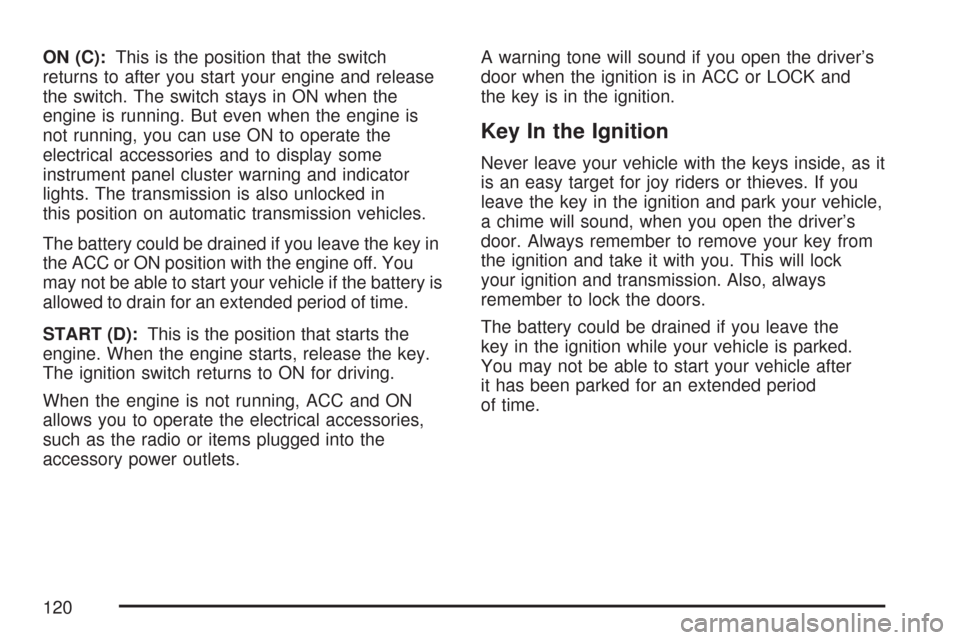
ON (C):This is the position that the switch
returns to after you start your engine and release
the switch. The switch stays in ON when the
engine is running. But even when the engine is
not running, you can use ON to operate the
electrical accessories and to display some
instrument panel cluster warning and indicator
lights. The transmission is also unlocked in
this position on automatic transmission vehicles.
The battery could be drained if you leave the key in
the ACC or ON position with the engine off. You
may not be able to start your vehicle if the battery is
allowed to drain for an extended period of time.
START (D):This is the position that starts the
engine. When the engine starts, release the key.
The ignition switch returns to ON for driving.
When the engine is not running, ACC and ON
allows you to operate the electrical accessories,
such as the radio or items plugged into the
accessory power outlets.A warning tone will sound if you open the driver’s
door when the ignition is in ACC or LOCK and
the key is in the ignition.
Key In the Ignition
Never leave your vehicle with the keys inside, as it
is an easy target for joy riders or thieves. If you
leave the key in the ignition and park your vehicle,
a chime will sound, when you open the driver’s
door. Always remember to remove your key from
the ignition and take it with you. This will lock
your ignition and transmission. Also, always
remember to lock the doors.
The battery could be drained if you leave the
key in the ignition while your vehicle is parked.
You may not be able to start your vehicle after
it has been parked for an extended period
of time.
120
Page 121 of 496
Retained Accessory Power (RAP)
These vehicle accessories can be used for up
to 20 minutes after the engine is turned off:
Audio System
Wipers
Power Windows
These features work when the key is in ON or
ACC. Once the key is turned from ON to LOCK,
power to these features continue to work for
up to 20 minutes or until a door is opened.
Starting the Engine
Place the transmission in the proper gear.
Automatic Transmission
Move your shift lever to PARK (P) or NEUTRAL (N).
Your engine will not start in any other position – this
is a safety feature. To restart when you are already
moving, use NEUTRAL (N) only.
Notice:Do not try to shift to PARK (P) if your
vehicle is moving. If you do, you could damage
the transmission. Shift to PARK (P) only when
your vehicle is stopped.
Manual Transmission
The shift lever should be in the NEUTRAL position
and the parking brake engaged. Hold the clutch
pedal to the oor and start the engine. Your
vehicle will not start if the clutch pedal is not all
the way down. That is a safety feature.
Starting Procedure
1. With your foot off the accelerator pedal, turn
the ignition key to START. When the engine
starts, let go of the key. The idle speed will go
down as the engine gets warm. Do not race the
engine immediately after starting it. Operate
the engine and transmission gently to allow the
oil to warm up and lubricate all moving parts.
Your vehicle has a Computer-Controlled
Cranking System. This feature assists in
starting the engine and protects components.
If the ignition key is turned to the START
position, and then released when the engine
begins cranking, the engine will continue
cranking for a few seconds or until the vehicle
starts. If the engine does not start and the
key is held in START for many seconds,
cranking will be stopped after 15 seconds
to prevent cranking motor damage.
121
Page 122 of 496
To prevent gear damage, this system also
prevents cranking if the engine is already
running. Engine cranking can be stopped
by turning the ignition switch to the ACC or
LOCK position.
Notice:Cranking the engine for long periods
of time, by returning the key to the START
position immediately after cranking has ended,
can overheat and damage the cranking
motor, and drain the battery. Wait at least
15 seconds between each try, to allow
the cranking motor to cool down.
2. If the engine does not start after 5-10 seconds,
especially in very cold weather (below 0°F
or−18°C), it could be ooded with too
much gasoline. Try pushing the accelerator
pedal all the way to the oor and holding
it there as you hold the key in START for
up to a maximum of 15 seconds. Wait at least
15 seconds between each try, to allow the
cranking motor to cool down. When the engine
starts, let go of the key and accelerator.If the vehicle starts briey but then stops
again, do the same thing. This clears the
extra gasoline from the engine. Do not race
the engine immediately after starting it.
Operate the engine and transmission gently
until the oil warms up and lubricates all
moving parts.
Notice:Your engine is designed to work with
the electronics in your vehicle. If you add
electrical parts or accessories, you could
change the way the engine operates. Before
adding electrical equipment, check with
your dealer/retailer. If you do not, your engine
might not perform properly. Any resulting
damage would not be covered by your
vehicle’s warranty.
122
Page 124 of 496
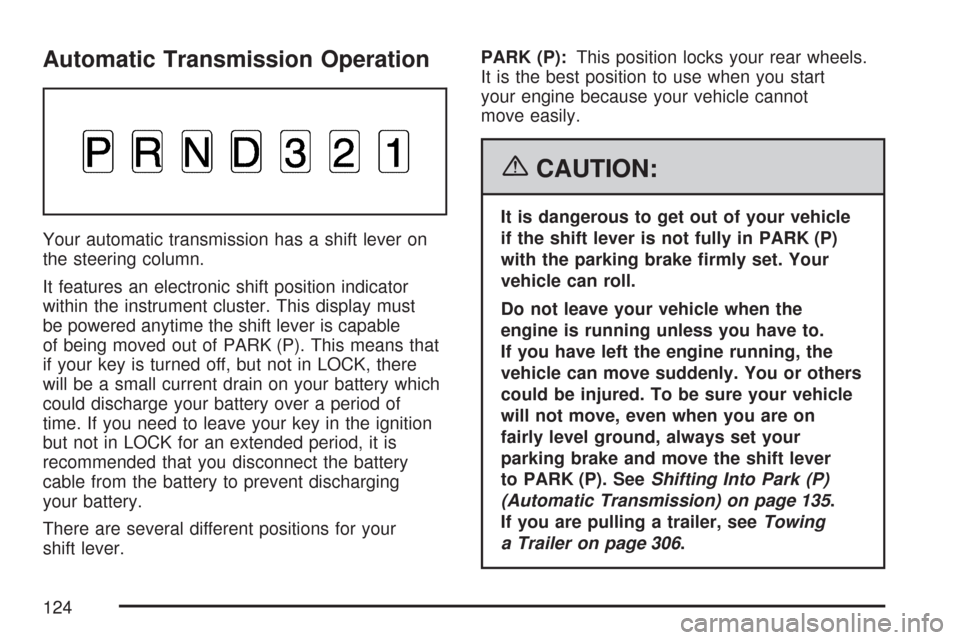
Automatic Transmission Operation
Your automatic transmission has a shift lever on
the steering column.
It features an electronic shift position indicator
within the instrument cluster. This display must
be powered anytime the shift lever is capable
of being moved out of PARK (P). This means that
if your key is turned off, but not in LOCK, there
will be a small current drain on your battery which
could discharge your battery over a period of
time. If you need to leave your key in the ignition
but not in LOCK for an extended period, it is
recommended that you disconnect the battery
cable from the battery to prevent discharging
your battery.
There are several different positions for your
shift lever.PARK (P):This position locks your rear wheels.
It is the best position to use when you start
your engine because your vehicle cannot
move easily.
{CAUTION:
It is dangerous to get out of your vehicle
if the shift lever is not fully in PARK (P)
with the parking brake rmly set. Your
vehicle can roll.
Do not leave your vehicle when the
engine is running unless you have to.
If you have left the engine running, the
vehicle can move suddenly. You or others
could be injured. To be sure your vehicle
will not move, even when you are on
fairly level ground, always set your
parking brake and move the shift lever
to PARK (P). SeeShifting Into Park (P)
(Automatic Transmission) on page 135.
If you are pulling a trailer, seeTowing
a Trailer on page 306.
124
Page 125 of 496
Make sure the shift lever is fully in PARK (P)
before starting the engine. Your vehicle has an
automatic transmission shift lock control system.
You must fully apply your regular brakes before
you can shift from PARK (P) when the ignition
key is in ON. If you cannot shift out of PARK (P),
ease pressure on the shift lever by pushing
the shift lever all the way into PARK (P) as
you maintain brake application. Then move the
shift lever into another gear. SeeShifting Out
of Park (P) (Automatic Transmission) on page 137.
REVERSE (R):Use this gear to back up.
Notice:Shifting to REVERSE (R) while your
vehicle is moving forward could damage the
transmission. The repairs would not be covered
by your warranty. Shift to REVERSE (R) only
after your vehicle is stopped.
To rock your vehicle back and forth to get out
of snow, ice, or sand without damaging your
transmission, seeIf Your Vehicle is Stuck in Sand,
Mud, Ice, or Snow on page 290.NEUTRAL (N):In this position, your engine does
not connect with the wheels. To restart when
you are already moving, use NEUTRAL (N) only.
{CAUTION:
Shifting into a drive gear while your
engine is running at high speed is
dangerous. Unless your foot is rmly on
the brake pedal, your vehicle could move
very rapidly. You could lose control and
hit people or objects. Do not shift into a
drive gear while your engine is running
at high speed.
Notice:Shifting out of PARK (P) or
NEUTRAL (N) with the engine running at
high speed may damage the transmission.
The repairs would not be covered by your
warranty. Be sure the engine is not running
at high speed when shifting your vehicle.
125
Page 130 of 496
Use these buttons to shift into and out of four-wheel
drive. You can choose from the following:
2
m(Two-Wheel High):This setting is for driving
in most street and highway situations. Your
front axle is not engaged in two-wheel drive.
{CAUTION:
Shifting the transfer case to NEUTRAL
can cause your vehicle to roll even if the
transmission is in PARK (P), or if you
have a manual transmission, even if you
are in gear. You or someone else could
be seriously injured. Be sure to set the
parking brake before placing the transfer
case in NEUTRAL. SeeParking Brake
on page 133.
N (NEUTRAL):Shift the vehicle’s transfer case
to NEUTRAL only when towing your vehicle.4
m(Four-Wheel High):This setting engages
your front axle to help drive your vehicle. Use
four-wheel high when you need extra traction,
such as on snowy or icy roads, or in most off-road
situations.
4
n(Four-Wheel Low):This setting also
engages your front axle to give you extra traction.
It sends the maximum power to all four wheels.
You might choose four-wheel low if you were
driving off-road in sand, mud, or deep snow and
while climbing or descending steep hills.
Indicator lights in the buttons show you which
setting you are in. The indicator lights will come
on briey when you turn on the ignition and
one will stay on the selected setting. If the lights
do not come on, you should take your vehicle in for
service. An indicator light will ash while shifting.
It will stay on when the shift is completed.
If for some reason the transfer case does not shift,
it will return to the last chosen setting.
Shifting from Two-Wheel High to
Four-Wheel High
Press and release the Four-Wheel High button.
This can be done at any speed, and the front
axle will lock automatically.
130