belt CHEVROLET CORVETTE 1994 4.G User Guide
[x] Cancel search | Manufacturer: CHEVROLET, Model Year: 1994, Model line: CORVETTE, Model: CHEVROLET CORVETTE 1994 4.GPages: 274, PDF Size: 15.61 MB
Page 23 of 274
Downloaded from www.Manualslib.com manuals search engine Seats and Restraint Systems
t":
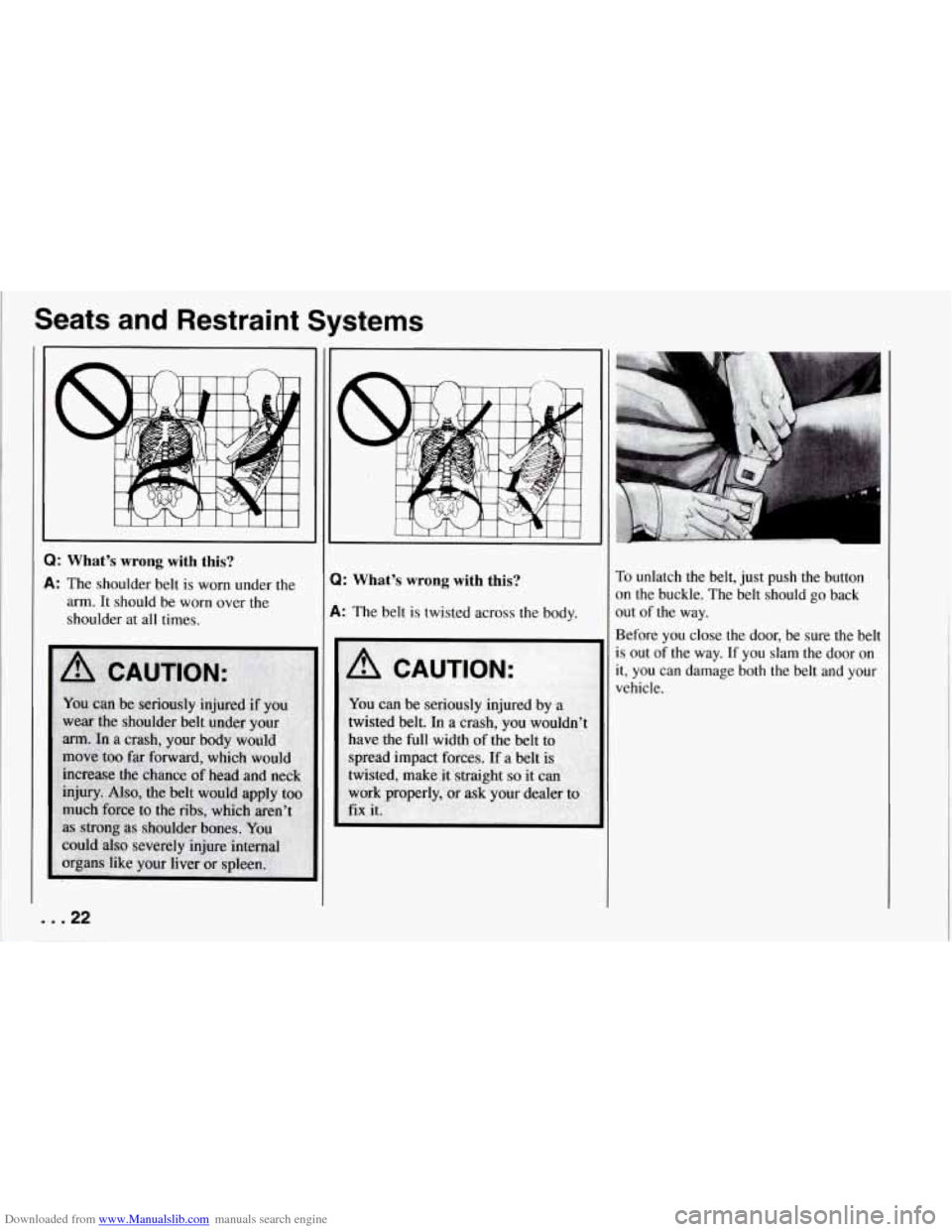
Q: What's wrong with this?
A: The shoulder belt is worn under the
arm. It should be
worn over the
shoulder at all times.
. . .22
Q: What's wrong with this?
A: The belt is twisted across the body. To unlatch
the belt, just push the button
on the buckle. The belt should go back
out
of the way.
Before you close the door, be sure the belt
is out of the way. If you slam the door on
it,
you can damage both the belt and your
vehicle.
Page 24 of 274
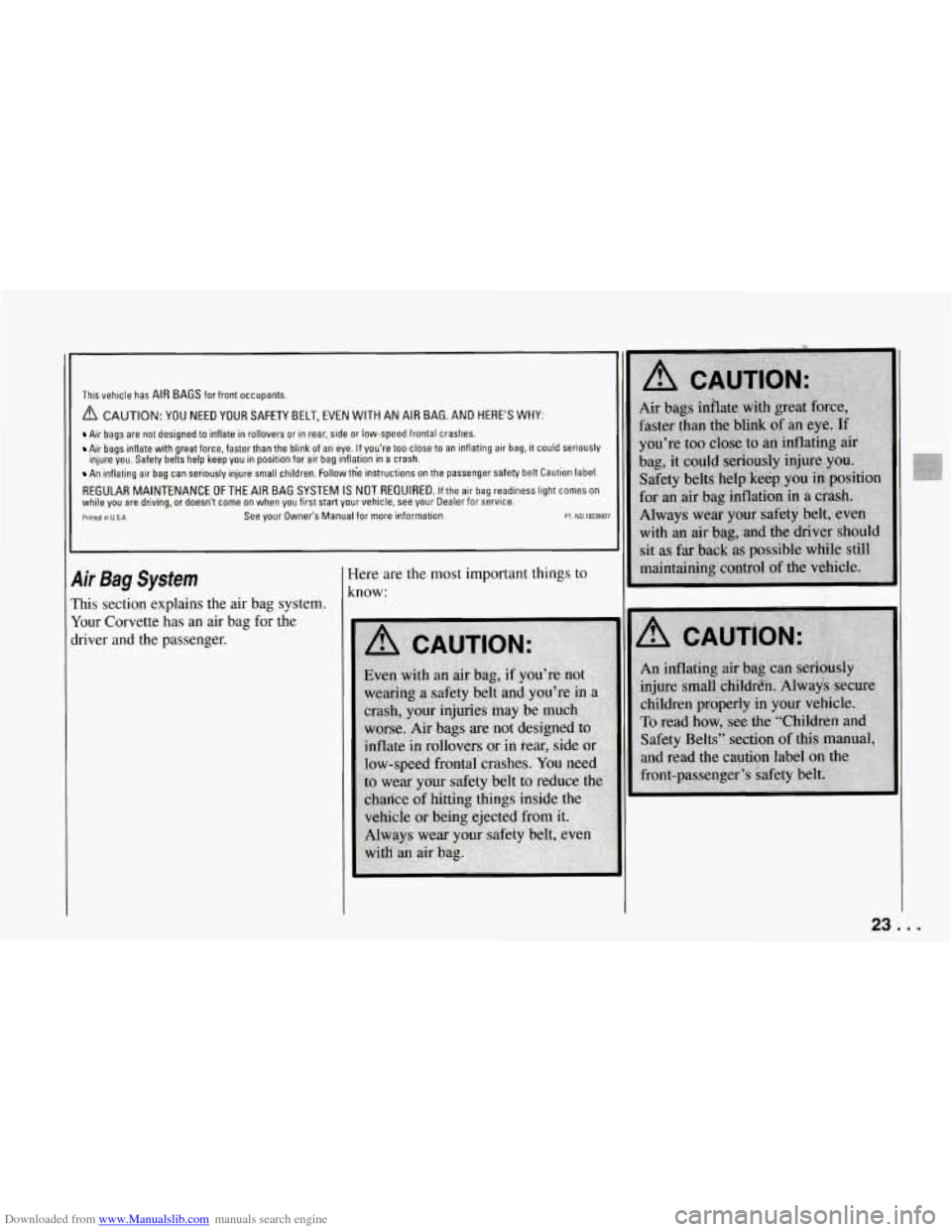
Downloaded from www.Manualslib.com manuals search engine This vehicle has AIR BAGS for front occupants.
A CAUTION: YOU NEED YOUR SAFETY BELT, EVEN WITH AN AIR BAG. AND HERE'S WHY:
Air bags are not designed to inflate in rollovers or in rear, side or low-speed frontal crashes.
Air bags inflate with great force, faster than the blink of an eye. If you're too close to an inflating air bag, it could seriously
An inflating air bag can seriously injure small children. Follow the instructions on the passenger safety belt Caution label.
REGULAR MAINTENANCE OF THE AIR BAG SYSTEM IS NOT REQUIRED. If the air bag readiness light comes on
while you are driving, or doesn't come on when you first start your vehicle, see your Dealer for service.
injure you. Safety belts help keep you
in position for air bag inflation in a crash.
Prlnled In UXA See
your Owner's Manual for more information. PT. NO 10239927
lir Bag System
'his section explains the air bag system.
our Corvette has an air bag for the
river and the passenger. Here are the
most important things to
know:
23.
Page 26 of 274
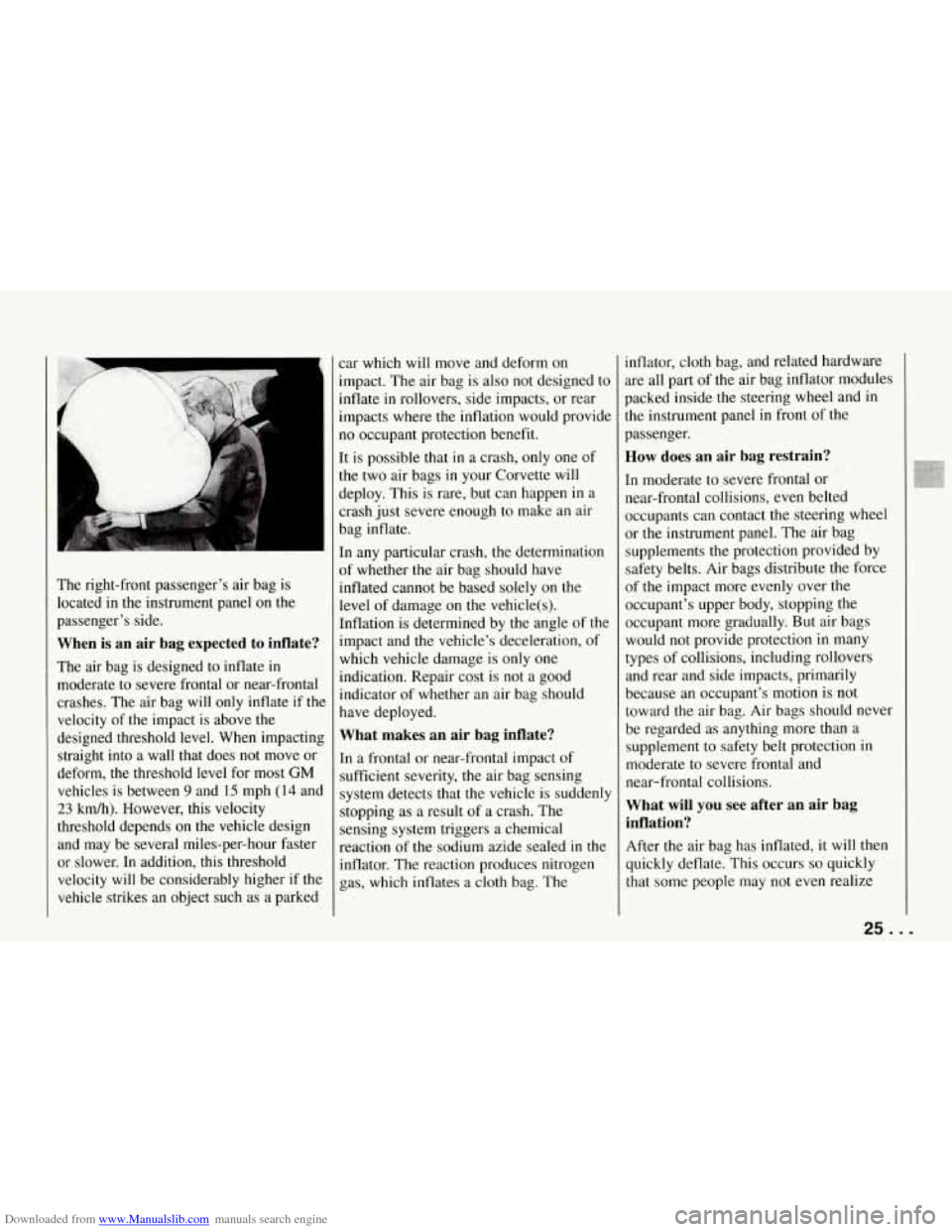
Downloaded from www.Manualslib.com manuals search engine The right-front passenger’s air bag is
located in the instrument panel on the
passenger’s side.
When is an air bag expected to inflate?
The air bag is designed to inflate in
moderate to severe frontal or near-frontal
crashes. The air bag will only inflate
if the
velocity of
the impact is above the
designed threshold level. When impacting straight into a wall that does not move or
deform, the threshold level for most
GM
vehicles is between 9 and 15 mph (14 and
23 kdh). However, this velocity
threshold depends on the vehicle design
and may be several miles-per-hour faster
or slower. In addition,
this threshold
velocity
will be considerably higher if the
vehicle strikes an object such as a parked car which will move and deform
on
impact. The air bag is also not designed to
inflate in rollovers, side impacts, or rear
impacts where the inflation would provide
no occupant protection benefit.
It is possible that
in a crash, only one of
the two air bags in your Corvette will
deploy. This is rare, but can happen
in a
crash just severe enough to make an air
bag inflate.
In any particular crash, the determination
of whether the air bag should have
inflated cannot be based solely on the level of damage on the vehicle(s).
Inflation is determined by
the angle of the
impact and the vehicle’s deceleration, of
which vehicle damage is only one
indication. Repair cost is not a good
indicator of whether an air bag should
have deployed.
What makes an air bag inflate?
In a frontal or near-frontal impact of
sufficient severity, the air bag sensing
system detects that
the vehicle is suddenly
stopping as a result
of a crash. The
sensing system triggers a chemical
reaction of
the sodium azide sealed in the
inflator. The reaction produces nitrogen
gas, which inflates a cloth bag. The inflator,
cloth bag, and related hardware
are all part of the air bag inflator modules
packed inside the steering wheel and
in
the instrument panel in front of the
passenger.
How does an air bag restrain?
In moderate to severe frontal or
near-frontal collisions, even belted
occupants can contact the steering
wheel
or the instrument panel. The air bag
supplements the protection provided by
safety belts.
Air bags distribute the force
of the impact more evenly over the
occupant’s upper body, stopping the
occupant more gradually. But air bags
would not provide protection in many
types of collisions, including rollovers
and rear and side impacts, primarily
because an occupant’s motion is not
toward the air bag. Air bags should never
be regarded as anything more than a
supplement to safety belt protection in
moderate to severe frontal and
near-frontal collisions.
What will you see after an air bag
inflation?
After the air bag has inflated, it will then
quickly deflate. This occurs
so quickly
that some people
may not even realize
25 . ,
Page 27 of 274
Downloaded from www.Manualslib.com manuals search engine Seats and Restraint Systems
that the air bag inflated. Some
components of the air bag module
in the
steering wheel hub for the driver’s air bag
or the instrument panel for the
passenger’s bag may be hot for a short
time, but the portion of the bag that comes
into contact with you will not be hot to
the touch. There will be small amounts of
smoke and dust coming from vents in the
deflated air bags. The air bag will
not
impede the driver’s vision or ability to
steer the vehicle, nor will it hinder
‘the
occupants from exiting the vehicle.
In many crashes severe enough to inflate
an air bag, windshields are broken by
vehicle deformation. Additional
windshield breakage may occur in
vehicles with passenger air bags because
the windshield acts as a reaction surface
for the inflating air bag.
The air bags are designed to inflate
only once. After they inflate, you’ll
need some new parts for your air bag
system. If you don’t get them,
the air
bag system won’t be there to help
protect you in another crash. A new
system will include air bag modules
and possibly other parts. The service
... 26
manual has information about the
need to replace other parts.
Your vehicle is equipped with a
diagnostic module, which records
information about the air bag system
if the air bag deploys in a crash. The
module records information about the
readiness of the system, which sensors
activated the deployment, and whether
the driver’s safety belt was in use.
Let only qualified technicians work on
your air bag system. Improper service
can mean that your air bag system
won’t work properly. See your dealer
for service.
NOTICE:
If you damage the cover for the
driver’s or the right-front passenger’s
air bag, they may not work properly.
You may have to replace the air bag
on the steering
wheel or both the air
bag and the instrument panel for the
passenger’s air bag.
Do not open or
break the air bag covers.
Is the smoke from an air bag inflation
harmful?
The particles emitted during air bag
inflation are not harmful to most people.
Some people with respiratory ailments may experience difficulty breathing
if
they stay in the vehicle with the windows
closed after air bag inflation.
So, if your
air bag inflates, you and any passengers
should exit the vehicle
if and when it is
safe to do
so. If you or your passengers
can’t get out of the vehicle, try to get
fresh air by opening a window, turning on
the fan, or opening a door.
Servicing Your Air Bag-Equipped
Corvette
Air bags affect how your Corvette should
be serviced. There are parts of the air bag
system in several places around your
vehicle. You don’t want
the system to
inflate while someone is working on your
vehicle. Your Chevrolet dealer and the 1994 Corvette Service Manual have
information about servicing your vehicle
and
the air bag system. The air bag
system does not need regular
maintenance.
Page 28 of 274
Downloaded from www.Manualslib.com manuals search engine Safety Belt Use during Pregnancy
Safety belts work for everyone, including
pregnant women. Like all occupants,
they
are more likely to be seriously injured if
they don’t wear safety belts.
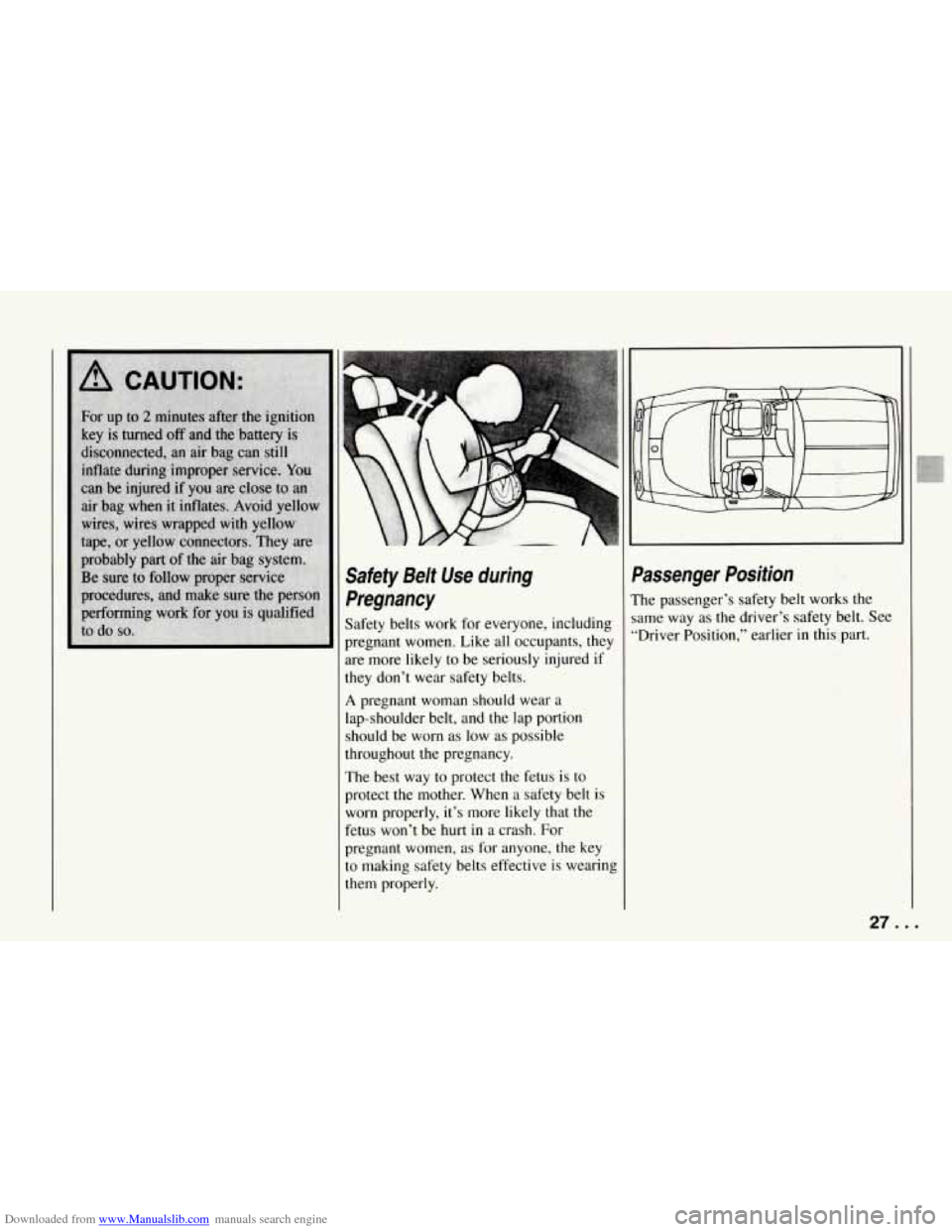
A pregnant woman should wear a
lap-shoulder belt, and
the lap portion
should be worn as low as possible
throughout the pregnancy.
The best way to protect the fetus is to
protect the mother. When a safety belt
is
worn properly, it’s more likely that the
fetus won’t be
hurt in a crash. For
pregnant women, as for anyone, the key
to making safety belts effective is wearing
them properly.
I
Dassenger Position
The passenger’s safety belt works the
iame way as the driver’s safety belt. See
‘Driver Position,’’ earlier in this part.
Page 30 of 274
Downloaded from www.Manualslib.com manuals search engine Child Restraints
Be sure to follow the instructions for the
restraint. You may find these instructions
on the restraint itself or in a booklet, or
both. These restraints use
the belt system
in your vehicle, but the child also has to
be secured within the restraint to help
reduce the chance of personal injury.
restraint will show you how to do that.
The child restraint must be secured
properly in the passenger seat.
Keep in mind that an unsecured child
restraint can move around in a collision
or sudden stop and injure people in the
vehicle. Be sure to properly secure any
child restraint in your vehicle
- even
when no child is in it.
I The instructions that come with the child 1
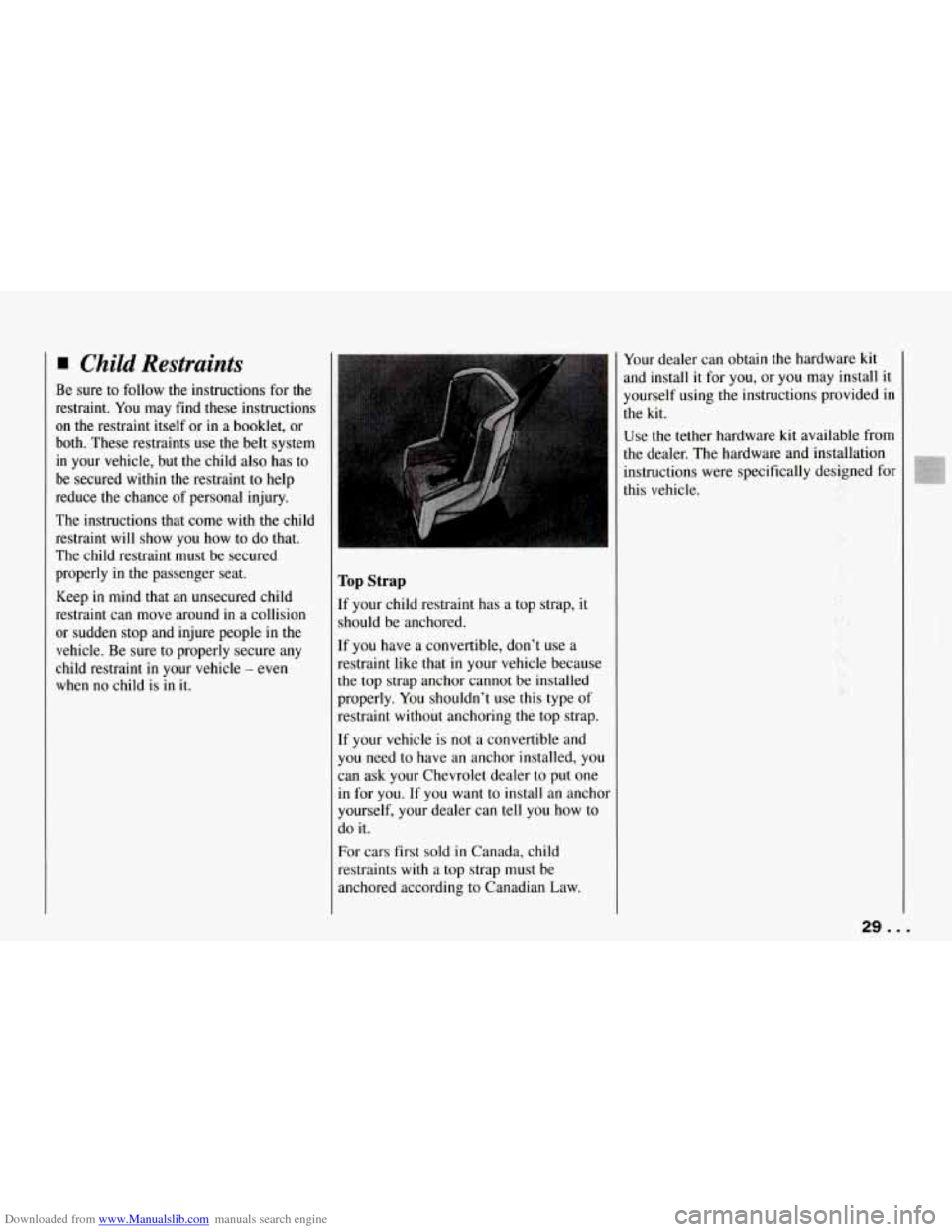
Top Strap
If your child restraint has a top strap, it
should be anchored.
If you have a convertible, don't use a
restraint like that in your vehicle because
the top strap anchor cannot be installed
properly. You shouldn't use this type of
restraint without anchoring the top strap.
If your vehicle is not a convertible and
you need to have an anchor installed,
yo^
can ask your Chevrolet dealer to put one
in for you. If you want to install an anchc
yourself, your dealer can tell you how to
do
it.
For cars first sold in Canada, child
restraints with
a top strap must be
anchored according to Canadian Law. Your
dealer can obtain the hardware kit
and install it for you, or you may install it
yourself using the instructions provided in
the kit.
Use the tether hardware kit available from
the dealer. The hardware and 'installation
instructions were specifically designed for
this vehicle.
29 . I I.
Page 31 of 274
Downloaded from www.Manualslib.com manuals search engine Seats and Restraint Systems
Securing a Child Restraint in the
Passenger Seat
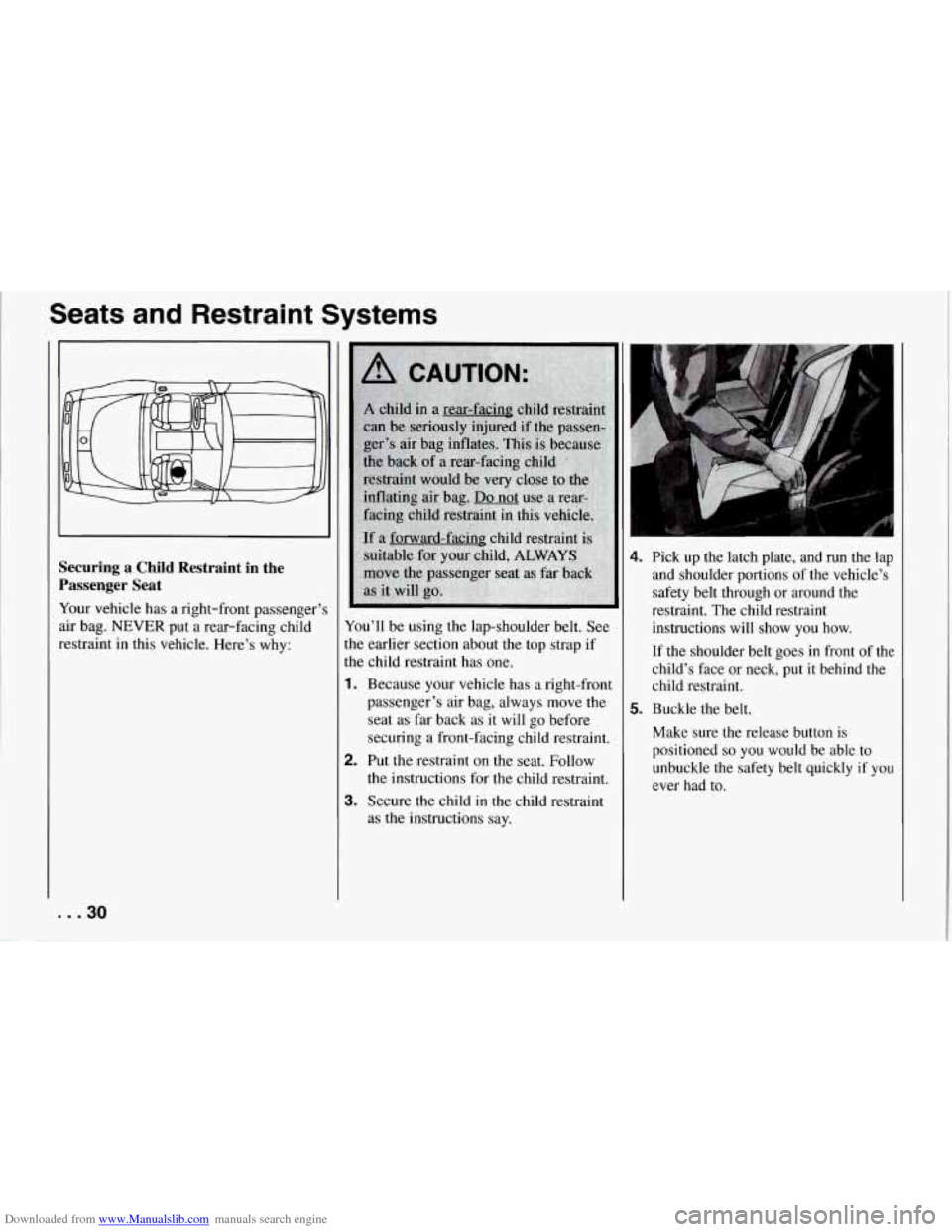
Your vehicle has a right-front passenger’s
air bag.
NEVER put a rear-facing child
restraint in this vehicle. Here’s why:
... 30
You’ll be using the lap-shoulder belt. See
the earlier section about the top strap if
the child restraint has one.
1. Because your vehicle has a right-front
passenger’s air bag, always move the
seat as far back as it will go before
securing a front-facing child restraint.
2. Put the restraint on the seat. Follow
the instructions for the child restraint.
3. Secure the child in the child restraint
as the instructions say.
4. Pick up the latch plate, and run the lap
and shoulder portions of the vehicle’s
safety belt through or around the
restraint. The child restraint instructions will show you how.
If the shoulder belt goes in front of the
child’s face or neck, put it behind the
child restraint.
5. Buckle the belt.
Make sure the release button is
positioned
so you would be able to
unbuckle the safety belt quickly if you
ever had to.
Page 32 of 274
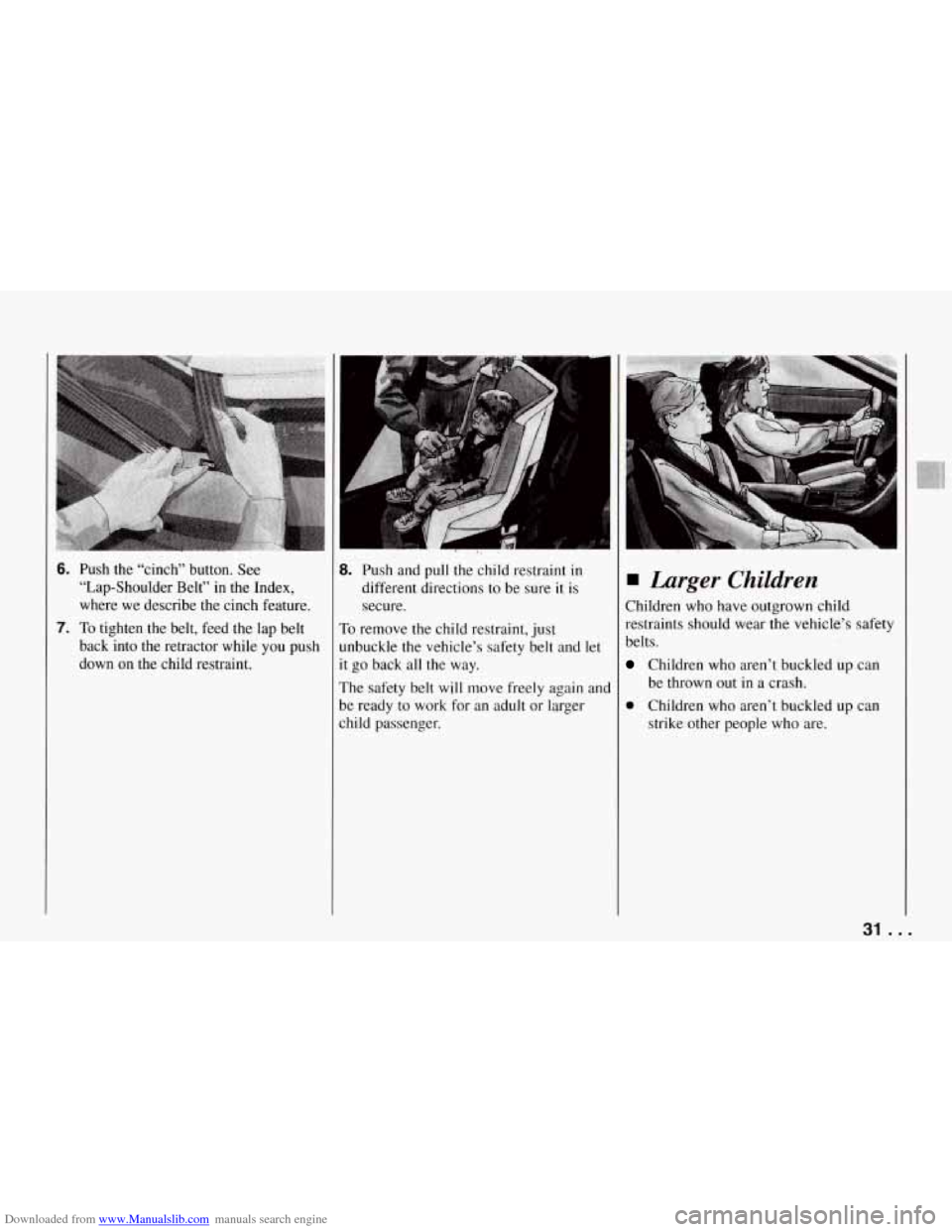
Downloaded from www.Manualslib.com manuals search engine 6. Push the “cinch” button. See
“Lap-Shoulder Belt” in the Index,
where we describe the cinch feature.
7. To tighten the belt, feed the lap belt
back into the retractor while you push down on the child restraint.
8. Push and pull the child restraint in
different directions to be sure
it is
secure.
To remove the child restraint, just
unbuckle the vehicle’s safety belt and let
it go back all the way.
The safety belt
will move freely again and
be ready to work for an adult or larger
child passenger.
Larger Children
Children who have outgrown child
restraints should wear the vehicle’s safety
belts.
Children who aren’t buckled up can
0 Children who aren’t buckled up can
be thrown
out
in a crash.
strike other people who are.
31 ...
Page 33 of 274
Downloaded from www.Manualslib.com manuals search engine Seats and Restraint Systems
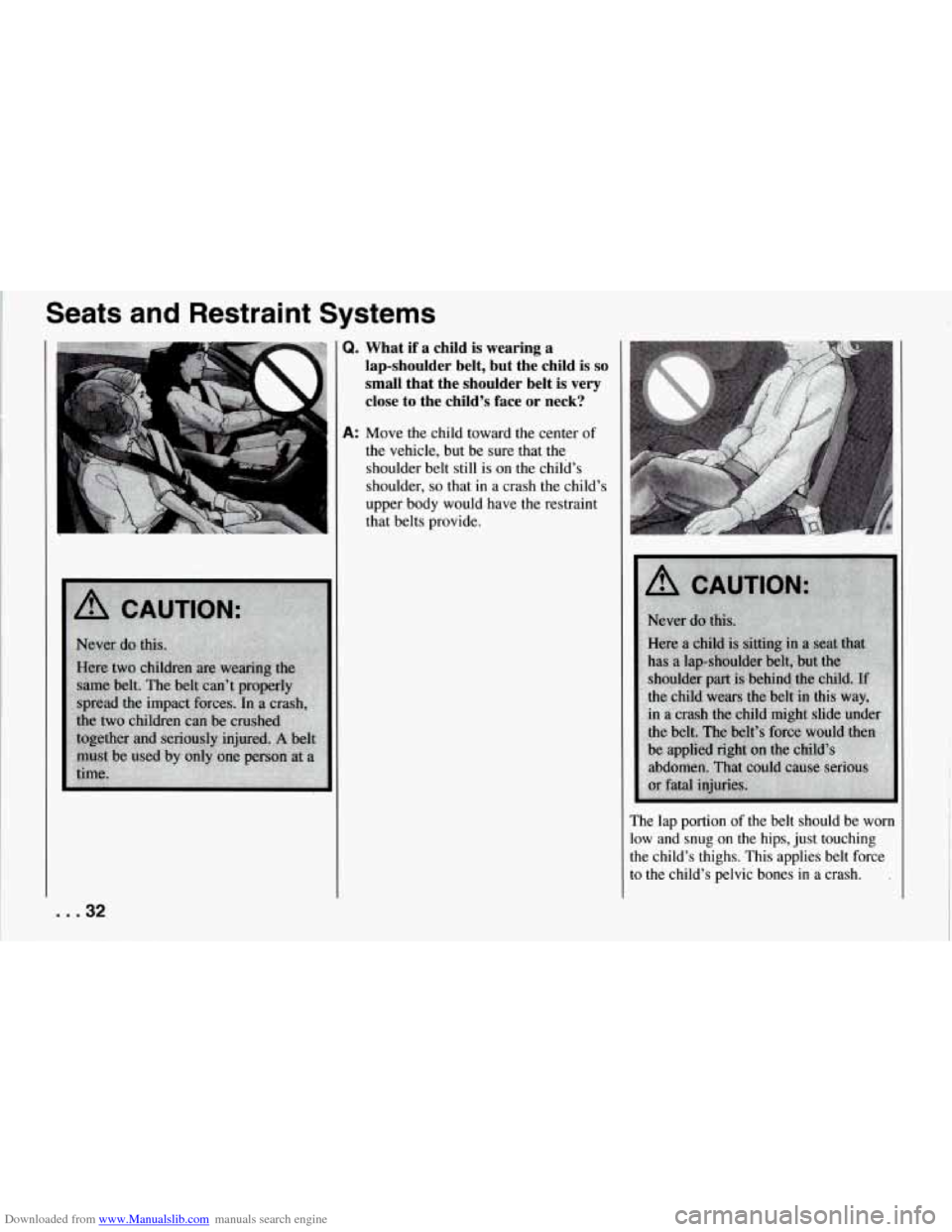
Q. What if a child is wearing a
lap-shoulder belt, but the child
is so
small that the shoulder belt is very
close to the child’s face
or neck?
A: Move the child toward the center of
the vehicle, but be sure that the
shoulder belt still
is on the child’s
shoulder,
so that in a crash the child’s
upper body would have the restraint
that belts provide.
The lap portion of the belt should be worn
low and snug on the hips, just touching
the child’s thighs. This applies belt force
to the child’s pelvic bones in a crash.
.
... 32
Page 34 of 274
Downloaded from www.Manualslib.com manuals search engine Safety Belt Extender
If the vehicle’s safety belt will fasten
around you, you should use it.
But if a safety belt isn’t long enough to
fasten, your dealer will order you an
extender. It’s free. When you go in to
order it, take the heaviest coat you will
wear,
so the extender will be long enough
for you. The extender will be just for you,
and just for the seat in your vehicle that
you choose. Don’t let someone else use it,
and use it only for the seat it is made to
fit. To wear it, just attach it to the regular
safety belt.
Checking Your
Restraint Systems
Now and then, make sure all your belts,
buckles, latch plates, retractors,
anchorages and reminder systems are
working properly.
Look for any loose
parts
or damage. If you see anything that
might keep a restraint system from doing
its job, have it repaired.
Replacing Safety Belts
after
a Crash
[f you’ve had a crash, do you need new
selts?
4fter a very minor collision, nothing may
3e necessary. But if the belts were
stretched, as they would be if worn during
I more severe crash, then you need new
3elts.
rf yo1
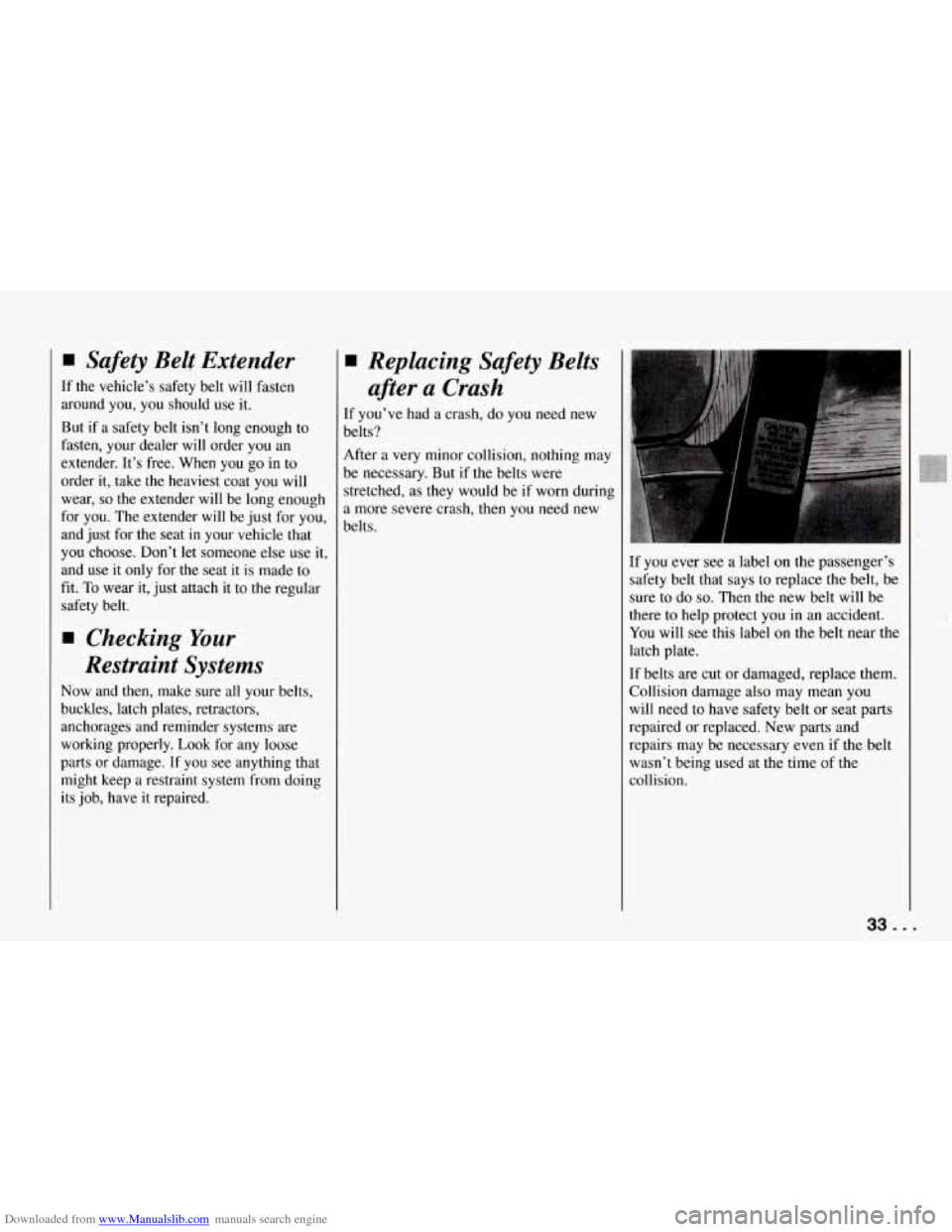
.I ever see a label on the passenger’s
safety belt that says to replace the belt, be
sure to do
so. Then the new belt will be
there to help protect you in an accident.
You will see this label on the belt near the
latch plate.
If belts are cut
or damaged, replace them.
Collision damage also may mean. you
will need to have safety belt
or seat parts
repaired or replaced. New parts and
repairs may be necessary even if the belt
wasn’t being used at the time of the
collision.
33 ...