belt CHEVROLET CORVETTE 1994 4.G Owners Manual
[x] Cancel search | Manufacturer: CHEVROLET, Model Year: 1994, Model line: CORVETTE, Model: CHEVROLET CORVETTE 1994 4.GPages: 274, PDF Size: 15.61 MB
Page 6 of 274

Downloaded from www.Manualslib.com manuals search engine For its 25th anniversary, the 1978 Corvette received a new fas\
tback roofline with a wide expanse of glass that wrapped
around the sides. Emblems front and rear identified the ’78 ’Vette as a Silver Anniversary model.
In 1984, the sixth generation
of America’s favorite sports car anticipated the future with a \
sleek look and advanced
technology that provided superior handling and performance. Winds\
hield angle was the sheerest of any domestic vehicle,
cornering ability the tightest of any production car. In short, the 1984 redesign enhanced the Corvette’s reputation as a leader
in the world sports car market.
With 41 years of experience and technology under its belt, Cor\
vette only gets better. From the 32-valve,
16 fuel injector,
twin double-overhead cam V8 engine
in the ZR-1 Special Performance Coupe to state-of-the-art refinements standard on all
Corvettes, today’s Corvette is a premier driving machine.
Page 8 of 274
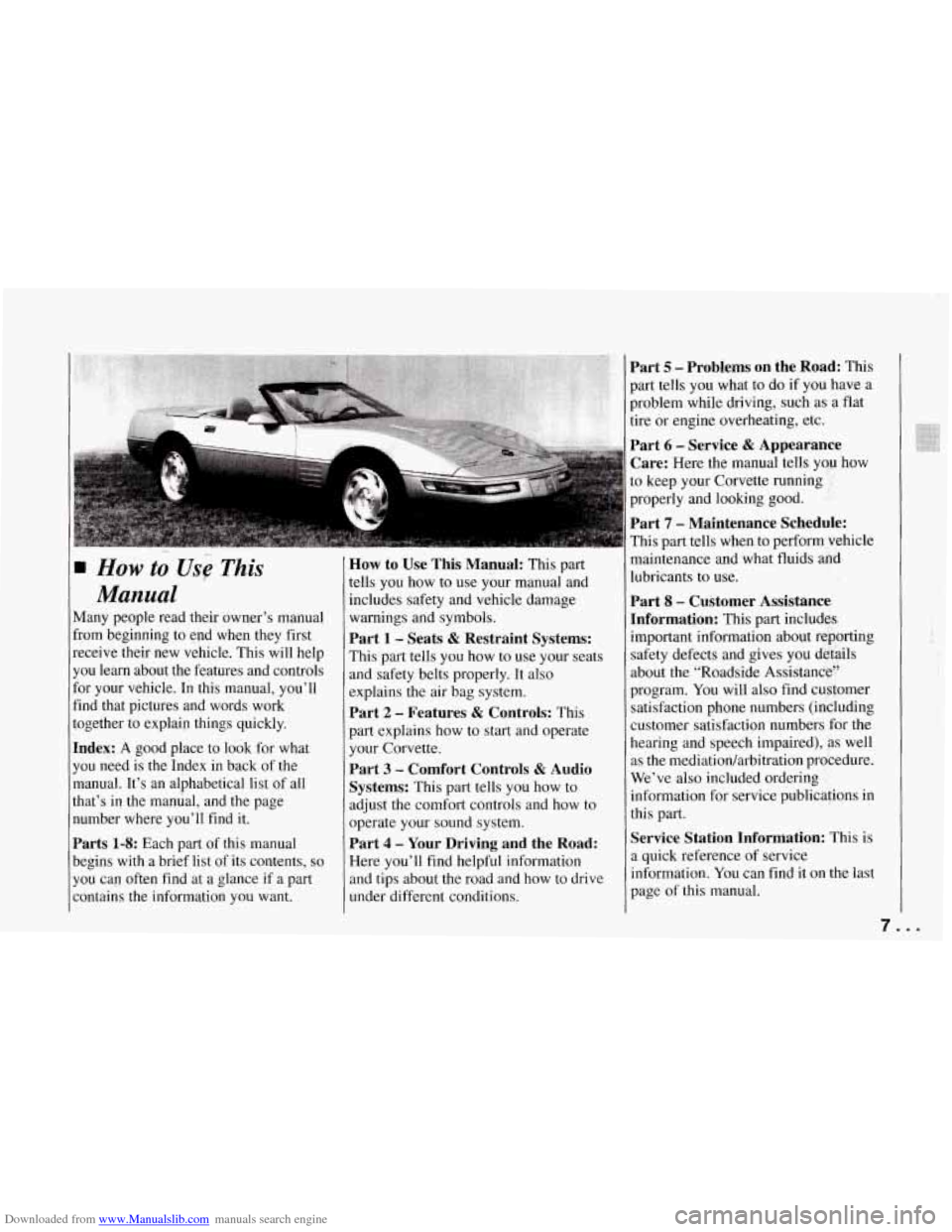
Downloaded from www.Manualslib.com manuals search engine How to Us; This
Manual
5.-
Many people read their owner’s manual
from beginning to end when they first
receive their new vehicle. This will help
you learn about the features and controls
for your vehicle.
In this manual, you’ll
find that pictures and words work
together to explain things quickly.
Index: A good place to look for what
you need is the In-dex in back of the
manual. It’s an alphabetical list of all
that’s iq the manual, and the page
number where you’ll find it.
Parts 1-8: Each part of this manual
begins with a brief list of its contents,
so
you cap often find at a glance if a part
Eontains the information you want.
How to Use This Manual: This part
tells you how to use your manual and
includes safety and vehicle damage
warnings and symbols.
Part 1 - Seats & Restraint Systems:
This part tells you how to use your seats
and safety belts properly. It also
explains the
air bag system.
Part 2 - Features & Controls: This
part explains how to start and operate
your Corvette.
Part 3 - Comfort Controls & Audio
Systems:
This ,part tells you how to
adjust the comfort controls and
how to
operate your sound system.
Part 4 - Your Driving and the Road:
Here you’ll find helpful information
and tips about the road and how to drive
under different conditions.
Part 5 - Problems on the Road: This
>art tells you what to do if you have a
Jroblem while driving, such as a flat
:ire or engine overheating, etc.
Part 6 - Service & Appearance
Care:
Here the manual tells yqap how
:o keep your Corvette running ’’:;’.
properly and looking good. ’,:.
Part 7 - Maintenance Schedule:
This part tells when to perfom,,vehicle
maintenance and what fluids
a&l
lubricants to use.
Part 8 - Customer Assistanc?
~nformation:
This part includ&
important information about rdiorting
safety defects and gives you &$$ls
about the “Roadside Assistancq?
program. You will also find cG$@mer
satisfaction phone numbers (ir&luding
customer satisfaction numbers .for the
hearing and speech impaired),
&s well
as the mediationhrbitration prokedure.
We’ve also included ordering
information for service publicagions in
this part.
Service Station Information: This is
a quick reference of service
information. You can find it
on the last
page of this manual.
..
I ‘I ,
7 I ...
Page 10 of 274
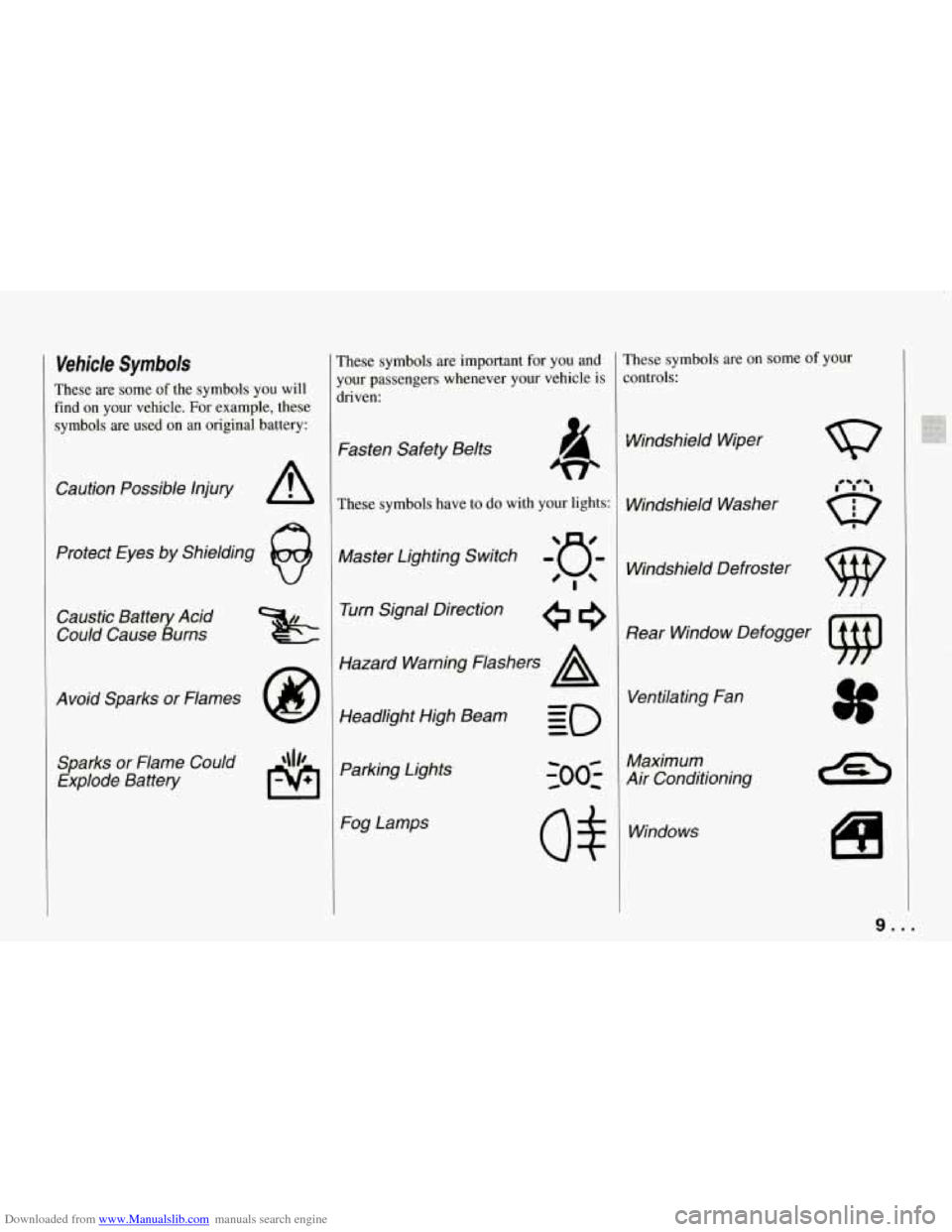
Downloaded from www.Manualslib.com manuals search engine Vehicle Symbols
These are some of the symbols you will
find on your vehicle. For example, these
symbols are used on an original battery:
Caution Possible Injury A
Protect Eyes by Shielding
Caustic Battery Acid
Could Cause Burns
Avoid Sparks
or Flames
Sparks
or Flame Could
Explode Battery
These symbols are important for you and
your passengers whenever your vehicle is
driven:
Fasten Safety Belts
These symbols have to do with your lights:
Master Lighting Switch -'a-
'!
Turn Signal Direction
Hazard Warning Flashers
A
Headlight High Beam Parking Lights Fog Lamps
rhese symbols are on some of your
:ontrols:
Windshield Wiper
Windshield Washer Windshield Defroster
Rear Window Defogger Ventilating Fan
Maximum
Air Conditioning
Windows
I
i
9...
Page 12 of 274
Downloaded from www.Manualslib.com manuals search engine Here you’ll find information
about the seats in your
Corvette and how to use your
safety belts properly
. You can
also learn about some things
you should
not do with safety
belts
.
Part 1
Seats 81 Restraint Systems
............................................. seats and Seat Controls 12
safety Belts: They’re for Everyone .................................... 14
Nhy Safety Belts Work
............................................. 15
Safety Belts
. and the Answers ........ ..................... 18
Safety Belt Reminder Light
......... .......................... 19
2hildren ...................... ............................ 28
Safety Belt Extender
.............. ................................ 33
Zhecking Your Restraint Systems ..................................... 33
Replacing Safety Belts after a Crash ................................... 33
lere Are Questions Many People Ask about
3ow to Wear Safety Belts Properly
... ............................ 19
Ihild Restraints 29
LargerChildren
................................................... 31
...................................................
11 ..
Page 15 of 274
Downloaded from www.Manualslib.com manuals search engine Seats and Restraint Systems
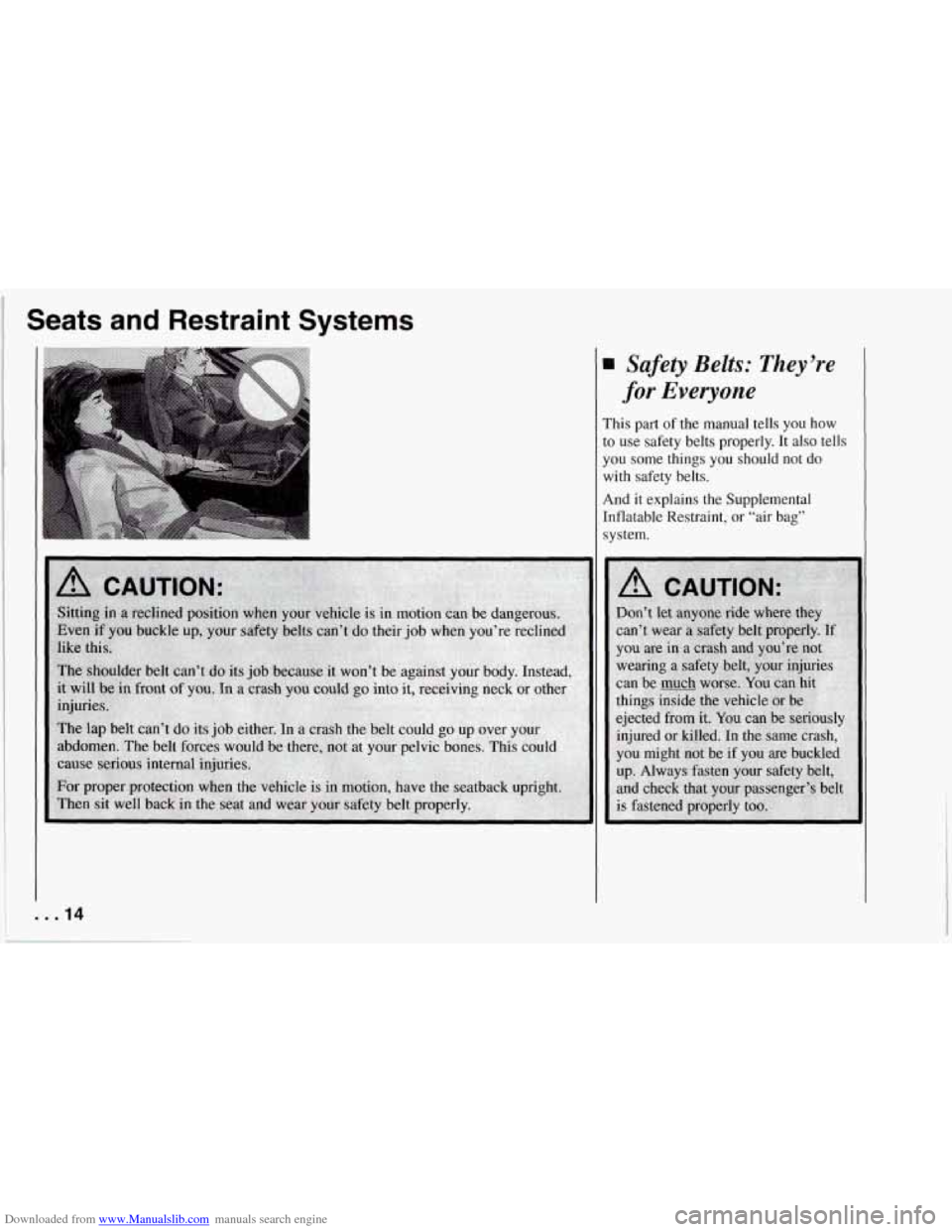
Safety Belts: They’re
for Everyone
This part of the manual tells you how
to use safety belts properly. It
also tells
you some things you
should not do
with safety belts.
And it explains the Supplemental Inflatable Restraint, or “air bag”
system.
. . .I4
Page 16 of 274
Downloaded from www.Manualslib.com manuals search engine II
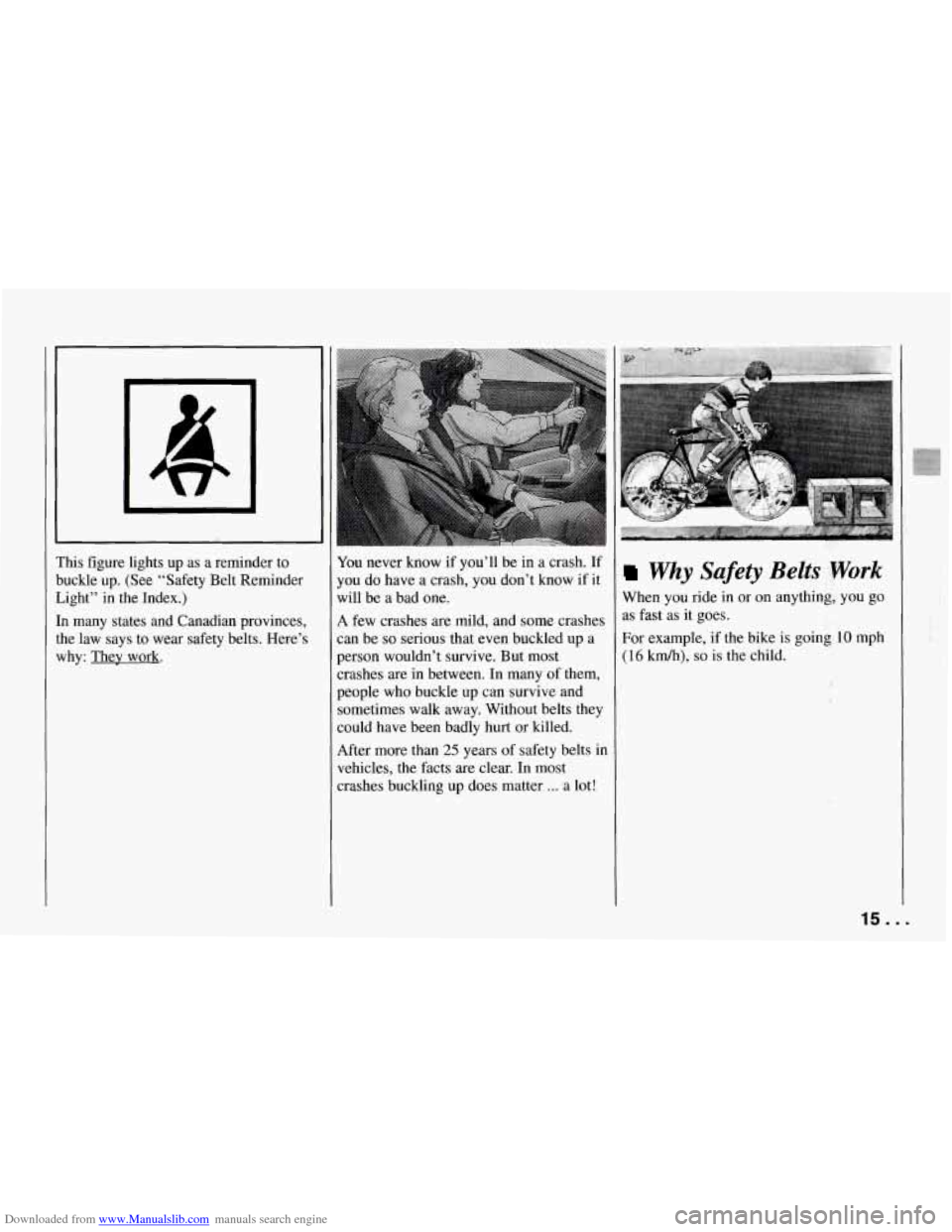
This figure lights up as a reminder to
buckle up. (See “Safety Belt Reininder
Light” in the Index.)
In many states and Canadian provinces,
the law says to wear safety belts. Here’s
why: They work.
-
I
-1
I
I
I
I
You never know if you’ll be in a crash. If
you do have a crash, you don’t know if it
will be a bad one.
A few crashes are mild, and some crashes
can be
so serious that even buckled up a
person wouldn’t survive. But most
;rashes are in between. In many of them,
people
who buckle up can survive and
sometimes walk away. Without belts they
could have been badly hurt or killed.
After more than
25 years of safety belts in
vehicles, the facts are clear. In most
crashes buckling up does matter
... a lot!
Why Safety Belts ;Work
When you ride in or on anything, you go
as fast as
it goes.
For example, if the bike
is goini.10 mph
(16 km/h), so is the child.
15 ...
Page 19 of 274
Downloaded from www.Manualslib.com manuals search engine Seats and Restraint Systems
or the safety belts!
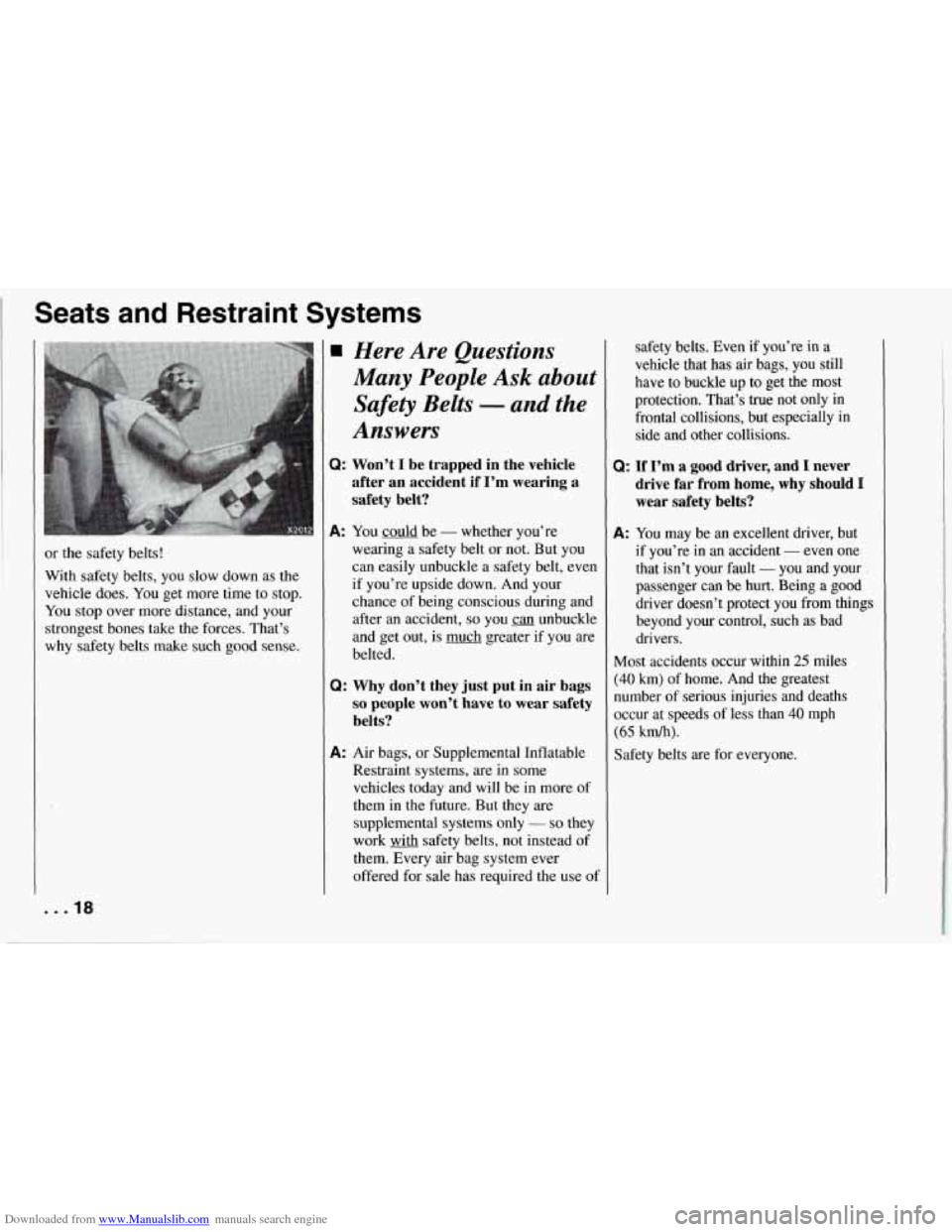
With safety belts, you slow down as the
vehicle does.
You get more time to stop.
You stop over more distance, and your
strongest bones take the forces. That’s
why safety belts make such good sense.
. . .I%
Here Are Questions
Many People Ask about
Safety Belts
- and the
Answers
Q: Won’t I be trapped in the vehicle
after an accident if I’m wearing
a
safety belt?
A: You could be - whether you’re
wearing a safety belt or not. But you
can easily unbuckle a safety belt, even
if you’re upside down. And your
chance of being conscious during and
after an accident,
so you can unbuckle
and get out,
is much greater if you are
belted.
Q: Why don’t they just put in air bags
so people won’t have to wear safety
belts?
A: Air bags, or Supplemental Inflatable
Restraint systems, are in some
vehicles today and will be
in more of
them in
the future. But they are
supplemental systems only
- so they
work safety belts, not instead of
them. Every air bag system ever
offered for sale has required the use of safety belts. Even
if you’re in a
vehicle that has
air bags, you still
have to buckle up
to get the most
protection. That’s true not only in frontal collisions, but especially in
side and other collisions.
Q: If I’m a good driver, and I never
drive far from home, why should I
wear safety belts?
A: You may be an excellent driver, but
if you’re
in an accident - even one
that isn’t your fault
- you and your .
passenger can be hurt. Being a good driver doesn’t protect you from things
beyond your control, such as bad
drivers.
Most accidents occur within
25 miles
(40 km) of home. And the greatest
number of serious injuries and deaths
occur at speeds of less than
40 mph
(65 km/h).
Safety belts are for everyone.
Page 20 of 274
Downloaded from www.Manualslib.com manuals search engine I Safety Belt Reminder
Light
Vhen the key is turned to “Run” or
Start,” a chime will come on for about
ight seconds to remind people to fasten
heir safety belts, unless the driver’s
,afety belt is already buckled. The safety
jelt light will also come
on and stay on
mtil the driver’s belt is buckled.
I How to Wear Safety
Belts
Properly
idults
rhis section is only for people of adult
;ize.
3e aware that there are special things to
;now about safety belts and children. And
here are different rules for smaller
:hildren and babies. If a child will be
iding
in your Corvette, see the section
ifter this one, called “Children.” Follow
hose rules for everyone’s protection.
I
First, you’ll want to know which restraint
systems your vehicle has.
We’ll
start with the driver position.
Driver Position
This section describes the driver’s
restraint system.
19 ...
Page 21 of 274
Downloaded from www.Manualslib.com manuals search engine Seats and Restraint Systems
Lap-Shoulder Belt
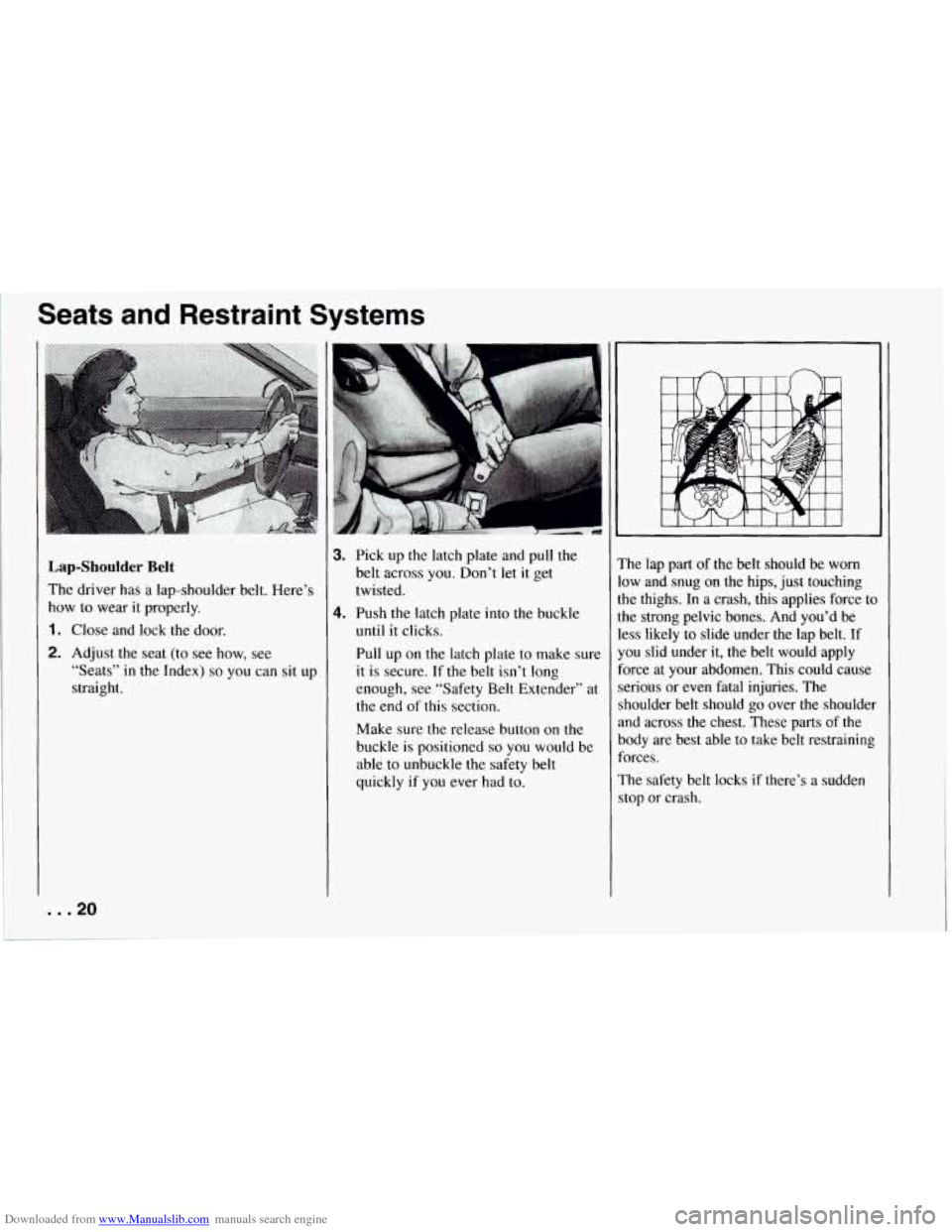
The driver has a lap-shoulder belt. Here’s
how to wear it properly.
1. Close and lock the door.
2. Adjust the seat (to see how, see
“Seats” in
the Index) so you can sit up
straight.
... 20
3. Pick up the latch plate and pull the
belt across you. Don’t let it get
twisted.
4. Push the latch plate into the buckle
until it clicks.
Pull up on the latch plate to make sure
it is secure. If the belt isn’t long
enough, see “Safety Belt Extender” at
the end of this section.
Make sure the release button on the
buckle is positioned
so you would be
able to unbuckle the safety belt
quickly if you ever had to. ’he
lap part of
the belt should be worn
3w and snug on the hips, just touching
he thighs. In a crash, this applies force to
he strong pelvic bones. And you’d be
ess likely to slide under the lap belt. If
[ou slid under it, the belt would apply
orce at your abdomen. This could cause
;erious or
even fatal injuries. The
‘houlder belt should go over the shoulder
md across the chest. These parts of the
pody are best able to take belt restraining
orces.
The safety belt locks if there’s a sudden
top or crash.
Page 22 of 274
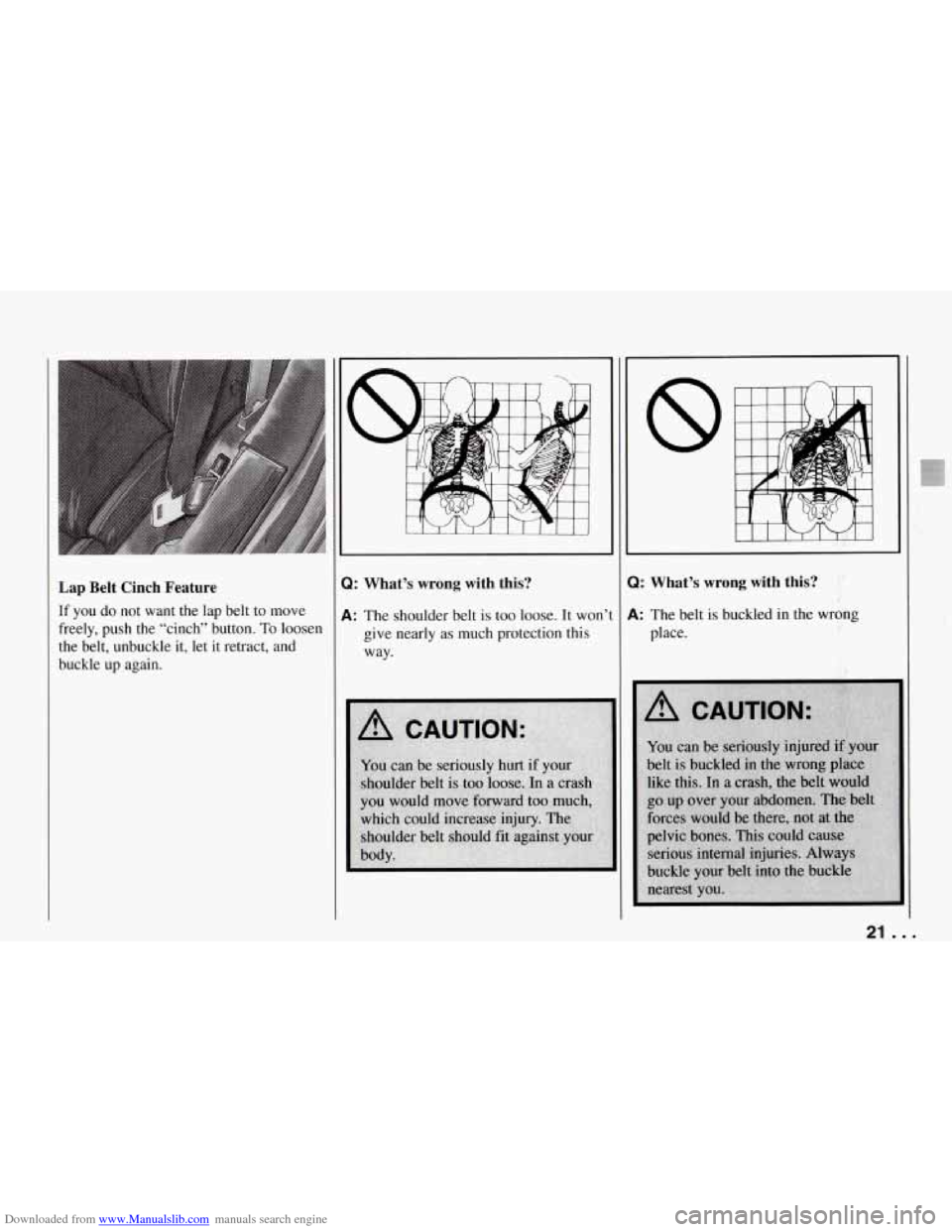
Downloaded from www.Manualslib.com manuals search engine Lap Belt Cinch Feature
If you do not want the lap belt to move
freely, push the “cinch” button.
To loosen
the belt, unbuckle it, let it retract, and
buckle
up again.
Q: What’s wrong with this?
A: The shoulder belt is too loose. It won’t
give nearly as much protection this
way.
8
Q: What’s wrong with this?
A: The belt is buckled in the wrong
place.
.. I - $5 I’i I 5i.
21 I