change time CHEVROLET CORVETTE 1994 4.G User Guide
[x] Cancel search | Manufacturer: CHEVROLET, Model Year: 1994, Model line: CORVETTE, Model: CHEVROLET CORVETTE 1994 4.GPages: 274, PDF Size: 15.61 MB
Page 129 of 274
Downloaded from www.Manualslib.com manuals search engine Your Driving and the Road
the tires against the road surface makes it
possible for the vehicle to change its path
when you
turn the front wheels. If there’s
no traction, inertia will keep the vehicle
going in the same direction. If you’ve
ever tried to steer a vehicle
on wet ice,
you’ll understand this.
The traction you can get in a curve
depends on the condition of your tires and
the road surface, the angle at which
the
curve is banked, and,your speed. While
you’re in a curve, speed is the one factor
you can control.
Suppose you’re steering through a sharp
curve. Then you suddenly accelerate.
Both control systems
- steering and
acceleration
- have to do their work
where the tires meet the road. Unless
your
ASR system is on, adding the
sudden acceleration can demand too
much of those places. You can lose
control.
What should you do if this ever happens?
Ease up on the accelerator pedal, steer the
vehicle the way you want it to go, and
slow down.
Speed limit signs near curves warn that
you should adjust your speed. Of course,
the posted speeds are based on good
weather and road conditions. Under less favorable conditions
you’ll want to go
slower.
If you need to reduce your speed as
you
approach a curve, do it before you enter
the curve, while your front wheels are
straight ahead.
Try to adjust your speed
so you can
“drive”. through the curve. Maintain
a reasonable, steady speed. Wait to
accelerate until you are out of
the curve,
and then accelerate gently into the
straightaway.
Steering in Emergencies
There are times when steering can be more
effective than braking. For example, you
come over a hill and find a truck stopped
in your lane, or a car suddenly pulls out
from nowhere, or a child darts out from
between parked cars and stops right in
front of you. You can avoid these problems
by braking
- if you can stop in time. But
sometimes you can’t; there isn’t room.
That’s the time for evasive action
-
steering around the problem.
Your Corvette can perform very well in
emergencies like these. First apply your
brakes. It is better to remove as much speed as you can from a possible collision.
Then steer around the problem, to the left
or right depending on the space available.
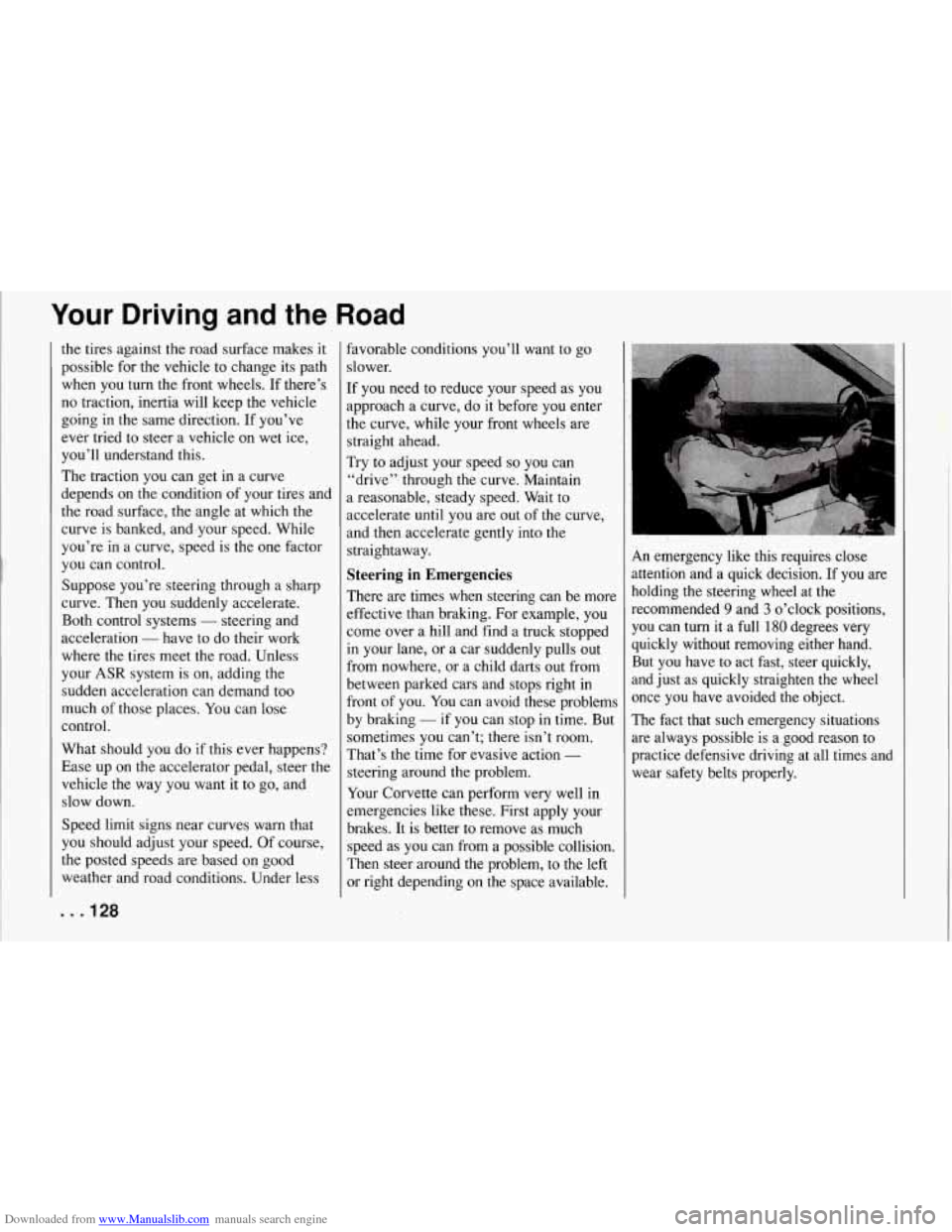
An emergency like this requires close
attention and a quick decision. If you are
holding the steering wheel at the recommended
9 and 3 o’clock positions,
you can turn it a full
180 degrees very
quickly without removing either hand. But you have to act fast, steer quickly,
and just as quickly straighten the wheel
once you have avoided the object.
The fact that such emergency situations
are always possible is
a good reason to
practice defensive driving at all times and
wear safety belts properly.
Page 131 of 274
Downloaded from www.Manualslib.com manuals search engine Your Driving and the Road
0
0
..
If other cars are lined up to pass a
slow vehicle, wait your turn. But take
care that someone isn’t trying to pass
you as you pull out to pass the slow
vehicle. Remember to glance over
your shoulder and check the blind
spot.
Check your mirrors, glance over your
shoulder, and start your left lane
change signal before moving out of
the right lane to pass. When you are
far enough ahead
of the passed vehicle
to see its front
in your inside mirror,
activate your right lane change signal
and move back into the right lane.
(Remember that your right outside
mirror is convex. The vehicle you just
passed may seem to be farther away
from you than it really is.)
Try not to pass more than one vehicle
at a time on two-lane roads.
Reconsider before passing the next vehicle.
Don’t overtake a slowly moving
vehicle too rapidly. Even though the
brake lights are not flashing, it may be
slowing down or starting
to turn.
If you’re being passed, make it easy
for the following driver to get ahead
of you. Perhaps you can ease a little
to the right.
,130
Loss of Control
Let’s review what driving experts say
about what happens when the three
control systems (brakes, steering and
acceleration) don’t have enough friction
where the tires meet the road to do what
the driver has asked.
In any emergency, don’t give up. Keep
trying to steer and constantly seek an
escape route or area of less danger.
Skidding
In a skid, a driver can lose control of the
vehicle. Defensive drivers avoid most
skids by taking reasonable care suited to
existing conditions, and by not
“overdriving” those conditions. But skids
are always possible.
The three types of skids correspond to
your Corvette’s three control systems.
In the braking skid your wheels aren’t
rolling. In the steering or cornering skid,
too much speed or steering in a curve
causes tires to slip and lose cornering
force. And in the acceleration skid too
much throttle causes the driving wheels
to spin.
A cornering skid
is best handled by
easing your foot
off the accelerator pedal. Remember: Any
ASR system helps avoid
only the acceleration skid. If your ASR
system is
off, then an acceleration skid is
also best handled by easing your foot off
the accelerator pedal.
If your vehicle starts to slide, ease your
foot
off the accelerator pedal and quickly
steer the way you want the vehicle to go.
If you start steering quickly enough, your
vehicle may straighten out. Always be
ready for a second skid if it occurs.
Of course, traction is reduced when water,
snow, ice, gravel, or other material is on
the road. For safety, you’ll want to slow
down and adjust your driving to these
conditions. It is important to slow down
on slippery surfaces because stopping
distance will be longer and vehicle
control more limited.
Page 132 of 274
Downloaded from www.Manualslib.com manuals search engine While driving on a surface with reduced
traction, try your best to avoid sudden steering, acceleration, or braking
(including engine braking by shifting to
a lower gear). Any sudden changes could
cause the tires to slide.
You may not
realize the surface is slippery until your vehicle is skidding. Learn to recognize
warning clues
- such as enough water,
ice or packed snow on the road to make a
“mirrored surface”
- and slow down
when you have any doubt.
Remember: Any anti-lock braking system (ABS) helps avoid only the braking skid.
I
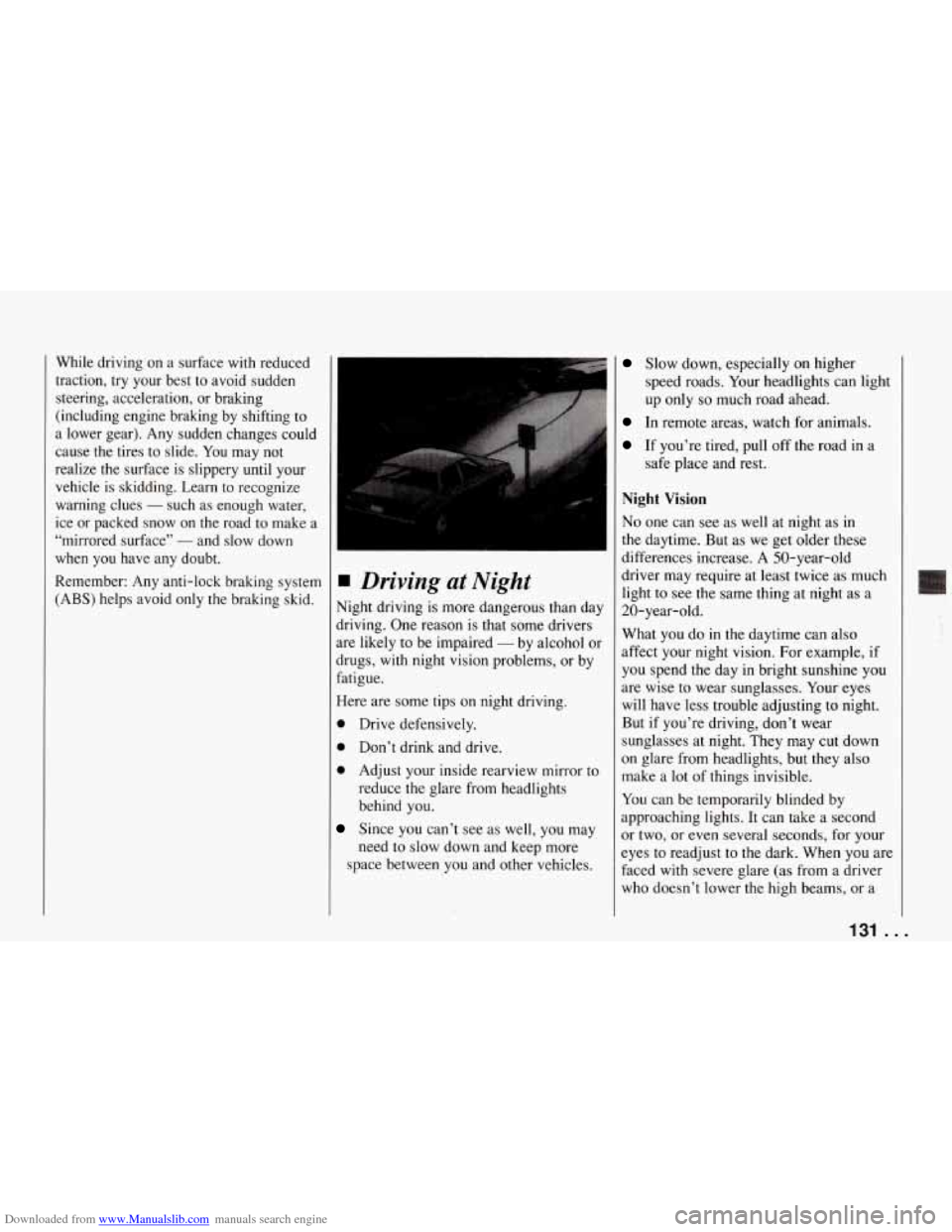
1 Driving at Night
Night driving is more dangerous than day
driving. One reason is that some drivers
are likely to be impaired
- by alcohol or
drugs, with night vision problems, or by
fatigue.
Here are some tips on night driving.
0 Drive defensively.
0 Don’t drink and drive.
0 Adjust your inside rearview mirror to
reduce the glare from headlights
behind you.
Since you can’t see as well, you may
need to slow down and keep more
space between you and other vehicles.
Slow down, especially on higher
speed roads. Your headlights can light
up only
so much road ahead.
In remote areas, watch for animals.
If you’re tired, pull off the road in a
safe place and rest.
Night Vision
No one can see as well at night as in
the daytime. But as we get older these
differences increase.
A 50-year-old
driver may require at least twice as much
light to see the same thing at night as a
20-year-old.
What you do in the daytime can also
affect your night vision. For example, if
you spend the day in bright sunshine you
are wise to wear sunglasses. Your eyes
will have less trouble adjusting to night.
But if you’re driving, don’t wear
sunglasses at night. They may cut down
on glare from headlights, but they also
make a lot of things invisible.
You can be temporarily blinded by
approaching lights. It can take
a second
or two, or even several seconds, for your
eyes to readjust to the dark. When you are
faced with severe glare (as from a driver
who doesn’t lower the high beams, or a
131 ..
Page 160 of 274
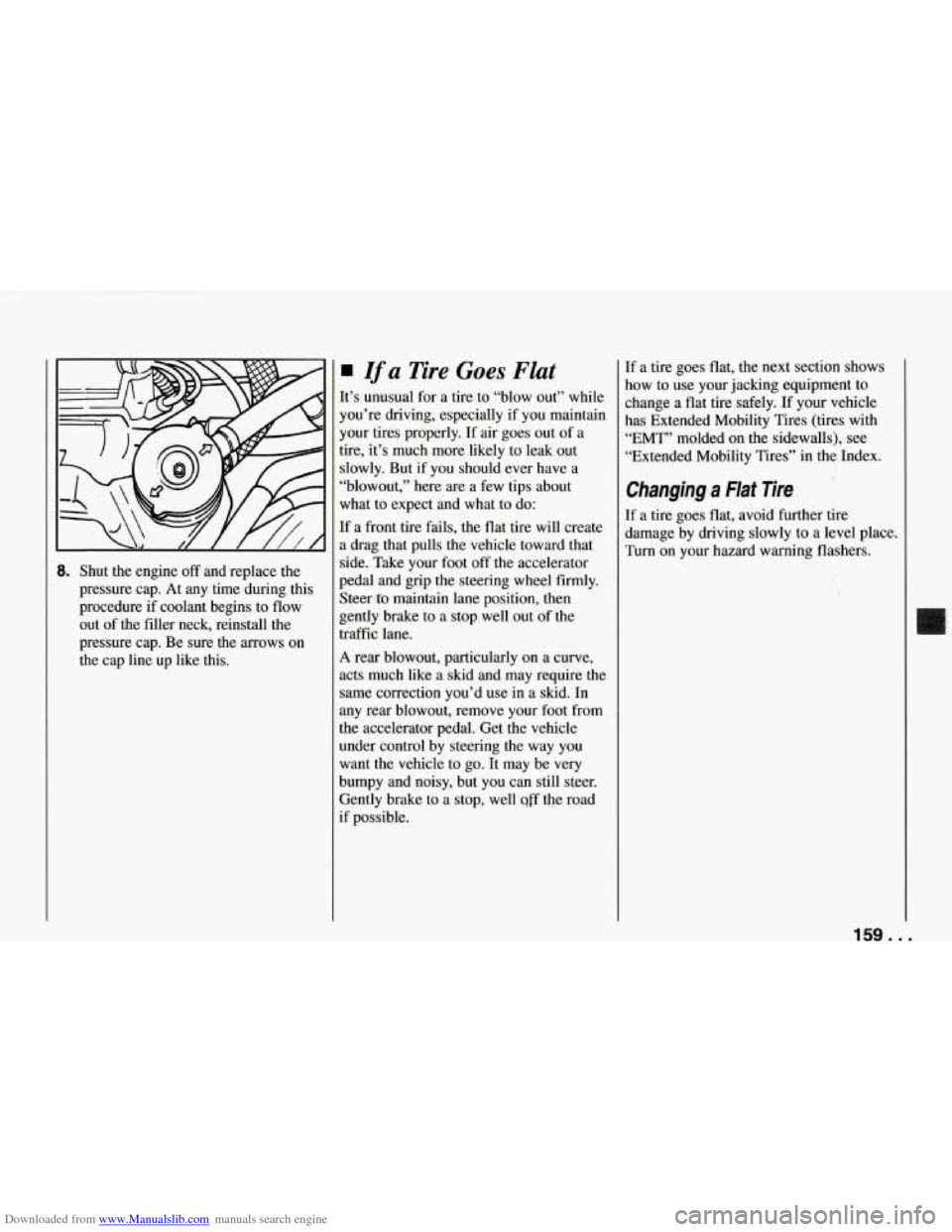
Downloaded from www.Manualslib.com manuals search engine 8. Shut the engine off and replace the
pressure cap. At any time during this
procedure if coolant begins
to flow
out
of the filler neck, reinstall the
pressure cap. Be sure the arrows on
the cap line up like this.
If a Tire Goes Flat
It’s unusual for a tire to “blow out” while
you’re driving, especially if you maintain
your tires properly. If air goes out of a
tire, it’s much more likely
to’ leak out
slowly. But
if you should ever have a
”blowout,” here are a few tips about
what to expect and what to do:
If a front tire fails, the flat tire will create
a drag that pulls the vehicle toward that
side. Take your foot off the accelerator
pedal and grip the steering wheel firmly.
Steer
to maintain lane position, then
gently brake to a stop well out of the
traffic lane.
A rear blowout, particularly on a curve,
acts much like a skid and may require the
same correction you’d use in a skid. In
any rear blowout, remove your foot from
the accelerator pedal. Get the vehicle
under control by steering the way you
want the vehicle to go.
It may be very
bumpy and noisy, but you can still steer.
Gently brake to a stop, well qff the road
if possible.
If a tire goes flat, the next section shows
how to use your jacking equipment to
change a flat tire safely. If your vehicle
has Extended Mobility Tires (tires with
“EMT” molded on the sidewalls), see
“Extended Mobility Tires” in the Index.
Changing a Flat Tire
If a tire goes flat, avoid further tire
damage by driving slowly to a level place.
Turn on your hazard warning flashers.
159 ...
Page 182 of 274
Downloaded from www.Manualslib.com manuals search engine Substitute Oil (LT1 Only): When adding
oil to maintain engine oil level, if an oil
meeting GM Standard GM4718M is not
available, you can use oil designated
either
SAE 5W-30 API Service SH or SG
at all temperatures, or
SAE 1OW-30 API
Service
SH or SG at temperatures above
0°F (-18°C). This oil should not be used
for an oil change.
Substitute Oil (LT5 Only): When adding
oil to maintain engine oil level, if an oil
meeting
GM Standard GM4718M is not
available, you can use oil designated SAE
1OW-30 API Service SH or
SG at all
temperatures. This oil should not be used
for an oil change.
Engine Oil Additives
Don’t add anything to your oil. Your
Chevrolet dealer is ready to advise if you
think something should be added.
When to Change Engine Oil
See if any one of these is true for you:
Most trips are less than 4 miles
It’s below freezing outside and most
trips are less than
10 miles (16 km).
(6 km).
The engine is at low speed most of
the time (as
in stop-and-go traffic).
Most trips are through dusty places.
If any one of these is true for your
vehicle, you need to change your oil and
filter every 3,000 miles
(5 000 km) or
3 months
- whichever comes first.
(See “Engine Oil Life Monitor” in the
Index.)
If none of them is true, change the oil
every 7,500 miles
( 12 500 km) or 12
months
- whichever comes first. Change
the filter at the first oil change and at
every other oil change after that. (See
“Engine Oil Life Monitor” in the Index.)
Engine Coolant Heater (Engine Block
Heater)
An engine coolant heater can be a big
help if you have to park outside in very
cold weather,
0 “F (- 18 “C) or colder. If
your vehicle has this feature, see “Engine
Coolant Heater” in the Index.
What to Do with Used Oil
Did you know that used engine oil
contains certain elements that may be
unhealthy for your skin and could even
cause cancer? Don’t let used oil stay on your
skin for very long. Clean your skin
and nails with soap and water, or a good
hand cleaner. Wash or throw away
clothing or rags containing used engine
oil. (See the manufacturer’s warnings
about the use and disposal of oil
products.)
Used oil can be a real threat to the
environment. If you change your own oil,
be sure to drain all free-flowing oil from
the filter before disposal. Don’t ever
dispose of oil by putting it in the trash,
pouring it on the ground, into sewers, or
into streams or bodies of water. Instead,
recycle
it by taking it to a place that
collects used oil. If you have a problem
properly disposing of your used oil, ask
your dealer, a service station or
a local
recycling center for help. L 1
181 ...
Page 185 of 274
Downloaded from www.Manualslib.com manuals search engine Service and Appearance Care
5.
0
0
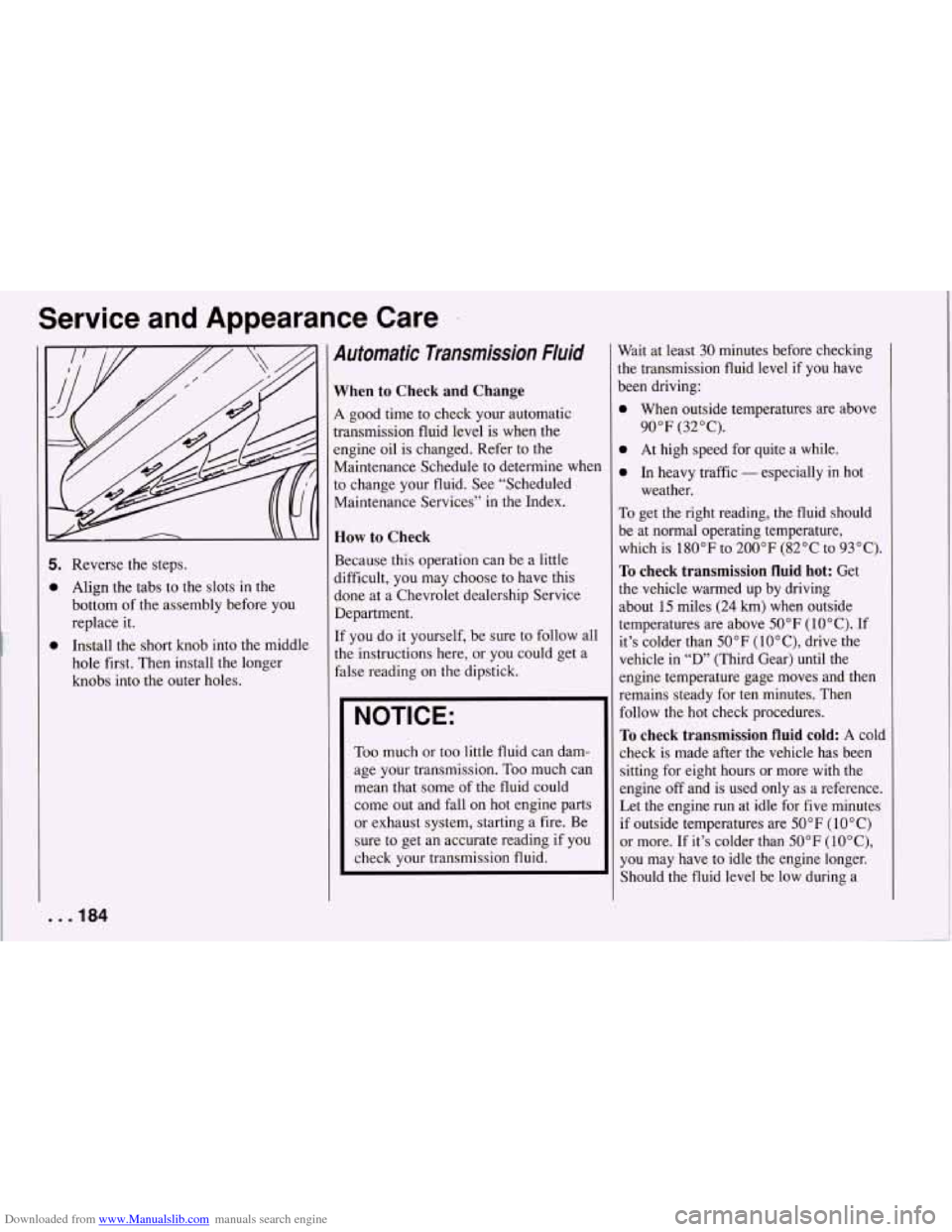
Reverse the steps.
Align the tabs
to the slots in the
bottom of the assembly before you
replace it.
Install the short knob into the middle
hole first. Then install the longer
knobs into the outer holes.
Automatic Transmission Fluid
When to Check and Change
4 good time to check your automatic
:ransmission fluid level is when the
mgine oil is changed. Refer to the
Maintenance Schedule to determine when
co change your fluid. See “Scheduled
Maintenance Services” in the Index.
How to Check
Because this operation can be a little
iifficult, you may choose to have this
done at a Chevrolet dealership Service
Department.
[f you do it yourself, be sure to follow all
the instructions here, or you could get a
false reading on the dipstick.
NOTICE:
Too much or too little fluid can dam-
age your transmission.
Too much can
mean that some of the fluid could
come out and fall
on hot engine parts
or exhaust system, starting a fire. Be
sure to get an accurate reading if you
check your transmission fluid. Wait
at least 30 minutes before checking
the transmission fluid level if you have
been driving:
0 When outside temperatures are above
0 At high speed for quite a while.
0 In heavy traffic - especially in hot
To get the right reading, the fluid should
be at normal operating temperature, which is
180°F to 200°F (82°C to 93°C).
To check transmission fluid hot: Get
the vehicle warmed up by driving
about
15 miles (24 km) when outside
temperatures are above
50°F (10°C). If
it’s colder than
50°F (10°C)’ drive the
vehicle in
“D’ (Third Gear) until the
engine temperature gage moves and then
remains steady for ten minutes. Then follow the hot check procedures.
To check transmission fluid cold: A cold
check is made after the vehicle has been sitting for eight hours or more with the
engine
off and is used only as a reference.
Let the engine run at idle for five minutes
if outside temperatures are 50” F ( 1 OOC)
or more. If it’s colder than 50°F ( 10°C)’
you may have to idle the engine longer.
Should the fluid level be low during a
90°F (32°C).
weather.
. . .184
Page 195 of 274
Downloaded from www.Manualslib.com manuals search engine Service and Appearance Care
NOTICE:
Don’t let someone put in the
wrong kind of fluid. For example,
just a few drops of mineral-based
oil, such as engine oil, in your
brake system can damage brake
system parts
so badly that they’ll
have to be replaced.
Brake fluid can damage paint,
so
be careful not to spill brake fluid
on your vehicle. If you
do, wash it
off immediately. See “Appearance
Care” in the Index.
Brake Wear
Your Corvette has four-wheel disc brakes.
Disc brake pads have built-in wear
indicators that make a high-pitched
warning sound when the brake pads are
worn and new pads are needed. The
sound may come and go or be heard all
the time your vehicle is moving (except
when you are pushing
on the brake pedal
firmly).
I NOTICE:
I
Continuing to drive with worn-out
brake pads could result in costly brake repair.
Some driving conditions or climates may
cause a brake squeal when the brakes are
first applied or lightly applied. This does not mean something is wrong with your
brakes. Brake linings should always be
replaced as complete axle sets.
Brake Pedal Travel
See your dealer if the brake pedal does
not return to normal height, or if there is
a rapid increase in pedal travel. This
could be a sign of brake trouble.
Brake Adjustment
As you make brake stops, your disc
brakes automatically adjust for wear.
Replacing Brake System Parts
The braking system on a modern vehicle
is complex. Its many parts have to be of
top quality and work well together
if the
vehicle is to have really good braking.
Vehicles we design and test have
top-quality GM brake parts in them, as
your Corvette does when it is new. When
you replace parts of your braking system
- for example, when your brake linings
wear down and you have to have new
ones put in
- be sure you get new
genuine GM replacement parts. If you
don’t, your brakes may no longer work
properly. For example,
if someone puts
in brake linings that are wrong for your
vehicle, the balance between your front
and rear brakes can change, for the worse. The braking performance you’ve come to
expect can change in many other ways
if
someone puts in the wrong replacement
brake parts.
. . .I94
Page 254 of 274
Downloaded from www.Manualslib.com manuals search engine Corvette Action Center
If you have any questions, comments or
problems regarding your Corvette, or
Corvette in general, you can call the
Corvette Action Center at
1 -800-457-VETT. The Corvette Action
Center is open between the hours of
6:OO a.m. to 2:30 p.m. CST, Monday
through Friday.
GM Participation in
Alternative Dispute Resolution Program
*
BBB AUTO LZNE -
Both Chevrolet and your Chevrolet dealer
are committed to making sure you are
completely satisfied with your new
vehicle. Our experience has shown that,
if a situation arises where you feel your
concern has not been adequately
addressed, the Customer Satisfaction Procedure described'earlier in this section
is very successful.
There may be instances where an
impartial third-party can assist in arriving
at a solution to a disagreement regarding
vehicle repairs or interpretation of the
New Vehicle Limited Warranty. To assist in resolving these disagreements
Chevrolet voluntarily participates in BBB
AUTO LINE.
BBB AUTO LINE is an out-of-court
program administered by the Better
Business Bureau system to settle disputes
between customers and automobile
manufacturers. This program is available
free of charge to customers who currently
own or lease
a GM vehicle.
If you are not satisfied after following the
Customer Satisfaction Procedure, you
may contact the BBB using the toll-free
telephone number, or write them at the
following address:
BBB AUTO LINE
Council of Better Business Bureaus
4200 Wilson Boulevard
Suite 800
Arlington, VA 22203
Telephone: 1-800-955-5100
To file a claim, you will be asked to
provide your name and address, your
vehicle identification number (VIN), and
a statement of the nature of your
complaint. Eligibility is limited by vehicle
age and mileage, and other factors.
We prefer you utilize the Customer
Satisfaction Procedure before you resort to
AUTO LINE, but you may contact the
BBB at any time. The BBB will attempt
to resolve the complaint serving as an
intermediary between you and Chevrolet.
If this mediation is unsuccessful, an
informal hearing will be scheduled where
eligible customers may present their case
to an impartial third-party arbitrator.
The arbitrator will make a decision which
you may accept or reject. If you accept
the decision, GM will be bound by that
decision. The entire dispute resolution
procedure should ordinarily take about
forty days from the time you file a claim
until a decision is made.
Some state laws may require you to use
this program before filing a claim with a
state-run arbitration program or in the
courts. For further information, contact
the BBB at 1-800-955-5100 or the
Chevrolet Customer Assistance Center at
1-800-222- 1020.
* This program may not be available
in all states, depending on state law.
Canadian owners refer to your
Warranty and Owner Assistance
information booklet. General Motors
reserves the right to change eligibility
limitations and/or to discontinue its
participation
in this program.
253. I
Page 257 of 274
Downloaded from www.Manualslib.com manuals search engine Customer Assistance Information
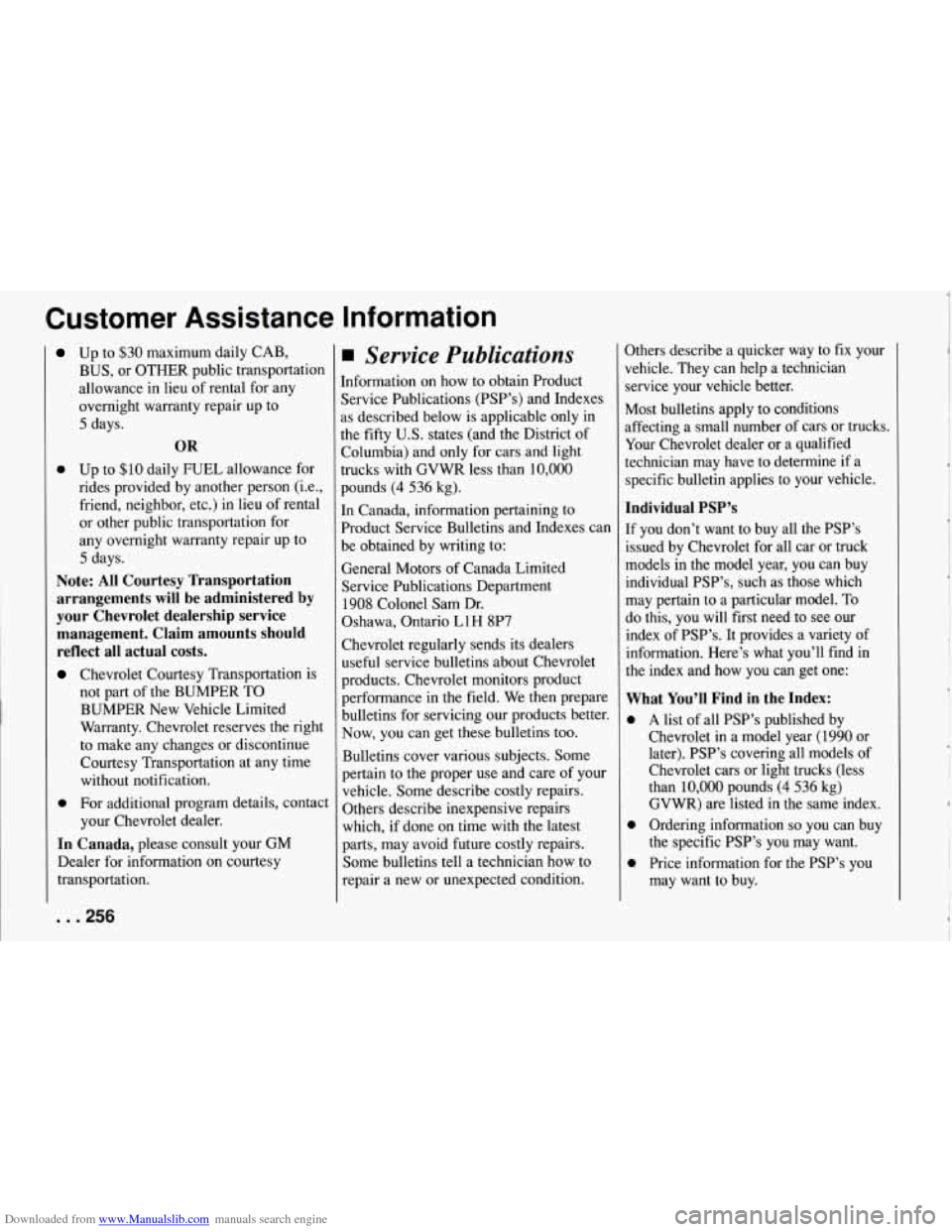
Up to $30 maximum daily CAB,
BUS, or OTHER public transportation
allowance in lieu of rental
for any
overnight warranty repair up, to
5 days.
OR
0 Up to $10 daily FUEL allowance for
rides provided by another person (i.e.,
friend, neighbor, etc.) in lieu of rental
or other public transportation for
any overnight warranty repair up to
5 days.
Note: All Courtesy Transportation
arrangements will be administered by
your Chevrolet dealership service
management. Claim amounts should
reflect all actual costs.
Chevrolet Courtesy Transportation is
not part of the BUMPER TO
BUMPER New Vehicle Limited
Warranty. Chevrolet reserves the right
to make any changes or discontinue
Courtesy Transportation at any time
without notification.
0 For additional program details, contact
In Canada, please consult your GM
Dealer for information on courtesy
transportation.
. . .256
your Chevrolet dealer.
Service Publications
Information on how to obtain Product
Service Publications (PSP’s) and Indexes
as described below is applicable only in
the fifty U.S. states (and the District of
Columbia) and only for cars and light
trucks with GVWR less than 10,000
pounds
(4 536 kg).
In Canada, information pertaining to
Product Service Bulletins and Indexes can
be obtained by writing to:
General Motors of Canada Limited
Service Publications Department
1908 Colonel Sam
Dr.
Oshawa, Ontario L1H 8P7
Chevrolet regularly sends its dealers
useful service bulletins about Chevrolet
products. Chevrolet monitors product performance
in the field. We then prepare
bulletins for servicing our products better.
Now, you can get these bulletins too.
Bulletins cover various subjects. Some
pertain to the proper use and care of your
vehicle. Some describe costly repairs.
Others describe inexpensive repairs
which, if done on time with the latest
parts, may avoid future costly repairs.
Some bulletins tell a technician how to
repair a new or unexpected condition. Others describe a quicker
way to fix your
vehicle. They can help a technician
service your vehicle better.
Most bulletins apply to conditions
affecting a small number of cars or trucks.
Your Chevrolet dealer or a qualified
technician may have to determine
if a
specific bulletin applies to your vehicle.
Individual PSP’s
If you don’t want to buy all the PSP’s
issued by Chevrolet for all car or truck
models
in the model year, you can buy
individual PSP’s, such as those which
may pertain to a particular model. To
do this, you will first need to see our
index
of PSP’s. It provides a variety of
information. Here’s what you’ll find in
the index and how you can get one:
What You’ll Find in the Index:
0 A list of all PSP’s published by
Chevrolet in a model year (1990 or
later). PSP’s covering all models of
Chevrolet cars or light trucks (less
than 10,000 pounds
(4 536 kg)
GVWR) are listed in the same index.
0 Ordering information so you can buy
the specific PSP’s you may want.
4 Price information for the PSP’s you
may want to buy.
Page 260 of 274
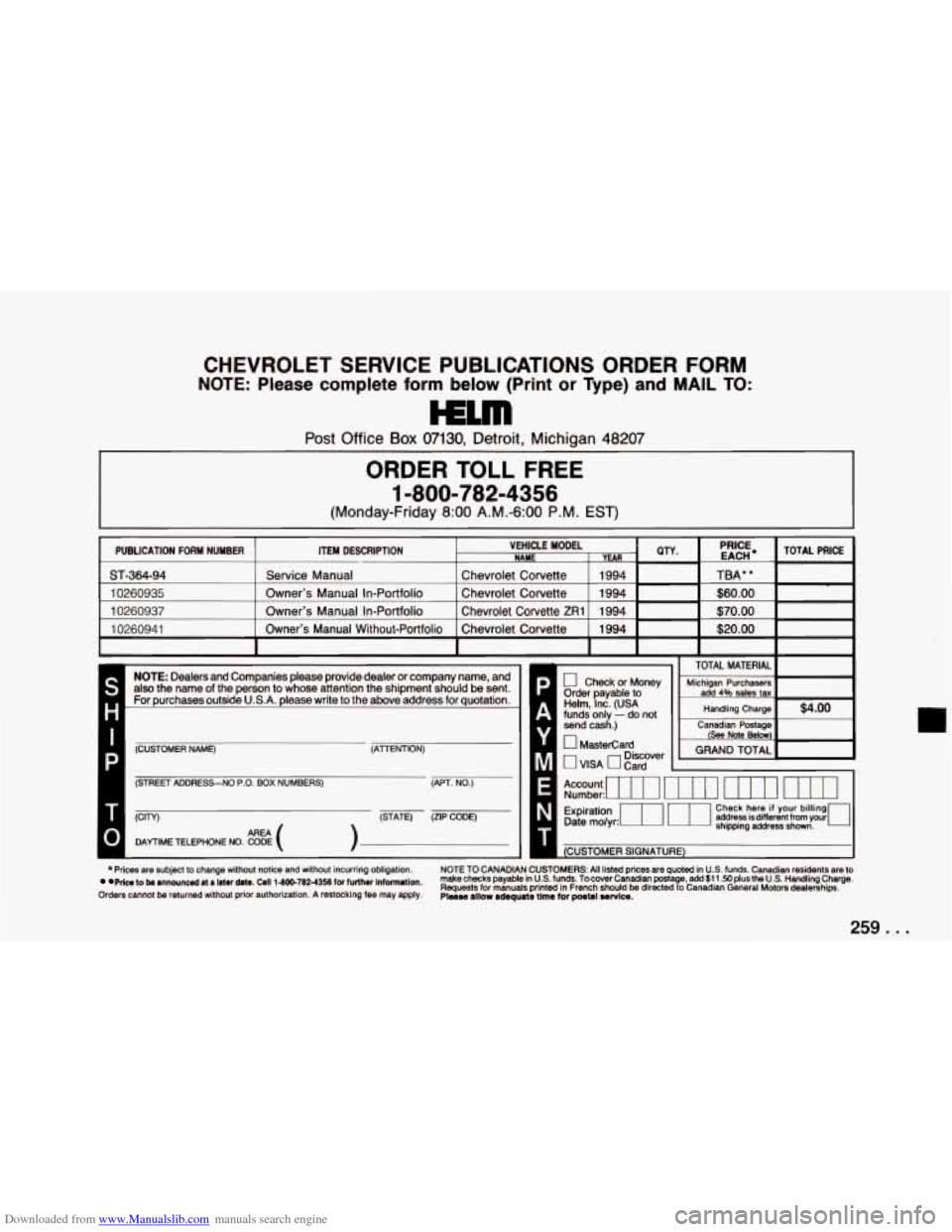
Downloaded from www.Manualslib.com manuals search engine CHEVROLET SERVICE PUBLICATIONS ORDER FORM
NOTE: Please complete form below (Print or Type) and MAIL TO:
Post Office Box 07130, Detroit, Michigan 48207
ORDER TOLL FREE
1 -800-782-4356
(Monday-Friday 8:OO A.M.-6:00 P.M. EST)
PUBLICATION FORM NUMBER
ITEM DESCRIPTION VEHICLE MODEL NAME I YEAR QTY. I :!E:* I TOTAL PRICE I
ST-364-94
1994 - ~ TBA’ * Chevrolet Corvette
Service Manual
10260935
10260937 1994 ~ $60.00 Chevrolet Corvette
Owner’s Manual In-Portfolio
1994 $20.00 Chevrolet Corvette
Owner’s Manual Without-Portfolio 10260941
- 1994 ~ $70.00 Chevrolet Corvette ZR1 Owner’s Manual In-Portfolio ~
NOTE: Dealers and Companies please provide dealer or company name, an\
d
also the name of the person to whose attention the shipment s\
hould be sent.
For DUrChaSeS outside USA. Dlease write to the above address for auotation.
(CUSTOMER NAME) (ATTENTION)
(STREET ADDRESS-NO
P.O. BOX NUMBERS) (APT. NO.)
(Crrv) (STATE) (ZIP CODE)
DAYTIME TELEPHONE NO. CODE
0 Check or Money
Order payable to Helm, Inc. (USA funds only - do not
send cash.)
0 MasterCard
0 VISA 0 Card Discover -
Account Number:
Expiration
Date mo/yr:
(CUSTOMER SIGNATURE)
Check here if your billing
address isdifferent from your shipping address shown.
TOTAL MATERIAL
Michigan Purchasers
add 4% sales tax
Handling Charge $4.00
Canadian Postage (See Note Below)
GRAND TOTAL
.
*Prices are subject to change without notice and without incurring obligation. NOTE TO CANADIAN CUSTOMERS: All listed prices are quoted in US. funds. Canadian residents are to pdm to ,, ktrr ae. hll1-800-7824358 for fuflhw 1donnrtlon. make checks payable in U.S. funds. To cover Canadian postage, add $1 1.50 plus the U.S. Handling Charge.
Orders cannot
be returned without prior authorization. A restocking fee may apply. piaw allow rmuae time for pwml wwlce. Requests for manuals printed in French should be directed to Canadian General Motors dealerships.
259. . .