Transmission CHEVROLET CORVETTE 1996 4.G User Guide
[x] Cancel search | Manufacturer: CHEVROLET, Model Year: 1996, Model line: CORVETTE, Model: CHEVROLET CORVETTE 1996 4.GPages: 386, PDF Size: 20.12 MB
Page 67 of 386
Downloaded from www.Manualslib.com manuals search engine Manual Transmission
6-Speed
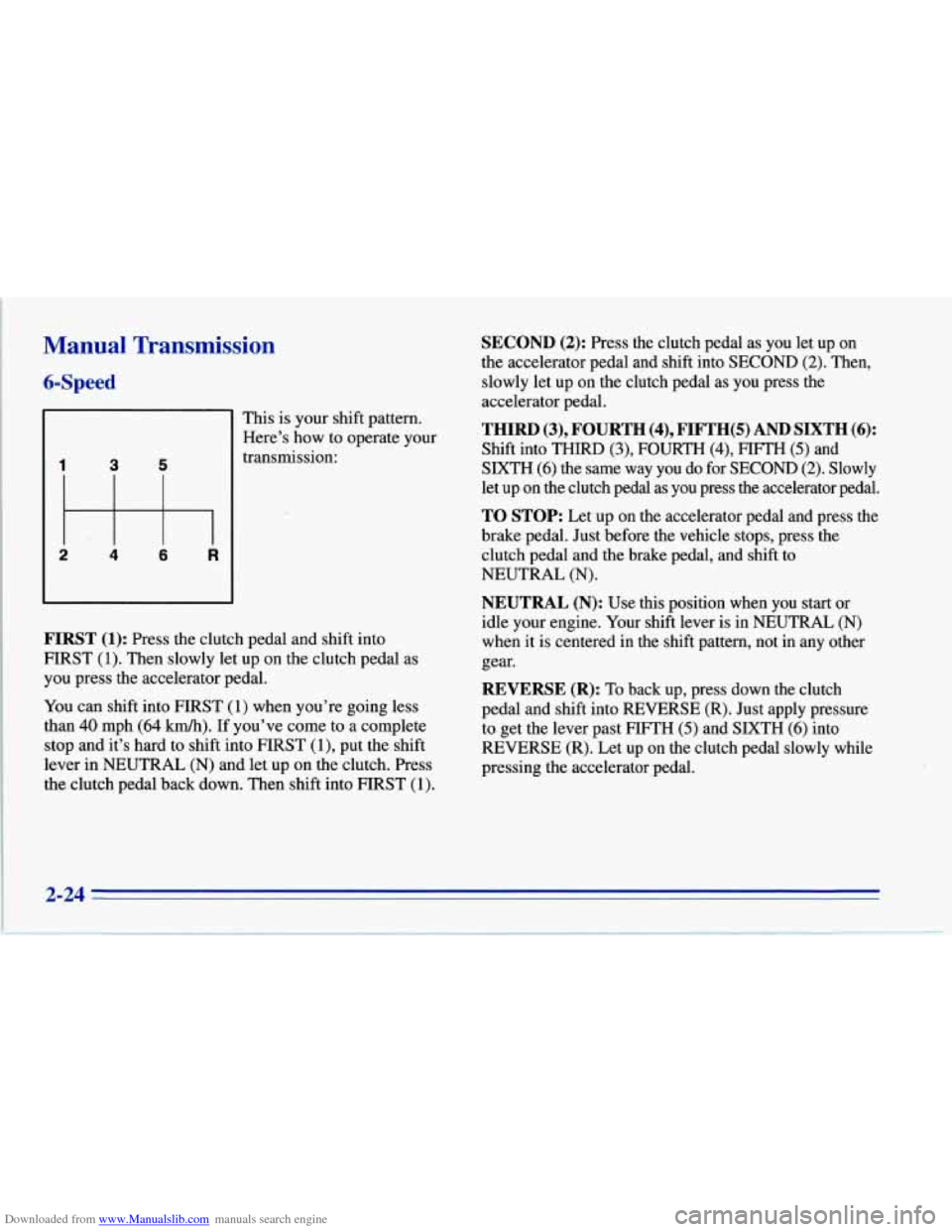
This is your shift pattern.
Here’s how to operate your
transmission:
5 3
FIRST (1): Press the clutch pedal and shift into
FIRST (1). Then slowly let up on the clutch pedal as
you press the accelerator pedal.
You can shift into FIRST
(1) when you’re going less
than
40 mph (64 km/h). If you’ve come to a complete
stop and it’s hard to shift into HRST
(I), put the shift
lever in NEUTRAL (N) and let up on the clutch. Press
the clutch pedal back down. Then shift into FIRST (1).
SECOND (2): Press the clutch pedal as you let up on
the accelerator pedal and shift into
SECOND (2). Then,
slowly let up on the clutch pedal as you press the
accelerator pedal.
THIRD(3),FOURTH(4),FIFTH(S)ANDSIXTH(6):
Shift into THIRD (3)’ FOURTH (4), F’IFTH (5) and
SIXTH (6) the same way you do for SECOND (2). Slowly
let up on the clutch pedal as you press the accelerator pedal.
TO STOP: Let up on the accelerator pedal and press the
brake pedal. Just before the vehicle stops, press the
clutch pedal and the brake pedal, and shift to
NEUTRAL
(N).
NEUTRAL (N): Use this position when you start or
idle your engine. Your shift lever is in NEUTRAL (N)
when it is centered in the shift pattern, not in any other
gear.
REVERSE (R): To back up, press down the clutch
pedal and shift into REVERSE (R). Just apply pressure
to get the lever past FIFTH
(5) and SIXTH (6) into
REVERSE
(R). Let up on the clutch pedal slowly while
pressing the accelerator pedal.
2-24
Page 68 of 386
Downloaded from www.Manualslib.com manuals search engine Shift Speeds (Manual Transmission)
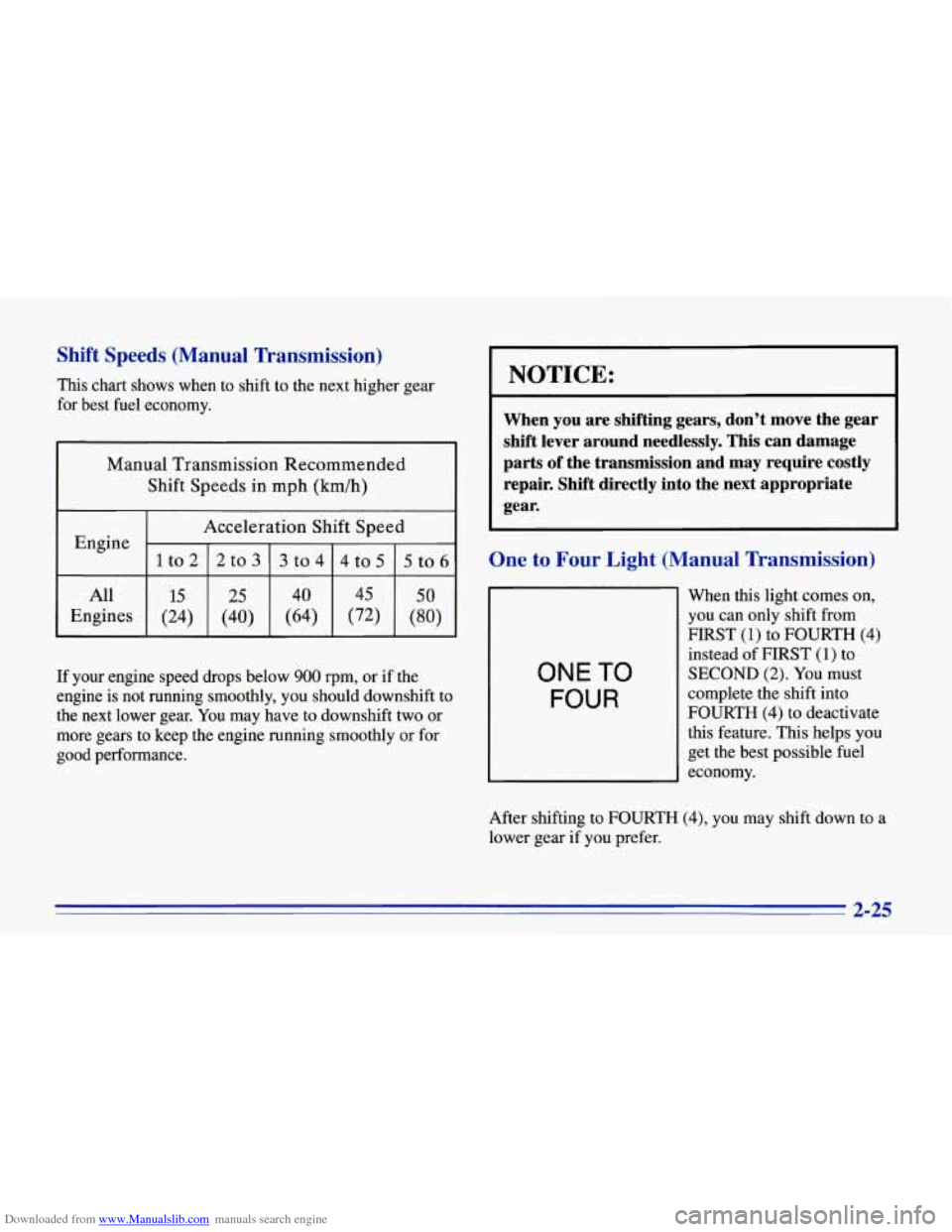
This chart shows when to shift to the next higher gear
for best fuel economy.
Manual Transmission Recommended
Shift Speeds in mph (km/h)
Acceleration Shift Speed
lto212to313to414to515to6
Engine -
All
(80) (72) (64) (40) (24) Engines
50 45 40 25 15
I NOTICE:
When you are shifting gears, don’t move the gear
shift lever around needlessly. This can damage
parts of the transmission and may require costly repair. Shift directly into the next appropriate
I gear.
One to Four Light (Manual Transmission)
If your engine speed drops below 900 rpm, or if the
engine is not running smoothly, you should downshift to
the next lower gear.
You may have to downshift two or
more gears to keep the engine running smoothly or for
good performance.
ONE TO
FOUR
When this light comes on,
you can only shift from
FIRST
(1) to FOURTH (4)
instead of FIRST (1) to
SECOND (2). You must
complete the shift into
FOURTH
(4) to deactivate
this feature. This helps you
get the best possible fuel
economy.
After shifting to FOURTH
(4), you may shift down to a
lower gear if you prefer.
2-25
Page 69 of 386
Downloaded from www.Manualslib.com manuals search engine NOTICE:
Do not try to force the shift lever into
SECOND (2) or THIRD (3) when the ONE TO
FOUR light comes on. Do not try to re-engage
FIRST (1) after starting to shift into FOURTH (4).
You will damage your transmission. Shift only
from FIRST
(1) to FOURTH (4) when the light
comes on.
This light will come on when:
The engine coolant temperature is higher than 120 OF
(49 O C).
0 You are going 15 to 19 mph (24 to 3 1 km/h), and
You are at 21 percent throttle or less.
Downshifting (Manual Transmission)
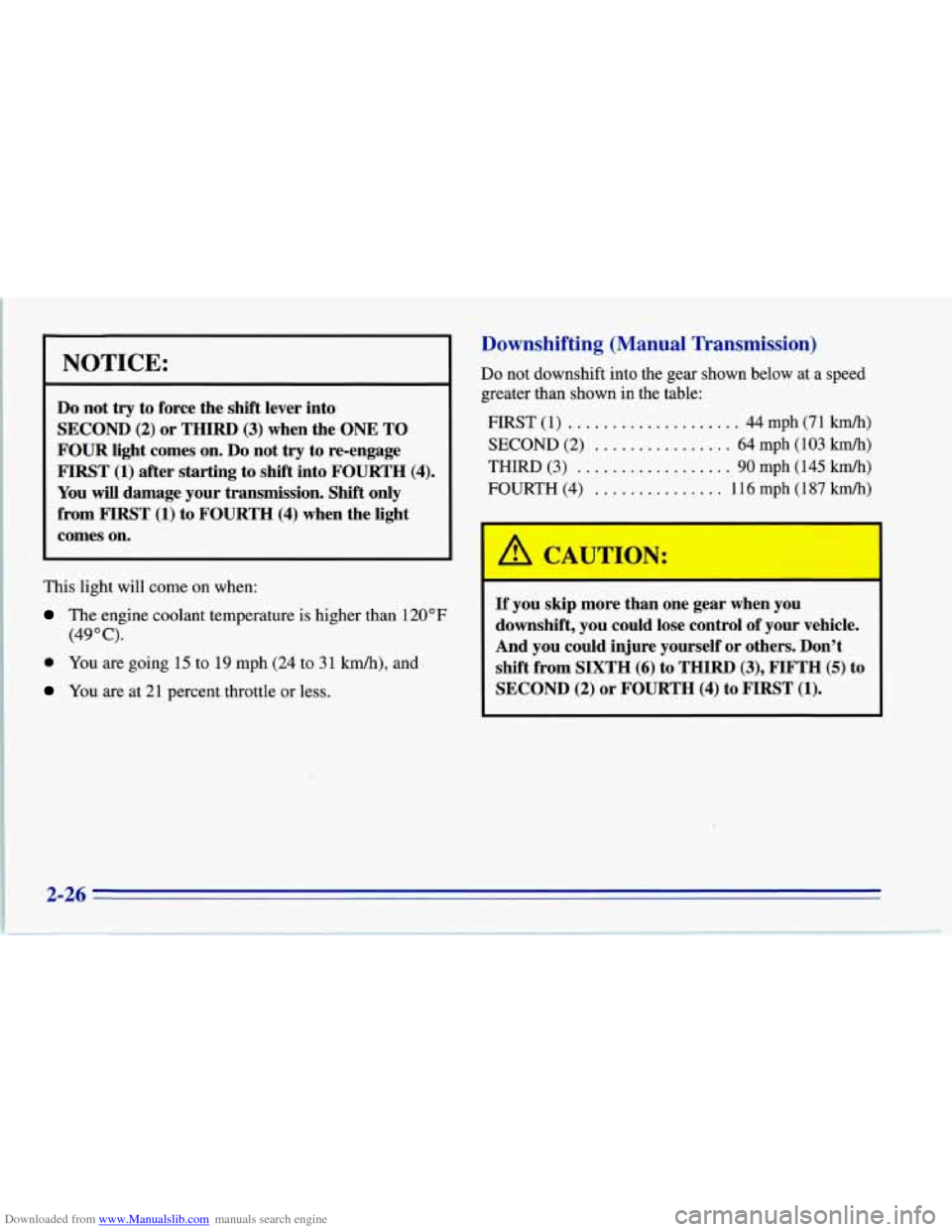
Do not downshift into the gear shown below at a speed
greater than shown in the table:
FIRST
(1) .......... :. ........ 44 mph (71 km/h)
SECOND (2) ................ 64 mph (103 km/h)
THIRD (3) .................. 90 mph (145 km/h)
FOURTH (4) ............... 116 mph (187 kmk)
If you skip more than one gear when you
downshift, you could lose control of your vehicle.
And you could injure yourself or others. Don’t
shift from SIXTH
(6) to THIRD (3), FIFTH (5) to
SECOND (2) or FOURTH (4) to FIRST (1).
Page 70 of 386
Downloaded from www.Manualslib.com manuals search engine NOTICE:
If you skip more than one gear when you
downshift, or if you race the engine when you
downshift, you can damage the clutch or
transmission.
The six-speed transmission has a spring that centers the
shift lever near THIRD
(3) and FOURTH (4). This
spring helps you know which gear you
are in when you
are shifting. Be careful when shifting from FIRST
(1) to
SECOND
(2) or downshifting from SIXTH (6) to
FIFTH
(5). The springs will try to pull the gear shift
lever toward FOURTH
(4) and THIRD (3). Make sure
you move the lever into SECOND
(2) or FIFTH (5). If
you let the lever move in the direction of the pulling,
you may end up shifting from FIRST
(1) to
FOURTH
(4) or from SIXTH (6) to THIRD (3).
Ride Control (Option)
You may have a ride control system on your Corvette
called Real Time Damping (RTD). The system provides
the following performance benefits:
Reduced impact harshness
0 Improved road isolation
0 Improved high-speed stability
0 Improved handling response
RIDE CONTROL
SPORT
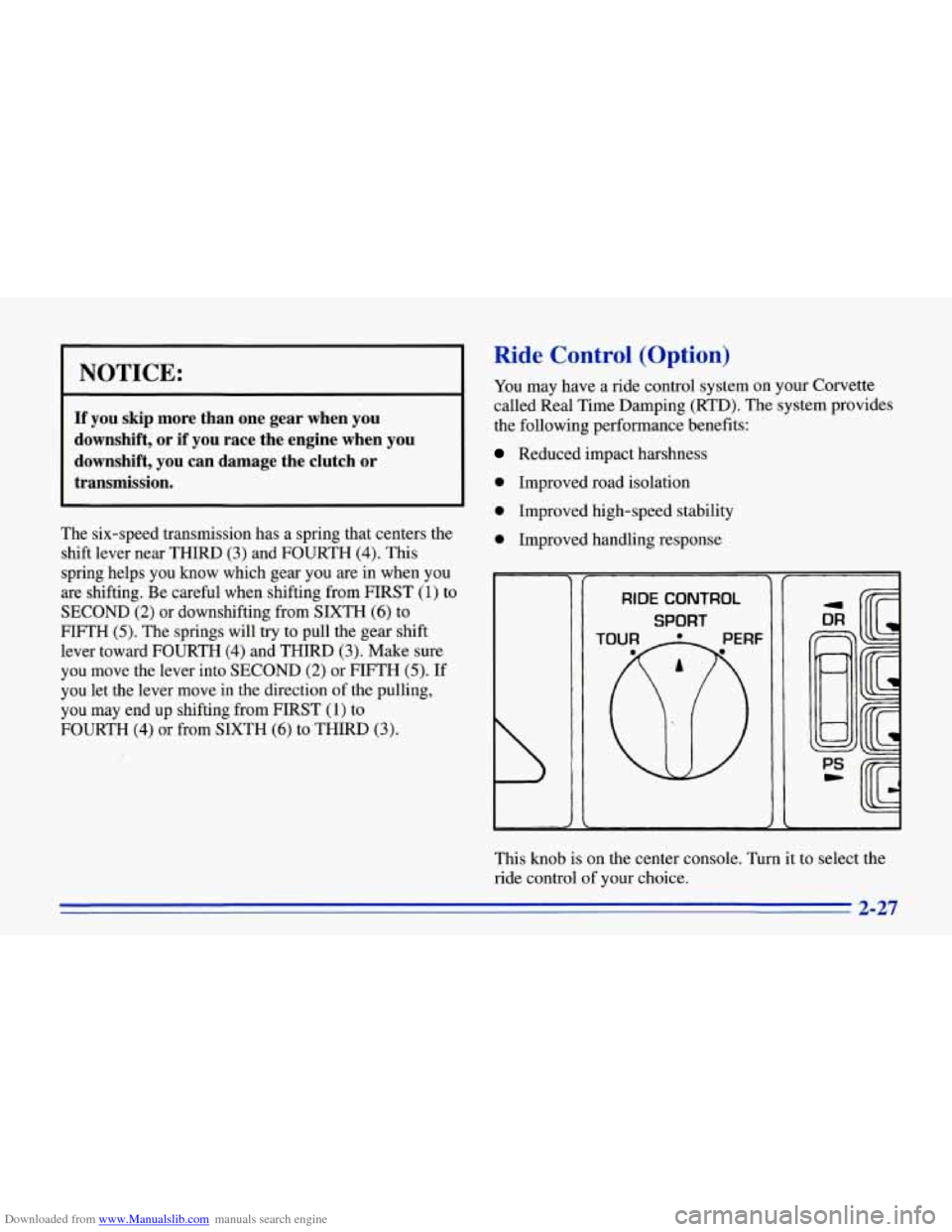
This knob is on the center console. Turn it to select the
ride control
of your choice.
2-27
Page 72 of 386
Downloaded from www.Manualslib.com manuals search engine Shifting Into PARK (P) (Automatic
Transmission
Mode’ 0 ly)
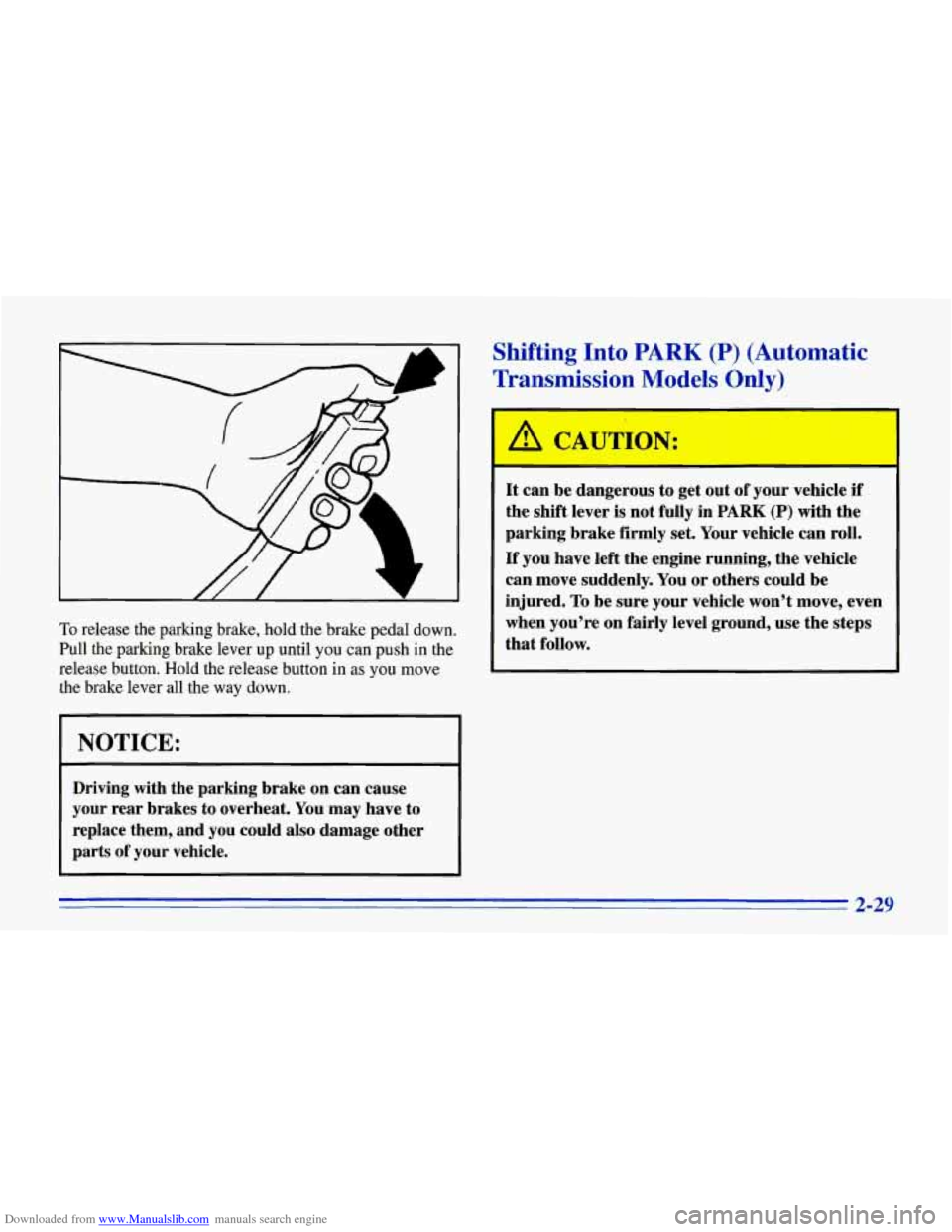
To release the parking brake, hold the brake pedal down.
Pull the parking brake lever up until you can push in the
release button. Hold the release button in as you move
the brake lever all the way down.
NOTICE:
Driving with the parking brake on can cause
your rear brakes to overheat. You may have to
replace them, and you could also damage other
parts
of your vehicle.
It can be dangerous to get out of yqur vehicle if
the shift lever
is not fully in PARK (P) with the
parking brake firmly set. Your vehicle can roll.
If you have left the engine running, the vehicle
can move suddenly. You or others could be
injured.
To be sure your vehicle won’t move, even
when you’re on fairly level ground, use the steps
that follow.
2-29
Page 73 of 386
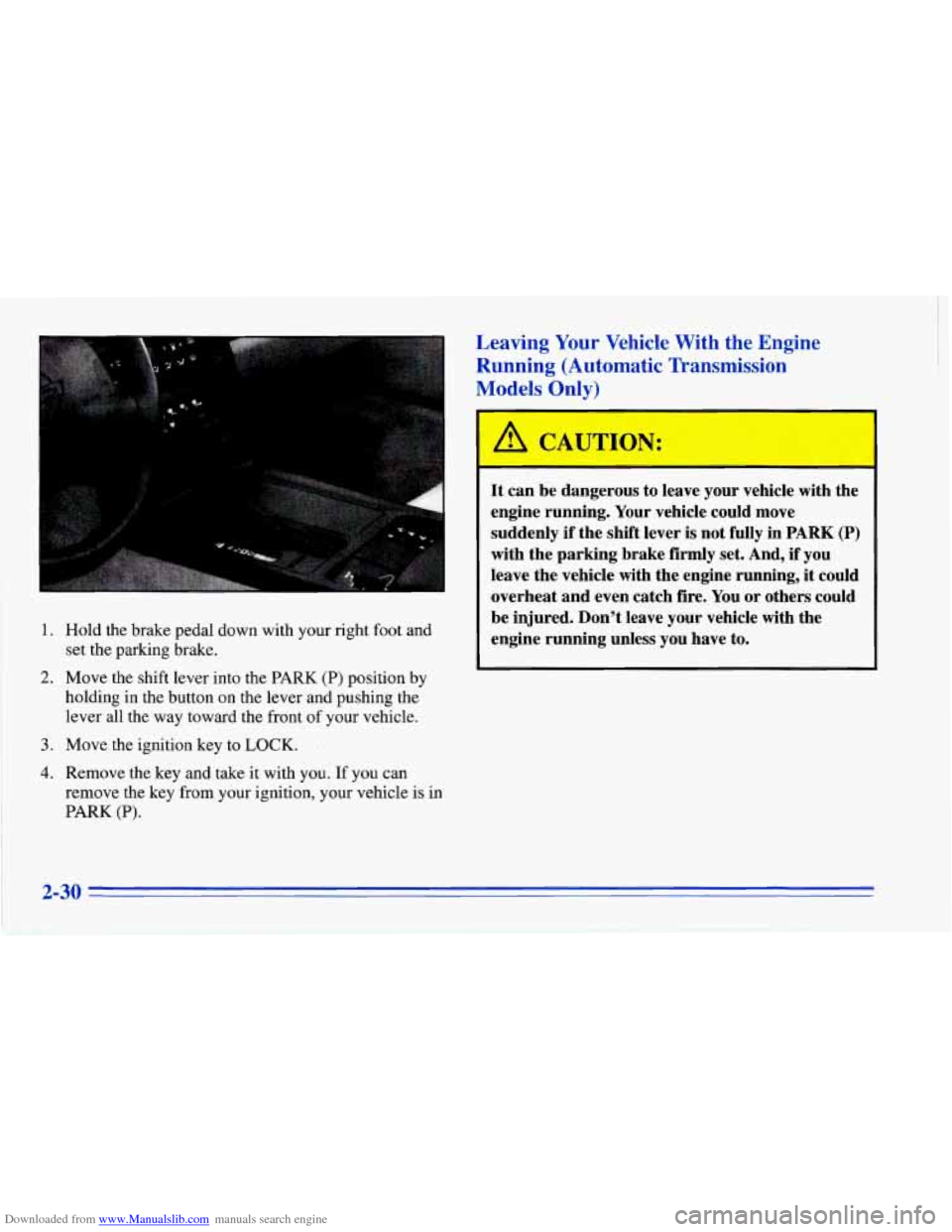
Downloaded from www.Manualslib.com manuals search engine 1. Hold the brake pedal down with your right foot and
set the parking brake.
2. Move the shift lever into the PARK (P) position by
holding in the button on the lever and pushing the
lever all the way toward the front
of your vehicle.
3. Move the ignition key to LOCK.
4. Remove the key and take it with you. If you can
remove the key from your ignition, your vehicle is in
PARK
(P).
Leaving Your Vehicle With the Engine
Running (Automatic Transmission
Models Only)
It can be dangerous to leave your vehicle with the
engine running. Your vehicle could move
suddenly
if the shift lever is not fully in PARK (P)
with the parking brake firmly set. And, if you
leave the vehicle with the engine running, it could
overheat and even catch fire. You
or others could
be injured. Don’t leave your vehicle with the
engine running unless you have to.
2-30
Page 74 of 386
Downloaded from www.Manualslib.com manuals search engine Torque Lock (Automatic Transmission)
If you are parking on a hill and you don’t shift your
transmission into PARK (P) properly, the weight of the
vehicle may put too much force on the parking pawl in
the transmission. You may find it difficult to pull the
shift lever out of PARK (P). This is called “torque lock.”
To prevent torque lock, set the parking brake and then
shift into PARK (P) properly before you leave the
driver’s seat. To find out how, see “Shifting Into
PARK
(P)” in the Index.
When you
are ready to drive, move the shift lever out of
PARK (P) before you release the parking brake.
If torque lock does occur, you may need to have another
vehicle push yours a little uphill to take some of the
pressure from the transmission,
so you can pull the shift
lever out of PARK (P).
Shifting Out of PARK (P)
(Automatic Transmission)
Your Corvette has a brake-transmission shift interlock.
You have to fully apply your regular brake before you
can shift from PARK (P) when the ignition is in the
RUN position. See “Automatic Transmission Operation”
in the Index. If you
cannot shift out of PARK (P), ease pressure on
the shift lever
-- push the shift lever all the way into
PARK (P) and release the shift lever button as you
maintain brake application. Then press the shift lever
button and move the shift lever into the gear you wish.
If
you ever hold the brake pedal down but still can’t
shift out of PARK (P), try this:
1. Turn the key to the
OFF position.
2. Apply and hold the brake until the end of Step 4.
3. Shift to NEUTRAL (N).
4. Start the engine and then shift to the drive gear
you want.
5. Have the vehicle fixed as soon as you can.
Parking Your Vehicle
(Manual Transmission)
Before you get out of your vehicle, put your manual
transmission in
REVERSE (R) and firmly apply the
parking brake.
2-31
Page 76 of 386
Downloaded from www.Manualslib.com manuals search engine Running Your. Engine While You’re
Parked (Automatic Transmission)
It’s better not to park with the engine running. But if you
ever have to, here are some things to know.
Idling the engine with the air system control off
could allow dangerous exhaust into your vehicle
(see the earlier Caution under “Engine
Exhaust”).
Also, idling in
a closed-in place can let deadly
carbon monoxide (CO) into your vehicle even if
the fan switch
is at the highest setting. One place
this can happen is a garage. Exhaust
-- with
CO
-- can come in easily. NEVER park in a
garage with the engine running.
Another closed-in place can be a blizzard. (See
“Blizzard” in the Index.)
r
It can be dangerous to get out of your vehicle if
the shift lever is not fully in PARK (P) with the
parking brake firmly set. Your vehicle can roll.
Don’t leave your vehicle when the engine
is
running unless you have to. If you’ve left the
engine running, the vehicle can move suddenly.
You or others could be injured.
To be sure your
vehicle won’t move, even when you’re on fairly
level ground, always set your parking brake and
move the shift lever to PARK
(P).
Follow the proper steps to be sure your vehicle won’t
nove. See “Shifting Into
PARK (P)” in the Index.
2-33
Page 84 of 386
Downloaded from www.Manualslib.com manuals search engine Reducing Speed While Using Cruise Control
There are two ways to reduce your speed while using
cruise control:
Push in the button at the end of the lever until you
reach the lower speed you want, then release it.
To slow down in very small amounts, push the
button for less than half a second. Each time you
do
this, you’ll go 1 mph (1.6 km/h) slower.
Passing Another Vehicle While Using Cruise Control
Use the accelerator pedal to increase your speed. When
you take your foot
off the pedal, your vehicle will slow
down to the cruise control speed you set earlier.
Using Cruise Control on Hills
How well your cruise control will work on hills depends
upon your speed, load and the steepness of the hills.
When going up steep hills, you may have to step on the
accelerator pedal to maintain your speed. When going
downhill, you may have to brake or shift to a lower gear
to keep your speed down. Of course, applying the brake
takes you out
of cruise control. Many drivers find this to
be too much trouble and don’t use cruise control on
steep hills.
Getting Out of Cruise Control
There are several ways to turn off the cruise control:
0 Step lightly on the brake pedal or push the clutch
pedal, if you have a manual transmission; or
0 Move the cruise switch to OFF.
Erasing Speed Memory
When you turn off the cruise control or the ignition,
your cruise control set speed memory is erased.
2-41
Page 96 of 386
Downloaded from www.Manualslib.com manuals search engine The pink wire connects to the ignition. Power is only
available in the RUN position.
The black wire connects to the ground.
NOTICE:
When using the accessory plug:
Don’t splice wires directly into the accessory
plug
wire. If done incorrectly, splicing might
cause damage to your electrical system.
The maximum load of any electrical
equipment should not exceed
10 amps.
0 Be sure to turn off any electrical equipment
when not in use. Leaving electrical
equipment on for extended periods can
drain your battery.
0 Do not use this plug if the electrical
equipment requires frequent connecting
and disconnecting. This may cause
excessive wear on the accessory plug and
damage your electrical system.
After you’ve installed the electrical equipment, put the trim
panel and console lid back in place and install the screws.
Roof Panel (Coupe)
Until you are sure you can remove the panel alone, have
someone help you.
Removing the Roof Panel
A CAUTION:
Don’t try to remove the roof panel while the
vehicle is moving. Trying to remove the roof
panel while the vehicle
is moving could cause an
accident. The panel could fall into the vehicle and
cause you to lose control, or it could
fly off and
strike another vehicle. You or others could be
injured. Remove the roof panel only when the
vehicle is parked.
1. Park on a level surface, set the parking brake firmly
and shift an automatic transmission into PARK (P).
Shift a manual transmission into REVERSE
(R).
Lower both windows, turn the ignition key to LOCK
and move both sunshades to the side.
2-53