instrument panel CHEVROLET CORVETTE 1996 4.G Owner's Manual
[x] Cancel search | Manufacturer: CHEVROLET, Model Year: 1996, Model line: CORVETTE, Model: CHEVROLET CORVETTE 1996 4.GPages: 386, PDF Size: 20.12 MB
Page 144 of 386
Downloaded from www.Manualslib.com manuals search engine Bi-Level
You may want to use BI-LEVEL on cool, but sunny
days. This setting directs outside air through the
instrument panel vents and the floor ducts.
Press BI-LEVEL and FAN UP, then slide the
temperature control lever to a comfortable setting.
Ventilation
For mild outside temperatures, when little heating or
cooling is needed, you can still direct outside air through
your vehicle.
Press VENT and FAN UP, then slide the temperature
control lever to a comfortable setting.
Defogging and Defrosting
Your vehicle has several settings for clearing your
windows. The air conditioning compressor will run to
help remove moisture from the air.
To defrost the windshield quickly, press DEFROST and
FAN UP, then slide the temperature control lever all the
way
to the right or to the FULL HOT position. To
defrost the side windows quickly, press BI-LEVEL
and FAN UP. Then slide the temperature control lever
all the way
to the right. Direct airflow through the air
conditioning outlets closest to the side windows.
Cooling
The air conditioner works best if you keep your
windows closed. On very hot days, open the windows
just long enough for the hot air to escape.
Press RECIRCULATE and FAN UP. Then slide the
temperature control lever to a comfortable setting.
Direct airflow through the air conditioning outlets
closest to the side windows.
After cool-down, adjust the air control buttons to
another setting. The compressor works in all settings
except VENT and HEATER and at all temperatures
above freezing.
When the air conditioning compressor is on, you may
notice slight changes in your vehicle’s engine speed and
power. This is normal because the system is designed to
cycle the compressor
on and off to keep the desired
temperature and help fuel economy.
3-3
Page 145 of 386
Downloaded from www.Manualslib.com manuals search engine Automatic Electronic Climate Control System (Option)
If 0
0
0 0 0 0 0 0
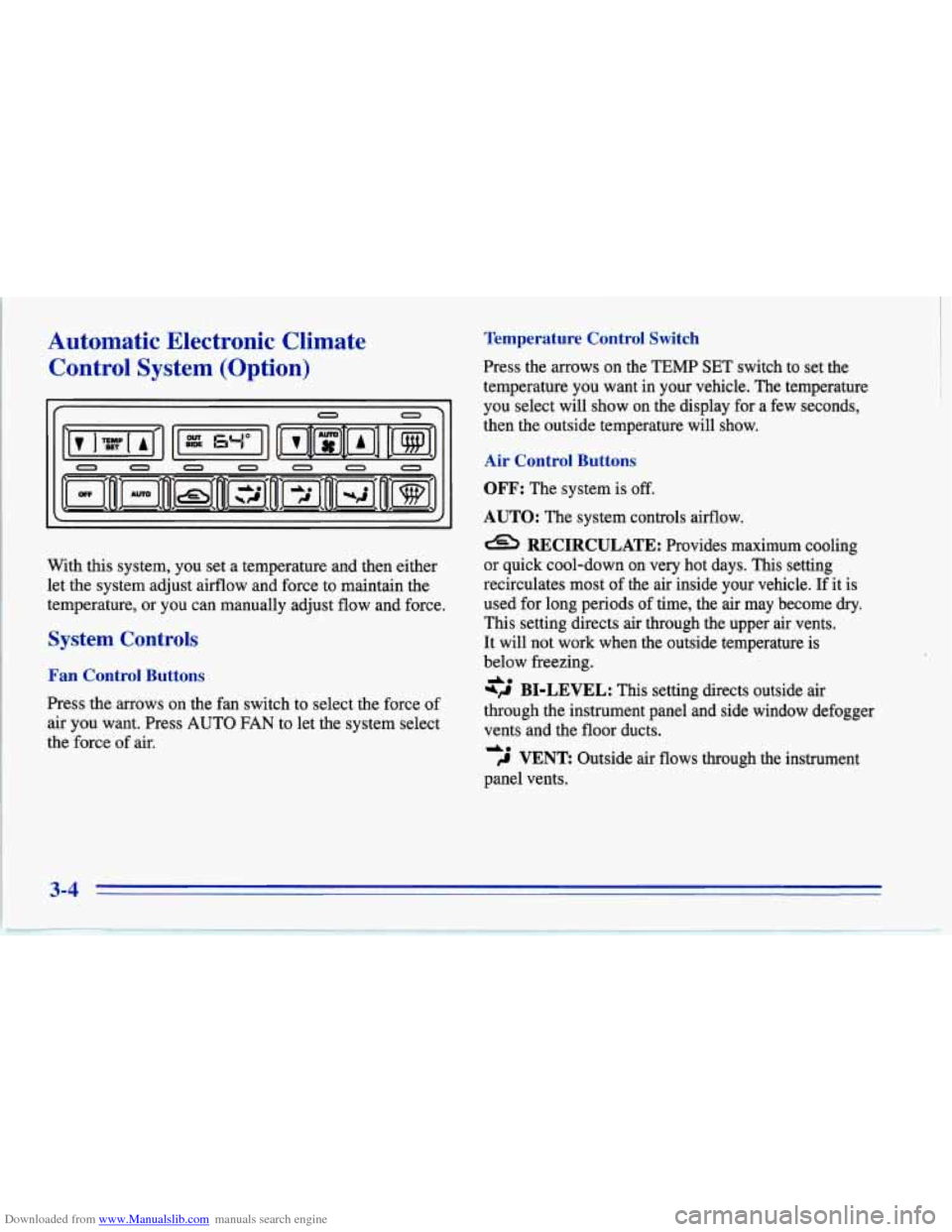
With this system, you set a temperature and then either
let the system adjust aifflow and force to maintain the
temperature, or you can manually adjust flow and force.
System Controls
Fan Control Buttons
Press the arrows on the fan switch to select the force of
air you want. Press AUTO FAN to let the system select
the force of air.
Temperature Control Switch
Press the mows on the TEMP SET switch to set the
temperature you want in your vehicle. The temperature
you select will show on the display for a few seconds,
then the outside temperature will show.
Air Control Buttons
OFF: The system is off.
AUTO: The system controls aifflow.
a RECIRCULATE: Provides maximum cooling
or quick cool-down on very hot days. This setting
recirculates most
of the air inside your vehicle. If it is
used for long periods of time, the air may become
dry.
This .setting directs air through the upper air vents.
It will not work when the outside temperature is
below freezing.
*fl BI-LEVEL: This setting directs outside air
through the instrument panel and side window defogger
vents and the floor ducts.
,d VENT: Outside air flows through the instrument
A.
d.
panel vents.
3-4
Page 146 of 386
Downloaded from www.Manualslib.com manuals search engine wJ HEATER: This setting directs all of the air
through the floor ducts.
DEFROST This setting directs most of the
air through the windshield defroster and side window
defogger vents and some
of the'air through the
floor ducts.
~,4 DEFOG: If you have the automatic system, this
setting directs air to the floor and defroster vents. 8.
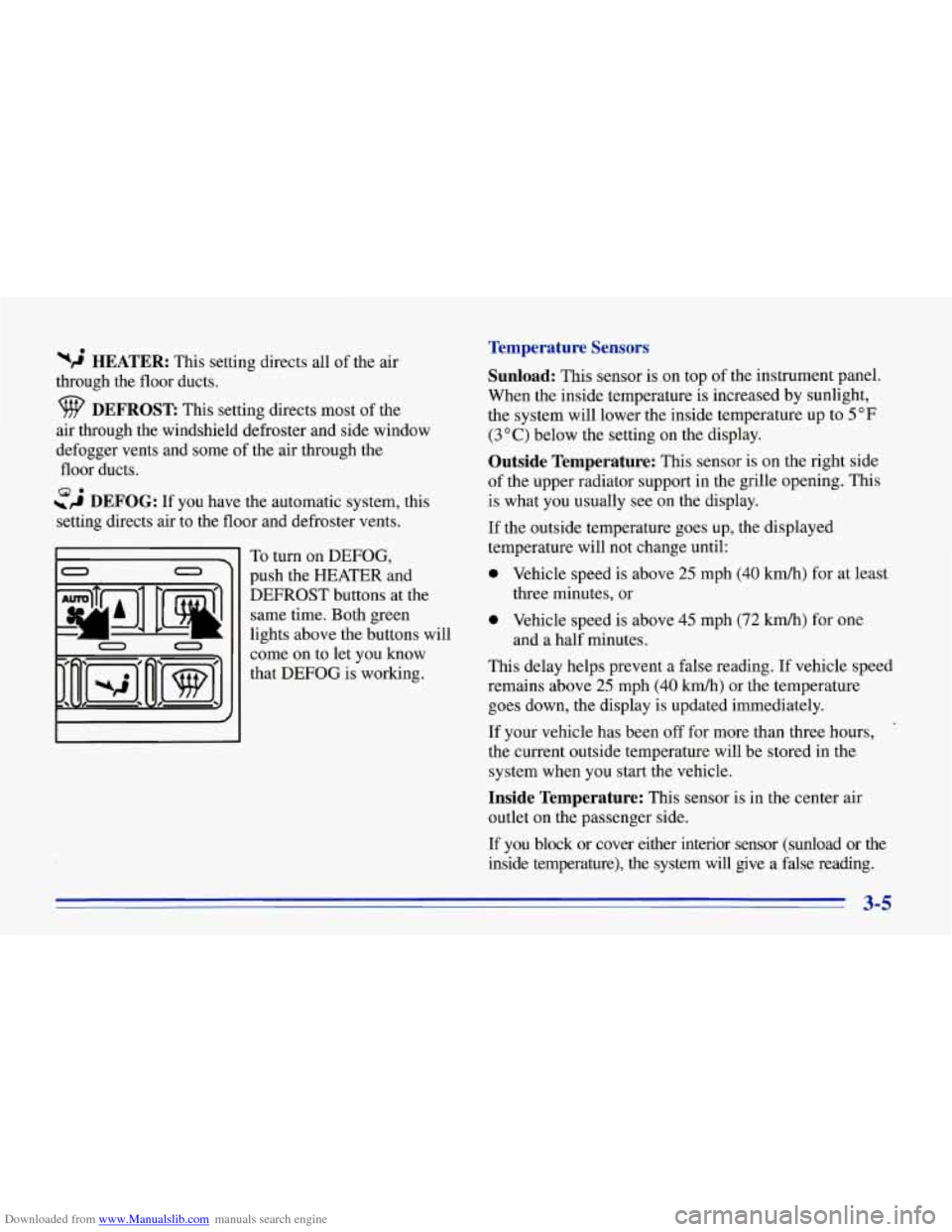
To turn on DEFOG,
push the HEATER and
DEFROST buttons at the same time. Both green
lights above the buttons will
come on to let you know
that DEFOG is working.
Temperature Sensors
Sunload:
This sensor is on top of the instrument panel.
When the inside temperature is increased by sunlight,
the system will lower the inside temperature up to 5
OF
(3 O C) below the setting on the display.
Outside Temperature: This sensor is on the right side
of the upper radiator support in the grille opening. This
is what you usually see on the display.
If the outside temperature goes up, the displayed
temperature will not change until:
0 Vehicle speed is above 25 mph (40 km/h) for at least
0 Vehicle speed is above 45 mph (72 km/h) for one
This delay helps prevent a false reading. If vehicle speed
remains above 25 mph
(40 kmh) or the temperature
goes down, the display is updated immediately.
If your vehicle has been off for more than three hours,
the current outside temperature will be stored in the
system when you start the vehicle.
three minutes, or
and a half minutes.
Inside Temperature: This sensor is in the center air
outlet on the passenger side.
I€ you block or cover either interior sensor (sunload or the
inside temperature), the system will give a false reading.
3-5
Page 234 of 386
Downloaded from www.Manualslib.com manuals search engine Fuel
If you have the 5.7L Code 5 engine, use premium
unleaded gasoline rated at
91 octane or higher.
If you have the 5.7L Code
P engine, use premium
unleaded gasoline rated at 91 octane or higher for best
performance. You may use middle grade
or regular
unleaded gasolines, but your vehicle may not accelerate
as well.
At a minimum, the gasoline you use should meet
specifications ASTM D4814 in the United States and
CGSB 3.5-M93
in Canada. Improved gasoline
specifications have been developed by the American
Automobile Manufacturers Association (AAMA) for
better vehicle performance and engine protection.
Gasolines meeting the AAMA specification could
provide improved driveability and emission control
system protection compared to other gasolines.
Be sure the posted octane for premium is at least 91
(at least 89 for middle grade and
87 for regular). If the
octane is less than 87, you may get a heavy knocking
noise when you drive. If it’s bad enough, it can damage
your engine.
If you’re using fuel rated at the recommended octane or
higher and you still hear heavy knocking, your engine
needs service. But don’t worry if you hear
a little
pinging noise when you’re accelerating or driving up a
hill. That’s normal, and you don’t have to buy a higher
octane fuel to get rid of pinging, It’s the heavy, constant
knock that means you have a problem.
If your vehicle
is certified to meet California Emission
Standards (indicated on the underhood tune-up label),
it
is designed to operate on fuels that meet California
specifications. If such fuels are not available in states
adopting California emissions standards, your vehicle
will operate satisfactorily on fuels meeting federal
specifications, but emission control system performance
may be affected. The malfunction indicator lamp on
your instrument panel may turn on and/or your vehicle
may fail a smog-check test. If this occurs, return to your
authorized Corvette dealer for diagnosis to determine
the cause of failure. In the event it is determined that the
cause of the condition is the type of fuels used, repairs
may not be covered by your warranty.
6-3
Page 235 of 386
Downloaded from www.Manualslib.com manuals search engine In Canada, some gasolines contain an octane enhancing
additive called MMT.
If you use such fuels, your
emission control system performance may deteriorate
and the malfunction indicator lamp on your instrument
panel may also turn on. If this happens, return to your
authorized Corvette dealer for service.
To pfovide cleaner air, all gasolines are now required to
contain additives that will help prevent deposits from
forming
in your engine and fuel system, ailowing your
emission control system to function properly. Therefore,
you should not have to add anything to the fuel.
In
addition, gasolines containing oxygenates, such as ethers
and ethanol, and reformulated gasolines may be
available in your area to help clean the air. General
Motors recommends that you use these gasolines
if they
comply with the specifications described earlier.
I NOTICE:
Your vehicle was not designed for fuel that
contains methanol. Don’t use it. It can corrode
metal parts in your fuel system and also damage plastic and rubber parts. That damage wouldn’t
be covered under your warranty.
Fuels in Foreign Countries
If you plan on driving in another country outside the
United States or Canada, the proper fuel may be hard to
find. Never use leaded gasoline or any other fuel not
recommended in
the previous text on fuel. Costly repairs
caused by use of improper fuel wouldn’t be covered by
your warranty.
To check on fuel availability, ask an auto club, or
contact a major oil company that does business in the
country where you’ll be driving.
You can also write us at the following address for
advice. Just tell us where you’re going and give your
Vehicle Identification Number
(VIN).
General Motors Overseas Distribution Corporation,
North American Export Sales (NAES)
1908 Colonel Sam Drive
Oshawa, Ontario
L1H 8P7
LA
Page 287 of 386
Downloaded from www.Manualslib.com manuals search engine Cleaning the Top of the Instrument Panel
Use only mild soap and water to clean the top surfaces
of the instrument panel. Sprays containing silicones or
waxes may cause annoying reflections in the windshield
and even make it difficult to see through the windshield
under certain conditions.
Cleaning Soft-Touch Paint Surfaces
Use only mild soap and water to clean the Soft-Touch
paint surfaces in your Corvette.
Cleaning Speaker Covers
Vacuum around a speaker cover gently, so that the
speaker won’t be damaged. Some spots and stains will
clean off better with just water and mild soap. If
something gets on one of them and you need to use a
solvent, follow these steps:
Gently scrape excess soil from the trim material
with a clean, dull knife or scraper. Use very little
cleaner, light pressure and clean cloths (preferably
cheesecloth). Cleaning should start at the outside of
the stain, “feathering” toward
the center. Keep
changing to
a clean section of the cloth.
When you clean a stain from fabric, immediately dry the
area with a blow dryer to help prevent a cleaning ring.
Care of Safety Belts
Keep belts clean and dry.
I
Do not bleach or dye safety belts. If you do, it
may severely weaken them. In a crash they might not be able to provide adequate protection. Clean
safety belts only with mild soap and lukewarm
water.
Glass
Glass should be cleaned often. GM Glass Cleaner (GM
Part
No. 1050427) or a liquid household glass cleaner
will remove normal tobacco smoke and dust films.
Don’t use abrasive cleaners on glass, because they may
cause scratches. Avoid placing decals on the inside rear
window, since they may have to be scraped
off later.
If abrasive cleaners are used on the inside of the rear
window, an
electric defogger element may be damaged.
Any temporary license should not be attached across the
defogger grid.
6-56
Page 294 of 386
Downloaded from www.Manualslib.com manuals search engine Vehicle Identification Number (VIN)
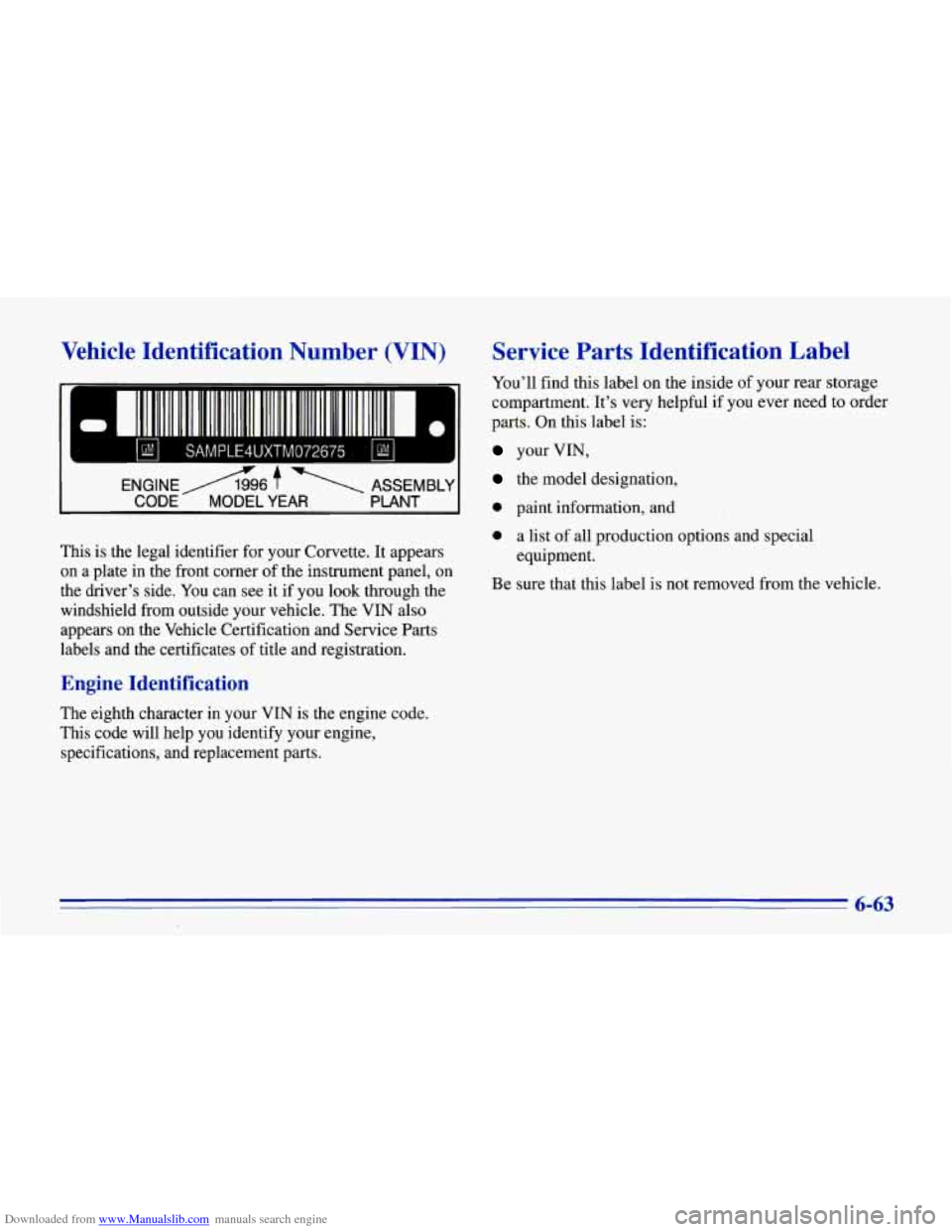
This is the legal identifier for your Corvette. It appears
on a plate
in the front corner of the instrument panel, on
the driver’s side. You can see it if you look through the
windshield from outside your vehicle. The
VIN also
appears on the Vehicle Certification and Service Parts
labels and the certificates of title and registration.
Engine Identification
The eighth character in your VIN is the engine code.
This code will help you identify your engine,
specifications, and replacement parts.
Service Parts Identification Label
You’ll find this label on the inside of your rear storage
compartment. It’s very helpful
if you ever need to order
parts. On this label
is:
your VIN,
the model designation,
0 paint information, and
0 a list of all production options and special
equipment.
Be sure that this label is not removed from the vehicle.
6-63
Page 296 of 386
Downloaded from www.Manualslib.com manuals search engine Fuses and Circuit Breakers
The wiring circuits in your vehicle are protected from
short circuits by a combination of maxi-fuses,
mini-fuses and circuit breakers. This greatly reduces
the chance
of fires caused by electrical problems.
Look at the silver-colored band inside the fuse. If the
band is broken or melted, replace the fuse.
Be sure you
replace a bad fuse with a new one of the identical size
and rating.
If you ever have a problem
on the road and don’t have
a spare fuse,
you can borrow one that has the same
amperage. Just pick some feature of your vehicle that
you can get along without
-- like the radio or cigarette
lighter
-- and use its fuse, if it is the correct amperage.
Replace it as soon as you can.
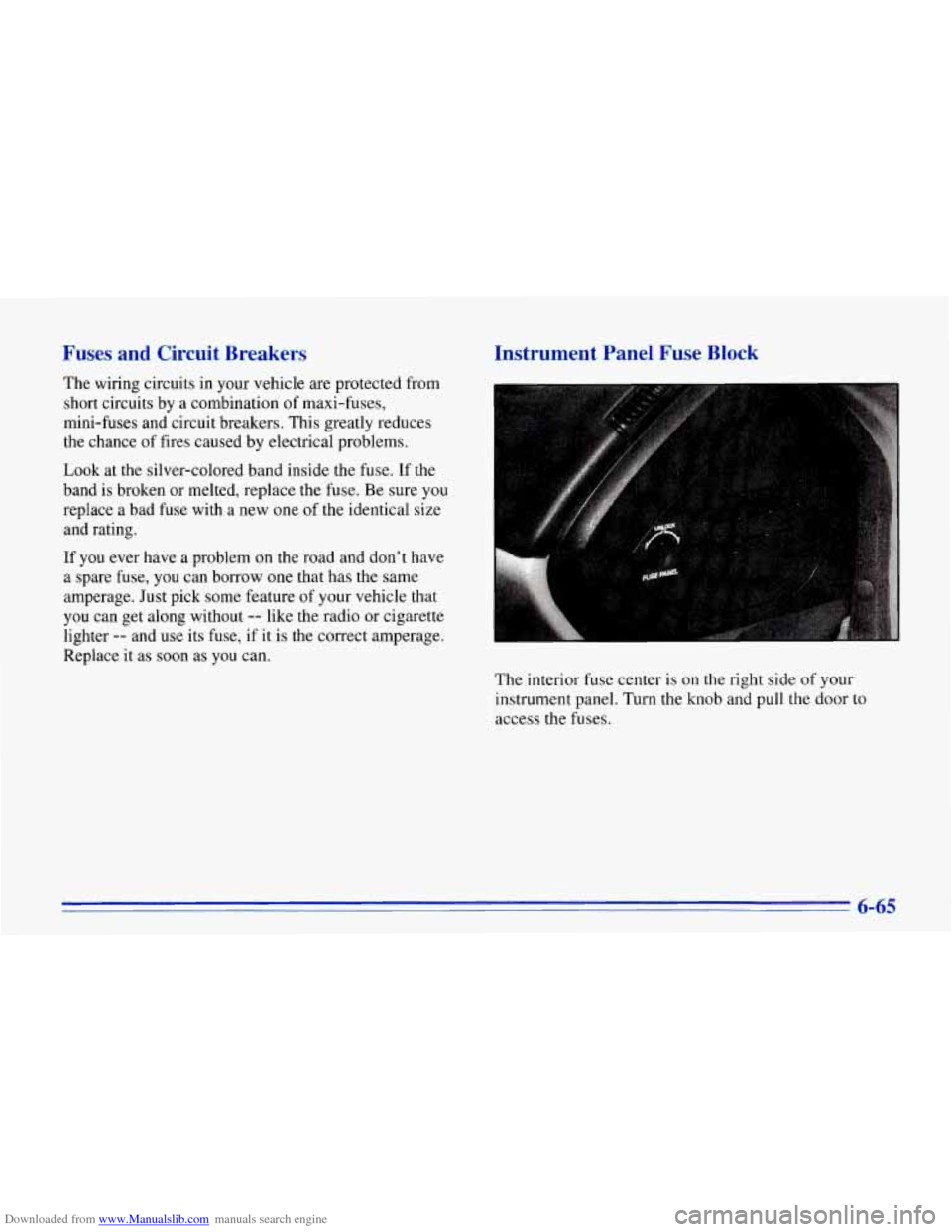
Instrument Panel Fuse Block
The interior fuse center is on the right side of your
instrument panel. Turn the knob and pull the door
to
access the fuses.
6-65
Page 364 of 386
Downloaded from www.Manualslib.com manuals search engine For prompt assistance, please have the following information available to give
the Customer Assistance Representative:
Your name, address, home and business
telephone numbers
Vehicle Identification Number (This is available
from the vehicle registration
or title, or the plate at
the top left of the instrument panel and visible
through the windshield.)
Dealership name and location
Vehicle delivery date and present mileage
Nature of concern
We encourage you to call us
so we can give your inquiry
prompt attention. However, if you wish to write
Chevrolet, write to:
Chevrolet Motor Division
Chevrolet Customer Assistance Center
P.O. Box 7047
Troy, MI 48007-7047
Refer to your Warranty and Owner Assistance
Information booklet for addresses
of Canadian and GM
Overseas offices.
When contacting Chevrolet, please remember that your
concern will likely be resolved in the dealership, using the
dealer's facilities, equipment and personnel. That
is why we
suggest you follow Step One first if you have a concern.
Customer Assistance for Text
Telephone (TTY) Users
To assist customers who are deaf, hard of hearing, or
speech-impaired and who use Text Telephones (TI%),
Corvette has lTY equipment available at its Customer
Assistance Center. Any
TTY user can communicate with
Corvette by dialing: 1-800-833-CHEV (1-800-833-2438).
(lTY users in Canada can dial 1-800-263-3830.)
Corvette Action Center
If you have any questions, comments or problems
regarding your Corvette in general, you can call the
Corvette Action Center at 1-800-457-VETT. The
Corvette Action Center is open between the hours
of
6:OO a.m. to 2:30 p.m. CST, Monday through Friday.
8-3
Page 376 of 386
Downloaded from www.Manualslib.com manuals search engine Fabric ...................................... 6-55
Glass
....................................... 6-56
Inside of Your Corvette
........................ 6-54
Instrument Panel
............................. 6-56
Leather
..................................... 6-55
Outside of Your Corvette
....................... 6-58
Removable Roof Panels
........................ 6-57
Soft-Touch Paint Surfaces
...................... 6-56
Speakercovers
.............................. 6-56
Stains
...................................... 6-54
Tires
....................................... 6-60
Vinyl
....................................... 6-55
Weatherstrips
................................ 6-57
Wheels
..................................... 6-60
Windshield and Wiper Blades
................... 6-57
Climate Control, Automatic Electronic
............... 3-4
Climate Control, Manual
.......................... 3- 1
Clock, Setting the
................................ 3-10
Clutch, Hydraulic
............................... 6-22
Comfort Controls
................................ 3- 1
Compact Disc Care
............................. 3- 19
Compact Disc Player
............................ 3- 15
Compact Spare Tire ............................. 5-38
Competitive Driving
............................ 2- 19
Console, Center
................................ 2-48
Control of a Vehicle
.............................. 4-5
'Convertible Hardtop
............................. 2-64
Convertible Top
................................ 2-58 Convex
Outside Mirror
.......................... 2-47
Coolant
.................................. 5- 17. 6-25
High Fill Reservoir
............................ 5-19
High Fill Reservoir Cap
........................ 6-29
Recovery Tank
............................... 5-17
Coolant Heater. Engine
.......................... 2-20
Cooling System
................................ 5-15
Cornering Lamp Bulb Replacement ................ 6-40
Corvette Action Center
........................... 8-3
Courtesy Lamps
................................ 2-45
Courtesy Transportation
........................... 8-6
Cruise Control
................................. 2-38
Customer Assistance for Text Telephone Users
......... 8-3
Customer Assistance Information
................... 8-1
Customer Satisfaction Procedure
.................... 8-1
Damage. Finish ............................... 6-60
Daytime Running Lamps
......................... 2-44
Dead Battery
................................... 5-2
Defects. Reporting Safety
......................... 8-9
Defensive Driving
............................... 4-1
Defogger. Rear Window
.......................... 3-8
Defogging
................................. 3-3. 3-7
Defrosting
................................. 3-3. 3.7
Delayed Accessory
Bus (DAB) .................... 2-17
Dimensions. Vehicle ............................ 6-77
Dolby
B Noise Reduction ........................ 3-10
9-3