fuel CHEVROLET CORVETTE 1998 5.G Owners Manual
[x] Cancel search | Manufacturer: CHEVROLET, Model Year: 1998, Model line: CORVETTE, Model: CHEVROLET CORVETTE 1998 5.GPages: 378, PDF Size: 19.91 MB
Page 15 of 378
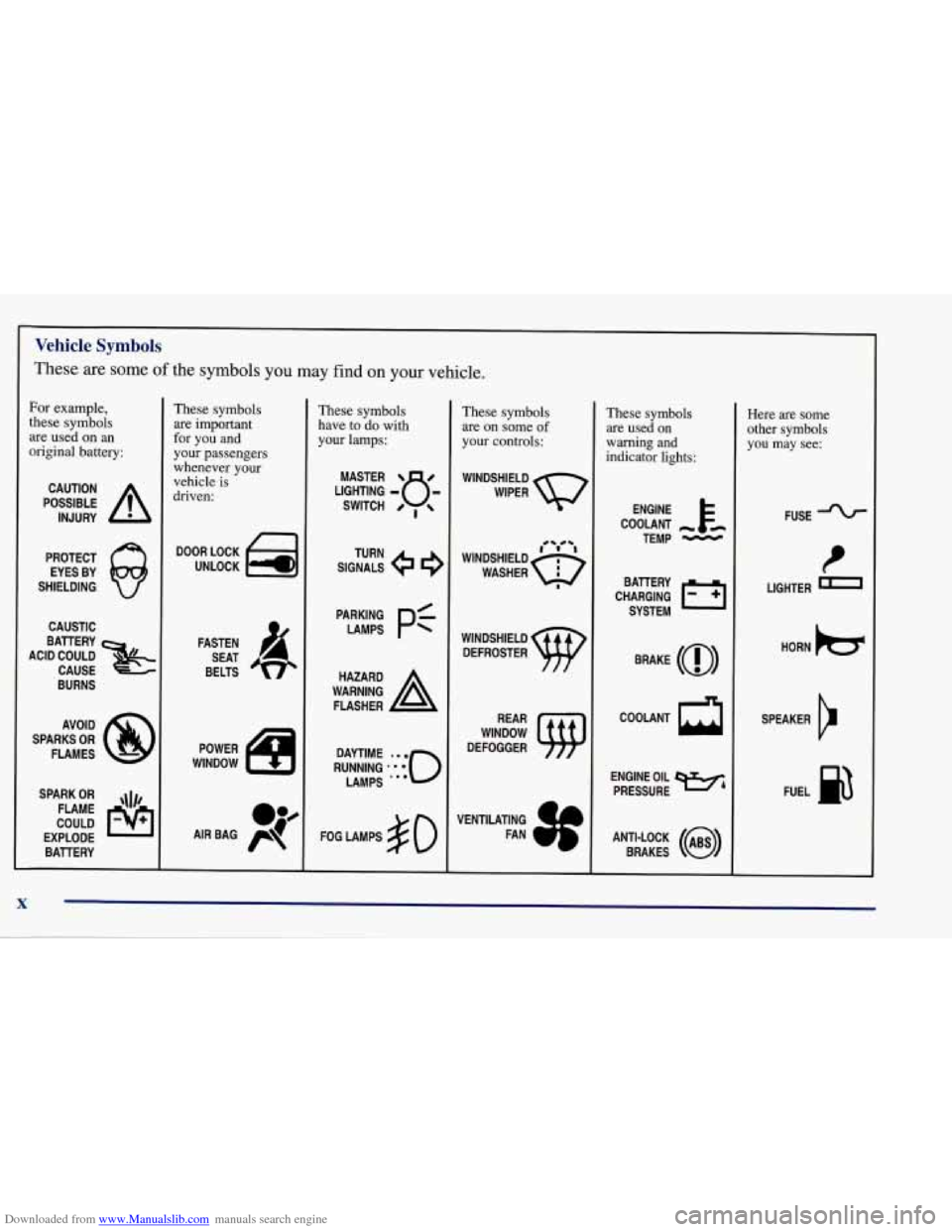
Downloaded from www.Manualslib.com manuals search engine Vehicle Symbols
These are some of the symbols you may find on your vehicle.
For example,
these symbols
are used on
an
original battery:
POSSIBLE A
CAUTION
INJURY
PROTECT EYES BY
SHIELDING
Q
CAUSTIC
These symbols
are important
for you and
your passengers
whenever your
vehicle
is
driven:
DOOR LOCK
UNLOCK
ACID COULD BAlTERY
CAUSE
BURNS
AVOID
SPARKS
OR
FLAMES
SPARK
OR ,\I/,
COULD FLAME
EXPLODE BAllERY FASTEN
SEAT
BELTS
These symbols
have
to do with
your lamps:
SIGNALS TURN
A
FLASHER
FOG LAMPS
$0
These symbols
are on some
of
your controls:
WINDSHIELD
DEFROSTER
WINDOW
DEFOGGER
VENTILATING FAN
These symbols
are used on
warning and
indicator lights:
COOLANT -
TEMP -
CHARGING I-1
BATTERY
SYSTEM
BRAKE
(@)
COOLANT
a
ENGINE OIL
PRESSURE
WA
ANTI-LOCK (@)
BRAKES
Here are some
other symbols
you may see:
FUSE
t
LIGHTER
HORN
b
SPEAKER
b
FUEL p3
X
Page 72 of 378
Downloaded from www.Manualslib.com manuals search engine When the PASS-Key system senses that someone is
using the wrong key, it shuts down the vehicle’s starter
and fuel systems. For about three minutes, the starter
won’t work and fuel won’t go to the engine.
If someone
tries to start your vehicle again or uses another key
during this time, the shutdown period will start over
again. This discourages someone from randomly trying
different keys with different resistor pellets in an attempt
to make a match.
The key must be clean and dry before it’s inserted in the
ignition or the engine may not start. If the SECURITY
light comes on, the key may be dirty or wet.
If this happens and the starter won’t work, turn the
ignition
off. Clean and dry the key, wait three minutes
and try again. If the starter still won’t work, wait
three minutes and try the other ignition key. At this time,
you may
also want to check the fuses (see “Fuses and
Circuit Breakers” in the Index). If the starter won’t work
with the other key, your vehicle needs service. If your
vehicle does start, the first ignition key may be faulty.
See your dealer or a locksmith who can service the
PASS-Key. If
you accidentally use a key that has a damaged or
missing resistor pellet, you will see no SECURITY
light. You don’t have to wait three minutes before trying
the proper key.
If the resistor pellet is damaged or missing, the starter
won’t work. Use the other ignition key, and see your
dealer or a locksmith who can service the PASS-Key to
have a new key made.
If the SECURITY light comes on while driving, have
your vehicle serviced as soon as possible.
If you lose or damage a PASS-Key ignition key, see
your dealer or a locksmith who can service PASS-Key.
In an emergency, call the Chevrolet Roadside Assistance
Center at 1-800-CHEV-USA
(1-800-243-8872). In
Canada, call 1-800-268-6800.
2-19
Page 77 of 378
Downloaded from www.Manualslib.com manuals search engine Racing or Other Competitive Driving
See your Warranty Book before using your vehicle for
racing
or other competitive driving.
NOTICE:
If you use your vehicle for racing or other
competitive driving, your engine may use more
oil than
it would with normal use. Low oil levels
can damage the engine. Be sure to check the oil
level often during racing or other competitive
driving and keep the level at or near the upper
mark on the engine
oil dipstick. You may need to
add oil. See “Adding Oil” under “Engine” in
the Index.
Engine Coolant Heater
(Canada Only)
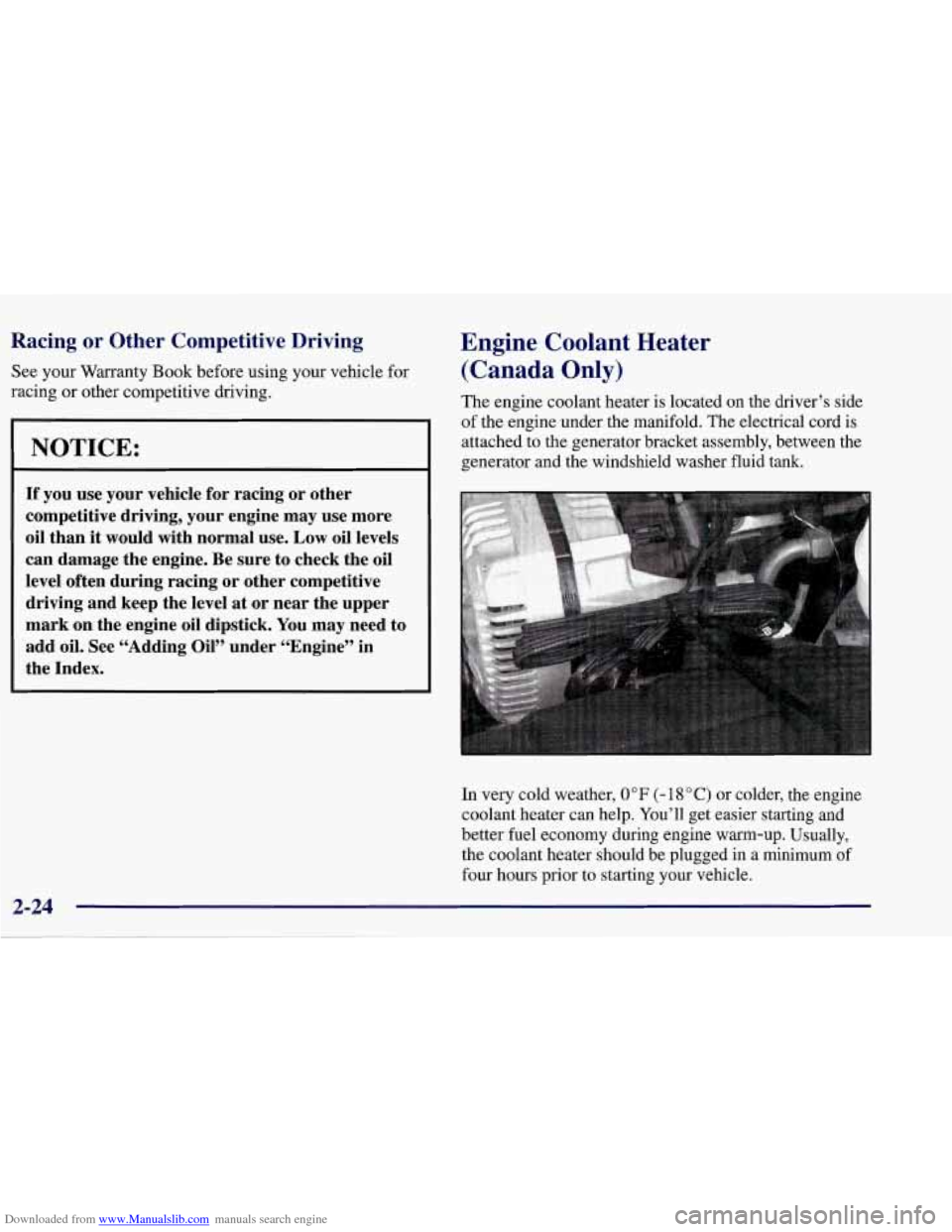
The engine coolant heater is located on the driver’s side
of the engine under the manifold. The electrical cord is
attached to the generator bracket assembly, between the
generator and the windshield washer fluid tank.
In very cold weather,
0 OF (- 18 O C) or colder, the engine
coolant heater can help. You’ll get easier starting and
better fuel economy during engine warm-up. Usually,
the coolant heater should be plugged in a minimum of
four hours prior to starting your vehicle.
2-24
Page 81 of 378
Downloaded from www.Manualslib.com manuals search engine NOTICE:
Damage to your transmission caused by shifting
out
of PARK (P) or NEUTRAL (N) with the
engine racing isn’t covered by your warranty.
1
AUTOMATIC OVERDRIVE (0): This position is for
normal driving.
THIRD (3): This position is also used for normal
driving, however, it offers more power and lower fuel
economy
than AUTOMATIC OVERDRIVE (0).
Here are some times you might choose THIRD (3)
instead of AUTOMATIC OVERDRIVE (a):
0 When driving on hilly, winding roads.
0 When going down a steep hill.
SECOND (2): This position gives you more power but
lower fuel economy. You can use SECOND
(2) on hills.
It can help control your speed as you go down steep
mountain roads, but then you would also want to use
your brakes off and on.
FIRST (1): This position gives you even more power
(but lower fuel economy) than SECOND
(2). You can
use it on very steep hills, or in deep snow
or mud. If the
selector lever is put in FIRST
(l), the transmission
won’t shift into first gear until the vehicle is going
slowly enough.
NOTICE:
If your rear wheels can’t rotate, don’t try to
drive. This might happen if you were stuck in
very deep sand
or mud or were up against a solid
object.
You could damage your transmission.
Also,
if you stop when going uphill, don’t hold
your vehicle there with only the accelerator
pedal. This could overheat and damage the
transmission. Use your brakes or shift into
PARK (P) to hold your vehicle in position on
a hill.
Maximum engine speed is limited to protect driveline
components from improper operation.
Page 83 of 378
Downloaded from www.Manualslib.com manuals search engine Shift Speeds (Manual Transmission)
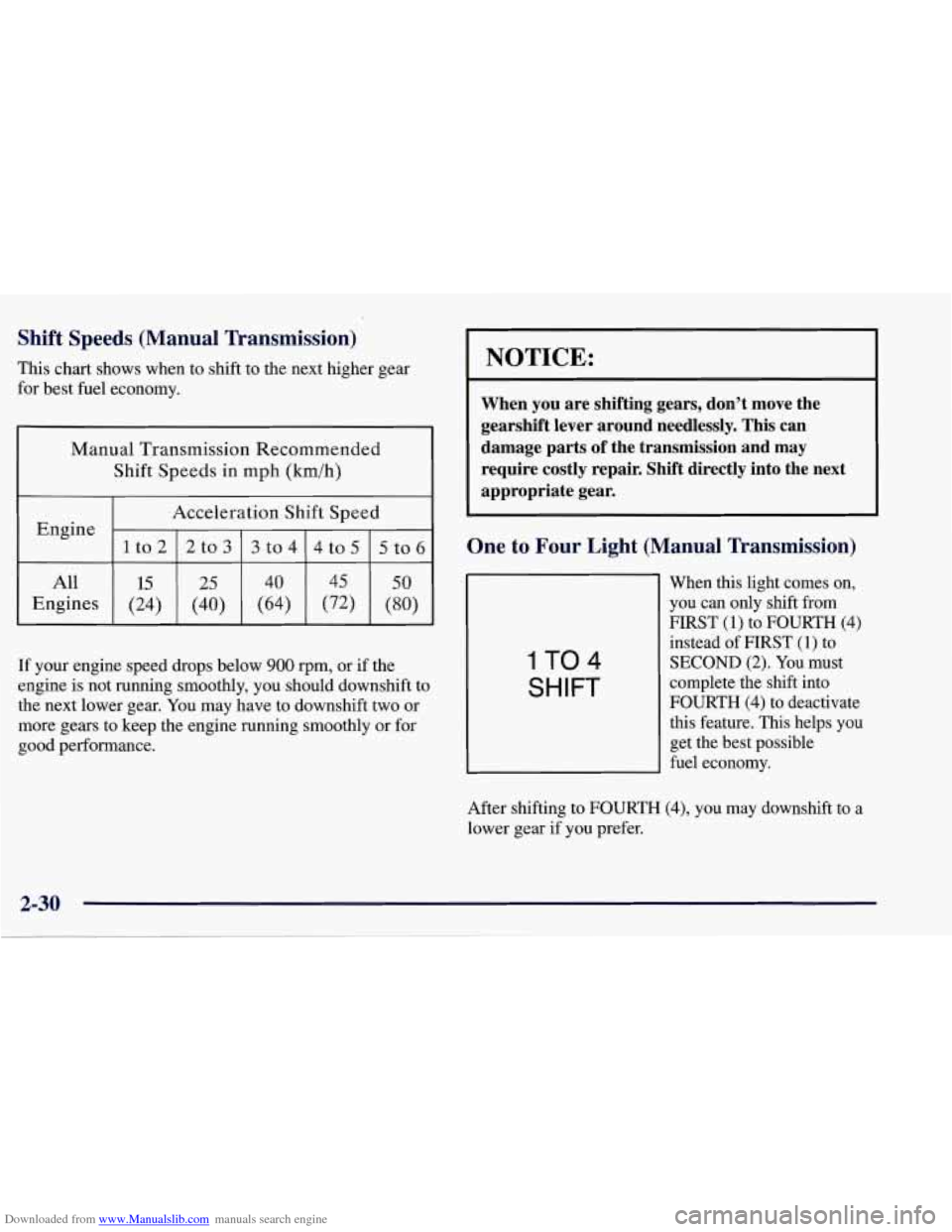
This chart shows when to shift to the next higher gear
for best fuel economy.
Manual Transmission Recommended Shift Speeds in mph (kmih)
Engine
Engines .Acceleration Shift Speed
If your engine speed drops below
900 rpm, or if the
engine is not running smoothly, you should downshift to
the next lower gear. You may have to downshift two
or
more gears to keep the engine running smoothly or for
good performance.
NOTICE:
When you are shifting gears, don't move the
gearshift lever around needlessly. This can
damage parts of the transmission and may
require costly repair. Shift directly into the next
appropriate gear.
One to Four Light (Manual Transmission)
IT04
SHIFT
When this light comes on,
you
can only shift from
F'IRST
(1) to FOURTH (4)
instead of FIRST (1) to
SECOND (2). You must
complete the shift into
FOURTH
(4) to deactivate
this feature. This helps you
get the best possible
fuel economy.
After shifting
to FOURTH (4), you may downshift to a
lower gear if you prefer.
2-30
Page 108 of 378
Downloaded from www.Manualslib.com manuals search engine Center Console
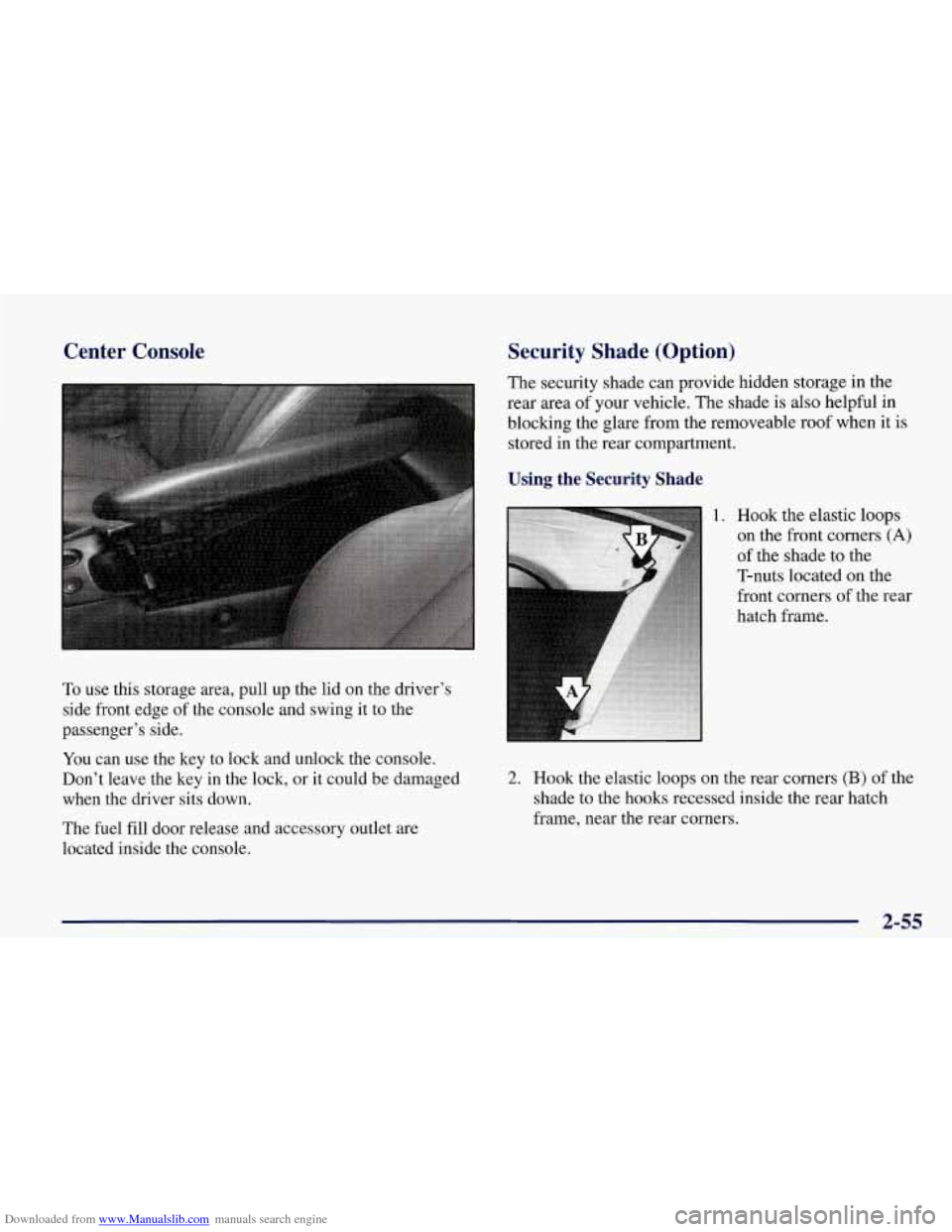
To use this storage area, pull up the lid on the driver's
side front edge of the console and swing it to the
passenger's side.
You can use the key to lock and unlock the console.
Don't leave the key in the lock, or it could be damaged
when the driver sits down.
The fuel fill door release and accessory outlet are
located inside the console.
Security Shade (Option)
The security shade can provide hidden storage in the
rear area of your vehicle. The shade is also helpful in
blocking the glare from the removeable roof when it is
stored in the rear compartment.
Using the Security Shade
1. Hook the elastic loops
on the front corners
(A)
of the shade to the
T-nuts located on the
front corners of the rear
hatch frame.
2. Hook the elastic loops on the rear corners (B) of the
shade to the hooks recessed inside the rear hatch
frame, near the rear corners.
2-55
Page 128 of 378
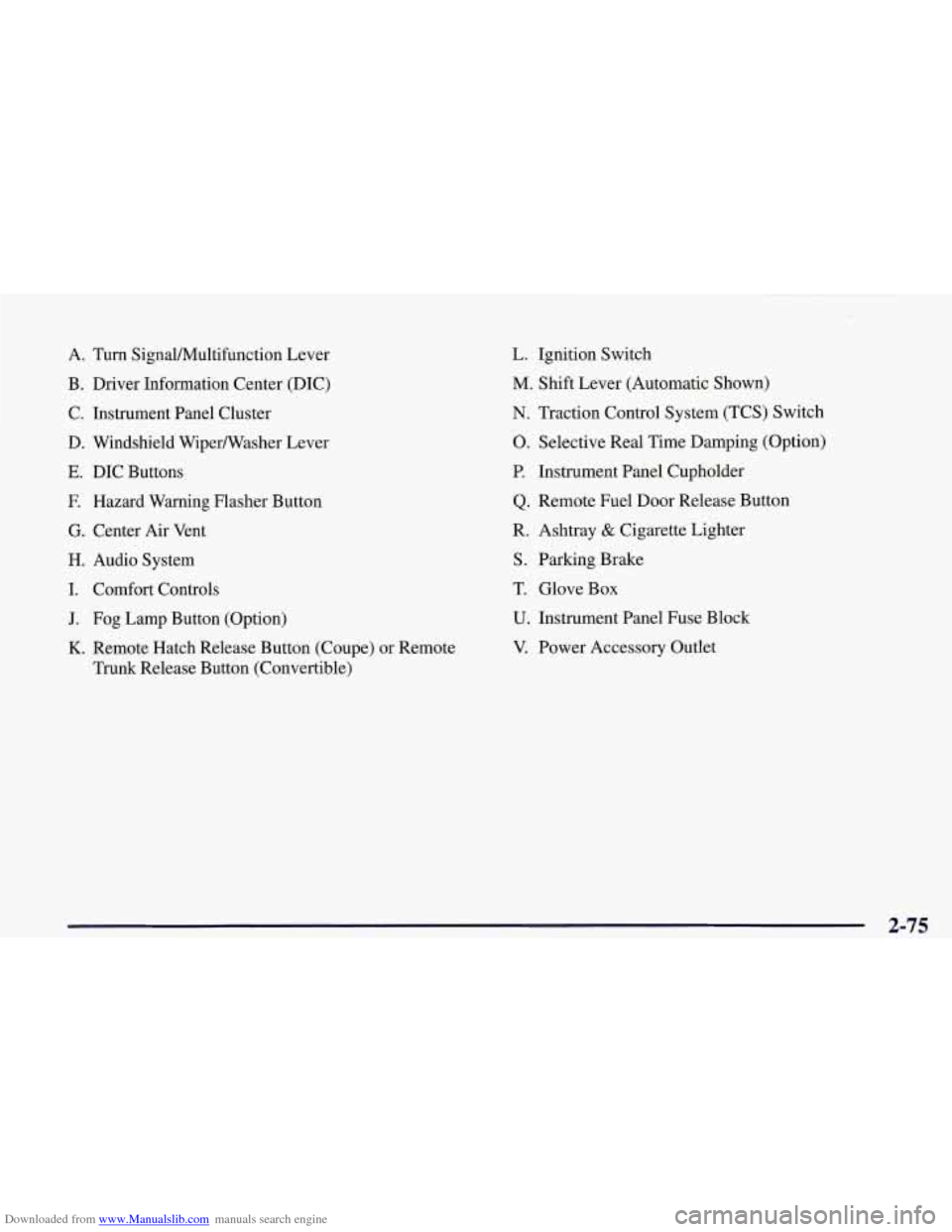
Downloaded from www.Manualslib.com manuals search engine A. Turn Signal/Multifunction Lever
B. Driver Information Center (DIC)
C. Instrument Panel Cluster
D. Windshield Wipermasher Lever
E. DIC Buttons
E Hazard Warning Flasher Button
G. Center Air Vent
H. Audio System
I. Comfort Controls
J. Fog Lamp Button (Option)
K. Remote Hatch Release Button (Coupe) or Remote
Trunk Release Button (Convertible)
L. Ignition Switch
M. Shift Lever (Automatic Shown)
N. Traction Control System (TCS) Switch
0. Selective Real Time Damping (Option)
P. Instrument Panel Cupholder
Q. Remote Fuel Door Release Button
R. Ashtray
& Cigarette Lighter
S. Parking Brake
T. Glove Box
U. Instrument Panel Fuse Block
V. Power Accessory Outlet
2-75
Page 129 of 378
Downloaded from www.Manualslib.com manuals search engine Instrument Panel Cluster
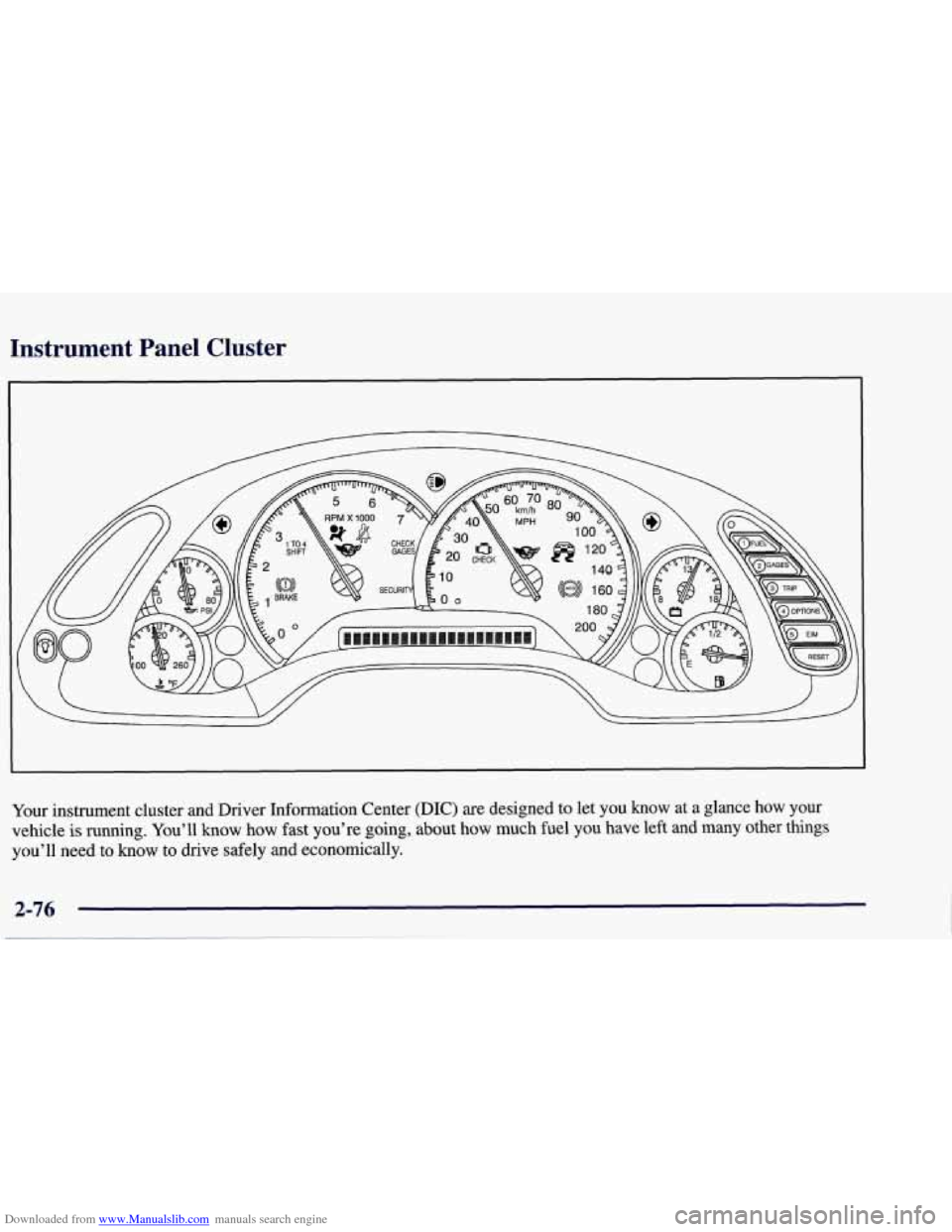
Your instrument cluster and Driver Information Center (DIC) are designed to let you know at a glance how your
vehicle
is running. You’ll know how fast you’re going, about how much fuel you have left and many other things
you’ll need to
know to drive safely and economically.
2-76
Page 130 of 378
Downloaded from www.Manualslib.com manuals search engine Speedometer
Your speedometer lets you see your speed in either miles
per hour (mph)
or kilometers per hour (km/h).
You may note that there are not two separate scales for
mph and
km/h. When you press the EM
(EnglishNetric) button on the Driver Information
Center (DIC), the cluster will calculate the proper speed
and move the needle to the correct position. Either the
MPH or the km/h telltale will illuminate, depending on
which measurement you choose.
Tachometer
The tachometer displays the engine speed in thousands
of revolutions per minute (rpm).
Fuel will shut
off at about 6200 rpm.
If you continue to drive your vehicle at the fuel shut off
rpm, you could damage your engine. Be sure to operate
your vehicle below the fuel shut off rpm or reduce your
rpm quickly when the fuel shuts off.
Warning Lights, Gages and Messages
This part describes the warning lights and gages that
may be on your vehicle. The pictures will help you
locate them.
Warning lights and gages can signal that something is wrong before it becomes serious enough to cause an
expensive repair or replacement. Paying attention to
your warning lights and gages could also save you or
others from injury.
Warning lights come on when there may be
or is a
problem with one of your vehicle’s functions.
As you
will see in the details on the next few pages, some
warning lights come on briefly when you start the
engine just to let you know they’re working.
If you are
familiar with this section, you should not be alarmed
when this happens.
Gages can indicate when there may be or is a problem
with one
of your vehicle’s functions. Often gages and
warning lights work together to let you
know when
there’s a problem with your vehicle.
2-77
Page 135 of 378
Downloaded from www.Manualslib.com manuals search engine Malfunction Indicator Lamp (Check Engine Light)
CHECK
Your vehicle is equipped
with a computer which
monitors operation of the
fuel, ignition and emission
control systems.
This system is called OBD
I1 (On-Board
Diagnostics-Second Generation) and is intended to
assure that emissions
are at acceptable levels for the life
of the vehicle, helping to produce a cleaner
environment. The
CHECK ENGINE light comes on to
indicate that there is a problem and service is required.
Malfunctions often will be indicated by the system
before any problem is apparent. This may prevent more
serious damage to your vehicle. This system is also
designed to assist your service technician in correctly
diagnosing any malfunction.
NOTICE:
If you keep driving your vehicle with this light
on, after a while, your emission controls may not
work as well, your fuel economy may not be as
good and your engine may not run as smoothly.
This could lead
to costly repairs that may not be
covered by your warranty.
This light should come on, as a check to show you it is
working, when the ignition is on and the engine is not
running. If the light doesn’t come on, have it repaired.
This light will also come on during a malfunction in one
of two ways:
0 Light Flashing -- A misfire condition has been
detected.
A misfire increases vehicle emissions and
may damage the emission control system on your
vehicle. Dealer or qualified service center diagnosis
and service may be required.
malfunction has been detected on your vehicle.
Dealer or qualified service center diagnosis and
service may be required.
Light On Steady -- An emission control system