tire pressure CHEVROLET CORVETTE 2008 6.G User Guide
[x] Cancel search | Manufacturer: CHEVROLET, Model Year: 2008, Model line: CORVETTE, Model: CHEVROLET CORVETTE 2008 6.GPages: 432, PDF Size: 2.4 MB
Page 247 of 432
Antilock Brake System (ABS)
Your vehicle has the Antilock Brake System (ABS), an
advanced electronic braking system that will help
prevent a braking skid.
When you start the engine and begin to drive away,
ABS will check itself. You might hear a momentary
motor or clicking noise while this test is going on, and
you might even notice that the brake pedal moves
a little. This is normal.
If there is a problem with
ABS, this warning light will
stay on. SeeAntilock Brake
System (ABS) Warning
Light on page 3-42.
Let us say the road is wet and you are driving safely.
Suddenly, an animal jumps out in front of you. You slam
on the brakes and continue braking. Here is what
happens with ABS:
A computer senses that wheels are slowing down. If
one of the wheels is about to stop rolling, the computer
will separately work the brakes at each wheel.ABS can change the brake pressure faster than any
driver could. The computer is programmed to make the
most of available tire and road conditions. This can
help you steer around the obstacle while braking hard.
As you brake, the computer keeps receiving updates
on wheel speed and controls braking pressure
accordingly.
Remember: ABS does not change the time you need to
get your foot up to the brake pedal or always decrease
stopping distance. If you get too close to the vehicle in
front of you, you will not have time to apply the brakes if
that vehicle suddenly slows or stops. Always leave
enough room up ahead to stop, even though you
have ABS.
Using ABS
Do not pump the brakes. Just hold the brake pedal
down rmly and let antilock work for you. You might hear
a motor or clicking noise and feel the brake pedal
move a little during a stop, but this is normal.
Braking in Emergencies
With ABS, you can steer and brake at the same time.
In many emergencies, steering can help you more than
even the very best braking.
4-5
Page 250 of 432
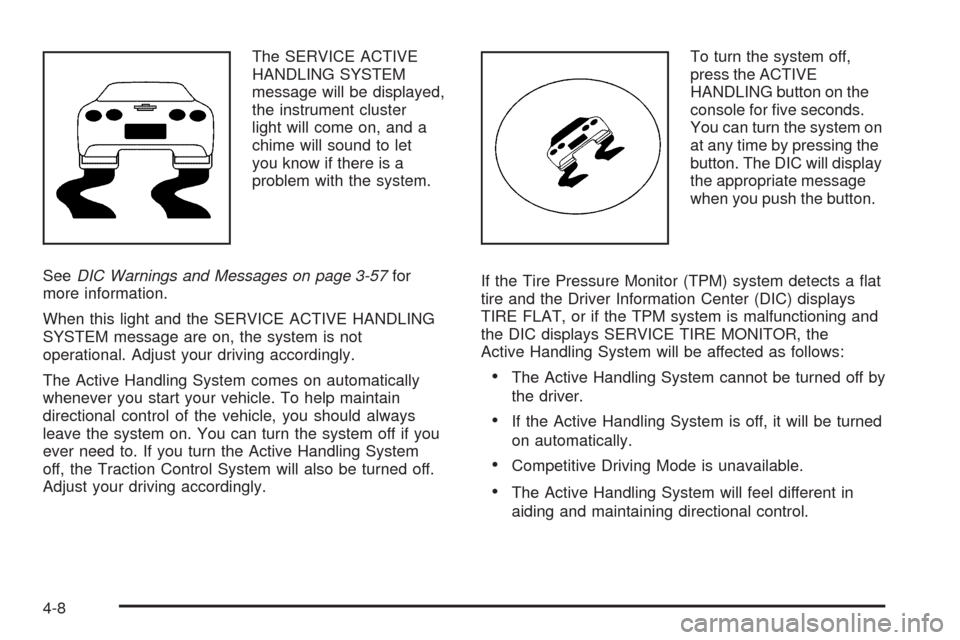
The SERVICE ACTIVE
HANDLING SYSTEM
message will be displayed,
the instrument cluster
light will come on, and a
chime will sound to let
you know if there is a
problem with the system.
SeeDIC Warnings and Messages on page 3-57for
more information.
When this light and the SERVICE ACTIVE HANDLING
SYSTEM message are on, the system is not
operational. Adjust your driving accordingly.
The Active Handling System comes on automatically
whenever you start your vehicle. To help maintain
directional control of the vehicle, you should always
leave the system on. You can turn the system off if you
ever need to. If you turn the Active Handling System
off, the Traction Control System will also be turned off.
Adjust your driving accordingly.To turn the system off,
press the ACTIVE
HANDLING button on the
console for ve seconds.
You can turn the system on
at any time by pressing the
button. The DIC will display
the appropriate message
when you push the button.
If the Tire Pressure Monitor (TPM) system detects a at
tire and the Driver Information Center (DIC) displays
TIRE FLAT, or if the TPM system is malfunctioning and
the DIC displays SERVICE TIRE MONITOR, the
Active Handling System will be affected as follows:
The Active Handling System cannot be turned off by
the driver.
If the Active Handling System is off, it will be turned
on automatically.
Competitive Driving Mode is unavailable.
The Active Handling System will feel different in
aiding and maintaining directional control.
4-8
Page 260 of 432
Before Leaving on a Long Trip
To prepare your vehicle for a long trip, consider having
it serviced by your dealer/retailer before departing.
Things to check on your own include:
Windshield Washer Fluid:Reservoir full? Windows
clean — inside and outside?
Wiper Blades:In good shape?
Fuel, Engine Oil, Other Fluids:All levels checked?
Lamps:Do they all work and are lenses clean?
Tires:Are treads good? Are tires inated to
recommended pressure?
Weather and Maps:Safe to travel? Have
up-to-date maps?
Highway Hypnosis
Always be alert and pay attention to your surroundings
while driving. If you become tired or sleepy, nd a
safe place to park your vehicle and rest.
Other driving tips include:
Keep the vehicle well ventilated.
Keep interior temperature cool.
Keep your eyes moving — scan the road ahead
and to the sides.
Check the rearview mirror and vehicle instruments
often.
Hill and Mountain Roads
Driving on steep hills or through mountains is different
than driving on at or rolling terrain. Tips for driving
in these conditions include:
Keep the vehicle serviced and in good shape.
Check all uid levels and brakes, tires, cooling
system, and transmission.
Going down steep or long hills, shift to a
lower gear.
4-18
Page 267 of 432
Tire and Loading Information Label
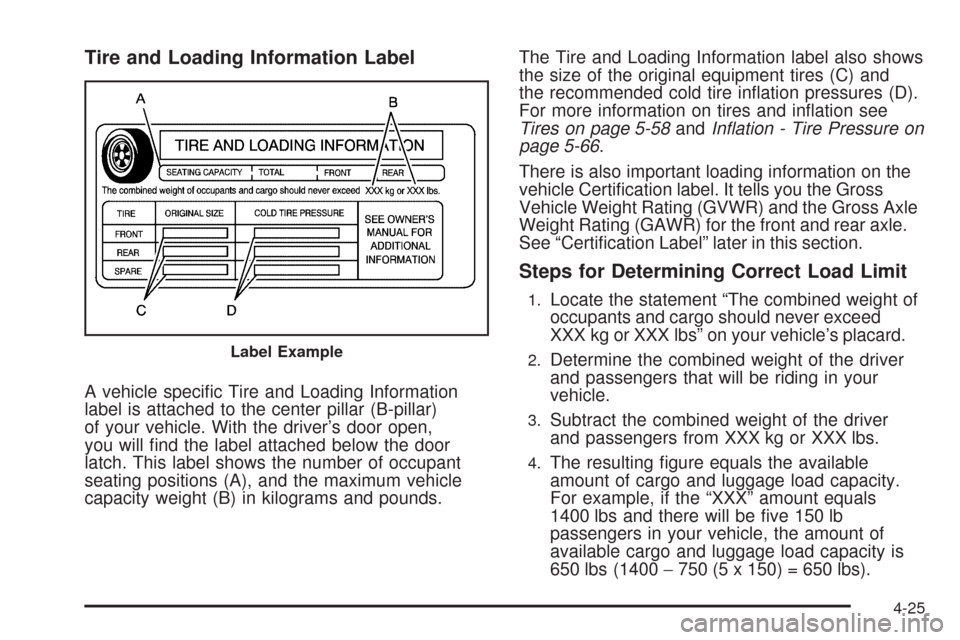
A vehicle specic Tire and Loading Information
label is attached to the center pillar (B-pillar)
of your vehicle. With the driver’s door open,
you will nd the label attached below the door
latch. This label shows the number of occupant
seating positions (A), and the maximum vehicle
capacity weight (B) in kilograms and pounds.The Tire and Loading Information label also shows
the size of the original equipment tires (C) and
the recommended cold tire ination pressures (D).
For more information on tires and ination see
Tires on page 5-58andInflation - Tire Pressure on
page 5-66.
There is also important loading information on the
vehicle Certication label. It tells you the Gross
Vehicle Weight Rating (GVWR) and the Gross Axle
Weight Rating (GAWR) for the front and rear axle.
See “Certication Label” later in this section.
Steps for Determining Correct Load Limit
1.Locate the statement “The combined weight of
occupants and cargo should never exceed
XXX kg or XXX lbs” on your vehicle’s placard.
2.Determine the combined weight of the driver
and passengers that will be riding in your
vehicle.
3.Subtract the combined weight of the driver
and passengers from XXX kg or XXX lbs.
4.The resulting gure equals the available
amount of cargo and luggage load capacity.
For example, if the “XXX” amount equals
1400 lbs and there will be ve 150 lb
passengers in your vehicle, the amount of
available cargo and luggage load capacity is
650 lbs (1400−750 (5 x 150) = 650 lbs).
Label Example
4-25
Page 273 of 432
Service............................................................5-3
Accessories and Modications..........................5-3
California Proposition 65 Warning.....................5-4
California Perchlorate Materials Requirements.....5-4
Doing Your Own Service Work.........................5-4
Adding Equipment to the Outside of the
Vehicle......................................................5-5
Fuel................................................................5-5
Gasoline Octane............................................5-5
Gasoline Specications....................................5-6
California Fuel...............................................5-6
Additives.......................................................5-7
Fuels in Foreign Countries...............................5-8
Filling the Tank..............................................5-8
Filling a Portable Fuel Container.....................5-11
Checking Things Under the Hood....................5-12
Hood Release..............................................5-13
Engine Compartment Overview.......................5-14
Engine Oil...................................................5-17
Engine Oil Life System..................................5-23
Engine Air Cleaner/Filter................................5-25
Automatic Transmission Fluid.........................5-27
Manual Transmission Fluid.............................5-27
Hydraulic Clutch...........................................5-27
Engine Coolant.............................................5-28
Coolant Surge Tank Pressure Cap..................5-31Engine Overheating.......................................5-31
Overheated Engine Protection
Operating Mode........................................5-33
Cooling System............................................5-34
Power Steering Fluid.....................................5-39
Windshield Washer Fluid................................5-41
Brakes........................................................5-42
Battery........................................................5-45
Jump Starting...............................................5-46
Rear Axle.......................................................5-51
Headlamp Aiming...........................................5-51
Bulb Replacement..........................................5-52
High Intensity Discharge (HID) Lighting............5-52
Halogen Bulbs..............................................5-52
Headlamps, Front Turn Signal, and
Parking Lamps..........................................5-53
Taillamps, Turn Signal, and Stoplamps............5-54
Replacement Bulbs.......................................5-55
Windshield Replacement.................................5-55
Windshield Wiper Blade Replacement..............5-55
Tires..............................................................5-58
Winter Tires.................................................5-59
Tire Sidewall Labeling...................................5-60
Tire Terminology and Denitions.....................5-62
Run-Flat Tires..............................................5-64
Section 5 Service and Appearance Care
5-1
Page 274 of 432
Ination - Tire Pressure.................................5-66
High-Speed Operation...................................5-68
Tire Pressure Monitor System.........................5-68
Tire Pressure Monitor Operation.....................5-70
Tire Inspection and Rotation...........................5-72
When It Is Time for New Tires.......................5-73
Buying New Tires.........................................5-74
Different Size Tires and Wheels......................5-75
Uniform Tire Quality Grading..........................5-76
Wheel Alignment and Tire Balance..................5-78
Wheel Replacement......................................5-78
Tire Chains..................................................5-81
Lifting the Vehicle.........................................5-81
If a Tire Goes Flat........................................5-86
Appearance Care............................................5-87
Interior Cleaning...........................................5-87
Fabric/Carpet...............................................5-88
Coated Moldings...........................................5-89
Leather.......................................................5-89
Instrument Panel, Vinyl, and Other Plastic
Surfaces..................................................5-90
Cargo Cover and Convenience Net.................5-90
Care of Safety Belts......................................5-90
Weatherstrips...............................................5-91
Washing Your Vehicle...................................5-91
Cleaning Exterior Lamps/Lenses.....................5-91Finish Care..................................................5-92
Windshield and Wiper Blades.........................5-93
Removable Roof Panel..................................5-93
Convertible Top............................................5-94
Aluminum or Chrome-Plated Wheels
and Trim..................................................5-94
Tires...........................................................5-95
Finish Damage.............................................5-95
Underbody Maintenance................................5-96
Fiberglass Springs (Composite Springs)...........5-96
Chemical Paint Spotting.................................5-96
Vehicle Care/Appearance Materials..................5-97
Vehicle Identication......................................5-98
Vehicle Identication Number (VIN).................5-98
Service Parts Identication Label.....................5-98
Electrical System............................................5-99
Add-On Electrical Equipment..........................5-99
Headlamp Wiring..........................................5-99
Windshield Wiper Fuses................................5-99
Power Windows and Other Power Options.......5-99
Fuses and Circuit Breakers..........................5-100
Instrument Panel Fuse Block........................5-100
Engine Compartment Fuse Block...................5-104
Capacities and Specications........................5-107
Section 5 Service and Appearance Care
5-2
Page 330 of 432
Tires
Your new vehicle comes with high-quality tires
made by a leading tire manufacturer. If you ever
have questions about your tire warranty and where
to obtain service, see your vehicle Warranty
booklet for details.
{CAUTION:
Poorly maintained and improperly
used tires are dangerous.
Overloading your tires can cause
overheating as a result of too much
exing. You could have an air-out and
a serious accident. SeeLoading the
Vehicle on page 4-24.
CAUTION: (Continued)
CAUTION: (Continued)
Underinated tires pose the same
danger as overloaded tires. The
resulting accident could cause serious
injury. Check all tires frequently to
maintain the recommended pressure.
Tire pressure should be checked when
your tires are cold. SeeInflation - Tire
Pressure on page 5-66.
Overinated tires are more likely to
be cut, punctured, or broken by a
sudden impact — such as when you
hit a pothole. Keep tires at the
recommended pressure.
Worn, old tires can cause accidents. If
your tread is badly worn, or if your tires
have been damaged, replace them.
SeeHigh-Speed Operation on page 5-68for
ination pressure adjustment for high
speed driving.
5-58
Page 331 of 432
Low-Prole Performance Tire
The original equipment tires on your vehicle are
classied as low-prole performance tires.
These tires are designed for very responsive
driving on wet or dry pavement. You may
also notice more road noise with low-prole tires
and that they tend to wear faster.
Notice:If the vehicle has low-prole tires,
they are more susceptible to damage from road
hazards or curb impact than standard prole
tires. Tire and/or wheel assembly damage
can occur when coming into contact with road
hazards like, potholes, or sharp edged
objects, or when sliding into a curb. The
vehicle warranty does not cover this type of
damage. Keep tires set to the correct ination
pressure and, when possible avoid contact
with curbs, potholes, and other road hazards.
Winter Tires
If you expect to drive on snow or ice covered roads
often, you may want to get winter tires for your vehicle.
All season tires provide good overall performance on
most surfaces but they may not offer the traction
you would like or the same level of performance as
winter tires on snow or ice covered roads.
Winter tires, in general, are designed for increased
traction on snow and ice covered roads. With winter
tires, there may be decreased dry road traction,
increased road noise, and shorter tread life. After
switching to winter tires, be alert for changes in vehicle
handling and braking.
See your dealer/retailer for details regarding winter tire
availability and proper tire selection. Also, seeBuying
New Tires on page 5-74.
If you choose to use winter tires:
Use tires of the same brand and tread type on all
four wheel positions.
Use only radial ply tires of the same size, load range,
and speed rating as the original equipment tires.
Winter tires with the same speed rating as your original
equipment tires may not be available for H, V, W, Y,
and ZR speed rated tires. If you choose winter tires with
a lower speed rating, never exceed the tire’s maximum
speed capability.
5-59
Page 333 of 432
(F) Uniform Tire Quality Grading (UTQG):Tire
manufacturers are required to grade tires
based on three performance factors: treadwear,
traction and temperature resistance. For more
information seeUniform Tire Quality Grading on
page 5-76.
(G) Maximum Cold Ination Load Limit
:Maximum load that can be carried and the
maximum pressure needed to support that load.
Tire Size
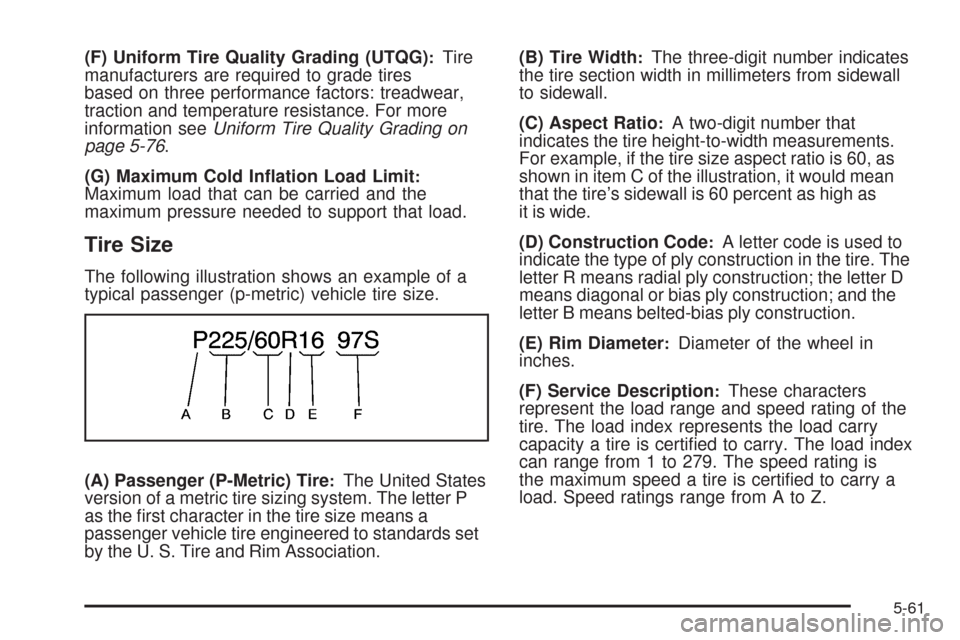
The following illustration shows an example of a
typical passenger (p-metric) vehicle tire size.
(A) Passenger (P-Metric) Tire
:The United States
version of a metric tire sizing system. The letter P
as the rst character in the tire size means a
passenger vehicle tire engineered to standards set
by the U. S. Tire and Rim Association.(B) Tire Width
:The three-digit number indicates
the tire section width in millimeters from sidewall
to sidewall.
(C) Aspect Ratio
:A two-digit number that
indicates the tire height-to-width measurements.
For example, if the tire size aspect ratio is 60, as
shown in item C of the illustration, it would mean
that the tire’s sidewall is 60 percent as high as
it is wide.
(D) Construction Code
:A letter code is used to
indicate the type of ply construction in the tire. The
letter R means radial ply construction; the letter D
means diagonal or bias ply construction; and the
letter B means belted-bias ply construction.
(E) Rim Diameter
:Diameter of the wheel in
inches.
(F) Service Description
:These characters
represent the load range and speed rating of the
tire. The load index represents the load carry
capacity a tire is certied to carry. The load index
can range from 1 to 279. The speed rating is
the maximum speed a tire is certied to carry a
load. Speed ratings range from A to Z.
5-61
Page 334 of 432
Tire Terminology and Denitions
Air Pressure:The amount of air inside the
tire pressing outward on each square inch of the
tire. Air pressure is expressed in pounds per
square inch (psi) or kilopascal (kPa).
Accessory Weight
:This means the combined
weight of optional accessories. Some examples of
optional accessories are, automatic transmission,
power steering, power brakes, power windows,
power seats, and air conditioning.
Aspect Ratio
:The relationship of a tire’s height
to its width.
Belt
:A rubber coated layer of cords that is located
between the plies and the tread. Cords may be
made from steel or other reinforcing materials.
Bead
:The tire bead contains steel wires wrapped
by steel cords that hold the tire onto the rim.
Bias Ply Tire
:A pneumatic tire in which the plies
are laid at alternate angles less than 90 degrees
to the centerline of the tread.
Cold Tire Pressure
:The amount of air pressure
in a tire, measured in pounds per square inch
(psi) or kilopascals (kPa) before a tire has built up
heat from driving. SeeInflation - Tire Pressure
on page 5-66.Curb Weight
:The weight of a motor vehicle with
standard and optional equipment including the
maximum capacity of fuel, oil, and coolant,
but without passengers and cargo.
DOT Markings
:A code molded into the sidewall
of a tire signifying that the tire is in compliance
with the U.S. Department of Transportation (DOT)
motor vehicle safety standards. The DOT code
includes the Tire Identication Number (TIN),
an alphanumeric designator which can also identify
the tire manufacturer, production plant, brand,
and date of production.
GVWR
:Gross Vehicle Weight Rating. See
Loading the Vehicle on page 4-24.
GAWR FRT
:Gross Axle Weight Rating for the
front axle. SeeLoading the Vehicle on page 4-24.
GAWR RR
:Gross Axle Weight Rating for the
rear axle. SeeLoading the Vehicle on page 4-24.
Intended Outboard Sidewall
:The side of an
asymmetrical tire, that must always face outward
when mounted on a vehicle.
Kilopascal (kPa)
:The metric unit for air pressure.
Light Truck (LT-Metric) Tire
:A tire used on
light duty trucks and some multipurpose passenger
vehicles.
5-62