engine overheat CHEVROLET CORVETTE 2008 6.G Owners Manual
[x] Cancel search | Manufacturer: CHEVROLET, Model Year: 2008, Model line: CORVETTE, Model: CHEVROLET CORVETTE 2008 6.GPages: 432, PDF Size: 2.4 MB
Page 88 of 432
To start your vehicle, do the following:
1. For an automatic transmission, with your foot on the
brake pedal, press the START button located on
the instrument panel. For a manual transmission,
while pressing in the clutch, press the START
button.
If there is not a keyless access transmitter in the
vehicle or if there is something causing interference
with it, the DIC will display NO FOBS DETECTED.
SeeDIC Warnings and Messages on page 3-57
for more information.
2. When the engine begins cranking, let go of the
button and the engine cranks automatically until
it starts. If the battery in the keyless access
transmitter is weak, the DIC displays FOB
BATTERY LOW. You can still drive the vehicle.
See “Battery Replacement” underKeyless Access
System Operation on page 2-6for more information.
If the fob battery is dead, you need to insert the
fob into the fob slot to enable engine starting.
See “No Fobs Detected” underDIC Warnings and
Messages on page 3-57.3. Do not race the engine immediately after starting it.
Operate the engine and transmission gently until
the oil warms up and lubricates all moving parts.
4. If the engine does not start and no DIC message is
displayed, wait 15 seconds before trying again to let
the cranking motor cool down.
If the engine does not start after 5-10 seconds,
especially in very cold weather (below 0°F or−18°C),
it could be ooded with too much gasoline. Try
pushing the accelerator pedal all the way to the oor
while cranking for up to 15 seconds maximum. Wait
at least 15 seconds between each try, to allow the
cranking motor to cool down. When the engine starts,
let go of the accelerator. If the vehicle starts briey
but then stops again, do the same thing. This clears
the extra gasoline from the engine.
Notice:Cranking the engine for long periods of
time, by pressing the START button immediately
after cranking has ended, can overheat and damage
the cranking motor, and drain the battery. Wait at
least 15 seconds between each try, to allow the
cranking motor to cool down.
2-24
Page 96 of 432
Downshifting (Manual Transmission)
Do not downshift into the gear shown below at a speed
greater than shown in the table:
FIRST (1) 50 mph (80 km/h)
SECOND (2) 74 mph (119 km/h)
THIRD (3) 101 mph (163 km/h)
FOURTH (4) 130 mph (209 km/h)
Notice:If you skip more than one gear when you
downshift, or if you race the engine when you
release the clutch pedal while downshifting, you
could damage the engine, clutch, driveshaft or the
transmission. Do not skip gears or race the
engine when downshifting.
The six-speed transmission has a spring that centers
the shift lever near THIRD (3) and FOURTH (4).
This spring helps you know which gear you are in when
you are shifting. Be careful when shifting from
FIRST (1) to SECOND (2) or downshifting from
SIXTH (6) to FIFTH (5). The spring will try to pull the
shift lever toward FOURTH (4) and THIRD (3).
Make sure you move the lever into SECOND (2) or
FIFTH (5). If you let the shift lever move in the direction
of the pulling, you may end up shifting from FIRST (1)
to FOURTH (4) or from SIXTH (6) to THIRD (3).
Parking Brake
The parking brake lever is located to the right of the
center console.
To set the parking brake, hold the brake pedal down.
Pull the parking brake lever up. If the ignition is on, the
brake system warning light will come on.
To release the parking brake, hold the brake pedal
down. Then push the release button in as you move the
parking brake lever all the way down.
Notice:Driving with the parking brake on can
overheat the brake system and cause premature
wear or damage to brake system parts. Make sure
that the parking brake is fully released and the brake
warning light is off before driving.
2-32
Page 97 of 432
Shifting Into Park
(Automatic Transmission)
{CAUTION:
It can be dangerous to get out of your vehicle
if the shift lever is not fully in PARK (P) with
the parking brake rmly set. Your vehicle can
roll. If you have left the engine running, the
vehicle can move suddenly. You or others
could be injured. To be sure your vehicle will
not move, even when you are on fairly level
ground, use the steps that follow.
1. Hold the brake pedal down with your right foot and
set the parking brake.
SeeParking Brake on page 2-32for more
information.
2. Move the shift lever into PARK (P) by holding in the
button on the lever and pushing the lever all the
way toward the front of the vehicle.
3. Press the Acc. button (ignition switch) to turn the
engine off.
Leaving Your Vehicle With the Engine
Running (Automatic Transmission)
{CAUTION:
It can be dangerous to leave the vehicle with
the engine running. The vehicle could move
suddenly if the shift lever is not fully in
P (Park) with the parking brake rmly set. And,
if you leave the vehicle with the engine
running, it could overheat and even catch re.
You or others could be injured. Do not leave
the vehicle with the engine running.
If you have to leave your vehicle with the engine
running, be sure your vehicle is in PARK (P) and your
parking brake is rmly set before you leave it. After you
have moved the shift lever into PARK (P), hold down
the regular brake pedal. See if you can move the
shift lever away from PARK (P) without rst pulling it
toward you. If you can, it means that the shift lever was
not fully locked into PARK (P).
2-33
Page 180 of 432
Engine Coolant Temperature Gage
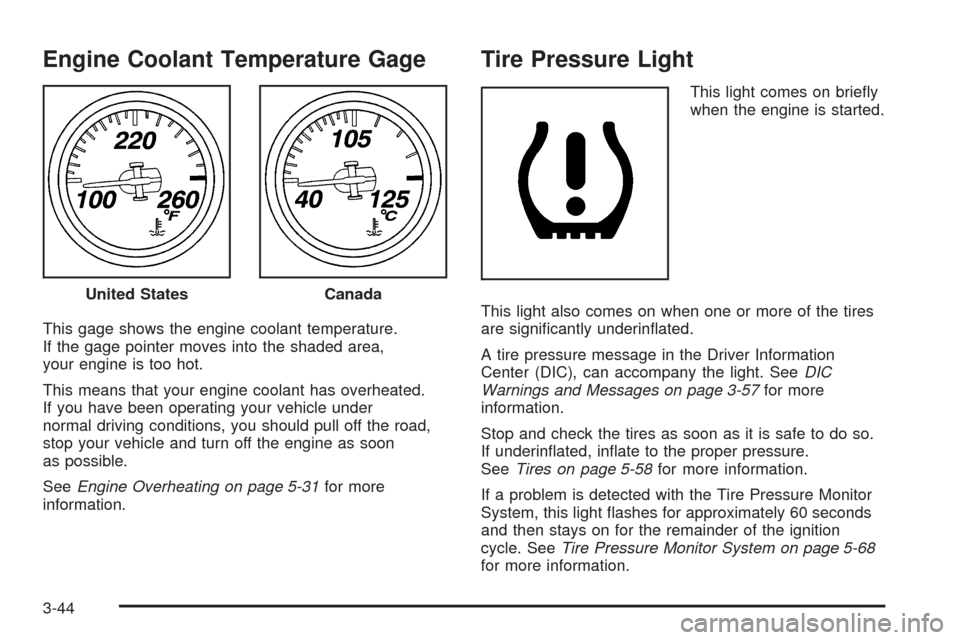
This gage shows the engine coolant temperature.
If the gage pointer moves into the shaded area,
your engine is too hot.
This means that your engine coolant has overheated.
If you have been operating your vehicle under
normal driving conditions, you should pull off the road,
stop your vehicle and turn off the engine as soon
as possible.
SeeEngine Overheating on page 5-31for more
information.
Tire Pressure Light
This light comes on briey
when the engine is started.
This light also comes on when one or more of the tires
are signicantly underinated.
A tire pressure message in the Driver Information
Center (DIC), can accompany the light. SeeDIC
Warnings and Messages on page 3-57for more
information.
Stop and check the tires as soon as it is safe to do so.
If underinated, inate to the proper pressure.
SeeTires on page 5-58for more information.
If a problem is detected with the Tire Pressure Monitor
System, this light ashes for approximately 60 seconds
and then stays on for the remainder of the ignition
cycle. SeeTire Pressure Monitor System on page 5-68
for more information. United States
Canada
3-44
Page 196 of 432
If the driver remains unbuckled when the ignition is on
and the vehicle is in motion, the reminder will be
repeated. If the driver’s safety belt is already buckled,
this message and chime will not come on.
This message is an additional reminder to the safety
belt reminder light in the instrument panel cluster.
SeeSafety Belt Reminders on page 3-36for more
information.
CHANGE ENGINE OIL
This message displays when the life of the engine oil
has expired. SeeScheduled Maintenance on page 6-4.
After an oil change, the engine oil life system must
be reset. See “Engine Oil Life” underDIC Operation
and Displays on page 3-52. Also, seeEngine Oil on
page 5-17andEngine Oil Life System on page 5-23for
more information.
CHECK BRAKE FLUID
This message displays, a chime sounds, and the brake
system warning light on the instrument panel cluster
turns on if the ignition is on to inform the driver that the
brake uid level is low. SeeBrake System Warning
Light on page 3-41. Have the brake system serviced by
your dealer/retailer as soon as possible. SeeBrakes
on page 5-42.
CHECK COOLANT LEVEL
This message displays when the engine coolant level
is low. Have the cooling system serviced by your
dealer/retailer as soon as possible. SeeEngine Coolant
on page 5-28.
CHECK GAS CAP
This message displays if the fuel cap has not been fully
tightened. Check the fuel cap to make sure that it is
on properly. Once tightened, it takes at least one
overnight park to reset or clear this message. If both the
CHECK GAS CAP message and the malfunction
indicator lamp in the instrument panel cluster are on,
you may need to see your dealer/retailer for service.
SeeMalfunction Indicator Lamp on page 3-45for more
information.
CHECK OIL LEVEL
On some vehicles, this message displays and two
chimes sound if the oil level in the vehicle is low.
Once the vehicle senses a change in the engine oil
level, the light remains off.
If this message appears after starting the engine,
the engine oil level may be too low. You may need to
add oil. SeeEngine Overheating on page 5-31.
3-60
Page 197 of 432
To acknowledge the message, press the RESET button.
The message reappears every 10 minutes until this
condition changes.
CLOSE TRUNK TO MOVE TOP
This message displays and a chime sounds if the trunk
is open while you are trying to operate the convertible
top. Make sure the trunk is closed before operating the
convertible top. SeeConvertible Top (Manual) on
page 2-62orConvertible Top (Power) on page 2-68.
COMPETITIVE DRIVING MODE
This message displays and a short chime sounds
when the Competitive Driving mode is selected.
The instrument panel cluster light will not be on
when the Competitive Driving mode is selected.
The Traction Control System (TCS) will not be operating
while in the Competitive Driving mode. Adjust your
driving accordingly. SeeRacing or Other Competitive
Driving on page 4-15for more information.
COOLANT OVER TEMPERATURE
This message displays and a chime sounds if the engine
coolant exceeds 255°F (124°C). If you have been
operating your vehicle under normal driving conditions,
pull off the road, stop your vehicle, and turn off the
engine as soon as possible.
You can monitor the coolant temperature with the gages
button on the DIC or the engine coolant temperature
gage on the instrument panel cluster. SeeEngine
Overheating on page 5-31,DIC Operation and Displays
on page 3-52, andEngine Coolant Temperature Gage
on page 3-44.
To acknowledge the message, press the RESET button.
The message reappears and a chime sounds every
minute until this condition changes. If you do not press
the RESET button, the message remains on until the
condition changes.
3-61
Page 198 of 432
CRUISE DISENGAGED
This message displays briey when you disengage the
cruise control system by stepping on the brake on
an automatic transmission vehicle or the clutch on a
manual transmission vehicle, or by turning off the cruise
control switch. SeeCruise Control on page 3-11for
more information.
ENGINE DRAG CONTROL ACTIVE
This message displays when engine drag control is
active. When driving in a lower gear in rainy, snowy, or
icy conditions and then letting up on the accelerator
or downshifting, the rear wheels may begin to slip and
this message displays. This message stays on for a
few seconds following the engine drag control event.
ENGINE OVERHEATED – STOP ENGINE
This message displays and a continuous chime sounds
when the engine has overheated. Stop and turn the
engine off immediately to avoid severe engine damage.
SeeEngine Overheating on page 5-31.
ENGINE PROTECTION REDUCE
ENGINE RPM
This message displays if the engine oil temperature
exceeds 320°F (160°C). Check the engine coolant
temperature and engine oil level. If the engine is
too hot, seeEngine Overheating on page 5-31.
Your vehicle may need service, so see your
dealer/retailer.
You can monitor the oil temperature with the gages
button on the DIC. SeeDIC Operation and Displays
on page 3-52.
Multiple chimes sound when this message is displayed.
This message remains displayed and active until the
issue is resolved.
HEADLAMPS SUGGESTED
This message displays if it is dark enough outside and
the headlamps and the Twilight Sentinel®controls
are off. This message informs the driver that turning on
the exterior lamps is recommended. It has become
dark enough outside to require the headlamps and/or
other exterior lamps.
3-62
Page 203 of 432
To acknowledge the message, press the RESET button.
The message reappears every ve minutes until this
condition changes.
If the REDUCED ENGINE POWER message is
displayed in combination with the COOLANT OVER
TEMPERATURE message, seeEngine Overheating
on page 5-31.
SERVICE ACTIVE HANDLING SYSTEM
This message displays if there is a problem with the
Active Handling System and your vehicle needs service.
The active handling system light on the instrument
panel cluster also turns on and a chime sounds.
See your dealer/retailer. When this message is
displayed, the system is not working. Adjust your driving
accordingly. SeeActive Handling System on page 4-7
for more information.
SERVICE AIR CONDITIONING
This message displays when the electronic sensors that
control the air conditioning and heating systems are
no longer working. Have the climate control system
serviced by your dealer/retailer if you notice a drop in
heating and air conditioning efficiency.
SERVICE ANTILOCK BRAKES
If this message displays while you are driving, stop as
soon as possible and turn the ignition off. Then start the
engine again to reset the system. If the message stays
on, or comes back on again while you are driving, your
vehicle is in need of service. See your dealer/retailer.
If the antilock brake system (ABS) warning light is on and
the regular brake system warning light is not on, you still
have brakes, but do not have ABS. If the regular brake
system warning light is also on, you do not have ABS and
there is a problem with the brakes. SeeAntilock Brake
System (ABS) Warning Light on page 3-42andBrake
System Warning Light on page 3-41.
If this message is displayed, the Traction Control
System (TCS) and the Active Handling System will also
be disabled. The DIC will scroll three messages:
SERVICE ANTILOCK BRAKES, SERVICE TRACTION
SYSTEM, and SERVICE ACTIVE HANDLING, and
the instrument panel cluster lights will come on along
with a chime. When the service message is displayed,
the computer controlled systems will not assist the
driver. Have the system repaired by your dealer/retailer
as soon as possible. Adjust your driving accordingly.
To acknowledge these messages, press the RESET
button.
3-67
Page 209 of 432
TRACTION SYSTEM – ON
This message displays and a single, quick tone sounds
when the Traction Control System (TCS) is turned
on by pressing the Active Handling System button on
the console. This message automatically clears from the
DIC display on its own. SeeTraction Control System
(TCS) on page 4-6for more information.
TRANSMISSION HOT IDLE ENGINE
This message displays and four chimes sound if the
transmission uid temperature rises above 270°F
(132°C) or rises rapidly. The transmission may shift
gears or apply the torque converter clutch to reduce the
uid temperature. Driving aggressively or driving on
long hills can cause the transmission uid temperature
to be higher than normal. If this message appears,
you may continue to drive at a slower speed. Monitor
the transmission uid temperature and allow it to cool
to at least 230°F (110°C). The transmission uid
temperature can be monitored with the gages button on
the DIC. SeeDIC Operation and Displays on page 3-52
andAutomatic Transmission Fluid on page 5-27.
Also check the engine coolant temperature. If it is also
hot, seeEngine Overheating on page 5-31.
If this message is displayed during normal vehicle
operation on at roads, your vehicle may need service.
See your dealer/retailer for an inspection.If driving in a performance or competitive manner,
the use of (S) Sport Automatic Mode or (S) Sport
Manual Paddle Shift gear selection is recommended.
SeeAutomatic Transmission Operation on page 2-26
for more information.
To acknowledge the message, press the RESET button.
The message reappears every 10 minutes until this
condition changes. If you do not press the RESET
button, the message remains on the display until the
condition changes.TURN SIGNAL ON
This message displays and a chime sounds if a turn
signal is left on for three-quarters of a mile (1.2 km).
Move the turn signal/multifunction lever to the off
position.
To acknowledge this message, press the RESET
button.
UNLATCH HEADER TO MOVE TOP
This message displays and a chime sounds if you try to
lower the convertible top without rst unlocking the
top. Move the latch handle to unlock the convertible top.
SeeConvertible Top (Manual) on page 2-62or
Convertible Top (Power) on page 2-68.
3-73
Page 265 of 432
Then, shut the engine off and close the window almost
all the way to preserve the heat. Start the engine again
and repeat this only when you feel really uncomfortable
from the cold. But do it as little as possible. Preserve the
fuel as long as you can. To help keep warm, you can get
out of the vehicle and do some fairly vigorous exercises
every half hour or so until help comes.
If Your Vehicle is Stuck in Sand,
Mud, Ice, or Snow
Slowly and cautiously spin the wheels to free the
vehicle when stuck in sand, mud, ice, or snow. See
Rocking Your Vehicle to Get It Out on page 4-24.
If the vehicle has a traction system, it can often help to
free a stuck vehicle. Refer to the vehicle’s traction
system in the Index. If stuck too severely for the traction
system to free the vehicle, turn the traction system off
and use the rocking method.
{CAUTION:
If you let your vehicle’s tires spin at high
speed, they can explode, and you or others
could be injured. The vehicle can overheat,
causing an engine compartment re or other
damage. Spin the wheels as little as possible
and avoid going above 35 mph (55 km/h) as
shown on the speedometer.
For information about using tire chains on the vehicle,
seeTire Chains on page 5-81.
4-23