maintenance CHEVROLET CORVETTE 2009 6.G Owner's Manual
[x] Cancel search | Manufacturer: CHEVROLET, Model Year: 2009, Model line: CORVETTE, Model: CHEVROLET CORVETTE 2009 6.GPages: 434, PDF Size: 2.53 MB
Page 322 of 434
Battery
This vehicle has a maintenance free battery. When it is
time for a new battery, see your dealer/retailer for one
that has the replacement number shown on the original
battery’s label.
For battery replacement, see your dealer/retailer or the
service manual. To purchase a service manual, see
Service Publications Ordering Information on page 7-15.
Warning:Battery posts, terminals, and related
accessories contain lead and lead compounds,
chemicals known to the State of California to cause
cancer and reproductive harm. Wash hands after
handling.
Vehicle Storage
{CAUTION:
Batteries have acid that can burn you and gas that
can explode. You can be badly hurt if you are not
careful. SeeJump Starting on page 5-51for tips
on working around a battery without getting hurt.
Infrequent Usage: If the vehicle is driven infrequently,
remove the black, negative (−) cable from the battery.
This helps keep the battery from running down.
See “Power Window Initialization” inPower Windows on
page 2-17.
Extended Storage: For extended storage of the vehicle,
remove the black, negative (−) cable from the battery or
use a battery trickle charger. This helps maintain the
charge of the battery over an extended period of time.
5-50
Page 332 of 434
Windshield Replacement
The windshield is part of the Head-Up Display (HUD)
system. If you ever have to get the windshield replaced,
get one that is designed for HUD or the HUD image
may look out of focus.
Windshield Wiper Blade
Replacement
Windshield wiper blades should be inspected for wear
and cracking. SeeScheduled Maintenance on page 6-4
for more information.
Replacement blades come in different types and are
removed in different ways. For the proper type and
length, seeMaintenance Replacement Parts on
page 6-14.
It is a good idea to clean or replace the wiper blade
assembly every six months. Allowing the wiper blade arm
to touch the windshield when no wiper blade is installed
could damage the windshield. Any damage that occurs
would not be covered by the vehicle’s warranty. Do not
allow the wiper blade arm to touch the windshield.
To remove the wiper blade assembly:
1. Open the hood to gain access to the windshield
wipers.
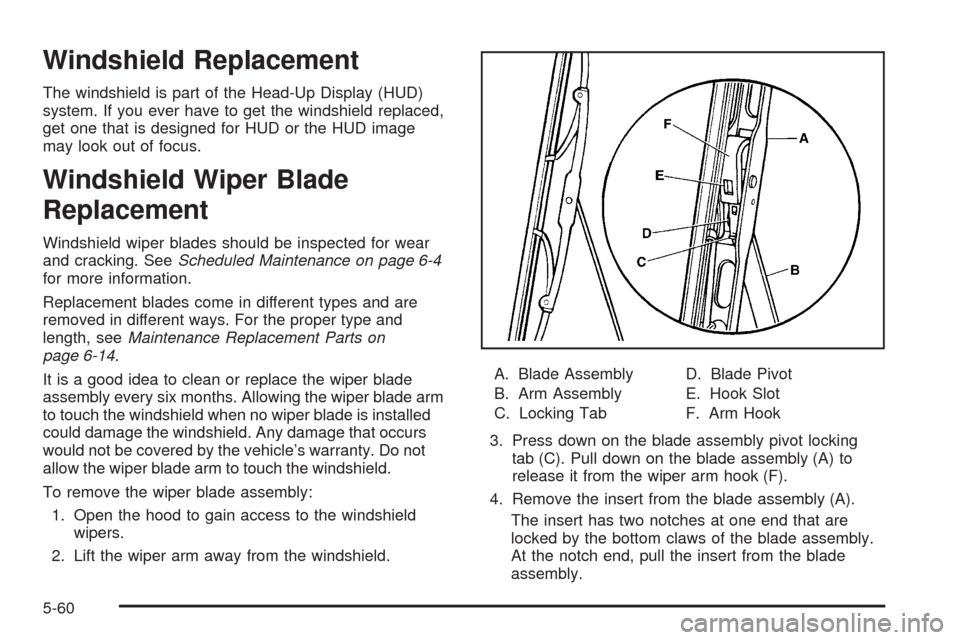
2. Lift the wiper arm away from the windshield.A. Blade Assembly
B. Arm Assembly
C. Locking TabD. Blade Pivot
E. Hook Slot
F. Arm Hook
3. Press down on the blade assembly pivot locking
tab (C). Pull down on the blade assembly (A) to
release it from the wiper arm hook (F).
4. Remove the insert from the blade assembly (A).
The insert has two notches at one end that are
locked by the bottom claws of the blade assembly.
At the notch end, pull the insert from the blade
assembly.
5-60
Page 345 of 434
Tire Pressure Monitor System
The Tire Pressure Monitor System (TPMS) uses radio
and sensor technology to check tire pressure levels.
The TPMS sensors monitor the air pressure in
your vehicle’s tires and transmit tire pressure readings
to a receiver located in the vehicle.
Each tire, including the spare (if provided), should be
checked monthly when cold and inated to the ination
pressure recommended by the vehicle manufacturer
on the vehicle placard or tire ination pressure label.
(If your vehicle has tires of a different size than the
size indicated on the vehicle placard or tire ination
pressure label, you should determine the proper
tire ination pressure for those tires.)
As an added safety feature, your vehicle has been
equipped with a tire pressure monitoring system (TPMS)
that illuminates a low tire pressure telltale when one
or more of your tires is signicantly under-inated.
Accordingly, when the low tire pressure telltale
illuminates, you should stop and check your tires
as soon as possible, and inate them to the proper
pressure. Driving on a signicantly under-inated
tire causes the tire to overheat and can lead to tire
failure. Under-ination also reduces fuel efficiency and
tire tread life, and may affect the vehicle’s handling
and stopping ability.Please note that the TPMS is not a substitute for proper
tire maintenance, and it is the driver’s responsibility to
maintain correct tire pressure, even if under-ination
has not reached the level to trigger illumination of
the TPMS low tire pressure telltale.
Your vehicle has also been equipped with a TPMS
malfunction indicator to indicate when the system is
not operating properly. The TPMS malfunction indicator
is combined with the low tire pressure telltale. When the
system detects a malfunction, the telltale will ash for
approximately one minute and then remain continuously
illuminated. This sequence will continue upon
subsequent vehicle start-ups as long as the malfunction
exists.
When the malfunction indicator is illuminated, the
system may not be able to detect or signal low tire
pressure as intended. TPMS malfunctions may occur
for a variety of reasons, including the installation of
replacement or alternate tires or wheels on the vehicle
that prevent the TPMS from functioning properly. Always
check the TPMS malfunction telltale after replacing one
or more tires or wheels on your vehicle to ensure that
the replacement or alternate tires and wheels allow the
TPMS to continue to function properly.
SeeTire Pressure Monitor Operation on page 5-74for
additional information.
5-73
Page 347 of 434
The low tire pressure warning light may come on in
cool weather when the vehicle is rst started, and then
turn off as you start to drive. This could be an early
indicator that the air pressure in the tire(s) are getting
low and need to be inated to the proper pressure.
A Tire and Loading Information label, attached to
your vehicle, shows the size of your vehicle’s original
equipment tires and the correct ination pressure for
your vehicle’s tires when they are cold. SeeLoading the
Vehicle on page 4-22, for an example of the Tire and
Loading Information label and its location on your vehicle.
Also seeInflation - Tire Pressure on page 5-70for
additional information.
Your vehicle’s TPMS can warn you about a low tire
pressure condition but it does not replace normal
tire maintenance. SeeTire Inspection and Rotation on
page 5-76,When It Is Time for New Tires on page 5-77,
andTires on page 5-62.
Notice:Liquid tire sealants could damage the Tire
Pressure Monitor System (TPMS) sensors. Sensor
damage caused by using a tire sealant is not covered
by your warranty. Do not use liquid tire sealants.TPMS Malfunction Light and Message
The TPMS will not function properly if one or more of
the TPMS sensors are missing or inoperable. When the
system detects a malfunction, the low tire warning light
ashes for about one minute and then stays on for the
remainder of the ignition cycle. A DIC warning message
is also displayed. The low tire warning light and DIC
warning message come on at each ignition cycle until
the problem is corrected. Some of the conditions that
can cause the malfunction light and DIC message to
come on are:
The TPMS sensor matching process was not done
or not completed successfully. The DIC message
should go off after successfully completing the
sensor matching process.
One or more TPMS sensors are missing or
damaged. Under these conditions the TPMS
malfunction light (low tire warning light) comes on,
and at the same time the DIC message is displayed.
The DIC message and TPMS malfunction light
should go off once the TPMS sensors are installed
and the sensor matching process is performed
successfully.
5-75
Page 349 of 434
When It Is Time for New Tires
Various factors, such as maintenance, temperatures,
driving speeds, vehicle loading, and road conditions,
inuence when you need new tires.
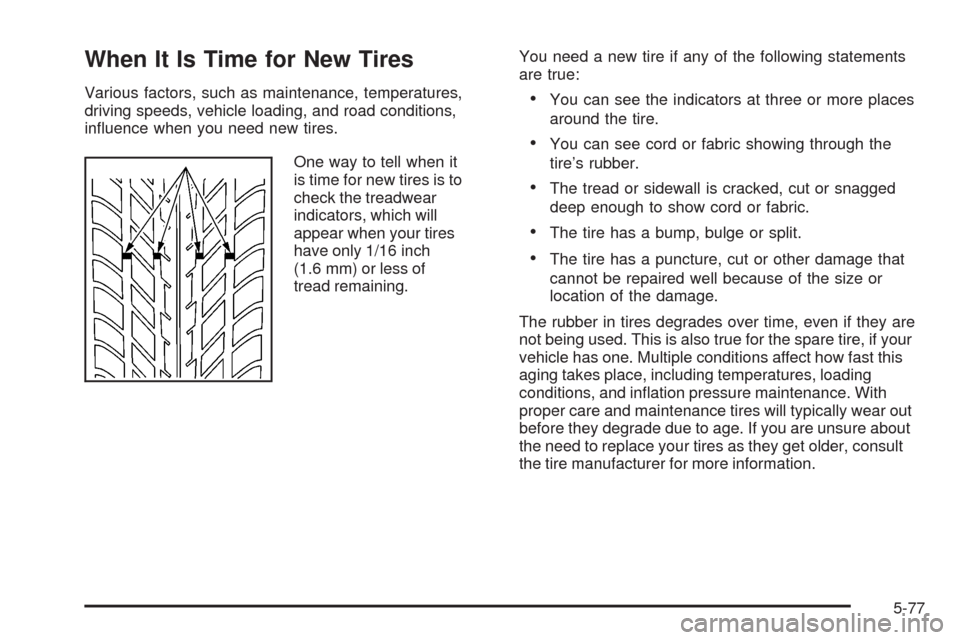
One way to tell when it
is time for new tires is to
check the treadwear
indicators, which will
appear when your tires
have only 1/16 inch
(1.6 mm) or less of
tread remaining.You need a new tire if any of the following statements
are true:You can see the indicators at three or more places
around the tire.
You can see cord or fabric showing through the
tire’s rubber.
The tread or sidewall is cracked, cut or snagged
deep enough to show cord or fabric.
The tire has a bump, bulge or split.
The tire has a puncture, cut or other damage that
cannot be repaired well because of the size or
location of the damage.
The rubber in tires degrades over time, even if they are
not being used. This is also true for the spare tire, if your
vehicle has one. Multiple conditions affect how fast this
aging takes place, including temperatures, loading
conditions, and ination pressure maintenance. With
proper care and maintenance tires will typically wear out
before they degrade due to age. If you are unsure about
the need to replace your tires as they get older, consult
the tire manufacturer for more information.
5-77
Page 372 of 434
Finish Damage
Any stone chips, fractures or deep scratches in the
nish should be repaired right away. Bare metal
will corrode quickly and may develop into major
repair expense.
Minor chips and scratches can be repaired with
touch-up materials available from your dealer/retailer.
Larger areas of nish damage can be corrected in your
dealer’s/retailer’s body and paint shop.
Underbody Maintenance
Chemicals used for ice and snow removal and dust
control can collect on the underbody. If these are
not removed, corrosion and rust can develop on the
underbody parts such as fuel lines, frame, oor pan,
and exhaust system even though they have corrosion
protection.
At least every spring, ush these materials from the
underbody with plain water. Clean any areas where mud
and debris can collect. Dirt packed in close areas of the
frame should be loosened before being ushed. Your
dealer/retailer or an underbody car washing system
can do this.
Fiberglass Springs
(Composite Springs)
Notice:If you use acidic or corrosive cleaning
products, engine degreasers or aluminum cleaning
agents on berglass springs, you may damage
the springs. The repairs would not be covered
by your warranty. Use only approved cleaners
when cleaning your vehicle’s berglass springs.
Chemical Paint Spotting
Some weather and atmospheric conditions can create a
chemical fallout. Airborne pollutants can fall upon and
attack painted surfaces on the vehicle. This damage
can take two forms: blotchy, ring-shaped discolorations,
and small, irregular dark spots etched into the paint
surface.
Although no defect in the paint job causes this, we
will repair, at no charge to the owner, the surfaces
of new vehicles damaged by this fallout condition within
12 months or 12,000 miles (20 000 km) of purchase,
whichever occurs rst.
5-100
Page 385 of 434
Maintenance Schedule......................................6-2
Introduction...................................................6-2
Maintenance Requirements..............................6-2
Your Vehicle and the Environment....................6-2
Using the Maintenance Schedule......................6-2
Scheduled Maintenance...................................6-4
Additional Required Services............................6-6
Maintenance Footnotes...................................6-7Owner Checks and Services............................6-9
At Each Fuel Fill............................................6-9
At Least Once a Month.................................6-10
At Least Once a Year...................................6-10
Recommended Fluids and Lubricants...............6-12
Maintenance Replacement Parts.....................6-14
Engine Drive Belt Routing..............................6-15
Maintenance Record.....................................6-16
Section 6 Maintenance Schedule
6-1
Page 386 of 434
Maintenance Schedule
Introduction
Important: Keep engine oil at the proper level and
change as recommended.
Have you purchased the GM Protection Plan? The Plan
supplements the vehicle warranties. See the Warranty
and Owner Assistance booklet or your dealer/retailer for
details.
Maintenance Requirements
Notice:Maintenance intervals, checks, inspections,
replacement parts, and recommended uids and
lubricants as prescribed in this manual are necessary
to keep this vehicle in good working condition. Any
damage caused by failure to follow scheduled
maintenance might not be covered by the vehicle
warranty.
Your Vehicle and the Environment
Proper vehicle maintenance not only helps to keep
the vehicle in good working condition, but also helps
the environment. All recommended maintenance is
important. Improper vehicle maintenance can even affect
the quality of the air we breathe. Improper uid levels or
the wrong tire ination can increase the level of emissions
from the vehicle. To help protect the environment, and to
keep the vehicle in good condition, be sure to maintain
the vehicle properly.
Using the Maintenance Schedule
We want to help keep this vehicle in good working
condition. But we do not know exactly how you will drive
it. You might drive very short distances only a few
times a week. Or you might drive long distances all the
time in very hot, dusty weather. You might use the
vehicle in making deliveries. Or you might drive
it to work, to do errands, or in many other ways.
Because of all the different ways people use their
vehicles, maintenance needs vary. You might need more
frequent checks and replacements. So please read
the following and note how you drive. If you have any
questions on how to keep the vehicle in good condition,
see your dealer/retailer.
6-2
Page 387 of 434
This schedule is for vehicles that:
carry passengers and cargo within recommended
limits on the Tire and Loading Information label.
SeeLoading the Vehicle on page 4-22.
are driven on reasonable road surfaces within legal
driving limits.
use the recommended fuel. SeeGasoline Octane
on page 5-6.
The services inScheduled Maintenance on page 6-4
should be performed when indicated. SeeAdditional
Required Services on page 6-6andMaintenance
Footnotes on page 6-7for further information.
{CAUTION:
Performing maintenance work on a vehicle can be
dangerous. In trying to do some jobs, you can be
seriously injured. Do your own maintenance work
only if you have the required know-how and the
proper tools and equipment for the job. If you have
any doubt, see your dealer/retailer to have a
qualied technician do the work. SeeDoing Your
Own Service Work on page 5-5.Some maintenance services can be complex. So, unless
you are technically qualied and have the necessary
equipment, have your dealer/retailer do these jobs.
When you go to your dealer/retailer for service, trained
and supported service technicians will perform the
work using genuine parts.
To purchase service information, seeService
Publications Ordering Information on page 7-15.
Owner Checks and Services on page 6-9tells what
should be checked, when to check it, and what
can easily be done to help keep the vehicle in good
condition.
The proper replacement parts, uids, and lubricants to
use are listed inRecommended Fluids and Lubricants
on page 6-12andMaintenance Replacement Parts
on page 6-14. When the vehicle is serviced, make sure
these are used. All parts should be replaced and all
necessary repairs done before you or anyone else
drives the vehicle. We recommend the use of genuine
parts from your dealer/retailer.
6-3
Page 388 of 434
Scheduled Maintenance
When the CHANGE ENGINE OIL message displays,
service is required for the vehicle. Have the vehicle
serviced as soon as possible within the next 600 miles
(1 000 km). It is possible that, if driving under the
best conditions, the engine oil life system may not
indicate that vehicle service is necessary for over a year.
However, the engine oil and lter must be changed at
least once a year and at this time the system must
be reset. Your dealer/retailer has trained service
technicians who will perform this work using genuine
parts and reset the system.
If the engine oil life system is ever reset accidentally,
service the vehicle within 3,000 miles (5 000 km)
since the last service. Remember to reset the oil life
system whenever the oil is changed. SeeEngine Oil Life
System on page 5-26for information on the Engine
Oil Life System and resetting the system.When the CHANGE ENGINE OIL message appears,
certain services, checks, and inspections are required.
Required services are described in the following for
“MaintenanceI” and “MaintenanceII.” Generally, it is
recommended that the rst service be MaintenanceI,
the second service be MaintenanceII, and then alternate
MaintenanceIand MaintenanceIIthereafter. However,
in some cases, MaintenanceIImay be required more
often.
MaintenanceI— Use MaintenanceIif the message
displays within 10 months since the vehicle was
purchased or MaintenanceIIwas performed.
MaintenanceII— Use MaintenanceIIif the previous
service performed was MaintenanceI. Always use
MaintenanceIIwhenever the message displays
10 months or more since the last service or if the
message has not come on at all for one year.
6-4