service CHEVROLET CORVETTE 2009 6.G Repair Manual
[x] Cancel search | Manufacturer: CHEVROLET, Model Year: 2009, Model line: CORVETTE, Model: CHEVROLET CORVETTE 2009 6.GPages: 434, PDF Size: 2.53 MB
Page 277 of 434
Doing Your Own Service Work
{CAUTION:
You can be injured and the vehicle could be
damaged if you try to do service work on a vehicle
without knowing enough about it.
Be sure you have sufficient knowledge,
experience, the proper replacement parts,
and tools before attempting any vehicle
maintenance task.
Be sure to use the proper nuts, bolts, and
other fasteners. English and metric fasteners
can be easily confused. If the wrong fasteners
are used, parts can later break or fall off.
You could be hurt.If doing some of your own service work, use the proper
service manual. It tells you much more about how to
service the vehicle than this manual can. To order
the proper service manual, seeService Publications
Ordering Information on page 7-15.
This vehicle has an airbag system. Before attempting
to do your own service work, seeServicing Your
Airbag-Equipped Vehicle on page 1-58.
Keep a record with all parts receipts and list the
mileage and the date of any service work performed.
SeeMaintenance Record on page 6-16.Adding Equipment to the Outside of
the Vehicle
Things added to the outside of the vehicle can affect the
airow around it. This can cause wind noise and can
affect fuel economy and windshield washer performance.
Check with your dealer/retailer before adding equipment
to the outside of the vehicle.
5-5
Page 278 of 434
Fuel
Use of the recommended fuel is an important part of
the proper maintenance of this vehicle. To help keep the
engine clean and maintain optimum vehicle performance,
we recommend the use of gasoline advertised as
TOP TIER Detergent Gasoline.
The 8th digit of the Vehicle Identication Number (VIN)
shows the code letter or number that identies the
vehicle’s engine. The VIN is at the top left of the
instrument panel. SeeVehicle Identification
Number (VIN) on page 5-101.
Gasoline Octane
If the vehicle has the 6.2L V8 engine (VIN Code W),
use premium unleaded gasoline with a posted octane
rating of 91 or higher. You can also use regular unleaded
gasoline rated at 87 octane or higher, but the vehicle’s
acceleration could be slightly reduced, and you might
notice a slight audible knocking noise, commonly referred
to as spark knock. If the octane is less than 87, you might
notice a heavy knocking noise when you drive. If this
occurs, use a gasoline rated at 87 octane or higher as
soon as possible. Otherwise, you could damage the
engine. If you are using gasoline rated at 87 octane or
higher and you hear heavy knocking, the engine needs
service.If the vehicle has the 6.2L V8 engine (VIN Code R) or
the 7.0L V8 engine (VIN Code E), use premium unleaded
gasoline with a posted octane rating of 91 or higher.
For best performance, use premium unleaded gasoline
with a posted octane rating of 93. In an emergency, you
can use regular unleaded gasoline with an octane rating
of 87 or higher. If 87 octane fuel is used, do not perform
any aggressive driving maneuvers such as wide open
throttle applications. You might also hear audible spark
knock during acceleration. Rell the tank with premium
fuel as soon as possible to avoid damaging the engine.
If you are using gasoline rated at 91 octane or higher and
you hear heavy knocking, the engine needs service.
Gasoline Specications
At a minimum, gasoline should meet ASTM specication
D 4814 in the United States or CAN/CGSB-3.5 or 3.511 in
Canada. Some gasolines contain an octane-enhancing
additive called methylcyclopentadienyl manganese
tricarbonyl (MMT). We recommend against the use of
gasolines containing MMT. SeeAdditives on page 5-7
for additional information.
5-6
Page 280 of 434
Gasolines containing oxygenates, such as ethers and
ethanol, and reformulated gasolines might be available in
your area. We recommend that you use these gasolines,
if they comply with the specications described earlier.
However, E85 (85% ethanol) and other fuels containing
more than 10% ethanol must not be used in vehicles that
were not designed for those fuels.
Notice:This vehicle was not designed for fuel
that contains methanol. Do not use fuel containing
methanol. It can corrode metal parts in the fuel
system and also damage plastic and rubber parts.
That damage would not be covered under the
vehicle warranty.
Some gasolines that are not reformulated for low
emissions can contain an octane-enhancing additive
called methylcyclopentadienyl manganese tricarbonyl
(MMT); ask the attendant where you buy gasoline
whether the fuel contains MMT. We recommend against
the use of such gasolines. Fuels containing MMT can
reduce the life of spark plugs and the performance of
the emission control system could be affected. The
malfunction indicator lamp might turn on. If this occurs,
return to your dealer/retailer for service.Fuels in Foreign Countries
If you plan on driving in another country outside the
United States or Canada, the proper fuel might be hard
to nd. Never use leaded gasoline or any other fuel not
recommended in the previous text on fuel. Costly repairs
caused by use of improper fuel would not be covered by
the vehicle warranty.
To check the fuel availability, ask an auto club, or
contact a major oil company that does business in
the country where you will be driving.
5-8
Page 298 of 434
Engine Oil Additives / Engine Oil
Flushes
Do not add anything to the oil. The recommended
oils with the starburst symbol that meet GM Standard
GM4718M are all that is needed for good performance
and engine protection.
Engine oil system ushes are not recommended and
could cause engine damage not covered by the vehicle
warranty.
Engine Oil Life System
When to Change Engine Oil
This vehicle has a computer that indicates when to
change the engine oil and lter. This is based on engine
revolutions and engine temperature, and not on mileage.
Based on driving conditions, the mileage at which an oil
change is indicated can vary considerably. For the oil life
system to work properly, the system must be reset every
time the oil is changed.Z06 and ZR1 models have a racetrack-ready dry sump
engine lubrication system. This high-performance system
operates differently than a standard engine lubrication
system and requires a special procedure when changing
the engine oil and lter. SeeEngine Oil on page 5-20.
When the system has calculated that oil life has been
diminished, it indicates that an oil change is necessary.
A CHANGE ENGINE OIL message comes on. Change
the oil as soon as possible within the next 600 miles
(1 000 km). It is possible that, if driving under the best
conditions, the oil life system might not indicate that an oil
change is necessary for over a year. However, the engine
oil and lter must be changed at least once a year and at
this time the system must be reset. Your dealer/retailer
has trained service people who will perform this work
using genuine parts and reset the system. It is also
important to check the oil regularly and keep it at the
proper level.
If the system is ever reset accidentally, the oil must be
changed at 3,000 miles (5 000 km) since the last oil
change. Remember to reset the oil life system whenever
the oil is changed.
5-26
Page 302 of 434
4. Inspect or replace the lter. SeeMaintenance
Replacement Parts on page 6-14.
5. Reverse Steps 1 and 3 to replace the air
cleaner/lter cover.
{CAUTION:
Operating the engine with the air cleaner/lter
off can cause you or others to be burned. The air
cleaner not only cleans the air; it helps to stop
ames if the engine backres. If it is not there and
the engine backres, you could be burned. Do not
drive with it off, and be careful working on the
engine with the air cleaner/lter off.
Notice:If the air cleaner/lter is off, a backre
can cause a damaging engine re. And, dirt can
easily get into the engine, which will damage it.
Always have the air cleaner/lter in place when
you are driving.
Automatic Transmission Fluid
How to Check Automatic Transmission
Fluid
It is not necessary to check the transmission uid level.
A transmission uid leak is the only reason for uid loss.
If a leak occurs, take the vehicle to your dealer/retailer
service department and have it repaired as soon as
possible.
There is a special procedure for checking and changing
the transmission uid. Because this procedure is difficult,
you should have this done at your dealer/retailer service
department. Contact your dealer/retailer for additional
information or the procedure can be found in the service
manual. To purchase a service manual, seeService
Publications Ordering Information on page 7-15.
Notice:Use of the incorrect automatic transmission
uid may damage the vehicle, and the damages may
not be covered by the vehicle’s warranty. Always
use the automatic transmission uid listed in
Recommended Fluids and Lubricants on page 6-12.
Change the uid and lter at the intervals listed in
Additional Required Services on page 6-6, and be
sure to use the uid listed inRecommended Fluids
and Lubricants on page 6-12.
5-30
Page 303 of 434
Manual Transmission Fluid
It is not necessary to check the manual transmission
uid level. A transmission uid leak is the only reason
for uid loss. If a leak occurs, take the vehicle to your
dealer/retailer service department and have it repaired
as soon as possible. SeeRecommended Fluids and
Lubricants on page 6-12for the proper uid to use.
Hydraulic Clutch
It is not necessary to regularly check clutch uid unless
you suspect there is a leak in the system. Adding
uid will not correct a leak. A uid loss in this system
could indicate a problem. Have the system inspected
and repaired.
When to Check and What to Use
The hydraulic clutch uid
reservoir cap has this
symbol on it. SeeEngine
Compartment Overview
on page 5-14for reservoir
location.
Refer to the Maintenance Schedule for the proper uid
to use. SeeRecommended Fluids and Lubricants on
page 6-12. The uid requires changing every two years.
SeeAdditional Required Services on page 6-6.
How to Check and Add Fluid
Visually check the clutch uid reservoir to make sure
the uid level is at the MIN (minimum) line on the side of
the reservoir. The hydraulic clutch uid system should
be closed and sealed.
Do not remove the cap to check the uid level or
to top-off the uid level. Remove the cap only when
necessary to add the proper uid until the level reaches
the MIN line.
5-31
Page 305 of 434
CAUTION: (Continued)
Do not run the engine if there is a leak. If you run
the engine, it could lose all coolant. That could
cause an engine re, and you could be burned.
Get any leak xed before you drive the vehicle.
Notice:Using coolant other than DEX-COOL
®can
cause premature engine, heater core, or radiator
corrosion. In addition, the engine coolant could
require changing sooner, at 30,000 miles (50 000 km)
or 24 months, whichever occurs rst. Any repairs
would not be covered by the vehicle warranty.
Always use DEX-COOL
®(silicate-free) coolant
in the vehicle.
Cooling System (Intercooler)
The 6.2L LS9 supercharged V8 engine has an
intercooler cooling system. SeeEngine Compartment
Overview on page 5-14for location of the intercooler.
The intercooler cooling system has a special procedure
for draining and adding coolant. Because this procedure
is difficult, see your dealer/retailer for service if the
intercooler is low on coolant. The procedure can also
be found in the service manual. To purchase a service
manual, seeService Publications Ordering Information
on page 7-15.
5-33
Page 306 of 434
Checking Coolant
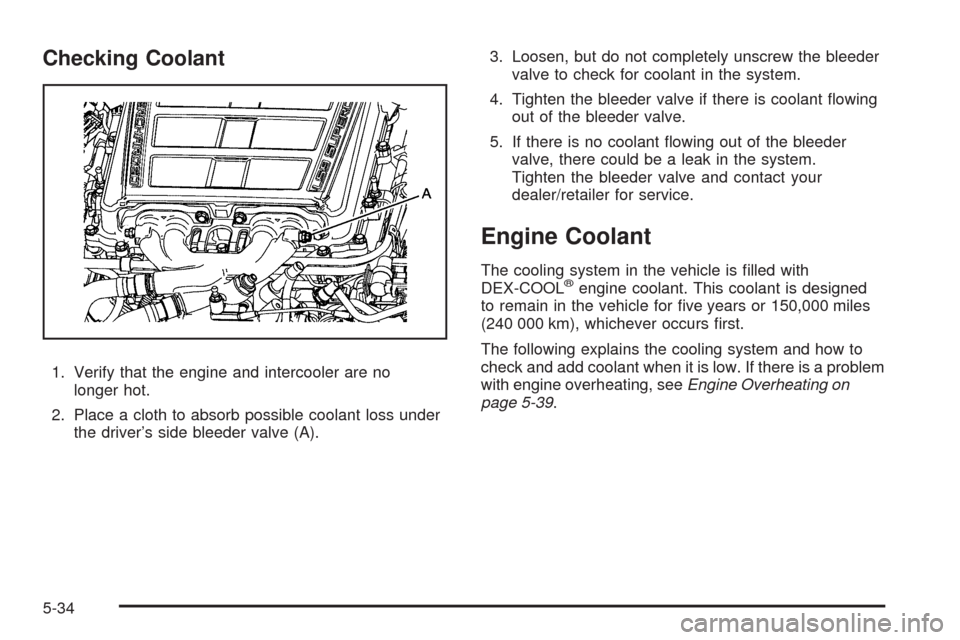
1. Verify that the engine and intercooler are no
longer hot.
2. Place a cloth to absorb possible coolant loss under
the driver’s side bleeder valve (A).3. Loosen, but do not completely unscrew the bleeder
valve to check for coolant in the system.
4. Tighten the bleeder valve if there is coolant owing
out of the bleeder valve.
5. If there is no coolant owing out of the bleeder
valve, there could be a leak in the system.
Tighten the bleeder valve and contact your
dealer/retailer for service.
Engine Coolant
The cooling system in the vehicle is lled with
DEX-COOL®engine coolant. This coolant is designed
to remain in the vehicle for ve years or 150,000 miles
(240 000 km), whichever occurs rst.
The following explains the cooling system and how to
check and add coolant when it is low. If there is a problem
with engine overheating, seeEngine Overheating on
page 5-39.
5-34
Page 308 of 434
Checking Coolant
The vehicle must be on a level surface when checking
the coolant level.
Check to see if coolant is visible in the coolant surge
tank. If the coolant inside the coolant surge tank is boiling,
do not do anything else until it cools down. If coolant
is visible but the coolant level is not at or above the
FULL COLD mark, add a 50/50 mixture of clean,
drinkable water and DEX-COOL coolant at the coolant
recovery tank, but be sure the cooling system is cool
before this is done. SeeEngine Coolant on page 5-34
for more information.
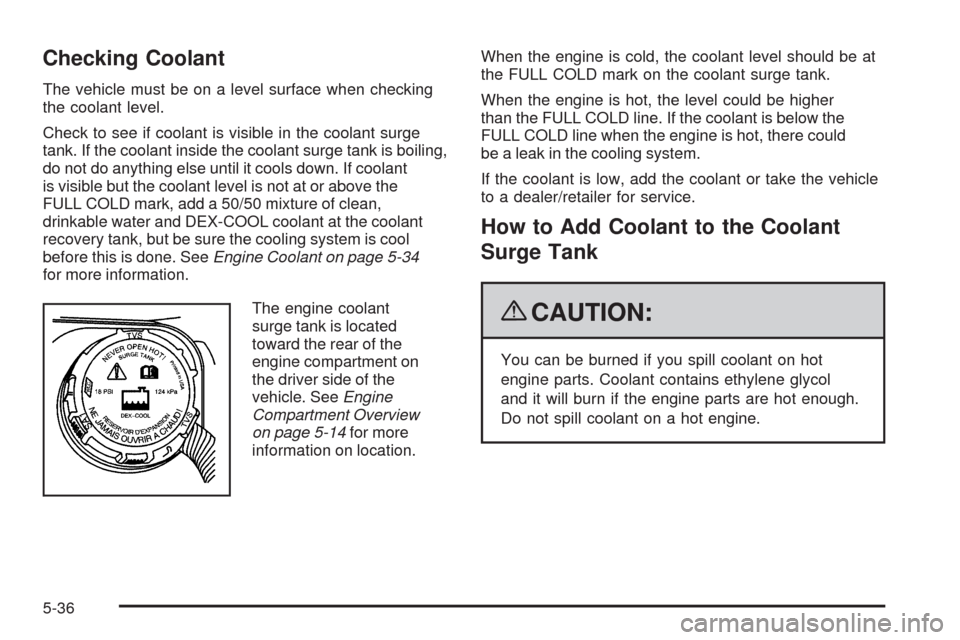
The engine coolant
surge tank is located
toward the rear of the
engine compartment on
the driver side of the
vehicle. SeeEngine
Compartment Overview
on page 5-14for more
information on location.When the engine is cold, the coolant level should be at
the FULL COLD mark on the coolant surge tank.
When the engine is hot, the level could be higher
than the FULL COLD line. If the coolant is below the
FULL COLD line when the engine is hot, there could
be a leak in the cooling system.
If the coolant is low, add the coolant or take the vehicle
to a dealer/retailer for service.
How to Add Coolant to the Coolant
Surge Tank
{CAUTION:
You can be burned if you spill coolant on hot
engine parts. Coolant contains ethylene glycol
and it will burn if the engine parts are hot enough.
Do not spill coolant on a hot engine.
5-36
Page 311 of 434
5. Replace the pressure cap. Be sure the pressure
cap is hand-tight and fully seated.
Check the level in the surge tank when the system
has cooled down. If the coolant is not at the proper
level, repeat Steps 1 through 4, then reinstall the
pressure cap. If the coolant is not at the proper
level when the system cools down again, see your
dealer/retailer.
Notice:If the pressure cap is not tightly installed,
coolant loss and possible engine damage may
occur. Be sure the cap is properly and tightly
secured.
Engine Overheating
The vehicle has several indicators to warn of engine
overheating.
There is an engine coolant temperature gage on
the instrument panel cluster. SeeEngine Coolant
Temperature Gage on page 3-41. The vehicle may
also display a COOLANT OVER TEMPERATURE
message on the Driver Information Center (DIC).
SeeDIC Warnings and Messages on page 3-54
for more information.You may decide not to lift the hood but to get service
help right away. SeeRoadside Assistance Program
on page 7-7.
If you do decide to lift the hood, make sure the vehicle
is parked on a level surface.
Then check to see if the engine cooling fan is running.
If the engine is overheating, the fan should be running.
If it is not, do not continue to run the engine and have the
vehicle serviced.
Notice:Engine damage from running your engine
without coolant is not covered by your warranty.
SeeOverheated Engine Protection Operating Mode
on page 5-41for information on driving to a safe
place in an emergency.
Notice:If the engine catches re while driving
with no coolant, the vehicle can be badly damaged.
The costly repairs would not be covered by the
vehicle warranty. SeeOverheated Engine Protection
Operating Mode on page 5-41for information on
driving to a safe place in an emergency.
5-39