service CHEVROLET CORVETTE 2009 6.G Manual PDF
[x] Cancel search | Manufacturer: CHEVROLET, Model Year: 2009, Model line: CORVETTE, Model: CHEVROLET CORVETTE 2009 6.GPages: 434, PDF Size: 2.53 MB
Page 318 of 434
Brake Wear (Except ZR1)
This vehicle has disc brakes. Disc brake pads have
built-in wear indicators that make a high-pitched warning
sound when the brake pads are worn and new pads
are needed. The sound can come and go or be heard
all the time the vehicle is moving, except when applying
the brake pedal rmly.
{CAUTION:
The brake wear warning sound means that soon
the brakes will not work well. That could lead to an
accident. When the brake wear warning sound is
heard, have the vehicle serviced.
Notice:Continuing to drive with worn-out brake
pads could result in costly brake repair.
Some driving conditions or climates can cause a brake
squeal when the brakes are rst applied or lightly applied.
This does not mean something is wrong with the brakes.
Brake linings should always be replaced as complete
axle sets.
Brake Wear (ZR1 Only)
The ZR1 model does not have built-in brake pad wear
indicators and periodic visual inspection of the brake pads
is required to determine when to replace the brake pads.
Notice:Continuing to drive with worn-out brake
pads could result in costly brake repair.
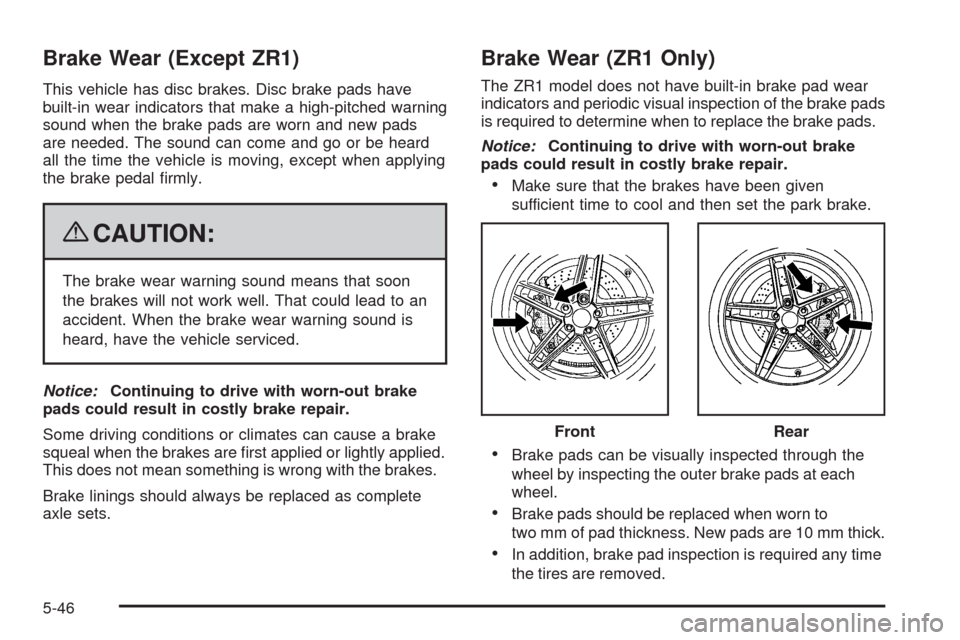
Make sure that the brakes have been given
sufficient time to cool and then set the park brake.
Brake pads can be visually inspected through the
wheel by inspecting the outer brake pads at each
wheel.
Brake pads should be replaced when worn to
two mm of pad thickness. New pads are 10 mm thick.
In addition, brake pad inspection is required any time
the tires are removed.Front
Rear
5-46
Page 319 of 434
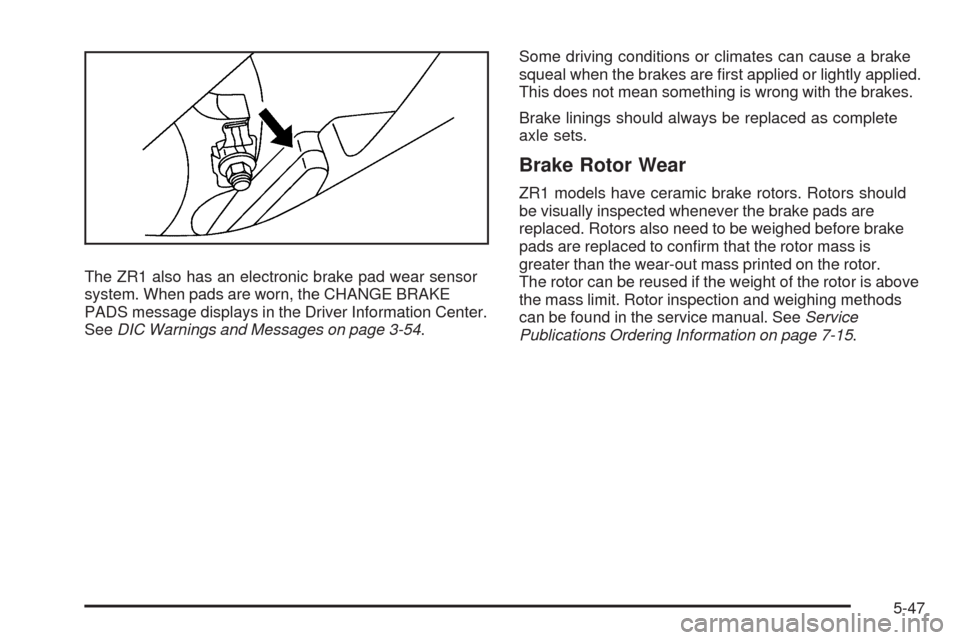
The ZR1 also has an electronic brake pad wear sensor
system. When pads are worn, the CHANGE BRAKE
PADS message displays in the Driver Information Center.
SeeDIC Warnings and Messages on page 3-54.Some driving conditions or climates can cause a brake
squeal when the brakes are rst applied or lightly applied.
This does not mean something is wrong with the brakes.
Brake linings should always be replaced as complete
axle sets.
Brake Rotor Wear
ZR1 models have ceramic brake rotors. Rotors should
be visually inspected whenever the brake pads are
replaced. Rotors also need to be weighed before brake
pads are replaced to conrm that the rotor mass is
greater than the wear-out mass printed on the rotor.
The rotor can be reused if the weight of the rotor is above
the mass limit. Rotor inspection and weighing methods
can be found in the service manual. SeeService
Publications Ordering Information on page 7-15.
5-47
Page 321 of 434
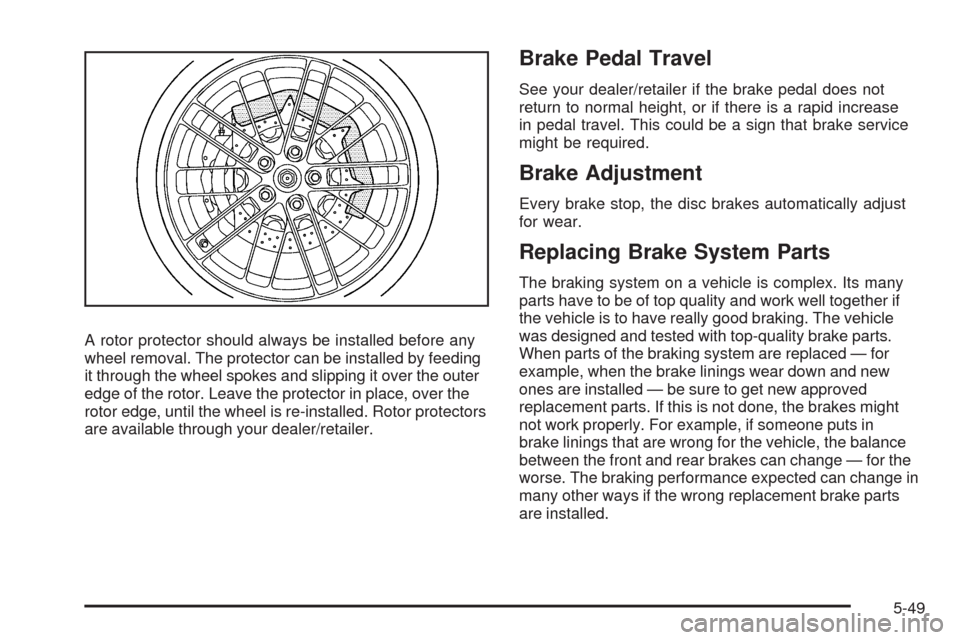
A rotor protector should always be installed before any
wheel removal. The protector can be installed by feeding
it through the wheel spokes and slipping it over the outer
edge of the rotor. Leave the protector in place, over the
rotor edge, until the wheel is re-installed. Rotor protectors
are available through your dealer/retailer.
Brake Pedal Travel
See your dealer/retailer if the brake pedal does not
return to normal height, or if there is a rapid increase
in pedal travel. This could be a sign that brake service
might be required.
Brake Adjustment
Every brake stop, the disc brakes automatically adjust
for wear.
Replacing Brake System Parts
The braking system on a vehicle is complex. Its many
parts have to be of top quality and work well together if
the vehicle is to have really good braking. The vehicle
was designed and tested with top-quality brake parts.
When parts of the braking system are replaced — for
example, when the brake linings wear down and new
ones are installed — be sure to get new approved
replacement parts. If this is not done, the brakes might
not work properly. For example, if someone puts in
brake linings that are wrong for the vehicle, the balance
between the front and rear brakes can change — for the
worse. The braking performance expected can change in
many other ways if the wrong replacement brake parts
are installed.
5-49
Page 322 of 434
Battery
This vehicle has a maintenance free battery. When it is
time for a new battery, see your dealer/retailer for one
that has the replacement number shown on the original
battery’s label.
For battery replacement, see your dealer/retailer or the
service manual. To purchase a service manual, see
Service Publications Ordering Information on page 7-15.
Warning:Battery posts, terminals, and related
accessories contain lead and lead compounds,
chemicals known to the State of California to cause
cancer and reproductive harm. Wash hands after
handling.
Vehicle Storage
{CAUTION:
Batteries have acid that can burn you and gas that
can explode. You can be badly hurt if you are not
careful. SeeJump Starting on page 5-51for tips
on working around a battery without getting hurt.
Infrequent Usage: If the vehicle is driven infrequently,
remove the black, negative (−) cable from the battery.
This helps keep the battery from running down.
See “Power Window Initialization” inPower Windows on
page 2-17.
Extended Storage: For extended storage of the vehicle,
remove the black, negative (−) cable from the battery or
use a battery trickle charger. This helps maintain the
charge of the battery over an extended period of time.
5-50
Page 326 of 434
7. Do not let the other end touch metal. Connect it to
the positive (+) terminal of the good battery. Use a
remote positive (+) terminal if the vehicle has one.
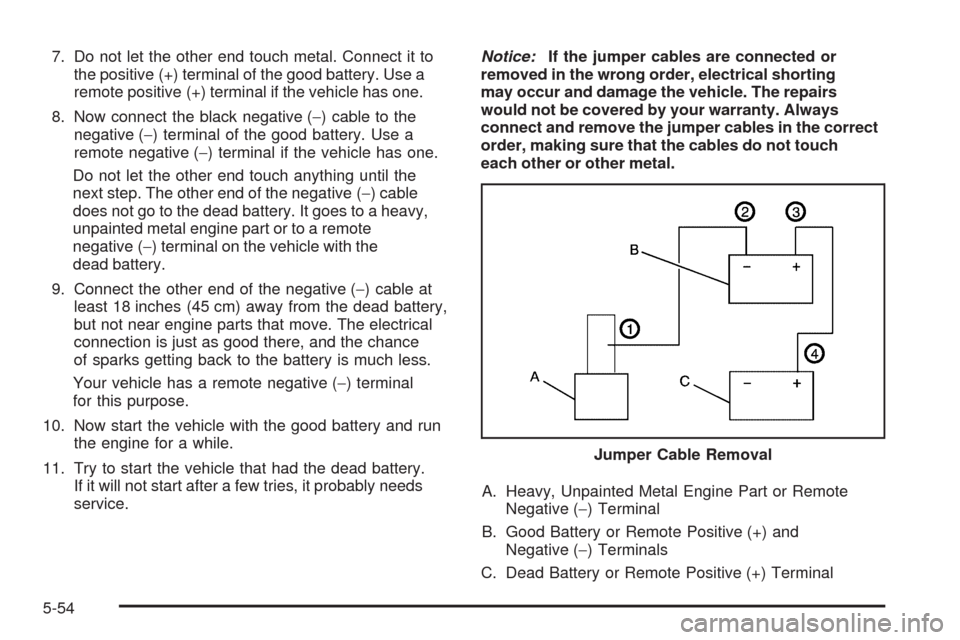
8. Now connect the black negative (−) cable to the
negative (−) terminal of the good battery. Use a
remote negative (−) terminal if the vehicle has one.
Do not let the other end touch anything until the
next step. The other end of the negative (−) cable
does not go to the dead battery. It goes to a heavy,
unpainted metal engine part or to a remote
negative (−) terminal on the vehicle with the
dead battery.
9. Connect the other end of the negative (−) cable at
least 18 inches (45 cm) away from the dead battery,
but not near engine parts that move. The electrical
connection is just as good there, and the chance
of sparks getting back to the battery is much less.
Your vehicle has a remote negative (−) terminal
for this purpose.
10. Now start the vehicle with the good battery and run
the engine for a while.
11. Try to start the vehicle that had the dead battery.
If it will not start after a few tries, it probably needs
service.Notice:If the jumper cables are connected or
removed in the wrong order, electrical shorting
may occur and damage the vehicle. The repairs
would not be covered by your warranty. Always
connect and remove the jumper cables in the correct
order, making sure that the cables do not touch
each other or other metal.
A. Heavy, Unpainted Metal Engine Part or Remote
Negative (−) Terminal
B. Good Battery or Remote Positive (+) and
Negative (−) Terminals
C. Dead Battery or Remote Positive (+) TerminalJumper Cable Removal
5-54
Page 328 of 434
What to Use
To add lubricant when the level is low, use Dexron
LS Gear Oil 75W-90 (GM Part No. US. 88862624, in
Canada 88862625) meeting GM Specication 9986290.
To completely rell after draining, seeRecommended
Fluids and Lubricants on page 6-12. Then ll to the
bottom of the ller plug hole with the Synthetic Gear
Lubricant.
Headlamp Aiming
Headlamp aim has been preset at the factory and
should need no further adjustment.
However, if your vehicle is damaged in a crash, the
headlamp aim may be affected. Aim adjustment to the
low-beam headlamps may be necessary if oncoming
drivers ash their high-beam headlamps at you
(for vertical aim).
If the headlamps need to be re-aimed, it is
recommended that you take the vehicle to your
dealer/retailer for service.
Bulb Replacement
For the proper type of replacement bulbs,
seeReplacement Bulbs on page 5-59.
For any bulb changing procedure not listed in
this section, contact your dealer/retailer.
High Intensity Discharge (HID)
Lighting
{CAUTION:
The low beam high intensity discharge lighting
system operates at a very high voltage. If you try to
service any of the system components, you could
be seriously injured. Have your dealer/retailer or a
qualied technician service them.
The vehicle may have HID headlamps. After an
HID headlamp bulb has been replaced, you may
notice that the beam is a slightly different shade
than it was originally. This is normal.
5-56
Page 334 of 434
Tires
Your new vehicle comes with high-quality tires
made by a leading tire manufacturer. If you ever
have questions about your tire warranty and where
to obtain service, see your vehicle Warranty booklet
for details. For additional information refer to the tire
manufacturer.
{CAUTION:
Poorly maintained and improperly used
tires are dangerous.
Overloading your tires can cause
overheating as a result of too much
exing. You could have an air-out and
a serious accident. SeeLoading the
Vehicle on page 4-22.
CAUTION: (Continued)
CAUTION: (Continued)
Underinated tires pose the same danger
as overloaded tires. The resulting accident
could cause serious injury. Check all tires
frequently to maintain the recommended
pressure. Tire pressure should be
checked when your tires are cold. See
Inflation - Tire Pressure on page 5-70.
Overinated tires are more likely to
be cut, punctured, or broken by a sudden
impact — such as when you hit a pothole.
Keep tires at the recommended pressure.
Worn, old tires can cause accidents.
If your tread is badly worn, or if your tires
have been damaged, replace them.
SeeHigh-Speed Operation on page 5-72for
ination pressure adjustment for high speed
driving.
5-62
Page 336 of 434
Tire Sidewall Labeling
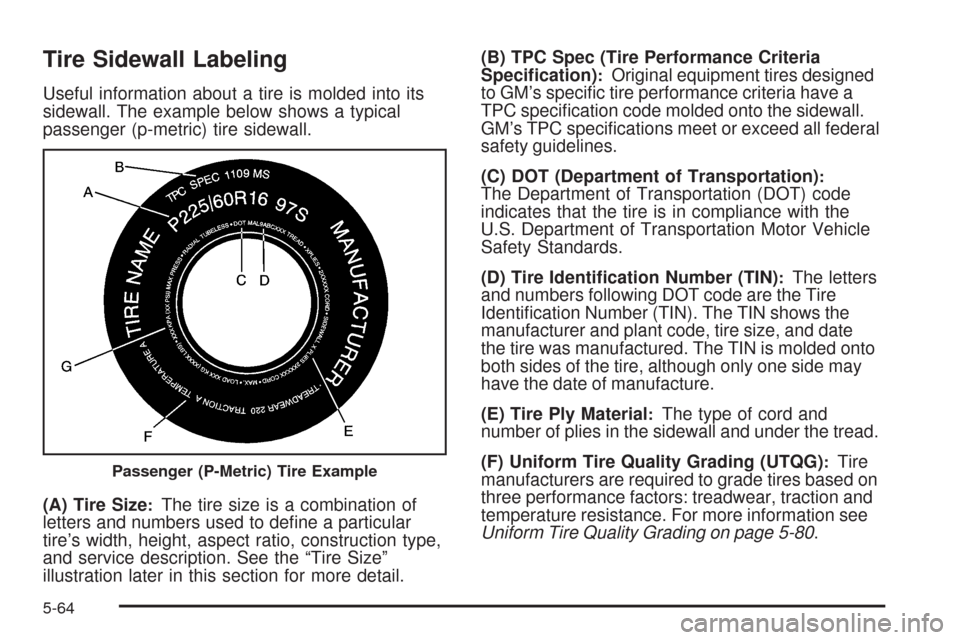
Useful information about a tire is molded into its
sidewall. The example below shows a typical
passenger (p-metric) tire sidewall.
(A) Tire Size
:The tire size is a combination of
letters and numbers used to dene a particular
tire’s width, height, aspect ratio, construction type,
and service description. See the “Tire Size”
illustration later in this section for more detail.(B) TPC Spec (Tire Performance Criteria
Specication)
:Original equipment tires designed
to GM’s specic tire performance criteria have a
TPC specication code molded onto the sidewall.
GM’s TPC specications meet or exceed all federal
safety guidelines.
(C) DOT (Department of Transportation)
:The Department of Transportation (DOT) code
indicates that the tire is in compliance with the
U.S. Department of Transportation Motor Vehicle
Safety Standards.
(D) Tire Identication Number (TIN)
:The letters
and numbers following DOT code are the Tire
Identication Number (TIN). The TIN shows the
manufacturer and plant code, tire size, and date
the tire was manufactured. The TIN is molded onto
both sides of the tire, although only one side may
have the date of manufacture.
(E) Tire Ply Material
:The type of cord and
number of plies in the sidewall and under the tread.
(F) Uniform Tire Quality Grading (UTQG)
:Tire
manufacturers are required to grade tires based on
three performance factors: treadwear, traction and
temperature resistance. For more information see
Uniform Tire Quality Grading on page 5-80.Passenger (P-Metric) Tire Example
5-64
Page 337 of 434
(G) Maximum Cold Ination Load Limit:Maximum load that can be carried and the
maximum pressure needed to support that load.
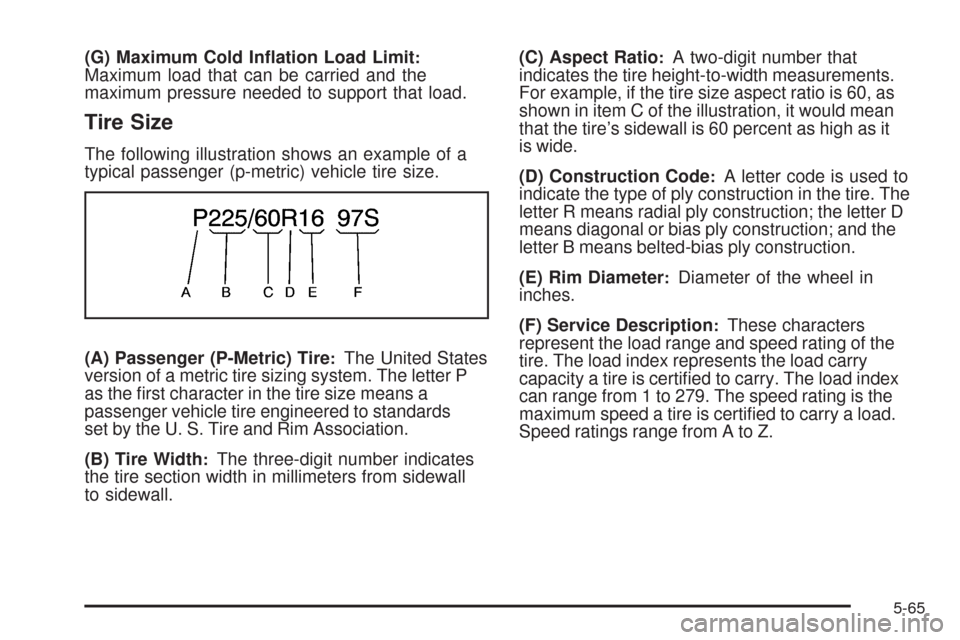
Tire Size
The following illustration shows an example of a
typical passenger (p-metric) vehicle tire size.
(A) Passenger (P-Metric) Tire
:The United States
version of a metric tire sizing system. The letter P
as the rst character in the tire size means a
passenger vehicle tire engineered to standards
set by the U. S. Tire and Rim Association.
(B) Tire Width
:The three-digit number indicates
the tire section width in millimeters from sidewall
to sidewall.(C) Aspect Ratio
:A two-digit number that
indicates the tire height-to-width measurements.
For example, if the tire size aspect ratio is 60, as
shown in item C of the illustration, it would mean
that the tire’s sidewall is 60 percent as high as it
is wide.
(D) Construction Code
:A letter code is used to
indicate the type of ply construction in the tire. The
letter R means radial ply construction; the letter D
means diagonal or bias ply construction; and the
letter B means belted-bias ply construction.
(E) Rim Diameter
:Diameter of the wheel in
inches.
(F) Service Description
:These characters
represent the load range and speed rating of the
tire. The load index represents the load carry
capacity a tire is certied to carry. The load index
can range from 1 to 279. The speed rating is the
maximum speed a tire is certied to carry a load.
Speed ratings range from A to Z.
5-65
Page 341 of 434
Run-Flat Tires
This vehicle, when new, had run-at tires. There is no
spare tire, no tire changing equipment, and no place
to store a tire in the vehicle. Run-at tires perform
so well without any air that a Tire Pressure Monitor
System (TPMS) is used to alert you if a tire has
lost pressure.
{CAUTION:
When the low tire warning light is displayed on
the instrument panel cluster, your vehicle’s handling
capabilities will be reduced during severe
maneuvers. If you drive too fast, you could lose
control of your vehicle. You or others could be
injured. Do not drive over 55 mph (90 km/h)
when the low tire warning light is displayed.
Drive cautiously and check your tire pressures
as soon as you can.
If a tire goes at, you will not need to stop on the side of
the road to change the tire. You can just keep on driving.
The shorter the distance you drive and the slower thespeed, the greater the chance that the tire will not have
to be replaced. If you drive on a deated run-at tire
for 25 miles (40 km) or less and at speeds of 55 mph
(90 km/h) or less, there is a good chance that the tire
can be repaired. The tires on coupe, convertible and
Z06 models can operate effectively with no air pressure
for up to 100 miles (160 km) at speeds up to 55 mph
(90 km/h), but the tire would then have to be replaced.
The tires on ZR1 models can operate effectively with no
air pressure for up to 50 miles (80 km) at speeds up to
55 mph (90 km/h), but the tire would then have to be
replaced. When a tire is lled with air, it provides a
cushion between the road and the wheel. Because you
will not have this cushion when driving on a deated tire,
try to avoid potholes that could damage your wheel and
require replacement of it.
Some road hazards can damage a tire beyond repair.
This damage could occur even before you have driven
on the tire in a deated condition. When a tire has
been damaged, or if you have driven any distance
on a run-at tire, check with an authorized run-at tire
service center to determine whether the tire can be
repaired or should be replaced. To maintain your
vehicle’s run-at feature, all replacement tires must
be self-supporting tires. As soon as possible, contact
the nearest authorized GM or run-at servicing
facility for inspection and repair or replacement.
5-69