service CHEVROLET CORVETTE 2010 6.G Repair Manual
[x] Cancel search | Manufacturer: CHEVROLET, Model Year: 2010, Model line: CORVETTE, Model: CHEVROLET CORVETTE 2010 6.GPages: 472, PDF Size: 11.44 MB
Page 346 of 472
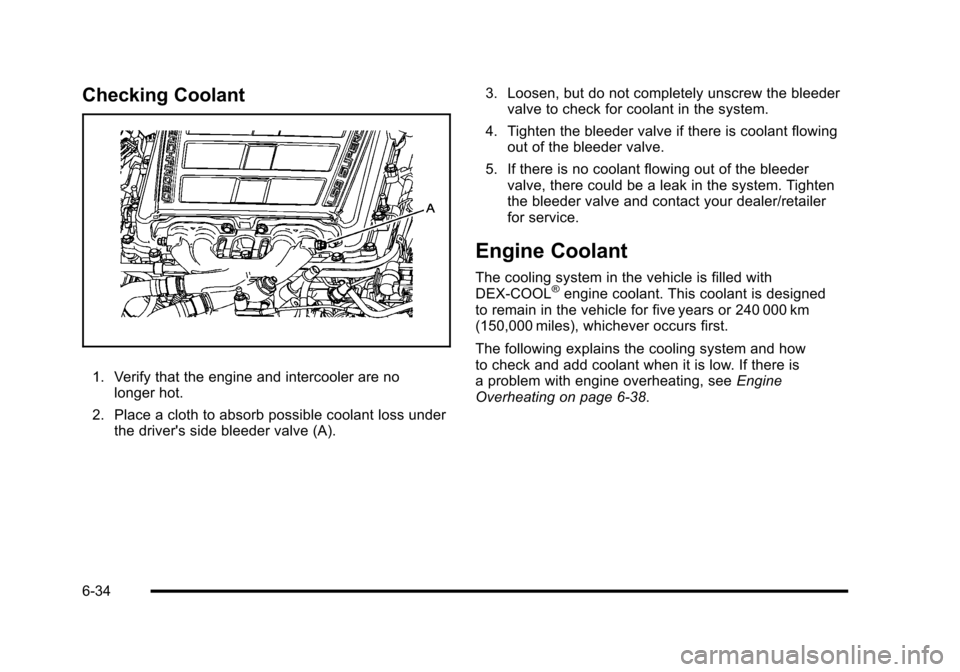
Checking Coolant
1. Verify that the engine and intercooler are no longer hot.
2. Place a cloth to absorb possible coolant loss under the driver's side bleeder valve (A). 3. Loosen, but do not completely unscrew the bleeder
valve to check for coolant in the system.
4. Tighten the bleeder valve if there is coolant flowing out of the bleeder valve.
5. If there is no coolant flowing out of the bleeder valve, there could be a leak in the system. Tighten
the bleeder valve and contact your dealer/retailer
for service.
Engine Coolant
The cooling system in the vehicle is filled with
DEX-COOL®engine coolant. This coolant is designed
to remain in the vehicle for five years or 240 000 km
(150,000 miles), whichever occurs first.
The following explains the cooling system and how
to check and add coolant when it is low. If there is
a problem with engine overheating, see Engine
Overheating on page 6‑38.
6-34
Page 348 of 472
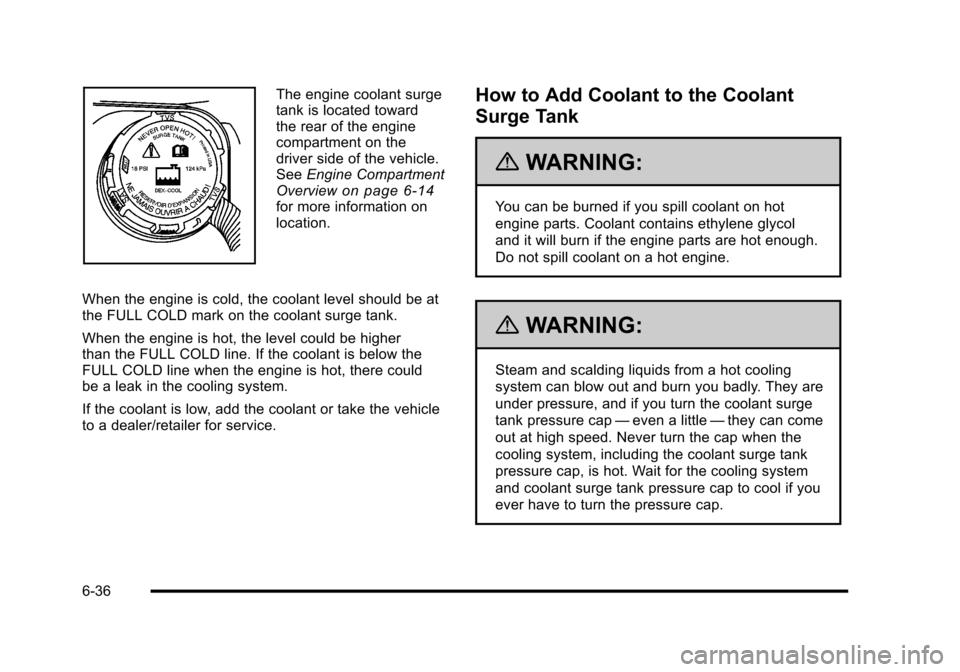
The engine coolant surge
tank is located toward
the rear of the engine
compartment on the
driver side of the vehicle.
See Engine Compartment
Overview
on page 6‑14for more information on
location.
When the engine is cold, the coolant level should be at
the FULL COLD mark on the coolant surge tank.
When the engine is hot, the level could be higher
than the FULL COLD line. If the coolant is below the
FULL COLD line when the engine is hot, there could
be a leak in the cooling system.
If the coolant is low, add the coolant or take the vehicle
to a dealer/retailer for service.
How to Add Coolant to the Coolant
Surge Tank
{WARNING:
You can be burned if you spill coolant on hot
engine parts. Coolant contains ethylene glycol
and it will burn if the engine parts are hot enough.
Do not spill coolant on a hot engine.
{WARNING:
Steam and scalding liquids from a hot cooling
system can blow out and burn you badly. They are
under pressure, and if you turn the coolant surge
tank pressure cap —even a little —they can come
out at high speed. Never turn the cap when the
cooling system, including the coolant surge tank
pressure cap, is hot. Wait for the cooling system
and coolant surge tank pressure cap to cool if you
ever have to turn the pressure cap.
6-36
Page 350 of 472
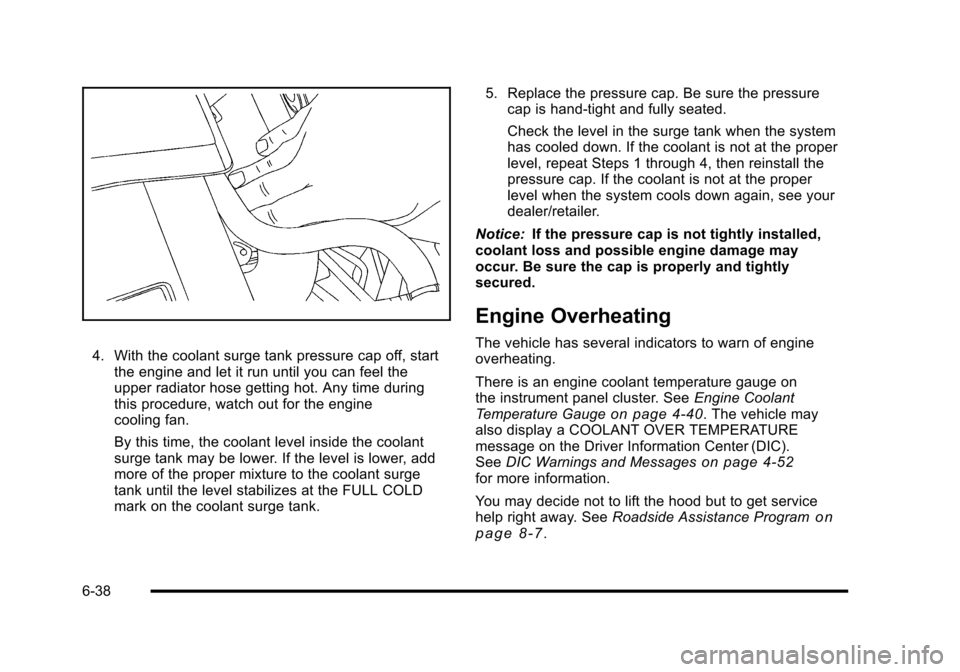
4. With the coolant surge tank pressure cap off, start the engine and let it run until you can feel the
upper radiator hose getting hot. Any time during
this procedure, watch out for the engine
cooling fan.
By this time, the coolant level inside the coolant
surge tank may be lower. If the level is lower, add
more of the proper mixture to the coolant surge
tank until the level stabilizes at the FULL COLD
mark on the coolant surge tank. 5. Replace the pressure cap. Be sure the pressure
cap is hand-tight and fully seated.
Check the level in the surge tank when the system
has cooled down. If the coolant is not at the proper
level, repeat Steps 1 through 4, then reinstall the
pressure cap. If the coolant is not at the proper
level when the system cools down again, see your
dealer/retailer.
Notice: If the pressure cap is not tightly installed,
coolant loss and possible engine damage may
occur. Be sure the cap is properly and tightly
secured.
Engine Overheating
The vehicle has several indicators to warn of engine
overheating.
There is an engine coolant temperature gauge on
the instrument panel cluster. See Engine Coolant
Temperature Gauge
on page 4‑40. The vehicle may
also display a COOLANT OVER TEMPERATURE
message on the Driver Information Center (DIC).
See DIC Warnings and Messages
on page 4‑52for more information.
You may decide not to lift the hood but to get service
help right away. See Roadside Assistance Program
on
page 8‑7.
6-38
Page 351 of 472
If you do decide to lift the hood , make sure the vehicle
is parked on a level surface.
Then check to see if the engine cooling fan is running.
If the engine is overheating, the fan should be running.
If it is not, do not continue to run the engine and have
the vehicle serviced.
Notice: Engine damage from running your engine
without coolant is not covered by your warranty.
See Overheated Engine Protection Operating Mode
on page 6‑41for information on driving to a safe
place in an emergency.
Notice: If the engine catches fire while driving
with no coolant, the vehicle can be badly damaged.
The costly repairs would not be covered by the
vehicle warranty. See Overheated Engine Protection
Operating Mode
on page 6‑41for information on
driving to a safe place in an emergency.
If Steam Is Coming From Your Engine
{WARNING:
Steam from an overheated engine can burn you
badly, even if you just open the hood. Stay away
from the engine if you see or hear steam coming
from it. Turn it off and get everyone away from
the vehicle until it cools down. Wait until there
is no sign of steam or coolant before you open
the hood.
If you keep driving when the vehicles engine is
overheated, the liquids in it can catch fire. You or
others could be badly burned. Stop the engine if
it overheats, and get out of the vehicle until the
engine is cool.
See Overheated Engine Protection Operating
Mode
on page 6‑41for information on driving to
a safe place in an emergency.
6-39
Page 357 of 472
Notice:
.Using the wrong fluid can badly damage
brake hydraulic system parts. For example,
just a few drops of mineral-based oil, such
as engine oil, in the brake hydraulic system
can damage brake hydraulic system parts
so badly that they will have to be replaced.
Do not let someone put in the wrong kind
of fluid.
.If brake fluid is spilled on the vehicle's
painted surfaces, the paint finish can be
damaged. Be careful not to spill brake
fluid on the vehicle. If you do, wash it off
immediately. See Washing Your Vehicle
on
page 6‑94
.
Brake Wear (Except ZR1)
This vehicle has disc brakes. Disc brake pads have
built-in wear indicators that make a high-pitched
warning sound when the brake pads are worn and new
pads are needed. The sound can come and go or be
heard all the time the vehicle is moving, except when
applying the brake pedal firmly.
{WARNING:
The brake wear warning sound means that soon
the brakes will not work well. That could lead to
an accident. When the brake wear warning sound
is heard, have the vehicle serviced.
Notice: Continuing to drive with worn-out brake
pads could result in costly brake repair.
Some driving conditions or climates can cause a brake
squeal when the brakes are first applied or lightly
applied. This does not mean something is wrong
with the brakes.
Brake linings should always be replaced as complete
axle sets.
6-45
Page 359 of 472
Brake Rotor Wear
ZR1 models have ceramic brake rotors. Rotors should
be visually inspected whenever the brake pads are
replaced. Rotors also need to be weighed before brake
pads are replaced to confirm that the rotor mass is
greater than the wear‐out mass printed on the rotor.
The rotor can be reused if the weight of the rotor is
above the mass limit. Rotor inspection and weighing
methods can be found in the service manual. See
Service Publications Ordering Information
on
page 8‑16.
Brake Rotor Protector
{WARNING:
Ceramic rotors will be very hot after operation and
touching them may cause burns. Be sure brake
system is completely cool prior to installation of
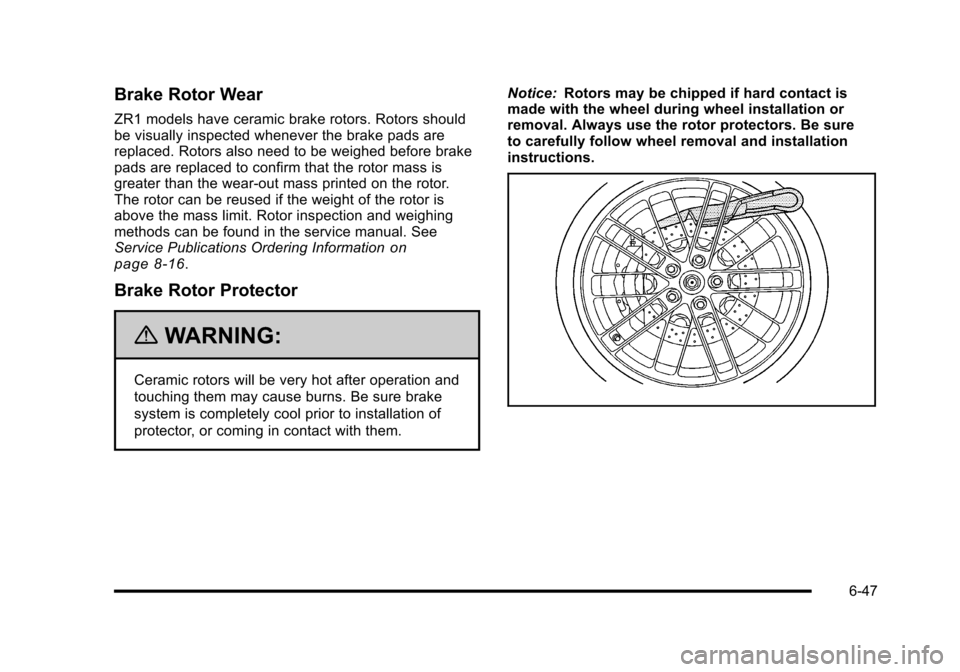
protector, or coming in contact with them. Notice:
Rotors may be chipped if hard contact is
made with the wheel during wheel installation or
removal. Always use the rotor protectors. Be sure
to carefully follow wheel removal and installation
instructions.
6-47
Page 360 of 472
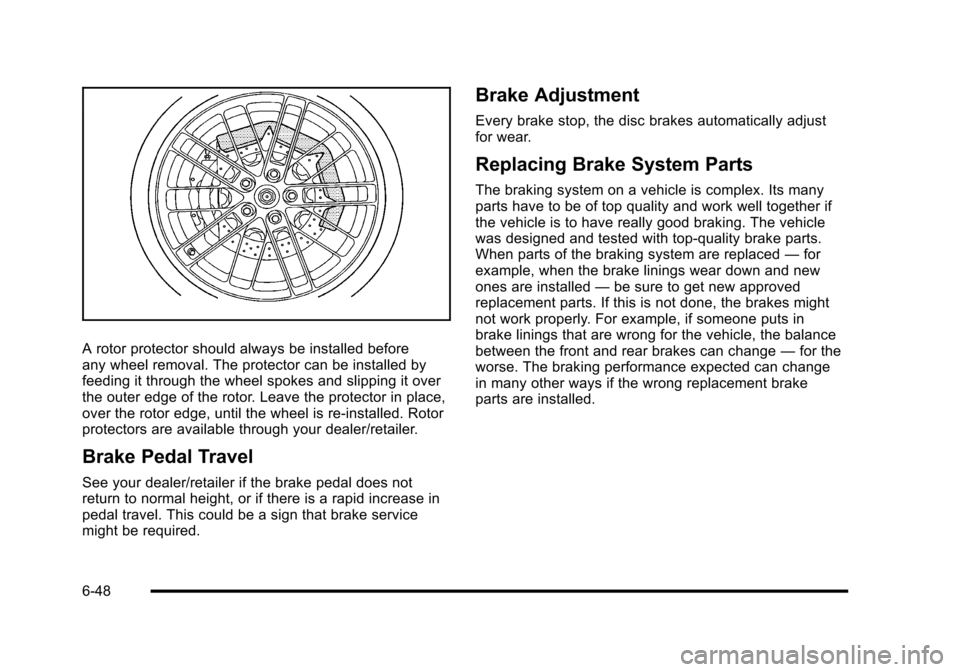
A rotor protector should always be installed before
any wheel removal. The protector can be installed by
feeding it through the wheel spokes and slipping it over
the outer edge of the rotor. Leave the protector in place,
over the rotor edge, until the wheel is re‐installed. Rotor
protectors are available through your dealer/retailer.
Brake Pedal Travel
See your dealer/retailer if the brake pedal does not
return to normal height, or if there is a rapid increase in
pedal travel. This could be a sign that brake service
might be required.
Brake Adjustment
Every brake stop, the disc brakes automatically adjust
for wear.
Replacing Brake System Parts
The braking system on a vehicle is complex. Its many
parts have to be of top quality and work well together if
the vehicle is to have really good braking. The vehicle
was designed and tested with top-quality brake parts.
When parts of the braking system are replaced —for
example, when the brake linings wear down and new
ones are installed —be sure to get new approved
replacement parts. If this is not done, the brakes might
not work properly. For example, if someone puts in
brake linings that are wrong for the vehicle, the balance
between the front and rear brakes can change —for the
worse. The braking performance expected can change
in many other ways if the wrong replacement brake
parts are installed.
6-48
Page 361 of 472
Battery
Refer to the replacement number on the original battery
label when a new battery is needed.
For battery replacement, see your dealer/retailer
or the service manual. To purchase a service manual,
see Service Publications Ordering Information
on
page 8‑16.
{DANGER:
Battery posts, terminals, and related accessories
contain lead and lead compounds, chemicals
known to the State of California to cause cancer
and reproductive harm. Wash hands after
handling.
Vehicle Storage
{WARNING:
Batteries have acid that can burn you and gas
that can explode. You can be badly hurt if you
are not careful. See Jump Starting
on page 6‑50
for tips on working around a battery without
getting hurt.
Infrequent Usage: Remove the black, negative (−) cable
from the battery to keep the battery from running down.
See “Power Window Initialization” inPower Windows
on
page 3‑17.
Extended Storage: Remove the black, negative (−)
cable from the battery or use a battery trickle charger.
6-49
Page 365 of 472

6. Connect the red positive (+) cable to the positive (+) terminal of the dead battery. Use a
remote positive (+) terminal if the vehicle has one.
7. Do not let the other end touch metal. Connect it to the positive (+) terminal of the good battery. Use a
remote positive (+) terminal if the vehicle has one.
8. Now connect the black negative (−) cable to the negative (−) terminal of the good battery. Use a
remote negative (−) terminal if the vehicle has one.
Do not let the other end touch anything until the
next step. The other end of the negative (−) cable
does not go to the dead battery. It goes to a heavy,
unpainted metal engine part or to a remote
negative (−) terminal on the vehicle with the dead
battery. 9. Connect the other end of the negative (−) cable
at least 18 inches (45 cm) away from the dead
battery, but not near engine parts that move.
The electrical connection is just as good there,
and the chance of sparks getting back to the
battery is much less.
Your vehicle has a remote negative (−) terminal for
this purpose.
10. Now start the vehicle with the good battery and run the engine for a while.
11. Try to start the vehicle that had the dead battery. If it will not start after a few tries, it probably needs
service.
6-53
Page 367 of 472
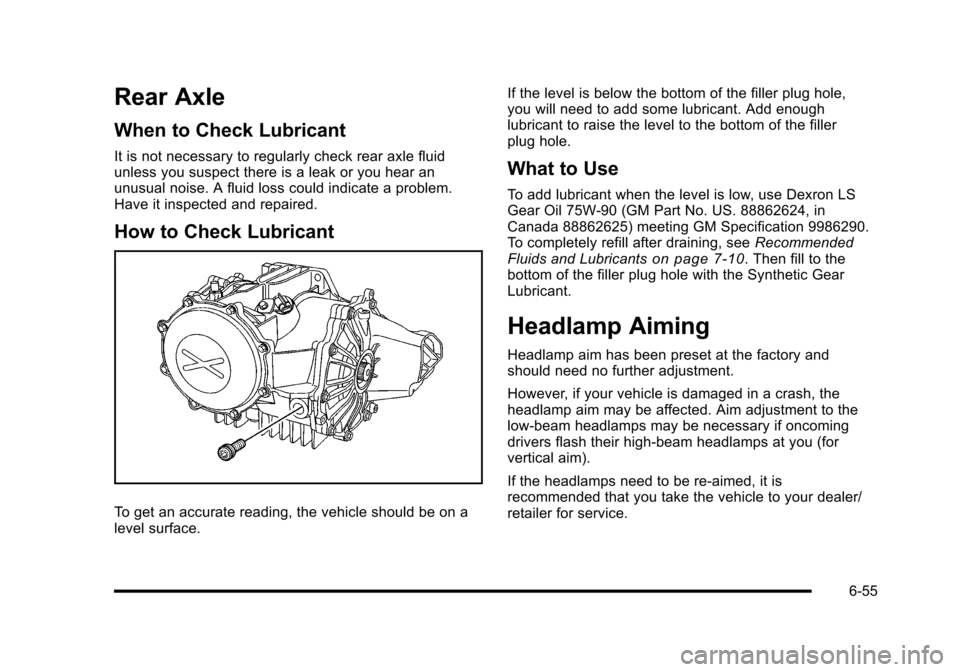
Rear Axle
When to Check Lubricant
It is not necessary to regularly check rear axle fluid
unless you suspect there is a leak or you hear an
unusual noise. A fluid loss could indicate a problem.
Have it inspected and repaired.
How to Check Lubricant
To get an accurate reading, the vehicle should be on a
level surface. If the level is below the bottom of the filler plug hole,
you will need to add some lubricant. Add enough
lubricant to raise the level to the bottom of the filler
plug hole.
What to Use
To add lubricant when the level is low, use Dexron LS
Gear Oil 75W-90 (GM Part No. US. 88862624, in
Canada 88862625) meeting GM Specification 9986290.
To completely refill after draining, see
Recommended
Fluids and Lubricants
on page 7‑10. Then fill to the
bottom of the filler plug hole with the Synthetic Gear
Lubricant.
Headlamp Aiming
Headlamp aim has been preset at the factory and
should need no further adjustment.
However, if your vehicle is damaged in a crash, the
headlamp aim may be affected. Aim adjustment to the
low-beam headlamps may be necessary if oncoming
drivers flash their high-beam headlamps at you (for
vertical aim).
If the headlamps need to be re-aimed, it is
recommended that you take the vehicle to your dealer/
retailer for service.
6-55