oil dipstick CHEVROLET CORVETTE 2010 6.G Owners Manual
[x] Cancel search | Manufacturer: CHEVROLET, Model Year: 2010, Model line: CORVETTE, Model: CHEVROLET CORVETTE 2010 6.GPages: 472, PDF Size: 11.44 MB
Page 297 of 472
If the vehicle starts to slide, ease your foot off the
accelerator pedal and quickly steer the way you want
the vehicle to go. If you start steering quickly enough,
the vehicle may straighten out. Always be ready for a
second skid if it occurs.
Of course, traction is reduced when water, snow, ice,
gravel, or other material is on the road. For safety, slow
down and adjust your driving to these conditions. It is
important to slow down on slippery surfaces because
stopping distance will be longer and vehicle control
more limited.
While driving on a surface with reduced traction, try
your best to avoid sudden steering, acceleration,
or braking, including reducing vehicle speed by shifting
to a lower gear. Any sudden changes could cause the
tires to slide. You may not realize the surface is slippery
until the vehicle is skidding. Learn to recognize warning
clues —such as enough water, ice, or packed snow on
the road to make a mirrored surface —and slow down
when you have any doubt.
Remember: Antilock brakes help avoid only the
braking skid.Racing or Other Competitive Driving
Racing or competitive driving may affect the vehicle
warranty. See the warranty book before using the
vehicle for racing or other competitive driving.
Notice: If you use the vehicle for racing or other
competitive driving, the engine may use more oil
than it would with normal use. Low oil levels can
damage the engine. For information on how to add
oil, see Engine Oil on page 6‑19.
Z06, ZR1, and Grand Sport Only: Be sure to check
the oil level often during racing or other competitive
driving and keep the level at or near the upper mark
that shows the proper operating range on the
engine oil dipstick.
Except Z06, ZR1, and Grand Sport: Be sure to check
the oil level often during racing or other competitive
driving and keep the level at or near 1 L (1 quart)
above the upper mark that shows the proper
operating range on the engine oil dipstick. After the
competitive driving, remove excess oil so that the
level on the dipstick is not above the upper mark
that shows the proper operating range.
Z06, ZR1, and Grand Sport Only: For racing or
competitive driving, it is recommended that the brake
fluid be replaced with a high performance brake fluid
that has a dry boiling point greater than 279°C (534°F).
5-19
Page 327 of 472

A. Clutch Master Cylinder Reservoir (If Equipped). See Hydraulic Clutch on page 6‑31.
B. Windshield Washer Fluid Reservoir. See “Adding
Washer Fluid” underWindshield Washer Fluid
on
page 6‑42.
C. Brake Fluid Reservoir. See “Brake Fluid”under
Brakes on page 6‑43.
D. Coolant Surge Tank and Pressure Cap. See Engine Coolant on page 6‑34.
E. Engine Air Cleaner/Filter on page 6‑27.
F. Power Steering Fluid Reservoir. See Power
Steering Fluid on page 6‑41. G. Engine Oil Fill Cap. See
“When to Add Engine Oil”
under Engine Oil on page 6‑19.
H. Engine Oil Dipstick. See “Checking Engine Oil”
under Engine Oil on page 6‑19.
I. Engine Compartment Fuse Block on page 6‑104.
J. Passenger Compartment Air Filter (Out of View). See Passenger Compartment Air Filter
on
page 4‑28.
K. Battery on page 6‑49.
6-15
Page 329 of 472

A. Intercooler. SeeCooling System (Engine)on
page 6‑32or Cooling System (Intercooler)on
page 6‑33.
B. Engine Air Cleaner/Filter on page 6‑27.
C. Power Steering Fluid Reservoir and Cap. See Power Steering Fluid on page 6‑41.
D. Coolant Surge Tank and Pressure Cap. See Engine Coolant on page 6‑34.
E. Windshield Washer Fluid Reservoir. See “Adding
Washer Fluid” underWindshield Washer Fluid
on
page 6‑42.
F. Clutch Master Cylinder Reservoir (If Equipped). See Hydraulic Clutch on page 6‑31.
G. Brake Fluid Reservoir. See “Brake Fluid”under
Brakes on page 6‑43. H. Passenger Compartment Air Filter (Out of View).
See Passenger Compartment Air Filter
on
page 4‑28.
I. Engine Oil Fill Cap. See “When to Add Engine Oil”
under Engine Oil on page 6‑19.
J. Dry Sump Engine Oil Tank. See “Changing Engine
Oil and Filter” Engine Oil on page 6‑19.
K. Engine Oil Dipstick. See “Checking Engine Oil”
under Engine Oil on page 6‑19.
L. Remote Positive (+) Terminal (Out of View). See Jump Starting on page 6‑50.
M. Engine Compartment Fuse Block on page 6‑104.
6-17
Page 331 of 472
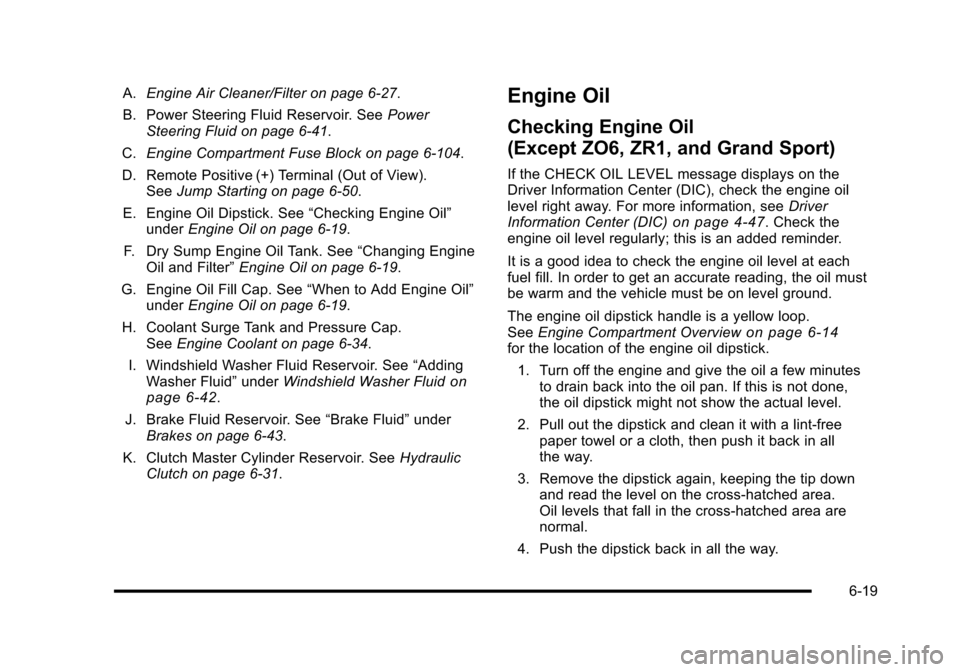
A.Engine Air Cleaner/Filter on page 6‑27.
B. Power Steering Fluid Reservoir. See Power
Steering Fluid on page 6‑41.
C. Engine Compartment Fuse Block on page 6‑104.
D. Remote Positive (+) Terminal (Out of View). See Jump Starting on page 6‑50.
E. Engine Oil Dipstick. See “Checking Engine Oil”
under Engine Oil on page 6‑19.
F. Dry Sump Engine Oil Tank. See “Changing Engine
Oil and Filter” Engine Oil on page 6‑19.
G. Engine Oil Fill Cap. See “When to Add Engine Oil”
under Engine Oil on page 6‑19.
H. Coolant Surge Tank and Pressure Cap. See Engine Coolant on page 6‑34.
I. Windshield Washer Fluid Reservoir. See “Adding
Washer Fluid” underWindshield Washer Fluid
on
page 6‑42.
J. Brake Fluid Reservoir. See “Brake Fluid”under
Brakes on page 6‑43.
K. Clutch Master Cylinder Reservoir. See Hydraulic
Clutch on page 6‑31.
Engine Oil
Checking Engine Oil
(Except ZO6, ZR1, and Grand Sport)
If the CHECK OIL LEVEL message displays on the
Driver Information Center (DIC), check the engine oil
level right away. For more information, see Driver
Information Center (DIC)
on page 4‑47. Check the
engine oil level regularly; this is an added reminder.
It is a good idea to check the engine oil level at each
fuel fill. In order to get an accurate reading, the oil must
be warm and the vehicle must be on level ground.
The engine oil dipstick handle is a yellow loop.
See Engine Compartment Overview
on page 6‑14for the location of the engine oil dipstick.
1. Turn off the engine and give the oil a few minutes to drain back into the oil pan. If this is not done,
the oil dipstick might not show the actual level.
2. Pull out the dipstick and clean it with a lint‐free paper towel or a cloth, then push it back in all
the way.
3. Remove the dipstick again, keeping the tip down and read the level on the cross‐hatched area.
Oil levels that fall in the cross‐hatched area are
normal.
4. Push the dipstick back in all the way.
6-19
Page 332 of 472
When to Add Engine Oil
(Except ZO6, ZR1, and Grand Sport)
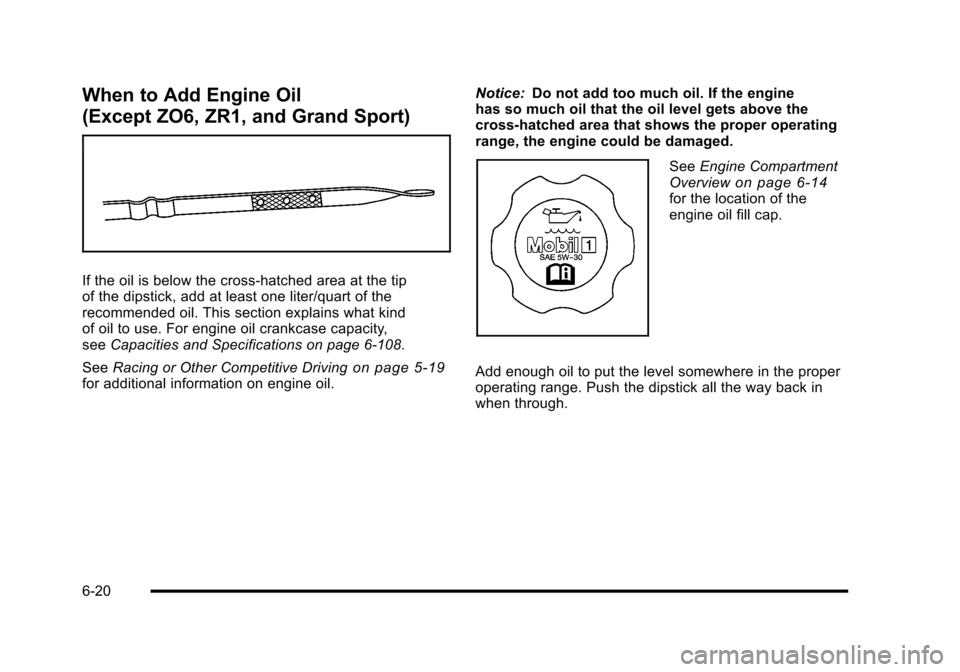
If the oil is below the cross-hatched area at the tip
of the dipstick, add at least one liter/quart of the
recommended oil. This section explains what kind
of oil to use. For engine oil crankcase capacity,
see Capacities and Specifications on page 6‑108.
See Racing or Other Competitive Driving
on page 5‑19for additional information on engine oil. Notice:
Do not add too much oil. If the engine
has so much oil that the oil level gets above the
cross-hatched area that shows the proper operating
range, the engine could be damaged.
See Engine Compartment
Overviewon page 6‑14for the location of the
engine oil fill cap.
Add enough oil to put the level somewhere in the proper
operating range. Push the dipstick all the way back in
when through.
6-20
Page 333 of 472
Checking Engine Oil (ZO6, ZR1, and
Grand Sport)
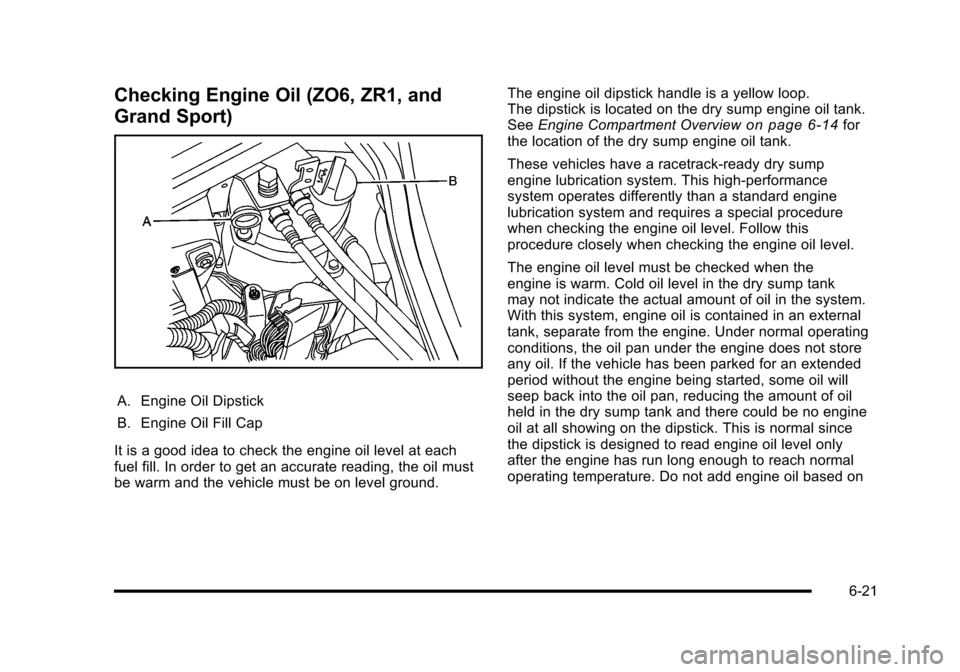
A. Engine Oil Dipstick
B. Engine Oil Fill Cap
It is a good idea to check the engine oil level at each
fuel fill. In order to get an accurate reading, the oil must
be warm and the vehicle must be on level ground. The engine oil dipstick handle is a yellow loop.
The dipstick is located on the dry sump engine oil tank.
See
Engine Compartment Overview
on page 6‑14for
the location of the dry sump engine oil tank.
These vehicles have a racetrack‐ready dry sump
engine lubrication system. This high‐performance
system operates differently than a standard engine
lubrication system and requires a special procedure
when checking the engine oil level. Follow this
procedure closely when checking the engine oil level.
The engine oil level must be checked when the
engine is warm. Cold oil level in the dry sump tank
may not indicate the actual amount of oil in the system.
With this system, engine oil is contained in an external
tank, separate from the engine. Under normal operating
conditions, the oil pan under the engine does not store
any oil. If the vehicle has been parked for an extended
period without the engine being started, some oil will
seep back into the oil pan, reducing the amount of oil
held in the dry sump tank and there could be no engine
oil at all showing on the dipstick. This is normal since
the dipstick is designed to read engine oil level only
after the engine has run long enough to reach normal
operating temperature. Do not add engine oil based on
6-21
Page 334 of 472
cold engine dipstick readings. The engine oil level on
the dipstick will also be inaccurate if checked while the
engine is running. 1. To obtain an accurate engine oil level reading, warm up the engine to at least 80°C (175°F).
Cold oil will not give a correct oil level reading.
2. Once the engine is warm, turn off the engine. Checking the oil while the engine is running will
result in an incorrect oil level reading.
3. Wait at least five minutes (but not more than 20 minutes) to allow oil to drain and settle in the
engine.
4. Remove the dipstick from the external engine oil tank and clean it with a lint‐free paper towel or a
cloth. Re‐insert the dipstick into the external oil
tank, pushing it all the way in until it stops.
5. Remove the dipstick from the oil tank and read the level on the cross‐hatched area. Oil levels that fall
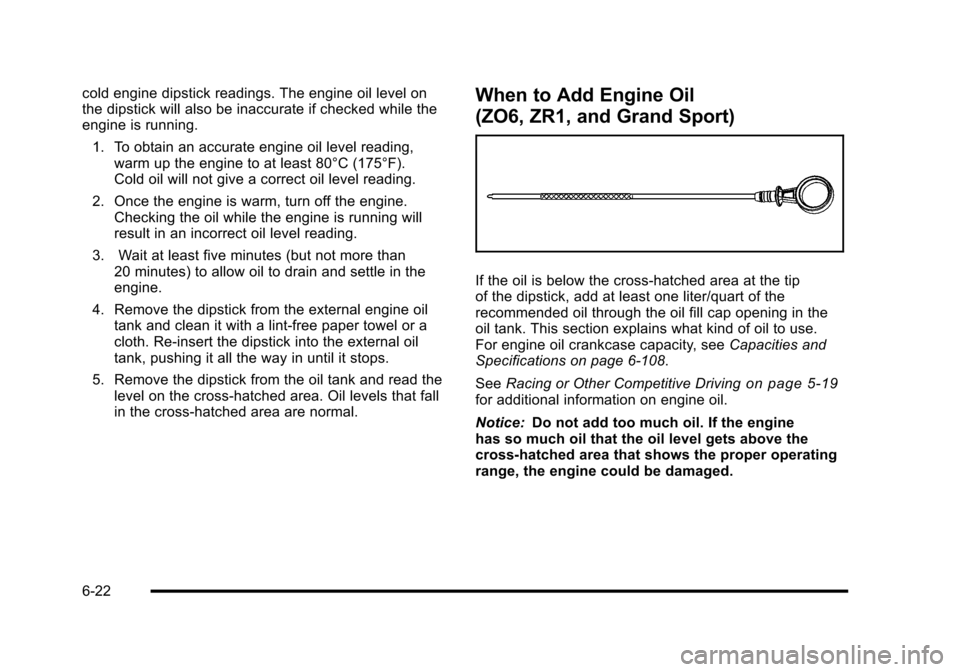
in the cross‐hatched area are normal.When to Add Engine Oil
(ZO6, ZR1, and Grand Sport)
If the oil is below the cross-hatched area at the tip
of the dipstick, add at least one liter/quart of the
recommended oil through the oil fill cap opening in the
oil tank. This section explains what kind of oil to use.
For engine oil crankcase capacity, see Capacities and
Specifications on page 6‑108.
See Racing or Other Competitive Driving
on page 5‑19for additional information on engine oil.
Notice: Do not add too much oil. If the engine
has so much oil that the oil level gets above the
cross-hatched area that shows the proper operating
range, the engine could be damaged.
6-22
Page 335 of 472
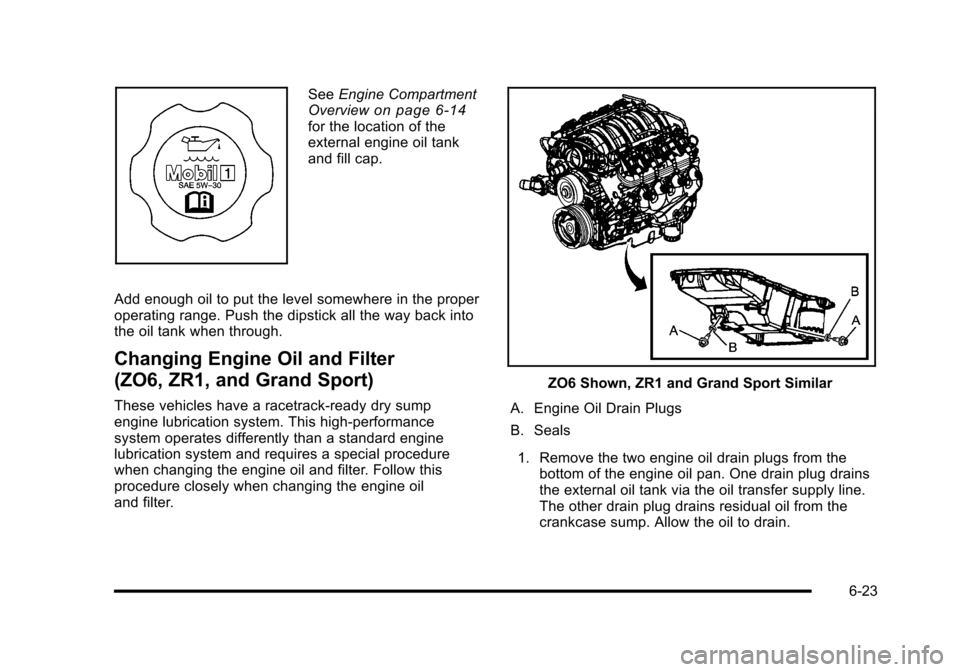
SeeEngine Compartment
Overviewon page 6‑14for the location of the
external engine oil tank
and fill cap.
Add enough oil to put the level somewhere in the proper
operating range. Push the dipstick all the way back into
the oil tank when through.
Changing Engine Oil and Filter
(ZO6, ZR1, and Grand Sport)
These vehicles have a racetrack‐ready dry sump
engine lubrication system. This high‐performance
system operates differently than a standard engine
lubrication system and requires a special procedure
when changing the engine oil and filter. Follow this
procedure closely when changing the engine oil
and filter.
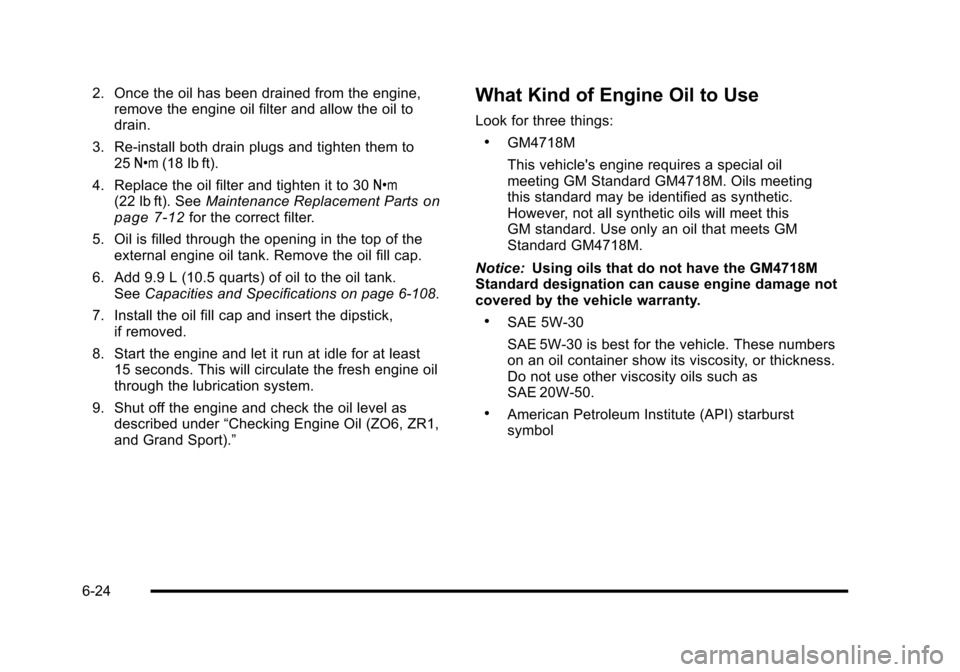
ZO6 Shown, ZR1 and Grand Sport Similar
A. Engine Oil Drain Plugs
B. Seals
1. Remove the two engine oil drain plugs from the bottom of the engine oil pan. One drain plug drains
the external oil tank via the oil transfer supply line.
The other drain plug drains residual oil from the
crankcase sump. Allow the oil to drain.
6-23
Page 336 of 472
2. Once the oil has been drained from the engine, remove the engine oil filter and allow the oil to
drain.
3. Re‐install both drain plugs and tighten them to 25 Y (18 lb ft).
4. Replace the oil filter and tighten it to 30 Y
(22 lb ft). See Maintenance Replacement Parts
on
page 7‑12for the correct filter.
5. Oil is filled through the opening in the top of the external engine oil tank. Remove the oil fill cap.
6. Add 9.9 L (10.5 quarts) of oil to the oil tank. See Capacities and Specifications on page 6‑108.
7. Install the oil fill cap and insert the dipstick, if removed.
8. Start the engine and let it run at idle for at least 15 seconds. This will circulate the fresh engine oil
through the lubrication system.
9. Shut off the engine and check the oil level as described under “Checking Engine Oil (ZO6, ZR1,
and Grand Sport).”
What Kind of Engine Oil to Use
Look for three things:
.GM4718M
This vehicle's engine requires a special oil
meeting GM Standard GM4718M. Oils meeting
this standard may be identified as synthetic.
However, not all synthetic oils will meet this
GM standard. Use only an oil that meets GM
Standard GM4718M.
Notice: Using oils that do not have the GM4718M
Standard designation can cause engine damage not
covered by the vehicle warranty.
.SAE 5W-30
SAE 5W-30 is best for the vehicle. These numbers
on an oil container show its viscosity, or thickness.
Do not use other viscosity oils such as
SAE 20W-50.
.American Petroleum Institute (API) starburst
symbol
6-24