maintenance CHEVROLET CORVETTE 2011 6.G Owner's Manual
[x] Cancel search | Manufacturer: CHEVROLET, Model Year: 2011, Model line: CORVETTE, Model: CHEVROLET CORVETTE 2011 6.GPages: 428, PDF Size: 6.63 MB
Page 308 of 428
Black plate (24,1)Chevrolet Corvette Owner Manual - 2011
10-24 Vehicle Care
Hydraulic Clutch
It is not necessary to regularly
check clutch fluid unless you
suspect there is a leak in the
system. Adding fluid will not correct
a leak. A fluid loss in this system
could indicate a problem. Have the
system inspected and repaired.
When to Check and What
to Use
The hydraulic clutch fluid reservoir
cap has this symbol on it. See
Engine Compartment Overview on
page 10‑10for reservoir location. Refer to the Maintenance
Schedule for the proper fluid
to use. See
Recommended Fluids
and Lubricants on page 11‑6.
The fluid requires changing every
two years. See Scheduled
Maintenance on page 11‑2.
How to Check and Add Fluid
Visually check the clutch fluid
reservoir to make sure the fluid level
is at the MIN (minimum) line on the
side of the reservoir. The hydraulic
clutch fluid system should be closed
and sealed.
Do not remove the cap to check
the fluid level or to top‐off the fluid
level. Remove the cap only when
necessary to add the proper fluid
until the level reaches the MIN line.
Engine Air Cleaner/Filter
See Engine Compartment Overview
on page 10‑10 for the location of the
engine air cleaner/filter.
Notice: If you spray water into
the engine air cleaner/filter intake
and water enters the engine air
cleaner/filter housing, you could
damage your vehicle's engine.
The repairs would not be covered
by your warranty. Do not spray
water into the engine air cleaner/
filter intake and/or housing.
If cleaning the vehicle with the hood
open, take care not to spray water
directly near the filter opening of
the air cleaner, as shown in the
illustration, as this could damage
the vehicle's engine.
Page 309 of 428
Black plate (25,1)Chevrolet Corvette Owner Manual - 2011
Vehicle Care 10-25
When to Inspect the Engine Air
Cleaner/Filter
Inspect the air cleaner/filter
at the scheduled maintenance
intervals and replace them at
the first oil change after each
80 000 km (50,000 mile) interval.
SeeScheduled Maintenance on
page 11‑2 for more information.
If driving in dusty/dirty conditions,
inspect the filter at each engine oil
change. How to Inspect the Engine Air
Cleaner/Filter
To inspect the air cleaner/filter,
remove the filter from the vehicle
and lightly shake the filter to release
loose dust and dirt. If the filter
remains caked with dirt, a new filter
is required.
To inspect or replace the engine air
cleaner/filter:
1. Open the hood. See
Hood on
page 10‑9.
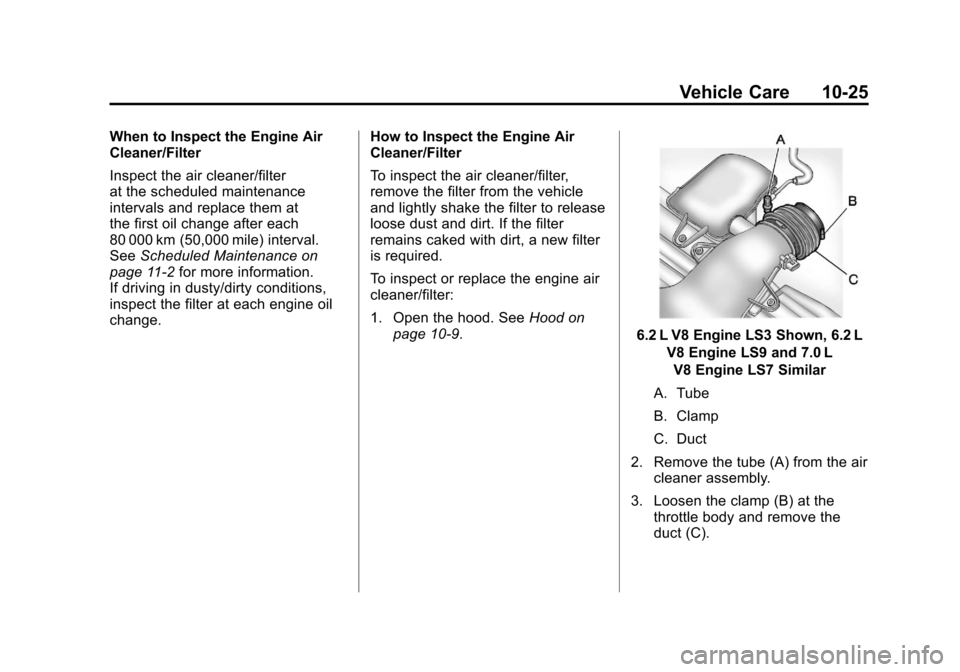
6.2 L V8 Engine LS3 Shown, 6.2 L
V8 Engine LS9 and 7.0 LV8 Engine LS7 Similar
A. Tube
B. Clamp
C. Duct
2. Remove the tube (A) from the air cleaner assembly.
3. Loosen the clamp (B) at the throttle body and remove the
duct (C).
Page 311 of 428
Black plate (27,1)Chevrolet Corvette Owner Manual - 2011
Vehicle Care 10-27
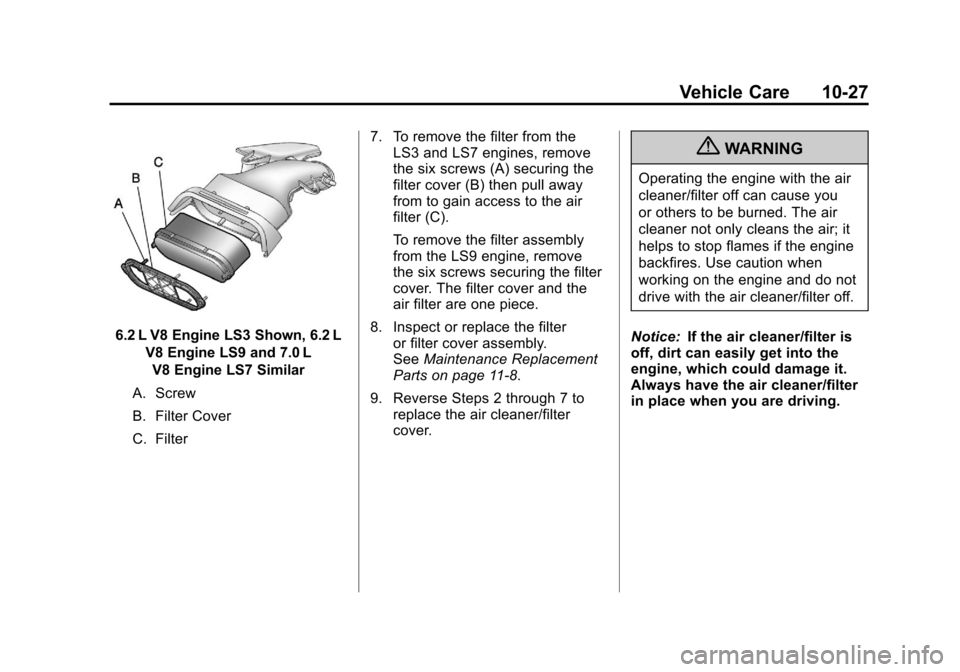
6.2 L V8 Engine LS3 Shown, 6.2 LV8 Engine LS9 and 7.0 LV8 Engine LS7 Similar
A. Screw
B. Filter Cover
C. Filter 7. To remove the filter from the
LS3 and LS7 engines, remove
the six screws (A) securing the
filter cover (B) then pull away
from to gain access to the air
filter (C).
To remove the filter assembly
from the LS9 engine, remove
the six screws securing the filter
cover. The filter cover and the
air filter are one piece.
8. Inspect or replace the filter or filter cover assembly.
See Maintenance Replacement
Parts on page 11‑8.
9. Reverse Steps 2 through 7 to replace the air cleaner/filter
cover.
{WARNING
Operating the engine with the air
cleaner/filter off can cause you
or others to be burned. The air
cleaner not only cleans the air; it
helps to stop flames if the engine
backfires. Use caution when
working on the engine and do not
drive with the air cleaner/filter off.
Notice: If the air cleaner/filter is
off, dirt can easily get into the
engine, which could damage it.
Always have the air cleaner/filter
in place when you are driving.
Page 326 of 428
Black plate (42,1)Chevrolet Corvette Owner Manual - 2011
10-42 Vehicle Care
Add or remove brake fluid, as
necessary, only when work is done
on the brake hydraulic system.
{WARNING
If too much brake fluid is added, it
can spill on the engine and burn,
if the engine is hot enough. You
or others could be burned, and
the vehicle could be damaged.
Add brake fluid only when work
is done on the brake hydraulic
system. See“Checking Brake
Fluid” in this section.
Refer to the Maintenance Schedule
to determine when to check the
brake fluid. See Scheduled
Maintenance on page 11‑2.
Checking Brake Fluid
Check brake fluid by looking at the
brake fluid reservoir. See Engine
Compartment Overview on
page 10‑10.
The fluid level should be above
the MIN mark on the reservoir.
If it is not, have the brake hydraulic
system checked to see if there is
a leak.
After work is done on the brake
hydraulic system, make sure the
level is between the MIN and MAX
marks. What to Add
Use only new DOT 3 brake
fluid from a sealed container.
See
Recommended Fluids and
Lubricants on page 11‑6.
Always clean the brake fluid
reservoir cap and the area around
the cap before removing it. This
helps keep dirt from entering the
reservoir.
{WARNING
With the wrong kind of fluid in
the brake hydraulic system, the
brakes might not work well. This
could cause a crash. Always use
the proper brake fluid.
Page 330 of 428
Black plate (46,1)Chevrolet Corvette Owner Manual - 2011
10-46 Vehicle Care
Wiper Blade Replacement
Windshield wiper blades should be
inspected for wear and cracking.
SeeScheduled Maintenance on
page 11‑2 for more information.
Replacement blades come in
different types and are removed
in different ways. For the proper
type and length, see Maintenance
Replacement Parts on page 11‑8.
It is a good idea to clean or replace
the wiper blade assembly every
six months. Allowing the wiper
blade arm to touch the windshield
when no wiper blade is installed
could damage the windshield. Any
damage that occurs would not be
covered by the vehicle's warranty.
Do not allow the wiper blade arm
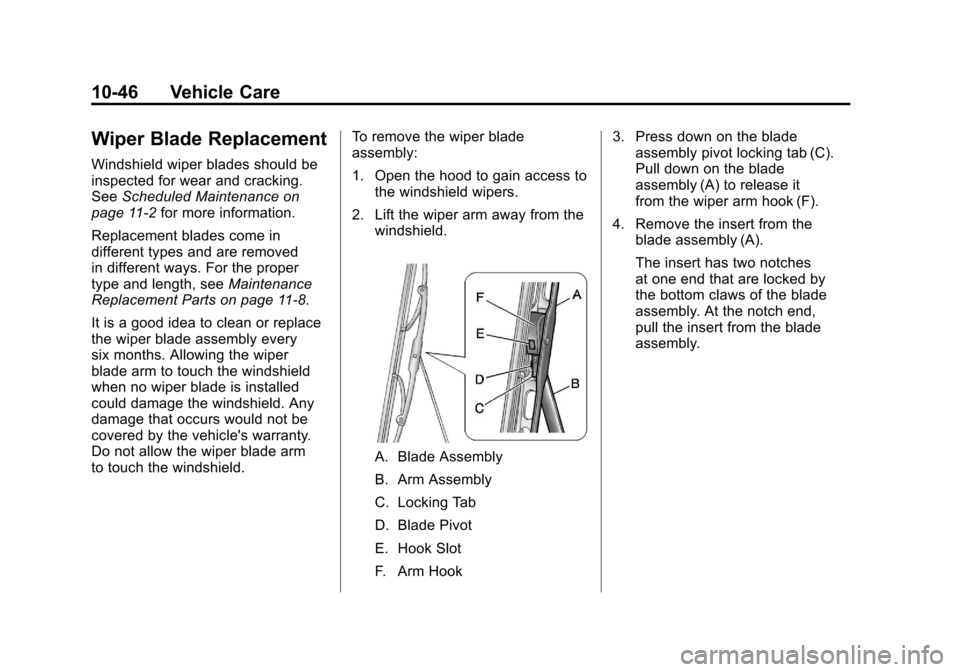
to touch the windshield. To remove the wiper blade
assembly:
1. Open the hood to gain access to
the windshield wipers.
2. Lift the wiper arm away from the windshield.
A. Blade Assembly
B. Arm Assembly
C. Locking Tab
D. Blade Pivot
E. Hook Slot
F. Arm Hook 3. Press down on the blade
assembly pivot locking tab (C).
Pull down on the blade
assembly (A) to release it
from the wiper arm hook (F).
4. Remove the insert from the blade assembly (A).
The insert has two notches
at one end that are locked by
the bottom claws of the blade
assembly. At the notch end,
pull the insert from the blade
assembly.
Page 353 of 428
Black plate (69,1)Chevrolet Corvette Owner Manual - 2011
Vehicle Care 10-69
Please note that the TPMS is
not a substitute for proper tire
maintenance, and it is the driver's
responsibility to maintain correct
tire pressure, even if under‐inflation
has not reached the level to trigger
illumination of the TPMS low tire
pressure telltale.
Your vehicle has also been
equipped with a TPMS malfunction
indicator to indicate when the
system is not operating properly.
The TPMS malfunction indicator is
combined with the low tire pressure
telltale. When the system detects a
malfunction, the telltale will flash for
approximately one minute and then
remain continuously illuminated.
This sequence will continue upon
subsequent vehicle start‐ups as
long as the malfunction exists.
When the malfunction indicator is
illuminated, the system may not be
able to detect or signal low tire
pressure as intended. TPMSmalfunctions may occur for a variety
of reasons, including the installation
of replacement or alternate tires or
wheels on the vehicle that prevent
the TPMS from functioning properly.
Always check the TPMS malfunction
telltale after replacing one or more
tires or wheels on your vehicle to
ensure that the replacement or
alternate tires and wheels allow
the TPMS to continue to function
properly.
See
Tire Pressure Monitor
Operation on page 10‑69 for
additional information.
Federal Communications
Commission (FCC) and
Industry Canada
See Radio Frequency Statement on
page 13‑19 for information
regarding Part 15 of the Federal
Communications Commission (FCC)
rules and Industry Canada
Standards RSS-210/220/310.
Tire Pressure Monitor
Operation
This vehicle may have a Tire
Pressure Monitor System (TPMS).
The TPMS is designed to warn the
driver when a low tire pressure
condition exists. TPMS sensors
are mounted onto each tire and
wheel assembly on your vehicle.
The TPMS sensors monitor the air
pressure in the vehicle's tires and
transmits the tire pressure readings
to a receiver located in the vehicle.
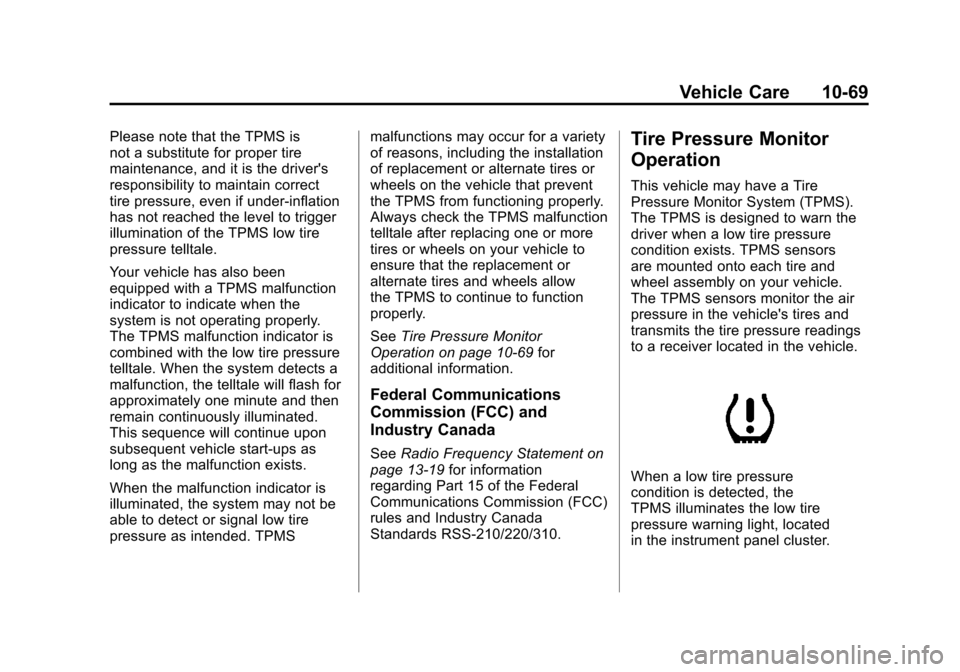
When a low tire pressure
condition is detected, the
TPMS illuminates the low tire
pressure warning light, located
in the instrument panel cluster.
Page 354 of 428
Black plate (70,1)Chevrolet Corvette Owner Manual - 2011
10-70 Vehicle Care
If the warning light comes on, stop
as soon as possible and inflate
the tires to the recommended
pressure shown on the tire loading
information label. SeeVehicle Load
Limits on page 9‑14.
At the same time a message to
check the pressure in a specific tire
appears on the Driver Information
Center (DIC) display. The low tire
pressure warning light and the DIC
warning message appear at each
ignition cycle until the tires are
inflated to the correct inflation
pressure. Using the DIC, tire
pressure levels can be viewed by
the driver. For additional information
and details about the DIC operation
and displays see Driver Information
Center (DIC) on page 5‑25 andTire
Messages on page 5‑51. The low tire pressure warning light
may come on in cool weather when
the vehicle is first started, and then
turn off as you start to drive. This
could be an early indicator that the
air pressure in the tire(s) are getting
low and need to be inflated to the
proper pressure.
A Tire and Loading Information
label, attached to your vehicle,
shows the size of your vehicle's
original equipment tires and the
correct inflation pressure for your
vehicle's tires when they are cold.
See
Vehicle Load Limits on
page 9‑14, for an example of the
Tire and Loading Information label
and its location on your vehicle.
Also see Tire Pressure on
page 10‑66 for additional
information. Your vehicle's TPMS can warn you
about a low tire pressure condition
but it does not replace normal tire
maintenance. See
Tire Inspection
on page 10‑72, Tire Rotation on
page 10‑72, When It Is Time for
New Tires on page 10‑72, and Tires
on page 10‑58.
Notice: Tire sealant materials are
not all the same. A non-approved
tire sealant could damage the Tire
Pressure Monitor System (TPMS)
sensors. TPMS sensor damage
caused by using an incorrect tire
sealant is not covered by the
vehicle warranty. Always use only
the GM approved tire sealant
available through your dealer
or included in the vehicle.
Page 356 of 428
Black plate (72,1)Chevrolet Corvette Owner Manual - 2011
10-72 Vehicle Care
Tire Inspection
We recommend that you
regularly inspect your vehicle's
tires, including the spare tire,
if the vehicle has one, for signs
of wear or damage at least once
a month.
Always remove the tires if
any of the following statements
are true:
.You can see the indicators at
three or more places around
the tire.
.You can see cord or fabric
showing through the tire's
rubber.
.The tread or sidewall is
cracked, cut, or snagged
deep enough to show cord
or fabric.
.The tire has a bump, bulge,
or split.
.The tire has a puncture, cut,
or other damage that cannot
be repaired well because of
the size or location of the
damage.
Tire Rotation
The tires on your vehicle are
different sizes front to rear.
Due to this, the tires should
not be rotated. Each tire and
wheel should be used only in
the position it is in.
When It Is Time for New
Tires
Various factors, such as
maintenance, temperatures, driving
speeds, vehicle loading, and road
conditions influence when you need
new tires.
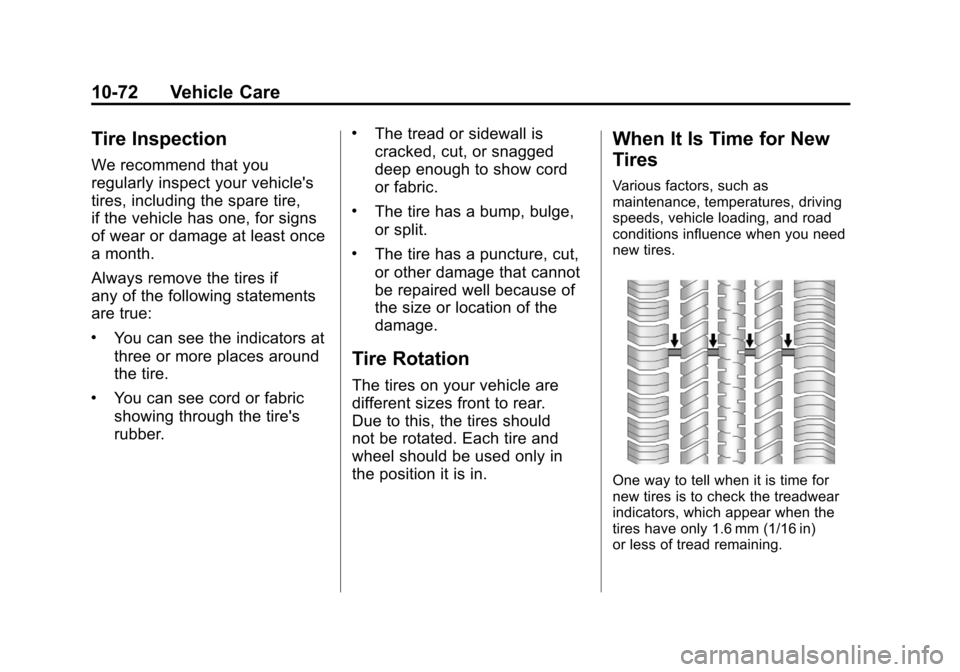
One way to tell when it is time for
new tires is to check the treadwear
indicators, which appear when the
tires have only 1.6 mm (1/16 in)
or less of tread remaining.
Page 357 of 428
Black plate (73,1)Chevrolet Corvette Owner Manual - 2011
Vehicle Care 10-73
SeeTire Inspection on page 10‑72
and Tire Rotation on page 10‑72 for
additional information.
The rubber in tires ages over time.
This is also true for the spare tire,
if the vehicle has one, even if it is
not being used. Multiple conditions
affect how fast this aging takes
place, including temperatures,
loading conditions, and inflation
pressure maintenance. Tires will
typically need to be replaced due
to wear before they may need to be
replaced due to age. Consult the tire
manufacturer for more information
on when tires should be replaced.Vehicle Storage
Tires age when stored normally
mounted on a parked vehicle.
Park a vehicle that will be stored
for at least a month in a cool, dry,
clean area away from direct sunlight
to slow aging. This area should be
free of grease, gasoline, or other
substances that can deteriorate
rubber.
Parking for an extended period
can cause flat spots on the tires
that may result in vibrations while
driving. When storing a vehicle for
at least a month, remove the tires
or raise the vehicle to reduce the
weight from the tires.
Buying New Tires
GM has developed and matched
specific tires for your vehicle.
The original equipment tires
installed on your vehicle, when it
was new, were designed to meet
General Motors Tire Performance
Criteria Specification (TPC Spec)
system rating. If you need
replacement tires, GM strongly
recommends that you get tires
with the same TPC Spec rating.
This way, your vehicle will continue
to have tires that are designed to
give the same performance and
vehicle safety, during normal use,
as the original tires.
Page 373 of 428
Black plate (89,1)Chevrolet Corvette Owner Manual - 2011
Vehicle Care 10-89
Tires
To clean the tires, use a stiff brush
with tire cleaner.
Notice:Using petroleum-based
tire dressing products on the
vehicle may damage the paint
finish and/or tires. When applying
a tire dressing, always wipe off
any overspray from all painted
surfaces on the vehicle.
Finish Damage
Any stone chips, fractures or deep
scratches in the finish should be
repaired right away. Bare metal will
corrode quickly and may develop
into major repair expense.
Minor chips and scratches can be
repaired with touch-up materials
available from your dealer. Larger
areas of finish damage can be
corrected in your dealer's/retailer's
body and paint shop. Chemicals used for ice and snow
removal and dust control can collect
on the underbody. If these are not
removed, corrosion and rust can
develop on the underbody parts
such as fuel lines, frame, floor pan,
and exhaust system even though
they have corrosion protection.
At least every spring, flush these
materials from the underbody
with plain water. Clean any areas
where mud and debris can collect.
Dirt packed in close areas of the
frame should be loosened before
being flushed. Your dealer or an
underbody car washing system
can do this.
Underbody Maintenance
Chemicals used for ice and snow
removal and dust control can collect
on the underbody. If these are not
removed, corrosion and rust can
develop on the underbody parts
such as fuel lines, frame, floor pan,
and exhaust system even though
they have corrosion protection.At least every spring, flush these
materials from the underbody
with plain water. Clean any areas
where mud and debris can collect.
Dirt packed in close areas of the
frame should be loosened before
being flushed. Your dealer or an
underbody car washing system
can do this.
Fiberglass Springs
(Composite Springs)
Notice:
If you use acidic or
corrosive cleaning products,
engine degreasers or aluminum
cleaning agents on fiberglass
springs, you may damage the
springs. The repairs would not
be covered by your warranty.
Use only approved cleaners when
cleaning your vehicle's fiberglass
springs.