steering CHEVROLET CORVETTE 2020 Owner's Guide
[x] Cancel search | Manufacturer: CHEVROLET, Model Year: 2020, Model line: CORVETTE, Model: CHEVROLET CORVETTE 2020Pages: 336, PDF Size: 5.21 MB
Page 151 of 336
Chevrolet Corvette Owner Manual (GMNA-Localizing-U.S./Canada/Mexico-
12470550) - 2020 - CRC - 4/23/20
150 Driving and Operating
1. Ease off the accelerator andthen, if there is nothing in the
way, steer the vehicle so that it
straddles the edge of the
pavement.
2. Turn the steering wheel about one-eighth of a turn, until the
right front tire contacts the
pavement edge.
3. Turn the steering wheel to go straight down the roadway.
Loss of Control
Skidding
There are three types of skids that
correspond to the vehicle's three
control systems:
.Braking Skid —wheels are not
rolling.
. Steering or Cornering Skid —
too much speed or steering in a
curve causes tires to slip and
lose cornering force.
. Acceleration Skid —too much
throttle causes the driving
wheels to spin. Defensive drivers avoid most skids
by taking reasonable care suited to
existing conditions, and by not
overdriving those conditions. But
skids are always possible.
If the vehicle starts to slide, follow
these suggestions:
.
Ease your foot off the
accelerator pedal and steer the
way you want the vehicle to go.
The vehicle may straighten out.
Be ready for a second skid if it
occurs.
. Slow down and adjust your
driving according to weather
conditions. Stopping distance
can be longer and vehicle
control can be affected when
traction is reduced by water,
snow, ice, gravel, or other
material on the road. Learn to
recognize warning clues —such
as enough water, ice, or packed
snow on the road to make a
mirrored surface —and slow
down when you have any doubt.
. Try to avoid sudden steering,
acceleration, or braking,
including reducing vehicle speed by shifting to a lower gear. Any
sudden changes could cause
the tires to slide.
Remember: Antilock brakes help
avoid only the braking skid.
Track Events and
Competitive Driving
(Z51 Only)
Vehicles without Z51 package
should not be used for track events
and competitive driving.
{Danger
High-performance features are
intended for use only on closed
tracks by experienced and
qualified drivers and should not
be used on public roads.
High-speed driving, aggressive
cornering, hard braking, and other
high-performance driving can be
dangerous. Improper driver inputs
for the conditions may result in (Continued)
Page 159 of 336
Chevrolet Corvette Owner Manual (GMNA-Localizing-U.S./Canada/Mexico-
12470550) - 2020 - CRC - 4/23/20
158 Driving and Operating
{Warning
Using the brakes to slow the
vehicle on a long downhill slope
can cause brake overheating, can
reduce brake performance, and
could result in a loss of braking.
Shift the transmission to a lower
gear to let the engine assist the
brakes on a steep downhill slope.
{Warning
Coasting downhill in N (Neutral)
or with the ignition off is
dangerous. This can cause
overheating of the brakes and
loss of steering assist. Always
have the engine running and the
vehicle in gear.
. Drive at speeds that keep the
vehicle in its own lane. Do not
swing wide or cross the
center line. .
Be alert on top of hills;
something could be in your lane
(e.g., stalled car, crash).
. Pay attention to special road
signs (e.g., falling rocks area,
winding roads, long grades,
passing or no-passing zones)
and take appropriate action.
Winter Driving
Driving on Snow or Ice
Snow or ice between the tires and
the road creates less traction or
grip, so drive carefully. Wet ice can
occur at about 0 °C (32 °F) when
freezing rain begins to fall. Avoid
driving on wet ice or in freezing rain
until roads can be treated.
For Slippery Road Driving:
.Accelerate gently. Accelerating
too quickly causes the wheels to
spin and makes the surface
under the tires slick.
. Turn on Traction Control. See
Traction Control/Electronic
Stability Control 0182. .
The Antilock Brake System
(ABS) improves vehicle stability
during hard stops, but the
brakes should be applied sooner
than when on dry pavement.
See Antilock Brake System
(ABS) 0179.
. Allow greater following distance
and watch for slippery spots. Icy
patches can occur on otherwise
clear roads in shaded areas.
The surface of a curve or an
overpass can remain icy when
the surrounding roads are clear.
Avoid sudden steering
maneuvers and braking while
on ice.
. Turn off cruise control.
. Turn on Weather Mode. See
Driver Mode Control 0184.
Blizzard Conditions
Stop the vehicle in a safe place and
signal for help. Stay with the vehicle
unless there is help nearby.
If possible, use Roadside
Page 161 of 336
Chevrolet Corvette Owner Manual (GMNA-Localizing-U.S./Canada/Mexico-
12470550) - 2020 - CRC - 4/23/20
160 Driving and Operating
Rocking the Vehicle to Get
it Out
Turn the steering wheel left and
right to clear the area around the
front wheels. Turn off any traction
system. Shift back and forth
between R (Reverse) and a low
forward gear, spinning the wheels
as little as possible. To prevent
transmission wear, wait until the
wheels stop spinning before shifting
gears. Release the accelerator
pedal while shifting, and press
lightly on the accelerator pedal
when the transmission is in gear.
Slowly spinning the wheels in the
forward and reverse directions
causes a rocking motion that could
free the vehicle. If that does not get
the vehicle out after a few tries, it
may need to be towed out. If the
vehicle does need to be towed out,
seeTowing the Vehicle 0271.
Vehicle Load Limits
It is very important to know how
much weight the vehicle can
carry. This weight is called the
vehicle capacity weight and includes the weight of all
occupants, cargo, and all
nonfactory-installed options.
Two labels on the vehicle may
show how much weight it may
properly carry: the Tire and
Loading Information label and
the Certification label.
{Warning
Do not load the vehicle any
heavier than the Gross
Vehicle Weight Rating
(GVWR), or either the
maximum front or rear Gross
Axle Weight Rating (GAWR).
This can cause systems to
break and change the way the
vehicle handles. This could
cause loss of control and a
crash. Overloading can also
reduce stopping distance,
damage the tires, and shorten
the life of the vehicle.
Tire and Loading Information
Label
Label Example
A vehicle-specific Tire and
Loading Information label is
attached to the center pillar
(B-pillar). This label shows the
number of occupant seating
positions (1), and the maximum
vehicle capacity weight (2) in
kilograms and pounds.
The Tire and Loading
Information label also shows the
size of the original equipment
tires (3) and the recommended
Page 166 of 336
Chevrolet Corvette Owner Manual (GMNA-Localizing-U.S./Canada/Mexico-
12470550) - 2020 - CRC - 4/23/20
Driving and Operating 165
Ignition Positions
The vehicle has an electronic
keyless ignition with pushbutton
start.
The remote key must be in the
vehicle for the system to operate.
If the pushbutton start is not
working, the vehicle may be near a
strong radio antenna signal causing
interference to the Keyless Access
system. SeeRemote Keyless Entry
(RKE) System Operation 09.
To shift out of P (Park), the vehicle
must be turned on and the brake
pedal must be applied. Stopping the Engine/OFF (No
Indicator Lights) :
When the
vehicle is stopped, press ENGINE
START/STOP once to turn the
engine off.
If the vehicle is in P (Park), the
ignition will turn off, and Retained
Accessory Power (RAP) will remain
active. See Retained Accessory
Power (RAP) 0168.
If the vehicle is in R (Reverse), D
(Drive), or M (Manual Mode), the
vehicle will shift to P (Park), the
ignition will turn off, and RAP will
remain active.
If the vehicle is in N (Neutral), the
ignition will return to ACC/
ACCESSORY and display the
message SHIFT TO PARK in the
Driver Information Center (DIC).
When the vehicle is shifted into
P (Park), the ignition will turn off.
Do not turn the engine off when the
vehicle is moving. This will cause a
loss of power assist in the brake
and steering systems and disable
the airbags. If the vehicle must be turned off in
an emergency:
1. Brake using a firm and steady pressure. Do not pump the
brakes repeatedly. This may
deplete power assist, requiring
increased brake pedal force.
2. Shift into N (Neutral). This can be done while the vehicle is
moving. After shifting into
N (Neutral), firmly apply the
brakes and steer the vehicle to
a safe location.
3. Come to a complete stop. Shift into P (Park).
4. Set the parking brake. See Electric Parking Brake 0179.
Press ENGINE START/STOP
to turn the vehicle off.
{Warning
Turning off the vehicle while
moving may cause loss of power
assist in the brake and steering
systems and disable the airbags.
While driving, only shut the
vehicle off in an emergency.
Page 175 of 336
Chevrolet Corvette Owner Manual (GMNA-Localizing-U.S./Canada/Mexico-
12470550) - 2020 - CRC - 4/23/20
174 Driving and Operating
Caution
A transmission hot message may
display if the transmission fluid is
too hot. Driving under this
condition can damage the vehicle.
Stop and idle the engine to cool
the transmission fluid. This
message clears when the
transmission fluid has cooled
sufficiently.
D : This position is for normal
driving. If more power is needed for
passing, press the accelerator
pedal.
If the vehicle is shifted into D (Drive)
while the speed is too high, the
transmission will get ready to
engage D (Drive). Reduce the
vehicle speed, then the
transmission will engage D (Drive).
To shift into D (Drive):
1. Bring the vehicle to a complete stop.
2. Pull the D (Drive) switch on the center console. To shift out of D (Drive):
1. Bring the vehicle to a complete stop.
2. Shift to the desired gear.
Downshifting the transmission in
slippery road conditions could result
in skidding. See “Skidding”under
Loss of Control 0150.
The transmission can be shifted like
a manual transmission using the
paddle shift controls while in D
(Drive). See Manual Mode 0174.
Caution
Spinning the tires or holding the
vehicle in one place on a hill
using only the accelerator pedal
may damage the transmission.
The repair will not be covered by
the vehicle warranty. If the vehicle
is stuck, do not spin the tires.
When stopping on a hill, use the
brakes to hold the vehicle in
place.
Manual Mode
Manual Paddle Shift
With the transmission in D (Drive),
press the M (Manual Mode) switch
on the center console to enter
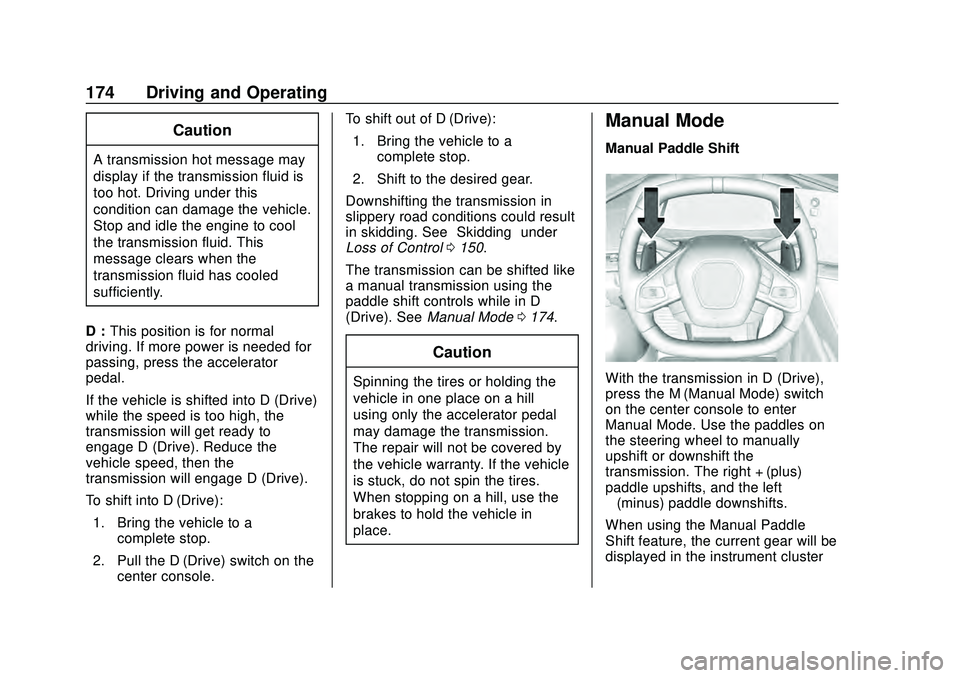
Manual Mode. Use the paddles on
the steering wheel to manually
upshift or downshift the
transmission. The right + (plus)
paddle upshifts, and the left
−(minus) paddle downshifts.
When using the Manual Paddle
Shift feature, the current gear will be
displayed in the instrument cluster
Page 180 of 336
Chevrolet Corvette Owner Manual (GMNA-Localizing-U.S./Canada/Mexico-
12470550) - 2020 - CRC - 4/23/20
Driving and Operating 179
Brakes
Electric Brake Boost
Vehicles equipped with electric
brake boost have hydraulic brake
circuits that are electronically
controlled when the brake pedal is
applied during normal operation.
The system performs routine tests
and turns off within a few minutes
after the vehicle is shutdown. Noise
may be heard during this time. If the
brake pedal is pressed during the
tests or when the electric brake
boost system is off, a noticeable
change in pedal force and travel
may be felt. This is normal.
Antilock Brake
System (ABS)
The Antilock Brake System (ABS)
helps prevent a braking skid and
maintain steering while
braking hard.
If there is a problem with ABS, this
warning light stays on. SeeAntilock
Brake System (ABS) Warning Light
0 105.
ABS does not change the time
needed to get a foot on the brake
pedal and does not always
decrease stopping distance. If you
get too close to the vehicle ahead,
there will not be enough time to
apply the brakes if that vehicle
suddenly slows or stops. Always
leave enough room ahead to stop,
even with ABS.
Using ABS
Do not pump the brakes. Just hold
the brake pedal down firmly.
Hearing and feeling ABS operate is
normal.
Braking in Emergencies
ABS allows steering and braking at
the same time. In many
emergencies, steering can help
even more than braking.
Electric Parking Brake
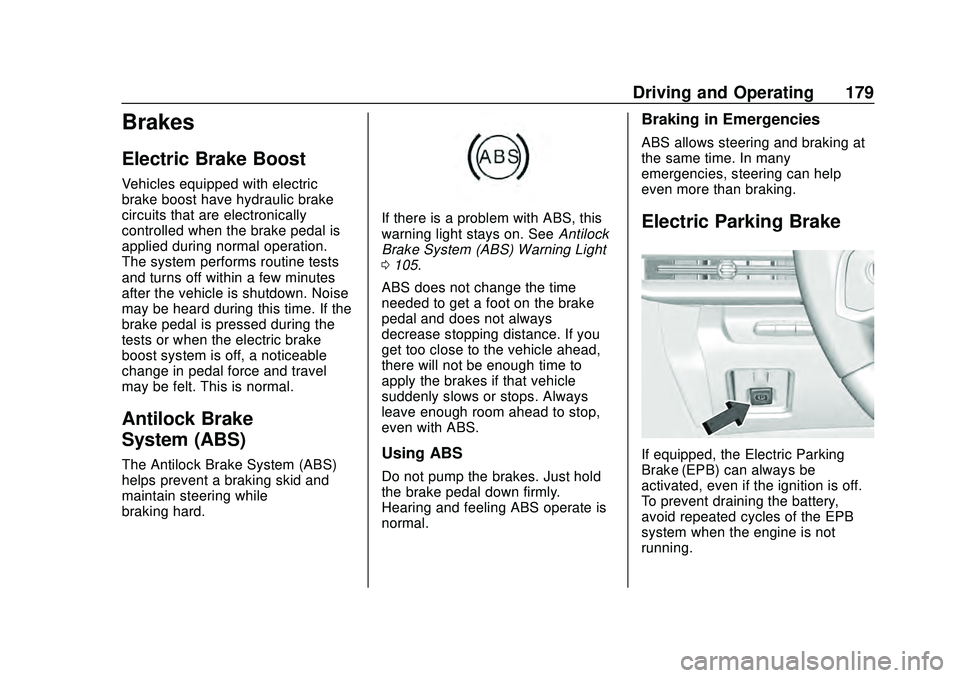
If equipped, the Electric Parking
Brake (EPB) can always be
activated, even if the ignition is off.
To prevent draining the battery,
avoid repeated cycles of the EPB
system when the engine is not
running.
Page 185 of 336
Chevrolet Corvette Owner Manual (GMNA-Localizing-U.S./Canada/Mexico-
12470550) - 2020 - CRC - 4/23/20
184 Driving and Operating
.If StabiliTrak/ESC is off, it will be
turned on automatically.
. Competitive Driving Mode or
Performance Traction
Management is unavailable.
. StabiliTrak/ESC will feel different
in aiding and maintaining
directional control.
Adding accessories can affect the
vehicle performance. See
Accessories and Modifications
0 211.
Hill Rollback Control
If the vehicle is in gear and
inadvertently rolls backwards, Hill
Rollback Control helps limit the
rollback to a very low speed.
A noise may be heard while the
vehicle speed is actively being
controlled. A Driver Information
Center (DIC) message displays
when active.
Driver Mode Control
Driver Mode Control (DMC) adds a
sportier feel, provides a more
comfortable ride, or assists in different weather conditions or
terrain. This system simultaneously
changes the software settings of
various sub-systems to optimize
driving performance. Depending on
the option package, available
features, and mode selection; the
Exhaust, Suspension, Steering,
Brakes, and Powertrain will change
settings to achieve the desired
mode characteristics. If the vehicle
is equipped with Magnetic Ride
Control, selecting the various driver
modes adjusts the ride of the
vehicle to enhance the ride
performance for the road conditions
and the selected mode.
Driver Mode Control has multiple
modes: My Mode, Weather, Tour,
Sport, Track, and Z-Mode.
Weather, Tour, Sport, and Track are
four modes that have preset vehicle
setting for use in different driving
conditions. My Mode and Z-Mode
are two modes which can be
customized by the driver. In these
two modes, vehicle settings are
configured to enhance and
personalize the driving experience.
See
“Mode Description,” later in this
section.
Mode Activation
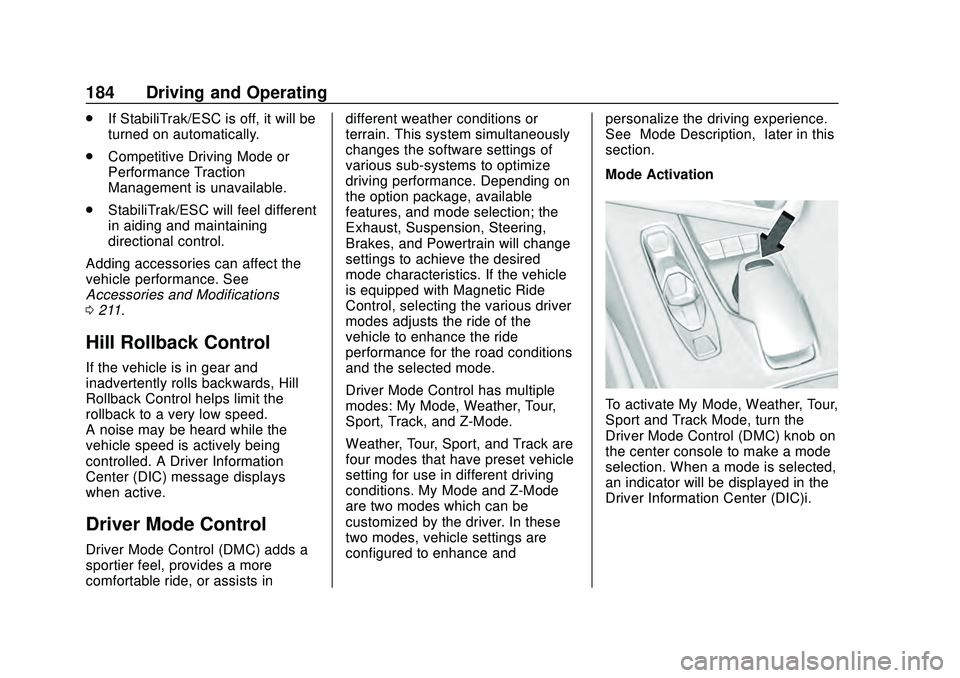
To activate My Mode, Weather, Tour,
Sport and Track Mode, turn the
Driver Mode Control (DMC) knob on
the center console to make a mode
selection. When a mode is selected,
an indicator will be displayed in the
Driver Information Center (DIC)i.
Page 186 of 336
Chevrolet Corvette Owner Manual (GMNA-Localizing-U.S./Canada/Mexico-
12470550) - 2020 - CRC - 4/23/20
Driving and Operating 185
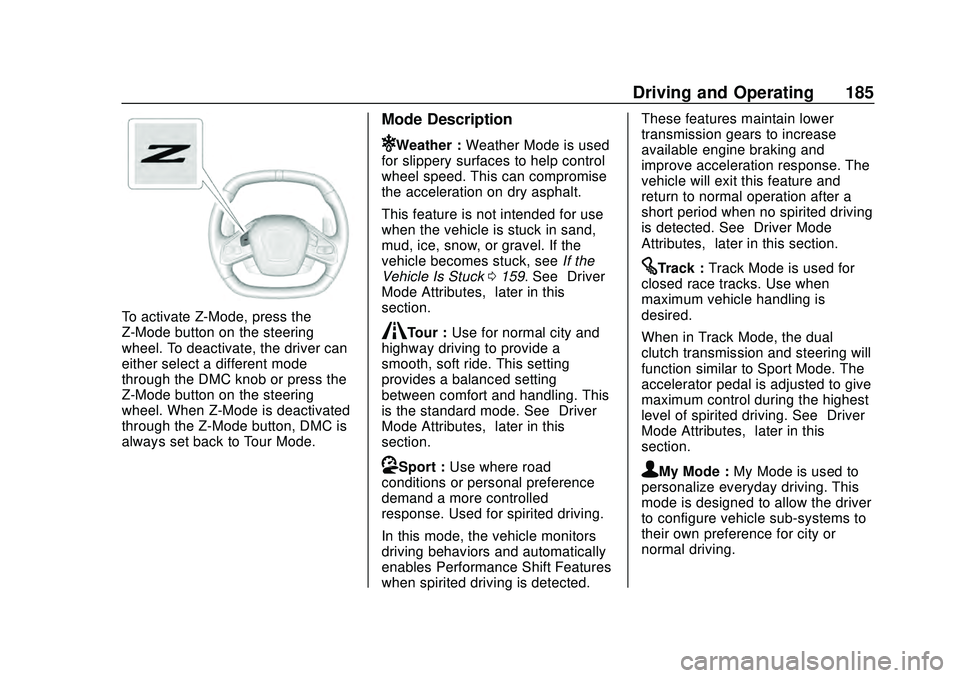
To activate Z-Mode, press the
Z-Mode button on the steering
wheel. To deactivate, the driver can
either select a different mode
through the DMC knob or press the
Z-Mode button on the steering
wheel. When Z-Mode is deactivated
through the Z-Mode button, DMC is
always set back to Tour Mode.
Mode Description
uWeather :Weather Mode is used
for slippery surfaces to help control
wheel speed. This can compromise
the acceleration on dry asphalt.
This feature is not intended for use
when the vehicle is stuck in sand,
mud, ice, snow, or gravel. If the
vehicle becomes stuck, see If the
Vehicle Is Stuck 0159. See “Driver
Mode Attributes,” later in this
section.
sTour : Use for normal city and
highway driving to provide a
smooth, soft ride. This setting
provides a balanced setting
between comfort and handling. This
is the standard mode. See “Driver
Mode Attributes,” later in this
section.
rSport : Use where road
conditions or personal preference
demand a more controlled
response. Used for spirited driving.
In this mode, the vehicle monitors
driving behaviors and automatically
enables Performance Shift Features
when spirited driving is detected. These features maintain lower
transmission gears to increase
available engine braking and
improve acceleration response. The
vehicle will exit this feature and
return to normal operation after a
short period when no spirited driving
is detected. See
“Driver Mode
Attributes,” later in this section.
tTrack :Track Mode is used for
closed race tracks. Use when
maximum vehicle handling is
desired.
When in Track Mode, the dual
clutch transmission and steering will
function similar to Sport Mode. The
accelerator pedal is adjusted to give
maximum control during the highest
level of spirited driving. See “Driver
Mode Attributes,” later in this
section.
qMy Mode : My Mode is used to
personalize everyday driving. This
mode is designed to allow the driver
to configure vehicle sub-systems to
their own preference for city or
normal driving.
Page 187 of 336
Chevrolet Corvette Owner Manual (GMNA-Localizing-U.S./Canada/Mexico-
12470550) - 2020 - CRC - 4/23/20
186 Driving and Operating
Through the center display, the
following vehicle sub-systems may
be available for customization in
this mode.
Through the center display, the
following vehicle sub-systems may
be available for customization in
this mode:
Engine Sound:(some choices,
if equipped) Stealth, Tour, Sport,
Track
Steering: Tour, Sport, Track
Suspension: If equipped, Tour,
Sport, Track Brake Response:
Tour, Sport,
Track
See “Driver Mode Attributes,” later
in this section.
See “Driver Mode Customization,”
later in this section. Cluster/HUD
can be set in the cluster.
vZ-Mode : Z-Mode is used to
personalize dynamic driving. This
mode is designed to allow the driver
to configure vehicle sub-systems to
their own preference for maximum
handling. Z-Mode further enhances
the driver experience by adding a
powertrain customization.
Through the center display, the
following vehicle sub-systems may
be available for customization in
this mode. Engine Sound:
(some choices,
if equipped) Stealth, Tour, Sport,
Track
Steering: Tour, Sport, Track
Suspension: If equipped, Tour,
Sport, Track
Powertrain: Normal, Sport, Track,
Weather
Brake Response: Tour, Sport,
Track
See “Driver Mode Attributes,” later
in this section.
See “Driver Mode Customization,”
later in this section.
Page 190 of 336
Chevrolet Corvette Owner Manual (GMNA-Localizing-U.S./Canada/Mexico-
12470550) - 2020 - CRC - 4/23/20
Driving and Operating 189
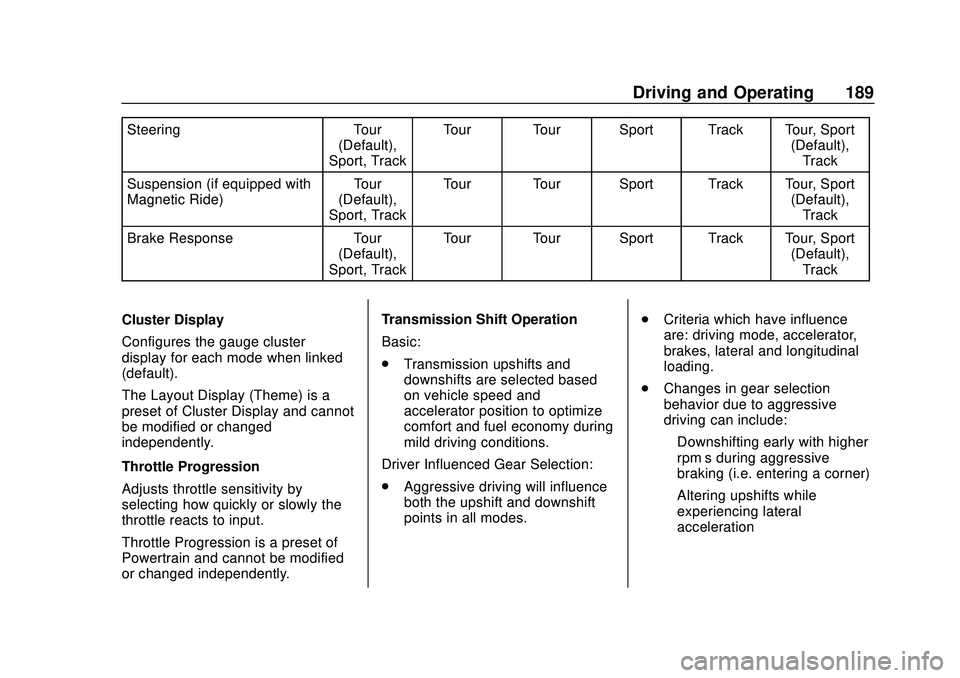
SteeringTour
(Default),
Sport, Track Tour Tour Sport Track Tour, Sport
(Default),Track
Suspension (if equipped with
Magnetic Ride) Tour
(Default),
Sport, Track Tour Tour Sport Track Tour, Sport
(Default),Track
Brake Response Tour
(Default),
Sport, Track Tour Tour Sport Track Tour, Sport
(Default),Track
Cluster Display
Configures the gauge cluster
display for each mode when linked
(default).
The Layout Display (Theme) is a
preset of Cluster Display and cannot
be modified or changed
independently.
Throttle Progression
Adjusts throttle sensitivity by
selecting how quickly or slowly the
throttle reacts to input.
Throttle Progression is a preset of
Powertrain and cannot be modified
or changed independently. Transmission Shift Operation
Basic:
.
Transmission upshifts and
downshifts are selected based
on vehicle speed and
accelerator position to optimize
comfort and fuel economy during
mild driving conditions.
Driver Influenced Gear Selection:
. Aggressive driving will influence
both the upshift and downshift
points in all modes. .
Criteria which have influence
are: driving mode, accelerator,
brakes, lateral and longitudinal
loading.
. Changes in gear selection
behavior due to aggressive
driving can include:
‐Downshifting early with higher
rpm’s during aggressive
braking (i.e. entering a corner)
‐ Altering upshifts while
experiencing lateral
acceleration