wheel CHEVROLET CORVETTE C6 2012 Service Manual
[x] Cancel search | Manufacturer: CHEVROLET, Model Year: 2012, Model line: CORVETTE C6, Model: CHEVROLET CORVETTE C6 2012Pages: 432, PDF Size: 5.73 MB
Page 261 of 432
Black plate (39,1)Chevrolet Corvette Owner Manual - 2012
Driving and Operating 9-39
If the Tire Pressure Monitor (TPM)
system detects a flat tire and the
Driver Information Center (DIC)
displays TIRE FLAT, or if the TPM
system is malfunctioning and the
DIC displays SERVICE TIRE
MONITOR, the Active Handling
System will be affected as follows:
.The Active Handling System
cannot be turned off by the
driver.
.If the Active Handling System
is off, it will be turned on
automatically.
.Competitive Driving Mode or
Performance Traction
Management is unavailable.
.The Active Handling System will
feel different in aiding and
maintaining directional control.
Competitive Driving Mode
Competitive Driving Mode,
Performance Traction Management,
and Launch Control are systems
designed to allow increased
performance while accelerating
and/or cornering. This is
accomplished by regulating and
optimizing the engine, brakes, and
suspension performance. These
modes are for use at a closed
course race track and are not
intended for use on public roads.
They will not compensate for a
driver’s inexperience or lack of
familiarity with the race track.
Drivers who prefer to allow the
system to have more control of
the engine, brake, and suspension
are advised to turn the normal
traction control and active handling
systems on. See Racing or Other
Competitive Driving on page 9‑6
for more information. Notice:
Do not attempt to shift
when the drive wheels are
spinning and do not have
traction. This may cause damage
to the transmission. Damage
caused by misuse of the vehicle
is not covered by the vehicle
warranty. See the warranty book
for additional information.
Competitive Driving Mode
(Except ZR1)
Competitive Driving Mode allows
full engine power while the Active
Handling System helps maintain
directional control of the vehicle
by selective brake application.
In this mode, TCS is off and
Launch Control is available.
Adjust your driving style to account
for the available engine power.
See “Launch Control” later in this
section.
Page 264 of 432
Black plate (42,1)Chevrolet Corvette Owner Manual - 2012
9-42 Driving and Operating
Launch Control
A Launch Control feature is
available, within Competitive Driving
Mode (except ZR1) or Performance
Traction Management (Z06, ZR1),
on vehicles with a manual
transmission to allow the driver to
achieve high levels of vehicle
acceleration in a straight line.
Launch Control is a form of traction
control that manages tire spin while
launching the vehicle. This feature
is intended for use during closed
course race events where
consistent zero to sixty and
quarter mile times are desirable.Launch Control is only available
when the following criteria are met:.Competitive Driving Mode is
selected (except ZR1) or any
of the Performance Traction
Management modes are
selected (Z06, ZR1). The TCS
light comes on the instrument
panel and the appropriate DIC
message displays.
.The vehicle is not moving.
.The steering wheel is pointing
straight.
.The clutch is pressed and the
vehicle is in first gear.
.The accelerator pedal is rapidly
applied to wide open throttle.
The Launch Control feature will
initially limit engine speed as the
driver rapidly applies the accelerator
pedal to wide open throttle. A smooth, quick release of the
clutch, while maintaining the fully
pressed accelerator pedal, will
manage wheel slip. Complete shifts
as described in
Manual
Transmission on page 9‑32.
After the vehicle is launched, the
system continues in Competitive
Mode (except ZR1) or Performance
Traction Management (Z06, ZR1).
Competitive Driving Mode,
Performance Traction Management,
and Launch Control are systems
designed for a closed course race
track and not intended for use on
public roads. The systems are not
intended to compensate for lack of
driver experience or familiarity with
the race track.
Page 265 of 432
Black plate (43,1)Chevrolet Corvette Owner Manual - 2012
Driving and Operating 9-43
Limited-Slip Rear Axle
Vehicles with a limited-slip rear axle
can give more traction on snow,
mud, ice, sand or gravel. It works
like a standard axle most of the
time, but when traction is low, this
feature allows the drive wheel with
the most traction to move the
vehicle.
Selective Ride Control
The vehicle may have a ride control
system called Magnetic Selective
Ride Control. The system provides
the following performance benefits:
.Reduced Impact Harshness
.Improved Road Isolation
.Improved High-Speed Stability
.Improved Handling Response
.Better Control of Body Ride
Motions
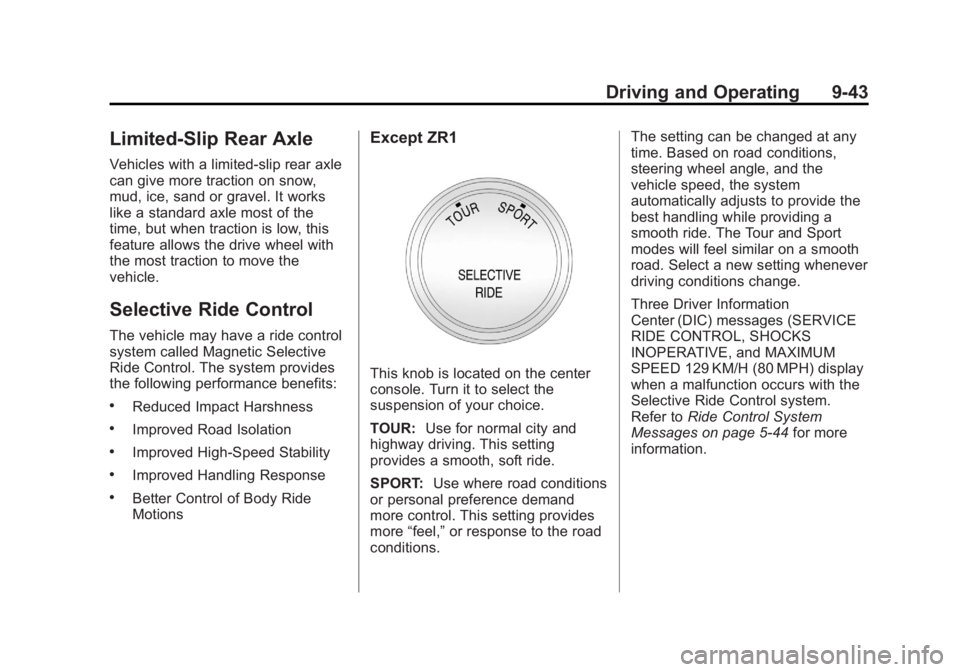
Except ZR1
This knob is located on the center
console. Turn it to select the
suspension of your choice.
TOUR:Use for normal city and
highway driving. This setting
provides a smooth, soft ride.
SPORT: Use where road conditions
or personal preference demand
more control. This setting provides
more “feel,” or response to the road
conditions. The setting can be changed at any
time. Based on road conditions,
steering wheel angle, and the
vehicle speed, the system
automatically adjusts to provide the
best handling while providing a
smooth ride. The Tour and Sport
modes will feel similar on a smooth
road. Select a new setting whenever
driving conditions change.
Three Driver Information
Center (DIC) messages (SERVICE
RIDE CONTROL, SHOCKS
INOPERATIVE, and MAXIMUM
SPEED 129 KM/H (80 MPH) display
when a malfunction occurs with the
Selective Ride Control system.
Refer to
Ride Control System
Messages on page 5‑44 for more
information.
Page 266 of 432
Black plate (44,1)Chevrolet Corvette Owner Manual - 2012
9-44 Driving and Operating
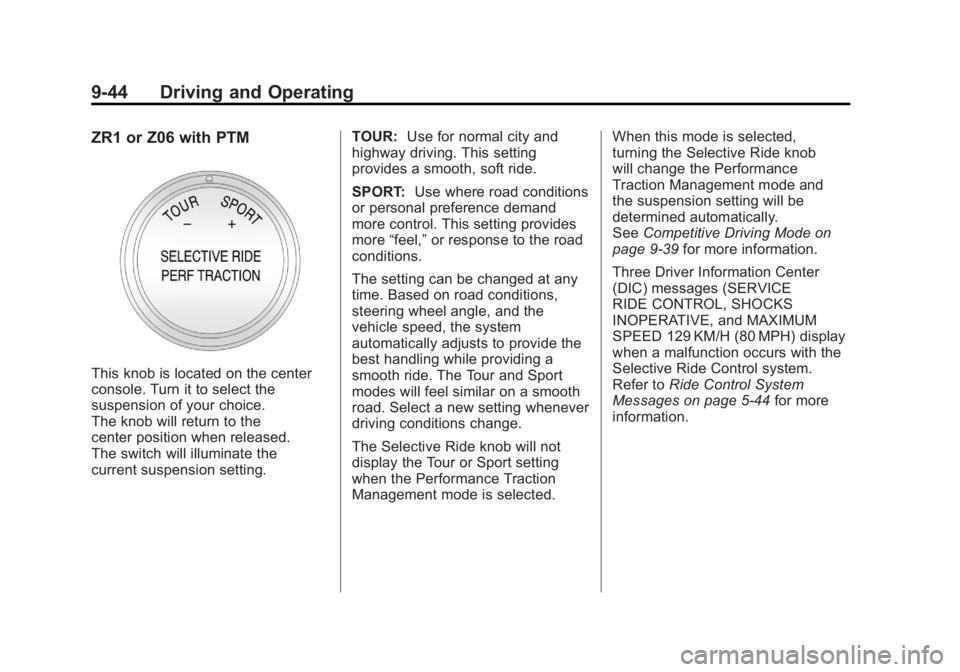
ZR1 or Z06 with PTM
This knob is located on the center
console. Turn it to select the
suspension of your choice.
The knob will return to the
center position when released.
The switch will illuminate the
current suspension setting.TOUR:
Use for normal city and
highway driving. This setting
provides a smooth, soft ride.
SPORT: Use where road conditions
or personal preference demand
more control. This setting provides
more “feel,” or response to the road
conditions.
The setting can be changed at any
time. Based on road conditions,
steering wheel angle, and the
vehicle speed, the system
automatically adjusts to provide the
best handling while providing a
smooth ride. The Tour and Sport
modes will feel similar on a smooth
road. Select a new setting whenever
driving conditions change.
The Selective Ride knob will not
display the Tour or Sport setting
when the Performance Traction
Management mode is selected. When this mode is selected,
turning the Selective Ride knob
will change the Performance
Traction Management mode and
the suspension setting will be
determined automatically.
See
Competitive Driving Mode on
page 9‑39 for more information.
Three Driver Information Center
(DIC) messages (SERVICE
RIDE CONTROL, SHOCKS
INOPERATIVE, and MAXIMUM
SPEED 129 KM/H (80 MPH) display
when a malfunction occurs with the
Selective Ride Control system.
Refer to Ride Control System
Messages on page 5‑44 for more
information.
Page 267 of 432
Black plate (45,1)Chevrolet Corvette Owner Manual - 2012
Driving and Operating 9-45
Cruise Control
With cruise control, a speed of
about 40 km/h (25 mph) or more can
be maintained without keeping your
foot on the accelerator. Cruise
control does not work at speeds
below about 40 km/h (25 mph).
Cruise control will not work if the
parking brake is set, or if the master
cylinder brake fluid level is low.
{WARNING
Cruise control can be dangerous
where you cannot drive safely at
a steady speed. So, do not use
the cruise control on winding
roads or in heavy traffic.
Cruise control can be dangerous
on slippery roads. On such roads,
fast changes in tire traction can
cause excessive wheel slip, and
you could lose control. Do not use
cruise control on slippery roads.If the vehicle is in cruise control,
and has the Traction Control
System (TCS), and it begins to limit
wheel spin, the cruise control
automatically disengages. See
Traction Control System (TCS) on
page 9‑36. When road conditions
allow the cruise control to be safely
used again, it can be turned
back on.
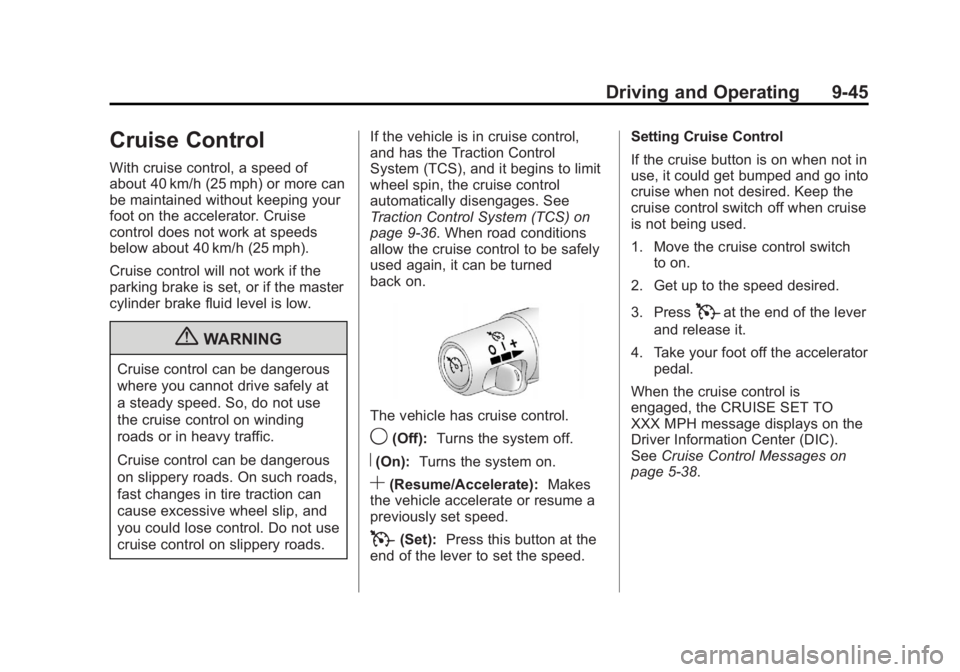
The vehicle has cruise control.
9(Off):
Turns the system off.
R(On):Turns the system on.
S(Resume/Accelerate): Makes
the vehicle accelerate or resume a
previously set speed.
T(Set): Press this button at the
end of the lever to set the speed. Setting Cruise Control
If the cruise button is on when not in
use, it could get bumped and go into
cruise when not desired. Keep the
cruise control switch off when cruise
is not being used.
1. Move the cruise control switch
to on.
2. Get up to the speed desired.
3. Press
Tat the end of the lever
and release it.
4. Take your foot off the accelerator pedal.
When the cruise control is
engaged, the CRUISE SET TO
XXX MPH message displays on the
Driver Information Center (DIC).
See Cruise Control Messages on
page 5‑38.
Page 273 of 432
Black plate (51,1)Chevrolet Corvette Owner Manual - 2012
Driving and Operating 9-51
Filling the Tank
{WARNING
Fuel vapor burns violently and a
fuel fire can cause bad injuries.
To help avoid injuries to you and
others, read and follow all the
instructions on the fuel pump
island. Turn off the engine when
refueling. Do not smoke near fuel
or when refueling the vehicle.
Do not use cellular phones.
Keep sparks, flames, and
smoking materials away from
fuel. Do not leave the fuel pump
unattended when refueling the
vehicle. This is against the law in
some places. Do not re-enter the
vehicle while pumping fuel. Keep
children away from the fuel pump;
never let children pump fuel.
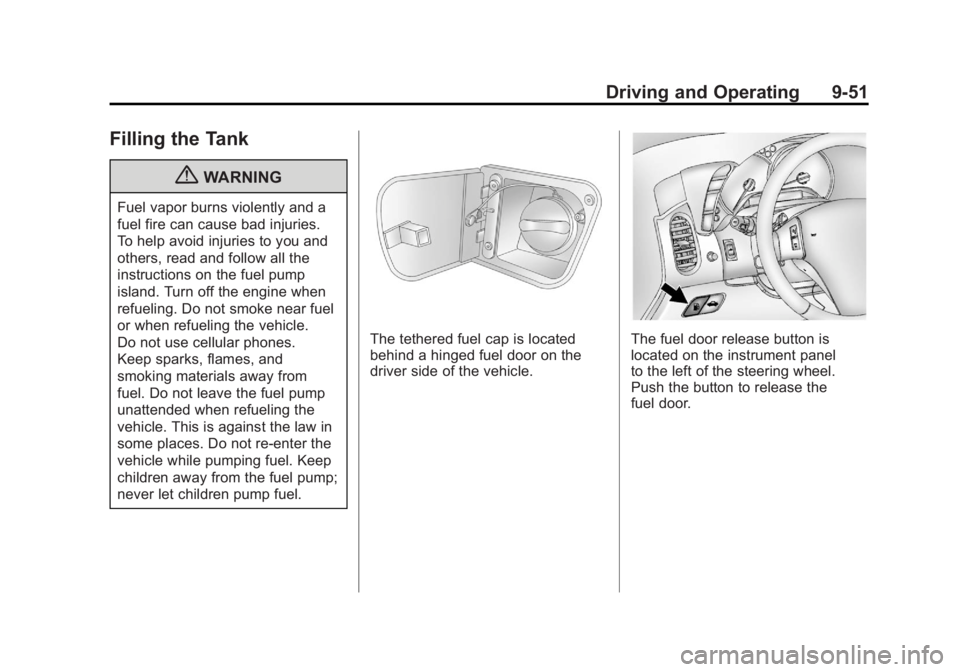
The tethered fuel cap is located
behind a hinged fuel door on the
driver side of the vehicle.The fuel door release button is
located on the instrument panel
to the left of the steering wheel.
Push the button to release the
fuel door.
Page 277 of 432
Black plate (1,1)Chevrolet Corvette Owner Manual - 2012
Vehicle Care 10-1
Vehicle Care
General Information
General Information . . . . . . . . . . 10-2
California Proposition65 Warning . . . . . . . . . . . . . . . . . 10-3
California Perchlorate Materials Requirements . . . . 10-3
Accessories and Modifications . . . . . . . . . . . . . . . 10-3
Lifting the Vehicle . . . . . . . . . . . . 10-4
Vehicle Checks
Doing Your Own Service Work . . . . . . . . . . . . . . . 10-7
Hood . . . . . . . . . . . . . . . . . . . . . . . . 10-7
Engine Compartment Overview . . . . . . . . . . . . . . . . . . . 10-8
Engine Oil . . . . . . . . . . . . . . . . . . 10-14
Engine Oil Life System . . . . . 10-19
Automatic Transmission Fluid . . . . . . . . . . . . . . . . . . . . . . 10-20
Manual Transmission Fluid . . . . . . . . . . . . . . . . . . . . . . 10-21
Hydraulic Clutch . . . . . . . . . . . . 10-21 Engine Air Cleaner/Filter . . . . 10-22
Cooling System (Engine) . . . 10-25
Cooling System
(Intercooler) . . . . . . . . . . . . . . . 10-26
Engine Coolant . . . . . . . . . . . . . 10-26
Engine Overheating . . . . . . . . 10-30
Overheated Engine
Protection
Operating Mode . . . . . . . . . . . 10-32
Power Steering Fluid . . . . . . . 10-32
Washer Fluid . . . . . . . . . . . . . . . 10-34
Brakes . . . . . . . . . . . . . . . . . . . . . 10-34
Brake Fluid . . . . . . . . . . . . . . . . . 10-38
Battery . . . . . . . . . . . . . . . . . . . . . 10-40
Rear Axle . . . . . . . . . . . . . . . . . . 10-40
Starter Switch Check . . . . . . . 10-41
Automatic Transmission Shift Lock Control
Function Check . . . . . . . . . . . 10-42
Park Brake and P (Park) Mechanism Check . . . . . . . . 10-42
Wiper Blade Replacement . . . . . . . . . . . . . . 10-43
Windshield Replacement . . . 10-43
Headlamp Aiming
Headlamp Aiming . . . . . . . . . . 10-44
Bulb Replacement
Bulb Replacement . . . . . . . . . . 10-44
Halogen Bulbs . . . . . . . . . . . . . . 10-44
High Intensity Discharge (HID) Lighting . . . . . . . . . . . . . 10-44
Headlamps, Front Turn
Signal and Parking
Lamps . . . . . . . . . . . . . . . . . . . . 10-45
Taillamps, Turn Signal, and Stoplamps . . . . . . . . . . . . . . . . 10-46
Replacement Bulbs . . . . . . . . . 10-46
Electrical System
Electrical System Overload . . . . . . . . . . . . . . . . . . 10-46
Fuses and Circuit Breakers . . . . . . . . . . . . . . . . . . 10-47
Engine Compartment
Fuse Block . . . . . . . . . . . . . . . . 10-48
Instrument Panel Fuse Block . . . . . . . . . . . . . . . . . . . . . 10-51
Wheels and Tires
Tires . . . . . . . . . . . . . . . . . . . . . . . . 10-54
Winter Tires . . . . . . . . . . . . . . . . 10-55
Run-Flat Tires . . . . . . . . . . . . . . 10-56
Low-Profile Tires . . . . . . . . . . . 10-57
Page 278 of 432
Black plate (2,1)Chevrolet Corvette Owner Manual - 2012
10-2 Vehicle Care
Sport Cup Tires . . . . . . . . . . . . 10-57
Tire Sidewall Labeling . . . . . . 10-58
Tire Designations . . . . . . . . . . . 10-59
Tire Terminology andDefinitions . . . . . . . . . . . . . . . . 10-59
Tire Pressure . . . . . . . . . . . . . . . 10-62
Tire Pressure for High-Speed Operation . . . . 10-64
Tire Pressure Monitor System . . . . . . . . . . . . . . . . . . . 10-64
Tire Pressure Monitor Operation . . . . . . . . . . . . . . . . . 10-66
Tire Inspection . . . . . . . . . . . . . . 10-68
Tire Rotation . . . . . . . . . . . . . . . 10-68
When It Is Time for New Tires . . . . . . . . . . . . . . . . . . . . . . 10-69
Buying New Tires . . . . . . . . . . . 10-70
Different Size Tires and Wheels . . . . . . . . . . . . . . . . . . . 10-72
Uniform Tire Quality Grading . . . . . . . . . . . . . . . . . . . 10-72 Wheel Alignment and Tire
Balance . . . . . . . . . . . . . . . . . . . 10-74
Wheel Replacement . . . . . . . . 10-74
Tire Chains . . . . . . . . . . . . . . . . . 10-76
If a Tire Goes Flat . . . . . . . . . . 10-77
Jump Starting
Jump Starting . . . . . . . . . . . . . . 10-78
Towing
Towing the Vehicle . . . . . . . . . 10-82
Recreational Vehicle Towing . . . . . . . . . . . . . . . . . . . . 10-82
Appearance Care
Exterior Care . . . . . . . . . . . . . . . 10-82
Interior Care . . . . . . . . . . . . . . . . 10-86
Floor Mats . . . . . . . . . . . . . . . . . . 10-89
General Information
For service and parts needs,
visit your dealer. You will receive
genuine GM parts and GM-trained
and supported service people.
Genuine GM parts have one of
these marks:
Page 280 of 432
Black plate (4,1)Chevrolet Corvette Owner Manual - 2012
10-4 Vehicle Care
Lifting the Vehicle
{WARNING
Lifting a vehicle can cause an
injury. The vehicle can slip off the
jack and roll over you or other
people. You and they could be
badly injured. Find a level place
to lift your vehicle. To help
prevent the vehicle from moving:1. Set the parking brake firmly.
2. Put an automatic transmission shift lever in
P (Park), or shift a manual
transmission to 1 (First)
or R (Reverse).
3. Turn off the engine.
To be even more certain the
vehicle won't move, put blocks in
front of and behind the wheels.
{WARNING
Getting under a vehicle when it
is lifted on a jack is dangerous.
If the vehicle slips off the jack,
you could be badly injured or
killed. Never get under a vehicle
when it is supported only by
a jack.
{WARNING
Raising the vehicle with the
jack improperly positioned can
damage the vehicle or the vehicle
may fall and cause you or others
injury.
If you ever use a jack to lift your
vehicle, follow the instructions that
came with the jack, and be sure to
use the correct lifting points to avoid
damaging your vehicle. Notice:
Lifting your vehicle
improperly can damage your
vehicle and result in costly
repairs not covered by your
warranty. To lift your vehicle
properly, follow the advice in
this part.
To help prevent vehicle damage:
.Be sure to place a block or
pad between the jack and the
vehicle.
.Make sure the jack you are
using spans at least two
crossmember ribs.
.Lift only in the areas shown
in the following pictures.
For additional information, see
your dealer and the Chevrolet
Corvette service manual.
Page 311 of 432
Black plate (35,1)Chevrolet Corvette Owner Manual - 2012
Vehicle Care 10-35
Notice:Continuing to drive with
worn-out brake pads could result
in costly brake repair.
Some driving conditions or climates
can cause a brake squeal when the
brakes are first applied or lightly
applied. This does not mean
something is wrong with the brakes.
Brake linings should always be
replaced as complete axle sets.
Brake Wear (ZR1, Z06, and
Grand Sport Only)
The ZR1, Z06, and Grand Sport
models do not have built-in brake
pad wear indicators and periodic
visual inspection of the brake pads
is required to determine when to
replace the brake pads. Notice:
Continuing to drive with
worn-out brake pads could result
in costly brake repair.
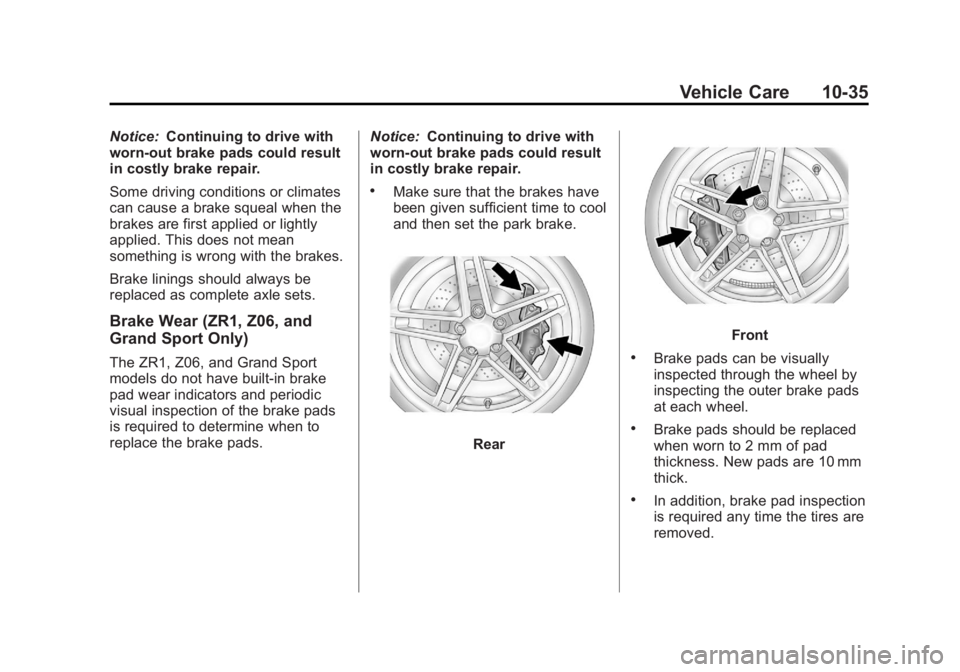
.Make sure that the brakes have
been given sufficient time to cool
and then set the park brake.
Rear
Front
.Brake pads can be visually
inspected through the wheel by
inspecting the outer brake pads
at each wheel.
.Brake pads should be replaced
when worn to 2 mm of pad
thickness. New pads are 10 mm
thick.
.In addition, brake pad inspection
is required any time the tires are
removed.