wheel CHEVROLET CORVETTE C6 2012 Workshop Manual
[x] Cancel search | Manufacturer: CHEVROLET, Model Year: 2012, Model line: CORVETTE C6, Model: CHEVROLET CORVETTE C6 2012Pages: 432, PDF Size: 5.73 MB
Page 312 of 432
Black plate (36,1)Chevrolet Corvette Owner Manual - 2012
10-36 Vehicle Care
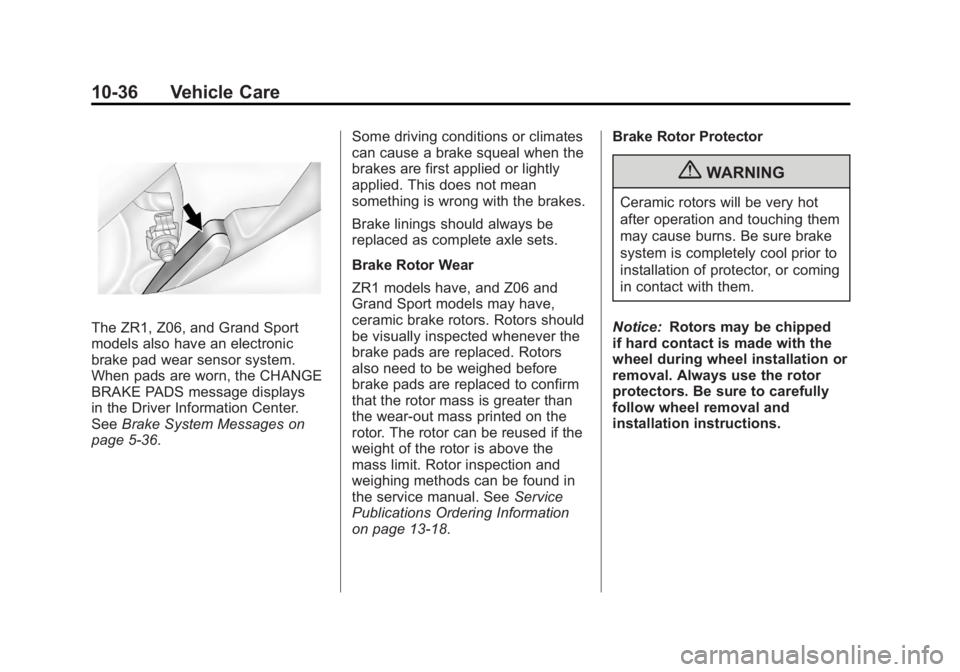
The ZR1, Z06, and Grand Sport
models also have an electronic
brake pad wear sensor system.
When pads are worn, the CHANGE
BRAKE PADS message displays
in the Driver Information Center.
SeeBrake System Messages on
page 5‑36. Some driving conditions or climates
can cause a brake squeal when the
brakes are first applied or lightly
applied. This does not mean
something is wrong with the brakes.
Brake linings should always be
replaced as complete axle sets.
Brake Rotor Wear
ZR1 models have, and Z06 and
Grand Sport models may have,
ceramic brake rotors. Rotors should
be visually inspected whenever the
brake pads are replaced. Rotors
also need to be weighed before
brake pads are replaced to confirm
that the rotor mass is greater than
the wear‐out mass printed on the
rotor. The rotor can be reused if the
weight of the rotor is above the
mass limit. Rotor inspection and
weighing methods can be found in
the service manual. See
Service
Publications Ordering Information
on page 13‑18. Brake Rotor Protector
{WARNING
Ceramic rotors will be very hot
after operation and touching them
may cause burns. Be sure brake
system is completely cool prior to
installation of protector, or coming
in contact with them.
Notice: Rotors may be chipped
if hard contact is made with the
wheel during wheel installation or
removal. Always use the rotor
protectors. Be sure to carefully
follow wheel removal and
installation instructions.
Page 313 of 432
Black plate (37,1)Chevrolet Corvette Owner Manual - 2012
Vehicle Care 10-37
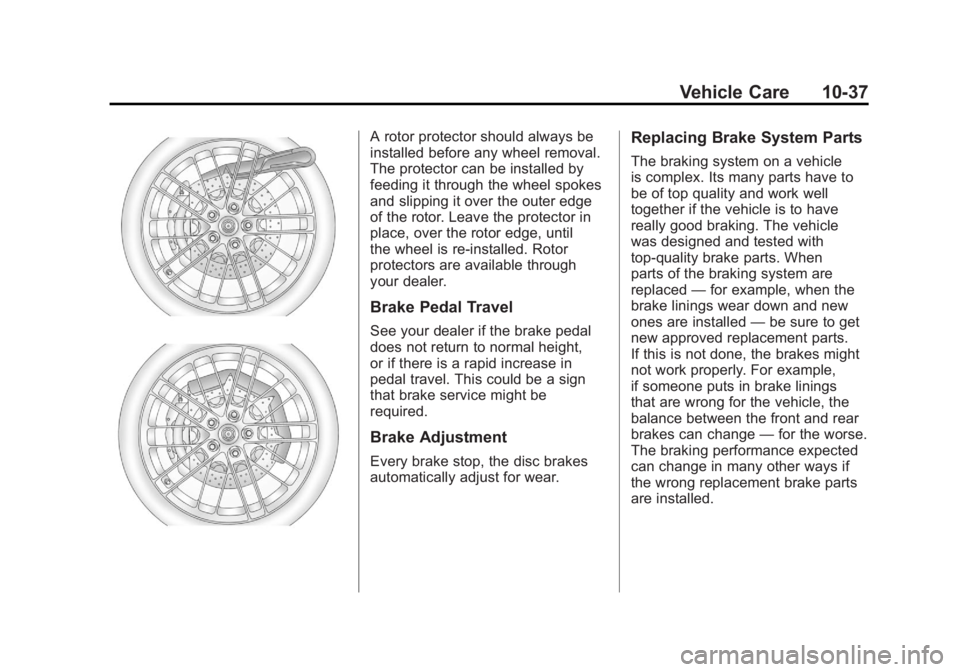
A rotor protector should always be
installed before any wheel removal.
The protector can be installed by
feeding it through the wheel spokes
and slipping it over the outer edge
of the rotor. Leave the protector in
place, over the rotor edge, until
the wheel is re‐installed. Rotor
protectors are available through
your dealer.
Brake Pedal Travel
See your dealer if the brake pedal
does not return to normal height,
or if there is a rapid increase in
pedal travel. This could be a sign
that brake service might be
required.
Brake Adjustment
Every brake stop, the disc brakes
automatically adjust for wear.
Replacing Brake System Parts
The braking system on a vehicle
is complex. Its many parts have to
be of top quality and work well
together if the vehicle is to have
really good braking. The vehicle
was designed and tested with
top-quality brake parts. When
parts of the braking system are
replaced—for example, when the
brake linings wear down and new
ones are installed —be sure to get
new approved replacement parts.
If this is not done, the brakes might
not work properly. For example,
if someone puts in brake linings
that are wrong for the vehicle, the
balance between the front and rear
brakes can change —for the worse.
The braking performance expected
can change in many other ways if
the wrong replacement brake parts
are installed.
Page 321 of 432
Black plate (45,1)Chevrolet Corvette Owner Manual - 2012
Vehicle Care 10-45
Headlamps, Front Turn
Signal and Parking
Lamps
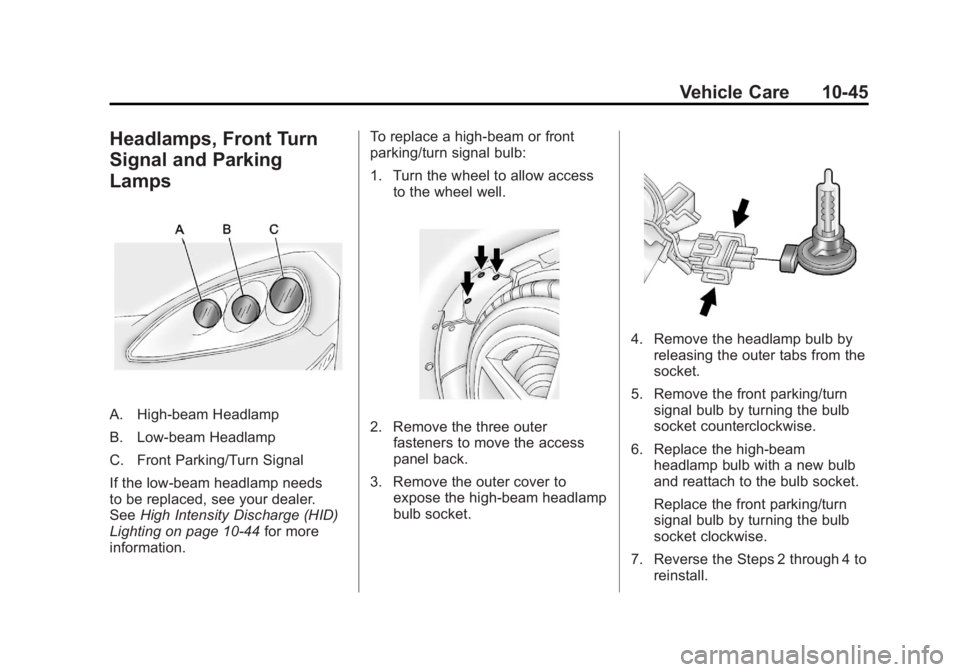
A. High-beam Headlamp
B. Low-beam Headlamp
C. Front Parking/Turn Signal
If the low-beam headlamp needs
to be replaced, see your dealer.
SeeHigh Intensity Discharge (HID)
Lighting on page 10‑44 for more
information. To replace a high-beam or front
parking/turn signal bulb:
1. Turn the wheel to allow access
to the wheel well.2. Remove the three outerfasteners to move the access
panel back.
3. Remove the outer cover to expose the high-beam headlamp
bulb socket.
4. Remove the headlamp bulb byreleasing the outer tabs from the
socket.
5. Remove the front parking/turn signal bulb by turning the bulb
socket counterclockwise.
6. Replace the high-beam headlamp bulb with a new bulb
and reattach to the bulb socket.
Replace the front parking/turn
signal bulb by turning the bulb
socket clockwise.
7. Reverse the Steps 2 through 4 to reinstall.
Page 328 of 432
Black plate (52,1)Chevrolet Corvette Owner Manual - 2012
10-52 Vehicle Care
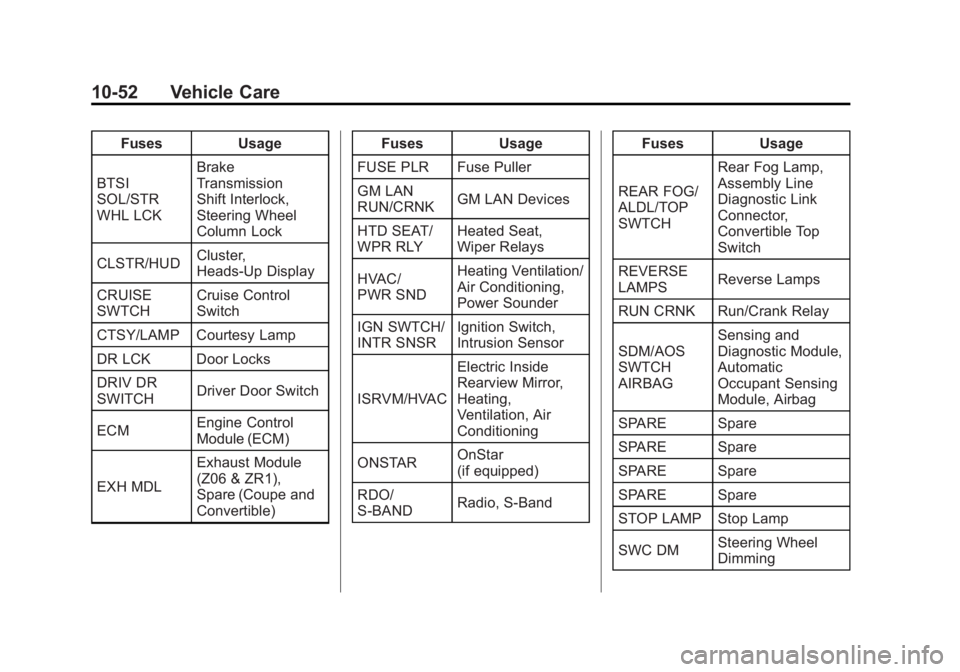
FusesUsage
BTSI
SOL/STR
WHL LCK Brake
Transmission
Shift Interlock,
Steering Wheel
Column Lock
CLSTR/HUD Cluster,
Heads-Up Display
CRUISE
SWTCH Cruise Control
Switch
CTSY/LAMP Courtesy Lamp
DR LCK Door Locks
DRIV DR
SWITCH Driver Door Switch
ECM Engine Control
Module (ECM)
EXH MDL Exhaust Module
(Z06 & ZR1),
Spare (Coupe and
Convertible) Fuses
Usage
FUSE PLR Fuse Puller
GM LAN
RUN/CRNK GM LAN Devices
HTD SEAT/
WPR RLY Heated Seat,
Wiper Relays
HVAC/
PWR SND Heating Ventilation/
Air Conditioning,
Power Sounder
IGN SWTCH/
INTR SNSR Ignition Switch,
Intrusion Sensor
ISRVM/HVAC Electric Inside
Rearview Mirror,
Heating,
Ventilation, Air
Conditioning
ONSTAR OnStar
(if equipped)
RDO/
S-BAND Radio, S-Band Fuses
Usage
REAR FOG/
ALDL/TOP
SWTCH Rear Fog Lamp,
Assembly Line
Diagnostic Link
Connector,
Convertible Top
Switch
REVERSE
LAMPS Reverse Lamps
RUN CRNK Run/Crank Relay
SDM/AOS
SWTCH
AIRBAG Sensing and
Diagnostic Module,
Automatic
Occupant Sensing
Module, Airbag
SPARE Spare
SPARE Spare
SPARE Spare
SPARE Spare
STOP LAMP Stop Lamp
SWC DM Steering Wheel
Dimming
Page 330 of 432
Black plate (54,1)Chevrolet Corvette Owner Manual - 2012
10-54 Vehicle Care
Wheels and Tires
Tires
Every new GM vehicle has
high-quality tires made by a
leading tire manufacturer.
See the warranty manual for
information regarding the tire
warranty and where to get
service. For additional
information refer to the tire
manufacturer.
{WARNING
.Poorly maintained and
improperly used tires are
dangerous.
.Overloading the tires can
cause overheating as a
result of too much flexing.
There could be a blowout and
a serious crash. SeeVehicle
Load Limits on page 9‑14.
.Underinflated tires pose the
same danger as overloaded
tires. The resulting crash
could cause serious injury.
Check all tires frequently to
maintain the recommended
pressure. Tire pressure
should be checked when the
tires are cold.
(Continued)
WARNING (Continued)
.Overinflated tires are
more likely to be cut,
punctured, or broken by a
sudden impact—such as
when hitting a pothole. Keep
tires at the recommended
pressure.
.Worn or old tires can cause a
crash. If the tread is badly
worn, replace them.
.Replace any tires that have
been damaged by impacts
with potholes, curbs, etc.
.Improperly repaired tires can
cause a crash. Only the
dealer or an authorized tire
service center should repair,
replace, dismount, and mount
the tires.
(Continued)
Page 331 of 432
Black plate (55,1)Chevrolet Corvette Owner Manual - 2012
Vehicle Care 10-55
WARNING (Continued)
.Do not spin the tires in
excess of 56 km/h (35 mph)
on slippery surfaces such
as snow, mud, ice, etc.
Excessive spinning may
cause the tires to explode.
SeeTire Pressure for
High-Speed Operation on
page 10‑64 for inflation pressure
adjustment for high-speed
driving.
Winter Tires
Consider installing winter tires on
the vehicle if frequent driving on
snow or ice covered roads is
expected. All season tires provide
good overall performance on most
surfaces, but they may not offer
the traction or the same level of
performance as winter tires on
snow or ice covered roads.
Winter tires, in general, are
designed for increased traction on
snow and ice covered roads. With
winter tires, there may be decreased
dry road traction, increased road
noise, and shorter tread life. After
changing to winter tires, be alert for
changes in vehicle handling and
braking. See your dealer for details
regarding winter tire availability and
proper tire selection. Also, see
Buying New Tires on page 10‑70.
If using snow tires:
.Use tires of the same brand and
tread type on all four wheel
positions.
.Use only radial ply tires of the
same size, load range, and
speed rating as the original
equipment tires.
Winter tires with the same speed
rating as the original equipment tires
may not be available for H, V, W, Y,
and ZR speed rated tires. If winter
tires with a lower speed rating are
chosen, never exceed the tire's
maximum speed capability.
Page 332 of 432
Black plate (56,1)Chevrolet Corvette Owner Manual - 2012
10-56 Vehicle Care
Run-Flat Tires
This vehicle, when new, had run-flat
tires. There is no spare tire, no tire
changing equipment, and no place
to store a tire in the vehicle.
The vehicle also has a Tire
Pressure Monitor System (TPMS)
that indicates a loss of tire pressure
in any of the tires.
{WARNING
If the low tire warning light
displays on the instrument panel
cluster, the handling capabilities
will be reduced during severe
maneuvers. Driving too fast could
cause loss of control and you or
others could be injured. Do not
drive over 90 km/h (55 mph)
when the low tire warning light is
displayed. Drive cautiously and
check the tire pressures as soon
as possible.If a tire goes flat, there is no need to
stop on the side of the road to
change the tire. Continue driving,
however, do not drive too far or too
fast. Driving on the tire may not be
possible if there is permanent
damage. The tire can be driven with
no air pressure for up to 105 km
(65 miles) at speeds slower than
90 km/h (55 mph). The shorter the
distance and the slower the speed,
the greater the chance the tire will
not have to be replaced. As soon
as possible, contact the nearest
authorized GM or run-flat servicing
facility for inspection and repair or
replacement. When driving on a
deflated run-flat tire, avoid potholes
and other road hazards that could
damage the tire and/or wheel
beyond repair. When a tire has been
damaged, or if driven any distance
on a deflated run-flat tire, check with
an authorized run-flat tire service
center to determine whether the
tire can be repaired or should be
replaced. To maintain the run-flat
feature, all replacement tires must
be run-flat tires. To locate the nearest GM or run-flat
servicing facility, call Roadside
Assistance. See
Roadside
Assistance Program (U.S. and
Canada) on page 13‑8 orRoadside
Assistance Program (Mexico) on
page 13‑10 for details.
The valve stems on run-flat
tires have sensors that are part of
the TPMS. See Tire Pressure
Monitor System on page 10‑64.
These sensors contain batteries that
are designed to last for 10 years
under normal driving conditions.
See your dealer for wheel or sensor
replacement.
Notice: Using liquid sealants can
damage the tire valves and tire
pressure monitor sensors in the
run-flat tires. This damage is not
covered by the vehicle warranty.
Do not use liquid sealants in
run-flat tires.
Page 333 of 432
Black plate (57,1)Chevrolet Corvette Owner Manual - 2012
Vehicle Care 10-57
Low-Profile Tires
Low‐Profile Performance Tire
The original equipment tires on
this vehicle are classified as
low‐profile performance tires.
These tires are designed for
very responsive driving on wet
or dry pavement, however, may
produce more road noise and
tend to wear faster.
Notice:Low‐profile tires are
more susceptible to damage
from road hazards or curb
impact than standard profile
tires. Tire and/or wheel
assembly damage can occur
when coming into contact
with road hazards like,
potholes, or sharp edged
objects, or when sliding into a
curb. The warranty does not
cover this type of damage. Keep tires set to the correct
inflation pressure and, when
possible, avoid contact with
curbs, potholes, and other
road hazards.
Sport Cup Tires
This vehicle may come with
Michelin Pilot Sport Cup competition
oriented tires that are DOT approved
for street use. These tires are
included on the Z06 model with the
Z07 Performance Package and on
the ZR1 model with the PDE High
Performance Package. Sport Cup
tires use a special tread and
compound that provide more
grip than normal road tires.
The minimum tread depth will be
reached earlier than typical tires,
resulting in reduced tire life.
This special tread and compound
will decrease performance in cold
climates, heavy rain, and standing
water.
{WARNING
Driving on wet roads, in heavy
rain, or through standing water
with Sport Cup tires may cause
hydroplaning and loss of control.
Use extreme caution and drive
slowly on wet roads.
{WARNING
Driving with Sport Cup tires on
snow, ice, or cold road surfaces
can cause loss of control or an
accident. Sport Cup tires are a
summer season tires and are not
intended to be driven on snow,
ice, or road surfaces below
10°C (50°F). Do not drive a
vehicle with Sport Cup tires in
these conditions.
Page 335 of 432
Black plate (59,1)Chevrolet Corvette Owner Manual - 2012
Vehicle Care 10-59
Tire Designations
Tire Size
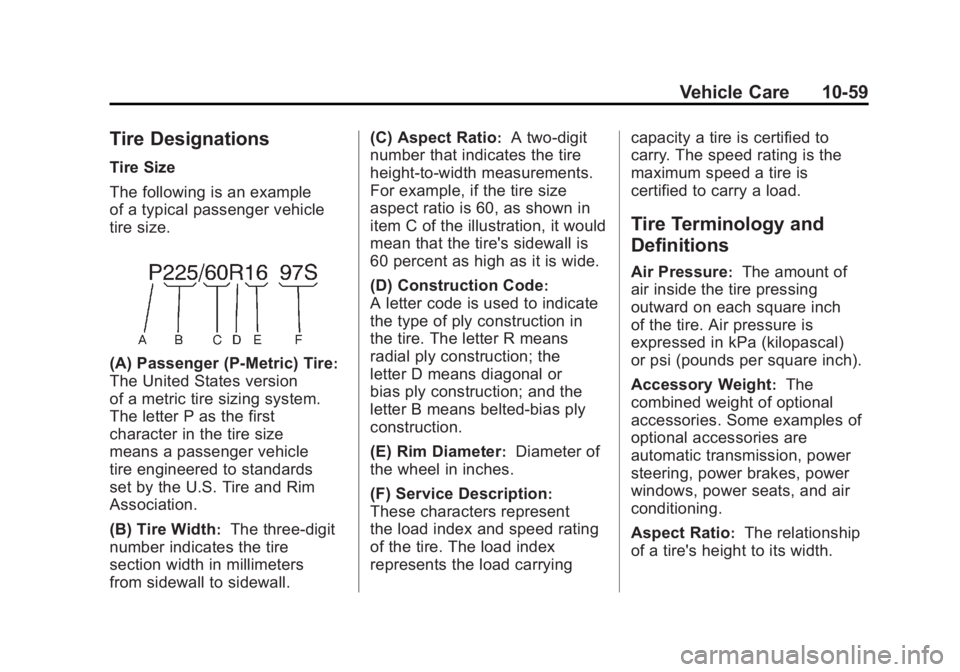
The following is an example
of a typical passenger vehicle
tire size.
(A) Passenger (P‐Metric) Tire:
The United States version
of a metric tire sizing system.
The letter P as the first
character in the tire size
means a passenger vehicle
tire engineered to standards
set by the U.S. Tire and Rim
Association.
(B) Tire Width
:The three‐digit
number indicates the tire
section width in millimeters
from sidewall to sidewall. (C) Aspect Ratio
:A two‐digit
number that indicates the tire
height‐to‐width measurements.
For example, if the tire size
aspect ratio is 60, as shown in
item C of the illustration, it would
mean that the tire's sidewall is
60 percent as high as it is wide.
(D) Construction Code
:
A letter code is used to indicate
the type of ply construction in
the tire. The letter R means
radial ply construction; the
letter D means diagonal or
bias ply construction; and the
letter B means belted‐bias ply
construction.
(E) Rim Diameter
:Diameter of
the wheel in inches.
(F) Service Description
:
These characters represent
the load index and speed rating
of the tire. The load index
represents the load carrying capacity a tire is certified to
carry. The speed rating is the
maximum speed a tire is
certified to carry a load.
Tire Terminology and
Definitions
Air Pressure:The amount of
air inside the tire pressing
outward on each square inch
of the tire. Air pressure is
expressed in kPa (kilopascal)
or psi (pounds per square inch).
Accessory Weight
:The
combined weight of optional
accessories. Some examples of
optional accessories are
automatic transmission, power
steering, power brakes, power
windows, power seats, and air
conditioning.
Aspect Ratio
:The relationship
of a tire's height to its width.
Page 341 of 432
Black plate (65,1)Chevrolet Corvette Owner Manual - 2012
Vehicle Care 10-65
As an added safety feature, your
vehicle has been equipped with a
tire pressure monitoring system
(TPMS) that illuminates a low tire
pressure telltale when one or
more of your tires is significantly
under‐inflated.
Accordingly, when the low tire
pressure telltale illuminates, you
should stop and check your tires as
soon as possible, and inflate them
to the proper pressure. Driving on a
significantly under‐inflated tire
causes the tire to overheat and can
lead to tire failure. Under‐inflation
also reduces fuel efficiency and
tire tread life, and may affect the
vehicle's handling and stopping
ability.
Please note that the TPMS is
not a substitute for proper tire
maintenance, and it is the driver's
responsibility to maintain correct tire
pressure, even if under‐inflation has
not reached the level to trigger
illumination of the TPMS low tire
pressure telltale.Your vehicle has also been
equipped with a TPMS malfunction
indicator to indicate when the
system is not operating properly.
The TPMS malfunction indicator is
combined with the low tire pressure
telltale. When the system detects a
malfunction, the telltale will flash for
approximately one minute and then
remain continuously illuminated.
This sequence will continue upon
subsequent vehicle start‐ups as
long as the malfunction exists.
When the malfunction indicator is
illuminated, the system may not be
able to detect or signal low tire
pressure as intended. TPMS
malfunctions may occur for a variety
of reasons, including the installation
of replacement or alternate tires or
wheels on the vehicle that prevent
the TPMS from functioning properly.
Always check the TPMS malfunction
telltale after replacing one or more
tires or wheels on your vehicle to
ensure that the replacement or
alternate tires and wheels allow
the TPMS to continue to function
properly.
See
Tire Pressure Monitor
Operation on page 10‑66 for
additional information.
Federal Communications
Commission (FCC) Rules and
with Industry Canada
Standards
See Radio Frequency Statement on
page 13‑21 for information
regarding Part 15 of the Federal
Communications Commission (FCC)
Rules and with Industry Canada
Standards RSS-GEN/210/220/310.