lock CHEVROLET DURAMAX 2006 User Guide
[x] Cancel search | Manufacturer: CHEVROLET, Model Year: 2006, Model line: DURAMAX, Model: CHEVROLET DURAMAX 2006Pages: 100, PDF Size: 0.71 MB
Page 73 of 100
{CAUTION:
You can be burned if you spill coolant on hot
components in the engine compartment.
Coolant contains ethylene glycol, and it will
burn if the engine parts are hot enough. Do not
spill coolant on a hot engine or components in
the engine compartment.
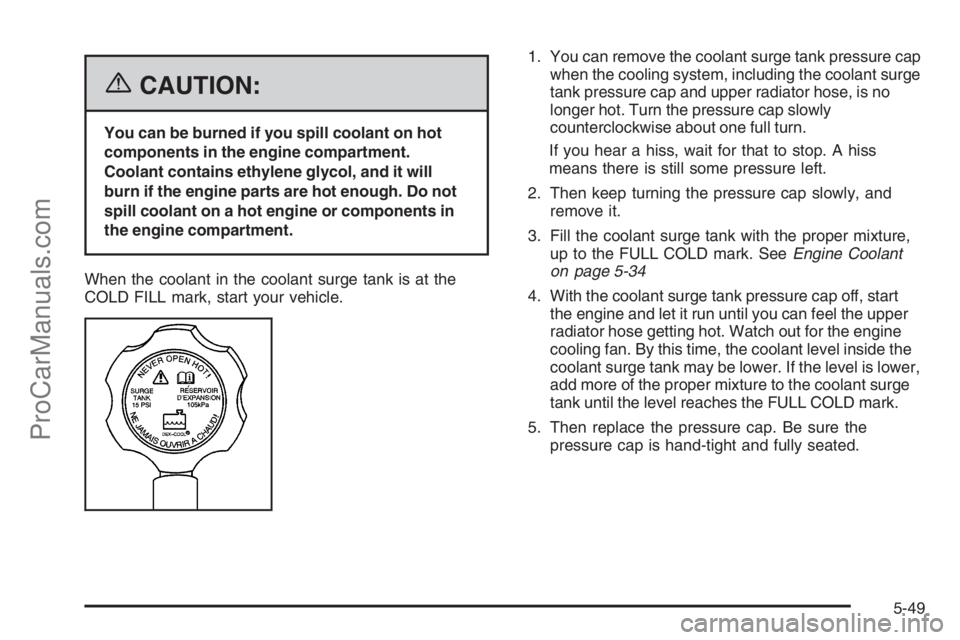
When the coolant in the coolant surge tank is at the
COLD FILL mark, start your vehicle.1. You can remove the coolant surge tank pressure cap
when the cooling system, including the coolant surge
tank pressure cap and upper radiator hose, is no
longer hot. Turn the pressure cap slowly
counterclockwise about one full turn.
If you hear a hiss, wait for that to stop. A hiss
means there is still some pressure left.
2. Then keep turning the pressure cap slowly, and
remove it.
3. Fill the coolant surge tank with the proper mixture,
up to the FULL COLD mark. SeeEngine Coolant
on page 5-34
4. With the coolant surge tank pressure cap off, start
the engine and let it run until you can feel the upper
radiator hose getting hot. Watch out for the engine
cooling fan. By this time, the coolant level inside the
coolant surge tank may be lower. If the level is lower,
add more of the proper mixture to the coolant surge
tank until the level reaches the FULL COLD mark.
5. Then replace the pressure cap. Be sure the
pressure cap is hand-tight and fully seated.
5-49
ProCarManuals.com
Page 84 of 100
(g)Make sure the safety belt reminder light and all your
belts, buckles, latch plates, retractors, and anchorages
are working properly. Look for any other loose or
damaged safety belt system parts. If you see anything
that might keep a safety belt system from doing its
job, have it repaired. Have any torn or frayed safety belts
replaced. Also look for any opened or broken airbag
coverings, and have them repaired or replaced.
The airbag system does not need regular maintenance.
(h)Lubricate all key lock cylinders, body door hinges,
hood latch assembly, secondary latch, pivots, spring
anchor, release pawl, fuel door hinge, locks, latches,
and any folding or moving seat hardware. Pickup
models: Lubricate tailgate hinges, tailgate linkage,
tailgate handle pivot points, and latch bolt. Van models:
Lubricate hood hinges and rear compartment hinges.
More frequent lubrication may be required when
exposed to a corrosive environment. Applying silicone
grease on weatherstrips with a clean cloth will make
them last longer, seal better, and not stick or squeak.
(i)Van Models: If the two chassis mounted fuel
lters have not been replaced, or if the vehicle has
been driven 20,000 miles (32 000 km) or more since the
fuel lters were last replaced, replace both fuel lters.(j)Pickup Models: This vehicle has a CHANGE FUEL
FILTER message in the Driver Information Center (DIC)
to tell you when to replace the fuel lter. See Driver
Information Center (DIC) (Pickup Models Only) on
page 3-9 for more information and how to reset the
message after the fuel lter is replaced. If the fuel lter
has not been replaced, or if the vehicle has been driven
15,000 miles (25 000 km) or more since the fuel lter was
last replaced, replace the lter and reset the message.
(k)Inspect shields and underhood insulation for damage
or looseness. Adjust or replace as required. This is a
Noise Emission Control Service. Applicable to vehicles
sold in the United States and recommended for
vehicles sold in Canada.
(l)Check the air intake system installation to assure
that gaskets are properly sealed and that all hose
connections, fasteners, and other components are tight.
Also check to be sure that the air cleaner housing is
properly seated and the cover ts tightly. Tighten
connections and fasteners or replace damaged parts as
necessary. This is a Noise Emission Control Service.
Applicable to vehicles sold in the United States and
recommended for vehicles sold in Canada.
(m)Check system for interference or binding and for
damaged or missing parts. Replace parts as needed.
Replace any components that have high effort or
excessive wear. Do not lubricate accelerator or
cruise control cables.
6-10
ProCarManuals.com
Page 87 of 100
Automatic Transmission Shift Lock
Control System Check
{CAUTION:
When you are doing this inspection, the
vehicle could move suddenly. If the vehicle
moves, you or others could be injured.
1. Before you start, be sure you have enough room
around the vehicle. It should be parked on a level
surface.
2. Firmly apply the parking brake. See “Parking Brake”
in your owner manual.
Be ready to apply the regular brake immediately if
the vehicle begins to move.3. With the engine off, turn the ignition to RUN, but do
not start the engine. Without applying the regular
brake, try to move the shift lever out of PARK (P)
with normal effort. If the shift lever moves out
of PARK (P), contact your GM Goodwrench
®
dealer for service.
Ignition Transmission Lock Check
While parked, and with the parking brake set, try to turn
the ignition to LOCK in each shift lever position.
•The ignition should turn to LOCK only when the
shift lever is in PARK (P).
•The key should come out only in LOCK.
Contact your GM Goodwrench
®dealer if service is
required.
6-13
ProCarManuals.com
Page 90 of 100
Usage Fluid/Lubricant
Pickup Models:
Manual
Transmission
(5-Speed
without
Low Gear,
RPO MG5)Synchromesh Transmission Fluid
(GM Part No. U.S. 12345349, in
Canada 10953465).
Pickup Models:
Manual
Transmission
(6-Speed)Synthetic Transmission Fluid
approved to Allison Transmission
®
specification TES-295
(GM Part No. U.S. 12378515,
in Canada 88900701).
Automatic
TransmissionDEXRON
®-VI Automatic
Transmission Fluid.
Key Lock
CylindersMulti-Purpose Lubricant, Superlube
(GM Part No. U.S. 12346241,
in Canada 10953474).
Pickup Models:
Floor Shift
LinkageLubriplate Lubricant Aerosol
(GM Part No. U.S. 12346293,
in Canada 992723) or lubricant
meeting requirements of NLGI #2
Category LB or GC-LB.
Chassis
LubricationChassis Lubricant
(GM Part No. U.S. 12377985,
in Canada 88901242) or lubricant
meeting requirements of NLGI #2,
Category LB or GC-LB.
Usage Fluid/Lubricant
Van Models:
Front Wheel
BearingsWheel bearing lubricant meeting
requirements of NLGI #2,
Category GC or GC-LB
(GM Part No. U.S. 1051344,
in Canada 993037).
Van Models:
Front and
Rear AxleSAE 75W-90 Synthetic
Axle Lubricant
(GM Part No. U.S. 12378261, in
Canada 10953455) or equivalent
meeting GM Specification 9986115.
Pickup Models:
Front AxleSAE 80W-90 Axle Lubricant
(GM Part No. U.S. 1052271,
in Canada 10950849).
Pickup Models:
Rear AxleSAE 75W-90 Synthetic
Axle Lubricant
(GM Part No. U.S. 12378261,
in Canada 10953455) meeting
GM Specification 9986115.
Pickup Models:
Manual
Transfer CaseDEXRON
®-III Automatic
Transmission Fluid. Look for
“Approved for the H-Specification”
on the label.
Pickup Models:
Automatic
Transfer CaseAUTO-TRAK II Fluid
(GM Part No. U.S. 12378508,
in Canada 10953626).
Van Models:
Transfer CaseDEXRON
®-III Automatic
Transmission Fluid. Look for
“Approved for the H-Specification”
on the label.
6-16
ProCarManuals.com