lock CHEVROLET DURAMAX 2006 Owners Manual
[x] Cancel search | Manufacturer: CHEVROLET, Model Year: 2006, Model line: DURAMAX, Model: CHEVROLET DURAMAX 2006Pages: 100, PDF Size: 0.71 MB
Page 4 of 100
Starting and Operating
Your Vehicle
Starting the Diesel Engine
Your diesel engine starts differently than a gasoline
engine.
Automatic Transmission
Move your shift lever to PARK (P) or NEUTRAL (N).
Your engine won’t start in any other position — that’s a
safety feature. To restart when you’re already moving,
use NEUTRAL (N) only.
Notice:Do not try to shift to PARK (P) if your
vehicle is moving. If you do, you could damage
the transmission. Shift to PARK (P) only when your
vehicle is stopped.
Manual Transmission
(Pickup Models Only)
Move your shift lever to neutral and hold the clutch pedal
to the floor while starting the engine. Your vehicle won’t
start if the clutch pedal is not all the way down — that’s
a safety feature.
Starting Your Engine
1. Turn your ignition key to RUN.
Observe the wait to start light. SeeWait to Start
Light on page 3-7. This light may not come on if
the engine is hot.
2. As soon as the wait to start light goes off,
immediately turn the ignition key to START.
When the engine starts, let go of the key.
Your engine has a fast warm-up glow plug system.
The wait to start light will illuminate for a much
shorter time than most diesel engines, due to the
rapid heating of the glow plug system.
Notice:Holding your key in START for longer than
15 seconds at a time will cause your battery to be
drained much sooner. And the excessive heat can
damage your starter motor.
Notice:If the wait to start light stays on after
starting your vehicle, your vehicle may not run
properly. Have your vehicle serviced right away.
3. If the engine does not start after 15 seconds of
cranking, turn the ignition key to LOCK. Wait
one minute for the starter to cool, then try the
same steps again.
If you’re trying to start your engine after you’ve run
out of fuel, follow the steps inRunning Out of Fuel
on page 5-11.
2-2
ProCarManuals.com
Page 29 of 100
It is acceptable to use diesel fuel containing up to 5%
biodiesel (B5), but the final blended fuel must meet the
same specification, CAN/CGSB-3.517 (Low Sulfur
Diesel) in Canada, as other fuels used in your vehicle,
and the biodiesel used for making this fuel must meet the
latest version of ASTM specification D 6751. Biodiesel is
produced from vegetable oils or animal fat that have been
chemically modified to reduce the possibility of damage
to your fuel system and engine. Higher concentration
(i.e., greater than B5) biodiesel-containing fuels or the
use of unmodified bio-oils blended into diesel fuel at any
concentration is not recommended and could damage
your fuel system and engine. Such damage would not be
covered by your warranty. If there are questions about
the biodiesel-containing fuels you are using, contact your
fuel supplier.
Very Cold Weather Operation
Follow the instructions listed previously under the
heading “What Fuel to Use.”
Notice:Never use home heating oil or gasoline in
your diesel engine. They can cause engine damage.
In cold weather, your fuel filter may become clogged
(waxed). To unclog it, move the vehicle to a warm garage
area and warm the filter to between 32°F and 50°F
(0°C to 10°C). You will not need to replace it. Additional
information on the fuel filter follows.
Water in Fuel
{CAUTION:
Diesel fuel containing water is still ammable.
You could be burned. If you ever try to drain
water from your fuel, keep sparks, ames and
smoking materials away from the mixture.
Notice:If there is water in your diesel fuel and the
weather is warm or humid, fungus and bacteria can
grow in the fuel. They can damage your fuel system
and fuel operated heater (FOH) (if equipped). A diesel
fuel biocide can be used to sterilize your fuel system.
However, your fuel system may still need to be
cleaned. Your dealer can advise you of the
appropriate solution.
If your fuel tank needs to be purged to remove
water, see your dealer or a qualied technician.
Improper purging can damage your fuel system
and block your FOH.
Sometimes, water can be pumped into your fuel tank
along with your diesel fuel. This can happen if a service
station doesn’t regularly inspect and clean its fuel tanks,
or if it gets contaminated fuel from its suppliers.
5-5
ProCarManuals.com
Page 34 of 100
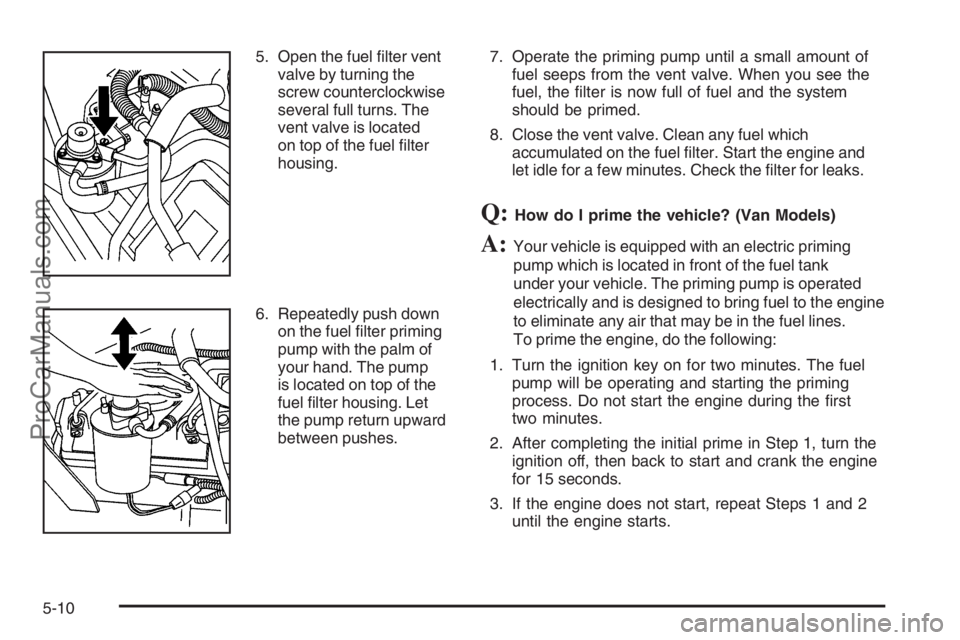
5. Open the fuel filter vent
valve by turning the
screw counterclockwise
several full turns. The
vent valve is located
on top of the fuel filter
housing.
6. Repeatedly push down
on the fuel filter priming
pump with the palm of
your hand. The pump
is located on top of the
fuel filter housing. Let
the pump return upward
between pushes.7. Operate the priming pump until a small amount of
fuel seeps from the vent valve. When you see the
fuel, the filter is now full of fuel and the system
should be primed.
8. Close the vent valve. Clean any fuel which
accumulated on the fuel filter. Start the engine and
let idle for a few minutes. Check the filter for leaks.
Q:How do I prime the vehicle? (Van Models)
A:Your vehicle is equipped with an electric priming
pump which is located in front of the fuel tank
under your vehicle. The priming pump is operated
electrically and is designed to bring fuel to the engine
to eliminate any air that may be in the fuel lines.
To prime the engine, do the following:
1. Turn the ignition key on for two minutes. The fuel
pump will be operating and starting the priming
process. Do not start the engine during the first
two minutes.
2. After completing the initial prime in Step 1, turn the
ignition off, then back to start and crank the engine
for 15 seconds.
3. If the engine does not start, repeat Steps 1 and 2
until the engine starts.
5-10
ProCarManuals.com
Page 37 of 100
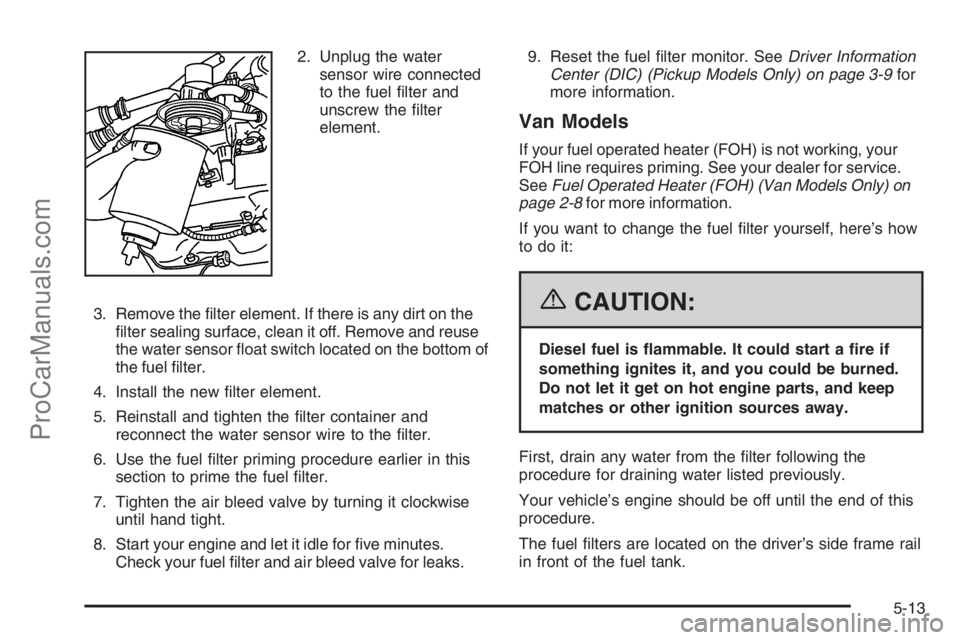
2. Unplug the water
sensor wire connected
to the fuel filter and
unscrew the filter
element.
3. Remove the filter element. If there is any dirt on the
filter sealing surface, clean it off. Remove and reuse
the water sensor float switch located on the bottom of
the fuel filter.
4. Install the new filter element.
5. Reinstall and tighten the filter container and
reconnect the water sensor wire to the filter.
6. Use the fuel filter priming procedure earlier in this
section to prime the fuel filter.
7. Tighten the air bleed valve by turning it clockwise
until hand tight.
8. Start your engine and let it idle for five minutes.
Check your fuel filter and air bleed valve for leaks.9. Reset the fuel filter monitor. SeeDriver Information
Center (DIC) (Pickup Models Only) on page 3-9for
more information.
Van Models
If your fuel operated heater (FOH) is not working, your
FOH line requires priming. See your dealer for service.
SeeFuel Operated Heater (FOH) (Van Models Only) on
page 2-8for more information.
If you want to change the fuel filter yourself, here’s how
to do it:
{CAUTION:
Diesel fuel is ammable. It could start a re if
something ignites it, and you could be burned.
Do not let it get on hot engine parts, and keep
matches or other ignition sources away.
First, drain any water from the filter following the
procedure for draining water listed previously.
Your vehicle’s engine should be off until the end of this
procedure.
The fuel filters are located on the driver’s side frame rail
in front of the fuel tank.
5-13
ProCarManuals.com
Page 40 of 100
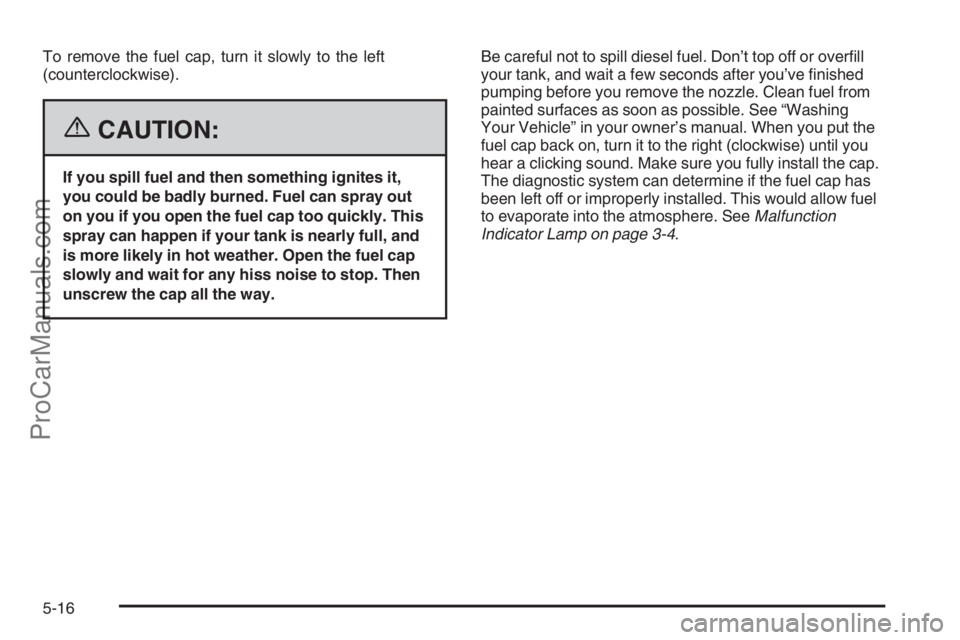
To remove the fuel cap, turn it slowly to the left
(counterclockwise).
{CAUTION:
If you spill fuel and then something ignites it,
you could be badly burned. Fuel can spray out
on you if you open the fuel cap too quickly. This
spray can happen if your tank is nearly full, and
is more likely in hot weather. Open the fuel cap
slowly and wait for any hiss noise to stop. Then
unscrew the cap all the way.Be careful not to spill diesel fuel. Don’t top off or overfill
your tank, and wait a few seconds after you’ve finished
pumping before you remove the nozzle. Clean fuel from
painted surfaces as soon as possible. See “Washing
Your Vehicle” in your owner’s manual. When you put the
fuel cap back on, turn it to the right (clockwise) until you
hear a clicking sound. Make sure you fully install the cap.
The diagnostic system can determine if the fuel cap has
been left off or improperly installed. This would allow fuel
to evaporate into the atmosphere. SeeMalfunction
Indicator Lamp on page 3-4.
5-16
ProCarManuals.com
Page 43 of 100
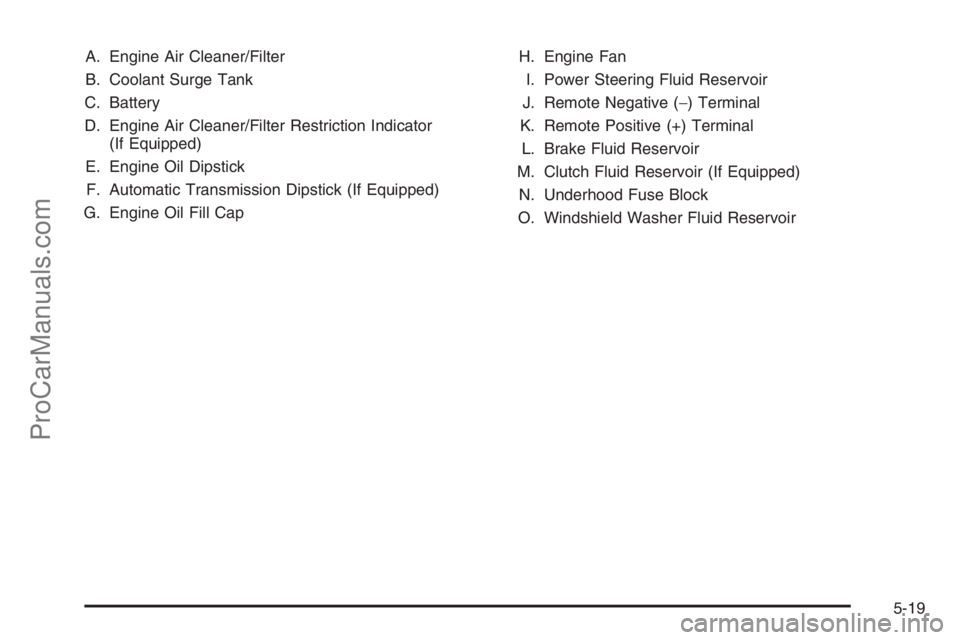
A. Engine Air Cleaner/Filter
B. Coolant Surge Tank
C. Battery
D. Engine Air Cleaner/Filter Restriction Indicator
(If Equipped)
E. Engine Oil Dipstick
F. Automatic Transmission Dipstick (If Equipped)
G. Engine Oil Fill CapH. Engine Fan
I. Power Steering Fluid Reservoir
J. Remote Negative (−) Terminal
K. Remote Positive (+) Terminal
L. Brake Fluid Reservoir
M. Clutch Fluid Reservoir (If Equipped)
N. Underhood Fuse Block
O. Windshield Washer Fluid Reservoir
5-19
ProCarManuals.com
Page 48 of 100
Engine Oil Additives
Do not add anything to your oil. The recommended oils
with the API service symbol are all you will need for
good performance and engine protection.
Engine Oil Life System
When to Change Engine Oil
Your vehicle has a computer system that lets you know
when to change the engine oil and filter. This is based on
engine timing, engine load, and engine temperature, and
not on mileage. Based on driving conditions, the mileage
at which an engine oil change will be indicated can vary
considerably. For the oil life system to work properly, you
must reset the system every time the oil is changed.
When the system has calculated that oil life has been
diminished, it will indicate that an oil change is necessary.
A CHANGE ENGINE OIL message in pickup models
or a change engine oil light in van models will come on.
Change your oil as soon as possible within the next
600 miles (1 000 km). It is possible that, if you are driving
under the best conditions, the oil life system may not
indicate that an oil change is necessary for over a year.
However, your engine oil and filter must be changed at
least once a year and at this time the system must be
reset. Your dealer has GM-trained service people who
will perform this work using genuine GM parts and reset
the system. It is also important to check your oil regularly
and keep it at the proper level.If the system is ever reset accidentally, you must
change your oil at 3,000 miles (5 000 km) since your
last oil change. Remember to reset the oil life system
whenever the oil is changed.
How to Reset the Engine Oil Life
System
The Engine Oil Life System calculates when to change
your engine oil and filter based on vehicle use. Anytime
your oil is changed, reset the system so it can calculate
when the next oil change is required. If a situation occurs
where you change your oil prior to a CHANGE ENGINE
OIL message (pickup models) or a change engine oil light
(van models) being turned on, reset the system.
To reset the Engine Oil Life System, do the following:
1. Turn the ignition key to RUN with the engine off.
2. Fully press and release the accelerator pedal
three times within five seconds.
Pickup Models: If the OIL LIFE RESET message
flashes for 10 seconds, the system is resetting.
Van Models: If the change engine oil light flashes
for five seconds, the system is reset.
3. Turn the key to LOCK.
If the message or light comes back on when you start
your vehicle, the engine oil life system has not reset.
Repeat the procedure. If it still does not reset, see your
dealer for service.
5-24
ProCarManuals.com
Page 57 of 100
Checking the Fluid Level
Prepare your vehicle as follows:
•Park your vehicle on a level place. Keep the engine
running.
•With the parking brake applied, place the shift lever
in PARK (P).
•With your foot on the brake pedal, move the shift
lever through each gear range, pausing for about
three seconds in each range. Then, position the shift
lever in PARK (P).
•Let the engine run at idle for three minutes or more.
Then, without shutting off the engine, follow these steps:The transmission dipstick is located near the center
of the engine compartment and will be labeled with the
graphic shown. SeeEngine Compartment Overview
on page 5-18for more information on location.
1. Flip the handle up and then pull out the dipstick
and wipe it with a clean rag or paper towel.
2. Push it back in all the way, wait three seconds and
then pull it back out again.
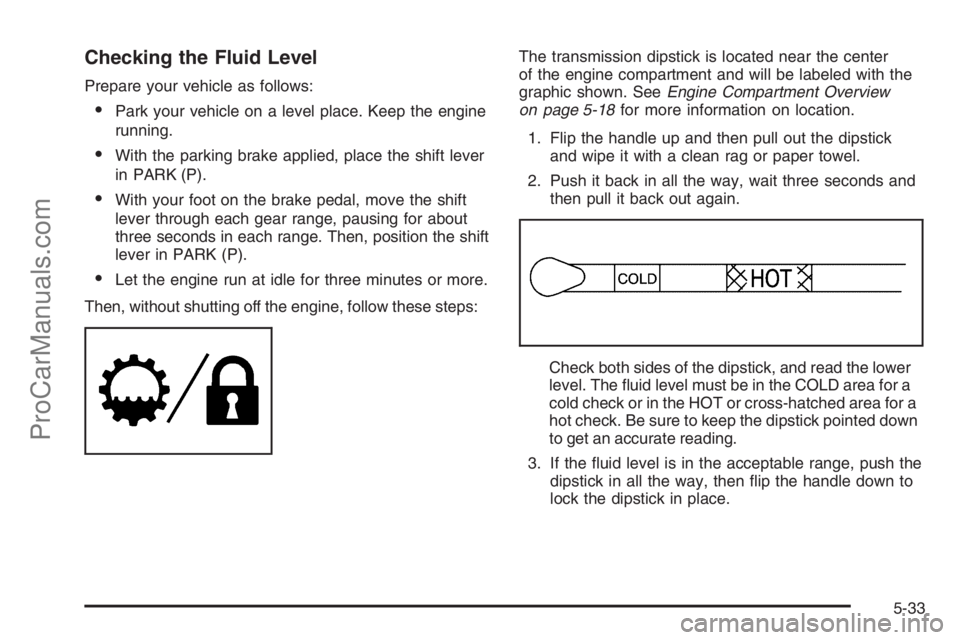
Check both sides of the dipstick, and read the lower
level. The fluid level must be in the COLD area for a
cold check or in the HOT or cross-hatched area for a
hot check. Be sure to keep the dipstick pointed down
to get an accurate reading.
3. If the fluid level is in the acceptable range, push the
dipstick in all the way, then flip the handle down to
lock the dipstick in place.
5-33
ProCarManuals.com
Page 58 of 100
How to Add Fluid
Refer to the Maintenance Schedule to determine what
kind of transmission fluid to use. SeeRecommended
Fluids and Lubricants on page 6-15.
Using a funnel, add fluid down the transmission dipstick
tube only after checking the transmission fluid while it is
hot. A cold check is used only as a reference. If the fluid
level is low, add only enough of the proper fluid to bring
the level up to the HOT area for a hot check. It does not
take much fluid, generally less than one pint (0.5L). Do
not overfill.
Notice:Use of the incorrect automatic transmission
uid may damage your vehicle, and the damages
may not be covered by your warranty. Always
use the automatic transmission uid listed in
Recommended Fluids and Lubricants on page 6-15.
•After adding fluid, recheck the fluid level as
described under “How to Check” earlier in
this section.
•When the correct fluid level is obtained, push the
dipstick back in all the way. Then flip the handle
down to lock the dipstick in place.
Engine Coolant
Pickup Models
The cooling system in your vehicle is filled with
DEX-COOL®engine coolant. This coolant is designed
to remain in your vehicle for 5 years or 150,000 miles
(240 000 km), whichever occurs first, if you add only
DEX-COOL
®extended life coolant.
The following explains your cooling system and how
to add coolant when it is low. If you have a problem
with engine overheating, seeEngine Overheating
on page 5-39.
A 50/50 mixture of clean, drinkable water and
DEX-COOL
®coolant will:
•Give freezing protection down to−34°F (−37°C)
•Give boiling protection up to 265°F (129°C)
•Protect against rust and corrosion
•Help keep the proper engine temperature
•Let the warning lights and gages work as they should
Notice:Using coolant other than DEX-COOL
®may
cause premature engine, heater core, or radiator
corrosion. In addition, the engine coolant may
require changing sooner, at the rst maintenance
service after each 30,000 miles (50 000 km) or
24 months, whichever occurs rst. Any repairs
would not be covered by your warranty. Always use
DEX-COOL
®(silicate-free) coolant in your vehicle.
5-34
ProCarManuals.com
Page 68 of 100
Notice:In cold weather, water can freeze and crack
the engine, radiator, heater core and other parts.
Use the recommended coolant and the proper
coolant mixture.
{CAUTION:
You can be burned if you spill coolant on hot
engine parts. Coolant contains ethylene glycol
and it will burn if the engine parts are hot
enough. Do not spill coolant on a hot engine.
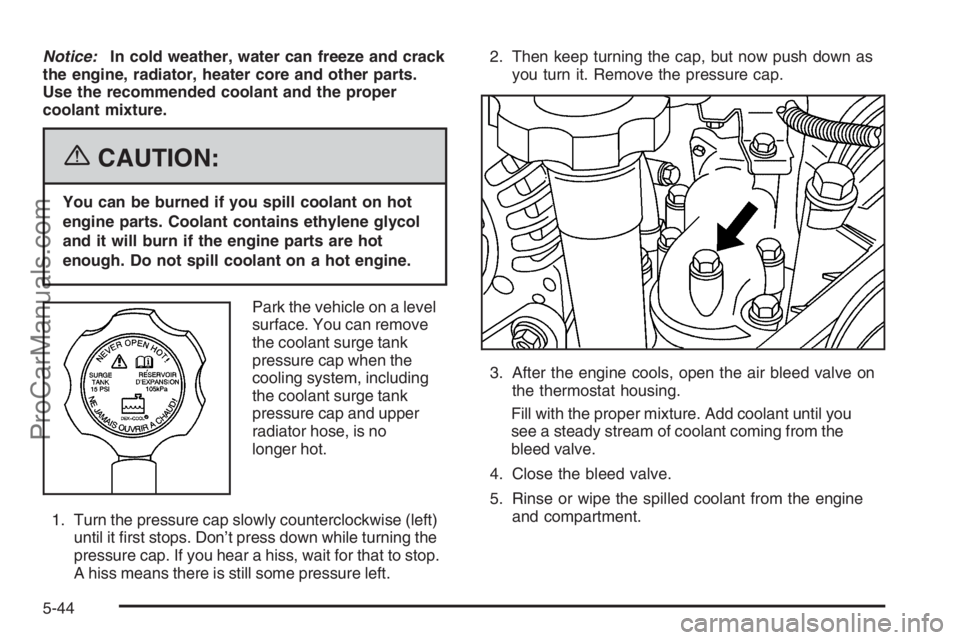
Park the vehicle on a level
surface. You can remove
the coolant surge tank
pressure cap when the
cooling system, including
the coolant surge tank
pressure cap and upper
radiator hose, is no
longer hot.
1. Turn the pressure cap slowly counterclockwise (left)
until it first stops. Don’t press down while turning the
pressure cap. If you hear a hiss, wait for that to stop.
A hiss means there is still some pressure left.2. Then keep turning the cap, but now push down as
you turn it. Remove the pressure cap.
3. After the engine cools, open the air bleed valve on
the thermostat housing.
Fill with the proper mixture. Add coolant until you
see a steady stream of coolant coming from the
bleed valve.
4. Close the bleed valve.
5. Rinse or wipe the spilled coolant from the engine
and compartment.
5-44
ProCarManuals.com