oil level CHEVROLET DURAMAX 2006 Owners Manual
[x] Cancel search | Manufacturer: CHEVROLET, Model Year: 2006, Model line: DURAMAX, Model: CHEVROLET DURAMAX 2006Pages: 100, PDF Size: 0.71 MB
Page 24 of 100
Towing
Towing a Trailer
When towing at high altitude on steep uphill grades,
consider the following:
Engine coolant will boil at a lower temperature than sea
level. If you turn your engine off immediately after towing
at high altitude on steep uphill grades, your vehicle may
show signs similar to engine overheating.To avoid this, let the engine run while parked (preferably
on level ground) with automatic transmission equipped
vehicles in PARK (P) or manual transmission equipped
vehicles in NEUTRAL with the park brake applied for at
least five minutes before turning the engine off. If you do
get the overheat warning, seeEngine Overheating on
page 5-39.
4-2
ProCarManuals.com
Page 45 of 100
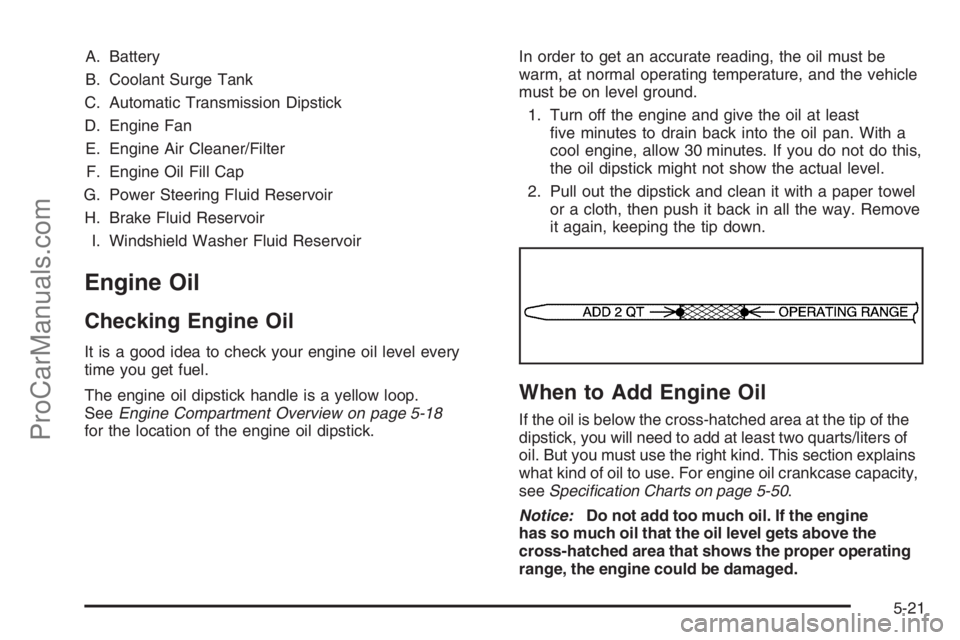
A. Battery
B. Coolant Surge Tank
C. Automatic Transmission Dipstick
D. Engine Fan
E. Engine Air Cleaner/Filter
F. Engine Oil Fill Cap
G. Power Steering Fluid Reservoir
H. Brake Fluid Reservoir
I. Windshield Washer Fluid Reservoir
Engine Oil
Checking Engine Oil
It is a good idea to check your engine oil level every
time you get fuel.
The engine oil dipstick handle is a yellow loop.
SeeEngine Compartment Overview on page 5-18
for the location of the engine oil dipstick.In order to get an accurate reading, the oil must be
warm, at normal operating temperature, and the vehicle
must be on level ground.
1. Turn off the engine and give the oil at least
five minutes to drain back into the oil pan. With a
cool engine, allow 30 minutes. If you do not do this,
the oil dipstick might not show the actual level.
2. Pull out the dipstick and clean it with a paper towel
or a cloth, then push it back in all the way. Remove
it again, keeping the tip down.
When to Add Engine Oil
If the oil is below the cross-hatched area at the tip of the
dipstick, you will need to add at least two quarts/liters of
oil. But you must use the right kind. This section explains
what kind of oil to use. For engine oil crankcase capacity,
seeSpecication Charts on page 5-50.
Notice:Do not add too much oil. If the engine
has so much oil that the oil level gets above the
cross-hatched area that shows the proper operating
range, the engine could be damaged.
5-21
ProCarManuals.com
Page 46 of 100
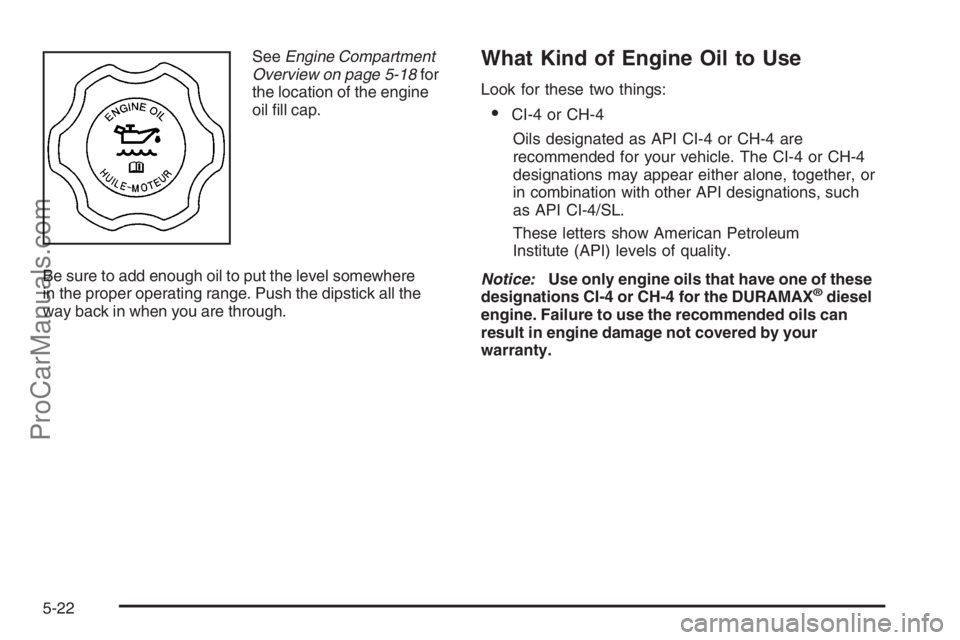
SeeEngine Compartment
Overview on page 5-18for
the location of the engine
oil fill cap.
Be sure to add enough oil to put the level somewhere
in the proper operating range. Push the dipstick all the
way back in when you are through.What Kind of Engine Oil to Use
Look for these two things:
•CI-4 or CH-4
Oils designated as API CI-4 or CH-4 are
recommended for your vehicle. The CI-4 or CH-4
designations may appear either alone, together, or
in combination with other API designations, such
as API CI-4/SL.
These letters show American Petroleum
Institute (API) levels of quality.
Notice:Use only engine oils that have one of these
designations CI-4 or CH-4 for the DURAMAX
®diesel
engine. Failure to use the recommended oils can
result in engine damage not covered by your
warranty.
5-22
ProCarManuals.com
Page 48 of 100
Engine Oil Additives
Do not add anything to your oil. The recommended oils
with the API service symbol are all you will need for
good performance and engine protection.
Engine Oil Life System
When to Change Engine Oil
Your vehicle has a computer system that lets you know
when to change the engine oil and filter. This is based on
engine timing, engine load, and engine temperature, and
not on mileage. Based on driving conditions, the mileage
at which an engine oil change will be indicated can vary
considerably. For the oil life system to work properly, you
must reset the system every time the oil is changed.
When the system has calculated that oil life has been
diminished, it will indicate that an oil change is necessary.
A CHANGE ENGINE OIL message in pickup models
or a change engine oil light in van models will come on.
Change your oil as soon as possible within the next
600 miles (1 000 km). It is possible that, if you are driving
under the best conditions, the oil life system may not
indicate that an oil change is necessary for over a year.
However, your engine oil and filter must be changed at
least once a year and at this time the system must be
reset. Your dealer has GM-trained service people who
will perform this work using genuine GM parts and reset
the system. It is also important to check your oil regularly
and keep it at the proper level.If the system is ever reset accidentally, you must
change your oil at 3,000 miles (5 000 km) since your
last oil change. Remember to reset the oil life system
whenever the oil is changed.
How to Reset the Engine Oil Life
System
The Engine Oil Life System calculates when to change
your engine oil and filter based on vehicle use. Anytime
your oil is changed, reset the system so it can calculate
when the next oil change is required. If a situation occurs
where you change your oil prior to a CHANGE ENGINE
OIL message (pickup models) or a change engine oil light
(van models) being turned on, reset the system.
To reset the Engine Oil Life System, do the following:
1. Turn the ignition key to RUN with the engine off.
2. Fully press and release the accelerator pedal
three times within five seconds.
Pickup Models: If the OIL LIFE RESET message
flashes for 10 seconds, the system is resetting.
Van Models: If the change engine oil light flashes
for five seconds, the system is reset.
3. Turn the key to LOCK.
If the message or light comes back on when you start
your vehicle, the engine oil life system has not reset.
Repeat the procedure. If it still does not reset, see your
dealer for service.
5-24
ProCarManuals.com
Page 53 of 100
Automatic Transmission Fluid
When to Check and Change
(Pickup Models)
A good time to check your automatic transmission fluid
level is when the engine oil is changed.
Change both the fluid and filter every 25,000 miles
(41 500 km) if the vehicle is mainly driven under one
or more of these conditions:
•In heavy city traffic where the outside temperature
regularly reaches 90°F (32°C) or higher.
•In hilly or mountainous terrain.
•When doing frequent trailer towing.
•Uses such as found in taxi, police or
delivery service.
If you do not use your vehicle under any of
these conditions, change the fluid and filter
every 50,000 miles (83 000 km).
SeeScheduled Maintenance on page 6-4.
How to Check
Because this operation can be a little difficult, you may
choose to have this done at the dealership service
department.
If you do it yourself, be sure to follow all the instructions
here, or you could get a false reading on the dipstick.
Notice:Too much or too little uid can damage your
transmission. Too much can mean that some of the
uid could come out and fall on hot engine part or
exhaust system parts, starting a re. Too little uid
could cause the transmission to overheat. Be sure
to get an accurate reading if you check your
transmission uid.
Wait at least 30 minutes before checking the
transmission fluid level if you have been driving:
•When outside temperatures are above 90°F (32°C).
•At high speed for quite a while.
•In heavy traffic — especially in hot weather.
•While pulling a trailer.
5-29
ProCarManuals.com
Page 56 of 100
When to Check and Change
(Van Models)
A good time to check your automatic transmission fluid
level is when the engine oil is changed.
Change the fluid and filter at the intervals listed in
“Additional Required Services”. SeeAdditional
Required Services on page 6-7.
And be sure to use the transmission fluid listed
in “Recommended Fluids and Lubricants”. See
Recommended Fluids and Lubricants on page 6-15
for more information.
How to Check
Because this operation can be a little difficult, you may
choose to have this done at the dealership service
department.
If you do it yourself, be sure to follow all the instructions
here, or you could get a false reading on the dipstick.
Notice:Too much or too little uid can damage your
transmission. Too much can mean that some of the
uid could come out and fall on hot engine part or
exhaust system parts, starting a re. Too little uid
could cause the transmission to overheat. Be sure
to get an accurate reading if you check your
transmission uid.Wait at least 30 minutes before checking the
transmission fluid level if you have been driving:
•When outside temperatures are above 90°F (32° C).
•At high speed for quite a while.
•In heavy traffic — especially in hot weather.
•While pulling a trailer.
To get the right reading, the fluid should be at normal
operating temperature, which is 180°F to 200°F
(82°C to 93°C). Get the vehicle warmed up by driving
about 15 miles (24 km) when outside temperatures are
above 50°F (10°C). If it is colder than 50°F (10°C), drive
the vehicle until the engine temperature gage moves and
then remains steady for 10 minutes.
A cold check can be made after the vehicle has been
sitting for eight hours or more with the engine off, but this
is used only as a reference. Let the engine run at idle for
five minutes if outside temperatures are 50°F (10°C) or
more. If it is colder than 50°F (10 C), you may have to idle
the engine longer. Should the fluid level be low during this
cold check, you must check the fluid hot before adding
fluid. Checking the fluid hot will give you a more accurate
reading of the fluid level.
5-32
ProCarManuals.com
Page 58 of 100
How to Add Fluid
Refer to the Maintenance Schedule to determine what
kind of transmission fluid to use. SeeRecommended
Fluids and Lubricants on page 6-15.
Using a funnel, add fluid down the transmission dipstick
tube only after checking the transmission fluid while it is
hot. A cold check is used only as a reference. If the fluid
level is low, add only enough of the proper fluid to bring
the level up to the HOT area for a hot check. It does not
take much fluid, generally less than one pint (0.5L). Do
not overfill.
Notice:Use of the incorrect automatic transmission
uid may damage your vehicle, and the damages
may not be covered by your warranty. Always
use the automatic transmission uid listed in
Recommended Fluids and Lubricants on page 6-15.
•After adding fluid, recheck the fluid level as
described under “How to Check” earlier in
this section.
•When the correct fluid level is obtained, push the
dipstick back in all the way. Then flip the handle
down to lock the dipstick in place.
Engine Coolant
Pickup Models
The cooling system in your vehicle is filled with
DEX-COOL®engine coolant. This coolant is designed
to remain in your vehicle for 5 years or 150,000 miles
(240 000 km), whichever occurs first, if you add only
DEX-COOL
®extended life coolant.
The following explains your cooling system and how
to add coolant when it is low. If you have a problem
with engine overheating, seeEngine Overheating
on page 5-39.
A 50/50 mixture of clean, drinkable water and
DEX-COOL
®coolant will:
•Give freezing protection down to−34°F (−37°C)
•Give boiling protection up to 265°F (129°C)
•Protect against rust and corrosion
•Help keep the proper engine temperature
•Let the warning lights and gages work as they should
Notice:Using coolant other than DEX-COOL
®may
cause premature engine, heater core, or radiator
corrosion. In addition, the engine coolant may
require changing sooner, at the rst maintenance
service after each 30,000 miles (50 000 km) or
24 months, whichever occurs rst. Any repairs
would not be covered by your warranty. Always use
DEX-COOL
®(silicate-free) coolant in your vehicle.
5-34
ProCarManuals.com
Page 65 of 100
If you get the overheat warning with no sign of steam,
try this for a minute or so:
1. In heavy traffic, let the engine idle in NEUTRAL (N)
while stopped. If it is safe to do so, pull off the road,
shift to PARK (P) or NEUTRAL (N), and let the
engine idle.
2. Turn on your heater to full hot at the highest fan
speed and open the window as necessary.
If you no longer have the overheat warning, you can
drive. Just to be safe, drive slower for about 10 minutes.
If the warning doesn’t come back on, you can drive
normally.
If the warning continues, pull over, stop, and park your
vehicle right away.
If there’s still no sign of steam and your vehicle is
equipped with an engine driven cooling fan, push down
the accelerator until the engine speed is about twice as
fast as normal idle speed for at least three minutes while
you’re parked. If there is no sign of steam and your
vehicle is equipped with an electric cooling fan, idle the
engine for three minutes while you’re parked. If you still
have the warning,turn off the engine and get everyone
out of the vehicleuntil it cools down.
You may decide not to lift the hood but to get service
help right away.Cooling System
Pickup Models
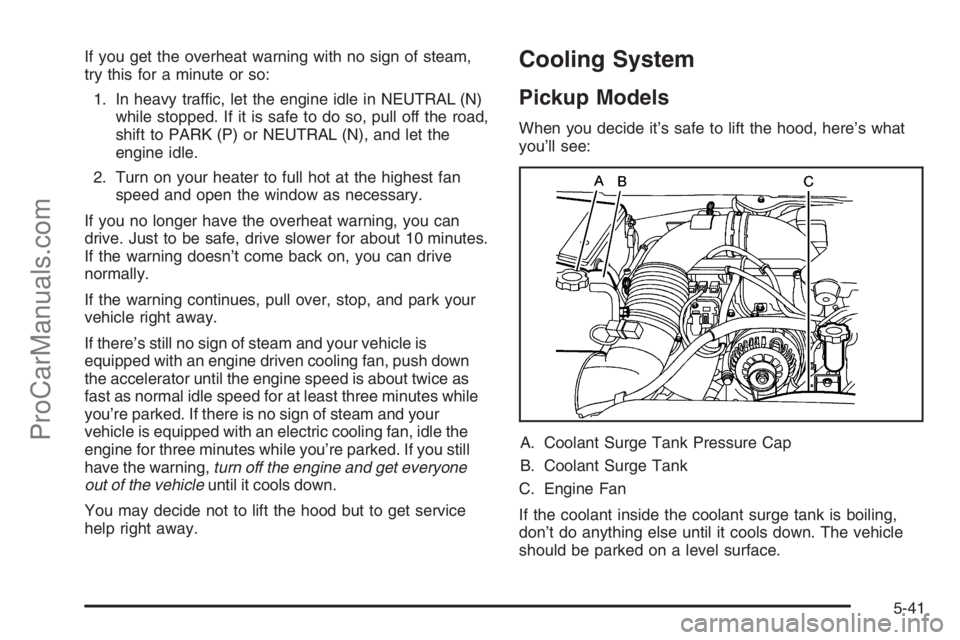
When you decide it’s safe to lift the hood, here’s what
you’ll see:
A. Coolant Surge Tank Pressure Cap
B. Coolant Surge Tank
C. Engine Fan
If the coolant inside the coolant surge tank is boiling,
don’t do anything else until it cools down. The vehicle
should be parked on a level surface.
5-41
ProCarManuals.com
Page 67 of 100
How to Add Coolant to the Coolant
Surge Tank
Notice:The diesel engine has a specic coolant
ll procedure. Failure to follow this procedure could
cause your engine to overheat and be severely
damaged.
If you haven’t found a problem yet, check to see
if coolant is visible in the surge tank. If coolant is visible
but the coolant level isn’t at or above the FULL COLD
mark, add a 50/50 mixture ofclean, drinkable waterand
DEX-COOL
®coolant at the coolant surge tank, but
be sure the cooling system, including the coolant surge
tank pressure cap, is cool before you do it. See
Engine Coolant on page 5-34for more information.
If no coolant is visible in the surge tank, add coolant
as follows:
{CAUTION:
Steam and scalding liquids from a hot cooling
system can blow out and burn you badly.
They are under pressure, and if you turn the
coolant surge tank pressure cap — even a
little — they can come out at high speed.
CAUTION: (Continued)
CAUTION: (Continued)
Never turn the cap when the cooling system,
including the coolant surge tank pressure cap,
is hot. Wait for the cooling system and coolant
surge tank pressure cap to cool if you ever
have to turn the pressure cap.
{CAUTION:
Adding only plain water to your cooling
system can be dangerous. Plain water, or
some other liquid such as alcohol, can boil
before the proper coolant mixture will. Your
vehicle’s coolant warning system is set for the
proper coolant mixture. With plain water or the
wrong mixture, your engine could get too hot
but you would not get the overheat warning.
Your engine could catch re and you or others
could be burned. Use a 50/50 mixture of clean,
drinkable water and DEX-COOL
®coolant.
5-43
ProCarManuals.com
Page 70 of 100
Van Models
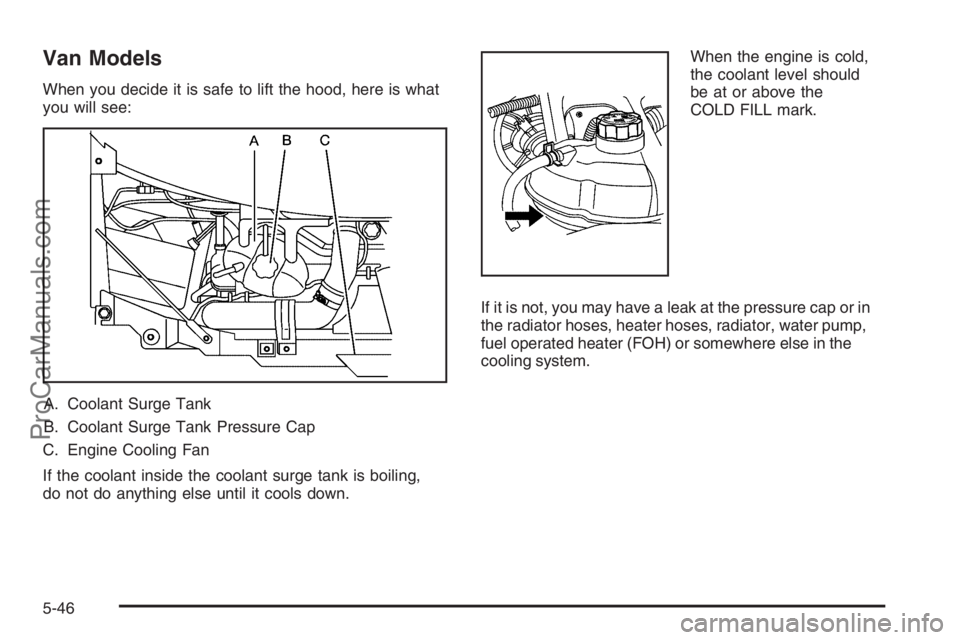
When you decide it is safe to lift the hood, here is what
you will see:
A. Coolant Surge Tank
B. Coolant Surge Tank Pressure Cap
C. Engine Cooling Fan
If the coolant inside the coolant surge tank is boiling,
do not do anything else until it cools down.When the engine is cold,
the coolant level should
be at or above the
COLD FILL mark.
If it is not, you may have a leak at the pressure cap or in
the radiator hoses, heater hoses, radiator, water pump,
fuel operated heater (FOH) or somewhere else in the
cooling system.
5-46
ProCarManuals.com