steering wheel CHEVROLET DURAMAX 2006 Owners Manual
[x] Cancel search | Manufacturer: CHEVROLET, Model Year: 2006, Model line: DURAMAX, Model: CHEVROLET DURAMAX 2006Pages: 100, PDF Size: 0.71 MB
Page 6 of 100
Be sure you are using the proper fuel for existing
weather conditions. SeeDiesel Fuel Requirements
and Fuel System on page 5-2.
If the engine starts, runs a short time, then stops, your
vehicle needs service.
{CAUTION:
Do not use gasoline or starting aids, such as
ether, in the air intake. They could damage
your engine. There could also be a re, which
could cause serious personal injury.
Elevated Idle/Exhaust Restrictor
The engine has a cold temperature high idle and exhaust
restrictor feature which elevates the engines idle speed
from 680 to 1200 rpms, and restricts the exhaust gas
flow, when outside temperatures are below 32°F (0°C),
and the engine coolant temperature is below 150°F
(65°C.) This feature enhances heater performance
by raising the engine coolant temperature faster.For pickup models, this feature can be turned off and
on using the DIC steering wheel control buttons. If your
vehicle is not equipped with the DIC steering wheel
control buttons, do the following to turn on this feature:
1. Turn the ignition to RUN, with the vehicle off.
2. Press the accelerator pedal to the floor and hold
while quickly pressing the brake pedal three times
in less than eight seconds.
3. Release the accelerator pedal and start the engine.
When the engine is started, it will slowly ramp up to the
high idle speed after a delay of a few seconds up to
approximately two minutes. For this method to work
properly there must be no throttle or brake pedal faults.
The engine idle speed will return to normal once the
following conditions are met:•Once engine coolant temperature reaches
150°F (65°C).
•Air intake temperature reaches 32°F (0°C).
2-4
ProCarManuals.com
Page 21 of 100
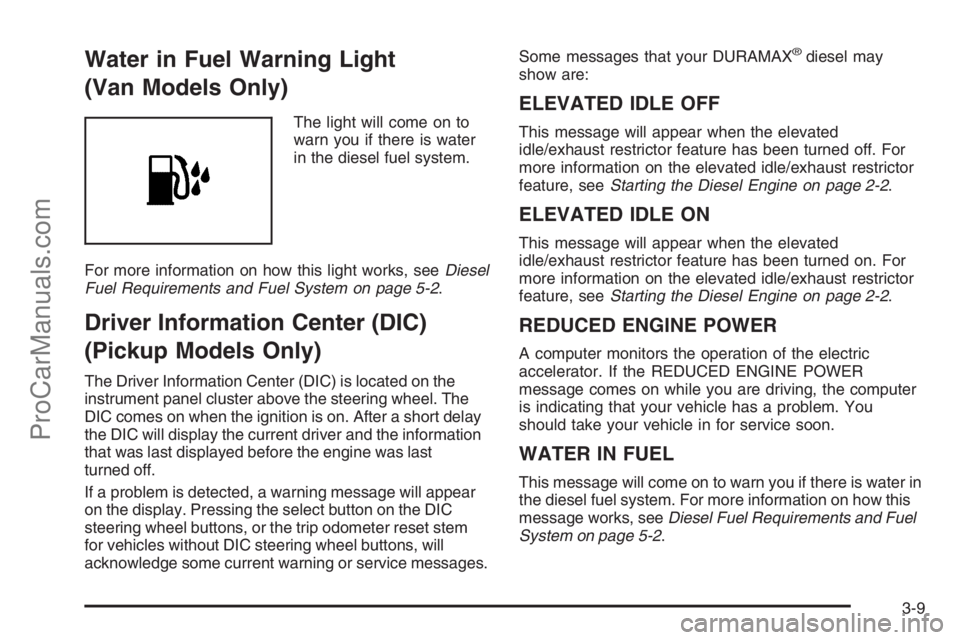
Water in Fuel Warning Light
(Van Models Only)
The light will come on to
warn you if there is water
in the diesel fuel system.
For more information on how this light works, seeDiesel
Fuel Requirements and Fuel System on page 5-2.
Driver Information Center (DIC)
(Pickup Models Only)
The Driver Information Center (DIC) is located on the
instrument panel cluster above the steering wheel. The
DIC comes on when the ignition is on. After a short delay
the DIC will display the current driver and the information
that was last displayed before the engine was last
turned off.
If a problem is detected, a warning message will appear
on the display. Pressing the select button on the DIC
steering wheel buttons, or the trip odometer reset stem
for vehicles without DIC steering wheel buttons, will
acknowledge some current warning or service messages.Some messages that your DURAMAX
®diesel may
show are:
ELEVATED IDLE OFF
This message will appear when the elevated
idle/exhaust restrictor feature has been turned off. For
more information on the elevated idle/exhaust restrictor
feature, seeStarting the Diesel Engine on page 2-2.
ELEVATED IDLE ON
This message will appear when the elevated
idle/exhaust restrictor feature has been turned on. For
more information on the elevated idle/exhaust restrictor
feature, seeStarting the Diesel Engine on page 2-2.
REDUCED ENGINE POWER
A computer monitors the operation of the electric
accelerator. If the REDUCED ENGINE POWER
message comes on while you are driving, the computer
is indicating that your vehicle has a problem. You
should take your vehicle in for service soon.
WATER IN FUEL
This message will come on to warn you if there is water in
the diesel fuel system. For more information on how this
message works, seeDiesel Fuel Requirements and Fuel
System on page 5-2.
3-9
ProCarManuals.com
Page 22 of 100
FUEL FILTER LIFE ###%
This feature is available on vehicles with steering wheel
controls. When the fuel button is pressed and FUEL
FILTER LIFE appears on the display, this information
will give the percentage of fuel filter life remaining.
FUEL FILTER LIFE RESET
This message will appear when a reset is performed
either by using the steering wheel controls or the
following manual procedure.
For vehicles with steering wheel controls, press and
hold the select button for five seconds while the
FUEL FILTER LIFE message is displayed. This
message will appear on the DIC for ten seconds.For vehicles without steering wheel controls, do the
following:
1. Without pressing the pedals, turn the ignition key to
the on position without starting the engine.
2. Wait five seconds.
3. Completely press the brake and the accelerator
pedals simultaneously and hold for ten seconds.
The system is now reset.
4. Turn the ignition key off.
The next time the engine is started, the message will
no longer be displayed. Always reset the FUEL FILTER
LIFE system after a fuel filter change.
CHANGE FUEL FILTER
This message will appear on the DIC for ten seconds
when a fuel filter change is required. SeeFuel Filter
Replacement on page 5-12for more information.
3-10
ProCarManuals.com
Page 83 of 100
Maintenance Footnotes
†The U.S. Environmental Protection Agency or the
California Air Resources Board has determined that the
failure to perform this maintenance item will not nullify
the emission warranty or limit recall liability prior to the
completion of the vehicle’s useful life. We, however,
urge that all recommended maintenance services be
performed at the indicated intervals and the maintenance
be recorded.
#Lubricate the front suspension, steering linkage,
transmission shift linkage (pickup models), rear driveline
center splines (van models), and parking brake cable
guides. Pickup models only: Control arm ball joints
require lubrication but should not be lubricated unless
their temperature is 10°F (-12°C) or higher, or they could
be damaged. Vehicles used under severe commercial
operating conditions require lubrication on a regular basis
every 3,000 miles (5 000 km).
(a)A uid loss in any vehicle system could indicate a
problem. Have the system inspected and repaired
and the uid level checked. Add uid if needed.
(b)If you drive regularly under dusty conditions, inspect
the lter or change indicator, if equipped, at each engine
oil change.(c)Visually inspect brake lines and hoses for proper
hook-up, binding, leaks, cracks, chang, etc. Inspect disc
brake pads for wear and rotors for surface condition.
Inspect drum brake linings/shoes for wear or cracks.
Inspect other brake parts, including drums, wheel
cylinders, calipers, parking brake, etc.
(d)Visually inspect front and rear suspension and
steering system for damaged, loose, or missing parts,
signs of wear or lack of lubrication. Inspect power
steering lines and hoses for proper hook-up, binding,
leaks, cracks, chang, etc. Pickup models: Visually
check constant velocity joints, rubber boots, and axle
seals for leaks.
(e)Visually inspect hoses and have them replaced if they
are cracked, swollen, or deteriorated. Inspect all pipes,
ttings, and clamps; replace with genuine GM parts as
needed. To help ensure proper operation, a pressure test
of the cooling system and pressure cap and cleaning the
outside of the radiator and air conditioning condenser is
recommended at least once a year.
(f)Visually inspect wiper blades for wear or cracking.
Replace wiper blades that appear worn or damaged
or that streak or miss areas of the windshield.
6-9
ProCarManuals.com