service CHEVROLET DYNASTY 1993 Service Manual
[x] Cancel search | Manufacturer: CHEVROLET, Model Year: 1993, Model line: DYNASTY, Model: CHEVROLET DYNASTY 1993Pages: 2438, PDF Size: 74.98 MB
Page 1680 of 2438
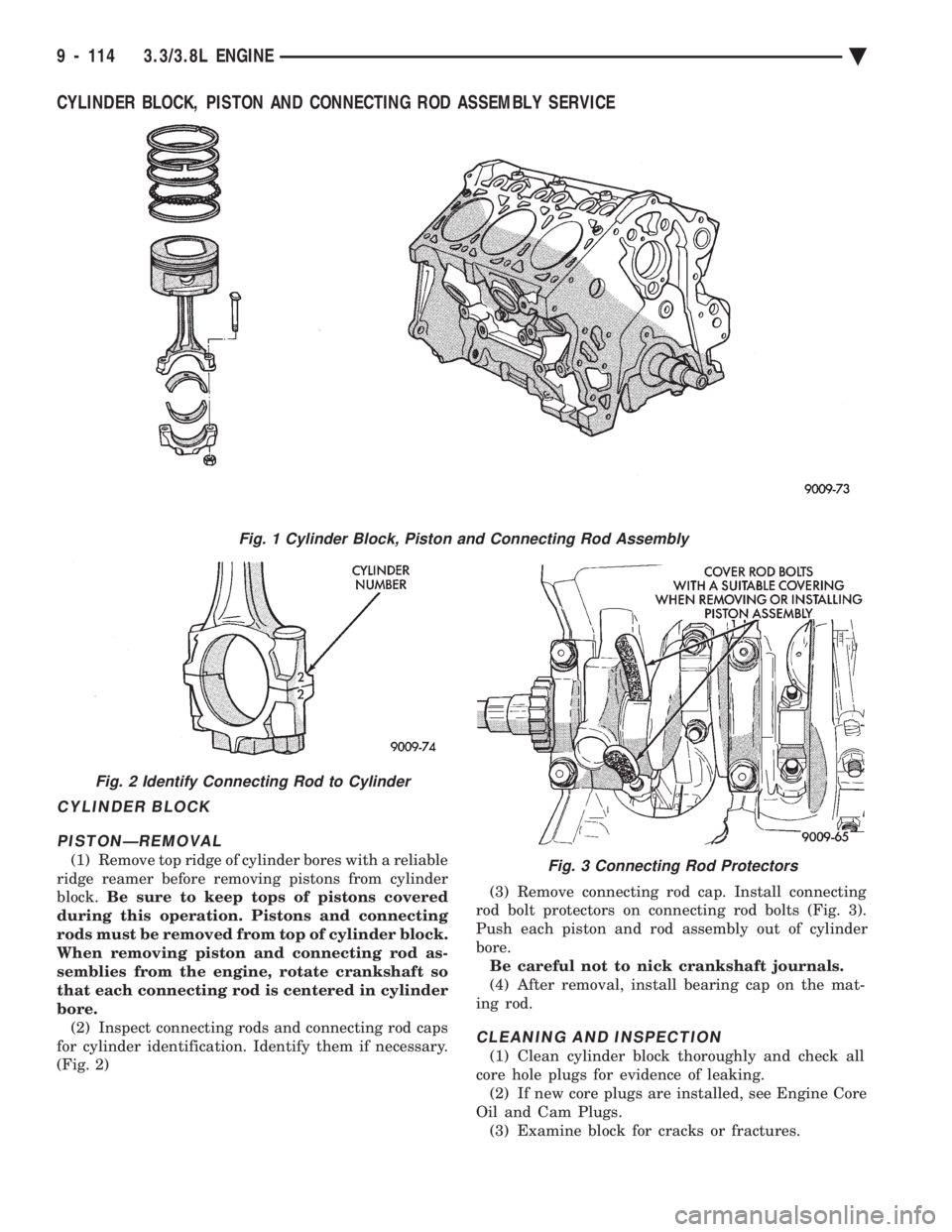
CYLINDER BLOCK, PISTON AND CONNECTING ROD ASSEMBLY SERVICE
CYLINDER BLOCK PISTONÐREMOVAL
(1) Remove top ridge of cylinder bores with a reliable
ridge reamer before removing pistons from cylinder
block. Be sure to keep tops of pistons covered
during this operation. Pistons and connecting
rods must be removed from top of cylinder block.
When removing piston and connecting rod as-
semblies from the engine, rotate crankshaft so
that each connecting rod is centered in cylinder
bore. (2) Inspect connecting rods and connecting rod caps
for cylinder identification. Identify them if necessary.
(Fig. 2) (3) Remove connecting rod cap. Install connecting
rod bolt protectors on connecting rod bolts (Fig. 3).
Push each piston and rod assembly out of cylinder
bore. Be careful not to nick crankshaft journals.
(4) After removal, install bearing cap on the mat-
ing rod.
CLEANING AND INSPECTION
(1) Clean cylinder block thoroughly and check all
core hole plugs for evidence of leaking. (2) If new core plugs are installed, see Engine Core
Oil and Cam Plugs. (3) Examine block for cracks or fractures.
Fig. 1 Cylinder Block, Piston and Connecting Rod Assembly
Fig. 2 Identify Connecting Rod to Cylinder
Fig. 3 Connecting Rod Protectors
9 - 114 3.3/3.8L ENGINE Ä
Page 1681 of 2438
CYLINDER BORE INSPECTION
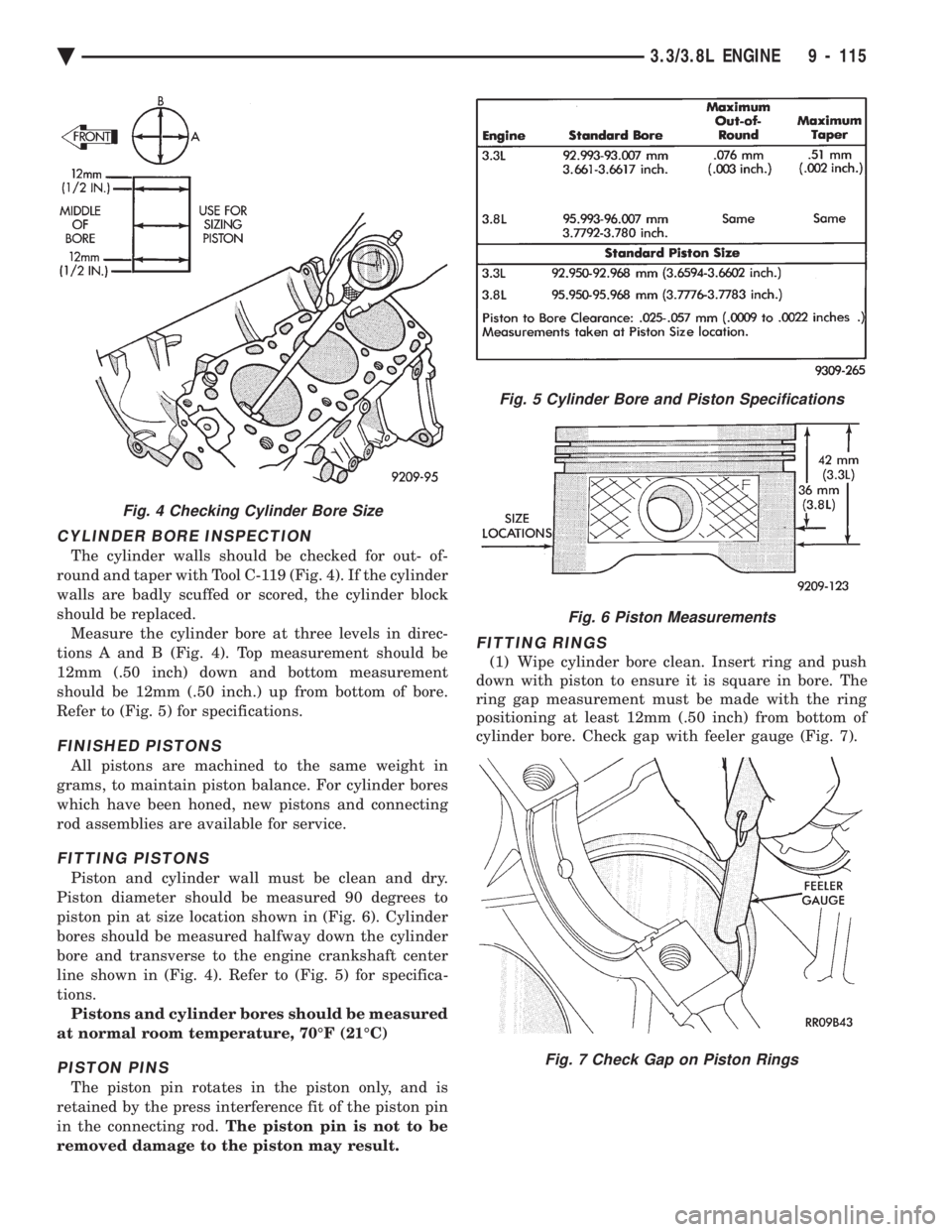
The cylinder walls should be checked for out- of-
round and taper with Tool C-119 (Fig. 4). If the cylinder
walls are badly scuffed or scored, the cylinder block
should be replaced. Measure the cylinder bore at three levels in direc-
tions A and B (Fig. 4). Top measurement should be
12mm (.50 inch) down and bottom measurement
should be 12mm (.50 inch.) up from bottom of bore.
Refer to (Fig. 5) for specifications.
FINISHED PISTONS
All pistons are machined to the same weight in
grams, to maintain piston balance. For cylinder bores
which have been honed, new pistons and connecting
rod assemblies are available for service.
FITTING PISTONS
Piston and cylinder wall must be clean and dry.
Piston diameter should be measured 90 degrees to
piston pin at size location shown in (Fig. 6). Cylinder
bores should be measured halfway down the cylinder
bore and transverse to the engine crankshaft center
line shown in (Fig. 4). Refer to (Fig. 5) for specifica-
tions. Pistons and cylinder bores should be measured
at normal room temperature, 70ÉF (21ÉC)
PISTON PINS
The piston pin rotates in the piston only, and is
retained by the press interference fit of the piston pin
in the connecting rod. The piston pin is not to be
removed damage to the piston may result.
FITTING RINGS
(1) Wipe cylinder bore clean. Insert ring and push
down with piston to ensure it is square in bore. The
ring gap measurement must be made with the ring
positioning at least 12mm (.50 inch) from bottom of
cylinder bore. Check gap with feeler gauge (Fig. 7).
Fig. 5 Cylinder Bore and Piston Specifications
Fig. 6 Piston Measurements
Fig. 7 Check Gap on Piston Rings
Fig. 4 Checking Cylinder Bore Size
Ä 3.3/3.8L ENGINE 9 - 115
Page 1684 of 2438
CONNECTING RODS
INSTALLATION OF CONNECTING ROD BEAR- INGS
Fit all rods on one bank until complete.
The bearing caps are not interchangeable and should
be marked at removal to insure correct assembly. The bearing shells must be installed with the tangs
inserted into the machined grooves in the rods and
caps. Install cap with the tangs on the same side as the
rod. Limits of taper or out-of-round on any crankshaft
journals should be held to .025mm (.001 inch). Bear-
ings are available in .025mm (.001 inch), .051mm (.002
inch),.076mm (.003 inch), .254mm (.010 inch) and
.305mm (.012 inch) undersize. Install the bearings
in pairs. Do not use a new bearing half with an
old bearing half. Do not file the rods or bearing
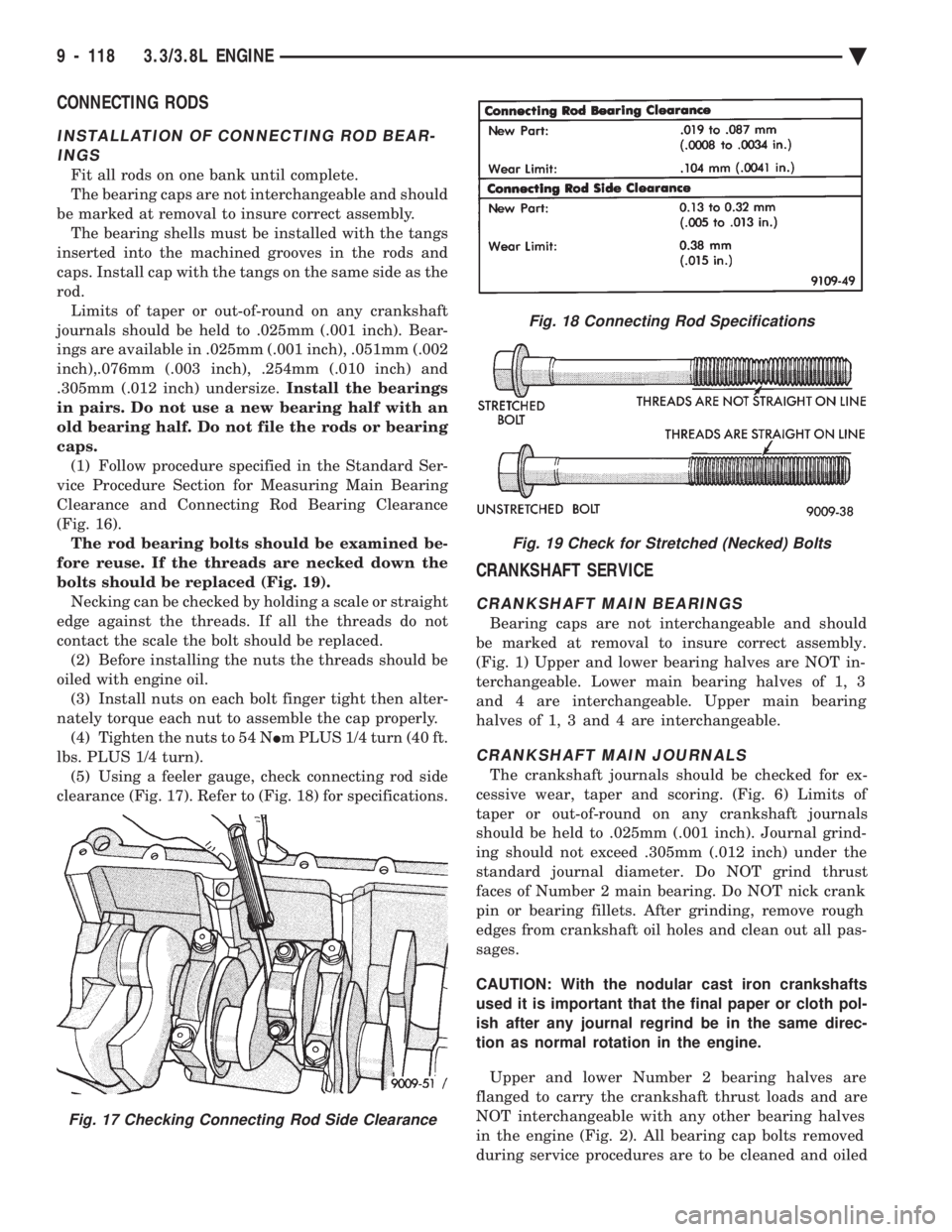
caps. (1) Follow procedure specified in the Standard Ser-
vice Procedure Section for Measuring Main Bearing
Clearance and Connecting Rod Bearing Clearance
(Fig. 16). The rod bearing bolts should be examined be-
fore reuse. If the threads are necked down the
bolts should be replaced (Fig. 19). Necking can be checked by holding a scale or straight
edge against the threads. If all the threads do not
contact the scale the bolt should be replaced. (2) Before installing the nuts the threads should be
oiled with engine oil. (3) Install nuts on each bolt finger tight then alter-
nately torque each nut to assemble the cap properly. (4) Tighten the nuts to 54 N Im PLUS 1/4 turn (40 ft.
lbs. PLUS 1/4 turn). (5) Using a feeler gauge, check connecting rod side
clearance (Fig. 17). Refer to (Fig. 18) for specifications.
CRANKSHAFT SERVICE
CRANKSHAFT MAIN BEARINGS
Bearing caps are not interchangeable and should
be marked at removal to insure correct assembly.
(Fig. 1) Upper and lower bearing halves are NOT in-
terchangeable. Lower main bearing halves of 1, 3
and 4 are interchangeable. Upper main bearing
halves of 1, 3 and 4 are interchangeable.
CRANKSHAFT MAIN JOURNALS
The crankshaft journals should be checked for ex-
cessive wear, taper and scoring. (Fig. 6) Limits of
taper or out-of-round on any crankshaft journals
should be held to .025mm (.001 inch). Journal grind-
ing should not exceed .305mm (.012 inch) under the
standard journal diameter. Do NOT grind thrust
faces of Number 2 main bearing. Do NOT nick crank
pin or bearing fillets. After grinding, remove rough
edges from crankshaft oil holes and clean out all pas-
sages.
CAUTION: With the nodular cast iron crankshafts
used it is important that the final paper or cloth pol-
ish after any journal regrind be in the same direc-
tion as normal rotation in the engine.
Upper and lower Number 2 bearing halves are
flanged to carry the crankshaft thrust loads and are
NOT interchangeable with any other bearing halves
in the engine (Fig. 2). All bearing cap bolts removed
during service procedures are to be cleaned and oiled
Fig. 18 Connecting Rod Specifications
Fig. 19 Check for Stretched (Necked) Bolts
Fig. 17 Checking Connecting Rod Side Clearance
9 - 118 3.3/3.8L ENGINE Ä
Page 1686 of 2438
cap and a crankshaft cheek using care not to damage
any bearing surface. Do notloosen main bearing cap.
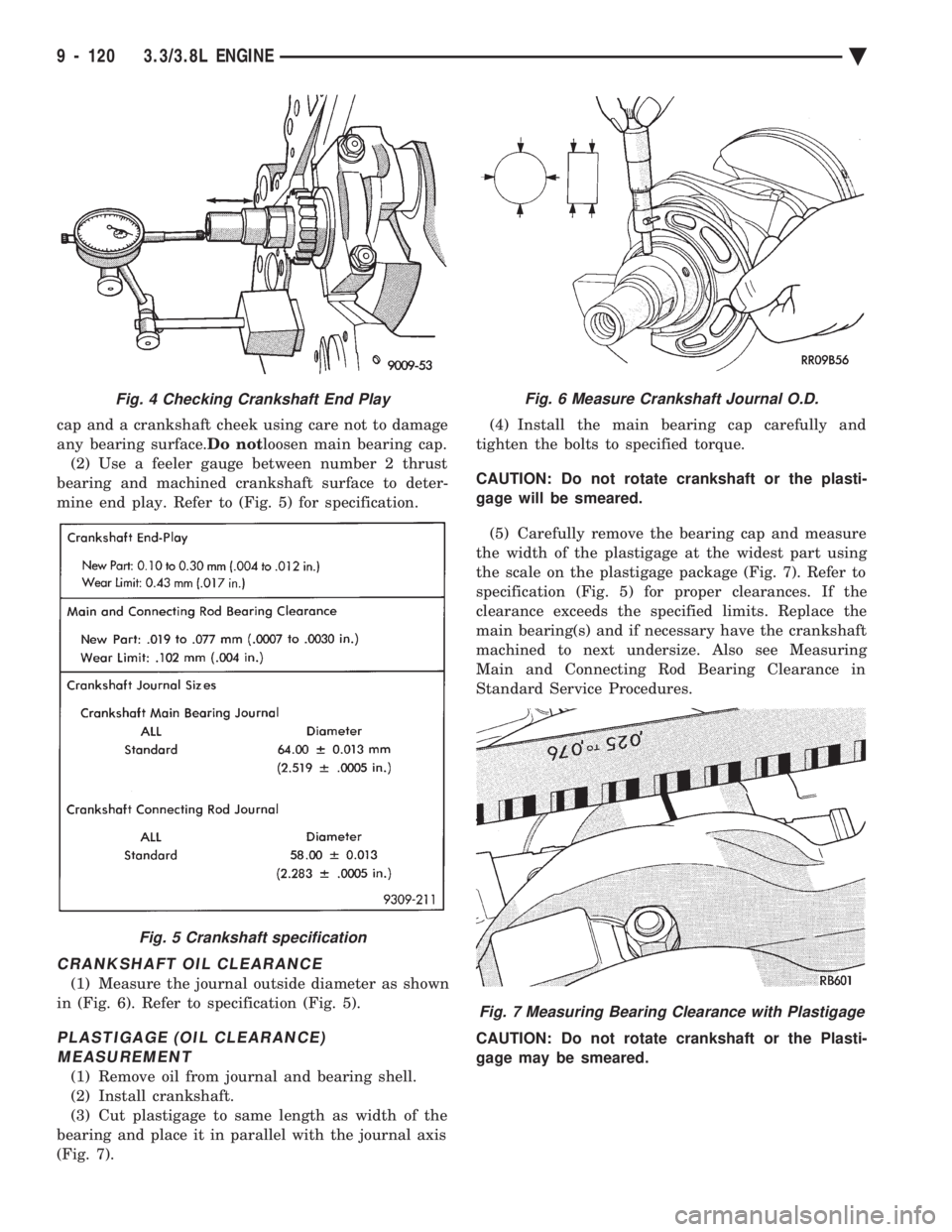
(2) Use a feeler gauge between number 2 thrust
bearing and machined crankshaft surface to deter-
mine end play. Refer to (Fig. 5) for specification.
CRANKSHAFT OIL CLEARANCE
(1) Measure the journal outside diameter as shown
in (Fig. 6). Refer to specification (Fig. 5).
PLASTIGAGE (OIL CLEARANCE) MEASUREMENT
(1) Remove oil from journal and bearing shell.
(2) Install crankshaft.
(3) Cut plastigage to same length as width of the
bearing and place it in parallel with the journal axis
(Fig. 7). (4) Install the main bearing cap carefully and
tighten the bolts to specified torque.
CAUTION: Do not rotate crankshaft or the plasti-
gage will be smeared.
(5) Carefully remove the bearing cap and measure
the width of the plastigage at the widest part using
the scale on the plastigage package (Fig. 7). Refer to
specification (Fig. 5) for proper clearances. If the
clearance exceeds the specified limits. Replace the
main bearing(s) and if necessary have the crankshaft
machined to next undersize. Also see Measuring
Main and Connecting Rod Bearing Clearance in
Standard Service Procedures.
CAUTION: Do not rotate crankshaft or the Plasti-
gage may be smeared.
Fig. 4 Checking Crankshaft End Play
Fig. 5 Crankshaft specification
Fig. 6 Measure Crankshaft Journal O.D.
Fig. 7 Measuring Bearing Clearance with Plastigage
9 - 120 3.3/3.8L ENGINE Ä
Page 1687 of 2438
CRANKSHAFT OIL SEALS SERVICE
REMOVAL
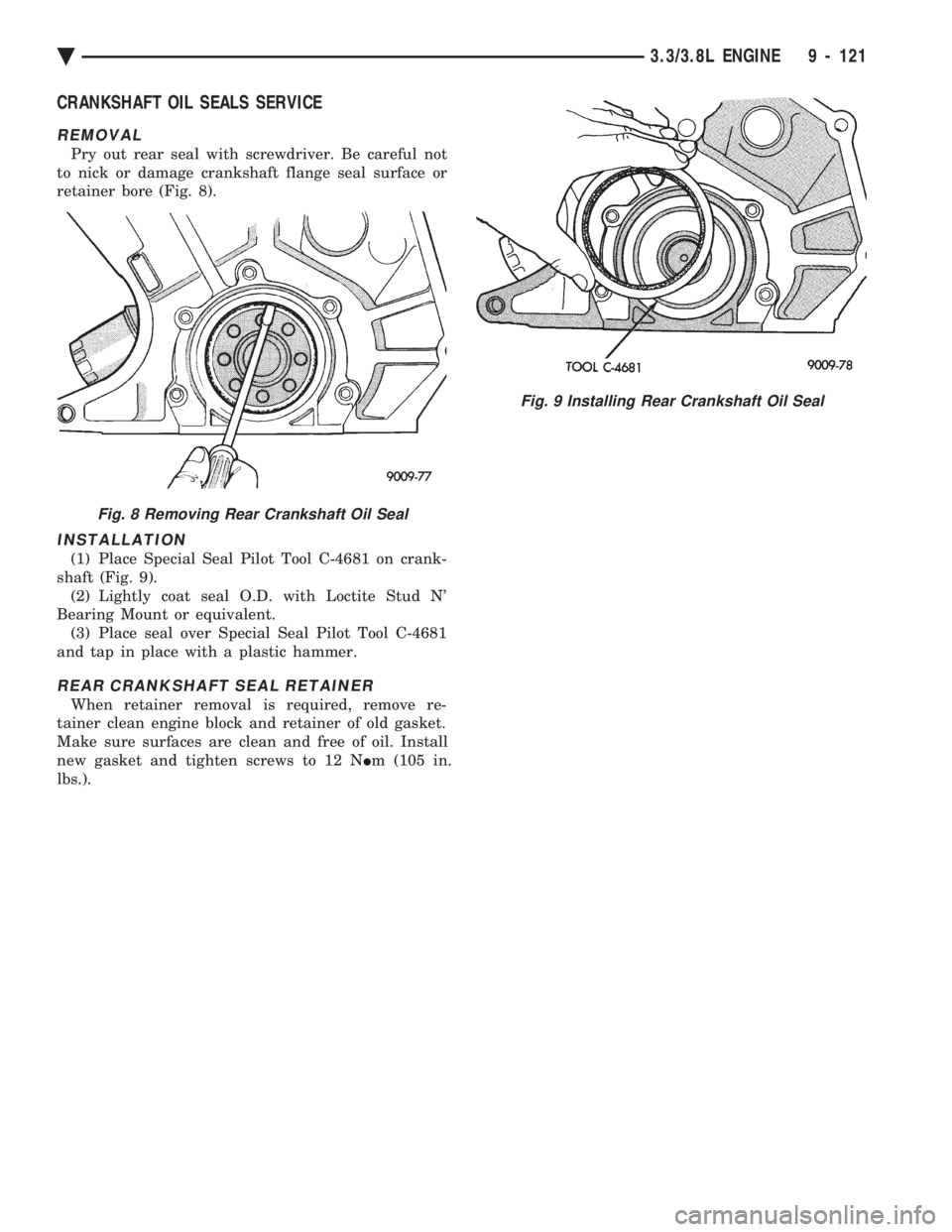
Pry out rear seal with screwdriver. Be careful not
to nick or damage crankshaft flange seal surface or
retainer bore (Fig. 8).
INSTALLATION
(1) Place Special Seal Pilot Tool C-4681 on crank-
shaft (Fig. 9). (2) Lightly coat seal O.D. with Loctite Stud N'
Bearing Mount or equivalent. (3) Place seal over Special Seal Pilot Tool C-4681
and tap in place with a plastic hammer.
REAR CRANKSHAFT SEAL RETAINER
When retainer removal is required, remove re-
tainer clean engine block and retainer of old gasket.
Make sure surfaces are clean and free of oil. Install
new gasket and tighten screws to 12 N Im (105 in.
lbs.).
Fig. 9 Installing Rear Crankshaft Oil Seal
Fig. 8 Removing Rear Crankshaft Oil Seal
Ä 3.3/3.8L ENGINE 9 - 121
Page 1688 of 2438
ENGINE LUBRICATION SYSTEM
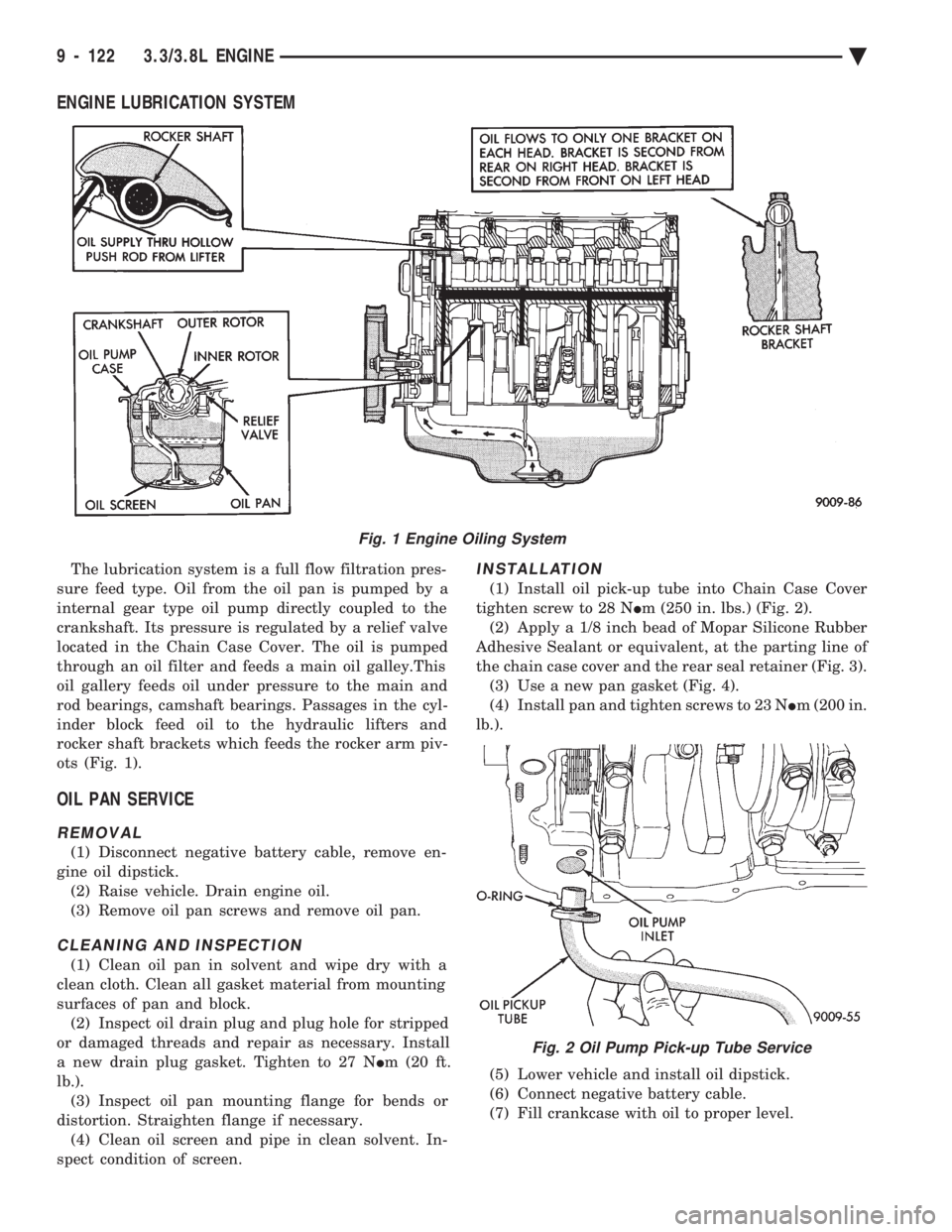
The lubrication system is a full flow filtration pres-
sure feed type. Oil from the oil pan is pumped by a
internal gear type oil pump directly coupled to the
crankshaft. Its pressure is regulated by a relief valve
located in the Chain Case Cover. The oil is pumped
through an oil filter and feeds a main oil galley.This
oil gallery feeds oil under pressure to the main and
rod bearings, camshaft bearings. Passages in the cyl-
inder block feed oil to the hydraulic lifters and
rocker shaft brackets which feeds the rocker arm piv-
ots (Fig. 1).
OIL PAN SERVICE
REMOVAL
(1) Disconnect negative battery cable, remove en-
gine oil dipstick. (2) Raise vehicle. Drain engine oil.
(3) Remove oil pan screws and remove oil pan.
CLEANING AND INSPECTION
(1) Clean oil pan in solvent and wipe dry with a
clean cloth. Clean all gasket material from mounting
surfaces of pan and block. (2) Inspect oil drain plug and plug hole for stripped
or damaged threads and repair as necessary. Install
a new drain plug gasket. Tighten to 27 N Im (20 ft.
lb.). (3) Inspect oil pan mounting flange for bends or
distortion. Straighten flange if necessary. (4) Clean oil screen and pipe in clean solvent. In-
spect condition of screen.
INSTALLATION
(1) Install oil pick-up tube into Chain Case Cover
tighten screw to 28 N Im (250 in. lbs.) (Fig. 2).
(2) Apply a 1/8 inch bead of Mopar Silicone Rubber
Adhesive Sealant or equivalent, at the parting line of
the chain case cover and the rear seal retainer (Fig. 3). (3) Use a new pan gasket (Fig. 4).
(4) Install pan and tighten screws to 23 N Im (200 in.
lb.).
(5) Lower vehicle and install oil dipstick.
(6) Connect negative battery cable.
(7) Fill crankcase with oil to proper level.
Fig. 1 Engine Oiling System
Fig. 2 Oil Pump Pick-up Tube Service
9 - 122 3.3/3.8L ENGINE Ä
Page 1689 of 2438
OIL PUMP SERVICE
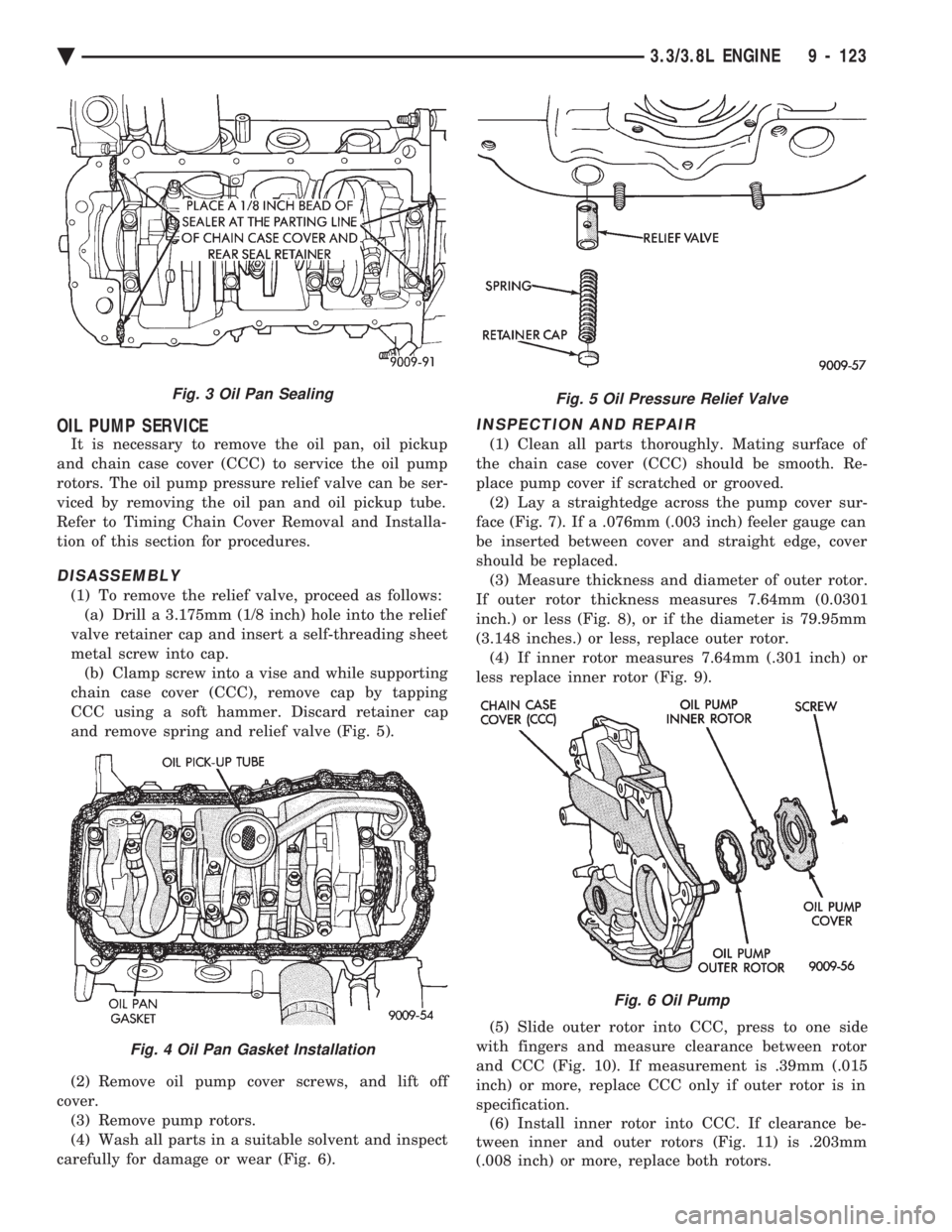
It is necessary to remove the oil pan, oil pickup
and chain case cover (CCC) to service the oil pump
rotors. The oil pump pressure relief valve can be ser-
viced by removing the oil pan and oil pickup tube.
Refer to Timing Chain Cover Removal and Installa-
tion of this section for procedures.
DISASSEMBLY
(1) To remove the relief valve, proceed as follows: (a) Drill a 3.175mm (1/8 inch) hole into the relief
valve retainer cap and insert a self-threading sheet
metal screw into cap. (b) Clamp screw into a vise and while supporting
chain case cover (CCC), remove cap by tapping
CCC using a soft hammer. Discard retainer cap
and remove spring and relief valve (Fig. 5).
(2) Remove oil pump cover screws, and lift off
cover. (3) Remove pump rotors.
(4) Wash all parts in a suitable solvent and inspect
carefully for damage or wear (Fig. 6).
INSPECTION AND REPAIR
(1) Clean all parts thoroughly. Mating surface of
the chain case cover (CCC) should be smooth. Re-
place pump cover if scratched or grooved. (2) Lay a straightedge across the pump cover sur-
face (Fig. 7). If a .076mm (.003 inch) feeler gauge can
be inserted between cover and straight edge, cover
should be replaced. (3) Measure thickness and diameter of outer rotor.
If outer rotor thickness measures 7.64mm (0.0301
inch.) or less (Fig. 8), or if the diameter is 79.95mm
(3.148 inches.) or less, replace outer rotor. (4) If inner rotor measures 7.64mm (.301 inch) or
less replace inner rotor (Fig. 9).
(5) Slide outer rotor into CCC, press to one side
with fingers and measure clearance between rotor
and CCC (Fig. 10). If measurement is .39mm (.015
inch) or more, replace CCC only if outer rotor is in
specification. (6) Install inner rotor into CCC. If clearance be-
tween inner and outer rotors (Fig. 11) is .203mm
(.008 inch) or more, replace both rotors.
Fig. 3 Oil Pan Sealing
Fig. 4 Oil Pan Gasket Installation
Fig. 5 Oil Pressure Relief Valve
Fig. 6 Oil Pump
Ä 3.3/3.8L ENGINE 9 - 123
Page 1697 of 2438
EXHAUST SYSTEM AND INTAKE MANIFOLD
CONTENTS
page page
GENERAL INFORMATION .................. 1
SERVICE PROCEDURES ................... 4 TORQUE SPECIFICATION
................. 25
GENERAL INFORMATION
Throughout this group, references may be made to
a particular vehicle by letter or number designation.
A chart showing the breakdown of these designations
is included in the Introduction Section at the front of
this service manual.
EXHAUST SYSTEMS
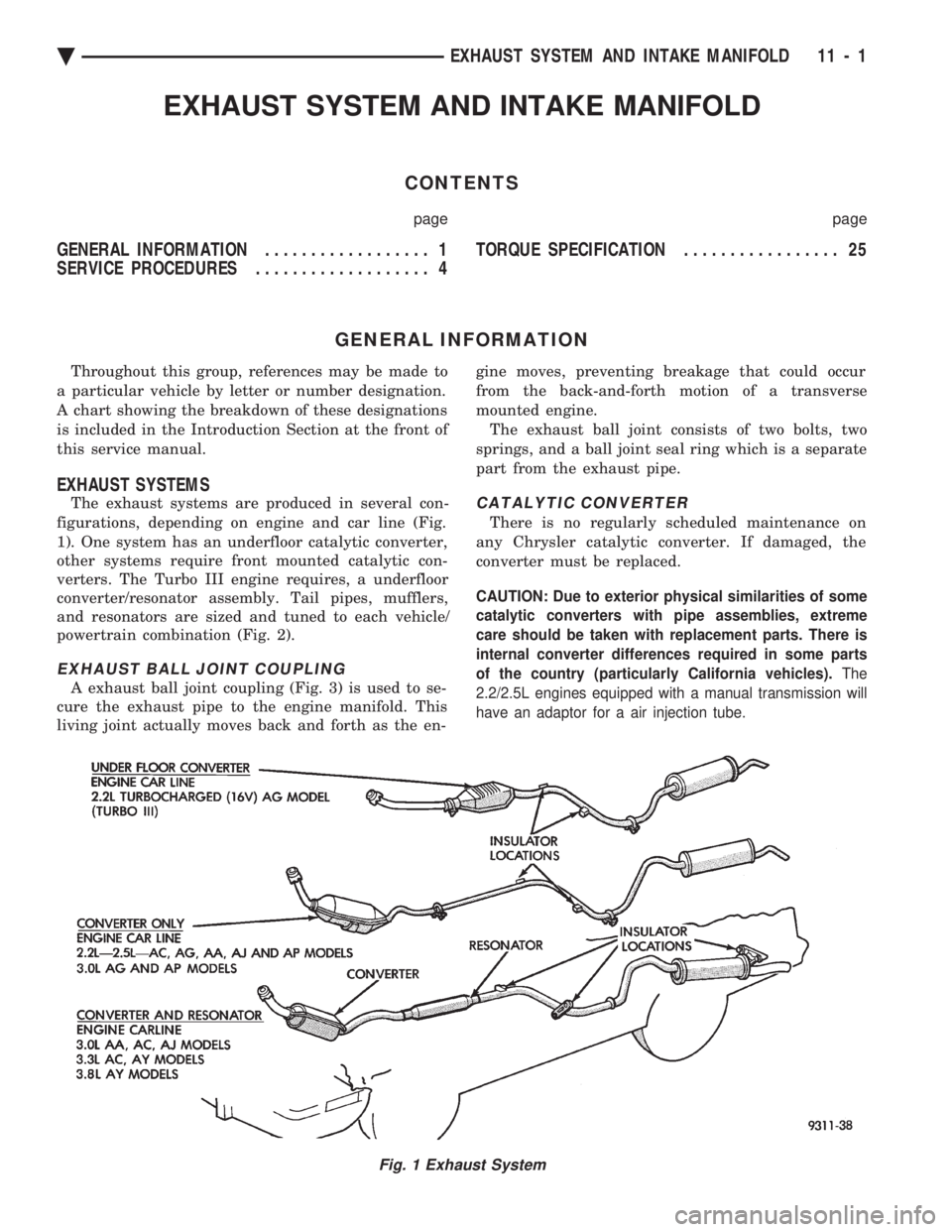
The exhaust systems are produced in several con-
figurations, depending on engine and car line (Fig.
1). One system has an underfloor catalytic converter,
other systems require front mounted catalytic con-
verters. The Turbo III engine requires, a underfloor
converter/resonator assembly. Tail pipes, mufflers,
and resonators are sized and tuned to each vehicle/
powertrain combination (Fig. 2).
EXHAUST BALL JOINT COUPLING
A exhaust ball joint coupling (Fig. 3) is used to se-
cure the exhaust pipe to the engine manifold. This
living joint actually moves back and forth as the en- gine moves, preventing breakage that could occur
from the back-and-forth motion of a transverse
mounted engine. The exhaust ball joint consists of two bolts, two
springs, and a ball joint seal ring which is a separate
part from the exhaust pipe.
CATALYTIC CONVERTER
There is no regularly scheduled maintenance on
any Chrysler catalytic converter. If damaged, the
converter must be replaced.
CAUTION: Due to exterior physical similarities of some
catalytic converters with pipe assemblies, extreme
care should be taken with replacement parts. There is
internal converter differences required in some parts
of the country (particularly California vehicles). The
2.2/2.5L engines equipped with a manual transmission will
have an adaptor for a air injection tube.
Fig. 1 Exhaust System
Ä EXHAUST SYSTEM AND INTAKE MANIFOLD 11 - 1
Page 1699 of 2438
CAUTION: Avoid application of rust prevention
compounds or undercoating materials to exhaust
system floor pan heat shields on cars if equipped.
Light overspray near the edges is permitted. Appli-
cation of coating will greatly reduce the efficiency
of the heat shields resulting in excessive floor pan
temperatures and objectionable fumes.
The combustion reaction caused by the catalyst re-
leases additional heat in the exhaust system. Caus-
ing temperature increases in the area of the reactor
under severe operating conditions. Such conditions
can exist when the engine misfires or otherwise does
not operate at peak efficiency. Do notremove spark
plug wires from plugs or by any other means short
out cylinders if exhaust system is equipped with cat-
alytic converter. Failure of the catalytic converter
can occur due to temperature increases caused by un-
burned fuel passing through the converter. The use of the catalysts also involves some non-au-
tomotive problems. Unleaded gasoline must be used
to avoid poisoning the catalyst core. Do not allow en- gine to operate above 1200 RPM in neutral for ex-
tended periods over 5 minutes. This condition may
result in excessive exhaust system/floor pan temper-
atures because of no air movement under the vehicle.
EXHAUST GAS RECIRCULATION (EGR) SYSTEM
To assist in the control of oxides of nitrogen (NOx)
in engine exhaust, some engines are equipped with
an exhaust gas recirculation system. The use of ex-
haust gas to dilute incoming air/fuel mixtures lowers
peak flame temperatures during combustion, thus
limiting the formation of NOx. Exhaust gases are taken from openings in the ex-
haust gas crossover passage in the intake manifold.
REFER TO SECTION 25 EMISSION SYSTEMS
FOR A COMPLETE DESCRIPTION, DIAGNOSIS
AND SERVICE PROCEDURES ON THE EXHAUST
GAS RECIRCULATION SYSTEM AND COMPO-
NENTS.
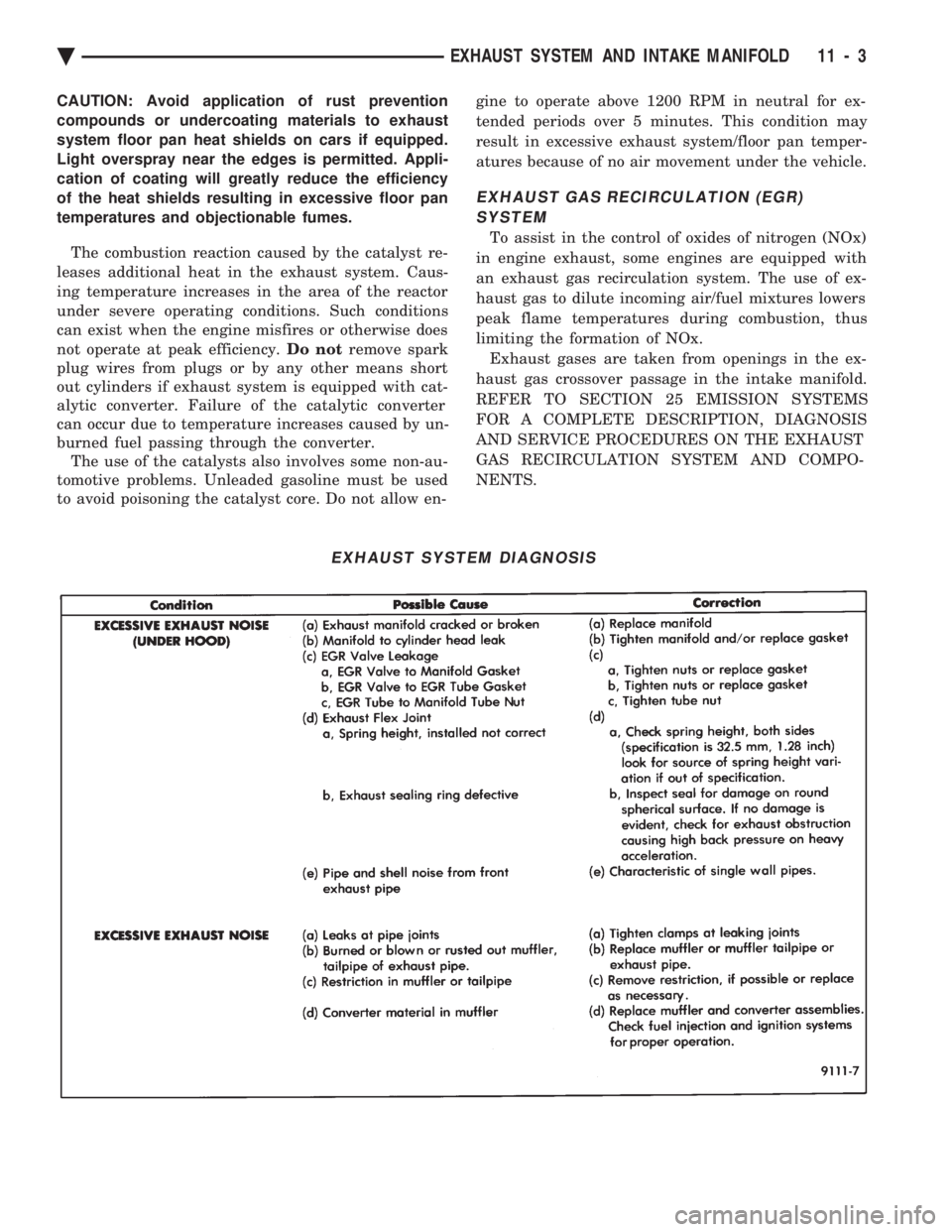
EXHAUST SYSTEM DIAGNOSIS
Ä EXHAUST SYSTEM AND INTAKE MANIFOLD 11 - 3
Page 1700 of 2438
SERVICE PROCEDURES INDEX
page page
Exhaust Pipes, Mufflers and Tailpipes .......... 4
Intake and Exhaust Manifolds ServiceÐTBI Engine.6Intake and Exhaust ManifoldsÐFlexible Fuel Engine.7
Intake and Exhaust ManifoldsÐTBI Engine ...... 5
Intake/Exhaust Manifold ServiceÐ3.0L Engine . . . 13
Intake/Exhaust Manifold ServiceÐ3.3/3.8L Engines.19
Intake/Exhaust Manifolds and Turbocharger ServiceÐTurbo III Engine .................. 9
Intake/Exhaust Manifolds ServiceÐFlexible Fuel Engines ............................... 7
EXHAUST PIPES, MUFFLERS AND TAILPIPES
REMOVAL
(1) Raise vehicle on hoist and apply penetrating oil
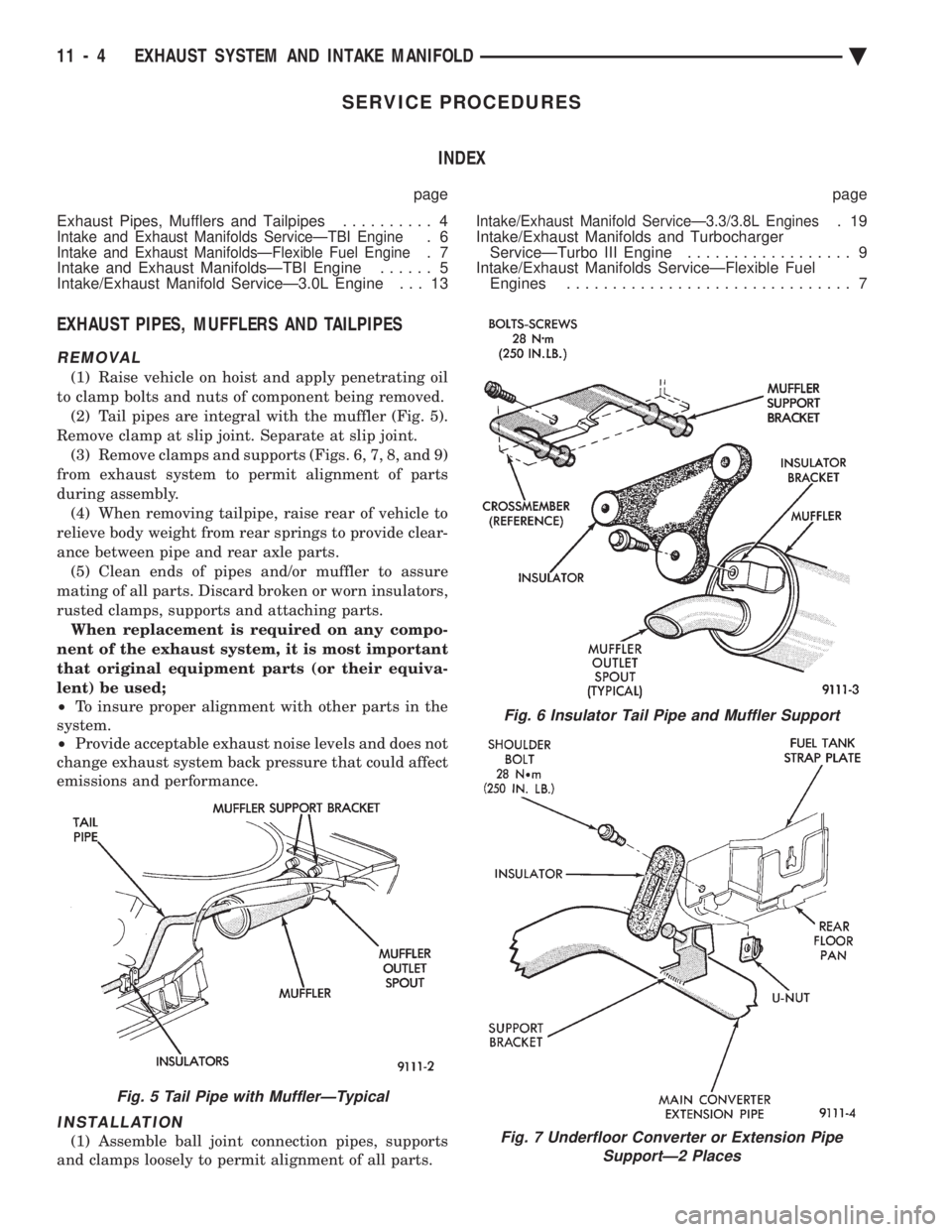
to clamp bolts and nuts of component being removed. (2) Tail pipes are integral with the muffler (Fig. 5).
Remove clamp at slip joint. Separate at slip joint. (3) Remove clamps and supports (Figs. 6, 7, 8, and 9)
from exhaust system to permit alignment of parts
during assembly. (4) When removing tailpipe, raise rear of vehicle to
relieve body weight from rear springs to provide clear-
ance between pipe and rear axle parts. (5) Clean ends of pipes and/or muffler to assure
mating of all parts. Discard broken or worn insulators,
rusted clamps, supports and attaching parts. When replacement is required on any compo-
nent of the exhaust system, it is most important
that original equipment parts (or their equiva-
lent) be used;
² To insure proper alignment with other parts in the
system.
² Provide acceptable exhaust noise levels and does not
change exhaust system back pressure that could affect
emissions and performance.
INSTALLATION
(1) Assemble ball joint connection pipes, supports
and clamps loosely to permit alignment of all parts.
Fig. 6 Insulator Tail Pipe and Muffler Support
Fig. 7 Underfloor Converter or Extension Pipe SupportÐ2 Places
Fig. 5 Tail Pipe with MufflerÐTypical
11 - 4 EXHAUST SYSTEM AND INTAKE MANIFOLD Ä