key CHEVROLET EQUINOX 2008 1.G Owners Manual
[x] Cancel search | Manufacturer: CHEVROLET, Model Year: 2008, Model line: EQUINOX, Model: CHEVROLET EQUINOX 2008 1.GPages: 436, PDF Size: 2.42 MB
Page 1 of 436
Seats and Restraint Systems........................... 1-1
Front Seats
............................................... 1-2
Rear Seats
..............................................1-10
Safety Belts
.............................................1-12
Child Restraints
.......................................1-31
Airbag System
.........................................1-56
Restraint System Check
............................1-72
Features and Controls..................................... 2-1
Keys
........................................................ 2-3
Doors and Locks
......................................2-10
Windows
.................................................2-15
Theft-Deterrent Systems
............................2-17
Starting and Operating Your Vehicle
...........2-20
Mirrors
....................................................2-37
OnStar
®System
......................................2-39
Storage Areas
.........................................2-42
Sunroof
..................................................2-49
Instrument Panel............................................. 3-1
Instrument Panel Overview
.......................... 3-4
Climate Controls
......................................3-19
Warning Lights, Gages, and Indicators
........3-24
Driver Information Center (DIC)
..................3-42
Audio System(s)
.......................................3-64Driving Your Vehicle....................................... 4-1
Your Driving, the Road, and Your Vehicle
..... 4-2
Towing
...................................................4-28
Service and Appearance Care.......................... 5-1
Service
..................................................... 5-3
Fuel
......................................................... 5-5
Checking Things Under the Hood
...............5-10
All-Wheel Drive
........................................5-42
Headlamp Aiming
.....................................5-44
Bulb Replacement
....................................5-44
Windshield Wiper Blade Replacement
.........5-50
Tires
......................................................5-52
Appearance Care
.....................................5-89
Vehicle Identication
.................................5-99
Electrical System
....................................5-100
Capacities and Specications
...................5-107
Maintenance Schedule..................................... 6-1
Maintenance Schedule
................................ 6-2
Customer Assistance Information.................... 7-1
Customer Assistance and Information
........... 7-2
Reporting Safety Defects
...........................7-14
Vehicle Data Recording and Privacy
...........7-16
Index................................................................ 1
2008 Chevrolet Equinox Owner ManualM
Page 8 of 436
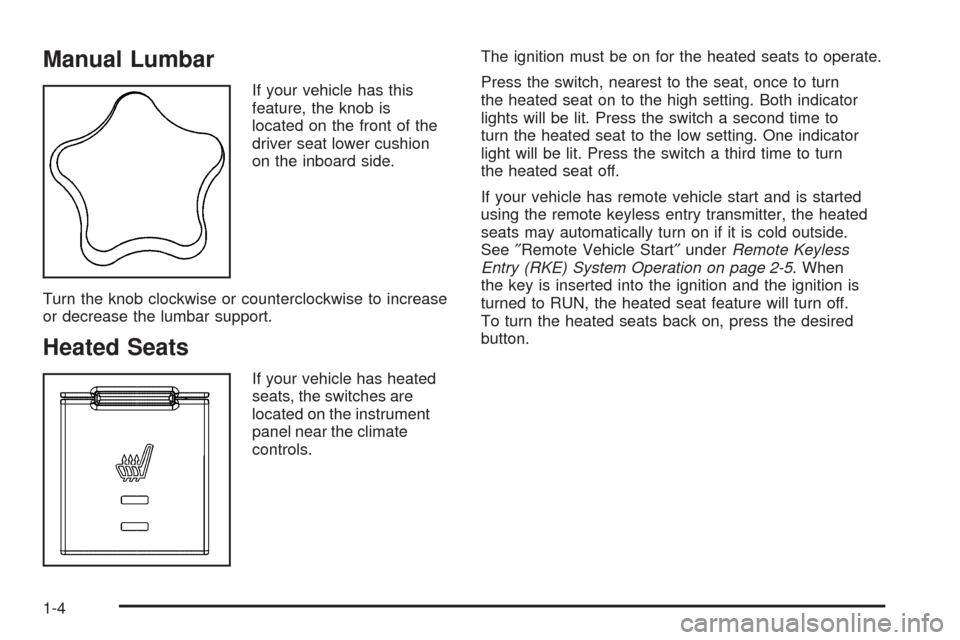
Manual Lumbar
If your vehicle has this
feature, the knob is
located on the front of the
driver seat lower cushion
on the inboard side.
Turn the knob clockwise or counterclockwise to increase
or decrease the lumbar support.
Heated Seats
If your vehicle has heated
seats, the switches are
located on the instrument
panel near the climate
controls.The ignition must be on for the heated seats to operate.
Press the switch, nearest to the seat, once to turn
the heated seat on to the high setting. Both indicator
lights will be lit. Press the switch a second time to
turn the heated seat to the low setting. One indicator
light will be lit. Press the switch a third time to turn
the heated seat off.
If your vehicle has remote vehicle start and is started
using the remote keyless entry transmitter, the heated
seats may automatically turn on if it is cold outside.
See″Remote Vehicle Start″underRemote Keyless
Entry (RKE) System Operation on page 2-5. When
the key is inserted into the ignition and the ignition is
turned to RUN, the heated seat feature will turn off.
To turn the heated seats back on, press the desired
button.
1-4
Page 34 of 436
Safety Belt Use During Pregnancy
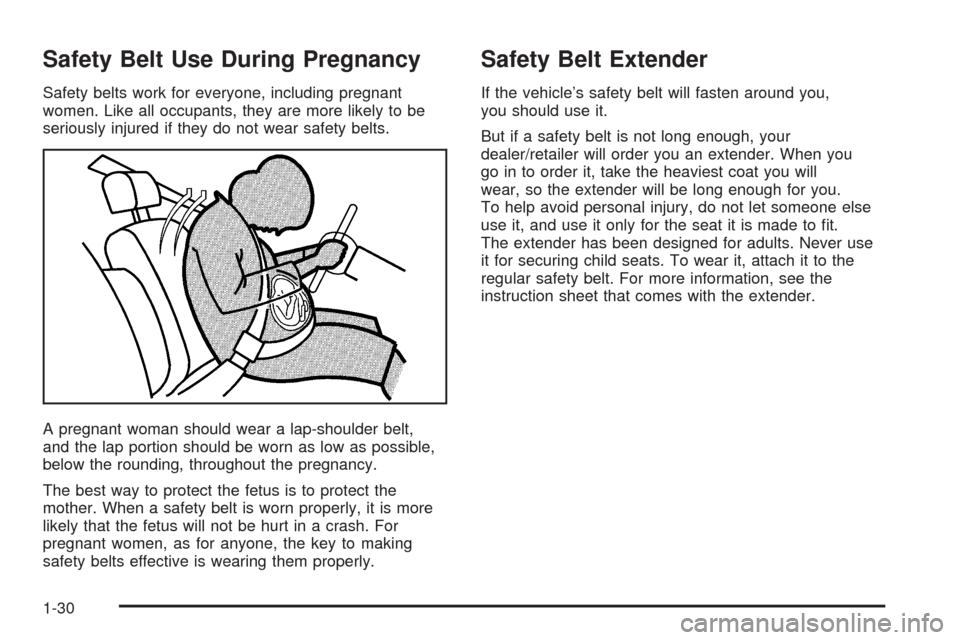
Safety belts work for everyone, including pregnant
women. Like all occupants, they are more likely to be
seriously injured if they do not wear safety belts.
A pregnant woman should wear a lap-shoulder belt,
and the lap portion should be worn as low as possible,
below the rounding, throughout the pregnancy.
The best way to protect the fetus is to protect the
mother. When a safety belt is worn properly, it is more
likely that the fetus will not be hurt in a crash. For
pregnant women, as for anyone, the key to making
safety belts effective is wearing them properly.
Safety Belt Extender
If the vehicle’s safety belt will fasten around you,
you should use it.
But if a safety belt is not long enough, your
dealer/retailer will order you an extender. When you
go in to order it, take the heaviest coat you will
wear, so the extender will be long enough for you.
To help avoid personal injury, do not let someone else
use it, and use it only for the seat it is made to t.
The extender has been designed for adults. Never use
it for securing child seats. To wear it, attach it to the
regular safety belt. For more information, see the
instruction sheet that comes with the extender.
1-30
Page 79 of 436
Keys...............................................................2-3
Remote Keyless Entry (RKE) System................2-4
Remote Keyless Entry (RKE) System
Operation...................................................2-5
Remote Vehicle Start......................................2-8
Doors and Locks............................................2-10
Door Locks..................................................2-10
Power Door Locks........................................2-11
Delayed Locking...........................................2-11
Programmable Automatic Door Locks..............2-11
Rear Door Security Locks..............................2-12
Lockout Protection........................................2-12
Liftgate........................................................2-13
Windows........................................................2-15
Power Windows............................................2-16
Sun Visors...................................................2-17
Theft-Deterrent Systems..................................2-17
Content Theft-Deterrent.................................2-17
PASS-Key
®III+............................................2-18
PASS-Key®III+ Operation..............................2-18Starting and Operating Your Vehicle................2-20
New Vehicle Break-In....................................2-20
Ignition Positions..........................................2-20
Retained Accessory Power (RAP)...................2-21
Starting the Engine.......................................2-22
Engine Coolant Heater..................................2-23
Automatic Transmission Operation
(3.4L V6 with 5-Speed)..............................2-24
Automatic Transmission Operation
(3.6L V6 with 6-Speed)..............................2-27
Parking Brake..............................................2-31
Shifting Into PARK (P)...................................2-32
Shifting Out of PARK (P)...............................2-34
Parking Over Things That Burn.......................2-34
Engine Exhaust............................................2-35
Running the Engine While Parked...................2-36
Mirrors...........................................................2-37
Manual Rearview Mirror.................................2-37
Manual Rearview Mirror with OnStar
®..............2-37
Automatic Dimming Rearview Mirror with
OnStar
®...................................................2-37
Outside Power Mirrors...................................2-38
Outside Convex Mirrors.................................2-38
Section 2 Features and Controls
2-1
Page 81 of 436
Keys
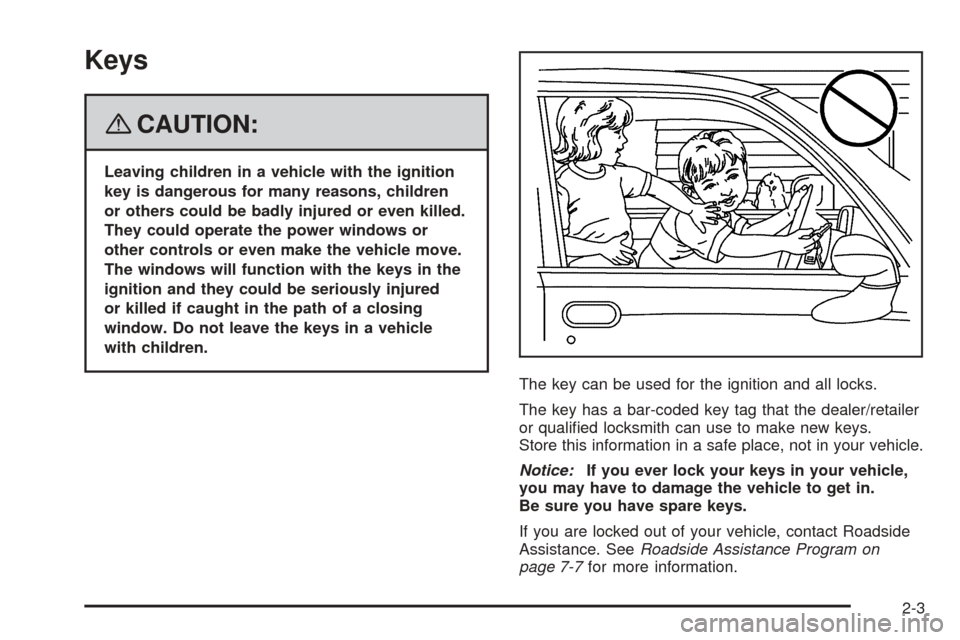
{CAUTION:
Leaving children in a vehicle with the ignition
key is dangerous for many reasons, children
or others could be badly injured or even killed.
They could operate the power windows or
other controls or even make the vehicle move.
The windows will function with the keys in the
ignition and they could be seriously injured
or killed if caught in the path of a closing
window. Do not leave the keys in a vehicle
with children.
The key can be used for the ignition and all locks.
The key has a bar-coded key tag that the dealer/retailer
or qualied locksmith can use to make new keys.
Store this information in a safe place, not in your vehicle.
Notice:If you ever lock your keys in your vehicle,
you may have to damage the vehicle to get in.
Be sure you have spare keys.
If you are locked out of your vehicle, contact Roadside
Assistance. SeeRoadside Assistance Program on
page 7-7for more information.
2-3
Page 82 of 436
Remote Keyless Entry (RKE)
System
If the vehicle has the Remote Keyless Entry (RKE)
system, it operates on a radio frequency subject
to Federal Communications Commission (FCC) Rules
and with Industry Canada.
This device complies with Part 15 of the FCC Rules.
Operation is subject to the following two conditions:
1. This device may not cause interference.
2. This device must accept any interference received,
including interference that may cause undesired
operation of the device.
This device complies with RSS-210 of Industry Canada.
Operation is subject to the following two conditions:
1. This device may not cause interference.
2. This device must accept any interference received,
including interference that may cause undesired
operation of the device.
Changes or modications to this system by other than
an authorized service facility could void authorization to
use this equipment.At times you may notice a decrease in range. This is
normal for any RKE system. If the transmitter does not
work or if you have to stand closer to your vehicle
for the transmitter to work, try this:Check the distance. You may be too far from your
vehicle. You may need to stand closer during
rainy or snowy weather.
Check the location. Other vehicles or objects may
be blocking the signal. Take a few steps to the
left or right, hold the transmitter higher, and
try again.
Check to determine if battery replacement is
necessary. See “Battery Replacement” later in this
section.
If you are still having trouble, see your dealer/retailer
or a qualied technician for service.
2-4
Page 83 of 436
Remote Keyless Entry (RKE)
System Operation
The vehicle’s doors can be locked and unlocked
from about 3 feet (1 m) up to 65 feet (20 m) away
with the Remote Keyless Entry (RKE) transmitter.
If your vehicle has the remote start feature you can
also start your vehicle with the RKE transmitter.
Your RKE transmitter, with the remote start button,
provides an increased range of 195 feet (60 m) away.
However, the range may be less while the vehicle
is running. As a result, you may need to be closer to
your vehicle to turn it off than you were to turn it on.
There are other conditions which can affect the
performance of the transmitter. SeeRemote Keyless
Entry (RKE) System on page 2-4.
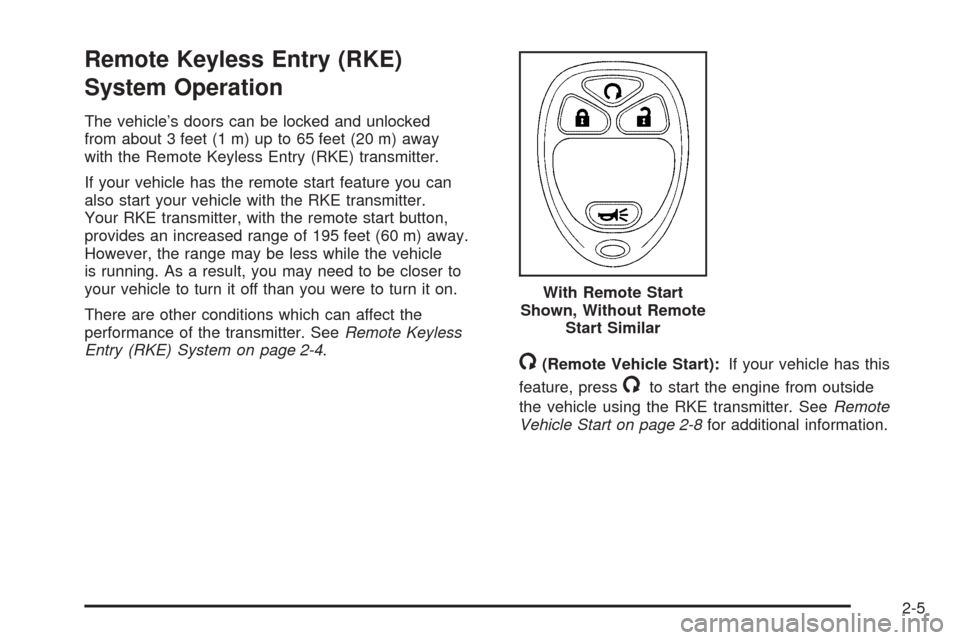
/(Remote Vehicle Start):If your vehicle has this
feature, press
/to start the engine from outside
the vehicle using the RKE transmitter. SeeRemote
Vehicle Start on page 2-8for additional information. With Remote Start
Shown, Without Remote
Start Similar
2-5
Page 85 of 436
Matching Transmitter(s) to
Your Vehicle
Each RKE transmitter is coded to prevent another
transmitter from unlocking your vehicle. If a transmitter is
lost or stolen, a replacement can be purchased through
your dealer/retailer. All transmitters need to be re-coded
to match the new transmitter. The lost transmitter will
no longer work after the new transmitters are re-coded.
The vehicle can have a maximum of four transmitters
matched to it. Or, see “Learn Remote Key” underDIC
Operation and Displays on page 3-43for instructions
on how to match RKE transmitters to your vehicle.
Battery Replacement
The battery is weak if the transmitter will not work at
the normal range in any location. If you have to get
close to your vehicle before the transmitter works,
change the battery.
Notice:When replacing the battery, use care not
to touch any of the circuitry. Static from your
body transferred to these surfaces may damage
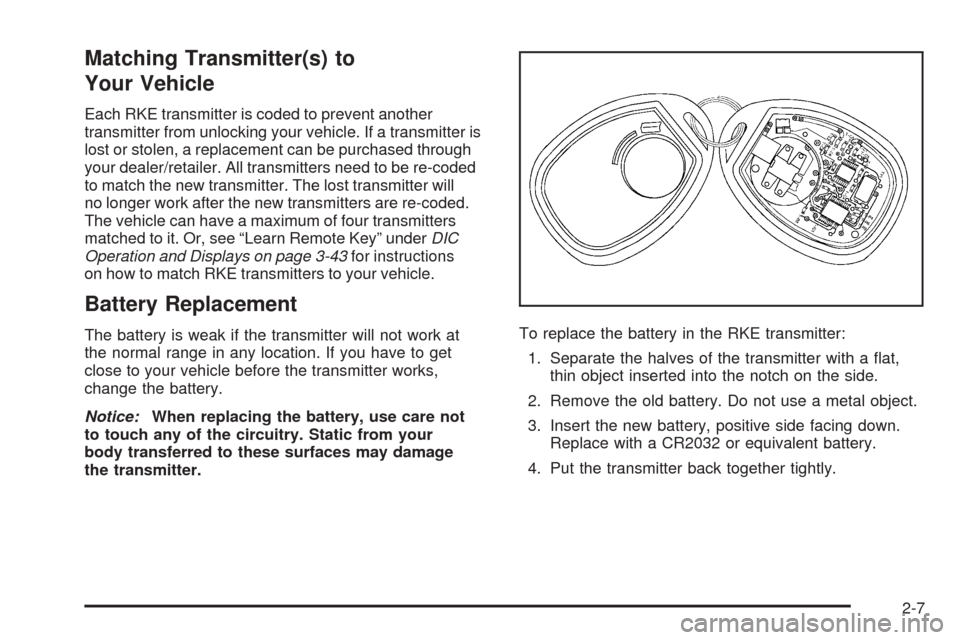
the transmitter.To replace the battery in the RKE transmitter:
1. Separate the halves of the transmitter with a at,
thin object inserted into the notch on the side.
2. Remove the old battery. Do not use a metal object.
3. Insert the new battery, positive side facing down.
Replace with a CR2032 or equivalent battery.
4. Put the transmitter back together tightly.
2-7
Page 86 of 436
Remote Vehicle Start
Your vehicle may have the remote start feature. This
feature allows you to start the engine from outside
the vehicle. See “REMOTE START” underDIC Vehicle
Personalization on page 3-58for instructions on how
to enable and disable this feature.
During a remote start, the climate control system will
turn on at the fan, temperature, and mode settings the
vehicle was set to when the vehicle was last turned
off. The rear window defogger will also turn on.
If your vehicle has heated seats, they may turn on
during colder outside temperatures and will shut
off when the key is turned to ON/RUN. You may not
notice an increase in seat surface temperature until the
seat is occupied for a short period of time.
Laws in some local communities may restrict the use of
remote starters. For example, some laws may require
a person using remote start to have the vehicle in view
when doing so. Check local regulations for any
requirements on remote starting of vehicles.
/(Remote Vehicle Start):This button will be on the
RKE transmitter if you have remote start.
Your RKE transmitter, with the remote start button,
provides an increased range of operation. However,
the range may be less while the vehicle is running.
As a result, you may need to be closer to your
vehicle to turn it off, than you were to turn it on.If your vehicle is low on fuel, do not use the remote
start feature. The vehicle may run out of fuel.
To start the engine using the remote start feature:
1. Aim the RKE transmitter, that has a remote vehicle
start button, at the vehicle.
2. Press and release the transmitter’s lock button,
then immediately press and hold the remote
vehicle start button. Hold the remote start button
until the vehicle’s turn signal lamps ash, or
for at least four seconds if the vehicle’s lights are
not visible. The vehicle’s doors will be locked.
Pressing the remote start button again after the
vehicle has started will turn off the ignition.
When the vehicle’s engine starts, the parking
lamps will turn on and remain on while the engine
is running.
3. To extend the engine run time by 10 minutes,
repeat Steps 1 and 2 while the engine is still
running. The engine run time can only be extended
if it is the rst remote start since the vehicle has
been driven. Remote start can be extended
one time.
If the remote start procedure is used again before
the rst 10 minute time frame has ended, the
rst 10 minutes will immediately expire and the
second 10 minute time frame will start.
2-8
Page 87 of 436
For example, if the lock button and then the remote
start buttons are pressed again after the vehicle
has been running for ve minutes, 10 minutes are
added, allowing the engine to run for 15 minutes.
4. After entering the vehicle during a remote start, insert
and turn the key to ON/RUN to drive the vehicle.
After a remote start, the engine will automatically
shut off after 10 minutes unless a time extension
has been done or the vehicle’s key is inserted into
the ignition switch and turned to ON/RUN.
A maximum of two remote starts or remote start
attempts are allowed between ignition cycles.
After your vehicle’s engine has been started two times
using the remote start button, the vehicle’s ignition
switch must be turned to ON/RUN and then back to
LOCK/OFF using the key before the remote start
procedure can be used again.
To manually shut off the engine after a remote start,
do any of the following:
Aim the RKE transmitter at the vehicle and press
the remote start button until the parking lamps
turn off.
Turn on the hazard warning ashers.
Insert the vehicle’s key into the ignition switch
and turn the switch to ON/RUN and then back
to LOCK/OFF.The remote vehicle start feature will not operate if
any of the following occur:
The vehicle’s key is in the ignition.
The vehicle’s hood, liftgate or doors are
not closed.
The hazard warning ashers are on.
There is an emission control system
malfunction.
The engine coolant temperature is too high.
The oil pressure is low.
Two remote vehicle starts have already been
used. The maximum number of remote starts
or remote start attempts between ignition cycles
with the key is two.
The remote start feature may be disabled.
The system may be enabled or disabled through
the DIC. See “REMOTE START” underDIC
Vehicle Personalization on page 3-58for
additional information.
Vehicles that have the remote vehicle start
feature are shipped from the factory with
the remote vehicle start system enabled.
2-9