heater CHEVROLET EXPRESS 1996 1.G User Guide
[x] Cancel search | Manufacturer: CHEVROLET, Model Year: 1996, Model line: EXPRESS, Model: CHEVROLET EXPRESS 1996 1.GPages: 376, PDF Size: 18.83 MB
Page 203 of 376
Downloaded from www.Manualslib.com manuals search engine If No Steam Is Coming From Your Engine
If you get the overheat warning but see or hear no
steam, the problem may
not be too serious. Sometimes
the engine can get a little too hot when you:
0 Climb a long hill on a hot day.
0 Stop after high-speed driving.
0 Idle for long periods in traffic.
0 Tow a trailer. See “Driving on Grades” in the Index.
If
you get the overheat warning with no sign of steam,
try this for a
minute or so:
1. If you have an air conditioner, turn it off.
2. Turn on your heater to full hot at the highest fan
speed and open the window as necessary.
3. If you’re in a traffic jam, shift to NEUTRAL (N);
otherwise, shift
to the highest gear while
driving
-- DRIVE (D).
If you no longer have the overheat warning, you can
drive. Just to be safe, drive slower for about
10 minutes.
If the warning doesn’t come back on,
you can
drive normally.
If the warning continues, pull over, stop, and park your
vehicle right away.
If there’s still no sign of steam, you can idle the engine
for two or three minutes while you’re parked,
to push
the accelerator until the engine speed is about twice as
fast as normal idle speed. Bring
the engine speed back to
normal idle speed after two or three minutes. Now see
if
the warning stops. But then, if you still have the
warning,
turn ofthe engine and get everyone out qf the
vehicle
until it cools down.
You may decide not to lift the hood but to get service
help right away.
5-11
Page 204 of 376
Downloaded from www.Manualslib.com manuals search engine Cooling System
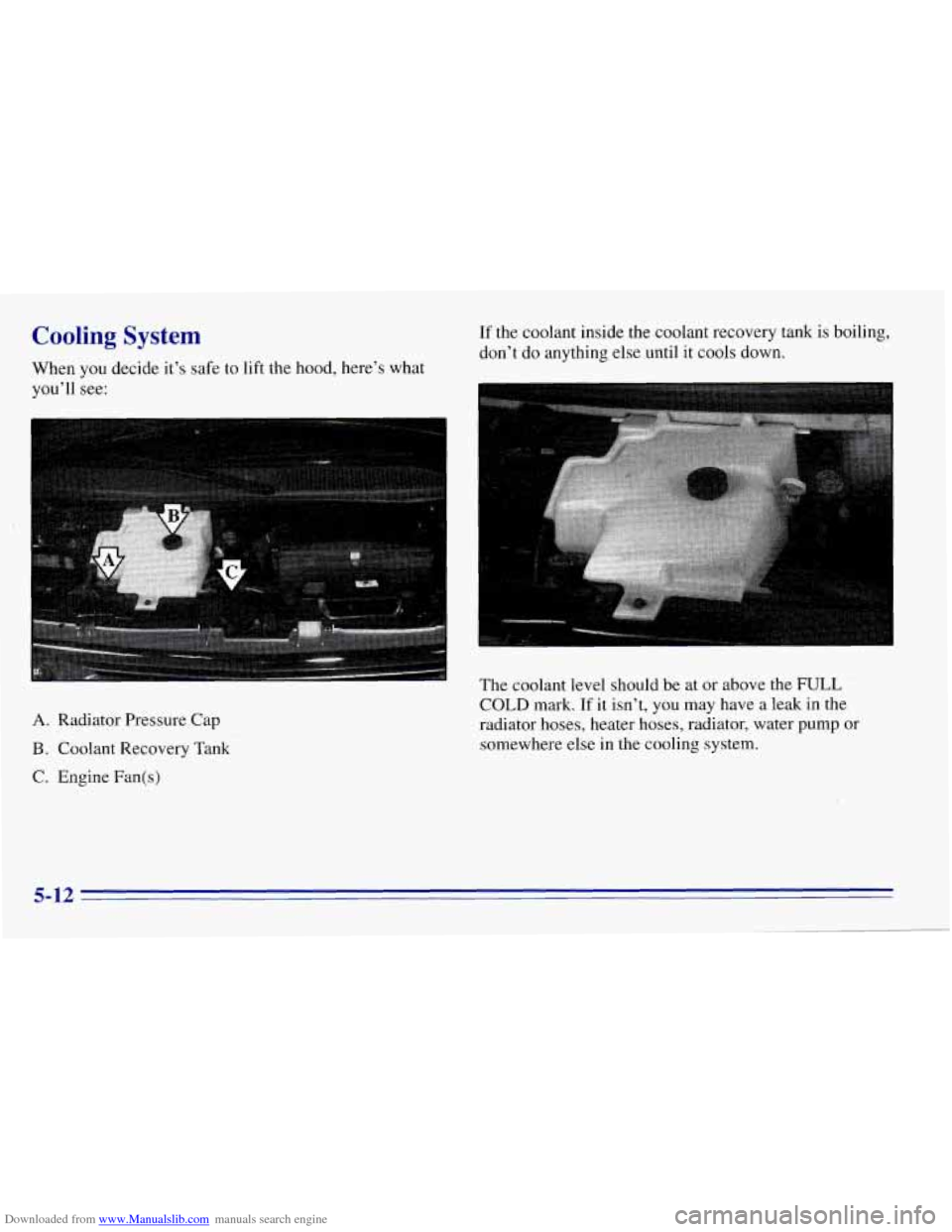
When you decide it’s safe to lift the hood, here’s what
you’ll see:
A. Radiator Pressure Cap
B. Coolant Recovery Tank
C. Engine Fan(s)
If the coolant inside the coolant recovery tank is boiling,
don’t
do anything else until it cools down.
The coolant level should be at
or above the FULL
COLD mark.
If it isn’t, you may have a leak in the
radiator hoses, heater
hoses, radiator, water pump or
somewhere else in the cooling system.
5-12
Page 205 of 376
Downloaded from www.Manualslib.com manuals search engine A CAUTION:
Heater and radiator hoses, and other engine
parts, can be very hot. Don’t touch them. If you
do,
you can be burned.
Don’t run the engine if there is
a leak. If you run
the engine, it could lose
all coolant. That could
cause an engine fire, and you could be burned.
Get any leak fixed before you drive the vehicle.
NOTICE:
Engine damage from running your engine
without coolant isn’t covered
by your warranty.
If there seems to be no leak, start the engine again. See
if the fan speed increases when idle speed is doubled by
pushing the accelerator pedal down.
If it doesn’t, your
vehicle needs service. Turn
off the engine.
How to Add Coolant to the Coolant
Recovery Tank
If you haven’t found a problem yet, but the coolant level
isn’t at the FULL COLD mark, add a 5060 mixture of
clean water (preferably distilled) and DEX-COOL’”
(orange-colored, silicate-free) antifreeze at the coolant
recovery tank. (See “Engine Coolant”
in the Index for
more information.)
Adding only plain water to your cooling sy,,,m
can be dangerous. Plain water, or some other
liquid like alcohol, can boil before the proper
coolant mix will. Your vehicle’s coolant warning
system is set for the proper coolant mix. With
plain water or the wrong mix, your engine could
get too hot but you wouldn’t get the overheat
warning. Your engine could catch fire and you or
others could be burned. Use
a 50/50 mix of clean
water and DEX=COOL
TM antifreeze.
c 11
Page 206 of 376
Downloaded from www.Manualslib.com manuals search engine I NOTICE:
~~
In cold weather, water can freeze and crack the
engine, radiator, heater core and other parts.
Use the recommended coolant and the proper
coolant mix.
A CAIJTION:
-
You can be b ed if you spill coolant on hot
engine parts. Coolant contains ethylene glycol
and it will burn if the engine parts are hot
enough. Don’t spill coolant on
a hot engine.
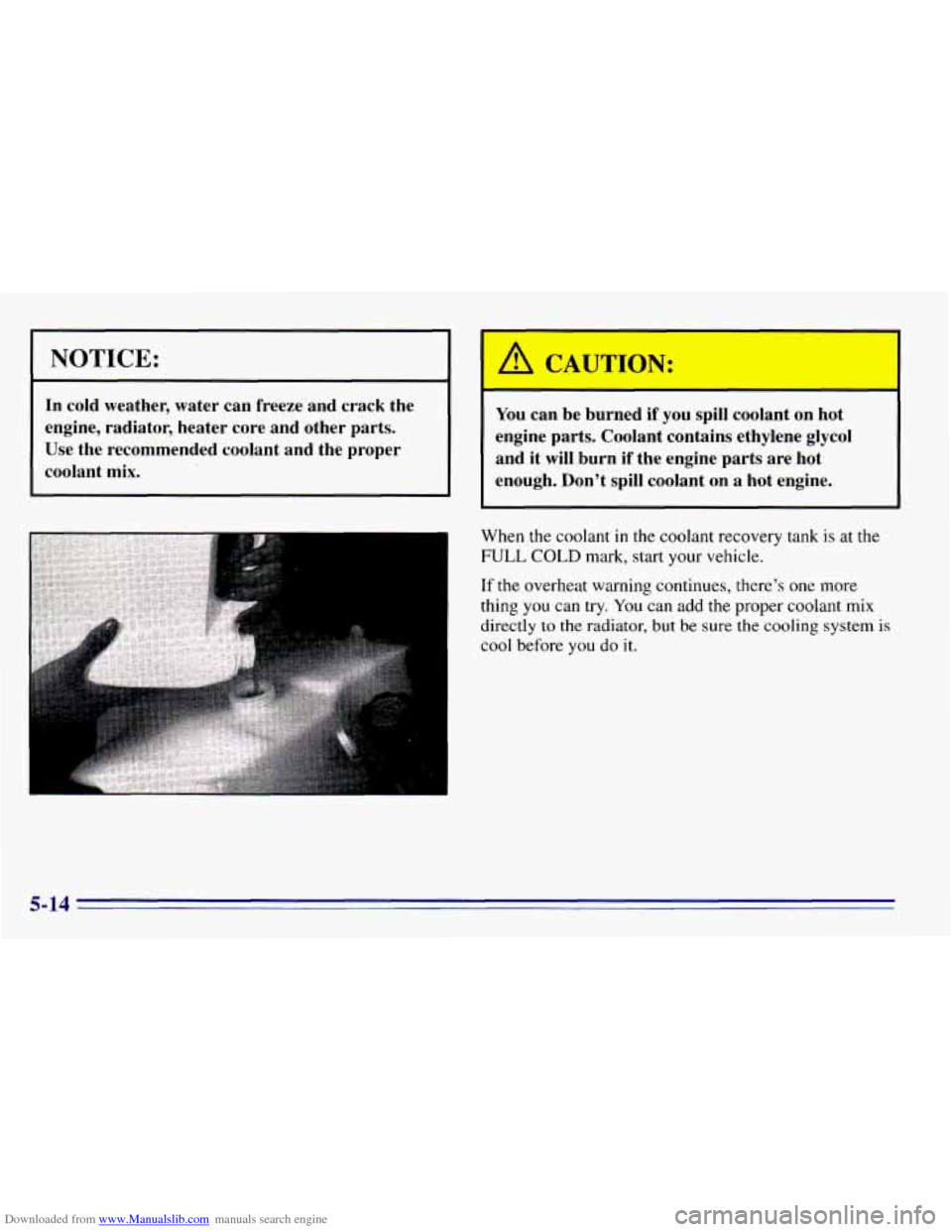
When the coolant in the coolant recovery tank is at the
FULL COLD mark, start your vehicle.
If the overheat warning continues, there’s one more
thing you can try. You can add the proper coolant mix
directly
to the radiator, but be sure the cooling system is
cool before you do it.
5-14
Page 248 of 376
Downloaded from www.Manualslib.com manuals search engine Engine Coolant
The cooling system in your vehicle is filled with new
DEX-COOL
TM (orange-colored, silicate-free) engine
coolant. This coolant is designed to remain
in your
vehicle for 5 years or 100,000 miles ( 166 000 km),
whichever occurs first.
The following explains your cooling system and how
to
add coolant when it is low. If you have a problem with
engine overheating, see “Engine Overheating” in
the Index.
A 5060 mixture of water and the proper coolant for
your vehicle will:
0 Give freezing protection down to -34°F (-37°C).
Give boiling protection up to 265 “F ( 129 O C).
Protect against rust and corrosion.
0 Help keep the proper engine temperature.
Let the warning lights and gages work as they should.
NOTICE:
When adding coolant it is important that you use
DEX-COOL TM (orange-colored, silicate-free)
coolant meeting
GM Specification 6277M.
If silicated coolant is added to the system,
premature engine, heater core or radiator
corrosion may result. In addition, the engine coolant
will require change sooner -- at
30,000 miles (50 000 km) or 24 months,
whichever occurs first.
6-20
Page 250 of 376
Downloaded from www.Manualslib.com manuals search engine NOTICE:
If you use an improper coolant mix, your engine
could overheat and be badly damaged. The
repair cost wouldn't be covered by your
warranty.
Too much water in the mix can freeze
and crack the engine, radiator, heater core and
other parts.
If you have to add coolant more than four times a year,
have
your dealer check your cooling system.
NOTICE:
If you use the proper coolant, you don't have to
add extra inhibitors or additives which claim to
improve the system. These can be harmful.
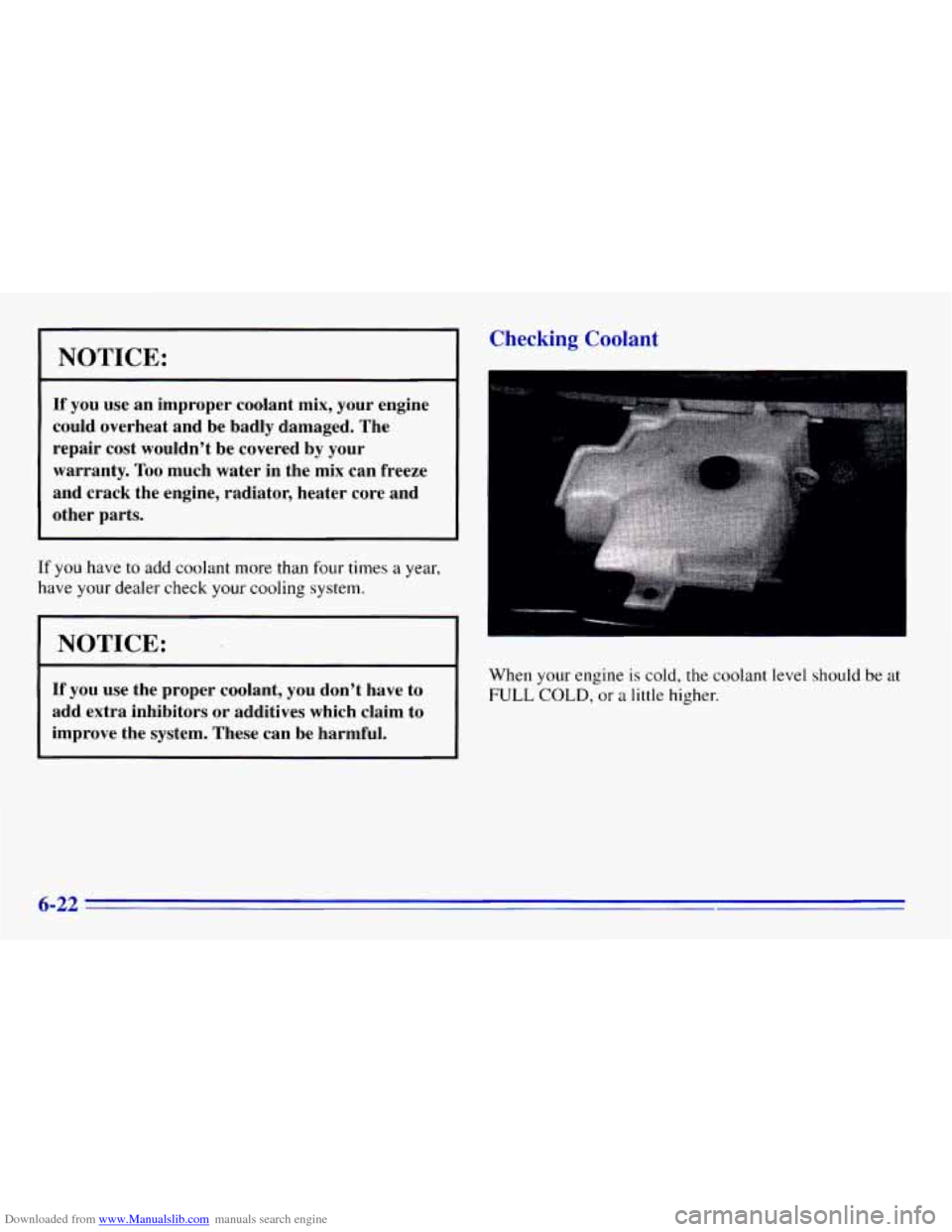
Checking Coolant
When your engine is cold, the coolant level should be at
FULL COLD, or a little higher.
6-22
Page 294 of 376
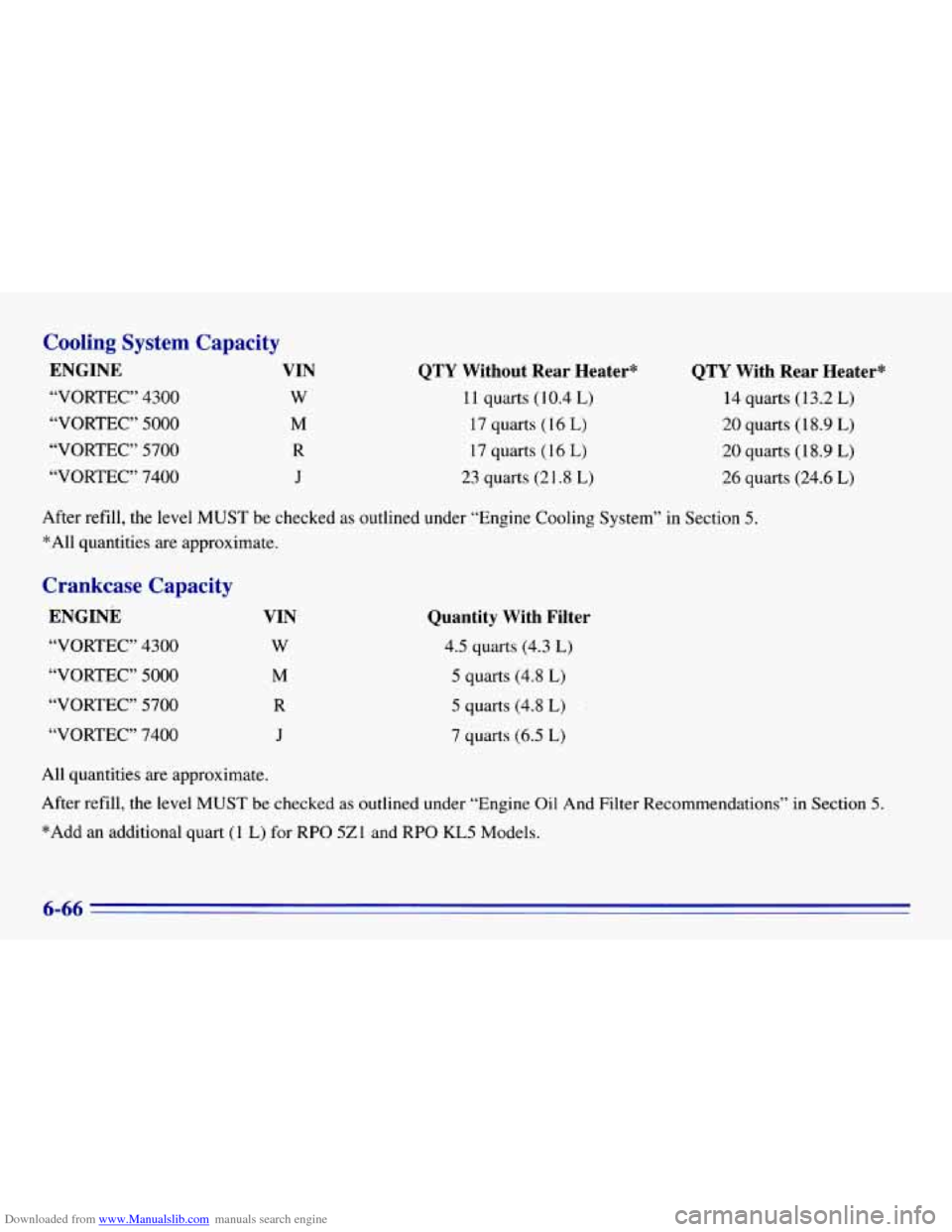
Downloaded from www.Manualslib.com manuals search engine Cooling System Capacity
ENGINE VIN
“VORTEC” 4300 W
“VORTEC” 5000 M
“VORTEC” 5700 R
“VORTEC” 7400
J
QTY Without Rear Heater*
11 quarts ( 10.4 L)
17 quarts ( 16 L)
17 quarts ( 16 L)
23 quarts (2 1.8 L)
QTY With Rear Heater*
14 quarts (13.2 L)
20 quarts (18.9 L)
20 quarts ( 18.9 L)
26 quarts (24.6 L)
After refill, the level MUST be checked as outlined under “Engine Cooling System” in Section 5.
*All quantities are approximate.
Crankcase Capacity
ENGINE
“VORTEC” 4300
“VORTEC”
5000
“VORTEC” 5700
“VORTEC” 7400
VIN
W
M
R
J
Quantity With Filter
4.5 quarts (4.3 L)
5 quarts (4.8 L)
5 quarts (4.8 L)
7 quarts (6.5 L)
All quantities are approximate.
After refill, the level
MUST be checked as outlined under “Engine Oil And Filter Recommendations” in Section 5.
*Add an additional quart (1 L) for RPO 521 and RPO KL5 Models.
Page 347 of 376
Downloaded from www.Manualslib.com manuals search engine Part C: Periodic Maintenance
Inspections
Listed below are inspections and services which should
be performed at least twice a year (for instance, each
spring and fall). You should let your
GM dealer’s
service department or other qualified service center do
these jobs. Make sure any necessary repairs are
completed at once.
Proper procedures to perform these services may be
found
in a service manual. See “Service and Owner
Publications”
in the Index.
Steering and Suspension Inspection
Inspect the front and rear suspension and steering
system for damaged, loose or missing parts, signs
of
wear or lack of lubrication. Inspect the power steering
lines and hoses for proper hook-up, binding, leaks,
cracks, chafing, etc.
Exhaust System Inspection
Inspect the complete exhaust system. Inspect the body
near the exhaust system.
Look for broken, damaged,
missing or out-of-position parts
as well as open seams,
holes, loose connections or other conditions which could
cause a heat build-up
in the floor pan or could let
exhaust fumes
into the vehicle. See “Engine Exhaust”
in the Index.
Radiator and Heater Hose Inspection
Inspect the hoses and have them replaced if they are
cracked, swollen or deteriorated. Inspect all pipes,
fittings and clamps; replace as needed.
Throttle Linkage Inspection
Inspect the throttle linkage for interference or binding,
and for damage or missing parts. Replace parts as
needed. Replace
any cables that have high effort or
excessive wear. Do not lubricate accelerator and cruise
control cables.
7-47
Page 369 of 376
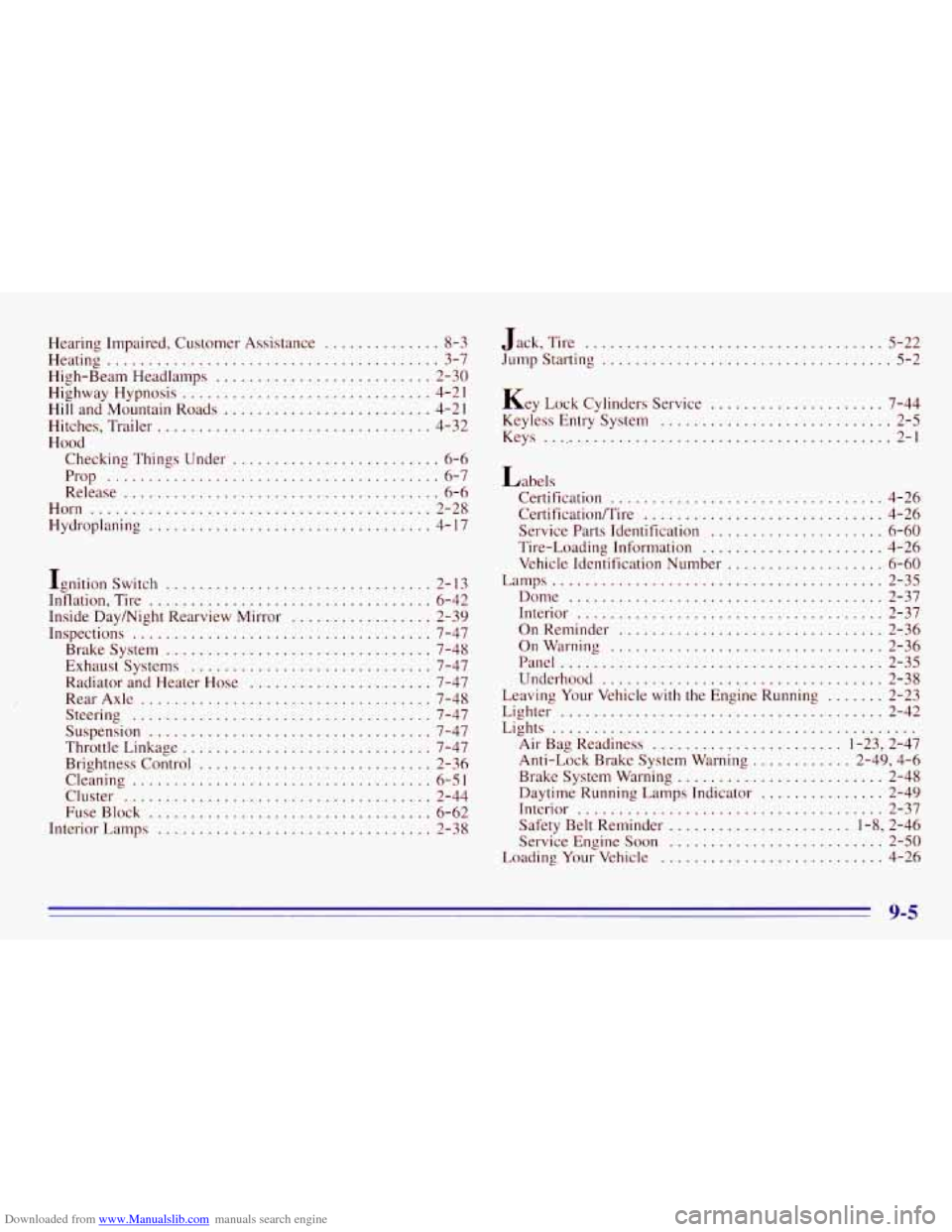
Downloaded from www.Manualslib.com manuals search engine Hearing Impaired. Customer Assistance .............. 8-3
Heating
........................................ 3-7
High-Beam Headlamps
.......................... 2-30
Highway Hypnosis
.............................. 4-21
Hill and Mountain Roads ......................... 4-21
Hitches. Trailer ................................. 4-32
Hood Checking Things Under
......................... 6-6
Prop ........................................ 6-7
Release
...................................... 6-6
Horn ......................................... 2-28
Hydroplaning
.................................. 4- I7
Ignition Switch ................................ 2- 13
Inflation. Tire
.................................. 6-42
Inside Daymight Rearview Mirror
................. 2-39
Inspections
.................................... 7-47
Brakesystem
................................ 7-48
Exhaust Systems
............................. 7-47
Radiator and Heater Hose
...................... 7-47
RearAxle
................................... 7-48
Steering
.................................... 7-47
Suspension
.................................. 7-47
Throttle Linkage
.............................. 7-47
Brightness Control
............................ 2-36
Cleaning
.................................... 6-51
Cluster
..................................... 2-44
FuseBlock
.................................. 6-62
Interior Lamps
................................. 2-38
Jack. Ere .................................... 5-22
Jump Starting ................................... 5-2
Key Lock Cylinders Service ..................... 7-44
Keyless Entry System
............................ 2-5
Keys
........................................... 2-1
Labels Certification
................................. 4-26
Certificationflire
............................. 4-26
Service Parts Identification
..................... 6-60
Tire-Loading Information
...................... 4-26
Vehicle Identification Number
................... 6-60
Lamps
........................................ 2-35
Dome
...................................... 2-37
Interior
..................................... 2-37
OnReminder
................................ 2-36
Onwarning
................................. 2-36
Panel
....................................... 2-35
Underhood
.................................. 2-38
Leaving Your Vehicle with the Engine Running
....... 2-23
Lighter
....................................... 2-42
Lights
............................................
Air Bag Readiness ....................... 1-23. 2-47
Anti-Lock Brake System Warning
............ 2.49. 4.6
Brake System Warning
......................... 2-48
Daytime Running Lamps Indicator
............... 2-49
Interior
..................................... 2-37
Safety Belt Reminder
...................... 1-23. 2-46
Service Engine
Soon .......................... 2-50
Loading Your Vehicle
........................... 4-26
9-5