steering CHEVROLET EXPRESS 1997 1.G Owner's Manual
[x] Cancel search | Manufacturer: CHEVROLET, Model Year: 1997, Model line: EXPRESS, Model: CHEVROLET EXPRESS 1997 1.GPages: 386, PDF Size: 20.32 MB
Page 195 of 386
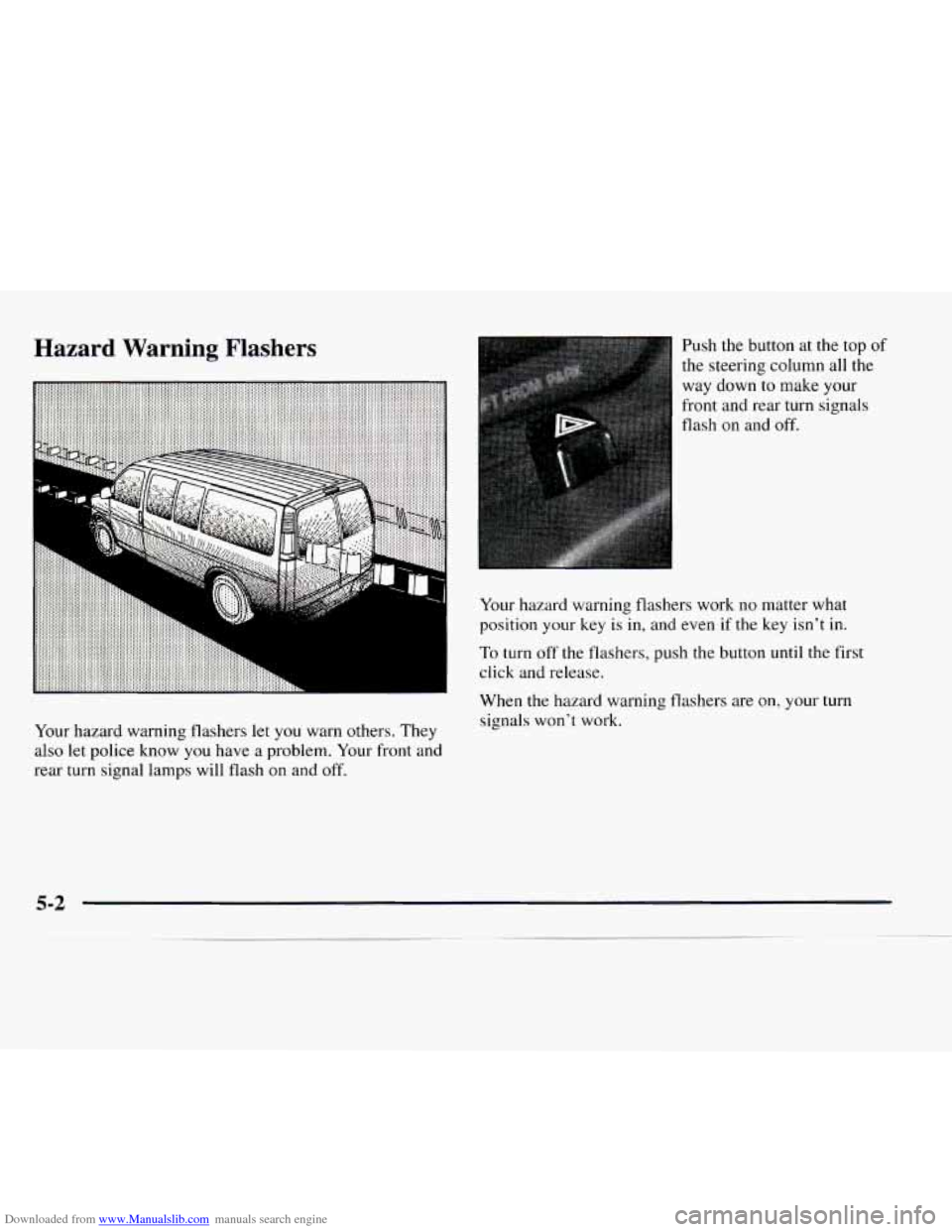
Downloaded from www.Manualslib.com manuals search engine Hazard Warning Flashers Push the button at the top of
the steering column all the
way down to make your
front and rear turn signals
flasb
cm and off.
Your hazard warning flashers
work no matter what
position your key is in, and even if
the key isn’t in.
To turn off the flashers, push the button until the first
click and release.
When the hazard warning flashers are on, your turn
signals won’t work.
Your hazard warning flashers let
you warn others. They
also
let police know you have a problem. Your front and
rear turn signal lamps will flash
on and off.
5-2
Page 202 of 386
Downloaded from www.Manualslib.com manuals search engine I I
’ A CAUTIO--:
- - -
To help avoid injury to you or others:
0
0
0
0
0
Never let passengers ride in a vehicle that is
being towed.
Never tow faster than safe or posted speeds.
Never tow with damaged parts not
fully secured. Never get under your vehicle after it has
been lifted by the tow truck.
Always use separate safety chains on each
side when towing a vehicle.
When your vehicle is being towed, have the ignition
key
off. The steering wheel should be clamped in a
straight-ahead position, with a clamping device
I designed for towing service. Do not use the vehicle’s
steering column lock for this. The transmission should
be
in NEUTRAL (N) and the parking brake should
be released.
A
,!1 CAUTION:
A vehicle can fall from a car carrier if it isn’t
adequately secured. This can cause a collision,
serious personal injury and vehicle damage.
The vehicle should be tightly secured with
chains or steel cables before it is transported.
Don’t use substitutes (ropes, leather straps,
canvas webbing, etc.) that can be cut by sharp
edges underneath the towed vehicle.
Page 215 of 386
Downloaded from www.Manualslib.com manuals search engine Engine Fan Noise
Your vehicle has a clutched engine cooling fan. When the
clutch is engaged, the fan spins faster to provide more air
to cool the engine. In most everyday driving conditions,
the fan is spinning slower and the clutch is not fully
engaged. This improves fuel economy and reduces fan
noise. Under heavy vehicle loading, trailer towing and/or
high outside temperatures, the fan speed increases as the
clutch more fully engages.
So you may hear an increase
in fan noise. This is normal and should
not be mistaken
as the transmission slipping or making extra shifts. It
is
merely the cooling system functioning properly. The fan
will slow down when additional cooling is not required
and
the clutch partially disengages.
You may also hear this fan noise when you start the engine.
It will go away as the fan clutch partially disengages.
If a Tire Goes Flat
It’s unusual for a tire to “blow out” while you’re driving,
especially
if you maintain your tires properly. If air goes
out of a tire, it’s much more likely to leak
out slowly.
But
if you should ever have a “blowout,” here are a
few tips about what to expect and what to do:
If a front tire fails, the flat tire will create a drag that
pulls the vehicle toward that side. Take your foot
off the
accelerator pedal and grip the steering wheel firmly.
Steer to maintain lane position, and then gently brake to
a stop well
out of the traffic lane.
A rear blowout, particularly on a curve, acts much like
a skid and may require
the same correction you’d use
in
a skid. In any rear blowout, remove your foot from
the accelerator pedal. Get the vehicle under control by
steering the way you want the vehicle
to go. It may be
very bumpy and noisy, but
you can still steer. Gently
brake
to a stop -- well off the road if possible.
If
a tire goes flat, the next part shows how to use your
jacking equipment to change
a flat tire safely.
5-22
Page 231 of 386
Downloaded from www.Manualslib.com manuals search engine NOTICE:
Spinning your wheels can destroy parts of your
vehicle as
well as the tires. If you spin the wheels
too fast while shifting
your transmission back
and forth, you can destroy your transmission.
For information about using tire chains on your vehicle,
see “Tire Chains” in the Index.
Rocking Your Vehicle To Get It Out
First, turn your steering wheel left and right. That will
clear the area around your front wheels. Then shift back
and forth between REVERSE (R) and a forward gear,
spinning
the wheels as little as possible. Release the
accelerator pedal while you shift, and press lightly
on
the accelerator pedal when the transmission is in gear.
If that doesn’t get you out after a few tries,
you may
need to be towed out. If you do need
to be towed out,
see “Towing Your Vehicle” in the Index.
Page 234 of 386
Downloaded from www.Manualslib.com manuals search engine Section 6 Service and Appearance Care
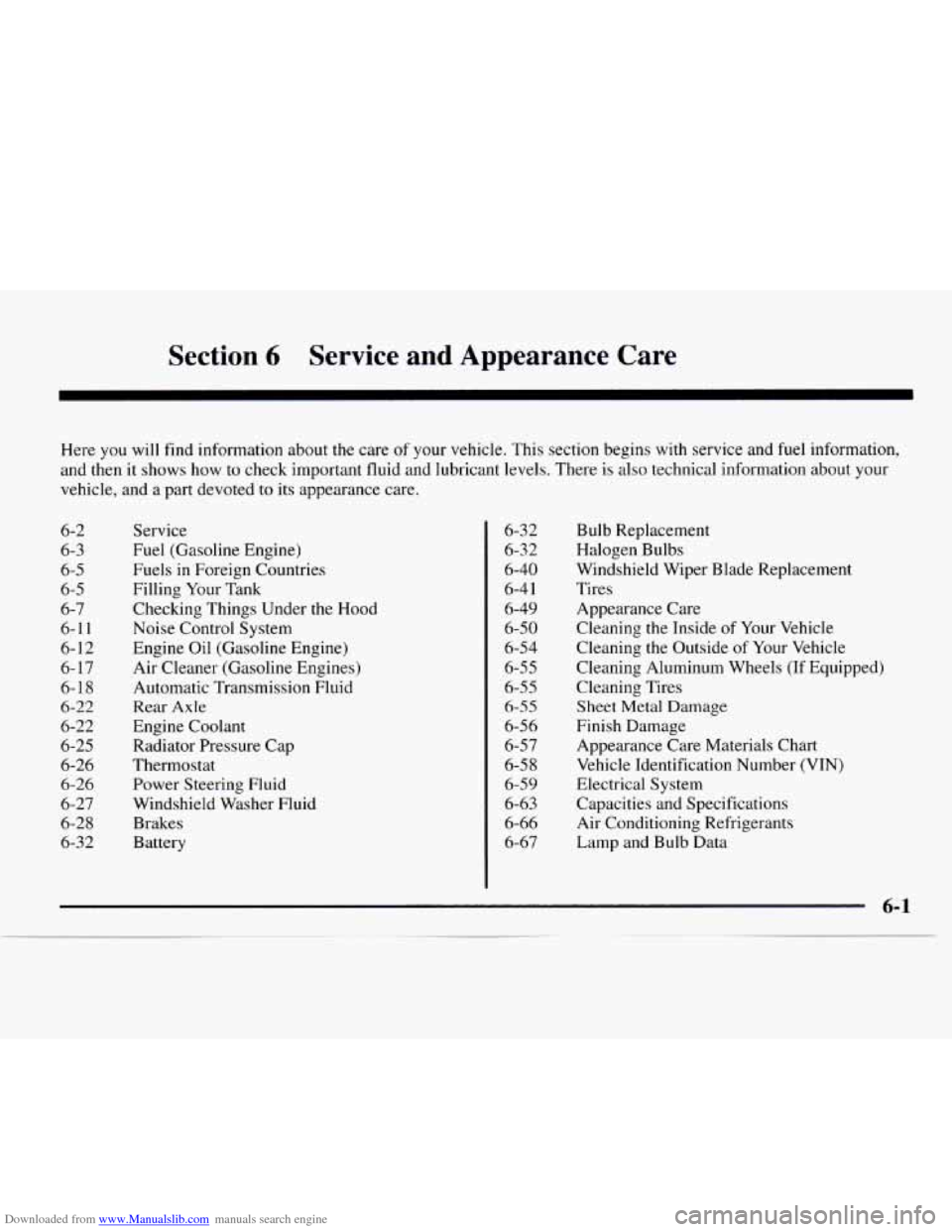
Here you will find information about the care of your vehicle. This section begins with service and fuel information,
and then it shows how to check important fluid and lubricant levels. There
is also technical information about your
vehicle, and
a part devoted to its appearance care.
6-2
6-3
6-5
6-5
6-7
6-1 1
6-12 6-17
6-18
6-22
6-22
6-25
6-26 6-26
6-27
6-28 6-32 Service
Fuel (Gasoline Engine)
Fuels in Foreign Countries
Filling Your Tank
Checking Things Under the Hood
Noise Control System
Engine Oil (Gasoline Engine)
Air Cleaner (Gasoline Engines)
Automatic Transmission Fluid
Rear Axle
Engine Coolant Radiator Pressure Cap
Thermostat Power Steering Fluid
Windshield Washer Fluid
Brakes
Battery 6-32
6-32
6-40
6-4
1
6-49
6-50
6-54
6-55
6-55
6-55
6-56
6-57
6-5 8
6-59
6-63
6-66
6-67 Bulb Replacement
Halogen Bulbs
Windshield Wiper Blade Replacement
Tires Appearance Care
Cleaning the Inside
of Your Vehicle
Cleaning the Outside of Your Vehicle
Cleaning Aluminum Wheels
(If Equipped)
Cleaning Tires Sheet Metal Damage
Finish Damage
Appearance Care Materials Chart
Vehicle Identification Number (VIN)
Electrical System
Capacities and Specifications
Air Conditioning Refrigerants
Lamp and Bulb Data
Page 242 of 386
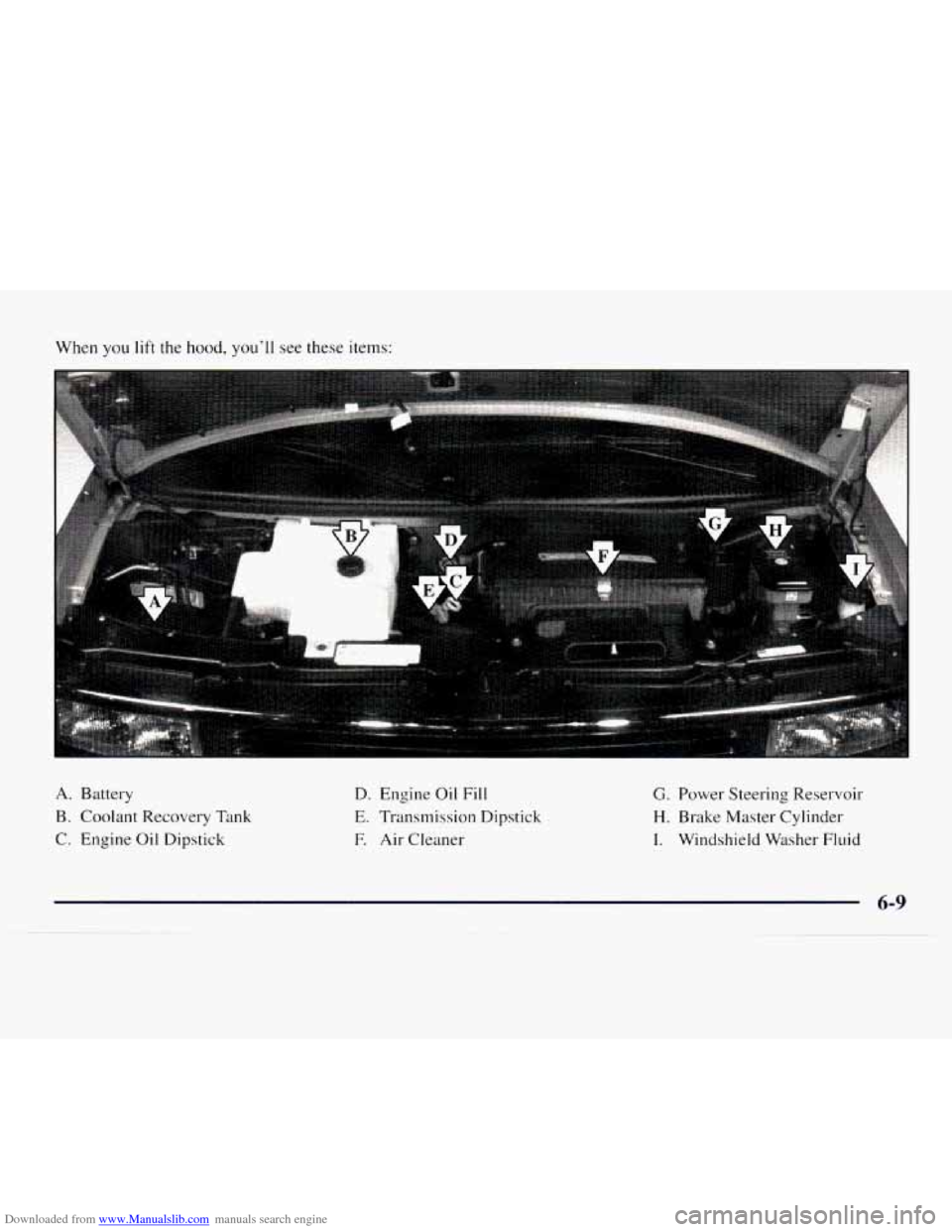
Downloaded from www.Manualslib.com manuals search engine When you lift the hood, you’ll see these items:
A. Battery
B. Coolant Recovery Tank
C. Engine Oil Dipstick D.
Engine Oil Fill E. Transmission Dipstick
E Air Cleaner
G. Power Steering Reservoir
H. Brake Master Cylinder
I. Windshield Washer Fluid
6-9
Page 259 of 386
Downloaded from www.Manualslib.com manuals search engine Thermostat
Engine coolant temperature is controlled by a thermostat
in the engine cooling system. The thermostat stops the
flow of coolant through the radiator until the coolant
reaches a preset temperature.
When you replace your thermostat, an
AC@ thermostat
is recommended.
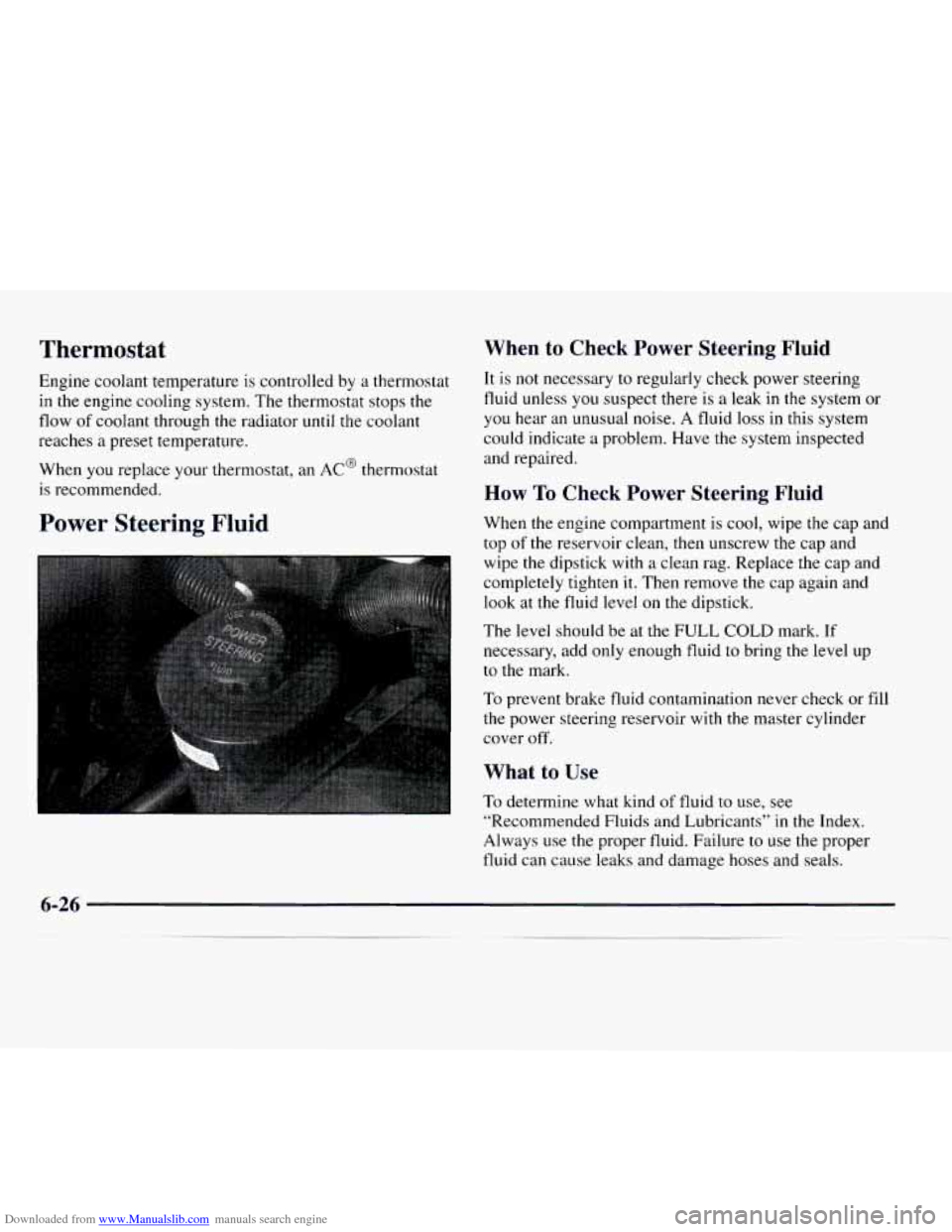
Power Steering Fluid
When to Check Power Steering Fluid
It is not necessary to regularly check power steering
fluid unless you suspect there is a leak in the system or
you hear an unusual noise.
A fluid loss in this system
could indicate a problem. Have the system inspected
and repaired.
How To Check Power Steering Fluid
When the engine compartment is cool, wipe the cap and
top
of the reservoir clean, then unscrew the cap and
wipe the dipstick with
a clean rag. Replace the cap and
completely tighten it. Then remove the cap again and
look at the fluid level on the dipstick.
The level should be at the
FULL COLD mark. If
necessary, add only enough fluid to bring the level up
to the mark.
To prevent brake fluid contamination never check or fill
the power steering reservoir with the master cylinder
cover
off.
What to Use
To determine what kind of fluid to use, see
“Recommended Fluids and Lubricants”
in the Index.
Always use the proper fluid. Failure
to use the proper
fluid can cause leaks and damage hoses and seals.
6-26
Page 295 of 386
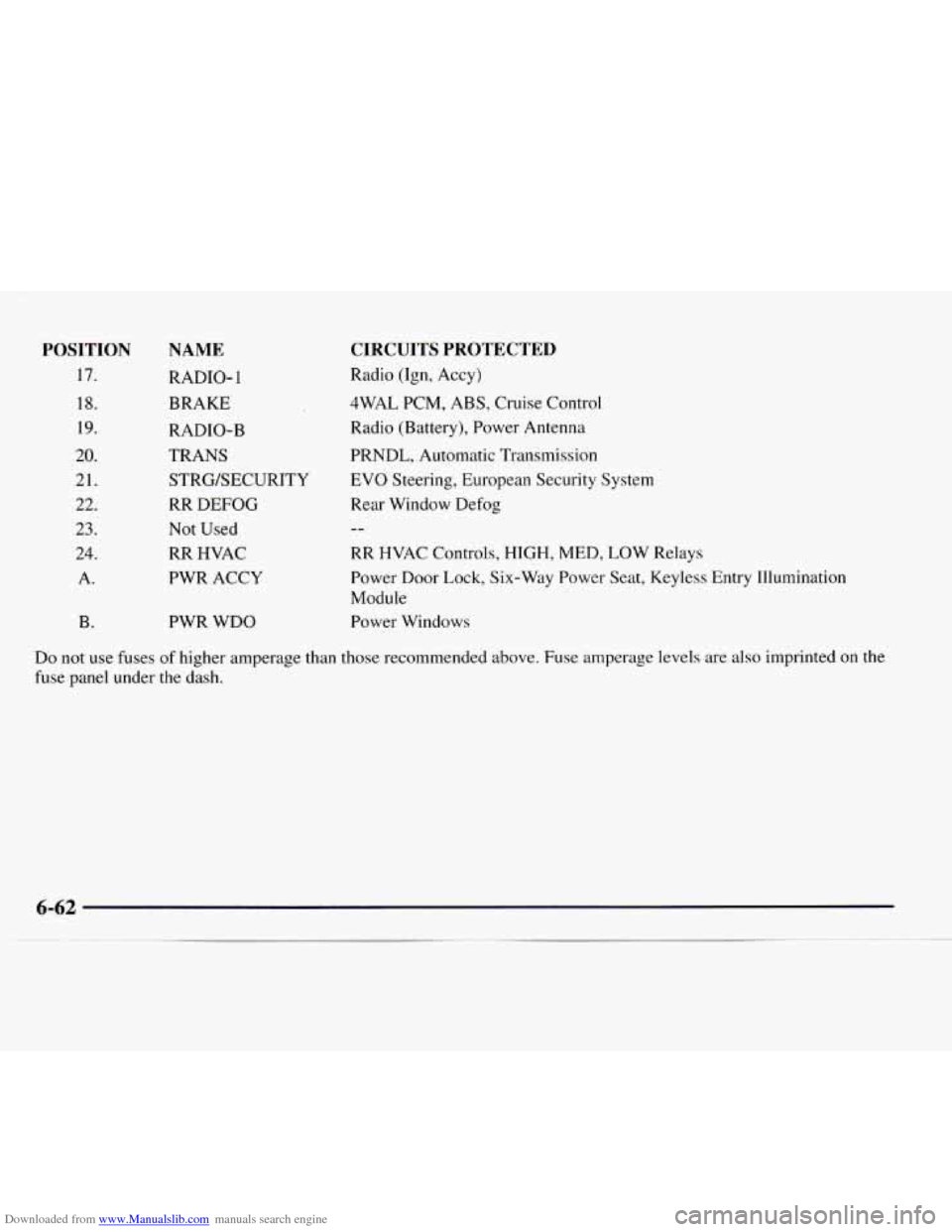
Downloaded from www.Manualslib.com manuals search engine POSITION
17.
18.
19.
20.
21.
22.
23.
24. A.
B.
NAME
RADIO- 1
BRAKE
RADIO-B
TRANS STRGEECURITY
RR DEFOG
Not Used
RR HVAC
PWR ACCY
PWR WDO
CIRCUITS PROTECTED
Radio (Ign, Accy)
4WAL PCM, ABS, Cruise Control
Radio (Battery), Power Antenna
PRNDL, Automatic Transmission
EVO Steering, European Security System
Rear Window Defog
RR HVAC Controls, HIGH, MED,
LOW Relays
Power Door Lock, Six-Way Power Seat, Keyless Entry Illumination
Module
Power Windows
Do not
use fuses of higher amperage than those recommended above. Fuse amperage levels are also imprinted on the
fuse panel under the dash.
Page 311 of 386
Downloaded from www.Manualslib.com manuals search engine I Short TripKity Maintenance Schedule =- Gasoline Engines I
The services shown in this schedule up to 100,000 miles
(1 66 000 km) should be performed after 100,000 miles
(166
000 km) at the same intervals. The services shown
at 150,000 miles
(240 000 km) should be performed at
the same interval after 150,000 miles (240 000 km).
See “Owner Checks and Services” and “Periodic
Maintenance Inspections” following.
Footnotes
3- The U.S. Environmental Protection Agency or the
California Air Resources Board has determined that the
failure to perform this maintenance item will
not nullify
the emission warranty or limit recall liability prior
to the
completion of the vehicle’s useful life. We, however,
urge that all recommended maintenance services be
performed at the indicated intervals and the maintenance
be recorded.
# Lubricate the front suspension, kingpin bushings,
steering linkage and rear driveline center splines.
+ A good time to check your brakes is during tire
rotation. See “Brake System Inspection’’ under “Periodic
Maintenance Inspection’’ in Part
C of this schedule.
** Drive axle service (see “Recommended Fluids and
Lubricants’’
in the Index for proper lubricant to use):
0
0
0
Locking Differential -- Drain fluid and refill at first
engine
oil change. At subsequent oil changes, check
fluid level and add fluid as needed.
If driving in
dusty areas or towing a trailer, drain fluid and refill
every 15,000 miles (25
000 km).
Standard Differential
-- Check fluid level and add
fluid as needed at every oil change. If driving in
dusty areas or towing a trailer, drain fluid and refill
every
15,000 miles (25 000 km).
More frequent lubrication may be required for
heavy-duty use.
Page 335 of 386
Downloaded from www.Manualslib.com manuals search engine Long Trip/Highway Maintenance Schedule -- Gasoline Engines I
The services shown in this schedule up to 100,000 miles
(166 000 km) should be performed after 100,000 miles
(166 000 km) at the same intervals. The services shown
at 150,000 miles
(240 000 km) should be performed at
the same interval after
150,000 miles (240 000 km).
See “Owner Checks and Services” and “Periodic
Maintenance Inspections” following.
Footnotes
ri‘ The U.S. Environmental Protection Agency or the
California Air Resources Board has determined that the
failure to perform this maintenance item will not
nullify
the emission warranty or limit recall liability prior to the
completion of the vehicle’s useful
life. We, however,
urge that all recommended maintenance services be
performed at the indicated intervals and the maintenance
be recorded.
## Lubricate the front suspension, kingpin bushings,
steering linkage and rear driveline center splines.
+ A good time to check your brakes is during tire
rotation. See “Brake System Inspection” under “Periodic
Maintenance Inspections”
in Part C of this schedule.
** Drive axle service (see “Recommended Fluids and
Lubricants”
in the Index for proper lubricant to use):
Locking Differential -- Drain fluid and refill at first
engine oil change. At subsequent
oil changes, check
fluid level and add fluid
as needed.
Standard Differential -- Check fluid level and add
fluid
as needed at every engine oil change.
7-32