belt CHEVROLET EXPRESS 1997 1.G Workshop Manual
[x] Cancel search | Manufacturer: CHEVROLET, Model Year: 1997, Model line: EXPRESS, Model: CHEVROLET EXPRESS 1997 1.GPages: 386, PDF Size: 20.32 MB
Page 190 of 386
Downloaded from www.Manualslib.com manuals search engine Parking on Hills
You really should not park your vehicle, with a trailer
attached, on a hill. If something goes wrong, your rig
could start
to move. People can be injured, and both
your vehicle and the trailer can be damaged.
But if
you ever have to park your rig on a hill, here’s
how
to do it:
1.
2.
3.
4.
5.
Apply your regular brakes, but don’t shift into
PARK
(P) yet. Then turn your wheels into the curb
if facing downhill or into traffic if facing uphill.
Have someone place chocks under the trailer wheels.
When the wheel chocks are in place, release the
regular brakes until
the chocks absorb the load.
Re-apply the regular brakes. Then apply your
parking brake and then shift to PARK
(P).
Release the reguIar brakes.
When You Are Ready to Leave After
Parking on a Hill
I. Apply your regular brakes and hold the pedal down
while
you:
Start your engine;
0 Shift into a gear; and
0 Release the parking brake.
2. Let up on the brake pedal.
3. Drive slowly until the trailer is clear of the chocks.
4. Stop and have someone pick up and store the chocks.
Maintenance When Trailer Towing
Your vehicle will need service more often when you’re
pulling a trailer. See
the Maintenance Schedule for more
on this. Things that are especially important in trailer
operation are automatic transmission fluid (don’t
overfill), engine oil, axle lubricant, belt, cooling system
and brake adjustment. Each
of these is covered in this
manual, and the Index will help you find them quickly.
If you’re trailering, it’s a good idea to review these
sections before you start your trip.
Check periodically
to see that all hitch nuts and bolts
are tight.
Page 243 of 386
Downloaded from www.Manualslib.com manuals search engine If your vehicle has a 7.4 liter engine and air
conditioning, your vehicle will have
a auxiliary engine
fan in addition to the belt driven fan.
1
,A CAUTION: I
If your vehicle has air conditioning, the auxiliary
engine fan under the hood can start up and
injure you even when the engine is not running.
Keep hands, clothing and tools away from any
underhood electric fan.
I A CAUTION:
i
Things that burn can get on hot engine parts and
start
a fire. These include liquids like gasoline,
oil, coolant, brake fluid, windshield washer and
other fluids, and plastic or rubber. You
or others
could be burned. Be careful not to drop or spill
things that will burn onto
a hot engine.
Before closing the hood, be sure all the filler caps are
on properly.
Then
lift the hood to relieve pressure on the hood prop.
Remove the hood prop from the slot in the hood and
return the prop
to its retainer. Then just let the hood
down and close
it firmly.
6-10
. .~
Page 278 of 386
Downloaded from www.Manualslib.com manuals search engine Dual Tire Operation
When the vehicle is new, or whenever a wheel, wheel
bolt or wheel nut is replaced, check the wheel
nut torque
after
100, 1,000 and 6,000 miles ( 160, 1 600 and
10 000 km) of driving. For proper torque, see “Wheel
Nut Torque’’ in
the Index.
The outer tire on a dual wheel setup generally wears
faster than the inner tire. Your tires will wear more
evenly and last longer if you rotate the tires periodically.
If you’re going to be doing a lot
of driving on
high-crown roads, you can reduce tire wear by adding
5 psi (35 kPa) to the tire pressure in the outer tires. Be
sure
to return to the recommended pressures when no
longer driving under those conditions. See “Changing a
Flat Tire” in the Index for more information.
A CAUTION:
Buying New Tires
To find out what kind and size of tires you need, look at
the Certificationrnire label.
The tires installed
on your vehicle when it was new had
a Tire Performance Criteria Specification (TPC Spec)
number
on each tire’s sidewall. When you get new tires,
get ones with that same TPC Spec number. That way
your vehicle will continue
to have tires that are designed
to give proper endurance, handling, speed rating,
traction, ride and other things during normal service on
your vehicle. If your tires have an all-season tread
design, the TPC number will be followed by
an “MS”
(for mud and snow).
If you ever replace your tires with those not having a
TPC Spec number, make sure they are the same size,
load range, speed rating and construction type (bias,
bias-belted or radial) as your original tires.
If you operate your vehicle with a tire that is
badly underinflated, the tire can overheat. An
overheated tire can lose air suddenly or catch
fire.
You or others could be injured. Be sure all
tires (including the spare) are properly inflated.
Page 279 of 386
Downloaded from www.Manualslib.com manuals search engine Mixing tires could cause you to lose control while
driving.
If you mix tires of different sizes or types
(radial and bias-belted tires), the vehicle may not
handle properly, and you could have a crash.
Using tires
of different sizes may also cause
damage to your vehicle.
Be sure to use the same
size and type tires on all wheels.
1
Uniform Tire Quality Grading
The following information relates to the system developed
by the United States National Highway Traffic Safety
Administration, which grades tires by treadwear, traction and temperature performance. (This applies only to
vehicles sold in the United States.) The grades are molded
on the sidewalls of most passenger car tires. The Uniform
Tire Quality Grading system does
not apply to deep tread,
winter-type snow tires, space-saver
or temporary use spare
tires, tires with nominal rim diameters
of 10 to 12 inches
(25 to 30 cm), or to some limited-production tires.
While
the tires available on General Motors passenger
cars and light trucks may vary with respect to these grades,
they must also conform to Federal safety
requirements and additional General Motors Tire
Performance Criteria
(TPC) standards.
Treadwear
The treadwear grade is a comparative rating based on
the wear rate of the tire when tested under controlled
conditions on a specified government test course. For
example, a tire graded
150 would wear one and a half
( 1 1/2) times as well on the government course as a tire
graded
100. The relative performance of tires depends
upon the actual conditions
of their use, however, and
may depart significantly from the norm due
to variations
in driving habits, service practices and differences in
road characteristics and climate.
Traction -- A, B, C
The traction grades, from highest to lowest, are A, B, and
C, and they represent the tire’s ability to stop on wet
pavement as measured under controlled conditions
on
specified government test surfaces of asphalt and concrete.
A tire marked C may have poor traction performance.
Warning: The traction grade assigned to this tire is based
on braking (straightahead) traction tests and does not
include cornering (turning) traction.
Page 286 of 386
Downloaded from www.Manualslib.com manuals search engine Care of Safety Belts
Keep belts cle: 1 dry.
Cleaning the Outside of the
Windshield and Wiper Blades
A CAUTION:
Do not bleach or dye safety belts. If you do, it
may severely weaken them. In a crash, they
might not be able to provide adequate protection.
Clean safety belts only with mild soap and
lukewarm water.
Cleaning Glass Surfaces
Glass should be cleaned often. GM Glass Cleaner (GM
Part
No. 1050427) or a liquid household glass cleaner
will remove normal tobacco smoke and dust films
on
interior glass.
Don’t use abrasive cleaners on glass, because they may
cause scratches. Avoid placing decals on the inside rear
window, since
they may have to be scraped off later.
If abrasive cleaners are used on the inside of the rear
window, an electric defogger element may be damaged.
Any temporary license should not be attached across the
defogger grid.
If the windshield is not clear after using the windshield
washer, or
if the wiper blade chatters when running,
wax, sap
or other material may be on the blade
or windshield.
Clean the outside of the windshield
with GM Glass
Cleaner, Bon Ami@ Powder (non-scratching glass
cleaning powder), GM Part
No. 105001 1. The
windshield is clean
if beads do not form when you
rinse
it with water.
Grime from the windshield
will stick to the wiper blades
and affect their performance. Clean the blade by wiping
vigorously with a cloth soaked
in full-strength windshield
washer solvent. Then rinse
the blade with water.
Check the wiper blades and clean them as necessary; replace worn blades.
Weatherstrips
Silicone grease on weatherstrips will make them last
longer, seal better, and not stick or squeak. Apply
silicone grease
with a clean cloth at least every six
months. During very cold, damp weather more frequent
application may be required. (See “Recommended
Fluids and Lubricants”
in the Index.)
Page 302 of 386
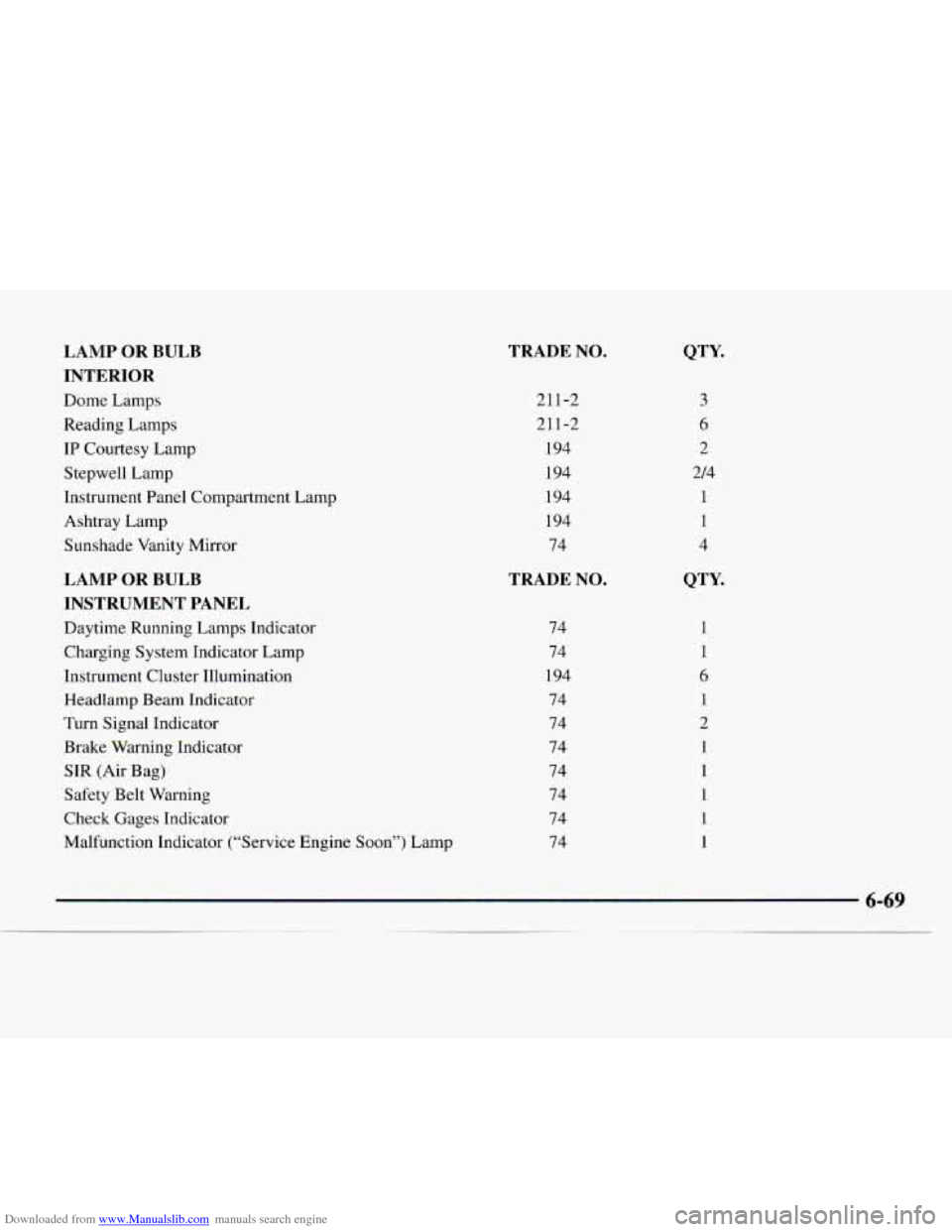
Downloaded from www.Manualslib.com manuals search engine LAMP OR BULB
INTERIOR
Dome Lamps
Reading Lamps
IP Courtesy Lamp
Stepwell Lamp
Instrument Panel Compartment Lamp
Ashtray Lamp
Sunshade Vanity Mirror
LAMP OR BULB
INSTRUMENT PANEL
Daytime Running Lamps Indicator
Charging System Indicator Lamp
Instrument Cluster Illumination
Headlamp Beam Indicator
Turn Signal Indicator
Brake Warning Indicator
SIR (Air Bag) Safety Belt Warning
Check Gages Indicator
Malfunction Indicator
("Service Engine Soon”) Lamp
TRADE NO.
211-2
21 1-2
194
194
194 194 74
TRADE NO.
74 74
194 74 74
74
74 74
74
74
3
6
2
214
1
1
4
QTY.
1
1
6
1
2
1
1
1
1
1
Page 308 of 386
Downloaded from www.Manualslib.com manuals search engine Maintenance Schedule
Short TripKity Definition -- Gasoline Engines
Follow the Short Trip/City Maintenance Schedule if any
one
of these conditions is true for your vehicle:
0 Most trips are less than 5 to 10 miles (8 to 16 km).
This is particularly important when outside
temperatures are below freezing.
0 Most trips include extensive idling (such as frequent
driving in stop-and-go traffic).
0 Most trips are through dusty areas.
0 You frequently tow a trailer or use a carrier on top of
your vehicle.
or other commercial application.
0 If the vehicle is used for delivery service, police, taxi
One of the reasons you should follow this schedule if
you operate your vehicle under any of these conditions
is that these conditions cause engine oil to break
down soonel:
Short TripKity Intervals -- Gasoline Engines
Every 3,000 Miles (5 000 km): Engine Oil and Filter
Change (or
3 months, whichever occurs first). Chassis
Lubrication (or
3 months, whichever occurs first). Drive
Axle Service (or
3 months, whichever occurs first).
Every 6,000 Miles (10 000 km): Tire Rotation.
Every 15,000 Miles (25 000 km): Air Cleaner Filter
Inspection, if driving in dusty conditions. Shields and
Underhood Insulation Inspection (GVWR above
8,500 lbs. only). Front Wheel Bearing Repack (or at
each brake relining, whichever occurs first).
Every 30,000 Miles (50 000 km): Air Cleaner Filter
Replacement.
Fuel Filter Replacement.
Every 50,000 Miles (83 000 km): Automatic
Transmission Service (vehicles over
8600 GVWR or
driven under severe conditions only).
Every 60,000 Miles (100 000 km): Engine Accessory
Drive Belt Inspection. Fuel Tank, Cap and Lines
Inspection. Exhaust Gas Recirculation System
Inspection. Evaporative Control System Inspection.
Page 310 of 386
Downloaded from www.Manualslib.com manuals search engine Maintenance Schedule
Every 7,500 Miles (12 500 km): Engine Oil and Filter
Change (or every
12 months, whichever occurs first).
Chassis Lubrication (or every
12 months, whichever
occurs first). Drive Axle Service. Tire Rotation.
Every 15,000 Miles (25 000 km): Shields and
Underhood Insulation Inspection (GVWR above
8,500 lbs. only).
Every 30,000 Miles (50 000 km): Fuel Filter
Replacement. Air Cleaner Filter Replacement. Front
Wheel Bearing Repack (or at each brake relining,
whichever occurs first).
Every 50,000 Miles (83 000 km): Automatic
Transmission Service (vehicles over
8600 GVWR or
driven under severe conditions only).
Every 60,000 Miles (100 000 km): Engine Accessory
Drive Belt Inspection. Fuel Tank, Cap and Lines
Inspection. Exhaust Gas Recirculation System
Inspection. Evaporative Control System Inspection.
I Long Tripmighway Intervals -- Gasoline Engines 1
Every 100,000 Miles (166 000 km): Spark Plug Wire
Inspection. Spark Plug Replacement. Positive
Crankcase Ventilation (PCV) Valve Inspection.
Every 150,000 Miles (240 000 km): Cooling System
Service (or every
60 months, whichever occurs first).
These intervals only summarize maintenance services.
Be sure to follow the complete maintenance schedule
on the following pages.
7-7
Page 324 of 386

Downloaded from www.Manualslib.com manuals search engine I Short Trip/City Maintenance Schedule -- Gasoline Engines I
60,000 Miles (100 000 km)
0 Change engine oil and filter (or every
3 months, whichever occurs first).
An Emission Control Service.
0 Lubricate chassis components (or every
3 months, whichever occurs first).
(See footnote
#.)
0 Check axle fluid level and add fluid as
needed. (See footnote
* * .)
0 Clean and repack the front wheel bearings
(or at each brake relining, whichever
occurs first).
0 Vehicles With GVWR Above 8,500 lbs.
Only: Inspect shields and underhood
insulation for damage or looseness. Adjust
or replace as required.
This is a Noise Emission
Control Service. Applicable
only to vehicles sold in
the United States.
0 Inspect engine accessory drive belt.
0 Replace fuel filter. An Emission Control Service.
(See footnote? .)
0 Conduct Exhaust Gas Recirculation (EGR)
system inspection as described in the
service manual.
An Emission Control Service.
(See footnote? .)
inspection. Check all fuel and vapor lines
and hoses for proper hook-up, routing and
condition. Check that the purge valve works
properly
(if equipped). Replace as needed.
An Emission Control Service. (See footnote f .)
An Emission Control Service.
0 Conduct evaporative control system
c] Replace air cleaner filter.
An Emission Control Service.
(Continued)
CI n-a
Page 341 of 386
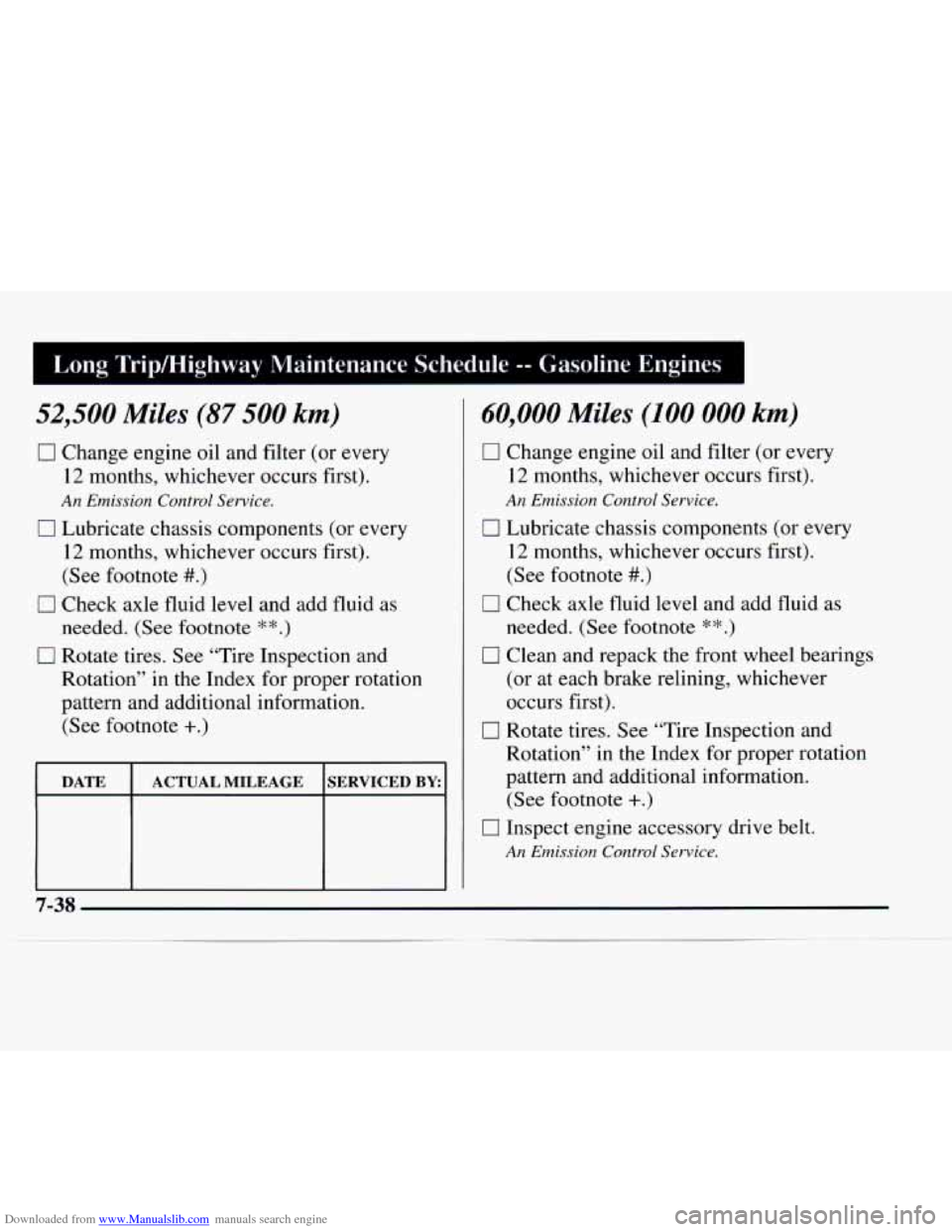
Downloaded from www.Manualslib.com manuals search engine Long TripMighway Maintenance Schedule -- Gasoline Engines I
52,500 Miles (87 500 km)
0 Change engine oil and filter (or every
12 months, whichever occurs first).
An Emission Control Service.
Cl Lubricate chassis components (or every
12 months, whichever occurs first).
(See footnote
#.)
0 Check axle fluid level and add fluid as
needed. (See footnote
** .)
0 Rotate tires. See “Tire Inspection and
Rotation” in
the Index for proper rotation
pattern and additional information. (See footnote
+.)
60,000 Miles (100 000 km)
0 Change engine oil and filter (or every
12 months, whichever occurs first).
An Emission Control Service.
0 Lubricate chassis components (or every
12 months, whichever occurs first).
(See footnote
#.)
0 Check axle fluid level and add fluid as
needed. (See footnote
** .)
0 Clean and repack the front wheel bearings
(or at each brake relining, whichever
occurs first).
0 Rotate tires. See “Tire Inspection and
Rotation” in the Index for proper rotation
pattern and additional information.
(See footnote
+.)
CI Inspect engine accessory drive belt.
An Emission Control Service.