trailer CHEVROLET EXPRESS 1997 1.G Owners Manual
[x] Cancel search | Manufacturer: CHEVROLET, Model Year: 1997, Model line: EXPRESS, Model: CHEVROLET EXPRESS 1997 1.GPages: 386, PDF Size: 20.32 MB
Page 77 of 386
Downloaded from www.Manualslib.com manuals search engine New Vehicle “Break-In”
NOTICE:
Your modern vehicle doesn’t need an elaborate
“break-in.” But it will perform better in the long
run if you follow these guidelines:
Keep your speed at 55 mph (88 kmh) or
less for the first
500 miles (805 km).
Don’t drive at any one speed -- fast or
slow
-- for the first 500 miles (805 km).
Don’t make full-throttle starts.
200 miles (322 km) or so. During this time
your new brake linings aren’t yet broken
in. Hard stops with new linings can mean
premature wear and earlier replacement.
Follow this breaking-in guideline every
time you get new brake linings.
See “Towing
a Trailer” in the Index for
more information.
Avoid making hard stops for the first
Don’t tow a trailer during break-in.
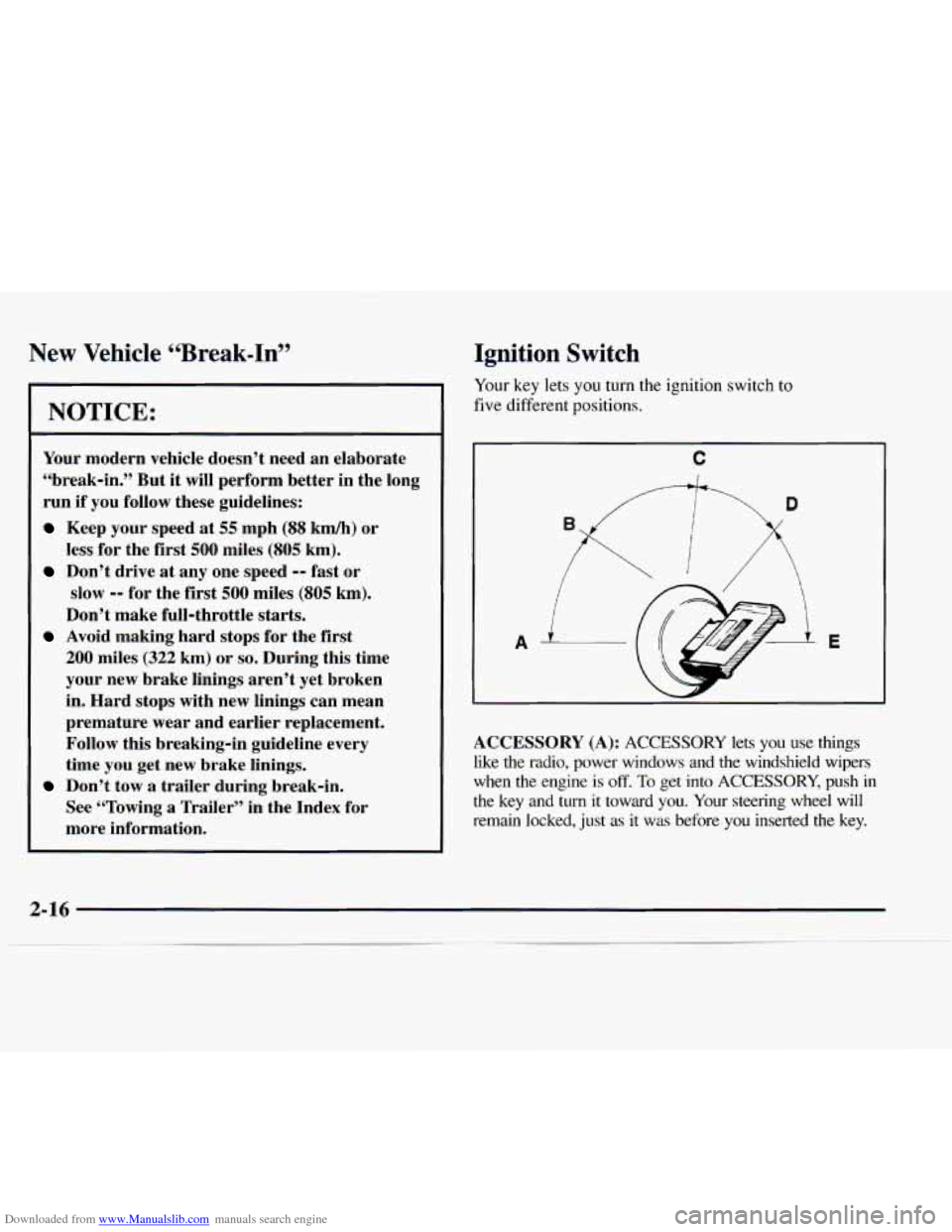
Ignition Switch
Your key lets you turn the ignition switch to
five different positions.
C
ACCESSORY (A): ACCESSORY lets you use things
like the radio, power windows and the windshield wipers
when the engine is
off. To get into ACCESSORY, push in
the key and turn
it toward you. Your steering wheel will
remain locked, just
as it was before you inserted the key.
Page 81 of 386
Downloaded from www.Manualslib.com manuals search engine Automatic Transmission Operation
There are several different positions for your shift lever.
If your vehicle is equipped with an automatic
transmission, it now features an electronic shift position
indicator within the instrument cluster. This display
must be powered anytime
the shift lever is capable of
being moved out of the PARK (P) position. This means
that
if your key is in the OFF position, but not locked,
there will be
a small current drain on your battery which
could discharge your battery over a period
of time. If
you have a need to leave your key in the ignition in the ’
OFF position for an extended period for any reason, it is
recommended that you disconnect the battery cable from
the battery
to prevent discharging your batter.y.
PARK Cp): This locks your rear wheels. It’s the best
position
to use when you start your engine because your
vehicle can’t move easily.
It is dangerous to get out of your vehicle if the
shift lever is not fully in
PARK (P) with the
parking brake firmly set. Your vehicle can roll.
Don’t leave your vehicle when the engine is
running unless you have to. If you have left the
engine running, the vehicle can move suddenly.
You or others could be injured.
To be sure your
vehicle won’t move, even when you’re on fairly
level ground, always set your parking brake and
move the shift lever to
PARK (P).
See “Shifting Into PARK (P)” in the Index. If
you’re pulling
a trailer, see “Towing a Trailer” in
the Index.
Page 83 of 386
Downloaded from www.Manualslib.com manuals search engine DRIVE (D): This position is for normal driving. If you
need more power for passing, and you’re:
Going less than about 35 mph (56 km/h), push your
accelerator pedal about halfway down.
Going about 35 mph (56 kmh) or more, push the
You’ll shift down to the next gear and have more power.
accelerator all
the way down.
You should
use DRIVE (D) (or, as you need to, a lower
gear) when towing a trailer to minimize heat build-up
and extend the life
of your transmission.
THIRD (3): This position is also used for normal
driving, however, it offers more power and lower fuel
economy than DRIVE
(D). You should use THIRD (3)
when carrying a heavy load or driving on steep hills.
SECOND (2): This position gives you more power
but lower fuel economy.
You can use SECOND (2) on
hills. It can help control your speed as you go down
steep mountain roads, but then you would also want
to use your brakes off and on. If you manually
select SECOND
(2), the transmission will drive in
SECOND (2). You may use this feature for reducing
torque to the rear wheels when you are trying to start
your vehicle from a stop on slippery road surfaces.
FIRST (1): This position gives you even more power
(but lower fuel economy) than SECOND
(2). You can
use it on very steep hills, or in deep
snow or mud. If
the selector lever is put in FIRST( l), the transmission
won’t shift into first gear until the vehicle is going
slowly enough.
NOTICE:
If your rear wheels can’t rotate, don’t try to
drive. This might happen if you are stuck in
very deep sand or mud or are
up against a solid
object. You could damage your transmission.
Also, if you stop when going uphill, don’t hold
your vehicle there with only the accelerator
pedal. This could overheat and damage the
transmission. Use your brakes or shift into
PARK (P) to hold your vehicle in position
on
a hill.
2-22
Page 85 of 386
Downloaded from www.Manualslib.com manuals search engine If the ignition is on when the parking brake is released,
the brake system warning light will go off.
NOTICE:
Driving with the parking brake on can
cause your rear brakes
to overheat. You may
have to replace them, and you could also damage
other parts of your vehicle. Always check to be
sure your parking brake is fully released before
you drive.
If you are towing a trailer and are parking on any hill,
see “Towing a Trailer’’
in the Index. That section shows
what
to do first to keep the trailer from moving.
Shifting Into PARK (P)
I
It can be dangerous to get out of your vehicle if
the shift lever is not fully in
PARK (P) with the
parking brake firmly set. Your vehicle can roll.
If you have left the engine running, the vehicle
can move suddenly. You or others could be
injured.
To be sure your vehicle won’t move, even
when you’re on fairly level ground, use the steps
that follow. If you’re pulling
a trailer, see
“Towing a Trailer” in
the Index.
1. Hold the brake pedal down with your right foot and
set the parking brake.
2-24
Page 90 of 386
Downloaded from www.Manualslib.com manuals search engine I A CAUTION:
It can be dangerous to get out of your vehicle if
the shift lever is not fully in
PARK (P) with the
parking brake firmly set. Your vehicle can roll.
Don’t leave your vehicle when the engine
is
running unless you have to. If you’ve left the
engine running, the vehicle can move suddenly.
You
or others could be injured. To be sure your
vehicle won’t move, even when you’re on fairly
level ground, always set your parking brake and
move the shift lever
to PARK (P).
Windows
Manual Windows
To operate your manual windows, turn the hand crank
on each door to raise or lower your side door windows.
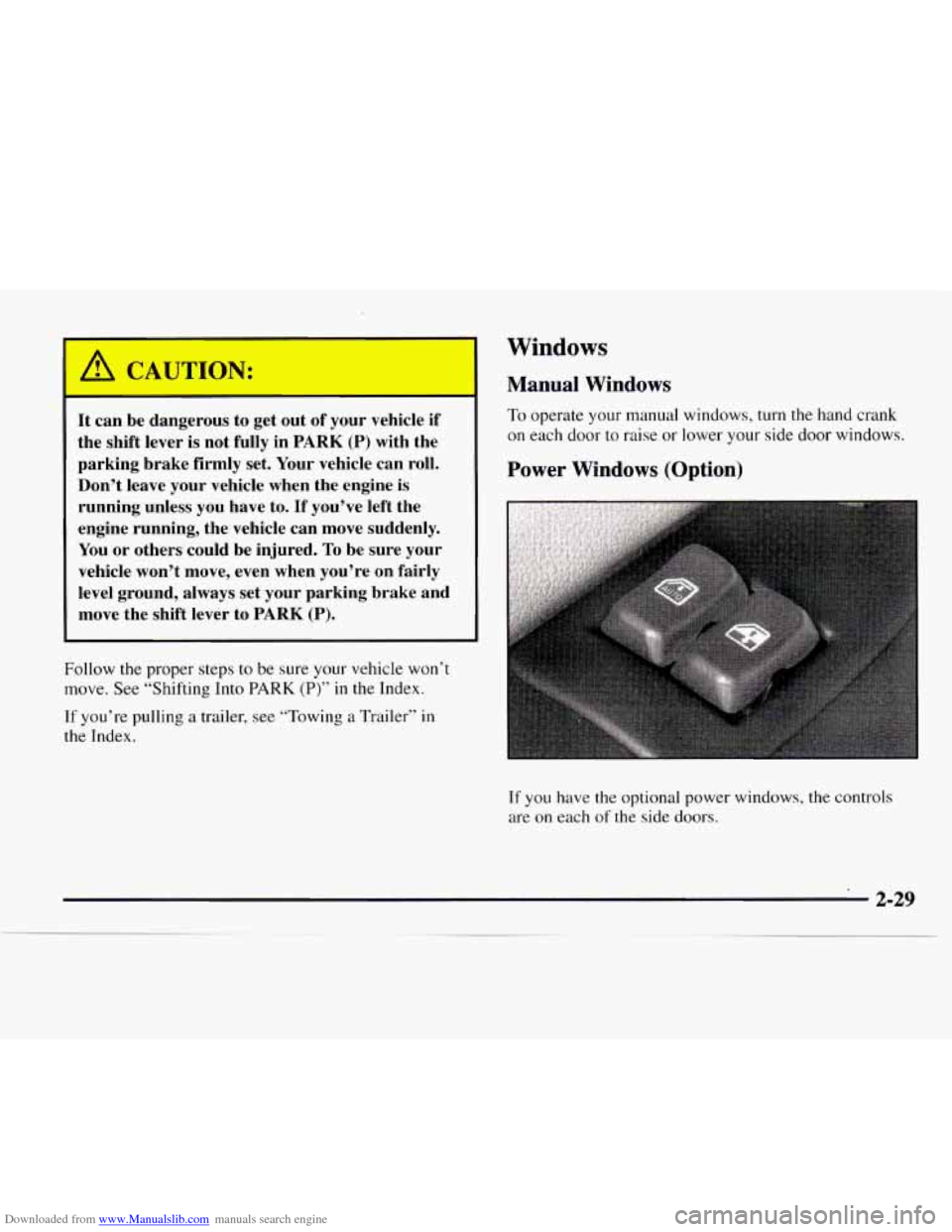
Power Windows (Option)
Follow the proper steps to be sure your vehicle won’t
move. See “Shifting Into PARK (P)” in the Index.
If you’re pulling a trailer, see “Towing a Trailer” in
the Index.
If you have the optional power windows, the controls
are
on each of the side doors.
Page 116 of 386
Downloaded from www.Manualslib.com manuals search engine If the Light Is Flashing
1 NOTICE:
If you keep driving your vehicle with this light
on, after
a while, your emission controls may not
work
as well, your fuel economy may not be as
good and your engine may not run as smoothly.
This could lead
to costly repairs that may not be
l covered by your warranty.
This light should come on, as a check to show you it is
working, when the ignition is on and the engine is not
running. If the light doesn’t come on, have it repaired.
This light
will also come on during a malfunction in one
of two ways:
Light Flashing -- A misfire condition has been
detected.
A misfire increases vehicle emissions and
may damage the emission control system
on your
vehicle. Dealer or qualified service center diagnosis
and service is required.
Light On Steady -- An emission control system
malfunction has been detected on your vehicle.
Dealer or qualified service center diagnosis and
service may be required. The following
may prevent more serious damage
to
your vehicle:
0 Reducing vehicle speed.
Avoiding hard accelerations.
0 Avoiding steep uphill grades.
0 If you are towing a trailer, reduce the amount of
cargo being hauled
as soon as it is possible.
If the light stops flashing and remains on steady, see “If
the Light
Is On Steady” following.
If the light continues to flash, when it is safe to do so,
stop the vehicle. Find a safe place to park your vehicle.
Turn
the key off, wait at least 10 seconds and restart the
engine.
If the light remains on steady, see “If the Light
Is On Steady” following. If the light is still flashing,
follow the previous steps, and drive the vehicle
to your
dealer or qualified service center for service.
Page 122 of 386
Downloaded from www.Manualslib.com manuals search engine Center High-Mounted Stoplamp
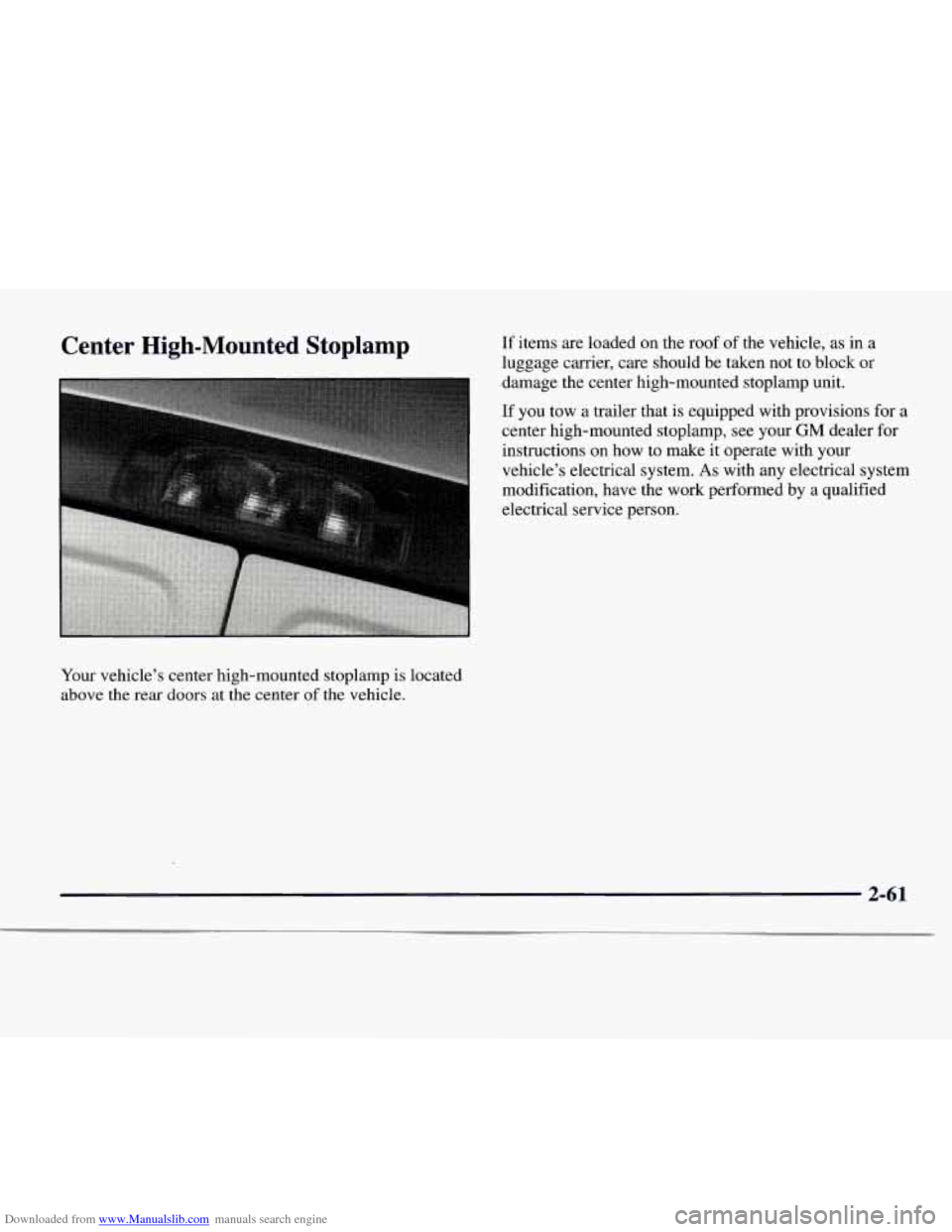
Your vehicle’s center high-mounted stoplamp is located
above the
rear doors at the center of the vehicle. If
items are loaded
on the roof of the vehicle, as in a
luggage carrier, care should be taken not to block or
damage the center high-mounted stoplamp unit.
If you tow a trailer that is equipped with provisions for a
center high-mounted stoplamp, see your
GM dealer for
instructions on how to make it operate with your
vehicle’s electrical system.
As with any electrical system
modification, have the work performed by a qualified
electrical service person.
2-61
Page 154 of 386
Downloaded from www.Manualslib.com manuals search engine Section 4 Your Driving and the Road
Here you’ll find information about driving on different kinds of roads and in varying weather conditions. We’ve also
included many other useful tips
on driving.
4-2
4-3
4-6 4-6
4-9
4-11 4-12
4- 13
4- 14 Defensive
Driving
Drunken Driving
Control
of a Vehicle
Braking
Steering
Off-Road Recovery
Passing
Loss of Control
Driving at Night 4-
16
4-19
4-20
4-2
1
4-22
4-22
4-24 4-27
4-29 Driving
in Rain and
on Wet Roads
City Driving
Freeway Driving
Before Leaving on a Long Trip
Highway Hypnosis Hill and Mountain Roads
Winter Driving
Loading Your Vehicle
Towing
a Trailer
Page 182 of 386
Downloaded from www.Manualslib.com manuals search engine Towing a Trailer
A CAUTION:
If you don’t use the correct equipment and drive
properly, you can lose control when you pull
a
trailer. For example, if the trailer is too heavy, the
brakes
may not work well -- or even at all. You
and your passengers could be seriously injured.
Pull
a trailer only if you have followed all the
steps in this section.
Ask your GM dealer for
advice and information about towing a trailer
with your vehicle.
NOTICE:
Pulling a trailer improperly can damage your
vehicle and result in costly repairs not covered by
your warranty.
To pull a trailer correctly, follow
the advice in this part, and see your
GM dealer
for important information about towing
a trailer
with your vehicle.
Your vehicle can tow a trailer. To identify what the
vehicle trailering capacity is for your vehicle, you
should read the information in “Weight of the Trailer’’
that appears later
in this section. But trailering is
different than just driving your vehicle by itself.
Trailering means changes in handling, durability and
fuel economy. Successful, safe trailering takes correct
equipment, and it has
to be used properly.
That’s the reason for this section.
In it are many
time-tested, important trailering tips and safety rules.
Many
of these are important for your safety and that of
your passengers. So please read this section carefully
before you pull a trailer.
Page 183 of 386
Downloaded from www.Manualslib.com manuals search engine If You Do Decide To Pull A Trailer
If you do, here are some important points:
0
0
0
There are many different laws, including speed limit
restrictions, having to do with trailering. Make sure
your rig will be legal, not only where you live but
also where you’ll be driving.
A good source for this
information can be state or provincial police.
Consider using a sway control if your trailer will
weigh
4,000 lbs. (I 800 kg) or less. You should
always
use a sway control if your trailer will weigh
more than
4,000 lbs. (1 800 kg). You can ask a hitch
dealer about sway controls.
Don’t tow a trailer at all during the first
500 miles
(800 km) your new vehicle is driven. Your engine,
axle or other parts could be damaged.
0
0 Then, during the first 500 miles (800 km) that you
tow a trailer, don’t drive over
50 mph (80 km/h) and
don’t make starts at full throttle. This helps your
engine and other parts of your vehicle wear in at the
heavier loads.
You should use DRIVE (D) (or, as you need to,
a lower gear) when towing a trailer. Operating your
vehicle
in DRIVE (D) when towing a trailer will
minimize heat buildup and extend
the life of
your transmission.
Three important considerations have to do with weight:
0 the weight of the trailer,
0 the weight of the trailer tongue
0 and the weight on your vehicle’s tires.
4-30
..