check engine CHEVROLET EXPRESS 1998 1.G Owner's Manual
[x] Cancel search | Manufacturer: CHEVROLET, Model Year: 1998, Model line: EXPRESS, Model: CHEVROLET EXPRESS 1998 1.GPages: 386, PDF Size: 20.74 MB
Page 132 of 386
Downloaded from www.Manualslib.com manuals search engine I A CAUTION:
Don’t keep driving if the oil pressure is low. If
you do, your engine can become so hot that it
catches fire. You or others could be burned.
Check your oil as soon
as possible and have your
vehicle serviced.
I NOTICE:
Damage to your engine from neglected oil
problems can be costly and
is not covered by
your warranty.
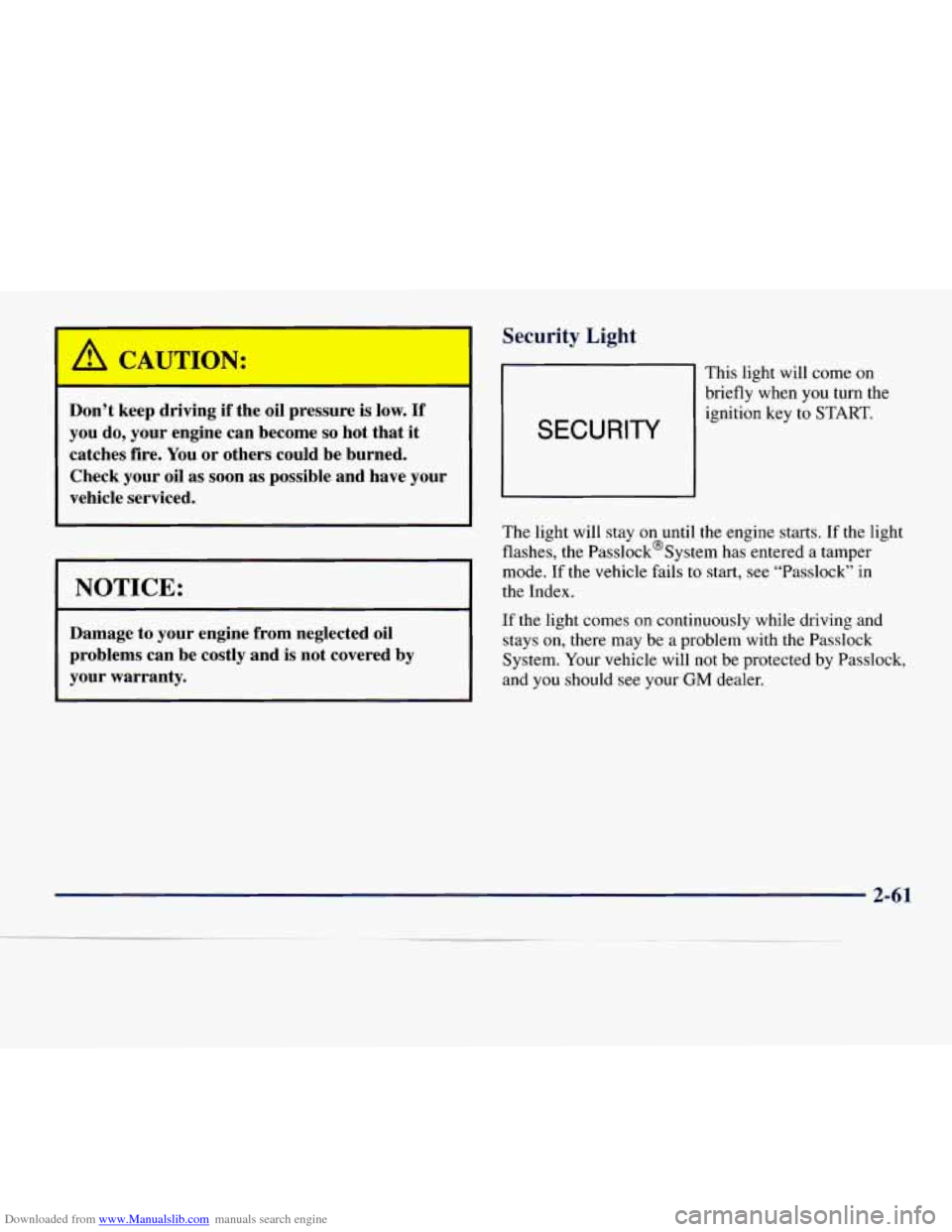
Security Light
SECURITY
This light will come on
briefly when you turn the
ignition key to START.
m
The light will stay on until the engine starts. If the
flashes, the Passlock%ystem has entered
a tampel light I-
mode. If the vehicle
fails to start, see “Passlock” in
the Index.
If the light comes
on continuously while driving and
stays on, there may be a problem with the Passlock
System.
Your vehicle will not be protected by Passlock,
and you should see your
GM dealer.
2-61
Page 133 of 386
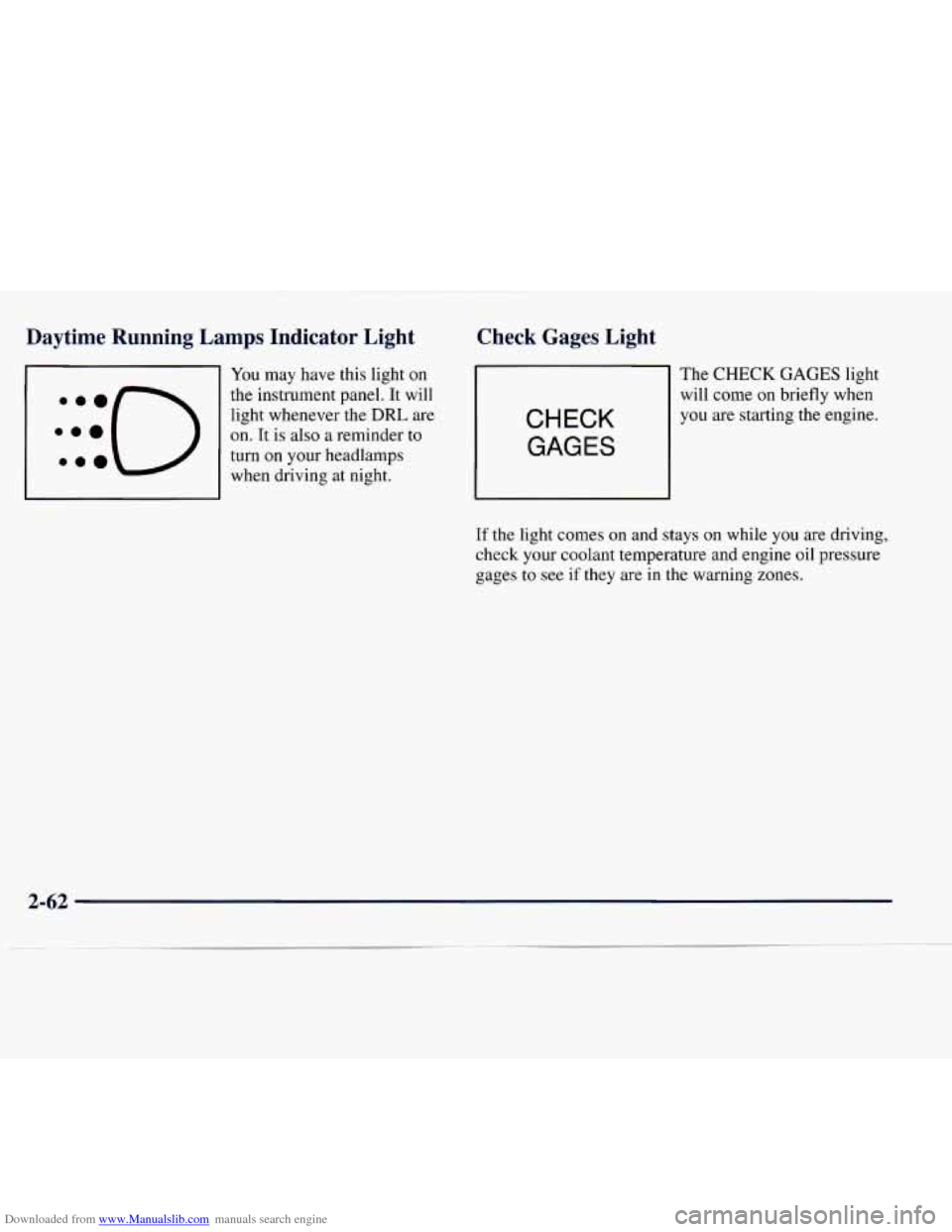
Downloaded from www.Manualslib.com manuals search engine Daytime Running Lamps Indicator Light
You may have this light on
the instrument panel. It will
light whenever the
DRL are
on. It is also a reminder to
turn on your headlamps
when driving at night.
Check Gages Light
CHECK
GAGES
The CHECK GAGES light
will come on briefly when
you are starting the engine.
If
the light comes on and stays on while you are driving,
check your coolant temperature and engine oil pressure
gages
to see if they are in the warning zones.
2-62
Page 159 of 386
Downloaded from www.Manualslib.com manuals search engine Tips About Your Audio System
Hearing damage from loud noise is almost undetectable
until
it is too late. Your hearing can adapt to higher
volumes of sound. Sound that seems normal can be loud
and harmful
to your hearing. Take precautions by
adjusting the volume control on your radio to a safe
sound level before your hearing adapts
to it.
To help avoid hearing loss or damage:
Adjust the volume control to the lowest setting.
0 Increase volume slowly until you hear comfortably
and clearly.
I
NOTICE:
Before you add any sound equipment to your
vehicle
-- like a tape player, CB radio, mobile
telephone or two-way radio
-- be sure you can
add what you want.
If you can, it’s very
important to do it properly. Added sound
equipment may interfere with the operation
of
your vehicle’s engine, Delco Electronics radio or
other systems, and even damage them. Your
vehicle’s systems may interfere with the
operation
of sound equipment that has been
added improperly.
So, before adding sound equipment, check with
your dealer and be sure to check Federal rules
covering mobile radio and telephone units.
3-24
Page 170 of 386
Downloaded from www.Manualslib.com manuals search engine Anti-Lock Brakes (ABS)
Your vehicle has anti-lock brakes (ABS). ABS is an
advanced electronic braking system that will help
prevent
a braking skid.
When you start your engine and begin to drive away,
your anti-lock brake system will check itself.
You may
hear a momentary motor
or clicking noise while this test
is going
on. This is normal.
ANTI -
LOCK
United States Canada
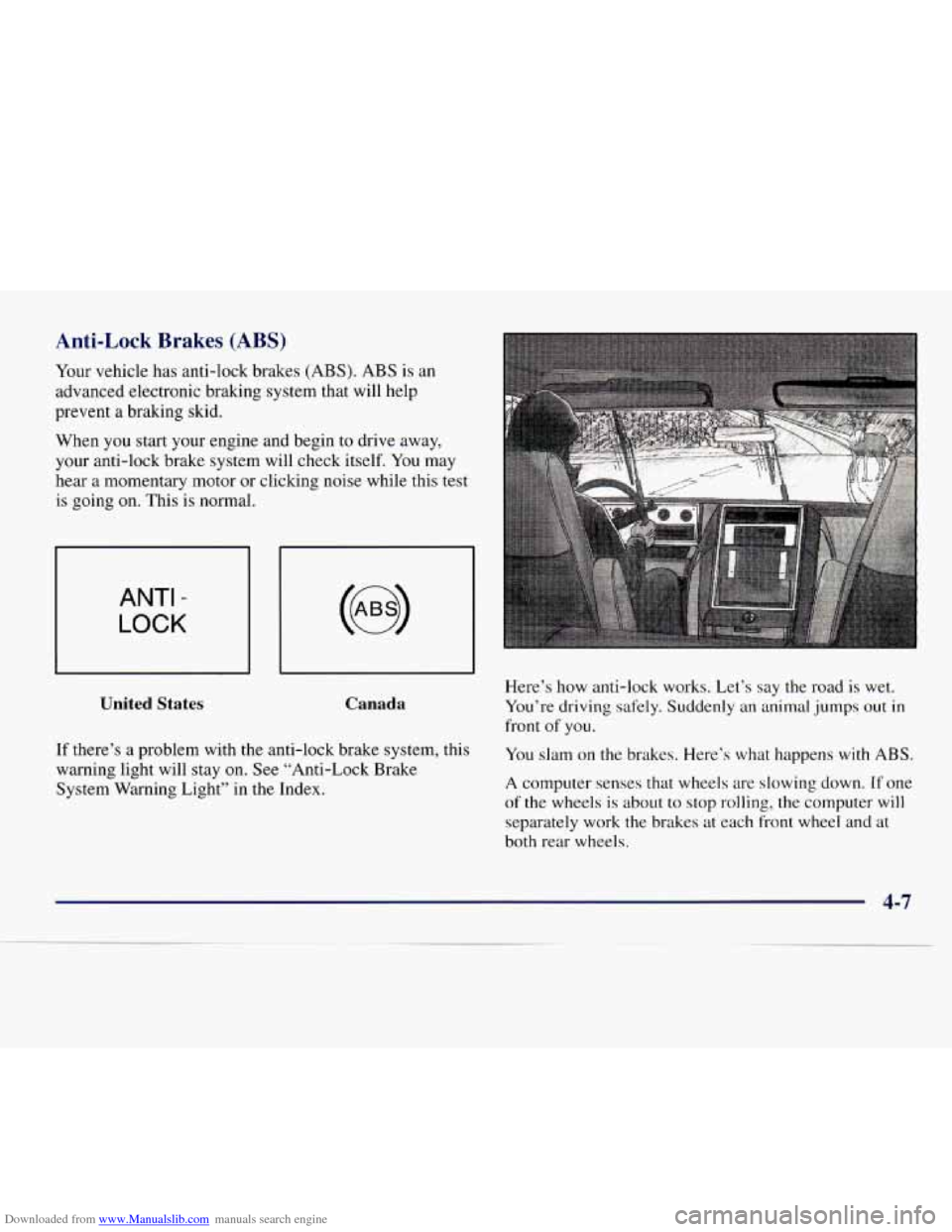
If there’s a problem with the anti-lock brake system, this
warning light will stay
on. See “Anti-Lock Brake
System Warning Light” in the Index. Here’s how anti-lock works. Let’s say the road
is wet.
You’re driving safely. Suddenly an animal jumps out
in
front of you.
You slam on the brakes. Here’s what happens with ABS.
A computer senses that wheels are slowing down. If one
of the wheels is about to stop rolling, the computer will
separately work the brakes at each front wheel and at
both rear wheels.
Page 175 of 386
Downloaded from www.Manualslib.com manuals search engine 0 Do not get too close to the vehicle you want to
pass while you’re awaiting an opportunity. For one
thing, following too closely reduces your area
of
vision, especially if you’re following a larger
vehicle. Also,
you won’t have adequate space if the
vehicle ahead suddenly slows or stops. Keep back
a
reasonable distance.
When it looks like a chance to pass is coming up,
start to accelerate but stay
in the right lane and don’t
get too close. Time your move
so you will be
increasing speed as the time comes
to move into the
other lane.
If the way is clear to pass, you will have a
“running start” that more than makes up for
the
distance you would lose by dropping back. And if
something happens
to cause you to cancel your pass,
you need only slow down and drop back again and
wait for another opportunity.
0 If other cars are lined up to pass a slow vehicle, wait
your turn. But take care that someone isn’t trying to
pass you as you pull
out to pass the slow vehicle.
Remember to glance over your shoulder and check
the blind spot.
Check your mirrors, glance over your shoulder and
start your left lane change signal before moving out
0
a
0
of the right lane to pass. When you are far enough
ahead of the passed vehicle to
see its front in your
inside mirror, activate your right lane change signal
and move back into the right lane. (Remember that
your right outside mirror is convex. The vehicle you
just passed may seem
to be farther away from you
than it really is.)
Try not to pass more than one vehicle at a time
on two-lane roads. Reconsider before passing the
next vehicle.
Don’t overtake a slowly moving vehicle too rapidly.
Even though the brake lamps are not flashing, it may
be slowing down or starting
to turn.
If you’re being passed, make it easy for the
following driver to get ahead
of you. Perhaps you
can ease a little to the right.
Loss of Control
Let’s review what driving experts say about what
happens when the three control systems (brakes, steering and acceleration) don’t have enough friction where
the
tires meet the road to do what the driver has asked.
In
any emergency, don’t give up. Keep trying to steer and
constantly seek an escape route or area of less danger.
4-12
Page 178 of 386
Downloaded from www.Manualslib.com manuals search engine You can be temporarily blinded by approaching
headlamps.
It can take a second or two, or even several
seconds, for your eyes to readjust to the dark. When you
are faced with severe glare (as from a driver who
doesn't lower the high beams, or a vehicle with
misaimed headlamps), slow down a little. Avoid staring
directly into the approaching headlamps.
Keep your windshield and all the glass on your vehicle
clean
-- inside and out. Glare at night is made much
worse by dirt on the glass. Even the inside of the glass
can build up a film caused by dust. Dirty glass makes
lights dazzle and flash more than clean glass would,
making the pupils of your eyes contract repeatedly.
Remember that your headlamps light up far less of a
roadway when you are in
a turn or curve. Keep your
eyes moving; that way, it's easier to pick
out dimly
lighted objects. Just as your headlamps should be
checked regularly
for proper aim, so should your eyes
be examined regularly. Some drivers suffer from night
blindness
-- the inability to see in dim light -- and
aren't even aware
of it.
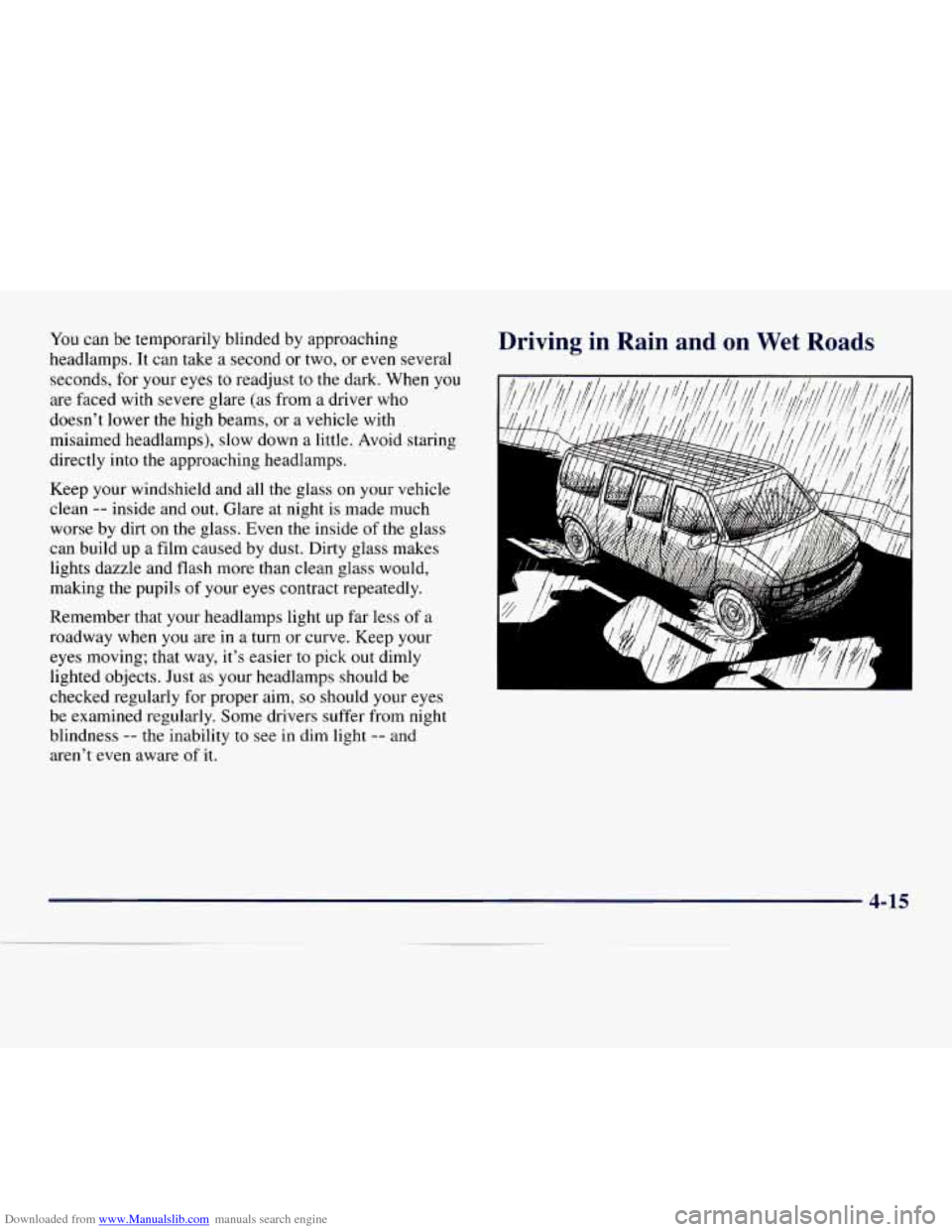
Driving in E 1 Wet Roads
4-15
Page 181 of 386
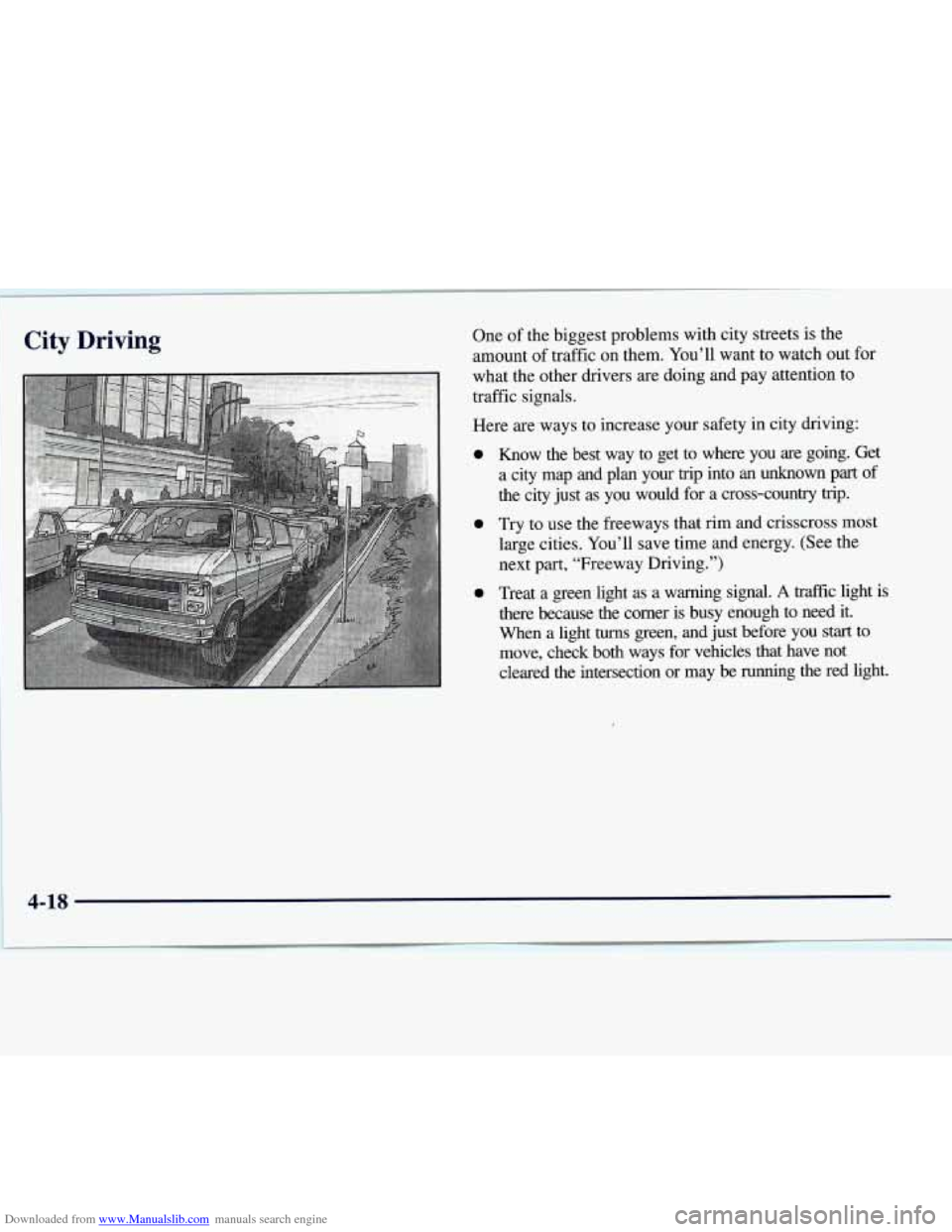
Downloaded from www.Manualslib.com manuals search engine Citv Driving One of the biggest problems with city streets is the
amount of traffic on them. You’ll want
to watch out for
what the other drivers are doing and pay attention to
traffic signals.
Here are ways to increase your safety in city driving:
0 Know the best way to get to where you are going. Get
a city map and plan your
trip into an unknown part of
the city just as you would for a cross-country hip.
0 Try to use the freeways that rim and crisscross most
large cities. You’ll save time and energy. (See the
next part, “Freeway Driving.”)
0 Treat a green light as a warning signal. A traffic light is
there because the corner is busy enough to need it. When a light
turns green, and just before you start to
move, check both ways for vehicles that have not
cleared the intersection
or may be running the red light.
4-18
Page 182 of 386
Downloaded from www.Manualslib.com manuals search engine Freeway Driving
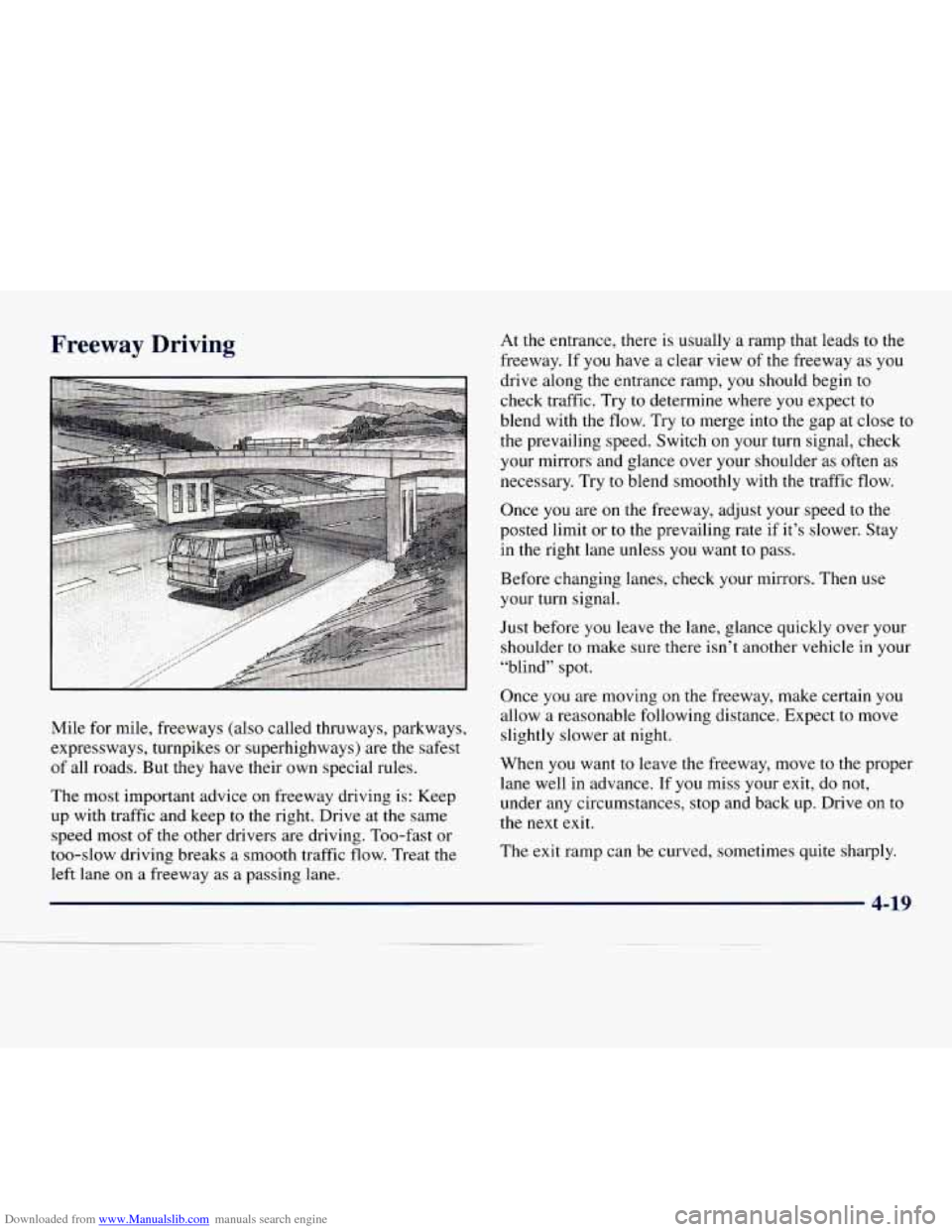
Mile for mile, freeways (also called thruways, parkways,
expressways, turnpikes or superhighways) are the safest
of all roads. But they have their own special rules.
The most important advice on freeway driving is: Keep
up with traffic and keep to
the right. Drive at the same
speed most
of the other drivers are driving. Too-fast or
too-slow driving breaks
a smooth traffic flow. Treat the
left lane on a freeway as a passing lane. At
the entrance, there is usually a ramp that leads to the
freeway. If you have
a clear view of the freeway as you
drive along the entrance ramp,
you should begin to
check traffic. Try to determine where you expect to
blend with the flow. Try to merge into the gap at close to
the prevailing speed. Switch on your turn signal, check
your mirrors and glance over your shoulder
as often as
necessary. Try to blend smoothly with the traffic flow.
Once
you are on the freeway, adjust your speed to the
posted limit or to the prevailing rate if it’s slower. Stay
in the right lane unless you want to
pass.
Before changing lanes, check your mirrors. Then use
your turn signal.
Just before you leave the lane, glance quickly over your
shoulder to make sure there isn’t another vehicle in your
“blind” spot.
Once you are moving
on the freeway, make certain you
allow a reasonable following distance. Expect to move
slightly slower at night.
When you want
to leave the freeway, move to the proper
lane well
in advance. If you miss your exit, do not,
under any circumstances, stop and back up. Drive on to
the next exit.
The exit ramp can
be curved, sometimes quite sharply.
4-19
Page 183 of 386
Downloaded from www.Manualslib.com manuals search engine The exit speed is usually posted.
Reduce
your speed according to your speedometer, not
to your sense of motion. After driving for any distance
at higher speeds, you may tend to think you are going
slower than you actually are.
Before Leaving on a Long Trip
Make sure you’re ready. Try to be well rested. If you
must start when you’re not fresh
-- such as after a day’s
work
-- don’t plan to make too many miles that first part
of the journey. Wear comfortable clothing and shoes you
can easily drive in.
Is your vehicle ready for a long trip? If you keep it
serviced and maintained, it’s ready to
go. If it needs
service, have
it done before starting out. Of course,
you’ll find experienced and able service experts in
GM
dealerships all across North America. They’ll be ready
and willing to help
if you need it. Here
are some things
you can check before a trip:
0
0
Windshield Washer Fluid: Is the reservoir full? Are
all windows clean inside and outside?
Wiper Blades: Are they in good shape?
Fuel, Engine Oil, Other Fluids: Have you checked
all levels?
Lamps: Are they all working? Are the lenses clean?
Tires: They are vitally important to a safe,
trouble-free trip.
Is the tread good enough for
long-distance driving? Are the tires all inflated to the
recommended pressure?
Weather Forecasts: What’s the weather outlook
along your route? Should you delay your trip a
short
time to avoid a major storm system?
Maps: Do you have up-to-date maps?
4-20
Page 184 of 386
Downloaded from www.Manualslib.com manuals search engine Highway Hypnosis
Is there actually such a condition as “highway hypnosis”?
Or is it just plain falling asleep at the wheel? Call it
highway hypnosis, lack
of awareness, or whatever.
There is something about
an easy stretch of road with the
same scenery, along with the hum
of the tires on the road,
the drone of the engine, and the rush of the wind against
the vehicle that can make you sleepy. Don’t let it happen
to you! If it does, your vehicle can leave the road in
less
than a second, and you could crash and be injured.
What can you do about highway hypnosis? First, be
aware that it can happen.
Then here are some tips:
0
0
0
Make sure your vehicle is well ventilated, with a
comfortably cool interior.
Keep your eyes moving. Scan the road ahead and
to the sides. Check your mirrors and your
instruments frequently.
If you get sleepy, pull off the road into a rest, service
or parking area and take a nap, get some exercise, or
both. For safety, treat drowsiness on the highway as
an emergency.
Hill and Mountain Roads
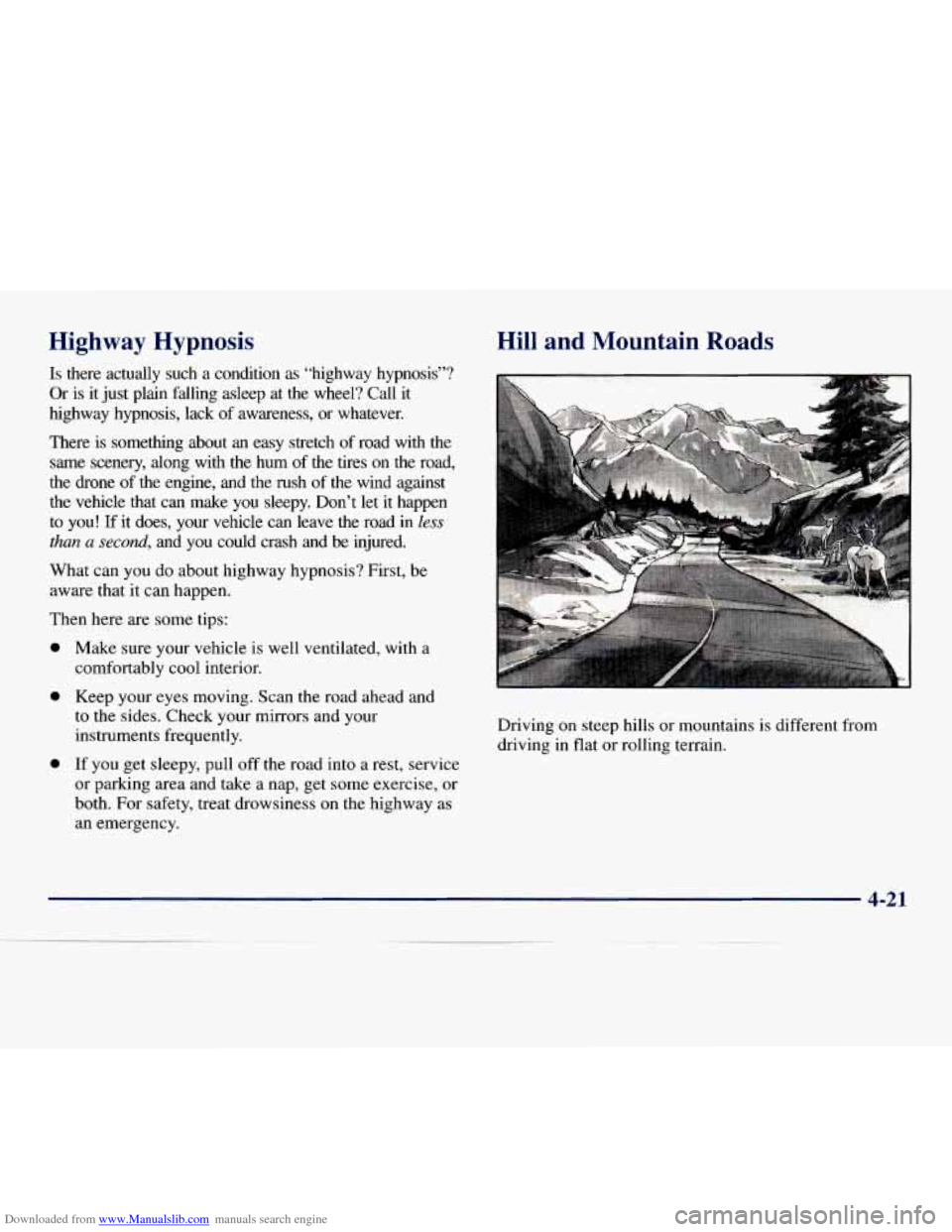
Driving on steep hills or mountains is different from
driving in flat or rolling terrain.
4-21