check engine CHEVROLET EXPRESS 1998 1.G Workshop Manual
[x] Cancel search | Manufacturer: CHEVROLET, Model Year: 1998, Model line: EXPRESS, Model: CHEVROLET EXPRESS 1998 1.GPages: 386, PDF Size: 20.74 MB
Page 264 of 386
Downloaded from www.Manualslib.com manuals search engine Thermostat
Engine coolant temperature is controlled by a thermostat
in the engine cooling system. The thermostat stops the
flow
of coolant through the radiator until the coolant
reaches
a preset temperature.
When you replace your thermostat, an
AC@ thermostat
is recommended.
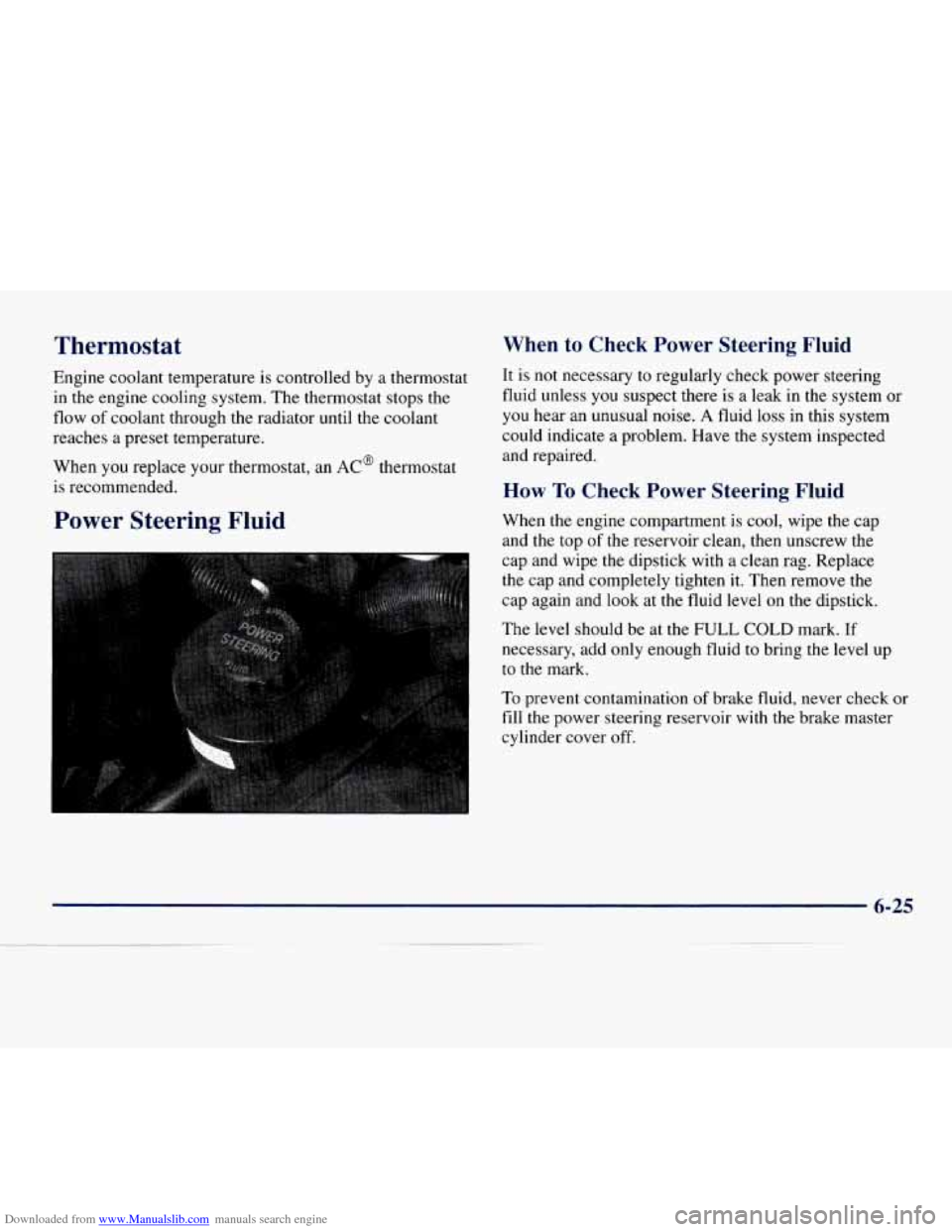
Power :ring !
When to Check Power Steering Fluid
It is not necessary to regularly check power steering
fluid unless you suspect there is a leak in the system or
you hear an unusual noise. A fluid loss in this system
could indicate a problem. Have the system inspected
and repaired.
How To Check Power Steering Fluid
When the engine compartment is cool, wipe the cap
and the top of the reservoir clean, then unscrew the
cap and wipe the dipstick with
a clean rag. Replace
the cap and completely tighten it.
Then remove the
cap again and look at the fluid level on the dipstick.
The level should be at the
FULL COLD mark. If
necessary, add only enough fluid to bring the level up
to the mark.
To prevent contamination of brake fluid, never check or
fill the power steering reservoir with the brake master
cylinder cover
off.
6-25
Page 267 of 386
Downloaded from www.Manualslib.com manuals search engine There are only two reasons why the brake fluid level in the
reservoir might go down. The first
is that the brake fluid
goes down
to an acceptable level during normal brake
lining wear. When new linings are put in, the fluid level
goes back up. The other reason is that fluid is leaking out
of the brake system. If it is, you should have your brake
system fixed, since a leak means that sooner or later your
brakes won’t work well, or won’t work at
all.
So, it isn’t a good idea to “top off” your brake fluid.
Adding brake fluid won’t correct a leak. If
you add fluid
when your linings are worn, then you’ll have too much
fluid when you get new brake linings.
You should add
(or remove) brake fluid, as necessary, only when work is
done on the brake hydraulic system.
If you have too much brake fluid, it can spill on
the engine. The fluid will burn
if the engine is
hot enough. You or others could be burned,
and your vehicle could be damaged. Add brake
fluid only when work is done on the brake
hydraulic system.
Refer to the Maintenance Schedule to determine when
to check your brake fluid. See “Periodic Maintenance
Inspections”
in the Index.
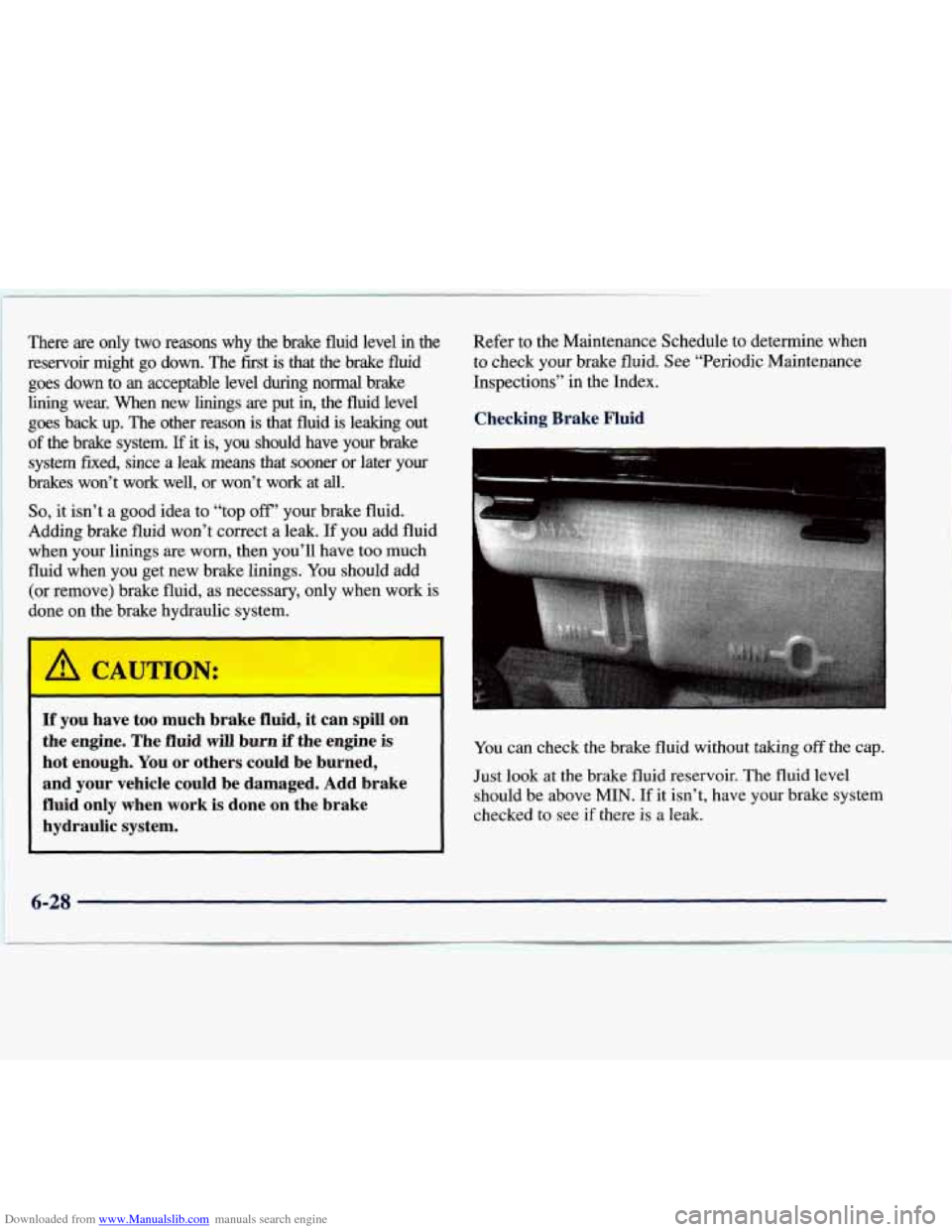
Checking Brake Fluid
You can check the brake fluid without taking off the cap.
Just look at the brake fluid reservoir. The fluid level
should be above
MIN. If it isn’t, have your brake system
checked to
see if there is a leak.
6-28
Page 280 of 386
Downloaded from www.Manualslib.com manuals search engine 2.
3.
4.
5.
6.
7.
Press down on the blade assembly pivot locking tab.
Pull down on the blade assembly to release it from
the wiper arm hook.
Remove the insert from the blade assembly. The
insert has two notches at one end that are locked by
bottom claws
of the blade assembly. At the notched
end, pull
the insert from the blade assembly.
To install the new wiper insert, slide the notched
end last, into the end with two blade claws. Slide
the insert all the way through the blade claws at the
opposite end.
Be sure that the notches are locked by the bottom
claws. Make sure that all other claws are properly
locked
on both sides of the insert slot.
Put the blade assembly pivot in the wiper arm
hook. Pull up until the pivot locking tab locks in
the hook slot.
Carefully lower the wiper
arm and blade assembly
into the windshield.
Tires
Yo%fS%%v vehicle comes with high-quality tires made by
a leading tire manufacturer. If you ever have questions
about your tire warranty and where to
obtain service, see
your
GM Warranty booklet for details.
A CAUTIOI.:
Poorly maintained and improperly used tires
are dangerous.
0
0
0
0
Overloading your tires can cause
overheating as
a result of too much friction.
You could have an air-out and a serious
accident. See “Loading Your Vehicle” in
the Index.
Underinflated tires pose the same danger
as overloaded tires. The resulting accident
could cause serious injury. Check all tires
frequently to maintain the recommended
pressure. Tire pressure should be checked
when your tires are cold.
Overinflated tires are more likely
to be
cut, punctured
or broken by a sudden
impact
-- such as when you hit a pothole.
Keep tires at the recommended pressure.
Worn, old tires can cause accidents.
If your
tread is badly worn, or if your tires have
been damaged, replace them.
6-41
Page 281 of 386
Downloaded from www.Manualslib.com manuals search engine Inflation -- Tire Pressure
The Certificationrnire label, which is on the rear edge of
the driver’s door, shows the correct inflation pressures
for your tires when they’re cold. “Cold” means your
vehicle has been
sitting for at least three hours or driven
no more
than 1 mile (1.6 km).
NOTICE:
Don’t let anyone tell you that underinflation or
overinflation is
all right. It’s not. If your tires
don’t have enough air (underinflation), you can
get the following:
0 Too much flexing
Too much heat
0 Tire overloading
0 Bad wear
0 Bad handling
Bad fuel economy.
NOTICE: (Continued) NOTICE: (Continued)
If your tires have too much air (overinflation),
you can get the following:
Unusual wear
0 Bad handling
0 Rough ride
0 Needless damage from road hazards.
When
to Check
Check your tires once a month or more.
Also, check the
tire pressure of the spare tire.
Page 282 of 386
Downloaded from www.Manualslib.com manuals search engine How to Check
Use a good quality pocket-type gage to check tire
pressure. You can’t tell if your tires are properly inflated
simply by looking at them. Radial tires may look
properly inflated even when they’re underinflated.
Be sure to put the valve caps back on the valve
stems. They help prevent leaks by keeping out dirt
and moisture.
Tire Inspection and Rotation
Tires should be rotated every 6,000 to 8,000 miles
(10 000 to 13 000 km). Any time you notice unusual
wear, rotate your tires as soon as possible and check
wheel alignment. Also check for damaged tires or
wheels. See “When It’s Time for New Tires” and
“Wheel Replacement” later
in this section for more
information.
If your vehicle has dual rear wheels,
also see “Dual Tire Operation” later in this section. The
purpose of regular rotation
is to achieve more
uniform wear for all tires on the vehicle. The first
rotation is the most important. See “Scheduled
Maintenance Services”
in the Index for scheduled
rotation intervals.
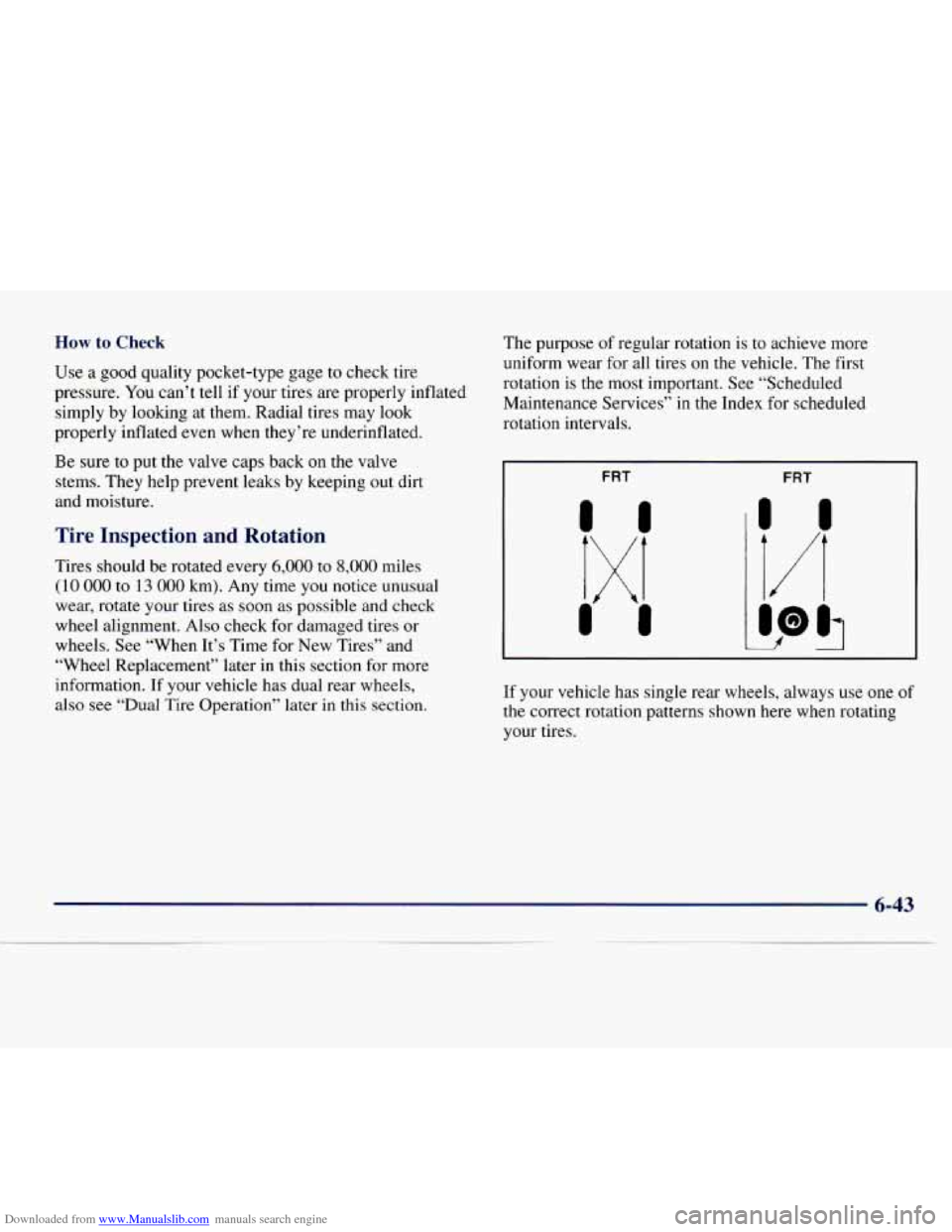
If your vehicle has single rear wheels, always use one of
the correct rotation patterns shown here when rotating
your tires.
6-43
~.
Page 284 of 386
Downloaded from www.Manualslib.com manuals search engine When It’s Time for New Tires
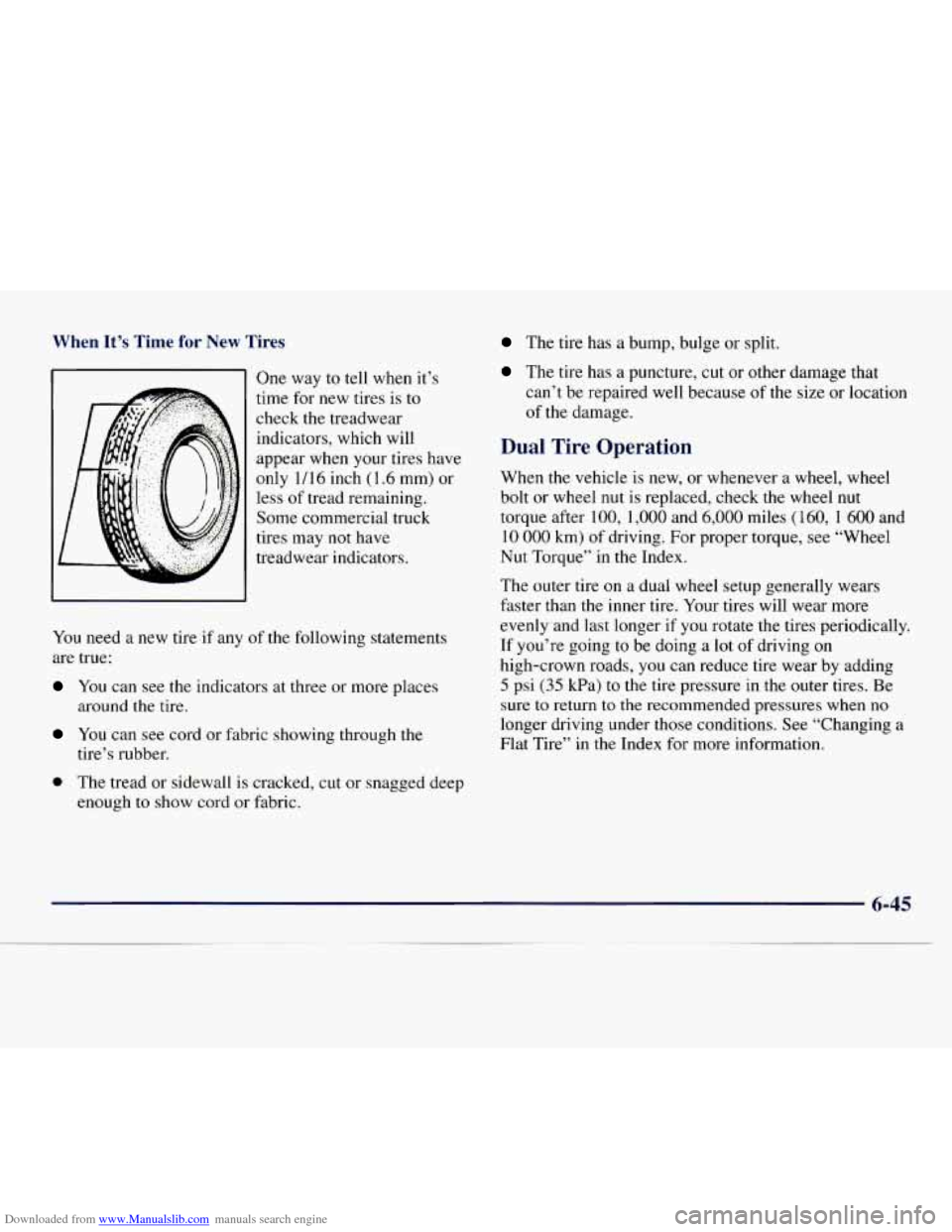
One way to tell when it’s
time for new tires
is to
check the treadwear
indicators, which will
appear when your tires have
only 1/16 inch
(1.6 mm) or
less
of tread remaining.
Some commercial truck
tires may not have
treadwear indicators.
You need
a new tire if any of the following statements
are true:
You can see the indicators at three or more places
around the tire.
You can see cord or fabric showing through the
tire’s rubber.
The tire has a bump, bulge or split.
The tire has a puncture, cut or other damage that
can’t be repaired well because of the size or location
of the damage.
Dual Tire Operation
When the vehicle is new, or whenever a wheel, wheel
bolt or wheel nut is replaced, check the wheel nut
torque after
100, 1,000 and 6,000 miles (160, 1 600 and
10 000 km) of driving. For proper torque, see “Wheel
Nut Torque” in the Index.
The outer tire on
a dual wheel setup generally wears
faster than the inner tire. Your tires will wear more
evenly and last longer if you rotate the tires periodically.
If you’re going to be doing a lot of driving on
high-crown roads, you can reduce tire wear by adding
5 psi (35 kPa) to the tire pressure in the outer tires. Be
sure to return
to the recommended pressures when no
longer driving under those conditions. See “Changing a
Flat Tire”
in the Index for more information.
0 The tread or sidewall is cracked, cut or snagged deep
enough
to show cord or fabric.
6-45
__
Page 289 of 386
Downloaded from www.Manualslib.com manuals search engine Whenever a wheel, wheel bolt or wheel nut is replaced
on
a dual wheel setup, check the wheel nut torque after
100, 1,000 and 6,000 miles ( 160, 1 600 and 10 000 km)
of driving. For proper torque, see “Wheel Nut Torque’’
in the Index.
See “Changing
a Flat Tire” in the Index for more
information.
Used Replacement Wheels
Putting a used wheel on your vehicle is
dangerous. You can’t know how it’s been used or
how
far it’s been driven. It could fail suddenly
and cause an accident. If you have to replace
a
wheel, use a new GM original equipment wheel.
NOTICE:
Use tire chains only where legal and only when you
must. Use chains that are the proper size for your
tires. Install them on the tires of the rear axle.
Tighten them as tightly as possible with the ends
securely fastened. Drive slowly and follow the
chain manufacturer’s instructions. If you can
hear the chains contacting your vehicle, stop
and retighten them.
If the contact continues,
slow down until it stops. Driving too fast
or
spinning the wheels with chains on will
damage your vehicle.
6-50
Page 293 of 386
Downloaded from www.Manualslib.com manuals search engine Care of Safety Belts
Keep belts clean and d
I
Do not bleach or dye safety belts. If you do, it
may severely weaken them. In a crash, they
might not be able to provide adequate protection.
Clean safety belts only with mild soap and
lukewarm water.
Cleaning Glass Surfaces
Glass should be cleaned often. GM Glass Cleaner (GM
Part No. 1050427) or a liquid household glass cleaner
will remove normal tobacco smoke and dust films on
interior glass.
Don’t use abrasive cleaners on glass, because they
may cause scratches. Avoid placing decals on the inside
rear window, since
they may have to be scraped off later.
If abrasive cleaners are used on the inside
of the rear
window, an electric defogger element may be damaged.
Any temporary license should
not be attached across the
defogger grid.
Cleaning the Outside of the
Windshield and Wiper Blades
If the windshield is not clear after using the windshield
sap or other material may be on the blade
or windshield.
Clean the outside of the windshield with
GM Windshield
Cleaner, Bon
Ami@ Powder (non-scratching glass
cleaning powder),
GM Part No. 105OO11. The windshield
is clean if beads do
not form when you rinse it with water.
Grime from the windshield will stick
to the wiper blades
and affect their performance. Clean the blade by wiping
vigorously with a cloth soaked in full-strength windshield
washer solvent. Then rinse the blade with water.
I washer, or if the wiper blade chatters when running, wax,
Check the wiper blades and clean them
as necessary;
replace blades that look worn.
Weatherstrips
Silicone grease on weatherstrips will make them last
longer, seal better, and
not stick or squeak. Apply
silicone grease with a clean cloth at least every six
months. During very cold, damp weather more frequent
application may be required. (See “Recommended
Fluids and Lubricants’’
in the Index.)
Page 300 of 386
Downloaded from www.Manualslib.com manuals search engine Electrical System
Add-on Electrical Equipment
NOTICE:
Don’t add anything electrical to your vehicle
unless you check with your dealer first. Some
electrical equipment can damage your vehicle
and the damage wouldn’t be covered by your
warranty. Some add-on electrical equipment
can keep other components from working
as
they should.
Your vehicle has an air bag system. Before attempting to
add anything electrical to your vehicle,
see “Servicing
Your Air Bag-Equipped Vehicle”
in the Index.
Headlamp Wiring
The headlamp wiring is protected by a circuit breaker in
the lamp switch. An electrical overload will cause the
lamps to flicker on and off, or in some cases to remain
off.
If this happens, have your headlamp wiring checked
right away.
Windshield Wiper Fuses
The windshield wiper motor is protected by a circuit
breaker and a fuse.
If the motor overheats due to heavy
snow, etc., the wiper will stop until the motor cools.
Although the circuit
is protected from electrical
overload, overload due to heavy snow, etc., may cause
wiper linkage damage. Always clear ice and heavy snow
from the the windshield before using the windshield
wipers.
If the overload is caused by some electrical
problem and not snow, etc., be sure to get it fixed.
Page 307 of 386

Downloaded from www.Manualslib.com manuals search engine Cooling System Capacity (Approximate)
ENGINE VIN QTY Without Rear Heater
“VORTEC”4300 W 1 1 Quarts ( 10.4 L)
“VORTEC”5000 M 17 Quarts (16 L)
“VORTEC”5700 R 17 Quarts (1 6 L)
“VORTEC”7400 J 23 Quarts (2 1.8 L)
QTY With Rear Heater
14 Quarts (13.2 L)
20 Quarts (18.9 L)
20 Quarts (18.9 L)
26 Quarts (24.6 L)
After refill, the level MUST be checked as outlined under “Engine Cooling System” in Section 5.
Crankcase Capacity (Approximate)
ENGINE VIN Quantity With Filter
“VORTEC”4300 W 4.5 Quarts (4.3 L)
“VORTEC”5000 M 5 Quarts (4.8 L)
“VORTEC”5700 R 5 Quarts (4.8 L)
“VORTEC”7400 J 6.6 Quarts (6.24 L)
After refill, the level MUST be rechecked. Add enough engine oil so that the fluid is within the proper operating
range. See “Engine Oil” in the Index.
*Add one additional quart for RPO 5Z1 and
RPO KL5 Models.
6-68