tow CHEVROLET EXPRESS 1998 1.G Workshop Manual
[x] Cancel search | Manufacturer: CHEVROLET, Model Year: 1998, Model line: EXPRESS, Model: CHEVROLET EXPRESS 1998 1.GPages: 386, PDF Size: 20.74 MB
Page 237 of 386
Downloaded from www.Manualslib.com manuals search engine If You’re Stuck: In Sand, Mud, Ice
or Snow
What you don’t want to do when your vehicle is stuck is
to spin your wheels too fast. The method known as
“rocking” can help you get
out when you’re stuck, but
you must
use caution.
1 A CAUTION:
1
If you let your tires spin at high speed, they can
explode, and you or others could be injured. And,
the transmission or other parts of the vehicle can
overheat. That could cause an engine
compartment fire or other damage. When you’re
stuck, spin the wheels as little
as possible. Don’t
spin the wheels above
35 mph (55 km/h) as shown
on the speedometer.
I NOTICE:
Spinning your wheels can destroy parts of your
vehicle as well as the tires.
If you spin the wheels
too fast while shifting your transmission back
and forth, you can destroy your transmission.
For information about using tire chains
on your vehicle,
see “Tire Chains” in the Index.
Rocking Your Vehi :o Get It Out
First, turn your steering wheel left and right. That will
clear the area around your front wheels. Then shift back
and forth between REVERSE
(R) and a forward gear,
spinning the wheels
as little as possible. Release the
accelerator pedal while
you shift, and press lightly on
the accelerator pedal when the transmission is in gear. If
that doesn’t get
you out after a few tries, you may need
to be towed
out. If you do need to be towed out, see
“Towing Your Vehicle” in the Index.
5-36
Page 252 of 386
Downloaded from www.Manualslib.com manuals search engine Checking Engine Oil
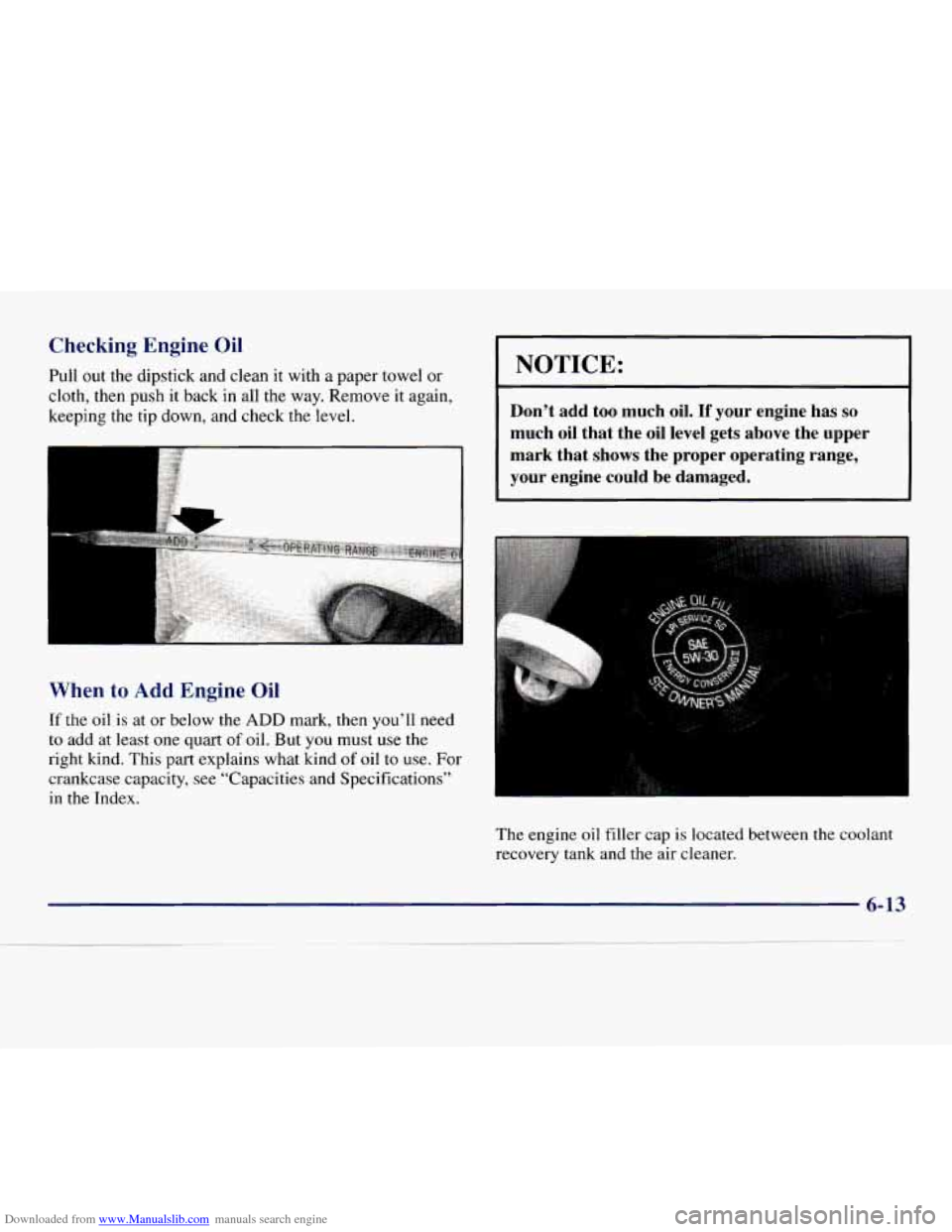
Pull out the dipstick and clean it with a paper towel or
cloth, then push it back in all the way. Remove it again,
keeping the tip down, and check the level.
When to Add Engine Oil
If the oil is at or below the ADD mark, then you’ll need
to add at least one quart of oil. But you must use the
right kind. This part explains what kind
of oil to use. For
crankcase capacity,
see “Capacities and Specifications”
in the Index.
NOTICE:
Don’t add too much oil. If your engine has so
much oil that the oil level gets above the upper
mark that
shows the proper operating range,
your engine could be damaged.
The engine oil filler cap is located between the coolant
recovery tank and
the air cleaner.
Page 254 of 386
Downloaded from www.Manualslib.com manuals search engine As shown in the chart, SAE 5W-30 is best for your
vehicle. However, you can
use SAE 1OW-30 if it's going
to be
0" F (- 18 " C) or above. These numbers on an oil
container show its viscosity, or thickness. Do not use
other viscosity oils, such as
SAE 20W-50.
NOTICE:
Use only engine oil with the American Petroleum
Institute Certified For Gasoline Engines "Starburst" symbol. Failure to use the
recommended oil can result in engine damage not covered by your warranty.
GM Goodwrench@ oil meets all the requirements for
your vehicle.
If you are in an area where the temperature falls
below -20°F
(-29 "C), consider using either an
SAE 5W-30 synthetic oil or an SAE OW-30 oil. Both
will provide easier cold starting and better protection
for your engine at extremely low temperatures.
Engine Oil Additives
Don't add anything to your oil. Your dealer is ready to
advise if
you think something should be added.
When to Change Engine Oil
If any one of these is true for you, use the short tripkity
maintenance schedule:
Most trips are less than 5 to 10 miles (8 to 16 km).
This is particularly important when outside
temperatures are below freezing.
Most trips include extensive idling (such as frequent
driving
in stop-and-go traffic).
Most trips are through dusty areas.
You frequently tow a trailer or use a carrier on top of
The vehicle is used for delivery service, police, taxi
your
vehicle.
or other commercial application.
Driving under these conditions causes engine oil
to
break down sooner. If any one of these is true for your
vehicle,
then you need to change your oil and filter
every
3,000 miles (5 000 km) or 3 months -- whichever
occurs first.
Page 256 of 386
Downloaded from www.Manualslib.com manuals search engine 5. Install a new filter element with the folds in the
down position.
Reverse Steps 1 through
4 to replace the air cleaner.
See “Normal Replacement Parts” for the proper filter
to use.
Refer to the Maintenance Schedule
to determine when to
replace the air filter and crankcase ventilation filter.
See “Scheduled Maintenance Services” in the Index.
I /!1 CAUTION:
Operating the engine with the air cleaner off can
cause
you or others to be burned. The air cleaner
not only cleans the air, it stops flame
if the engine
backfires.
If it isn’t there, and the engine
backfires, you could be burned. Don’t drive with
it
off, and be careful working on the engine with
the air cleaner
off.
I NOTICE: I
If the air cleaner is off, a backfire can cause a
damaging engine fire. And, dirt can easily get
into your engine, which will damage it. Always
have the air cleaner in place when you’re driving.
Automatic Transmission Fluid
If your vehicle has a diesel engine, see “Automatic
Transmission Fluid” in the Diesel Supplement.
When to Check and Change
A good time to check your automatic transmission fluid
level is when the engine oil
is changed.
Change both the fluid and filter every
50,000 miles
(83 000 km) if the vehicle’s GVWR is over 8,600 or
if the vehicle
is mainly driven under one or more of
these conditions:
In heavy city traffic where the outside temperature
regularly reaches
90” F (32” C) or higher.
In hilly or mountainous terrain.
0 When doing frequent trailer towing.
6-17
Page 258 of 386
Downloaded from www.Manualslib.com manuals search engine Checking Transmission Fluid Cold
A cold check is made after the vehicle has been sitting
for eight hours or more with the engine off and is used
only
as a reference. Let the engine run at idle for five
minutes if outside temperatures are
50°F ( 10°C) or
more. If it's colder than
50°F (lO"C), you may have
to idle the engine longer. Should the fluid level be low
during a cold check, you
must perform a hot check
before adding fluid. This will give you a more
accurate reading
of the fluid level.
Checking the Fluid Hot or Cold
0
0
0
0
Park your vehicle on a level place. Keep the engine
running.
With the parking brake applied, place the shift lever
in PARK (P).
With your foot on the brake pedal, move the shift
lever through each gear range, pausing for about
three seconds in each range. Then, position the
shift lever in PARK
(P).
Let the engine run at idle for three minutes or more. Then, without shutting
off the engine, follow these steps:
,., I
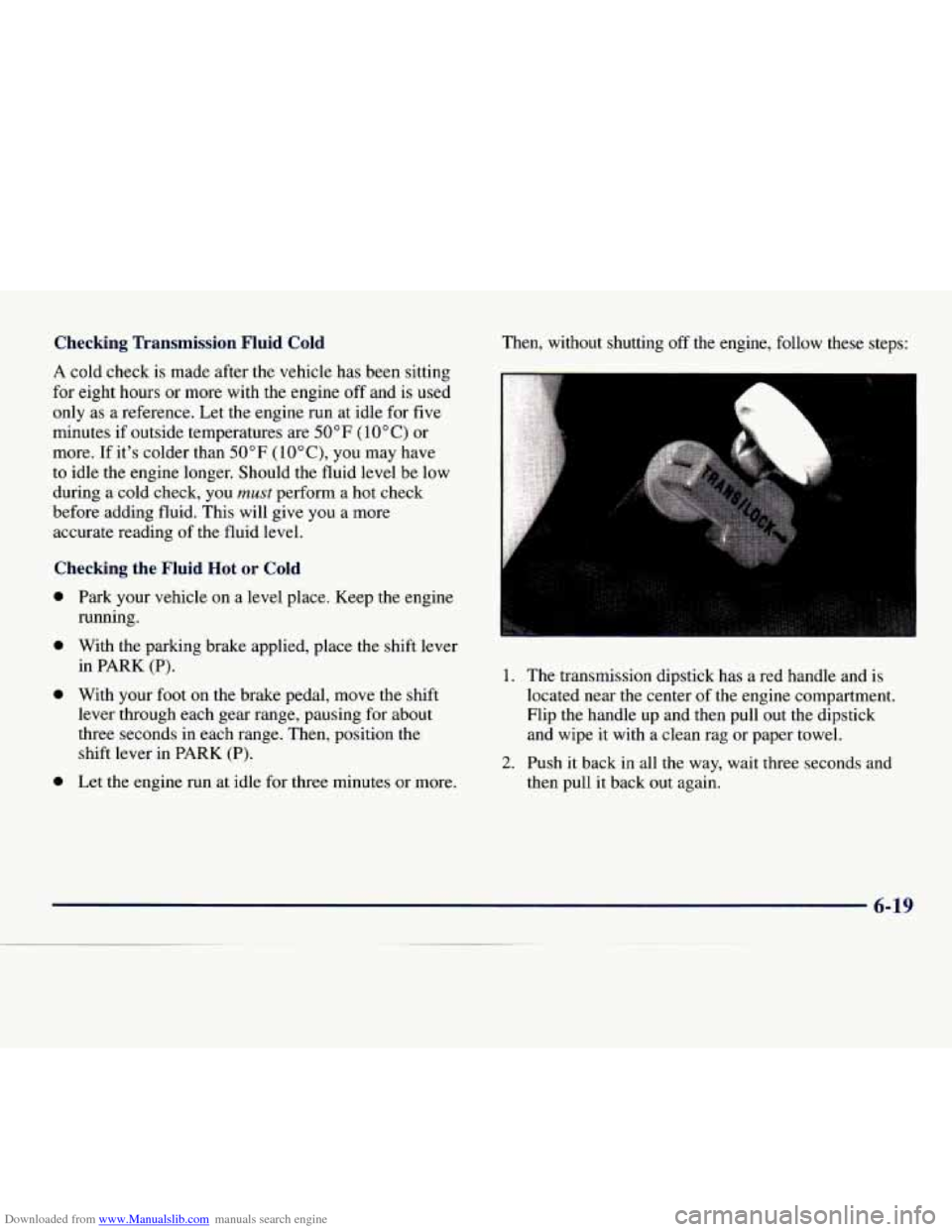
1. The
transmission dipstick has a red handle and is
located near the center
of the engine compartment.
Flip
the handle up and then pull out the dipstick
and wipe it with a clean rag or paper towel.
2. Push it back in all the way, wait three seconds and
then pull it back out again.
Page 278 of 386
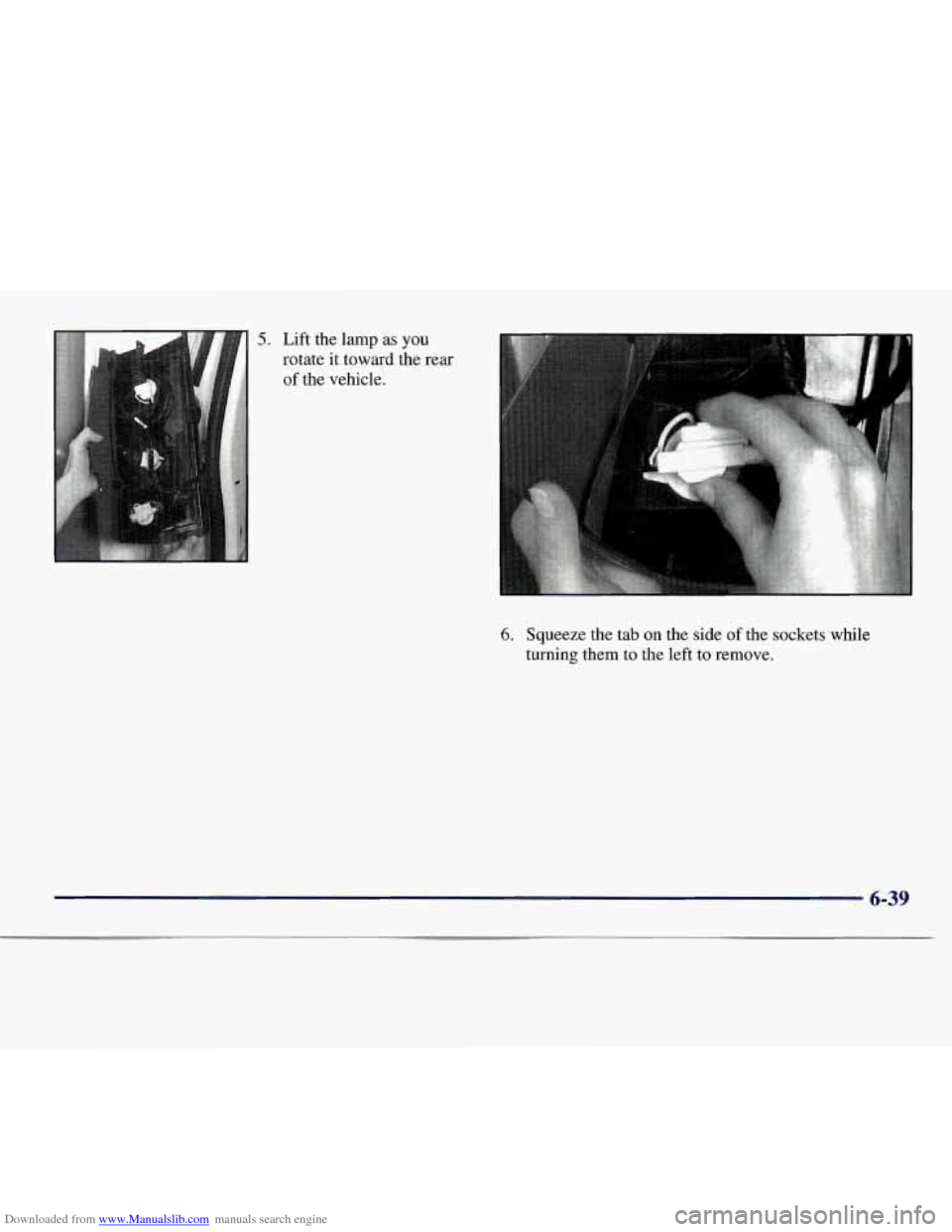
Downloaded from www.Manualslib.com manuals search engine 5. Lift the lamp as you
rotate it toward the rear
of the vehicle.
6. Squeeze the tab on the side of the sockets while
turning them
to the left to remove.
6-39
Page 283 of 386
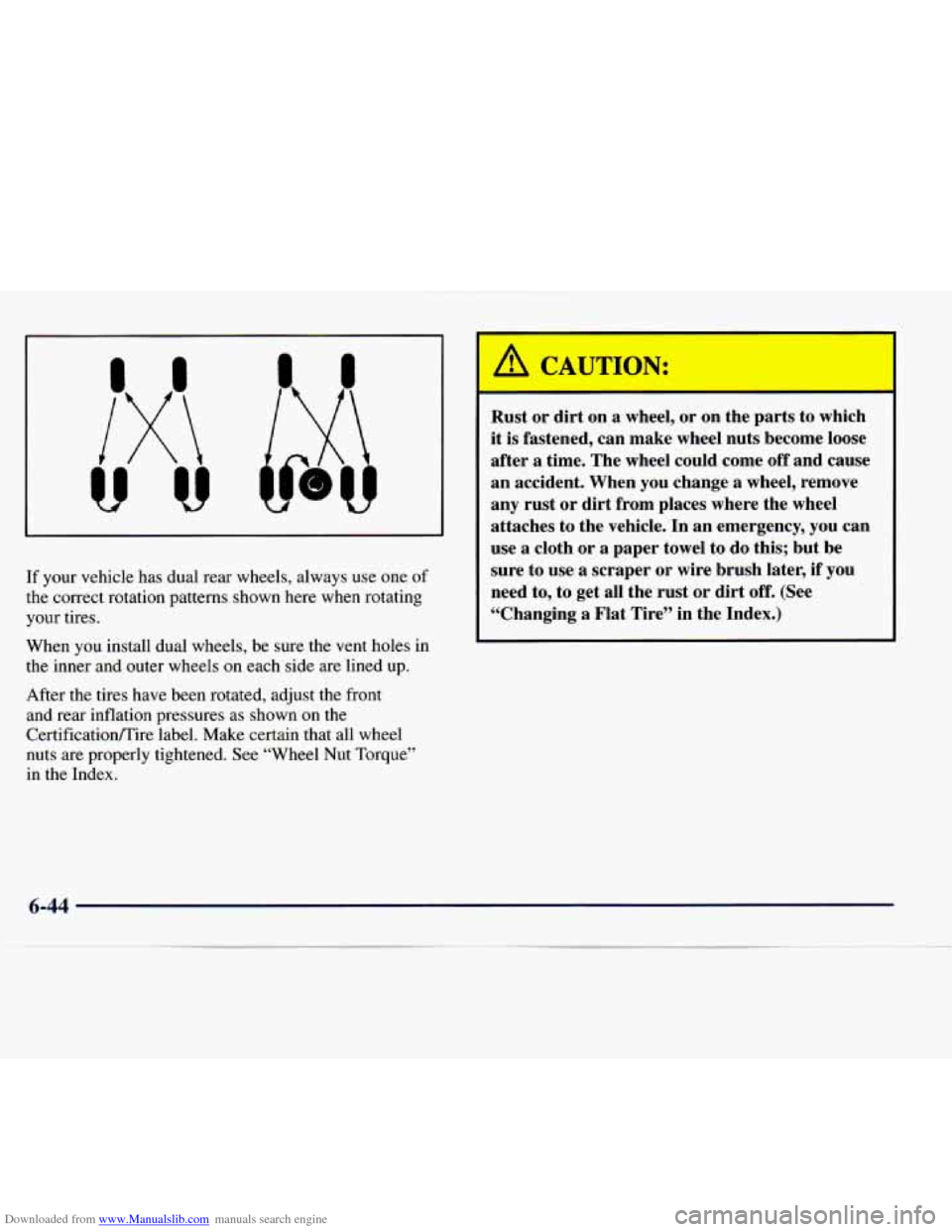
Downloaded from www.Manualslib.com manuals search engine If your vehicle has dual rear wheels, always use one of
the correct rotation patterns shown here when rotating
your tires.
When you install dual wheels, be sure the vent holes in
the inner and outer wheels on each side are lined up.
After the tires have been rotated, adjust the front
and rear inflation pressures
as shown on the
Certificationflire label. Make certain
that all wheel
nuts are properly tightened. See “Wheel Nut Torque’’
in the Index.
A CAUTION:
Rust or dirt on a wheel, or on the parts to which
it is fastened, can make wheel nuts become loose
after
a time. The wheel could come off and cause
an accident. When you change
a wheel, remove
any rust or dirt from places where the wheel
attaches to the vehicle. In an emergency,
you can
use a cloth or a paper towel to do this; but be
sure to use a scraper or wire brush later, if you
need to, to get all the rust or dirt
off. (See
“Changing
a Flat Tire” in the Index.)
6-44
Page 291 of 386
Downloaded from www.Manualslib.com manuals search engine Using Multi-Purpose Interior Cleaner
on Fabric
1.
2.
3.
4.
5.
6.
7.
Vacuum and brush the area to remove any loose dirt.
Always clean a whole trim panel or section. Mask
surrounding trim along stitch
or welt lines.
Mix powdered cleaner following the directions
on
the container label to form thick suds.
Use suds only and apply with a clean sponge. Don’t
saturate the material and don’t rub it roughly.
As soon as you’ve cleaned the section, use a sponge
to remove the suds.
Wipe cleaned area
with a clean, damp towel or cloth.
Wipe with
a clean cloth and let dry.
Special Fabric Cleaning Problems
Stains caused by such things as catsup, coffee (black),
egg, fruit, fruit juice, milk, soft drinks, vomit, urine and
blood can be removed as follows:
1. Carefully scrape off excess stain, then sponge the
soiled area with cool water.
2. If a stain remains, follow the multi-purpose interior
cleaner instructions described earlier.
3. If an odor lingers after cleaning vomit or urine,
treat
the area with a waterhaking soda solution:
1 teaspoon (5 ml) of baking soda to 1 cup (250 ml)
of lukewarm water.
4. Let dry.
Stains caused by candy, ice cream, mayonnaise, chili
sauce and unknown stains can be removed as follows:
1. Carefully scrape off excess stain.
2. First, clean with cool water and allow IO
dry completely.
3. If a stain remains, follow instructions for
Multi-Purpose Interior Cleaner.
6-52
Page 294 of 386
Downloaded from www.Manualslib.com manuals search engine Cleaning the Outside of Your Vehicle
The paint finish on your vehicle provides beauty, depth
of color, gloss retention and durability.
Washing Your Vehicle
The best way to preserve your vehicle’s finish is to
keep
it clean by washing it often with lukewarm or
cold water.
Don’t wash your vehicle in the direct rays of the sun.
Don’t use strong soaps or chemical detergents. Use
liquid hand, dish or car washing (mild detergent) soaps.
You can get GM-approved cleaning products from your
dealer. (See “Appearance Care and Materials” in the
Index.) Don’t use cleaning agents that are petroleum
based, or that contain acid or abrasives. All cleaning
agents should be flushed promptly and not allowed to
dry on the surface, or
they could stain. Dry the finish
with a soft, clean chamois or an all-cotton towel to
avoid surface scratches and water spotting.
High pressure car washes may cause water to enter
your vehicle.
Cleaning Exterior LampsLenses
Use lukewarm or cold water, a soft cloth and a liquid
hand, dish or car washing (mild detergent) soap to clean
exterior lamps and lenses. Follow instructions under
“Washing Your Vehicle.”
Finish Care
Occasional waxing or mild polishing of your vehicle by
hand may be necessary to remove residue from the paint
finish. You can get GM-approved cleaning products
from your dealer. (See “Appearance Care and Materials”
in the Index.)
Your vehicle may have
a “basecoatklearcoat” paint
finish. The clearcoat gives more depth and gloss to the
colored basecoat. Always use waxes and polishes that
are non-abrasive and made for a basecoatklearcoat
paint finish.
I I
I NOTICE:
Machine compounding or aggressive polishing on
a basecoatklearcoat paint finish may dull the
finish or leave swirl marks.
Page 295 of 386
Downloaded from www.Manualslib.com manuals search engine Foreign materials such as calcium chloride and other
salts, ice melting agents, road oil and tar, tree sap, bird
droppings, chemicals from industrial chimneys, etc., can
damage your vehicle’s finish if they remain on painted
surfaces. Wash the vehicle as soon as possible. If
necessary,
use non-abrasive cleaners that are marked
safe for painted surfaces to remove foreign matter.
Exterior painted surfaces are subject to aging, weather
and chemical fallout that can take their toll over
a period
of years. You can help to keep the paint finish looking
new by keeping your vehicle garaged or covered
whenever possible.
Protecting Exterior Bright Metal Parts
Bright metal parts should be cleaned regularly to keep
their luster. Washing with water is all that is usually
needed. However, you may use chrome polish on
chrome or stainless steel trim, if necessary.
Use special care with aluminum trim.
To avoid
damaging protective trim, never use auto or chrome
polish, steam or caustic soap
to clean aluminum. A
coating of wax, rubbed to high polish, is recommended
for all bright metal parts.
Cleaning Aluminum Wheels
(If Equipped)
Keep your wheels clean using a soft clean cloth with
mild soap and water. Rinse with clean water. After
rinsing thoroughly, dry with a soft clean towel. A wax
may then be applied.
The surface
of these wheels is similar to the painted
surface of your vehicle. Don’t use strong soaps,
chemicals, abrasive polishes, abrasive cleaners or
abrasive cleaning brushes on them because you could
damage the surface.
Don’t take your vehicle through an automatic car wash
that has silicon carbide tire cleaning brushes. These
brushes can also damage the surface of these wheels.