tow CHEVROLET EXPRESS CARGO VAN 2007 1.G Repair Manual
[x] Cancel search | Manufacturer: CHEVROLET, Model Year: 2007, Model line: EXPRESS CARGO VAN, Model: CHEVROLET EXPRESS CARGO VAN 2007 1.GPages: 458, PDF Size: 2.62 MB
Page 375 of 458
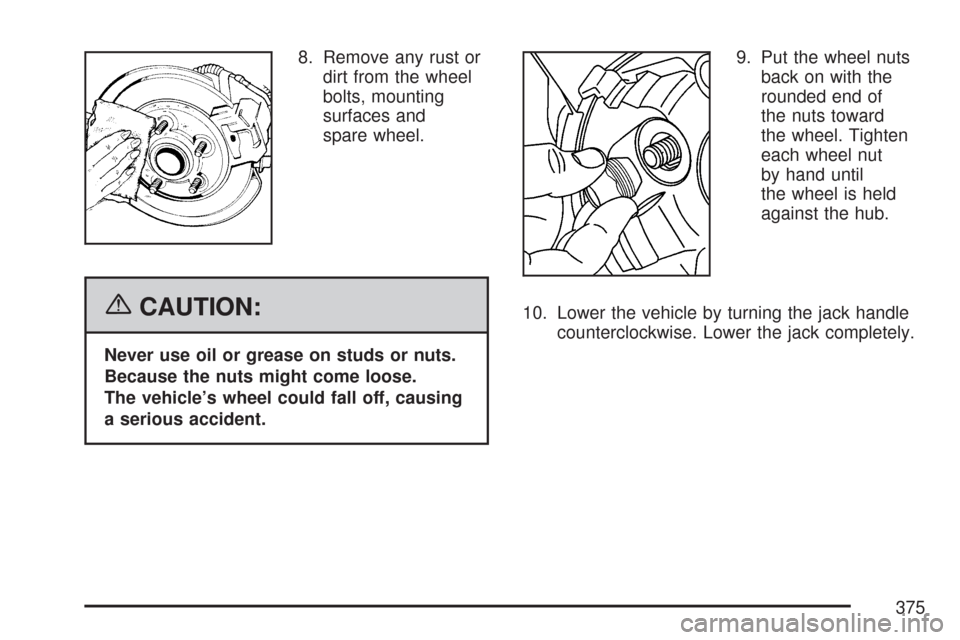
8. Remove any rust or
dirt from the wheel
bolts, mounting
surfaces and
spare wheel.
{CAUTION:
Never use oil or grease on studs or nuts.
Because the nuts might come loose.
The vehicle’s wheel could fall off, causing
a serious accident.9. Put the wheel nuts
back on with the
rounded end of
the nuts toward
the wheel. Tighten
each wheel nut
by hand until
the wheel is held
against the hub.
10. Lower the vehicle by turning the jack handle
counterclockwise. Lower the jack completely.
375
Page 377 of 458
Secondary Latch System
Your vehicle has an underbody-mounted tire
hoist assembly equipped with a secondary latch
system. It is designed to stop the spare tire
from suddenly falling off the vehicle if the cable
holding the spare tire is damaged. For the
secondary latch to work, the tire must be
stowed with the valve stem pointing down.
SeeStoring a Flat or Spare Tire and Tools on
page 380for instructions on storing the spare
tire correctly.
{CAUTION:
Before beginning this procedure read all
the instructions. Failure to read and follow
the instructions could damage the hoist
assembly and you and others could get
hurt. Read and follow the instructions
listed next.To release the spare tire from the secondary latch:
{CAUTION:
Someone standing too close during the
procedure could be injured by the jack.
If the spare tire does not slide off the jack
completely, make sure no one is behind
you or on either side of you as you pull
the jack out from the under spare.
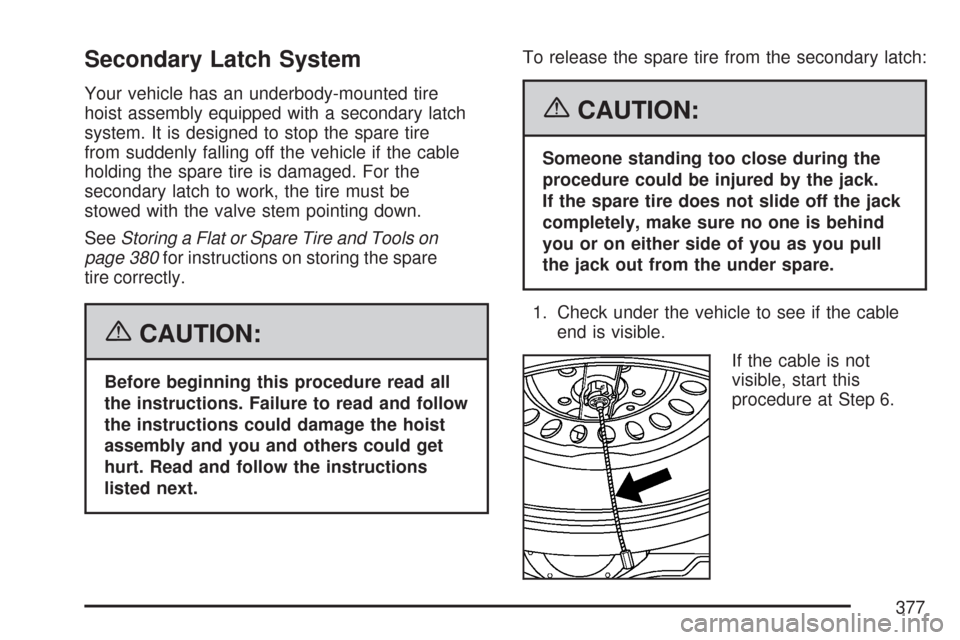
1. Check under the vehicle to see if the cable
end is visible.
If the cable is not
visible, start this
procedure at Step 6.
377
Page 381 of 458
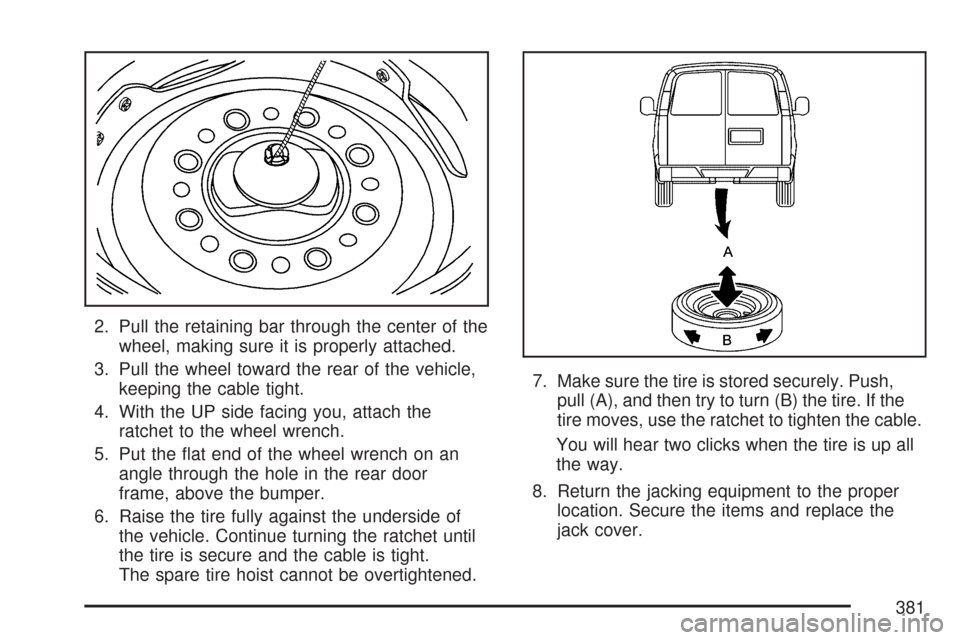
2. Pull the retaining bar through the center of the
wheel, making sure it is properly attached.
3. Pull the wheel toward the rear of the vehicle,
keeping the cable tight.
4. With the UP side facing you, attach the
ratchet to the wheel wrench.
5. Put the flat end of the wheel wrench on an
angle through the hole in the rear door
frame, above the bumper.
6. Raise the tire fully against the underside of
the vehicle. Continue turning the ratchet until
the tire is secure and the cable is tight.
The spare tire hoist cannot be overtightened.7. Make sure the tire is stored securely. Push,
pull (A), and then try to turn (B) the tire. If the
tire moves, use the ratchet to tighten the cable.
You will hear two clicks when the tire is up all
the way.
8. Return the jacking equipment to the proper
location. Secure the items and replace the
jack cover.
381
Page 384 of 458
Fabric/Carpet
Use a vacuum cleaner with a soft brush
attachment frequently to remove dust and loose
dirt. A canister vacuum with a beater bar in
the nozzle may only be used on floor carpet and
carpeted floor mats. For soils, always try to remove
them first with plain water or club soda. Before
cleaning, gently remove as much of the soil
as possible using one of the following techniques:
•For liquids: gently blot the remaining soil with a
paper towel. Allow the soil to absorb into the
paper towel until no more can be removed.
•For solid dry soils: remove as much as possible
and then vacuum.
To clean, use the following instructions:
1. Saturate a lint-free, clean white cloth with
water or club soda.
2. Wring the cloth to remove excess moisture.3. Start on the outside edge of the soil and
gently rub toward the center. Continue
cleaning, using a clean area of the cloth
each time it becomes soiled.
4. Continue to gently rub the soiled area until
the cleaning cloth remains clean.
5. If the soil is not completely removed, use a
mild soap solution and repeat the cleaning
process that was used with plain water.
If any of the soil remains, a commercial fabric
cleaner or spot lifter may be necessary. When a
commercial upholstery cleaner or spot lifter is to
be used, test a small hidden area for colorfastness
first. If the locally cleaned area gives any
impression that a ring formation may result,
clean the entire surface.
After the cleaning process has been completed,
a paper towel can be used to blot excess moisture
from the fabric or carpet.
384
Page 386 of 458
Washing Your Vehicle
The paint finish on the vehicle provides beauty,
depth of color, gloss retention, and durability.
The best way to preserve the vehicle’s finish is to
keep it clean by washing it often with lukewarm
or cold water.
Do not wash the vehicle in the direct rays of
the sun. Use a car washing soap. Do not
use strong soaps or chemical detergents.
Be sure to rinse the vehicle well, removing all
soap residue completely. Approved cleaning
products can be obtained from your dealer. See
Vehicle Care/Appearance Materials on page 391.
Do not use cleaning agents that are petroleum
based, or that contain acid or abrasives.
All cleaning agents should be flushed promptly
and not allowed to dry on the surface, or they
could stain. Dry the finish with a soft, clean
chamois or an all-cotton towel to avoid surface
scratches and water spotting.
High pressure car washes may cause water
to enter the vehicle.
Cleaning Exterior Lamps/Lenses
Use only lukewarm or cold water, a soft cloth
and a car washing soap to clean exterior lamps
and lenses. Follow instructions underWashing
Your Vehicle on page 386.
Finish Care
Occasional waxing or mild polishing of your
vehicle by hand may be necessary to remove
residue from the paint finish. You can get approved
cleaning products from your dealer. SeeVehicle
Care/Appearance Materials on page 391.
If your vehicle has a basecoat/clearcoat paint
finish, the clearcoat gives more depth and gloss
to the colored basecoat. Always use waxes
and polishes that are non-abrasive and made for
a basecoat/clearcoat paint finish.
Notice:Machine compounding or aggressive
polishing on a basecoat/clearcoat paint
nish may damage it. Use only non-abrasive
waxes and polishes that are made for a
basecoat/clearcoat paint nish on your vehicle.
386
Page 387 of 458
Foreign materials such as calcium chloride and
other salts, ice melting agents, road oil and tar,
tree sap, bird droppings, chemicals from industrial
chimneys, etc., can damage your vehicle’s finish if
they remain on painted surfaces. Wash the vehicle
as soon as possible. If necessary, use non-abrasive
cleaners that are marked safe for painted surfaces
to remove foreign matter.
Exterior painted surfaces are subject to aging,
weather and chemical fallout that can take their
toll over a period of years. You can help to
keep the paint finish looking new by keeping your
vehicle garaged or covered whenever possible.
Protecting Exterior Bright Metal Parts
Bright metal parts should be cleaned regularly
to keep their luster. Washing with water is all
that is usually needed. However, you may
use chrome polish on chrome or stainless steel
trim, if necessary.
Use special care with aluminum trim. To avoid
damaging protective trim, never use auto or
chrome polish, steam or caustic soap to clean
aluminum. A coating of wax, rubbed to high polish,
is recommended for all bright metal parts.
Windshield and Wiper Blades
Clean the outside of the windshield with
glass cleaner.
Clean the rubber blades using a lint free cloth or
paper towel soaked with windshield washer fluid or
a mild detergent. Wash the windshield thoroughly
when cleaning the blades. Bugs, road grime,
sap, and a buildup of vehicle wash/wax treatments
may cause wiper streaking. Replace the wiper
blades if they are worn or damaged.
Wipers can be damaged by:
•Extreme dusty conditions
•Sand and salt
•Heat and sun
•Snow and ice, without proper removal
387
Page 388 of 458
Aluminum Wheels
Notice:If you use strong soaps, chemicals,
abrasive polishes, cleaners, brushes, or
cleaners that contain acid on aluminum or
chrome-plated wheels, you could damage the
surface of the wheel(s). The repairs would
not be covered by your warranty. Use
only approved cleaners on aluminum or
chrome-plated wheels.
Keep the wheels clean using a soft clean cloth
with mild soap and water. Rinse with clean water.
After rinsing thoroughly, dry with a soft clean
towel. A wax may then be applied.
Notice:Using chrome polish on aluminum
wheels could damage the wheels. The repairs
would not be covered by your warranty.
Use chrome polish on chrome wheels only.The surface of these wheels is similar to the
painted surface of the vehicle. Do not use strong
soaps, chemicals, abrasive polishes, abrasive
cleaners, cleaners with acid, or abrasive cleaning
brushes on them because the surface could
be damaged. Do not use chrome polish on
aluminum wheels.
Notice:If you drive your vehicle through an
automatic car wash that has silicone carbide
tire cleaning brushes, you could damage the
aluminum or chrome-plated wheels. The repairs
would not be covered by your warranty. Never
drive a vehicle equipped with aluminum or
chrome-plated wheels through an automatic
car wash that uses silicone carbide tire cleaning
brushes.
388
Page 410 of 458
(c)Visually inspect hoses and have them replaced
if they are cracked, swollen, or deteriorated.
Inspect all pipes, ttings, and clamps; replace with
genuine parts as needed. To help ensure proper
operation, a pressure test of the cooling system
and pressure cap and cleaning the outside of the
radiator and air conditioning condenser is
recommended at least once a year.
(d)Inspect wiper blades for wear, cracking,
or contamination. Clean the windshield and wiper
blades, if contaminated. Replace wiper blades
that are worn or damaged. See Windshield Wiper
Blade Replacement on page 344 and Windshield
and Wiper Blades on page 387 for more
information.
(e)Make sure the safety belt reminder light and
all belts, buckles, latch plates, retractors, and
anchorages are working properly. Look for
any other loose or damaged safety belt system
parts. If you see anything that might keep a safety
belt system from doing its job, have it repaired.
Have any torn or frayed safety belts replaced.
Also look for any opened or broken airbag
coverings, and have them repaired or replaced.
The airbag system does not need regular
maintenance.(f)Lubricate all key lock cylinders, hood hinges,
hood prop rod pivot, hood latch assembly,
secondary latch, pivots, spring anchor, release
pawl, rear compartment hinges, latches, locks, fuel
door hinge, and any moving seat hardware. More
frequent lubrication may be required when exposed
to a corrosive environment. Applying silicone grease
on weatherstrips with a clean cloth will make them
last longer, seal better, and not stick or squeak.
(g)Vehicles with Gross Vehicle Weight Rating
(GVWR) above 10,000 lbs (4 536 kg) only: Inspect
shields for damage or looseness. Adjust or
replace as required. This is a Noise Emission
Control Service. Applicable to vehicles sold in the
United States and recommended for vehicles
sold in Canada.
(h)Change automatic transmission uid and lter
if the vehicle is mainly driven under one or
more of these conditions:
-In heavy city traffic where the outside
temperature regularly reaches 90°F (32°C)
or higher.
-In hilly or mountainous terrain.
-When doing frequent trailer towing.
-Uses such as found in taxi, police,
or delivery service.
410
Page 430 of 458
Roadside Assistance Program
In the U.S., call1-800-CHEV-USA
(1-800-243-8872); (Text telephone (TTY):
1-800-833-6000).
In Canada, call1-800-268-6800.
Service is available 24 hours a day,
365 days a year.
As the owner of a new Chevrolet vehicle,
you are automatically enrolled in the
Chevrolet Roadside Assistance program.
Who is Covered?
Roadside Assistance coverage is for the vehicle
operator, regardless of ownership. In Canada,
a person driving this vehicle without the consent
of the owner is not eligible for coverage.
The following services are provided in the U.S.
during the Bumper-to-Bumper warranty period and,
in Canada, during the Base Warranty coverage
period of the New Vehicle Limited Warranty, up to
a maximum coverage of $100.
•Fuel Delivery:Delivery of enough fuel for the
vehicle to get to the nearest service station
(approximately $5 in Canada). Serviceto provide diesel may be restricted. For safety
reasons, propane and other alternative
fuels will not be provided through this service.
•Lock-out Service:To ensure security,
the driver must present personal identification
before lock-out service is provided. In
Canada, the vehicle registration is also
required. Lock-out service will be covered at
no charge if you are unable to gain entry
into your vehicle. A remote unlock may
be available if you have an active OnStar
®
subscription.
•Emergency Tow From a Public Roadway
or Highway:Tow to the nearest dealership
for warranty service or in the event of a
vehicle-disabling accident. Winch-out
assistance when the vehicle is mired in sand,
mud, or snow.
•Flat Tire Change:Installation of a spare tire
in good condition, when equipped and
properly inflated, is covered at no charge.
The customer is responsible for the repair or
replacement of the tire if not covered by a
warrantable failure.
430
Page 432 of 458
For prompt and efficient assistance when calling,
please provide the following to the Roadside
Assistance Representative:
•Your name, home address, and home
telephone number
•Telephone number of your location
•Location of the vehicle
•Model, year, color, and license plate number
of the vehicle
•Odometer reading, Vehicle Identification
Number (VIN), and delivery date of the vehicle
•Description of the problem
Chevrolet and General Motors of Canada Limited
reserve the right to limit services or reimbursement
to an owner or driver when, in their sole
discretion, the claims become excessive in
frequency or type of occurrence.
Roadside Assistance is not part of or included in
the coverage provided by the New Vehicle Limited
Warranty. Chevrolet and General Motors of
Canada Limited reserve the right to make any
changes or discontinue the Roadside Assistance
program at any time without notification.
Towing and Road Service Exclusions
Specifically excluded from Roadside Assistance
coverage are towing or services for vehicles
operated on a non-public roadway or highway,
fines, impound towing caused by a violation
of local, Municipal, State, Provincial, or Federal
law, and mounting, dismounting or changing
of snow tires, chains, or other traction devices.
Courtesy Transportation
To enhance your ownership experience, we and
our participating dealers are proud to offer
Courtesy Transportation, a customer support
program for new vehicles.
For warranty repairs during the Bumper-to-Bumper
(U.S.) or Base Warranty Coverage period
(Canada), provided by the New Vehicle Limited
Warranty, interim transportation may be available
under the Courtesy Transportation program.
Several courtesy transportation options are
available to assist in reducing your inconvenience
when warranty repairs are required.
432