warning light CHEVROLET HHR 2007 1.G Owner's Manual
[x] Cancel search | Manufacturer: CHEVROLET, Model Year: 2007, Model line: HHR, Model: CHEVROLET HHR 2007 1.GPages: 446, PDF Size: 2.43 MB
Page 257 of 446
Hydroplaning
Hydroplaning is dangerous. So much water can
build up under the tires that they can actually ride
on the water. This can happen if the road is
wet enough and you are going fast enough. When
your vehicle is hydroplaning, it has little or no
contact with the road.
Hydroplaning does not happen often. But it can if
the tires do not have much tread or if the
pressure in one or more is low. It can happen if a
lot of water is standing on the road. If you can
see reections from trees, telephone poles,
or other vehicles, and raindrops dimple the water’s
surface, there could be hydroplaning.
Hydroplaning usually happens at higher speeds.
There just is not a hard and fast rule about
hydroplaning. The best advice is to slow down
when it is raining.
Driving Through Deep Standing Water
Notice:If you drive too quickly through deep
puddles or standing water, water can come in
through the engine’s air intake and badly
damage the engine. Never drive through water
that is slightly lower than the underbody of your
vehicle. If you cannot avoid deep puddles or
standing water, drive through them very slowly.
Driving Through Flowing Water
{CAUTION:
Flowing or rushing water creates strong
forces. If you try to drive through owing
water, as you might at a low water
crossing, your vehicle can be carried away.
As little as six inches of owing water can
carry away a smaller vehicle. If this
happens, you and other vehicle occupants
could drown. Do not ignore police warning
signs, and otherwise be very cautious
about trying to drive through owing water.
257
Page 259 of 446
Here are ways to increase your safety in city
driving:
Know the best way to get to where you are
going. Get a city map and plan your trip
into an unknown part of the city just as you
would for a cross-country trip.
Try to use the freeways that rim and crisscross
most large cities. You will save time and
energy. SeeFreeway Driving on page 259.
Treat a green light as a warning signal.
A traffic light is there because the corner
is busy enough to need it. When a light turns
green, and just before you start to move,
check both ways for vehicles that have not
cleared the intersection or may be running
the red light.
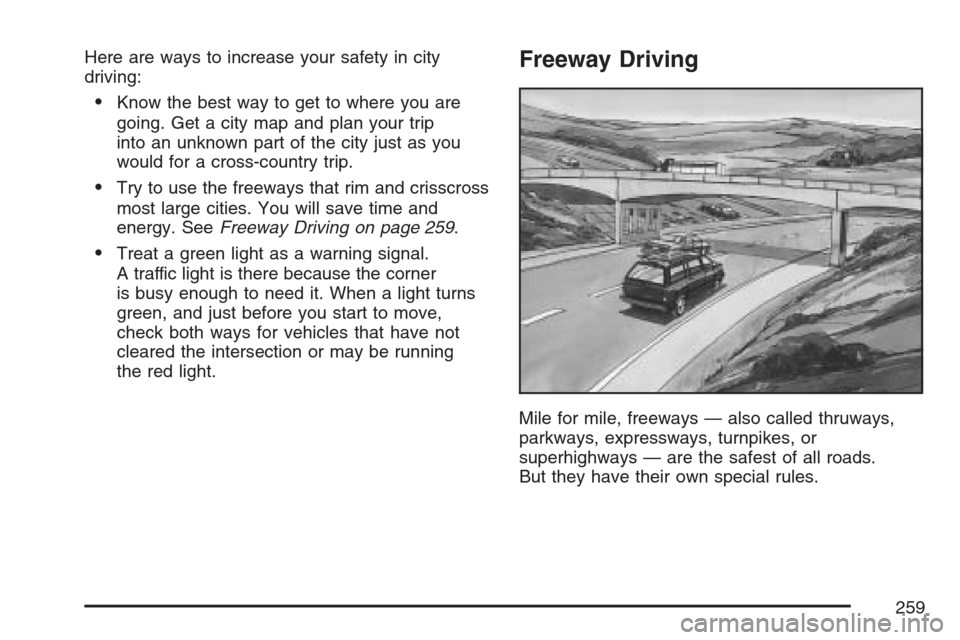
Freeway Driving
Mile for mile, freeways — also called thruways,
parkways, expressways, turnpikes, or
superhighways — are the safest of all roads.
But they have their own special rules.
259
Page 264 of 446
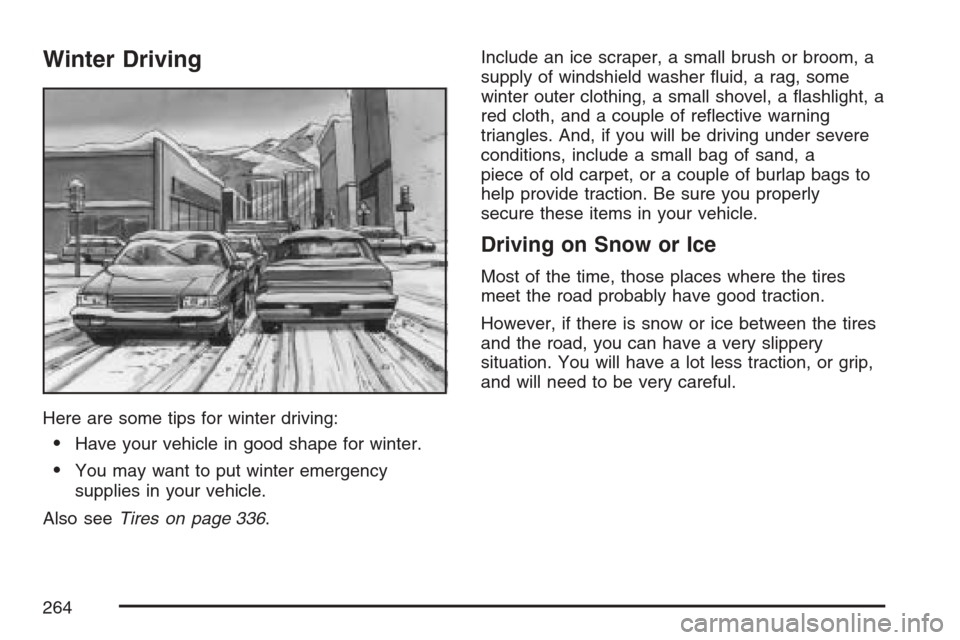
Winter Driving
Here are some tips for winter driving:
Have your vehicle in good shape for winter.
You may want to put winter emergency
supplies in your vehicle.
Also seeTires on page 336.Include an ice scraper, a small brush or broom, a
supply of windshield washer uid, a rag, some
winter outer clothing, a small shovel, a ashlight, a
red cloth, and a couple of reective warning
triangles. And, if you will be driving under severe
conditions, include a small bag of sand, a
piece of old carpet, or a couple of burlap bags to
help provide traction. Be sure you properly
secure these items in your vehicle.
Driving on Snow or Ice
Most of the time, those places where the tires
meet the road probably have good traction.
However, if there is snow or ice between the tires
and the road, you can have a very slippery
situation. You will have a lot less traction, or grip,
and will need to be very careful.
264
Page 295 of 446
{CAUTION:
If you spill fuel and then something
ignites it, you could be badly burned. Fuel
can spray out on you if you open the fuel
cap too quickly. This spray can happen if
your tank is nearly full, and is more likely
in hot weather. Open the fuel cap slowly
and wait for any hiss noise to stop. Then
unscrew the cap all the way.
Be careful not to spill fuel. Do not top off or overll
the tank and wait a few seconds after you have
nished pumping before removing the nozzle.
Clean fuel from painted surfaces as soon
as possible. SeeWashing Your Vehicle on
page 373.
When replacing the fuel cap, turn it clockwise until
it clicks. Make sure the cap is fully installed.
The diagnostic system can determine if the fuel
cap has been left off or improperly installed.
This would allow fuel to evaporate into the
atmosphere. SeeMalfunction Indicator Lamp on
page 188.The CHECK GAS CAP message will be displayed
on the Driver Information Center (DIC) if the
fuel cap is not properly installed. SeeDIC
Warnings and Messages on page 197for more
information.
To close the fuel door securely, push the door to
the closed position.
{CAUTION:
If a re starts while you are refueling, do
not remove the nozzle. Shut off the ow of
fuel by shutting off the pump or by
notifying the station attendant. Leave the
area immediately.
Notice:If you need a new fuel cap, be sure to
get the right type. Your dealer can get one
for you. If you get the wrong type, it may not
t properly. This may cause your malfunction
indicator lamp to light and may damage
your fuel tank and emissions system. See
Malfunction Indicator Lamp on page 188.
295
Page 306 of 446
Hydraulic Clutch
The hydraulic clutch linkage in your vehicle is
self-adjusting. This system does not have its own
reservoir. It receives uid from the brake master
cylinder reservoir.
SeeBrakes on page 317for more information.
Engine Coolant
The cooling system in your vehicle is lled with
DEX-COOL®engine coolant. This coolant is
designed to remain in your vehicle for ve years or
150,000 miles (240 000 km), whichever occurs
rst, if you add only DEX-COOL
®extended
life coolant.
The following explains your cooling system and
how to add coolant when it is low. If you have
a problem with engine overheating, seeEngine
Overheating on page 309.A 50/50 mixture of clean, drinkable water and
DEX-COOL
®coolant will:
Give freezing protection down
to−34°F (−37°C).
Give boiling protection up to 265°F (129°C).
Protect against rust and corrosion.
Help keep the proper engine temperature.
Let the warning lights and gages work as they
should.
Notice:Using coolant other than DEX-COOL
®
may cause premature engine, heater core,
or radiator corrosion. In addition, the engine
coolant may require changing sooner, at
the rst maintenance service after each
30,000 miles (50 000 km) or 24 months,
whichever occurs rst. Any repairs would not
be covered by your warranty. Always use
DEX-COOL
®(silicate-free) coolant in your
vehicle.
306
Page 309 of 446
{CAUTION:
You can be burned if you spill coolant on
hot engine parts. Coolant contains
ethylene glycol, and it will burn if the
engine parts are hot enough. Do not spill
coolant on a hot engine.
Pressure Cap
Notice:If the pressure cap is not tightly
installed, coolant loss and possible engine
damage may occur. Be sure the cap is properly
and tightly secured.
SeeEngine Compartment Overview on page 298
for more information on location.
Engine Overheating
You will nd a coolant temperature warning light
and a coolant temperature gage on your vehicle’s
instrument panel. SeeEngine Coolant
Temperature Warning Light on page 187and
Engine Coolant Temperature Gage on page 188
for more information.
309
Page 310 of 446
If Steam Is Coming From Your Engine
{CAUTION:
Steam from an overheated engine can
burn you badly, even if you just open the
hood. Stay away from the engine if you
see or hear steam coming from it. Just
turn it off and get everyone away from the
vehicle until it cools down. Wait until
there is no sign of steam or coolant
before you open the hood.
If you keep driving when your engine is
overheated, the liquids in it can catch re.
You or others could be badly burned.
Stop your engine if it overheats, and get
out of the vehicle until the engine is cool.Notice:If your engine catches re because
you keep driving with no coolant, your vehicle
can be badly damaged. The costly repairs
would not be covered by your warranty.If No Steam Is Coming From
Your Engine
An engine coolant temperature warning can
indicate a serious problem. SeeEngine Coolant
Temperature Warning Light on page 187.
If you get an engine coolant temperature warning,
but see or hear no steam, the problem may not
be too serious. Sometimes the engine can
get a little too hot when you:
Climb a long hill on a hot day.
Stop after high-speed driving.
Idle for long periods in traffic.
Tow a trailer.
310
Page 318 of 446
So, it is not a good idea to top off your brake uid.
Adding brake uid will not correct a leak. If you
add uid when your linings are worn, then you will
have too much uid when you get new brake
linings. You should add or remove brake uid, as
necessary, only when work is done on the
brake hydraulic system.
{CAUTION:
If your vehicle has too much brake uid, it
can spill on the engine. The uid will burn
if the engine is hot enough. You or others
could be burned, and your vehicle could
be damaged. Add brake uid only when
work is done on the brake hydraulic
system.
When your brake uid falls to a low level, your
brake warning light will come on. SeeBrake
System Warning Light on page 185.
Brake Wear
Your vehicle has front disc brakes and rear drum
brakes.
Disc brake pads have built-in wear indicators that
make a high-pitched warning sound when the
brake pads are worn and new pads are needed.
The sound may come and go or be heard all
the time your vehicle is moving, except when you
are pushing on the brake pedal rmly.
{CAUTION:
The brake wear warning sound means that
soon the brakes will not work well. That
could lead to an accident. When you hear
the brake wear warning sound, have your
vehicle serviced.
Notice:Continuing to drive with worn-out
brake pads could result in costly brake repair.
318
Page 433 of 446
A
Accessories and Modications..................... 289
Accessory Power Outlet(s).......................... 169
Adding Equipment to Your Airbag-Equipped
Vehicle....................................................... 89
Additives, Fuel............................................ 292
Add-On Electrical Equipment....................... 380
Air Cleaner/Filter, Engine............................. 304
Air Conditioning........................................... 170
Airbag
Passenger Status Indicator....................... 182
Readiness Light....................................... 181
Airbag Sensing and Diagnostic
Module (SDM).......................................... 423
Airbag System............................................... 71
Adding Equipment to Your
Airbag-Equipped Vehicle......................... 89
How Does an Airbag Restrain?.................. 79
Passenger Sensing System....................... 82
Servicing Your Airbag-Equipped Vehicle..... 88
What Makes an Airbag Inate?.................. 79
What Will You See After an Airbag
Inates?................................................. 80
When Should an Airbag Inate?................. 77
Where Are the Airbags?............................. 74
Antenna, Fixed Mast................................... 236Antenna, XM™ Satellite Radio Antenna
System.................................................... 236
Anti-Lock Brake System (ABS).................... 243
Anti-Lock Brake, System Warning Light....... 186
Appearance Care
Aluminum or Chrome-Plated Wheels........ 375
Care of Safety Belts................................ 373
Chemical Paint Spotting........................... 377
Cleaning Exterior Lamps/Lenses.............. 374
Cleaning the Inside of Your Vehicle.......... 370
Fabric/Carpet........................................... 371
Finish Care.............................................. 374
Finish Damage......................................... 377
Instrument Panel, Vinyl, and Other
Plastic Surfaces.................................... 372
Sheet Metal Damage............................... 376
Tires........................................................ 376
Underbody Maintenance........................... 377
Vehicle Care/Appearance Materials.......... 378
Washing Your Vehicle .............................. 373
Weatherstrips........................................... 373
Windshield and Wiper Blades................... 375
Ashtray(s).................................................... 170
Audio System(s).......................................... 206
Audio Steering Wheel Controls................. 234
Care of Your CD Player........................... 235
Care of Your CDs.................................... 235
433
Page 434 of 446
Audio System(s) (cont.)
Fixed Mast Antenna................................. 236
Radio with CD................................210, 215
Setting the Time..............................207, 208
Theft-Deterrent Feature............................ 233
Understanding Radio Reception............... 234
XM™ Satellite Radio Antenna System...... 236
Automatic Door Lock................................... 105
Automatic Headlamp System....................... 165
Automatic Transaxle
Fluid........................................................ 305
Operation................................................. 122
B
Battery........................................................ 320
Electric Power Management..................... 168
Run-Down Protection............................... 168
Before Leaving on a Long Trip.................... 260
Brake
Anti-Lock Brake System (ABS)................. 243
Emergencies............................................ 245
Parking.................................................... 127
System Warning Light.............................. 185
Brakes........................................................ 317
Braking....................................................... 242
Braking in Emergencies............................... 245Break-In, New Vehicle................................. 115
Bulb Replacement....................................... 330
Center High-Mounted
Stoplamp (CHMSL)............................... 331
Halogen Bulbs......................................... 330
Headlamp Aiming..................................... 327
Headlamps, Front Turn Signal, and
Parking Lamps..................................... 330
License Plate Lamps................................ 334
Replacement Bulbs.................................. 334
Taillamps, Turn Signal, Stoplamps
and Back-up Lamps.............................. 332
Buying New Tires........................................ 347C
Calibration..........................................134, 136
California Fuel............................................. 292
California Proposition 65 Warning................ 290
Canadian Owners........................................... 3
Capacities and Specications...................... 386
Carbon Monoxide......................106, 132, 264,
276, 277
Care of
Safety Belts............................................. 373
Your CD Player........................................ 235
Your CDs ................................................. 235
CD, MP3 ..................................................... 226
434