check engine CHEVROLET HHR 2008 1.G Owner's Guide
[x] Cancel search | Manufacturer: CHEVROLET, Model Year: 2008, Model line: HHR, Model: CHEVROLET HHR 2008 1.GPages: 430, PDF Size: 5.63 MB
Page 279 of 430
If you have to add coolant more than four times a year,
have your dealer/retailer check your cooling system.
Notice:If you use extra inhibitors and/or additives
in your vehicle’s cooling system, you could
damage your vehicle. Use only the proper mixture
of the engine coolant listed in this manual for
the cooling system. SeeRecommended Fluids and
Lubricants on page 6-12for more information.
Checking Coolant
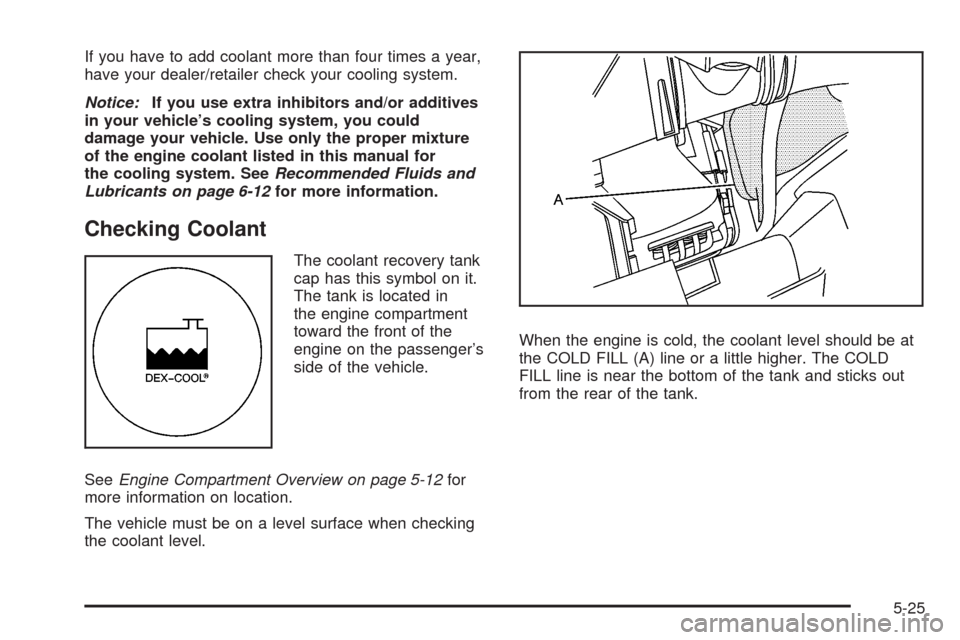
The coolant recovery tank
cap has this symbol on it.
The tank is located in
the engine compartment
toward the front of the
engine on the passenger’s
side of the vehicle.
SeeEngine Compartment Overview on page 5-12for
more information on location.
The vehicle must be on a level surface when checking
the coolant level.When the engine is cold, the coolant level should be at
the COLD FILL (A) line or a little higher. The COLD
FILL line is near the bottom of the tank and sticks out
from the rear of the tank.
5-25
Page 283 of 430
{CAUTION:
An electric engine cooling fan under the hood
can start up even when the engine is not
running and can injure you. Keep hands,
clothing, and tools away from any underhood
electric fan.
If the coolant inside the coolant recovery tank is
boiling, do not do anything else until it cools down.
The vehicle should be parked on a level surface.
When the engine is cold, the coolant level should be at
or above the COLD FILL line. If it is not, you may
have a leak at the pressure cap or in the radiator hoses,
heater hoses, radiator, water pump, or somewhere in
the cooling system.
{CAUTION:
Heater and radiator hoses, and other engine
parts, can be very hot. Do not touch them.
If you do, you can be burned.
Do not run the engine if there is a leak. If you
run the engine, it could lose all coolant.
That could cause an engine re, and you could
be burned. Get any leak xed before you drive
the vehicle.
If there seems to be no leak, with the engine on, check
to see if the electric engine cooling fan is running.
If the engine is overheating, the fan should be running.
If it is not, than the vehicle needs service.
Notice:Engine damage from running the engine
without coolant is not covered by the warranty.
Notice:Using coolant other than DEX-COOL
®may
cause premature engine, heater core, or radiator
corrosion. In addition, the engine coolant could
require changing sooner, at 30,000 miles (50 000 km)
or 24 months, whichever occurs rst. Any repairs
would not be covered by the warranty. Always use
DEX-COOL
®(silicate-free) coolant in the vehicle.
5-29
Page 286 of 430
3. Add the proper DEX-COOL®coolant mixture to
the coolant ll port, up to the base of the port.
SeeEngine Coolant on page 5-24for more
information about the proper coolant mixture.
4. Rinse or wipe any spilled coolant from the engine
and the compartment.
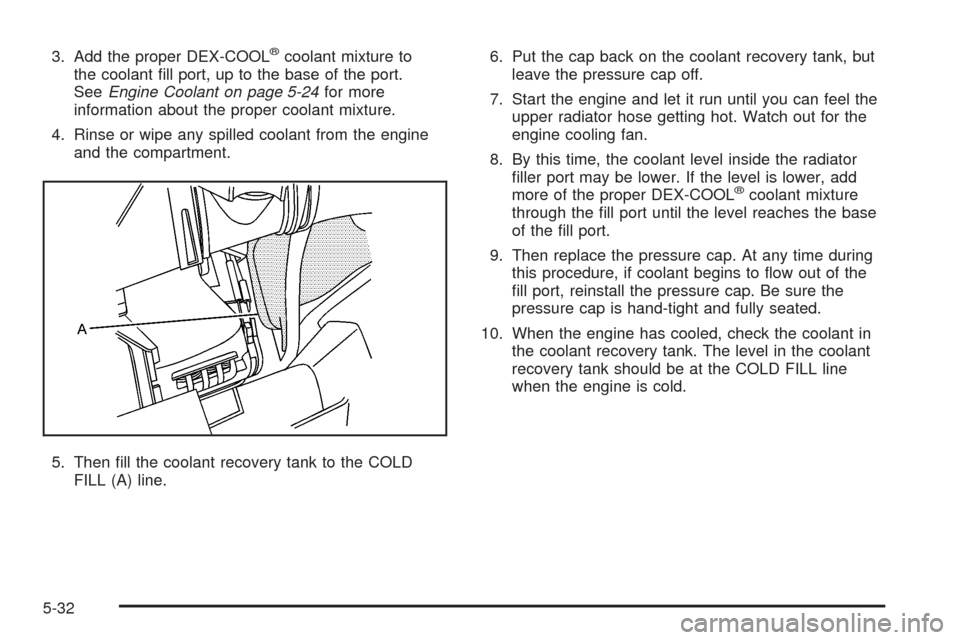
5. Then ll the coolant recovery tank to the COLD
FILL (A) line.6. Put the cap back on the coolant recovery tank, but
leave the pressure cap off.
7. Start the engine and let it run until you can feel the
upper radiator hose getting hot. Watch out for the
engine cooling fan.
8. By this time, the coolant level inside the radiator
ller port may be lower. If the level is lower, add
more of the proper DEX-COOL
®coolant mixture
through the ll port until the level reaches the base
of the ll port.
9. Then replace the pressure cap. At any time during
this procedure, if coolant begins to ow out of the
ll port, reinstall the pressure cap. Be sure the
pressure cap is hand-tight and fully seated.
10. When the engine has cooled, check the coolant in
the coolant recovery tank. The level in the coolant
recovery tank should be at the COLD FILL line
when the engine is cold.
5-32
Page 295 of 430
5. Check that the jumper cables do not have loose or
missing insulation. If they do, you could get a
shock. The vehicles could be damaged too.
Before you connect the cables, here are some
basic things you should know. Positive (+) will go to
positive (+) or to a remote positive (+) terminal if
the vehicle has one. Negative (−) will go to a heavy,
unpainted metal engine part or to a remote
negative (−) terminal if the vehicle has one.
Do not connect positive (+) to negative (−)oryou
will get a short that would damage the battery
and maybe other parts too. And do not connect the
negative (−) cable to the negative (−) terminal on
the dead battery because this can cause sparks.
6. Connect the red positive (+) cable to the positive (+)
terminal location on the vehicle with the dead
battery. Use a remote positive (+) terminal if the
vehicle has one.7. Do not let the other end touch metal. Connect it to
the positive (+) terminal of the good battery. Use a
remote positive (+) terminal if the vehicle has one.
8. Now connect the black negative (−) cable to the
negative (−) terminal of the good battery. Use a
remote negative (−) terminal if the vehicle has one.
Do not let the other end touch anything until the
next step. The other end of the negative (−) cable
does not go to the dead battery. It goes to a
heavy, unpainted metal engine part or to a remote
negative (−) terminal on the vehicle with the
dead battery.
9. Connect the other end of the negative (−) cable to
the negative (−) terminal location on the vehicle with
the dead battery. Your vehicle has a remote
negative (−) ground terminal marked GND (−).
10. Now start the vehicle with the good battery and run
the engine for a while.
11. Try to start the vehicle that had the dead battery.
If it will not start after a few tries, it probably needs
service.
5-41
Page 372 of 430
Vehicle Identication
Vehicle Identication Number (VIN)
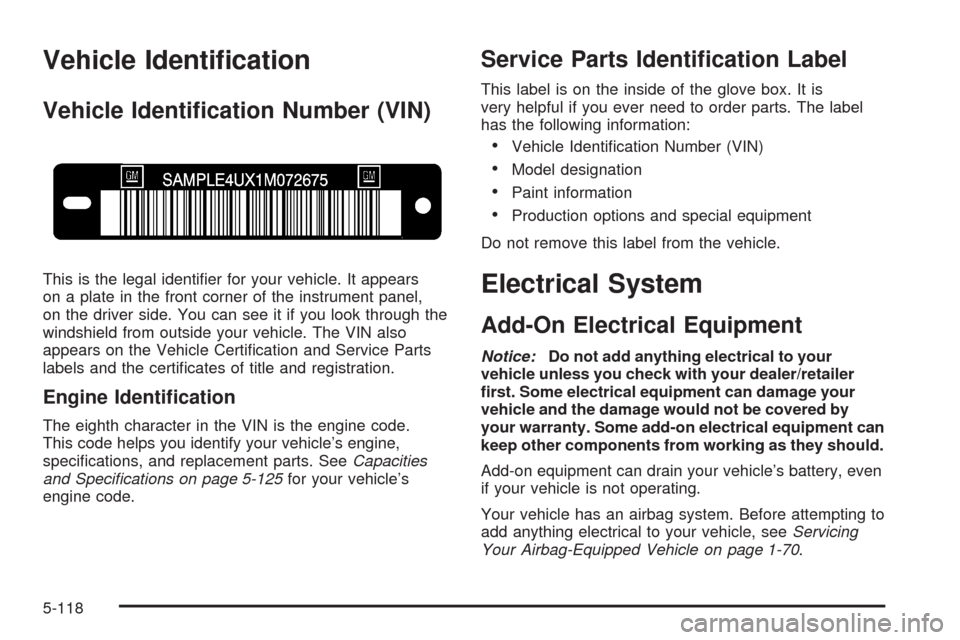
This is the legal identier for your vehicle. It appears
on a plate in the front corner of the instrument panel,
on the driver side. You can see it if you look through the
windshield from outside your vehicle. The VIN also
appears on the Vehicle Certication and Service Parts
labels and the certicates of title and registration.
Engine Identication
The eighth character in the VIN is the engine code.
This code helps you identify your vehicle’s engine,
specications, and replacement parts. SeeCapacities
and Specifications on page 5-125for your vehicle’s
engine code.
Service Parts Identication Label
This label is on the inside of the glove box. It is
very helpful if you ever need to order parts. The label
has the following information:
Vehicle Identication Number (VIN)
Model designation
Paint information
Production options and special equipment
Do not remove this label from the vehicle.
Electrical System
Add-On Electrical Equipment
Notice:Do not add anything electrical to your
vehicle unless you check with your dealer/retailer
rst. Some electrical equipment can damage your
vehicle and the damage would not be covered by
your warranty. Some add-on electrical equipment can
keep other components from working as they should.
Add-on equipment can drain your vehicle’s battery, even
if your vehicle is not operating.
Your vehicle has an airbag system. Before attempting to
add anything electrical to your vehicle, seeServicing
Your Airbag-Equipped Vehicle on page 1-70.
5-118
Page 373 of 430
Headlamp Wiring
The headlamp wiring is protected by fuses in the fuse
block. An electrical overload will cause the lamps to turn
off. If this happens, have your headlamp wiring checked
right away.
Windshield Wiper Fuses
The windshield wiper motor is protected by a circuit
breaker and a fuse. If the motor overheats due to heavy
snow, etc., the wiper will stop until the motor cools.
If the overload is caused by some electrical problem,
have it xed.
Power Windows and Other Power
Options
Fuses in the fuse block protect the power windows.
When the current load is too heavy, the fuse opens
protecting the circuit until the problem is xed.
Fuses and Circuit Breakers
The wiring circuits in your vehicle are protected from
short circuits by a combination of fuses, circuit breakers
and fusible thermal links. This greatly reduces the
chance of damage caused by electrical problems.
Look at the silver-colored band inside the fuse. If the
band is broken or melted, replace the fuse. Be sure you
replace a bad fuse with a new one of the identical
size and rating.
If you ever have a problem on the road and do not have
a spare fuse, you can “borrow” one that has the same
amperage. Just pick some feature of your vehicle
that you can get along without — like the radio or
cigarette lighter — and use its fuse if it is the correct
amperage. Replace it as soon as you can.
There are two fuse blocks in your vehicle: the oor
console fuse block and the engine compartment
fuse block.
There are also one or two fuses located at the back of
the vehicle near the battery.
5-119
Page 381 of 430
Maintenance Schedule.....................................6-2
Introduction...................................................6-2
Maintenance Requirements..............................6-2
Your Vehicle and the Environment....................6-2
Using the Maintenance Schedule......................6-2
Scheduled Maintenance...................................6-4
Additional Required Services............................6-6
Maintenance Footnotes...................................6-7Owner Checks and Services............................6-8
At Each Fuel Fill............................................6-8
At Least Once a Month...................................6-9
At Least Once a Year.....................................6-9
Recommended Fluids and Lubricants...............6-12
Maintenance Replacement Parts.....................6-14
Engine Drive Belt Routing..............................6-15
Maintenance Record.....................................6-16
Section 6 Maintenance Schedule
6-1
Page 382 of 430
Maintenance Schedule
Introduction
Important: Keep engine oil at the proper level and
change as recommended.
Have you purchased the GM Protection Plan? The Plan
supplements your new vehicle warranties. See your
Warranty and Owner Assistance booklet or your
dealer/retailer for details.
Maintenance Requirements
Notice:Maintenance intervals, checks, inspections,
replacement parts, and recommended uids and
lubricants as prescribed in this manual are
necessary to keep your vehicle in good working
condition. Any damage caused by failure to follow
scheduled maintenance might not be covered
by warranty.
Your Vehicle and the Environment
Proper vehicle maintenance not only helps to keep your
vehicle in good working condition, but also helps the
environment. All recommended maintenance is
important. Improper vehicle maintenance can even
affect the quality of the air we breathe. Improper uid
levels or the wrong tire ination can increase the level of
emissions from your vehicle. To help protect our
environment, and to keep your vehicle in good condition,
be sure to maintain your vehicle properly.
Using the Maintenance Schedule
We want to help you keep your vehicle in good working
condition. But we do not know exactly how you will
drive it. You might drive very short distances only a few
times a week. Or you might drive long distances all
the time in very hot, dusty weather. You might use your
vehicle in making deliveries. Or you might drive it to
work, to do errands, or in many other ways.
Because of all the different ways people use their
vehicles, maintenance needs vary. You might need more
frequent checks and replacements. So please read
the following and note how you drive. If you have any
questions on how to keep your vehicle in good condition,
see your dealer/retailer.
6-2
Page 384 of 430
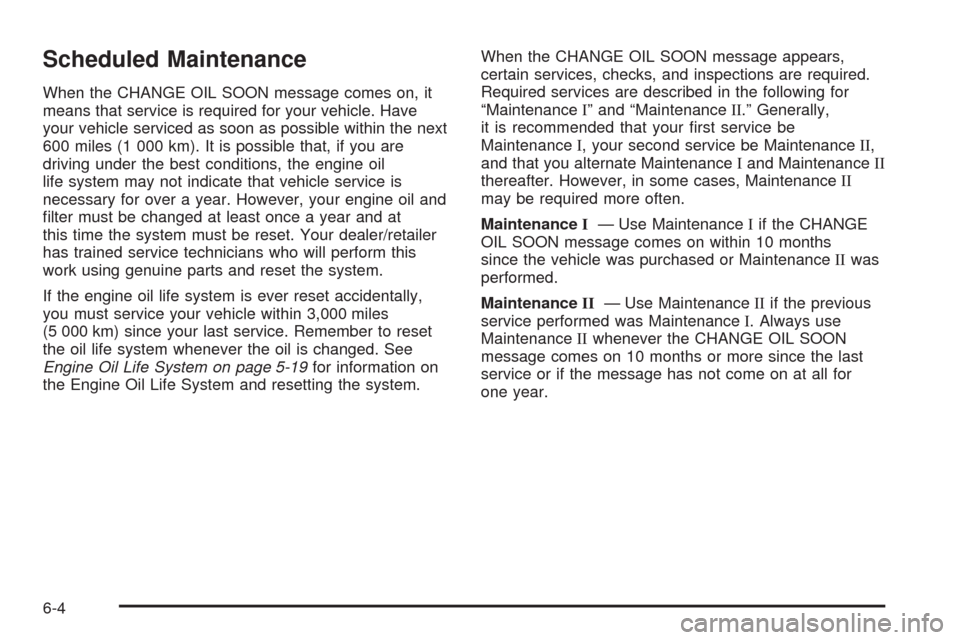
Scheduled Maintenance
When the CHANGE OIL SOON message comes on, it
means that service is required for your vehicle. Have
your vehicle serviced as soon as possible within the next
600 miles (1 000 km). It is possible that, if you are
driving under the best conditions, the engine oil
life system may not indicate that vehicle service is
necessary for over a year. However, your engine oil and
lter must be changed at least once a year and at
this time the system must be reset. Your dealer/retailer
has trained service technicians who will perform this
work using genuine parts and reset the system.
If the engine oil life system is ever reset accidentally,
you must service your vehicle within 3,000 miles
(5 000 km) since your last service. Remember to reset
the oil life system whenever the oil is changed. See
Engine Oil Life System on page 5-19for information on
the Engine Oil Life System and resetting the system.When the CHANGE OIL SOON message appears,
certain services, checks, and inspections are required.
Required services are described in the following for
“MaintenanceI” and “MaintenanceII.” Generally,
it is recommended that your rst service be
MaintenanceI, your second service be MaintenanceII,
and that you alternate MaintenanceIand MaintenanceII
thereafter. However, in some cases, MaintenanceII
may be required more often.
MaintenanceI— Use MaintenanceIif the CHANGE
OIL SOON message comes on within 10 months
since the vehicle was purchased or MaintenanceIIwas
performed.
MaintenanceII— Use MaintenanceIIif the previous
service performed was MaintenanceI. Always use
MaintenanceIIwhenever the CHANGE OIL SOON
message comes on 10 months or more since the last
service or if the message has not come on at all for
one year.
6-4
Page 385 of 430
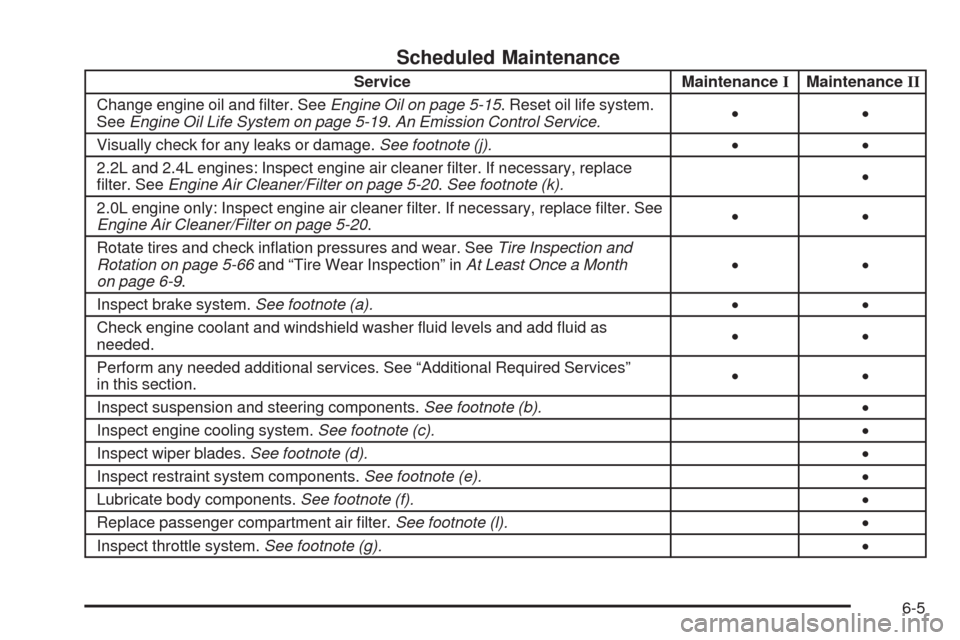
Scheduled Maintenance
Service MaintenanceIMaintenanceII
Change engine oil and lter. SeeEngine Oil on page 5-15. Reset oil life system.
SeeEngine Oil Life System on page 5-19.An Emission Control Service.••
Visually check for any leaks or damage.See footnote (j).••
2.2L and 2.4L engines: Inspect engine air cleaner lter. If necessary, replace
lter. SeeEngine Air Cleaner/Filter on page 5-20.See footnote (k).•
2.0L engine only: Inspect engine air cleaner lter. If necessary, replace lter. See
Engine Air Cleaner/Filter on page 5-20.••
Rotate tires and check ination pressures and wear. SeeTire Inspection and
Rotation on page 5-66and “Tire Wear Inspection” inAt Least Once a Month
on page 6-9.••
Inspect brake system.See footnote (a).••
Check engine coolant and windshield washer uid levels and add uid as
needed.••
Perform any needed additional services. See “Additional Required Services”
in this section.••
Inspect suspension and steering components.See footnote (b).•
Inspect engine cooling system.See footnote (c).•
Inspect wiper blades.See footnote (d).•
Inspect restraint system components.See footnote (e).•
Lubricate body components.See footnote (f).•
Replace passenger compartment air lter.See footnote (l).•
Inspect throttle system.See footnote (g).•
6-5