brakes CHEVROLET IMPALA 2005 8.G Owner's Manual
[x] Cancel search | Manufacturer: CHEVROLET, Model Year: 2005, Model line: IMPALA, Model: CHEVROLET IMPALA 2005 8.GPages: 398, PDF Size: 10.04 MB
Page 247 of 398
But if you ever have to park your rig on a hill,
here’s how to do it:
1. Apply your regular brakes, but don’t shift into
PARK (P) yet.
2. Have someone place chocks under the trailer
wheels.
3. When the wheel chocks are in place, release the
regular brakes until the chocks absorb the load.
4. Reapply the regular brakes. Then apply your
parking brake, and then shift to PARK (P).
5. Release the regular brakes.
When You Are Ready to Leave After
Parking on a Hill
1. Apply your regular brakes and hold the pedal down
while you:
start your engine,
shift into a gear, and
release the parking brake.
2. Let up on the brake pedal.
3. Drive slowly until the trailer is clear of the chocks.
4. Stop and have someone pick up and store the
chocks.
Maintenance When Trailer Towing
Your vehicle will need service more often when you’re
pulling a trailer. See the Maintenance Schedule for more
on this. Things that are especially important in trailer
operation are automatic transaxle uid (don’t overll),
engine oil, drive belts, cooling system and brake system.
Each of these is covered in this manual, and the
Index will help you nd them quickly. If you’re trailering,
it’s a good idea to review this information before you
start your trip.
Check periodically to see that all hitch nuts and bolts
are tight.
Engine Cooling When Trailer Towing
Your cooling system may temporarily overheat during
severe operating conditions. SeeEngine Overheating on
page 5-32.
4-43
Page 249 of 398
Service............................................................5-3
Doing Your Own Service Work.........................5-4
Adding Equipment to the Outside of
Your Vehicle..............................................5-5
Fuel................................................................5-5
Gasoline Octane............................................5-5
Gasoline Specications....................................5-6
California Fuel...............................................5-6
Additives.......................................................5-6
Fuels in Foreign Countries...............................5-7
Filling the Tank..............................................5-8
Filling a Portable Fuel Container.....................5-10
Checking Things Under the Hood....................5-10
Hood Release..............................................5-11
Engine Compartment Overview.......................5-12
Engine Oil...................................................5-18
Engine Oil Life System..................................5-21
Supercharger Oil..........................................5-24
Engine Air Cleaner/Filter................................5-25
Automatic Transaxle Fluid..............................5-26
Engine Coolant.............................................5-29
Radiator Pressure Cap..................................5-31
Engine Overheating.......................................5-32Overheated Engine Protection
Operating Mode........................................5-34
Cooling System............................................5-34
Power Steering Fluid.....................................5-43
Windshield Washer Fluid................................5-44
Brakes........................................................5-45
Battery........................................................5-48
Jump Starting...............................................5-49
Headlamp Aiming...........................................5-54
Bulb Replacement..........................................5-54
Halogen Bulbs..............................................5-54
Headlamps, Front Turn Signal, and
Parking Lamps..........................................5-55
Taillamps, Turn Signal, Stoplamps and
Sidemarker Lamps.....................................5-57
Back-Up Lamps............................................5-58
Replacement Bulbs.......................................5-58
Windshield Wiper Blade Replacement..............5-59
Tires..............................................................5-60
Tire Sidewall Labelling...................................5-61
Tire Terminology and Denitions.....................5-64
Ination - Tire Pressure.................................5-66
Tire Pressure Monitor System.........................5-68
Section 5 Service and Appearance Care
5-1
Page 261 of 398
A. Windshield Washer Fluid Reservoir. See “Adding
Washer Fluid” underWindshield Washer Fluid
on page 5-44.
B. Battery. SeeBattery on page 5-48.
C. Remote Positive (+) Terminal. SeeJump Starting on
page 5-49.
D. Upper Underhood Fuse Block. See “Underhood
Fuse Block (Upper)” underUnderhood Fuse Block
on page 5-103.
E. Lower Underhood Fuse Block. See “Underhood
Fuse Block (Lower)” underUnderhood Fuse Block
on page 5-103.
F. Engine Coolant Recovery Tank. See “Checking
Coolant” underCooling System on page 5-34.
G. Radiator Pressure Cap. SeeRadiator Pressure Cap
on page 5-31.
H. Power Steering Fluid Reservoir. SeePower Steering
Fluid on page 5-43.I. Engine Coolant Air Bleed Valves (underneath engine
shield). See “How to Add Coolant to the Radiator”
underCooling System on page 5-34.
J. Electric Cooling Fan. SeeCooling System on
page 5-34.
K. Engine Oil Fill Cap. See “When to Add Engine Oil”
underEngine Oil on page 5-18.
L. Engine Oil Dipstick. See “Checking Engine Oil”
underEngine Oil on page 5-18.
M. Automatic Transaxle Fluid Dipstick. See “Checking
the Fluid Level” underAutomatic Transaxle Fluid
on page 5-26.
N. Brake Master Cylinder Reservoir. See “Brake Fluid”
underBrakes on page 5-45.
O. Engine Air Cleaner/Filter. SeeEngine Air
Cleaner/Filter on page 5-25.
5-13
Page 263 of 398
A. Windshield Washer Fluid Reservoir. See “Adding
Washer Fluid” underWindshield Washer Fluid
on page 5-44.
B. Battery. SeeBattery on page 5-48.
C. Remote Positive (+) Terminal. SeeJump Starting on
page 5-49.
D. Upper Underhood Fuse Block. See “Underhood
Fuse Block (Upper)” underUnderhood Fuse Block
on page 5-103.
E. Lower Underhood Fuse Block. See “Underhood
Fuse Block (Lower)” underUnderhood Fuse Block
on page 5-103.
F. Engine Coolant Recovery Tank. See “Checking
Coolant” underCooling System on page 5-34.
G. Radiator Pressure Cap. SeeRadiator Pressure Cap
on page 5-31.
H. Electric Cooling Fan. SeeCooling System on
page 5-34.I. Power Steering Fluid Reservoir (low in engine
compartment). SeePower Steering Fluid on
page 5-43.
J. Engine Oil Dipstick. See “Checking Engine Oil”
underEngine Oil on page 5-18.
K. Engine Oil Fill Cap. See “When to Add Engine Oil”
underEngine Oil on page 5-18.
L. Engine Coolant Air Bleed Valves (underneath engine
shield). See “How to Add Coolant to the Radiator”
underCooling System on page 5-34.
M. Automatic Transaxle Fluid Dipstick. See “Checking
the Fluid Level” underAutomatic Transaxle Fluid
on page 5-26.
N. Brake Master Cylinder Reservoir. See “Brake Fluid”
underBrakes on page 5-45.
O. Engine Air Cleaner/Filter. SeeEngine Air
Cleaner/Filter on page 5-25.
5-15
Page 265 of 398
A. Windshield Washer Fluid Reservoir. See “Adding
Washer Fluid” underWindshield Washer Fluid
on page 5-44.
B. Battery. SeeBattery on page 5-48.
C. Radiator Pressure Cap. SeeRadiator Pressure Cap
on page 5-31.
D. Underhood Fuse Block. SeeUnderhood Fuse Block
on page 5-103.
E. Remote Positive (+) Terminal. SeeBattery on
page 5-48.
F. Engine Coolant Recovery Tank. See “Checking
Coolant” underCooling System on page 5-34.
G. Electric Cooling Fan. SeeCooling System on
page 5-34.H. Power Steering Fluid Reservoir (below generator).
SeePower Steering Fluid on page 5-43.
I. Engine Oil Dipstick. See “Checking Engine Oil”
underEngine Oil on page 5-18.
J. Engine Oil Fill Cap. See “When to Add Engine Oil”
underEngine Oil on page 5-18.
K. Automatic Transaxle Fluid Dipstick. See “Checking
the Fluid Level” underAutomatic Transaxle Fluid
on page 5-26.
L. Brake Fluid Reservoir. See “Brake Fluid” under
Brakes on page 5-45.
M. Engine Air Cleaner/Filter. SeeEngine Air
Cleaner/Filter on page 5-25.
5-17
Page 293 of 398
Brakes
Brake Fluid
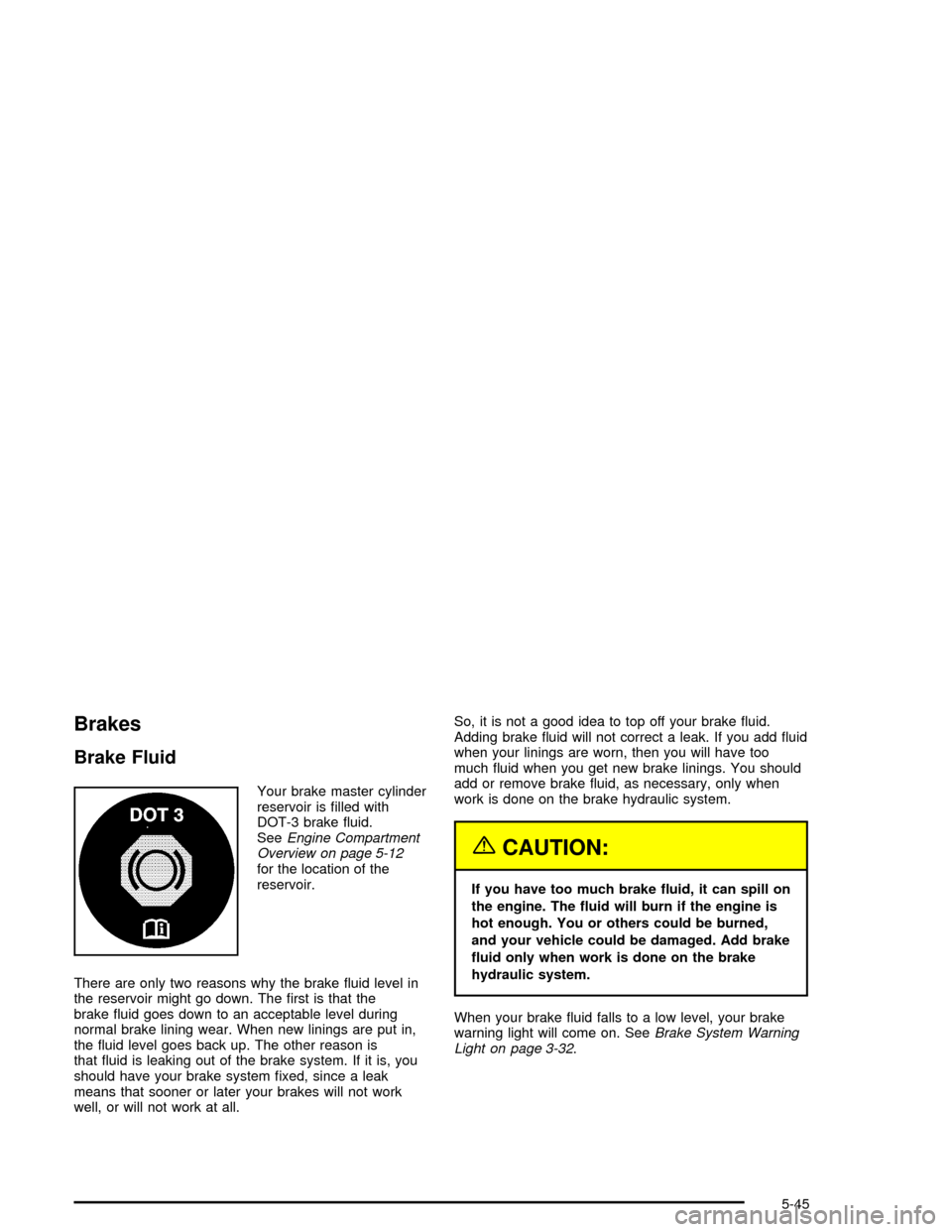
Your brake master cylinder
reservoir is lled with
DOT-3 brake uid.
SeeEngine Compartment
Overview on page 5-12
for the location of the
reservoir.
There are only two reasons why the brake uid level in
the reservoir might go down. The rst is that the
brake uid goes down to an acceptable level during
normal brake lining wear. When new linings are put in,
the uid level goes back up. The other reason is
that uid is leaking out of the brake system. If it is, you
should have your brake system xed, since a leak
means that sooner or later your brakes will not work
well, or will not work at all.So, it is not a good idea to top off your brake uid.
Adding brake uid will not correct a leak. If you add uid
when your linings are worn, then you will have too
much uid when you get new brake linings. You should
add or remove brake uid, as necessary, only when
work is done on the brake hydraulic system.
{CAUTION:
If you have too much brake uid, it can spill on
the engine. The uid will burn if the engine is
hot enough. You or others could be burned,
and your vehicle could be damaged. Add brake
uid only when work is done on the brake
hydraulic system.
When your brake uid falls to a low level, your brake
warning light will come on. SeeBrake System Warning
Light on page 3-32.
5-45
Page 294 of 398
What to Add
When you do need brake uid, use only DOT-3 brake
uid. Use new brake uid from a sealed container
only. SeeRecommended Fluids and Lubricants on
page 6-12.
Always clean the brake uid reservoir cap and the area
around the cap before removing it. This will help
keep dirt from entering the reservoir.
{CAUTION:
With the wrong kind of uid in your brake
system, your brakes may not work well, or they
may not even work at all. This could cause a
crash. Always use the proper brake uid.Notice:
Using the wrong uid can badly damage brake
system parts. For example, just a few drops of
mineral-based oil, such as engine oil, in your
brake system can damage brake system
parts so badly that they will have to be
replaced. Do not let someone put in the
wrong kind of uid.
If you spill brake uid on your vehicle’s painted
surfaces, the paint nish can be damaged.
Be careful not to spill brake uid on your
vehicle. If you do, wash it off immediately.
SeeAppearance Care on page 5-89.
5-46
Page 295 of 398
Brake Wear
Your vehicle has four-wheel disc brakes.
Disc brake pads have built-in wear indicators that make
a high-pitched warning sound when the brake pads
are worn and new pads are needed. The sound
may come and go or be heard all the time your vehicle
is moving, except when you are pushing on the
brake pedal rmly.
{CAUTION:
The brake wear warning sound means that soon
your brakes will not work well. That could lead
to an accident. When you hear the brake wear
warning sound, have your vehicle serviced.
Notice:Continuing to drive with worn-out brake
pads could result in costly brake repair.Some driving conditions or climates may cause a brake
squeal when the brakes are rst applied or lightly
applied. This does not mean something is wrong with
your brakes.
Properly torqued wheel nuts are necessary to help
prevent brake pulsation. When tires are rotated, inspect
brake pads for wear and evenly tighten wheel nuts in
the proper sequence to GM torque specications.
Brake linings should always be replaced as complete
axle sets.
Brake Pedal Travel
See your dealer if the brake pedal does not return to
normal height, or if there is a rapid increase in
pedal travel. This could be a sign of brake trouble.
Brake Adjustment
Every time you apply the brakes, with or without the
vehicle moving, your brakes adjust for wear.
5-47
Page 296 of 398
Replacing Brake System Parts
The braking system on a vehicle is complex.
Its many parts have to be of top quality and work well
together if the vehicle is to have really good braking.
Your vehicle was designed and tested with top-quality
GM brake parts. When you replace parts of your braking
system — for example, when your brake linings wear
down and you need new ones put in — be sure you get
new approved GM replacement parts. If you do not,
your brakes may no longer work properly. For example,
if someone puts in brake linings that are wrong for
your vehicle, the balance between your front and rear
brakes can change — for the worse. The braking
performance you have come to expect can change in
many other ways if someone puts in the wrong
replacement brake parts.
Battery
Your vehicle has a maintenance free battery. When it is
time for a new battery, get one that has the replacement
number shown on the original battery’s label.
We recommend an ACDelco
®replacement battery.
SeeEngine Compartment Overview on page 5-12for
battery location.Warning:Battery posts, terminals and related
accessories contain lead and lead compounds,
chemicals known to the State of California to cause
cancer and reproductive harm. Wash hands after
handling.
Vehicle Storage
If you are not going to drive your vehicle for 25 days
or more, remove the black, negative (−) cable from
the battery. This will help keep your battery from
running down.
{CAUTION:
Batteries have acid that can burn you and gas
that can explode. You can be badly hurt if you
are not careful. SeeJump Starting on page 5-49
for tips on working around a battery without
getting hurt.
5-48
Page 312 of 398
Tire Terminology and Denitions
Air Pressure:The amount of air inside the tire pressing
outward on each square inch of the tire. Air pressure
is expressed in pounds per square inch (psi) or
kilopascal (kPa).
Accessory Weight:This means the combined weight
of optional accessories. Some examples of optional
accessories are, automatic transmission, power steering,
power brakes, power windows, power seats, and air
conditioning.
Aspect Ratio:The relationship of a tire’s height to
its width.
Belt:A rubber coated layer of cords that is located
between the plies and the tread. Cords may be made
from steel or other reinforcing materials.
Bead:The tire bead contains steel wires wrapped by
steel cords that hold the tire onto the rim.
Bias Ply Tire:A pneumatic tire in which the plies are
laid at alternate angles less than 90 degrees to the
centerline of the tread.
Cold Ination Pressure:The amount of air pressure in
a tire, measured in pounds per square inch (psi) or
kilopascals (kPa) before a tire has built up heat
from driving. SeeInation - Tire Pressure on page 5-66.Curb Weight:This means the weight of a motor
vehicle with standard and optional equipment including
the maximum capacity of fuel, oil and coolant, but
without passengers and cargo.
DOT Markings:A code molded into the sidewall of a
tire signifying that the tire is in compliance with the
U.S. Department of Transportation (DOT) motor vehicle
safety standards. The DOT code includes the Tire
Identication Number (TIN), an alphanumeric designator
which can also identify the tire manufacturer, production
plant, brand and date of production.
GVWR:Gross Vehicle Weight Rating, seeLoading
Your Vehicle on page 4-30.
GAWR FRT:Gross Axle Weight Rating for the front
axle, seeLoading Your Vehicle on page 4-30.
GAWR RR:Gross Axle Weight Rating for the rear axle,
seeLoading Your Vehicle on page 4-30.
Intended Outboard Sidewall:The side of an
asymmetrical tire, that must always face outward when
mounted on a vehicle.
Kilopascal (kPa):The metric unit for air pressure.
Light Truck (LT-Metric) Tire:A tire used on light duty
trucks and some multipurpose passenger vehicles.
5-64