automatic transmission CHEVROLET KODIAK 2004 Owner's Manual
[x] Cancel search | Manufacturer: CHEVROLET, Model Year: 2004, Model line: KODIAK, Model: CHEVROLET KODIAK 2004Pages: 366, PDF Size: 6.87 MB
Page 207 of 366
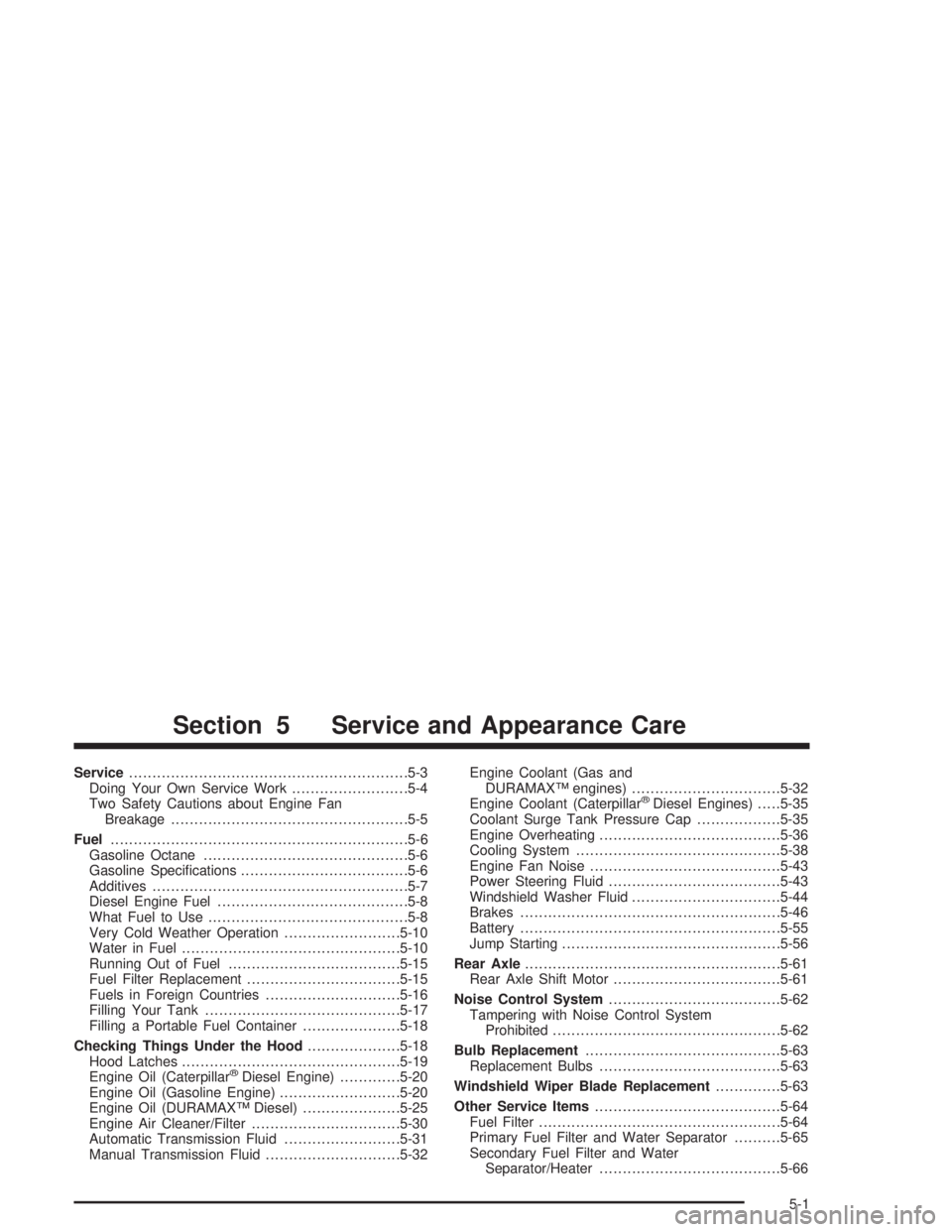
Service............................................................5-3
Doing Your Own Service Work.........................5-4
Two Safety Cautions about Engine Fan
Breakage...................................................5-5
Fuel................................................................5-6
Gasoline Octane............................................5-6
Gasoline Specifications....................................5-6
Additives.......................................................5-7
Diesel Engine Fuel.........................................5-8
What Fuel to Use...........................................5-8
Very Cold Weather Operation.........................5-10
Water in Fuel...............................................5-10
Running Out of Fuel.....................................5-15
Fuel Filter Replacement.................................5-15
Fuels in Foreign Countries.............................5-16
Filling Your Tank..........................................5-17
Filling a Portable Fuel Container.....................5-18
Checking Things Under the Hood....................5-18
Hood Latches...............................................5-19
Engine Oil (Caterpillar
®Diesel Engine).............5-20
Engine Oil (Gasoline Engine)..........................5-20
Engine Oil (DURAMAX™ Diesel).....................5-25
Engine Air Cleaner/Filter................................5-30
Automatic Transmission Fluid.........................5-31
Manual Transmission Fluid.............................5-32Engine Coolant (Gas and
DURAMAX™ engines)................................5-32
Engine Coolant (Caterpillar
®Diesel Engines).....5-35
Coolant Surge Tank Pressure Cap..................5-35
Engine Overheating.......................................5-36
Cooling System............................................5-38
Engine Fan Noise.........................................5-43
Power Steering Fluid.....................................5-43
Windshield Washer Fluid................................5-44
Brakes........................................................5-46
Battery........................................................5-55
Jump Starting...............................................5-56
Rear Axle.......................................................5-61
Rear Axle Shift Motor....................................5-61
Noise Control System.....................................5-62
Tampering with Noise Control System
Prohibited.................................................5-62
Bulb Replacement..........................................5-63
Replacement Bulbs.......................................5-63
Windshield Wiper Blade Replacement..............5-63
Other Service Items........................................5-64
Fuel Filter....................................................5-64
Primary Fuel Filter and Water Separator..........5-65
Secondary Fuel Filter and Water
Separator/Heater.......................................5-66
Section 5 Service and Appearance Care
5-1
Page 214 of 366
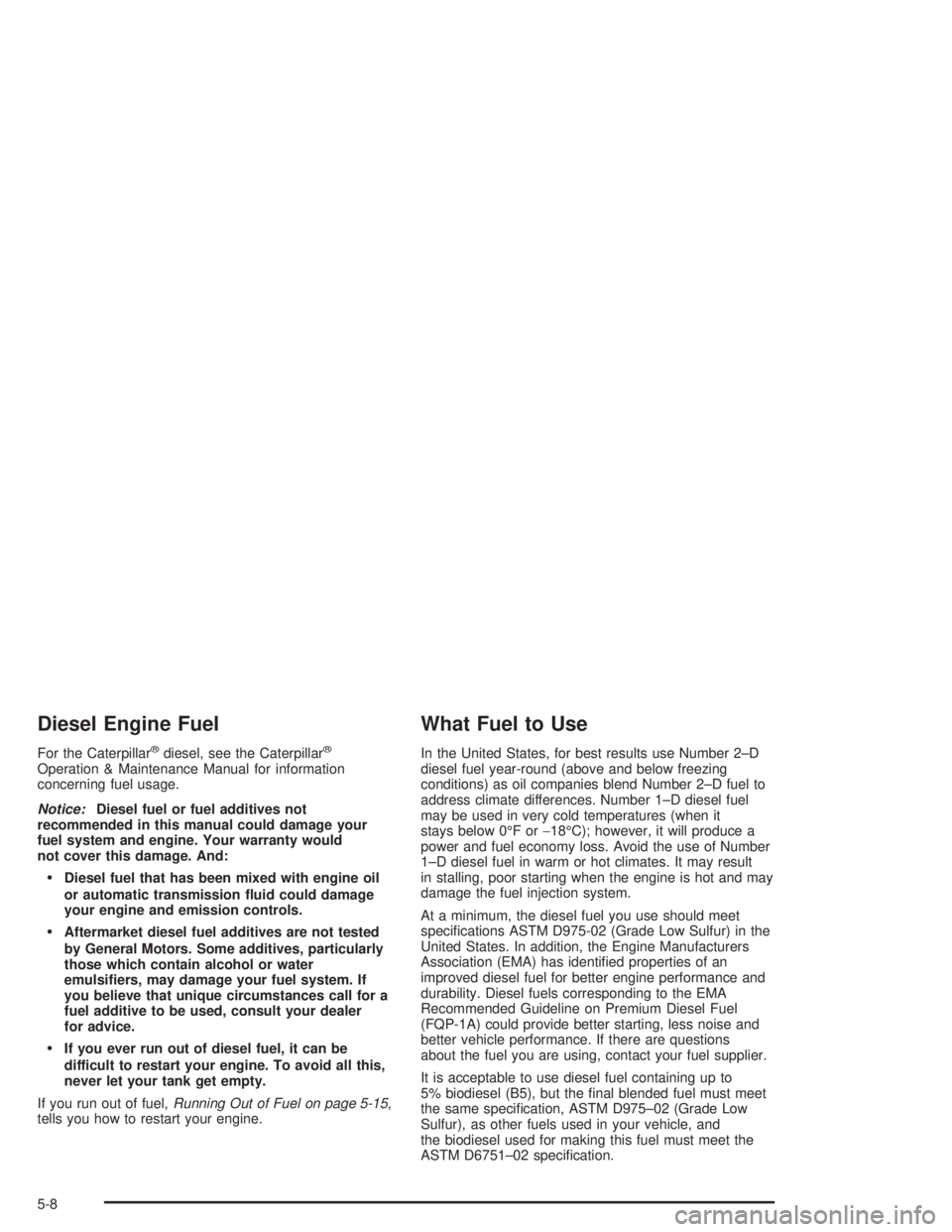
Diesel Engine Fuel
For the Caterpillar®diesel, see the Caterpillar®
Operation & Maintenance Manual for information
concerning fuel usage.
Notice:Diesel fuel or fuel additives not
recommended in this manual could damage your
fuel system and engine. Your warranty would
not cover this damage. And:
Diesel fuel that has been mixed with engine oil
or automatic transmission uid could damage
your engine and emission controls.
Aftermarket diesel fuel additives are not tested
by General Motors. Some additives, particularly
those which contain alcohol or water
emulsiers, may damage your fuel system. If
you believe that unique circumstances call for a
fuel additive to be used, consult your dealer
for advice.
If you ever run out of diesel fuel, it can be
difficult to restart your engine. To avoid all this,
never let your tank get empty.
If you run out of fuel,Running Out of Fuel on page 5-15,
tells you how to restart your engine.
What Fuel to Use
In the United States, for best results use Number 2–D
diesel fuel year-round (above and below freezing
conditions) as oil companies blend Number 2–D fuel to
address climate differences. Number 1–D diesel fuel
may be used in very cold temperatures (when it
stays below 0°F or−18°C); however, it will produce a
power and fuel economy loss. Avoid the use of Number
1–D diesel fuel in warm or hot climates. It may result
in stalling, poor starting when the engine is hot and may
damage the fuel injection system.
At a minimum, the diesel fuel you use should meet
specifications ASTM D975-02 (Grade Low Sulfur) in the
United States. In addition, the Engine Manufacturers
Association (EMA) has identified properties of an
improved diesel fuel for better engine performance and
durability. Diesel fuels corresponding to the EMA
Recommended Guideline on Premium Diesel Fuel
(FQP-1A) could provide better starting, less noise and
better vehicle performance. If there are questions
about the fuel you are using, contact your fuel supplier.
It is acceptable to use diesel fuel containing up to
5% biodiesel (B5), but the final blended fuel must meet
the same specification, ASTM D975–02 (Grade Low
Sulfur), as other fuels used in your vehicle, and
the biodiesel used for making this fuel must meet the
ASTM D6751–02 specification.
5-8
Page 237 of 366
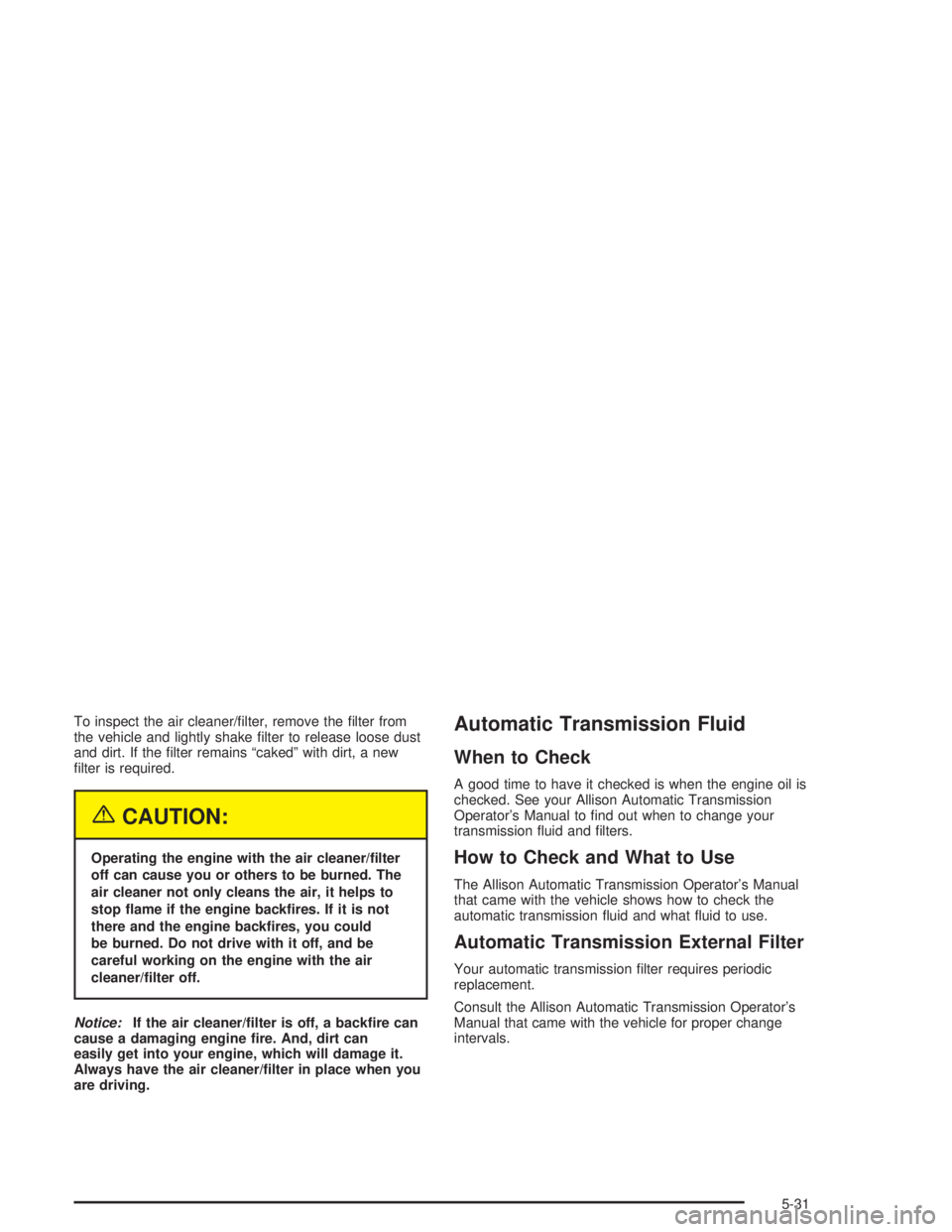
To inspect the air cleaner/filter, remove the filter from
the vehicle and lightly shake filter to release loose dust
and dirt. If the filter remains “caked” with dirt, a new
filter is required.
{CAUTION:
Operating the engine with the air cleaner/lter
off can cause you or others to be burned. The
air cleaner not only cleans the air, it helps to
stop ame if the engine backres. If it is not
there and the engine backres, you could
be burned. Do not drive with it off, and be
careful working on the engine with the air
cleaner/lter off.
Notice:If the air cleaner/lter is off, a backre can
cause a damaging engine re. And, dirt can
easily get into your engine, which will damage it.
Always have the air cleaner/lter in place when you
are driving.
Automatic Transmission Fluid
When to Check
A good time to have it checked is when the engine oil is
checked. See your Allison Automatic Transmission
Operator’s Manual to find out when to change your
transmission fluid and filters.
How to Check and What to Use
The Allison Automatic Transmission Operator’s Manual
that came with the vehicle shows how to check the
automatic transmission fluid and what fluid to use.
Automatic Transmission External Filter
Your automatic transmission filter requires periodic
replacement.
Consult the Allison Automatic Transmission Operator’s
Manual that came with the vehicle for proper change
intervals.
5-31
Page 262 of 366
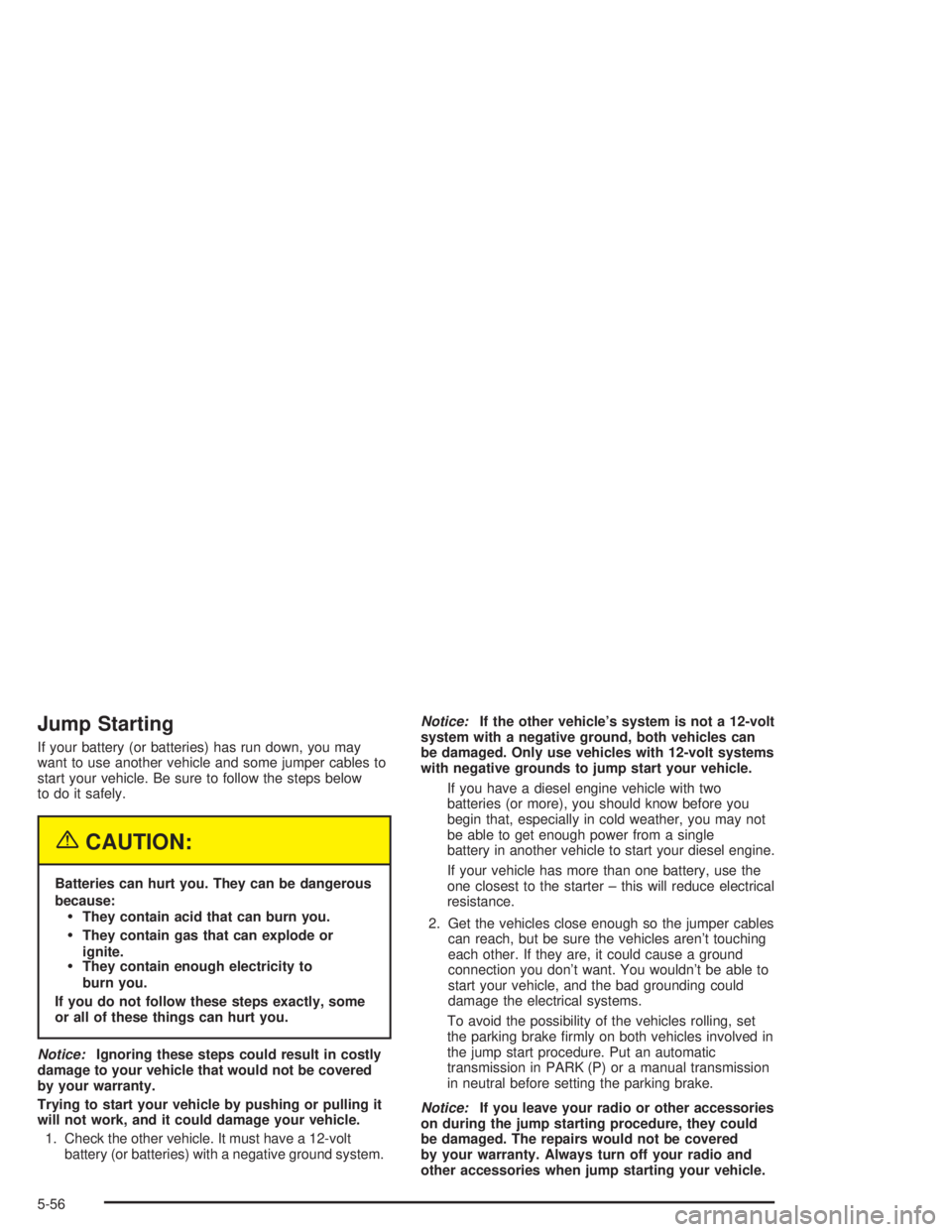
Jump Starting
If your battery (or batteries) has run down, you may
want to use another vehicle and some jumper cables to
start your vehicle. Be sure to follow the steps below
to do it safely.
{CAUTION:
Batteries can hurt you. They can be dangerous
because:
They contain acid that can burn you.
They contain gas that can explode or
ignite.
They contain enough electricity to
burn you.
If you do not follow these steps exactly, some
or all of these things can hurt you.
Notice:Ignoring these steps could result in costly
damage to your vehicle that would not be covered
by your warranty.
Trying to start your vehicle by pushing or pulling it
will not work, and it could damage your vehicle.
1. Check the other vehicle. It must have a 12-volt
battery (or batteries) with a negative ground system.Notice:If the other vehicle’s system is not a 12-volt
system with a negative ground, both vehicles can
be damaged. Only use vehicles with 12-volt systems
with negative grounds to jump start your vehicle.
If you have a diesel engine vehicle with two
batteries (or more), you should know before you
begin that, especially in cold weather, you may not
be able to get enough power from a single
battery in another vehicle to start your diesel engine.
If your vehicle has more than one battery, use the
one closest to the starter – this will reduce electrical
resistance.
2. Get the vehicles close enough so the jumper cables
can reach, but be sure the vehicles aren’t touching
each other. If they are, it could cause a ground
connection you don’t want. You wouldn’t be able to
start your vehicle, and the bad grounding could
damage the electrical systems.
To avoid the possibility of the vehicles rolling, set
the parking brake firmly on both vehicles involved in
the jump start procedure. Put an automatic
transmission in PARK (P) or a manual transmission
in neutral before setting the parking brake.
Notice:If you leave your radio or other accessories
on during the jump starting procedure, they could
be damaged. The repairs would not be covered
by your warranty. Always turn off your radio and
other accessories when jump starting your vehicle.
5-56
Page 300 of 366
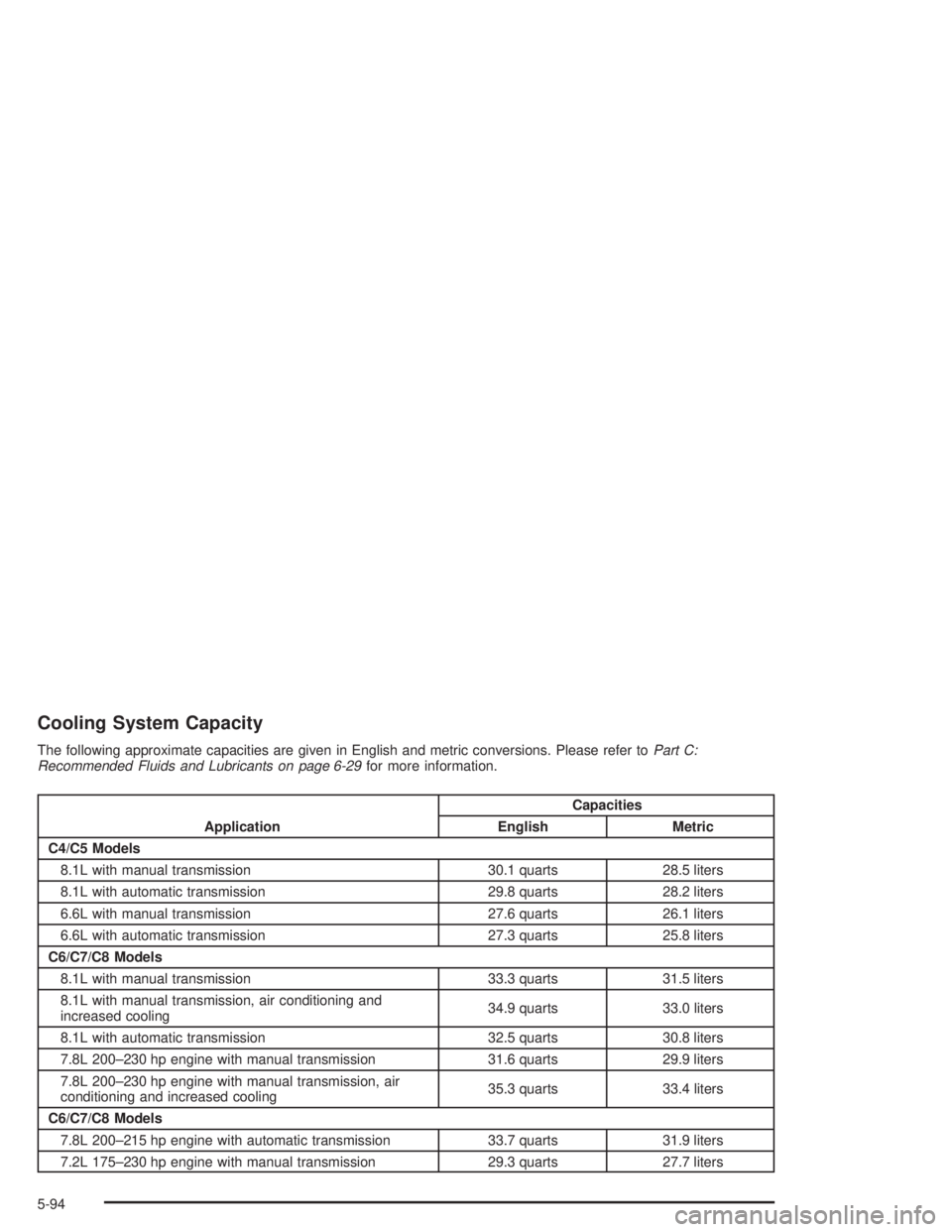
Cooling System Capacity
The following approximate capacities are given in English and metric conversions. Please refer toPart C:
Recommended Fluids and Lubricants on page 6-29for more information.
ApplicationCapacities
English Metric
C4/C5 Models
8.1L with manual transmission 30.1 quarts 28.5 liters
8.1L with automatic transmission 29.8 quarts 28.2 liters
6.6L with manual transmission 27.6 quarts 26.1 liters
6.6L with automatic transmission 27.3 quarts 25.8 liters
C6/C7/C8 Models
8.1L with manual transmission 33.3 quarts 31.5 liters
8.1L with manual transmission, air conditioning and
increased cooling34.9 quarts 33.0 liters
8.1L with automatic transmission 32.5 quarts 30.8 liters
7.8L 200–230 hp engine with manual transmission 31.6 quarts 29.9 liters
7.8L 200–230 hp engine with manual transmission, air
conditioning and increased cooling35.3 quarts 33.4 liters
C6/C7/C8 Models
7.8L 200–215 hp engine with automatic transmission 33.7 quarts 31.9 liters
7.2L 175–230 hp engine with manual transmission 29.3 quarts 27.7 liters
5-94
Page 301 of 366
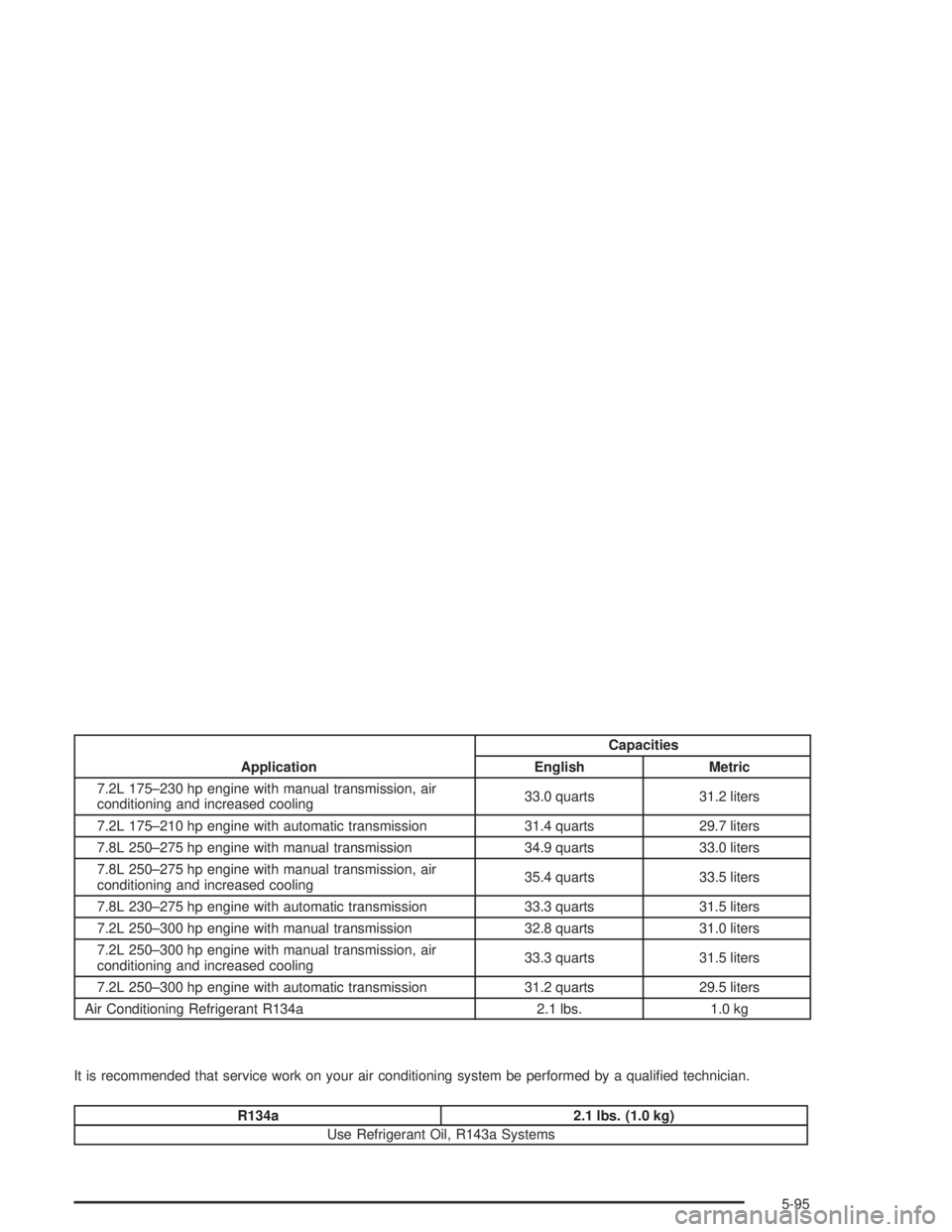
ApplicationCapacities
English Metric
7.2L 175–230 hp engine with manual transmission, air
conditioning and increased cooling33.0 quarts 31.2 liters
7.2L 175–210 hp engine with automatic transmission 31.4 quarts 29.7 liters
7.8L 250–275 hp engine with manual transmission 34.9 quarts 33.0 liters
7.8L 250–275 hp engine with manual transmission, air
conditioning and increased cooling35.4 quarts 33.5 liters
7.8L 230–275 hp engine with automatic transmission 33.3 quarts 31.5 liters
7.2L 250–300 hp engine with manual transmission 32.8 quarts 31.0 liters
7.2L 250–300 hp engine with manual transmission, air
conditioning and increased cooling33.3 quarts 31.5 liters
7.2L 250–300 hp engine with automatic transmission 31.2 quarts 29.5 liters
Air Conditioning Refrigerant R134a 2.1 lbs. 1.0 kg
It is recommended that service work on your air conditioning system be performed by a qualified technician.
R134a 2.1 lbs. (1.0 kg)
Use Refrigerant Oil, R143a Systems
5-95
Page 304 of 366
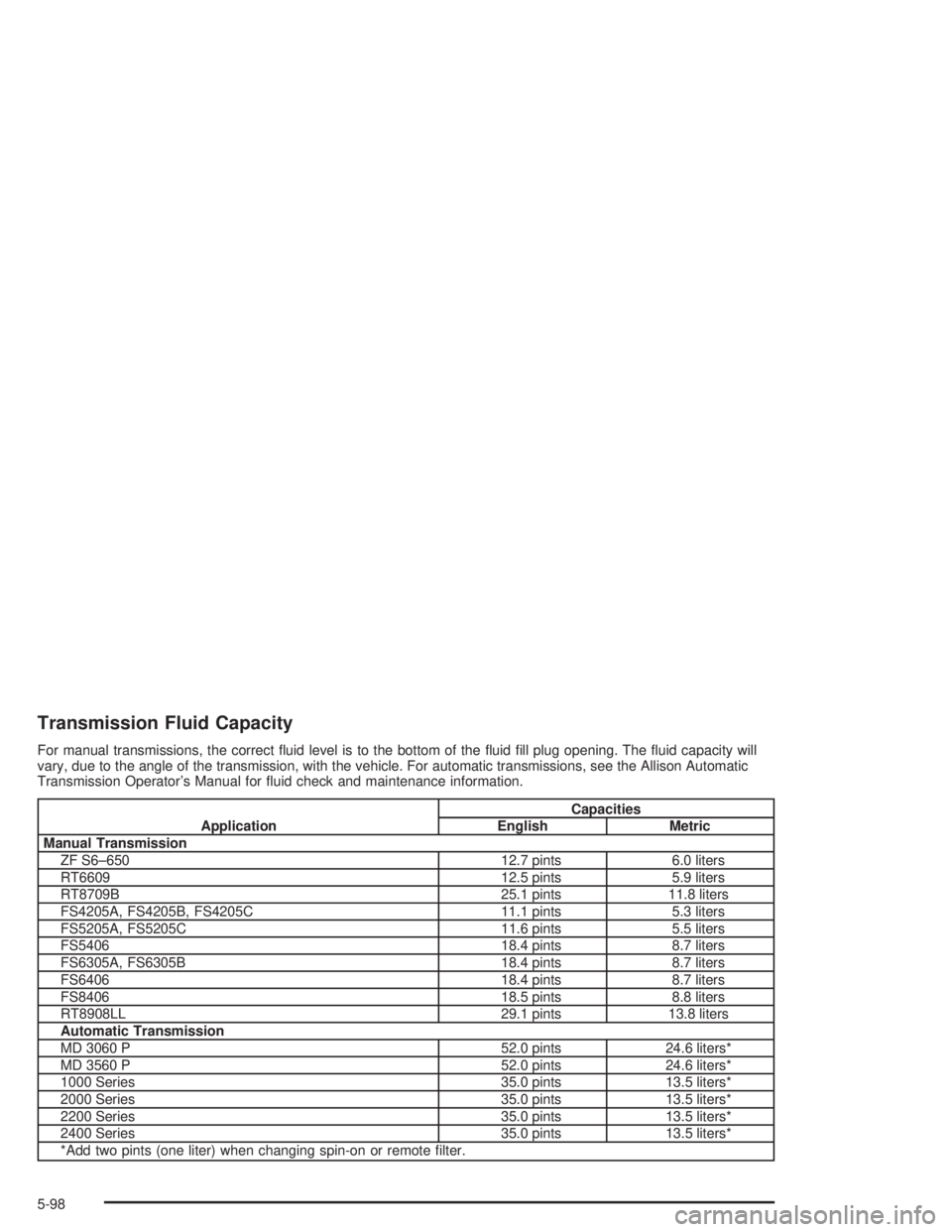
Transmission Fluid Capacity
For manual transmissions, the correct fluid level is to the bottom of the fluid fill plug opening. The fluid capacity will
vary, due to the angle of the transmission, with the vehicle. For automatic transmissions, see the Allison Automatic
Transmission Operator’s Manual for fluid check and maintenance information.
ApplicationCapacities
English Metric
Manual Transmission
ZF S6–650 12.7 pints 6.0 liters
RT6609 12.5 pints 5.9 liters
RT8709B 25.1 pints 11.8 liters
FS4205A, FS4205B, FS4205C 11.1 pints 5.3 liters
FS5205A, FS5205C 11.6 pints 5.5 liters
FS5406 18.4 pints 8.7 liters
FS6305A, FS6305B 18.4 pints 8.7 liters
FS6406 18.4 pints 8.7 liters
FS8406 18.5 pints 8.8 liters
RT8908LL 29.1 pints 13.8 liters
Automatic Transmission
MD 3060 P 52.0 pints 24.6 liters*
MD 3560 P 52.0 pints 24.6 liters*
1000 Series 35.0 pints 13.5 liters*
2000 Series 35.0 pints 13.5 liters*
2200 Series 35.0 pints 13.5 liters*
2400 Series 35.0 pints 13.5 liters*
*Add two pints (one liter) when changing spin-on or remote filter.
5-98
Page 329 of 366
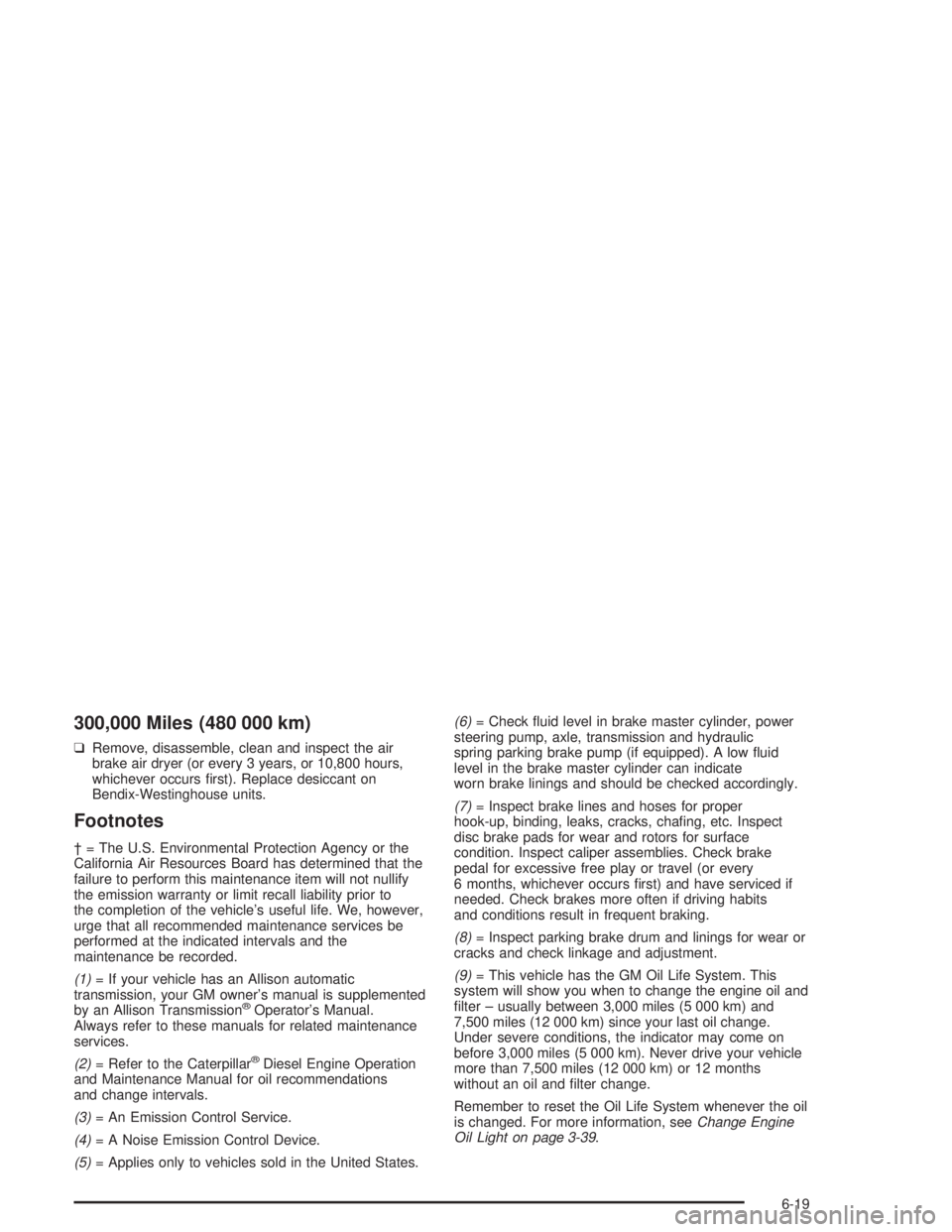
300,000 Miles (480 000 km)
❑Remove, disassemble, clean and inspect the air
brake air dryer (or every 3 years, or 10,800 hours,
whichever occurs first). Replace desiccant on
Bendix-Westinghouse units.
Footnotes
† = The U.S. Environmental Protection Agency or the
California Air Resources Board has determined that the
failure to perform this maintenance item will not nullify
the emission warranty or limit recall liability prior to
the completion of the vehicle’s useful life. We, however,
urge that all recommended maintenance services be
performed at the indicated intervals and the
maintenance be recorded.
(1)= If your vehicle has an Allison automatic
transmission, your GM owner’s manual is supplemented
by an Allison Transmission
®Operator’s Manual.
Always refer to these manuals for related maintenance
services.
(2)= Refer to the Caterpillar
®Diesel Engine Operation
and Maintenance Manual for oil recommendations
and change intervals.
(3)= An Emission Control Service.
(4)= A Noise Emission Control Device.
(5)= Applies only to vehicles sold in the United States.(6)= Check fluid level in brake master cylinder, power
steering pump, axle, transmission and hydraulic
spring parking brake pump (if equipped). A low fluid
level in the brake master cylinder can indicate
worn brake linings and should be checked accordingly.
(7)= Inspect brake lines and hoses for proper
hook-up, binding, leaks, cracks, chafing, etc. Inspect
disc brake pads for wear and rotors for surface
condition. Inspect caliper assemblies. Check brake
pedal for excessive free play or travel (or every
6 months, whichever occurs first) and have serviced if
needed. Check brakes more often if driving habits
and conditions result in frequent braking.
(8)= Inspect parking brake drum and linings for wear or
cracks and check linkage and adjustment.
(9)= This vehicle has the GM Oil Life System. This
system will show you when to change the engine oil and
filter – usually between 3,000 miles (5 000 km) and
7,500 miles (12 000 km) since your last oil change.
Under severe conditions, the indicator may come on
before 3,000 miles (5 000 km). Never drive your vehicle
more than 7,500 miles (12 000 km) or 12 months
without an oil and filter change.
Remember to reset the Oil Life System whenever the oil
is changed. For more information, seeChange Engine
Oil Light on page 3-39.
6-19
Page 336 of 366
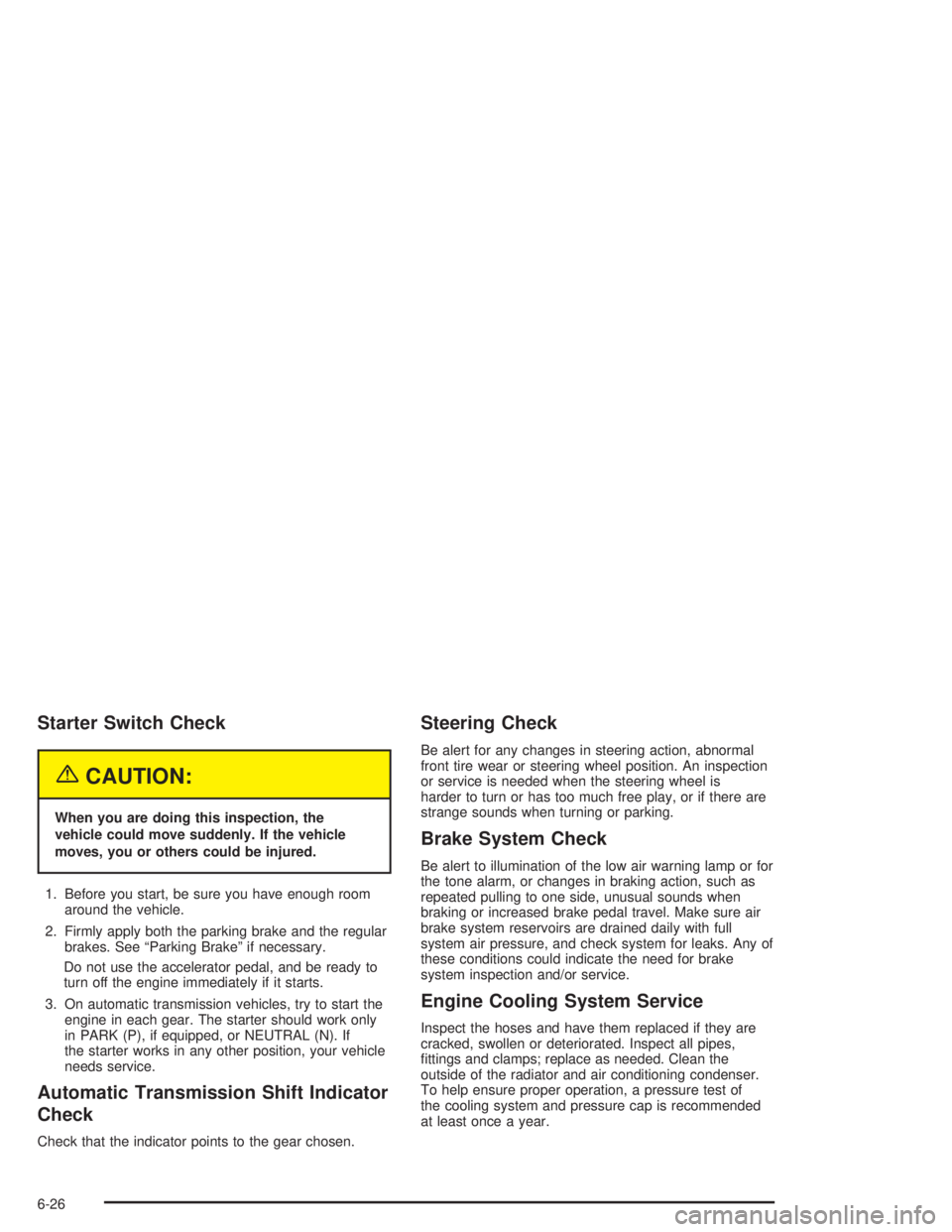
Starter Switch Check
{CAUTION:
When you are doing this inspection, the
vehicle could move suddenly. If the vehicle
moves, you or others could be injured.
1. Before you start, be sure you have enough room
around the vehicle.
2. Firmly apply both the parking brake and the regular
brakes. See “Parking Brake” if necessary.
Do not use the accelerator pedal, and be ready to
turn off the engine immediately if it starts.
3. On automatic transmission vehicles, try to start the
engine in each gear. The starter should work only
in PARK (P), if equipped, or NEUTRAL (N). If
the starter works in any other position, your vehicle
needs service.
Automatic Transmission Shift Indicator
Check
Check that the indicator points to the gear chosen.
Steering Check
Be alert for any changes in steering action, abnormal
front tire wear or steering wheel position. An inspection
or service is needed when the steering wheel is
harder to turn or has too much free play, or if there are
strange sounds when turning or parking.
Brake System Check
Be alert to illumination of the low air warning lamp or for
the tone alarm, or changes in braking action, such as
repeated pulling to one side, unusual sounds when
braking or increased brake pedal travel. Make sure air
brake system reservoirs are drained daily with full
system air pressure, and check system for leaks. Any of
these conditions could indicate the need for brake
system inspection and/or service.
Engine Cooling System Service
Inspect the hoses and have them replaced if they are
cracked, swollen or deteriorated. Inspect all pipes,
fittings and clamps; replace as needed. Clean the
outside of the radiator and air conditioning condenser.
To help ensure proper operation, a pressure test of
the cooling system and pressure cap is recommended
at least once a year.
6-26
Page 339 of 366
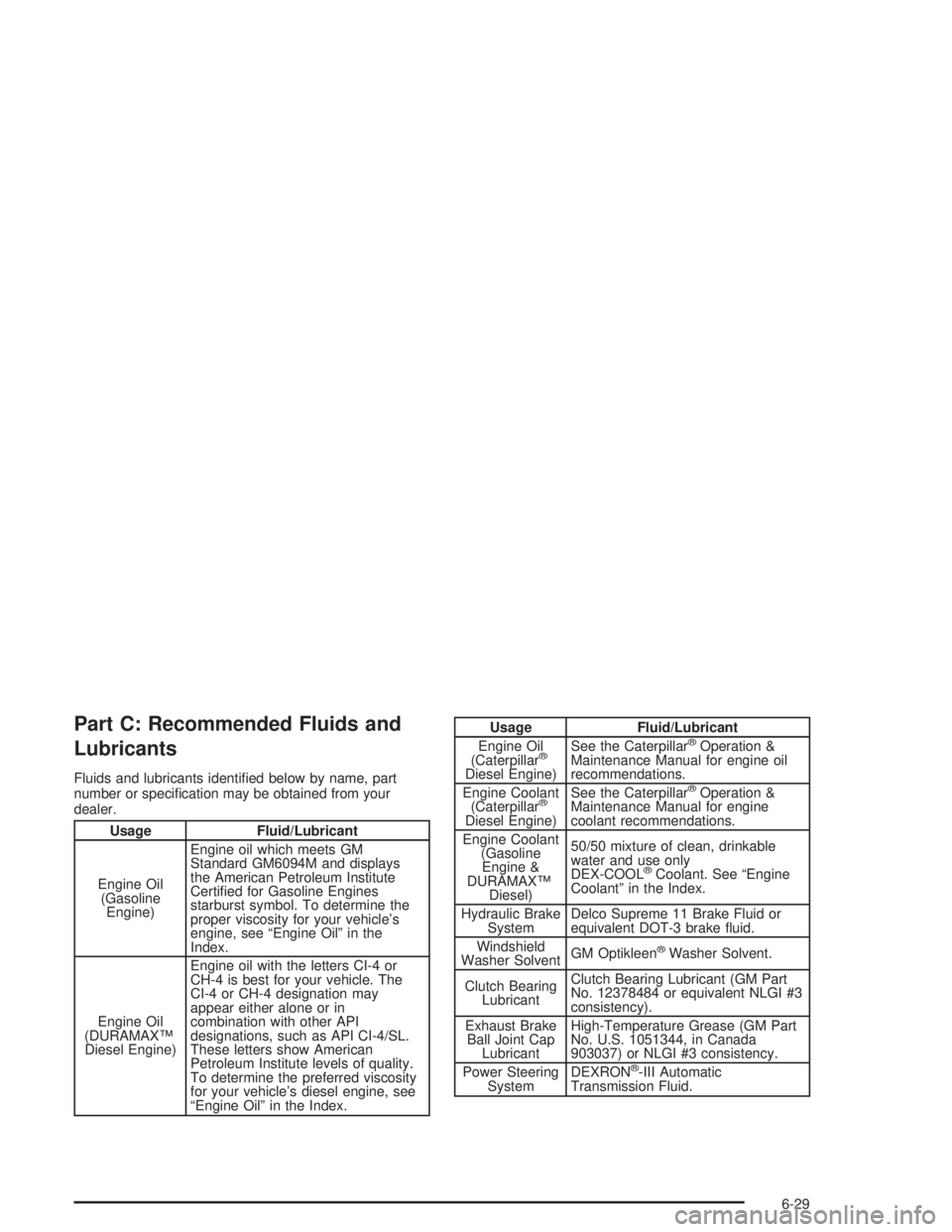
Part C: Recommended Fluids and
Lubricants
Fluids and lubricants identified below by name, part
number or specification may be obtained from your
dealer.
Usage Fluid/Lubricant
Engine Oil
(Gasoline
Engine)Engine oil which meets GM
Standard GM6094M and displays
the American Petroleum Institute
Certified for Gasoline Engines
starburst symbol. To determine the
proper viscosity for your vehicle’s
engine, see “Engine Oil” in the
Index.
Engine Oil
(DURAMAX™
Diesel Engine)Engine oil with the letters CI-4 or
CH-4 is best for your vehicle. The
CI-4 or CH-4 designation may
appear either alone or in
combination with other API
designations, such as API CI-4/SL.
These letters show American
Petroleum Institute levels of quality.
To determine the preferred viscosity
for your vehicle’s diesel engine, see
“Engine Oil” in the Index.
Usage Fluid/Lubricant
Engine Oil
(Caterpillar
®
Diesel Engine)See the Caterpillar
®Operation &
Maintenance Manual for engine oil
recommendations.
Engine Coolant
(Caterpillar
®
Diesel Engine)See the Caterpillar
®Operation &
Maintenance Manual for engine
coolant recommendations.
Engine Coolant
(Gasoline
Engine &
DURAMAX™
Diesel)50/50 mixture of clean, drinkable
water and use only
DEX-COOL
®Coolant. See “Engine
Coolant” in the Index.
Hydraulic Brake
SystemDelco Supreme 11 Brake Fluid or
equivalent DOT-3 brake fluid.
Windshield
Washer SolventGM Optikleen
®Washer Solvent.
Clutch Bearing
LubricantClutch Bearing Lubricant (GM Part
No. 12378484 or equivalent NLGI #3
consistency).
Exhaust Brake
Ball Joint Cap
LubricantHigh-Temperature Grease (GM Part
No. U.S. 1051344, in Canada
903037) or NLGI #3 consistency.
Power Steering
SystemDEXRON
®-III Automatic
Transmission Fluid.
6-29