maintenance CHEVROLET KODIAK 2004 Owner's Manual
[x] Cancel search | Manufacturer: CHEVROLET, Model Year: 2004, Model line: KODIAK, Model: CHEVROLET KODIAK 2004Pages: 366, PDF Size: 6.87 MB
Page 254 of 366
What to Add
Use the proper fluid listed in your Maintenance
Schedule. Use new brake fluid from a sealed
container only.
Always clean the brake fluid reservoir cap/cover and the
area around the cap/cover before removing it. This
will help keep dirt from entering the reservoir.
{CAUTION:
With the wrong kind of uid in your brake
system, your brakes may not work well, or
they may not even work at all. This could
cause a crash. Always use the proper brake
uid.Notice:
Using the wrong uid can badly damage brake
system parts. For example, just a few drops of
mineral-based oil, such as engine oil, in your
brake system can damage brake system
parts so badly that they will have to be replaced.
Do not let someone put in the wrong kind of
uid, and do not use DOT-5 silicone brake uid.
If you spill brake uid on your vehicle’s painted
surfaces, the paint nish can be damaged. Be
careful not to spill brake uid on your vehicle. If
you do, wash it off immediately. SeeAppearance
Care on page 5-76.
5-48
Page 256 of 366
Air Brake Systems
If your vehicle has air brakes, it is important to get rid of
moisture in your system. Moisture will damage your
system if it is not removed daily.
There are two ways to do this. One is automatic if your
air-brake vehicle has the optional moisture ejector. If
your vehicle does not have that option, you must drain
the air reservoirs occasionally to be sure the air
dryer is working properly.
Drain the air brakes at full system pressure. To be sure
you are at full pressure, check your air pressure
gage. It should read at least 100 psi (692 kPa).
Moisture Ejector
If you have air brakes with a moisture ejector, the valve
automatically ejects moisture from the reserve tank
when the air compressor cycles.
Air Dryer
If your vehicle has air brakes, it may have an air dryer.
This collects and removes dirt, moisture or other
foreign matter from the air prior to entering the brake
system. It is mounted on the passenger’s side frame rail.
If your dryer is a Bendix-Westinghouse, it has a filter
that you need to change at intervals. SeeScheduled
Maintenance on page 6-5for more about servicing this
filter.
5-50
Page 257 of 366
Electric Air Compressor
Your vehicle may have an electric air compressor. This
compressor is used to run options that require
pressurized air, such as air horn, air seat, exhaust
restrictor or an exhaust brake.
The air compressor is used when vehicles are not
equipped with an air brake system.
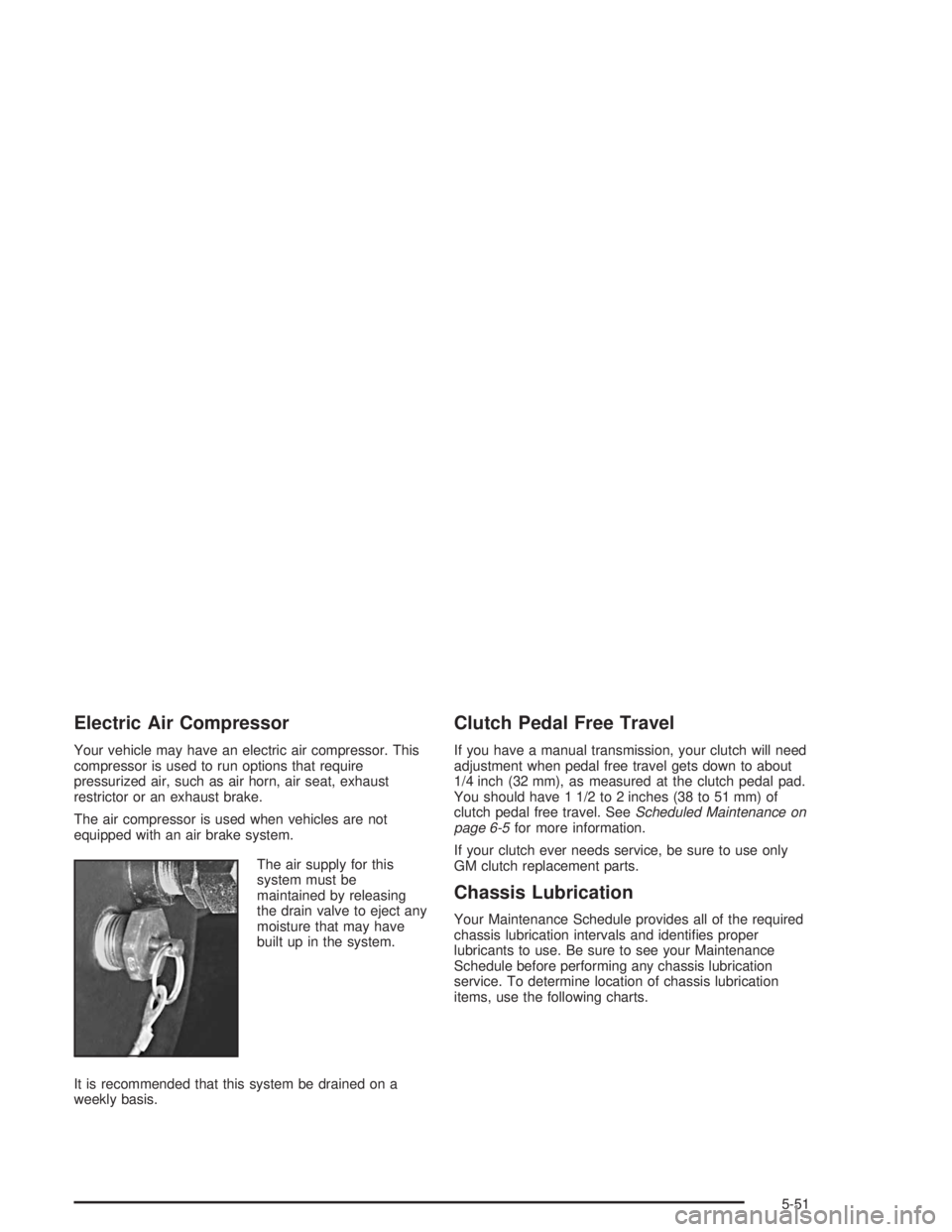
The air supply for this
system must be
maintained by releasing
the drain valve to eject any
moisture that may have
built up in the system.
It is recommended that this system be drained on a
weekly basis.
Clutch Pedal Free Travel
If you have a manual transmission, your clutch will need
adjustment when pedal free travel gets down to about
1/4 inch (32 mm), as measured at the clutch pedal pad.
You should have 1 1/2 to 2 inches (38 to 51 mm) of
clutch pedal free travel. SeeScheduled Maintenance on
page 6-5for more information.
If your clutch ever needs service, be sure to use only
GM clutch replacement parts.
Chassis Lubrication
Your Maintenance Schedule provides all of the required
chassis lubrication intervals and identifies proper
lubricants to use. Be sure to see your Maintenance
Schedule before performing any chassis lubrication
service. To determine location of chassis lubrication
items, use the following charts.
5-51
Page 261 of 366
Battery
Your new vehicle comes with one or more maintenance
free ACDelco®batteries. When it is time for a new
battery, be sure it has the replacement number shown
on the original battery’s label. We recommend an
ACDelco
®battery.
Warning:Battery posts, terminals and related
accessories contain lead and lead compounds,
chemicals known to the State of California to cause
cancer and reproductive harm. Wash hands after
handling.
Vehicle Storage
If you are not going to drive your vehicle for 25 days or
more, remove the black, negative (−) cable from the
battery. This will help keep your battery from running
down. (If your vehicle has more than one battery,
be sure to remove the negative (−) battery cable from
each battery.)
{CAUTION:
Batteries have acid that can burn you and gas
that can explode. You can be badly hurt if you
are not careful. SeeJump Starting on
page 5-56for tips on working around a battery
without getting hurt.
When you are ready to use the vehicle again, refer to
the engine starting procedure in the Index.
Contact your dealer to learn how to prepare your
vehicle for longer storage periods.
5-55
Page 267 of 366
Rear Axle
When to Check and Change Lubricant
Refer to the Maintenance Schedule to determine
how often to check the lubricant and when to change it.
SeeScheduled Maintenance on page 6-5.
How to Check Lubricant
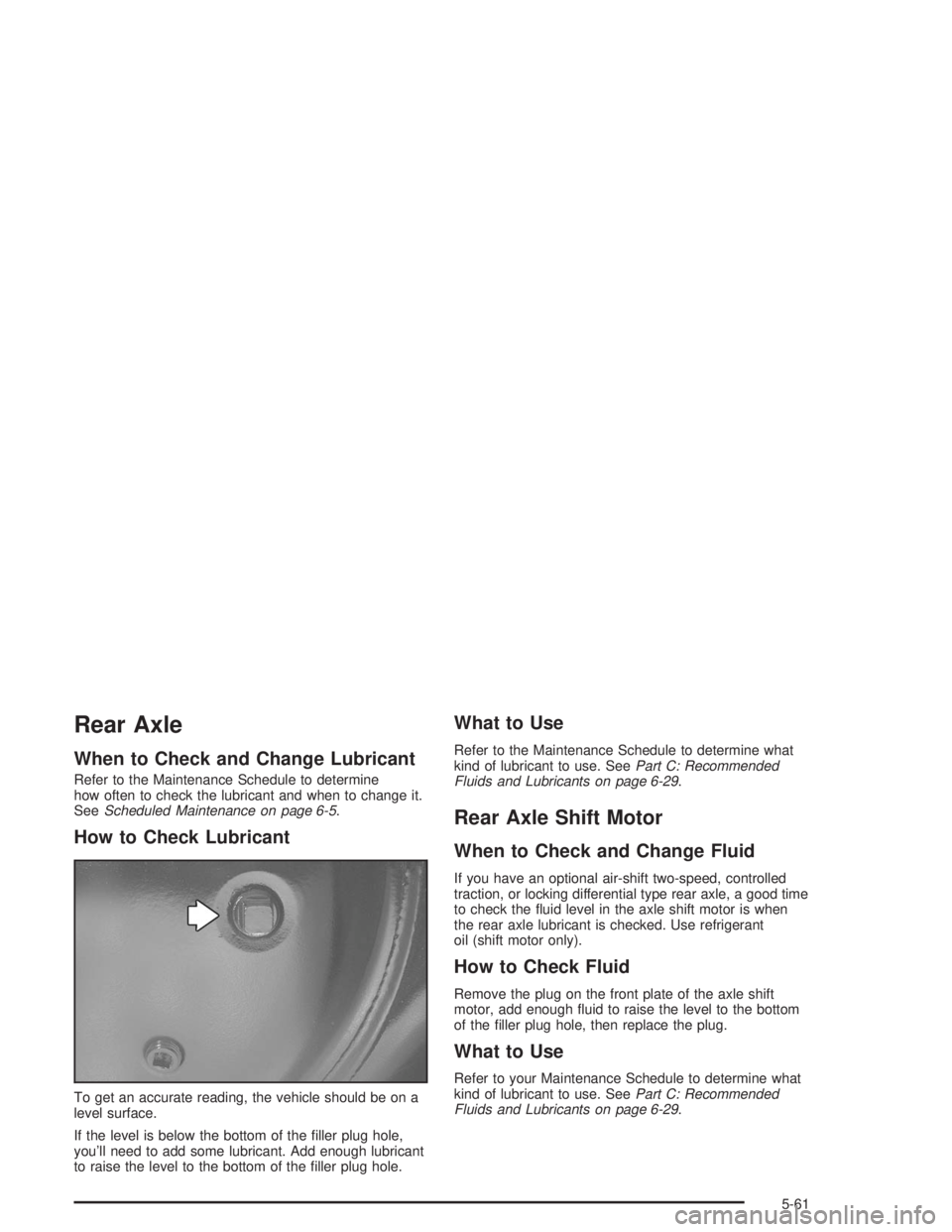
To get an accurate reading, the vehicle should be on a
level surface.
If the level is below the bottom of the filler plug hole,
you’ll need to add some lubricant. Add enough lubricant
to raise the level to the bottom of the filler plug hole.
What to Use
Refer to the Maintenance Schedule to determine what
kind of lubricant to use. SeePart C: Recommended
Fluids and Lubricants on page 6-29.
Rear Axle Shift Motor
When to Check and Change Fluid
If you have an optional air-shift two-speed, controlled
traction, or locking differential type rear axle, a good time
to check the fluid level in the axle shift motor is when
the rear axle lubricant is checked. Use refrigerant
oil (shift motor only).
How to Check Fluid
Remove the plug on the front plate of the axle shift
motor, add enough fluid to raise the level to the bottom
of the filler plug hole, then replace the plug.
What to Use
Refer to your Maintenance Schedule to determine what
kind of lubricant to use. SeePart C: Recommended
Fluids and Lubricants on page 6-29.
5-61
Page 268 of 366
Noise Control System
Tampering with Noise Control
System Prohibited
The following information relates to compliance with
federal noise emission standards for vehicles with
a Gross Vehicle Weight Rating (GVWR) of more than
10,000 lbs (4 536 kg). The Maintenance Schedule
provides information on maintaining the noise control
system to minimize degradation of the noise emission
control system during the life of your vehicle. The noise
control system warranty is given in your warranty
booklet.
These standards apply only to vehicles sold in the
United States.
Federal law prohibits the following acts or the causing
thereof:
1. The removal or rendering inoperative by any
person, other than for purposes of maintenance,
repair or replacement, of any device or element of
design incorporated into any new vehicle for
the purpose of noise control, prior to its sale or
delivery to the ultimate purchaser or while it is in
use; or2. The use of the vehicle after such device or element
of design has been removed or rendered inoperative
by any person.
Among those acts presumed to constitute tampering are
the acts listed below.Insulation:
•
Removal of the noise shields or any underhood
insulation.
Engine:
•
Removal or rendering engine speed governor (if
equipped) inoperative so as to allow engine
speed to exceed manufacturer specifications.
Fan and Drive:
•
Removal of fan clutch (if equipped) or rendering
clutch inoperative.
•Removal of the fan shroud (if equipped).
Air Intake:
•
Removal of the air cleaner silencer.
•Modification of the air cleaner.
Exhaust:
•
Removal of the muffler and/or resonator.
•Removal of the exhaust pipes and exhaust pipe
clamps.
5-62
Page 270 of 366
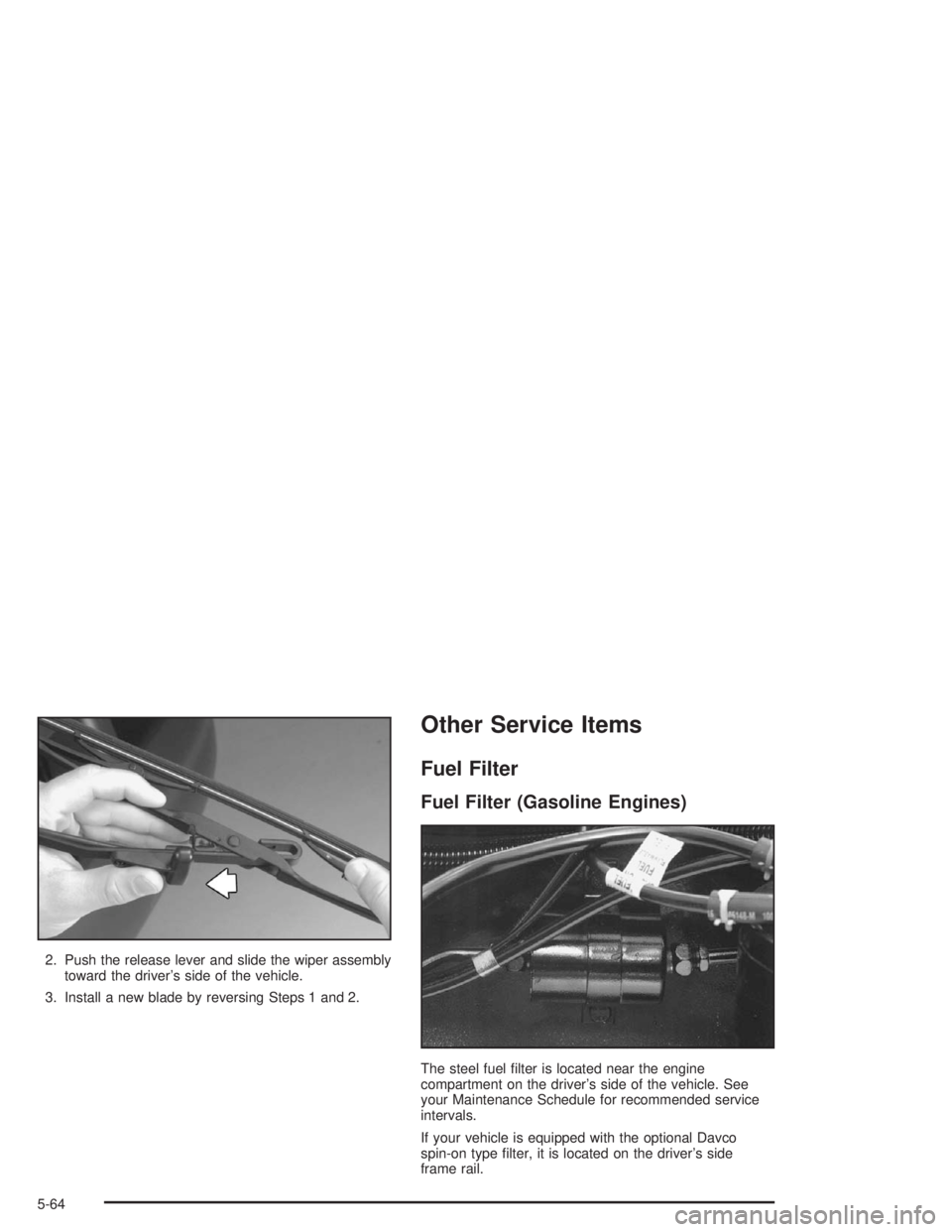
2. Push the release lever and slide the wiper assembly
toward the driver’s side of the vehicle.
3. Install a new blade by reversing Steps 1 and 2.
Other Service Items
Fuel Filter
Fuel Filter (Gasoline Engines)
The steel fuel filter is located near the engine
compartment on the driver’s side of the vehicle. See
your Maintenance Schedule for recommended service
intervals.
If your vehicle is equipped with the optional Davco
spin-on type filter, it is located on the driver’s side
frame rail.
5-64
Page 271 of 366
Fuel Filter (Diesel Engines)
If you have a diesel engine, your fuel filter is located in
the engine compartment on the driver’s side of the
vehicle, or along the driver’s side frame rail. SeeFuel
Filter Replacementearlier in this section for further
information.
Also seeScheduled Maintenance on page 6-5for
recommended service intervals.
Primary Fuel Filter and Water
Separator
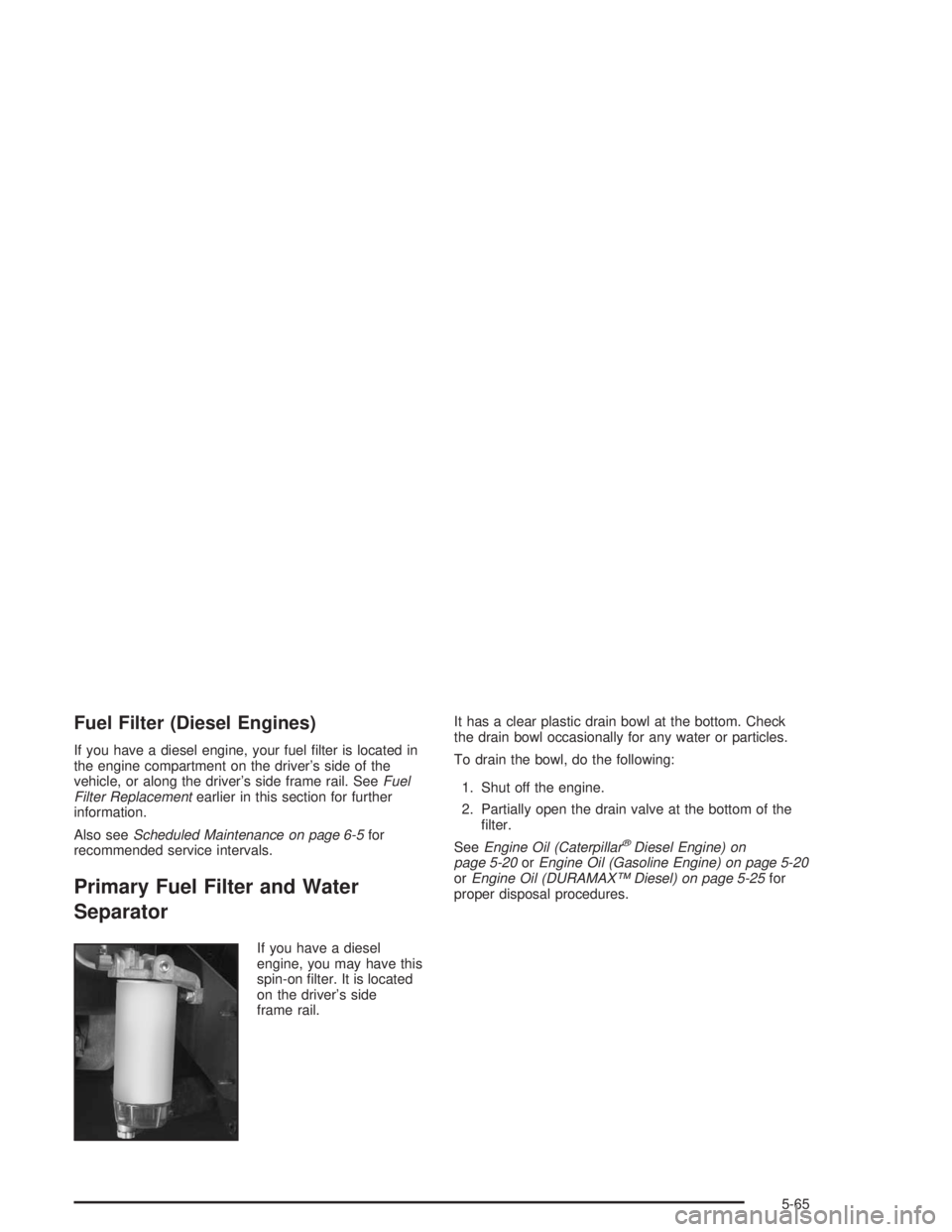
If you have a diesel
engine, you may have this
spin-on filter. It is located
on the driver’s side
frame rail.It has a clear plastic drain bowl at the bottom. Check
the drain bowl occasionally for any water or particles.
To drain the bowl, do the following:
1. Shut off the engine.
2. Partially open the drain valve at the bottom of the
filter.
SeeEngine Oil (Caterpillar
®Diesel Engine) on
page 5-20orEngine Oil (Gasoline Engine) on page 5-20
orEngine Oil (DURAMAX™ Diesel) on page 5-25for
proper disposal procedures.
5-65
Page 273 of 366
6. Install a new gasket whenever you take out the
cylinder. Use only one gasket and spread a light
film of clean oil on it before installation.
7. Put in the new cylinder. Turn it clockwise until it just
starts to contact the gasket.
8. Tighten the cylinder another half turn (180 degrees).
Don’t over-tighten.
9. Retighten the cylinder clamp.
Front Wheel Bearings with
Oil-Filled Hubs
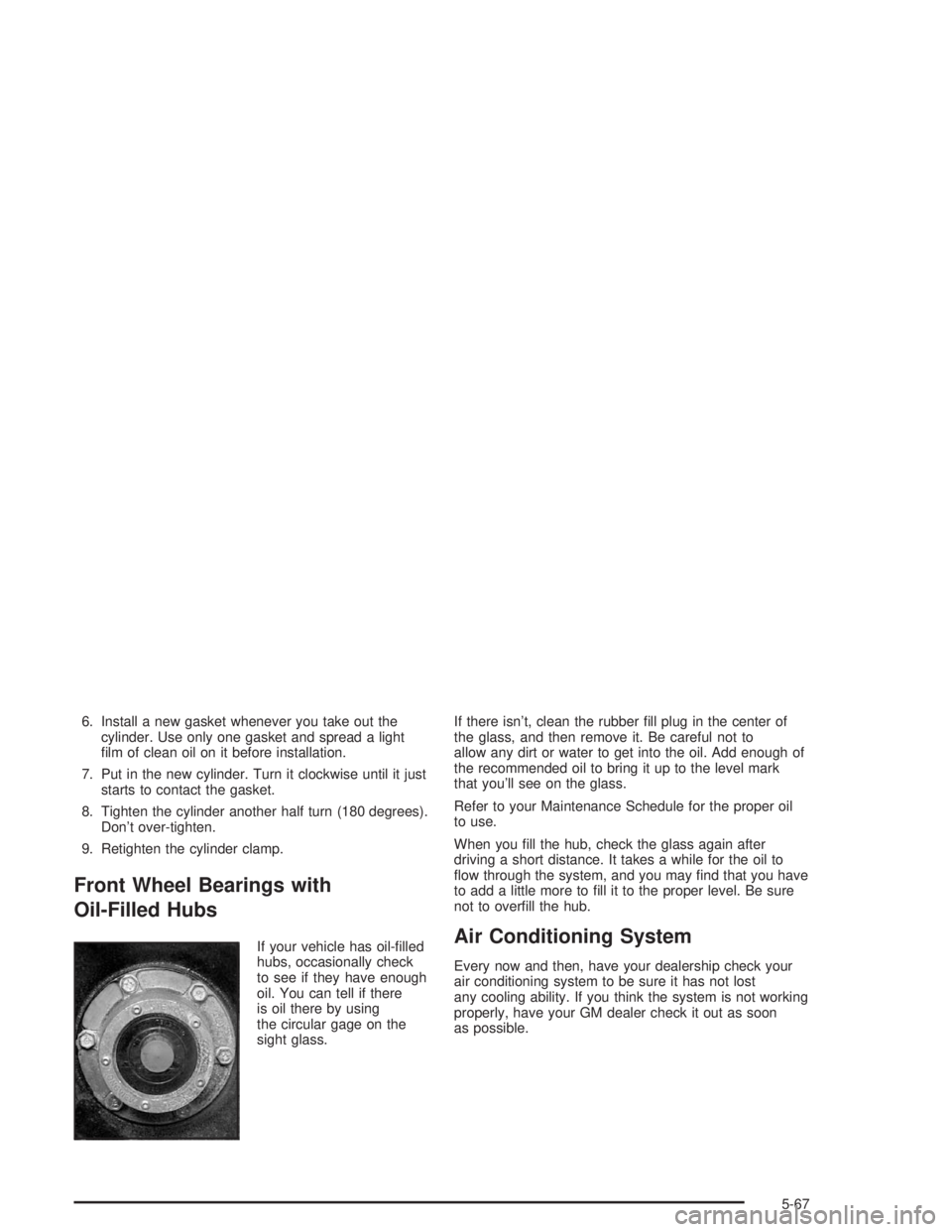
If your vehicle has oil-filled
hubs, occasionally check
to see if they have enough
oil. You can tell if there
is oil there by using
the circular gage on the
sight glass.If there isn’t, clean the rubber fill plug in the center of
the glass, and then remove it. Be careful not to
allow any dirt or water to get into the oil. Add enough of
the recommended oil to bring it up to the level mark
that you’ll see on the glass.
Refer to your Maintenance Schedule for the proper oil
to use.
When you fill the hub, check the glass again after
driving a short distance. It takes a while for the oil to
flow through the system, and you may find that you have
to add a little more to fill it to the proper level. Be sure
not to overfill the hub.Air Conditioning System
Every now and then, have your dealership check your
air conditioning system to be sure it has not lost
any cooling ability. If you think the system is not working
properly, have your GM dealer check it out as soon
as possible.
5-67
Page 279 of 366
{CAUTION:
If wheel studs are damaged, they can break. If
all the studs on a wheel broke, the wheel could
come off and cause a crash. If any stud is
damaged because of a loose-running wheel, it
could be that all of the studs are damaged. To
be sure, replace all studs on the wheel. If the
stud holes in a wheel have become larger, the
wheel could collapse in operation. Replace any
wheel if its stud holes have become larger or
distorted in any way. Inspect hubs and hub
piloted wheels for damage. Because of loose
running wheels, piloting pad damage may
occur and require replacement of the entire
hub, for proper centering of the wheels. When
replacing studs, hubs, wheel nuts or wheels,
be sure to use GM original equipment parts.
{CAUTION:
Rust or dirt on a wheel, or on the parts to
which it is fastened, can make wheel nuts
become loose after a time. The wheel could
come off and cause a crash. When you change
a wheel, remove any rust or dirt from places
where the wheel attaches to the vehicle. In an
emergency, you can use a cloth or a paper
towel to do this; but be sure to use a scraper
or wire brush later, if you need to, to get all the
rust or dirt off.
How Often to Check
Wheel tightness is so important you should have a
technician check nut tightness on all wheels with
a torque wrench after your first 100 miles (160 km), and
then 1,000 miles (1 600 km) after that. Be sure to
repeat this service whenever you have a tire removed
or serviced. SeeScheduled Maintenance on page 6-5
for further information.
5-73