brake CHEVROLET KODIAK 2005 User Guide
[x] Cancel search | Manufacturer: CHEVROLET, Model Year: 2005, Model line: KODIAK, Model: CHEVROLET KODIAK 2005Pages: 374, PDF Size: 5.46 MB
Page 91 of 374
Diesel Engine Exhaust Brake
If your vehicle is equipped with a diesel engine,
it may have an exhaust brake, which is located in the
exhaust system.
The exhaust brake is used to help slow the vehicle and
may assist the vehicle’s foundation brakes. The use of
the exhaust brake will assist the braking of the vehicle
and prolong the life of the foundation brake lining
material.
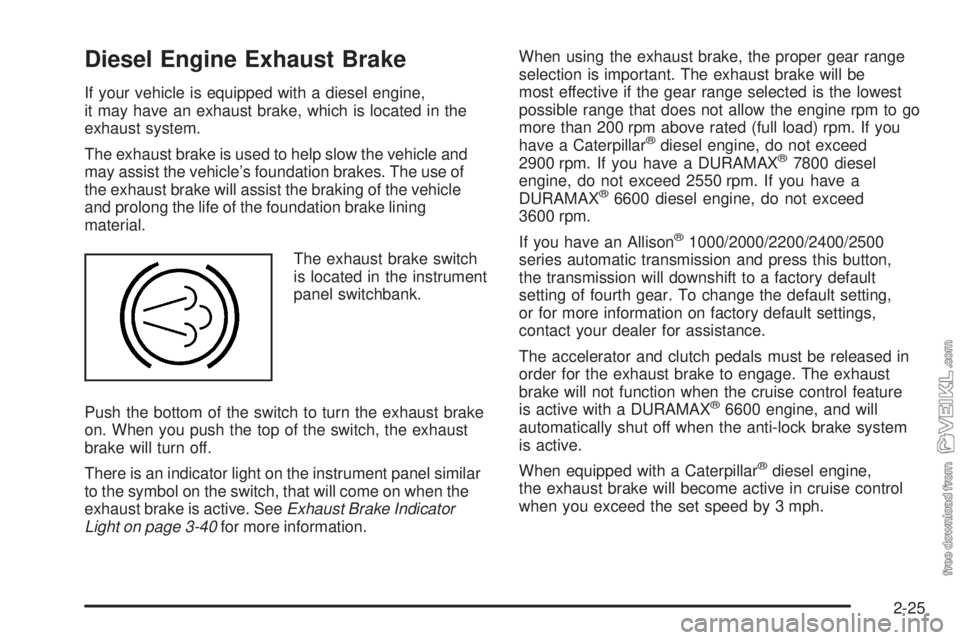
The exhaust brake switch
is located in the instrument
panel switchbank.
Push the bottom of the switch to turn the exhaust brake
on. When you push the top of the switch, the exhaust
brake will turn off.
There is an indicator light on the instrument panel similar
to the symbol on the switch, that will come on when the
exhaust brake is active. SeeExhaust Brake Indicator
Light on page 3-40for more information.When using the exhaust brake, the proper gear range
selection is important. The exhaust brake will be
most effective if the gear range selected is the lowest
possible range that does not allow the engine rpm to go
more than 200 rpm above rated (full load) rpm. If you
have a Caterpillar
®diesel engine, do not exceed
2900 rpm. If you have a DURAMAX®7800 diesel
engine, do not exceed 2550 rpm. If you have a
DURAMAX
®6600 diesel engine, do not exceed
3600 rpm.
If you have an Allison
®1000/2000/2200/2400/2500
series automatic transmission and press this button,
the transmission will downshift to a factory default
setting of fourth gear. To change the default setting,
or for more information on factory default settings,
contact your dealer for assistance.
The accelerator and clutch pedals must be released in
order for the exhaust brake to engage. The exhaust
brake will not function when the cruise control feature
is active with a DURAMAX
®6600 engine, and will
automatically shut off when the anti-lock brake system
is active.
When equipped with a Caterpillar
®diesel engine,
the exhaust brake will become active in cruise control
when you exceed the set speed by 3 mph.
2-25
Page 92 of 374
Two-Speed Rear Axle Electric
Shift Control
If your vehicle is equipped with this feature, you will find
a label on the headliner above the windshield or in
another place near the driver that shows how to use it.
Be sure to follow the directions carefully.
Use the following directions based on the type of shift
control you have.
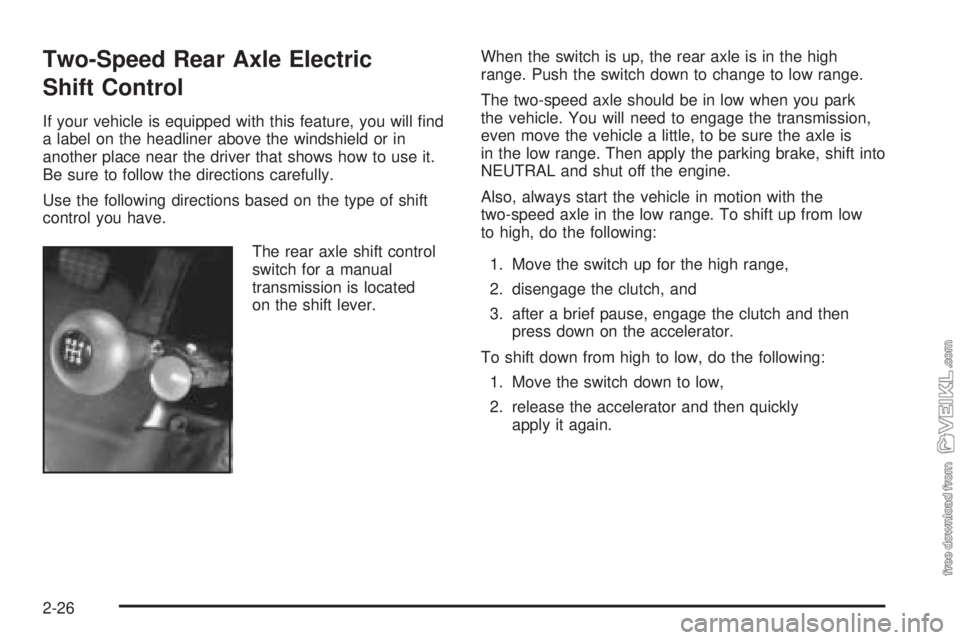
The rear axle shift control
switch for a manual
transmission is located
on the shift lever.When the switch is up, the rear axle is in the high
range. Push the switch down to change to low range.
The two-speed axle should be in low when you park
the vehicle. You will need to engage the transmission,
even move the vehicle a little, to be sure the axle is
in the low range. Then apply the parking brake, shift into
NEUTRAL and shut off the engine.
Also, always start the vehicle in motion with the
two-speed axle in the low range. To shift up from low
to high, do the following:
1. Move the switch up for the high range,
2. disengage the clutch, and
3. after a brief pause, engage the clutch and then
press down on the accelerator.
To shift down from high to low, do the following:
1. Move the switch down to low,
2. release the accelerator and then quickly
apply it again.
2-26
Page 93 of 374
Air Shift Control
(Automatic Transmission)
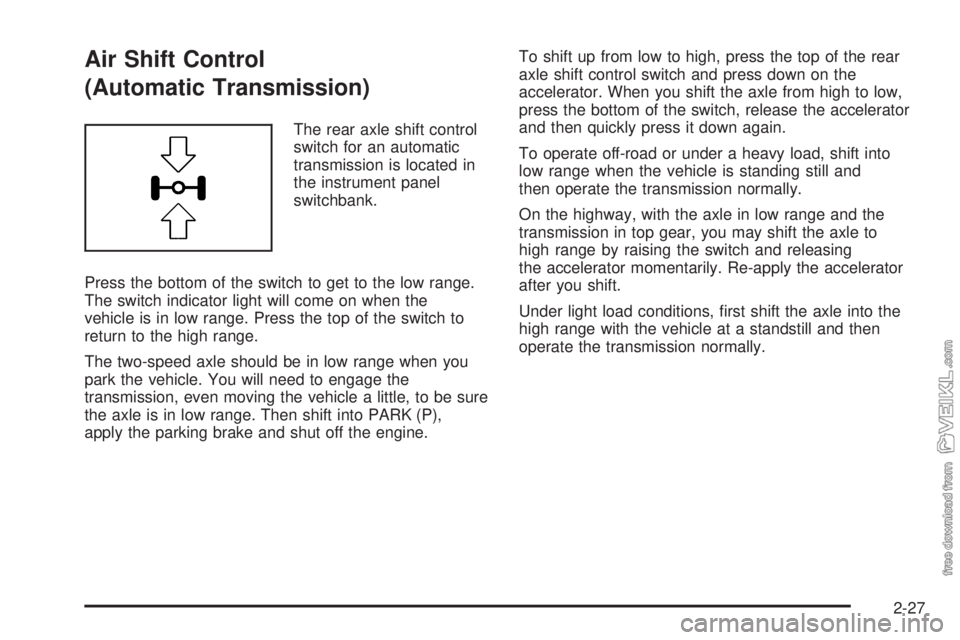
The rear axle shift control
switch for an automatic
transmission is located in
the instrument panel
switchbank.
Press the bottom of the switch to get to the low range.
The switch indicator light will come on when the
vehicle is in low range. Press the top of the switch to
return to the high range.
The two-speed axle should be in low range when you
park the vehicle. You will need to engage the
transmission, even moving the vehicle a little, to be sure
the axle is in low range. Then shift into PARK (P),
apply the parking brake and shut off the engine.To shift up from low to high, press the top of the rear
axle shift control switch and press down on the
accelerator. When you shift the axle from high to low,
press the bottom of the switch, release the accelerator
and then quickly press it down again.
To operate off-road or under a heavy load, shift into
low range when the vehicle is standing still and
then operate the transmission normally.
On the highway, with the axle in low range and the
transmission in top gear, you may shift the axle to
high range by raising the switch and releasing
the accelerator momentarily. Re-apply the accelerator
after you shift.
Under light load conditions, first shift the axle into the
high range with the vehicle at a standstill and then
operate the transmission normally.
2-27
Page 94 of 374
Automatic Transmission Operation
We build vehicles with Allison®five and six-speed
automatic transmissions. This part of the manual covers
the basics of these. With these transmissions, you
will find another Allison
®manual in your vehicle that
goes into more detail. On the headliner, in front of and
above the driver, or in some other place near the
driver, you will see a label that describes important
operating facts about the automatic transmission in
your vehicle. Make sure you follow the instructions on
this label.
Be sure to keep your parking brake set until you are
ready to shift into DRIVE (D), and press the brake pedal
while shifting from NEUTRAL (N) or PARK (P) to a
drive gear.
All vehicles equipped with automatic transmissions can
be started in PARK (P), if equipped, or in NEUTRAL (N).
See the Allison
®Transmission Operator’s Manual in
your vehicle for more information about this.
{CAUTION:
It can be dangerous to get out of your vehicle
without the parking brake rmly set. Your
vehicle can roll. If you have left the engine
running, the vehicle can move suddenly. You or
others could be injured. To be sure your vehicle
will not move, even when you are on fairly level
ground, always set the parking brake.
{CAUTION:
Shifting into a drive gear while your engine is
running at high speed is dangerous. Unless
your foot is rmly on the brake pedal, your
vehicle could move very rapidly. You could
lose control and hit people or objects. Do not
shift into a drive gear while your engine is
running at high speed.
2-28
Page 97 of 374
During the first 500 miles (805 km) of vehicle use, start
the vehicle moving in FIRST (1) gear. This allows
the clutch components to wear-in properly.
FIRST (1):With the vehicle at a stop, release the
brake, press the clutch pedal and shift into FIRST (1).
Then, slowly let up on the clutch pedal as you press the
accelerator pedal. Only downshift into FIRST (1)
when the vehicle has come to a complete stop. If the
shift lever will not go into FIRST (1), put the lever
in NEUTRAL and let up on the clutch pedal to fully
engage the clutch. Press the clutch pedal again.
Then, shift into FIRST (1).
SECOND (2):With the vehicle at a stop, release the
brake, press the clutch pedal and shift into SECOND (2).
Then, slowly let up on the clutch pedal as you press
the accelerator pedal. With the vehicle moving, press the
clutch pedal and upshift into SECOND (2) from
FIRST (1) while applying light pressure to the right on
the shifter. Then, slowly let up on the clutch pedal
as you press the accelerator pedal. If you come to a
complete stop and the shift lever will not go into
SECOND (2), put the lever in NEUTRAL and let up on
the clutch pedal to fully engage the clutch. Press
the clutch pedal again. Then, shift into SECOND (2).THIRD (3):Press the clutch pedal and upshift into
THIRD (3). Then, slowly let up on the clutch pedal as
you press the accelerator pedal.
FOURTH (4), FIFTH (5) and SIXTH (6):Upshift into
the higher forward gears the same way as you do
THIRD (3). Slowly let up on the clutch pedal as you
press the accelerator pedal.
NEUTRAL:Use this position when you start or idle
your engine.
REVERSE (R):To back up, press the clutch pedal.
Wait for the vehicle to stop moving and then, shift
to REVERSE (R). Let up on the clutch slowly while
pressing the accelerator pedal. Also, use REVERSE (R),
along with the parking brake, when turning off your
engine and parking your vehicle.
2-31
Page 98 of 374
Eaton®Fuller®Nine and Ten-Speed
Non-Synchronized Manual
Transmissions
If your vehicle has one of these transmissions the
engine rpm and road speed must match when upshifting
and downshifting. The label above the windshield will
tell you the operating basics you need to know.
The following are driving tips.
•Always choose an initial starting gear suitable for
the load and terrain.
•Always use double-clutching procedures when
shifting.
•Never move the range shift lever to the LO speed
gear position after HI range preselection, or
anytime the transmission is in the HI range.
•Never move the range knob or lever with the shift
lever in NEUTRAL while the vehicle is moving.
•Never make a range shift while moving in
REVERSE (R).
Clutch Brake (Vehicles with
Non-Synchronized Transmission)
A clutch brake is used to stop transmission input shaft
rotation so that FIRST (1) or REVERSE (R) gear
selection can be initiated when the vehicle is at a
standstill and the engine is idling.
Press the clutch pedal all the way down to the floorboard
to apply the clutch brake.
When using the clutch brake, disengage the clutch
pedal and shift the transmission into either the initial
starting gear or REVERSE (R). If the tooth-butting
occurs between the clutching teeth, re-engage the clutch
while applying light pressure to the shift lever. This
will provide for a smooth shift into either FIRST (1) or
REVERSE (R) gear.
Notice:Using the clutch brake for shifting into any
gear other than FIRST (1) or REVERSE (R) may
cause premature wear of the clutch brake and make
gear shift effort more difficult. Do not use the
clutch brake for shifting after engaging FIRST (1) or
REVERSE (R).
2-32
Page 101 of 374
4n(Four-Wheel Low):This setting sends maximum
power to all four wheels. You might choose Four-Wheel
Low if you are driving off-road in deep sand, deep mud,
and climbing or descending steep hills. Be sure the
front wheel hubs are locked when you want to drive in
Four-Wheel Low.
{CAUTION:
Shifting the transfer case to NEUTRAL can
cause your vehicle to roll even if the
transmission is in PARK (P). You or someone
else could be injured. If you are going to leave
your vehicle, set the parking brake and shift
the transmission to PARK (P) and make sure
the transfer case is in a drive gear.Notice:If your vehicle has an Allison
®transmission
and you try to put the transmission in PARK (P)
while the transfer case is in Four-Wheel Low,
the transmission may not go into PARK (P) and
could damage your vehicle. When parking your
vehicle, make sure the transfer case is in Two-Wheel
High or Four-Wheel High.
NEUTRAL:Shift the vehicle’s transfer case to
NEUTRAL only when towing your vehicle.
Shifting Into Four-Wheel High
Turn the knob to four-wheel high. This can be done
at 3 mph or less and when you are shifting out of
Four-Wheel Low. The indicator light will flash while
shifting. It will remain illuminated when the shift is
complete.
Shifting Into Two-Wheel High
Turn the knob to Two-Wheel High. This can be done
at 3 mph or less and when you are shifting out of
Four-Wheel Low.
2-35
Page 103 of 374
Shifting Into NEUTRAL
Before shifting the transfer case to NEUTRAL, first
make sure the vehicle is parked so that it will not roll.
1. Set the parking brake.
2. Start the vehicle.
3. Put the transmission in NEUTRAL (N).
4. Shift the transfer case to Two-Wheel High.
5. Turn the transfer case knob all of the way past
Four-Wheel Low and hold it there for a minimum
of 10 seconds. The neutral indicator light will
come on.
6. Shift the transmission to REVERSE (R) for
one second, then shift the transmission to
DRIVE (D) for one second.
7. Turn the ignition to OFF.
8. Place the transmission shift lever in PARK. (P).
9. Turn the ignition to LOCK.
Shifting Out of NEUTRAL
To shift the transfer case out of NEUTRAL, do the
following:
1. Set the parking brake and apply the regular
brake pedal.
2. Turn the ignition to RUN with the engine off.
3. Put the transmission in NEUTRAL (N).
4. Turn the transfer case knob to the desired shift
position (Two-Wheel High, Four-Wheel High,
Four-Wheel Low).
5. After the transfer case has shifted out of NEUTRAL,
the indicator light will go out.
6. Release the parking brake.
7. Start the engine and shift the transmission lever to
the desired position.
Excessively shifting the transfer case into or out of the
different modes may cause the transfer case to enter the
shift protection mode. This will protect the transfer case
from possible damage and will only allow the transfer
case to respond to one shift per 10 seconds. The transfer
case may stay in this mode for up to three minutes.
2-37
Page 104 of 374
Parking
{CAUTION:
If you do not park your vehicle properly, it can
roll. If you have left the engine running, it can
move very quickly. You or others could be
injured. To be sure your vehicle will not move,
even when you are on level ground, follow the
steps below.
Two-Speed Rear Axle
1. With the engine running, shift the two-speed rear
axle into low. To be sure it is in low, you will need
to move the vehicle in gear just a little.
2. Hold the regular brake pedal down with your
right foot.
3. Apply the parking brake.
4. Shift the transmission to NEUTRAL for manual
transmission or PARK (P) for automatic
transmission.
Hydraulic Brakes
(Parking Brake Operation)
If your vehicle has hydraulic brakes, it has either a
parking brake foot pedal or hand lever. If you have the
parking brake foot pedal, it is located below the
instrument panel to the left of the steering column.
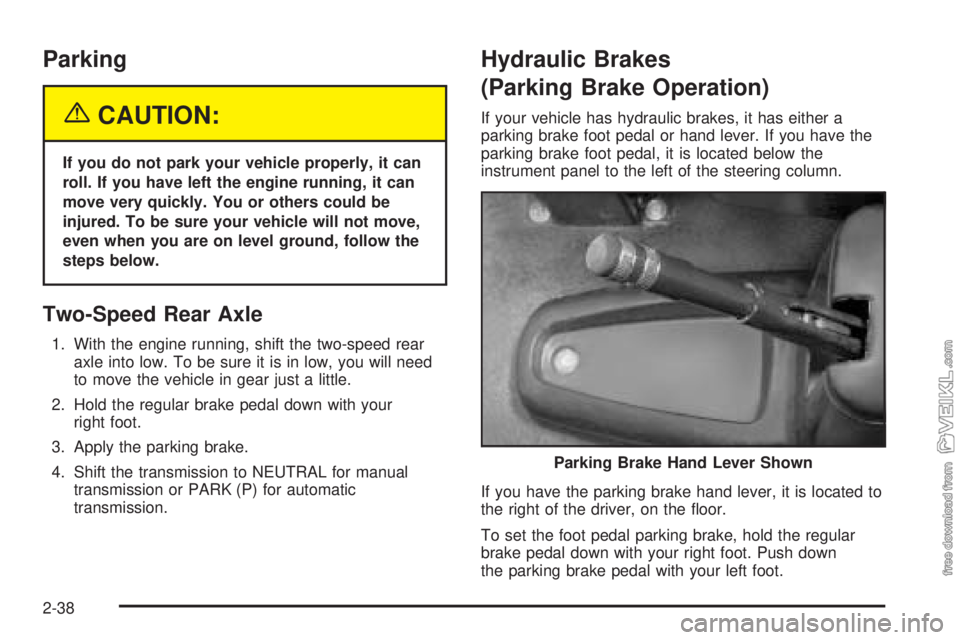
If you have the parking brake hand lever, it is located to
the right of the driver, on the floor.
To set the foot pedal parking brake, hold the regular
brake pedal down with your right foot. Push down
the parking brake pedal with your left foot.Parking Brake Hand Lever Shown
2-38
Page 105 of 374
To set the hand lever parking brake, hold the regular
brake pedal down with your right foot. Pull up on
the handle with your right hand, until it stops.
If the ignition is on when the parking brake is set,
the brake system warning light will come on.
To release the foot pedal parking brake, hold the
regular brake pedal down. Pull the brake release handle,
located just above the parking brake pedal, to release
the parking brake.
To release the hand lever parking brake, hold the
regular brake pedal down and push down on the handle
until it stops.
If the ignition is on when the parking brake is released,
the brake system warning light will go off.
Propshaft Brake Burnish Procedure
It is recommended that the propshaft-mounted parking
brake be burnished as part of the new vehicle break-in.
The parking brake will work best after it has been
burnished following these instructions:
Make 10 stops, using the parking brake hand lever or
foot pedal, from 20 mph (32 km/h) about 2 1/2 miles
(4 km) apart. Between stops, drive the vehicle at
20 mph (32 km/h) to allow the brake to cool.Notice:Driving with the parking brake on can
damage the transmission and brake system parts.
Verify that the parking brake is fully released and the
brake warning light is off before driving.
Rear Wheel Park Brake Burnish
Procedure
It is recommended that the rear wheel mounted
parking brake be burnished as part of the new vehicle
break-in. The parking brake will work best after it
has been burnished following these instructions:
Make one or two stops using the parking brake hand
lever or foot pedal from 55 mph (92 km/h) to a stop
with moderate apply. Each stop should occur within
1/4 of a mile.
Notice:Driving with the parking brake on can
overheat the brake system and cause premature
wear or damage to brake system parts. Verify that
the parking brake is fully released and the brake
warning light is off before driving.
2-39