warning CHEVROLET KODIAK 2005 Service Manual
[x] Cancel search | Manufacturer: CHEVROLET, Model Year: 2005, Model line: KODIAK, Model: CHEVROLET KODIAK 2005Pages: 374, PDF Size: 5.46 MB
Page 267 of 374
Battery
Your vehicle has one or more maintenance free
batteries. When it is time for a new battery, be sure it
has the replacement number shown on the original
battery’s label. We recommend an ACDelco
®
replacement battery.
Warning:Battery posts, terminals, and related
accessories contain lead and lead compounds,
chemicals known to the State of California to cause
cancer and reproductive harm. Wash hands after
handling.
Vehicle Storage
If you are not going to drive your vehicle for 25 days or
more, remove the black, negative (−) cable from the
battery. This will help keep your battery from running
down. (If your vehicle has more than one battery,
be sure to remove the negative (−) battery cable from
each battery.)
{CAUTION:
Batteries have acid that can burn you and gas
that can explode. You can be badly hurt if you
are not careful. SeeJump Starting on
page 5-56for tips on working around a battery
without getting hurt.
When you are ready to use the vehicle again, refer to
the engine starting procedure in the Index.
5-55
Page 289 of 374
Wheel Replacement
Replace any wheel that is bent, cracked or badly rusted
or corroded. If wheel nuts keep coming loose, replace
the wheel. If the wheel leaks air, replace it.
Your dealer will know the kind of wheel you need.
Each new wheel should have the same load-carrying
capacity, diameter, width, offset and be mounted
the same way as the one it replaces.
If you need to replace any of your wheels, wheel bolts
or wheel nuts, replace them only with new GM
original equipment parts. This way, you will be sure to
have the right wheel, wheel bolts and wheel nuts
for your vehicle.
{CAUTION:
A leaking wheel could fail without warning. A
wheel designed for tubeless tires could be
leaking because it is damaged. Do not use an
inner tube or some other thing to try to stop the
leaking. Get a new wheel or the proper type.
{CAUTION:
Without the correct wheel, you may not be able
to stop properly, and you could have other
problems like a tire air-out. You could have a
collision. If you do not go to your dealer to get
a new wheel, be sure you get the correct one.
Each new wheel should match the original
wheel in load-carrying capacity, ination
pressure capacity, diameter, width, offset and
mounting conguration.
Using wheels and tires with higher load-carrying limits
than the original wheels and tires does not change
the Gross Axle Weight Rating (GAWR) or the Gross
Vehicle Weight Rating (GVWR) of your vehicle.
SeeLoading Your Vehicle on page 4-32for more
information.
Notice:The wrong wheel can cause trouble in
bearing life, brake cooling, speedometer/odometer
calibration, headlamp aim, bumper height, vehicle
ground clearance, stopping distance and tire
clearance to the body and chassis. You could also
have other problems like a tire air-out.
5-77
Page 290 of 374
Used Replacement Wheels
{CAUTION:
Putting a used wheel on your vehicle is
dangerous. You cannot know how it has been
used or how far it has been driven. It could fail
suddenly and cause a crash. If you have to
replace a wheel, use a new GM original
equipment wheel.
If a Tire Goes Flat
It’s unusual for a tire to “blow out” while you’re driving,
especially if you maintain your tires properly. If air
goes out of a tire, it’s much more likely to leak out
slowly. But if you should ever have a “blow out,” here
are a few tips about what to expect and what to do:
If a front tire fails, the flat tire will create a drag that pulls
the vehicle toward that side. Take your foot off the
accelerator pedal and grip the steering wheel firmly.
Steer to maintain lane position, and then gently brake to
a stop well out of the traffic lane.A rear blowout, particularly on a curve, acts much like a
skid and may require the same correction you’d use
in a skid. In any rear blowout, remove your foot from the
accelerator pedal. Get the vehicle under control by
steering the way you want the vehicle to go. It may be
very bumpy and noisy, but you can still steer. Gently
brake to a stop –– well off the road if possible.
If a tire goes flat, avoid further tire and wheel damage
by driving slowly to a level place and turn on your
hazard warning flashers.
{CAUTION:
Your vehicle, when new, did not include tire
changing equipment or a place to store a tire
in the vehicle. Special tools and procedures
are required if a tire needs to be serviced. If
these tools and procedures are not used, you
or others could be injured or killed while trying
to change or service a truck tire.
Your truck, when new, did not include tire changing
equipment or a place to store a tire in the vehicle. Few
drivers of these vehicles have the necessary equipment
aboard to be able to change a flat tire safely.
5-78
Page 291 of 374
For example, you would need a truck jack that can lift
several thousand pounds and a torque wrench that can
generate several hundred foot-pounds (Y)of
twisting force.
{CAUTION:
If you try to put air back into a tire that has run
at, even a tire that was extremely low on air,
the tire can have a sudden air-out. This could
cause you to lose control of the vehicle and
have a serious crash. Do not rell a at or very
low tire with air without rst having the tire
taken off the wheel and checked for damage.
So if you’re stopped somewhere by a flat or damaged
tire or wheel, you should get expert help. SeeRoadside
Assistance Program on page 7-5.
Appearance Care
Cleaning products can be hazardous. Some are toxic.
Other cleaning products can burst into flames if a match
is struck near them or if they get on a hot part of the
vehicle. Some are dangerous if their fumes are inhaled
in an enclosed space. When anything from a container
is used to clean the vehicle, be sure to follow the
manufacturer’s warnings and instructions. Always open
the doors or windows of the vehicle when cleaning
the inside.
Never use these to clean the vehicle:
•Benzene
•Naphtha
•Carbon Tetrachloride
•Acetone
•Paint Thinner
•Turpentine
•Lacquer Thinner
•Nail Polish Remover
5-79
Page 302 of 374
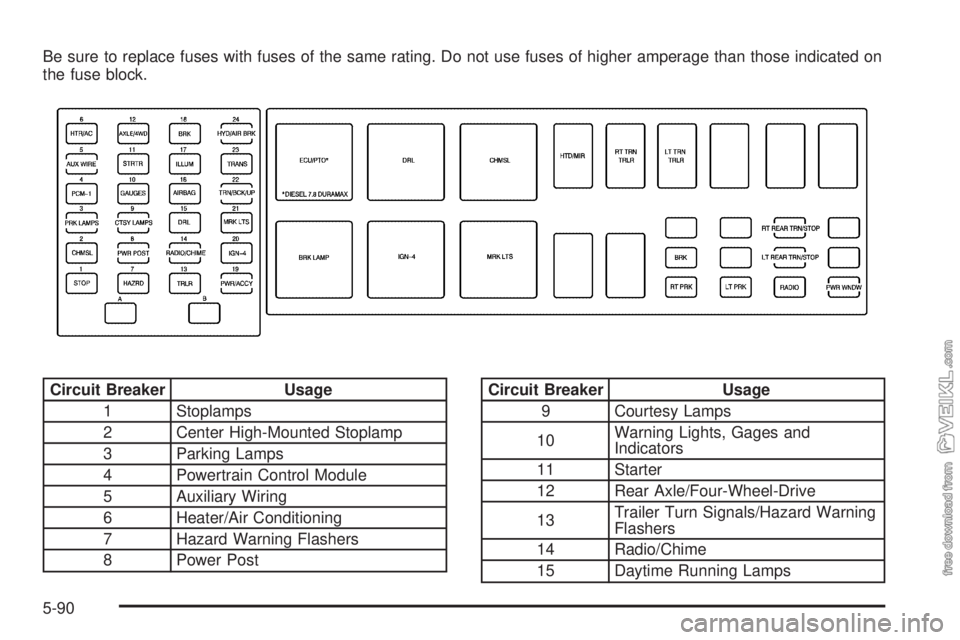
Be sure to replace fuses with fuses of the same rating. Do not use fuses of higher amperage than those indicated on
the fuse block.
Circuit Breaker Usage
1 Stoplamps
2 Center High-Mounted Stoplamp
3 Parking Lamps
4 Powertrain Control Module
5 Auxiliary Wiring
6 Heater/Air Conditioning
7 Hazard Warning Flashers
8 Power PostCircuit Breaker Usage
9 Courtesy Lamps
10Warning Lights, Gages and
Indicators
11 Starter
12 Rear Axle/Four-Wheel-Drive
13Trailer Turn Signals/Hazard Warning
Flashers
14 Radio/Chime
15 Daytime Running Lamps
5-90
Page 303 of 374
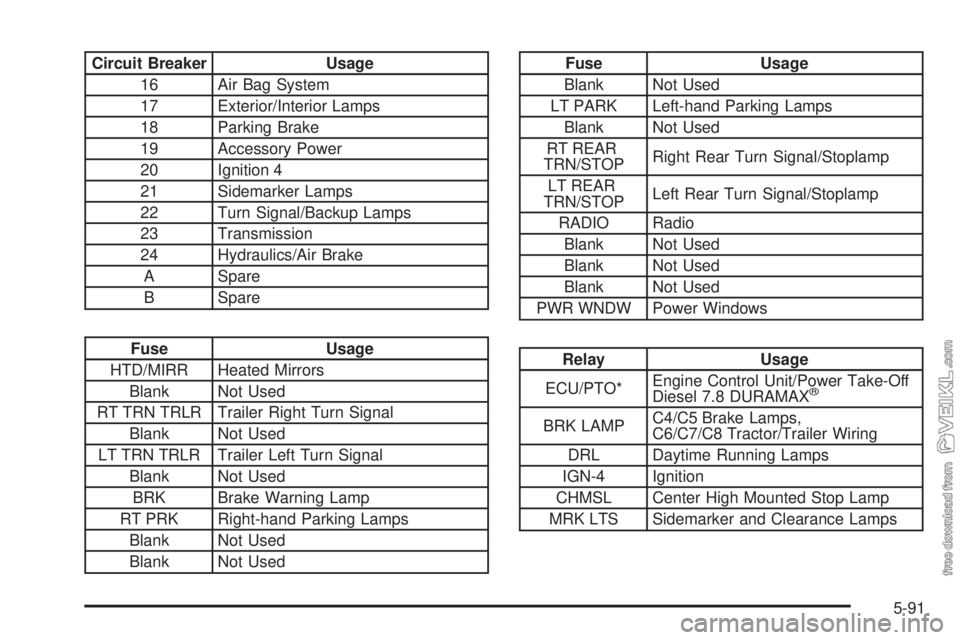
Circuit Breaker Usage
16 Air Bag System
17 Exterior/Interior Lamps
18 Parking Brake
19 Accessory Power
20 Ignition 4
21 Sidemarker Lamps
22 Turn Signal/Backup Lamps
23 Transmission
24 Hydraulics/Air Brake
A Spare
B Spare
Fuse Usage
HTD/MIRR Heated Mirrors
Blank Not Used
RT TRN TRLR Trailer Right Turn Signal
Blank Not Used
LT TRN TRLR Trailer Left Turn Signal
Blank Not Used
BRK Brake Warning Lamp
RT PRK Right-hand Parking Lamps
Blank Not Used
Blank Not Used
Fuse Usage
Blank Not Used
LT PARK Left-hand Parking Lamps
Blank Not Used
RT REAR
TRN/STOPRight Rear Turn Signal/Stoplamp
LT REAR
TRN/STOPLeft Rear Turn Signal/Stoplamp
RADIO Radio
Blank Not Used
Blank Not Used
Blank Not Used
PWR WNDW Power Windows
Relay Usage
ECU/PTO*Engine Control Unit/Power Take-Off
Diesel 7.8 DURAMAX
®
BRK LAMPC4/C5 Brake Lamps,
C6/C7/C8 Tractor/Trailer Wiring
DRL Daytime Running Lamps
IGN-4 Ignition
CHMSL Center High Mounted Stop Lamp
MRK LTS Sidemarker and Clearance Lamps
5-91
Page 306 of 374
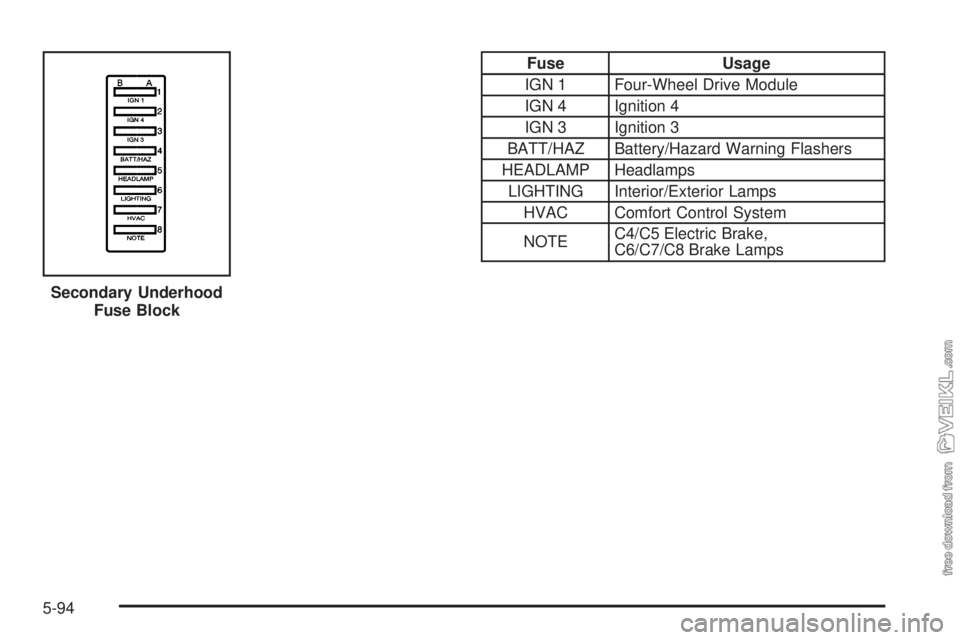
Fuse Usage
IGN 1 Four-Wheel Drive Module
IGN 4 Ignition 4
IGN 3 Ignition 3
BATT/HAZ Battery/Hazard Warning Flashers
HEADLAMP Headlamps
LIGHTING Interior/Exterior Lamps
HVAC Comfort Control System
NOTEC4/C5 Electric Brake,
C6/C7/C8 Brake Lamps
Secondary Underhood
Fuse Block
5-94
Page 343 of 374
Starter Switch Check
{CAUTION:
When you are doing this inspection, the
vehicle could move suddenly. If the vehicle
moves, you or others could be injured.
1. Before you start, be sure you have enough room
around the vehicle.
2. Firmly apply both the parking brake and the
regular brakes.
Do not use the accelerator pedal, and be ready to
turn off the engine immediately if it starts.
3. On automatic transmission vehicles, try to start the
engine in each gear. The starter should work only
in PARK (P), if equipped, or NEUTRAL (N). If
the starter works in any other position, your vehicle
needs service. On manual transmission vehicles,
the starter should work only when the clutch pedal is
all the way down.
Automatic Transmission Shift
Indicator Check
Check that the indicator points to the gear chosen.
Steering Check
Be alert for any changes in steering action, abnormal
front tire wear or steering wheel position. An inspection
or service is needed when the steering wheel is
harder to turn or has too much free play, or if there are
strange sounds when turning or parking.
Brake System Check
Be alert to illumination of the low air warning lamp or for
the tone alarm, or changes in braking action, such as
repeated pulling to one side, unusual sounds when
braking or increased brake pedal travel. Make sure air
brake system reservoirs are drained daily with full
system air pressure, and check system for leaks. Any of
these conditions could indicate the need for brake
system inspection and/or service.
6-29
Page 344 of 374
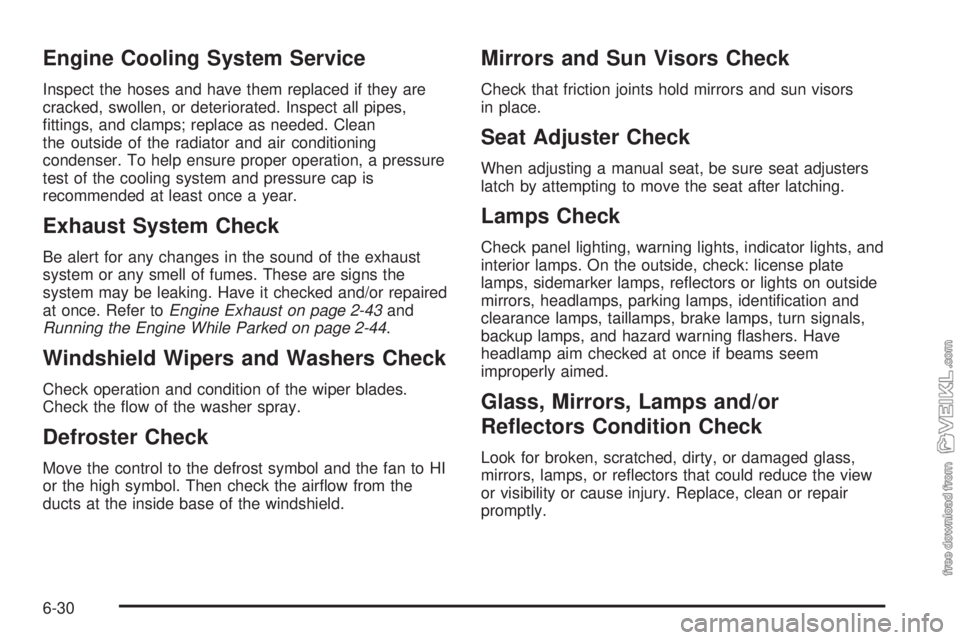
Engine Cooling System Service
Inspect the hoses and have them replaced if they are
cracked, swollen, or deteriorated. Inspect all pipes,
fittings, and clamps; replace as needed. Clean
the outside of the radiator and air conditioning
condenser. To help ensure proper operation, a pressure
test of the cooling system and pressure cap is
recommended at least once a year.
Exhaust System Check
Be alert for any changes in the sound of the exhaust
system or any smell of fumes. These are signs the
system may be leaking. Have it checked and/or repaired
at once. Refer toEngine Exhaust on page 2-43and
Running the Engine While Parked on page 2-44.
Windshield Wipers and Washers Check
Check operation and condition of the wiper blades.
Check the flow of the washer spray.
Defroster Check
Move the control to the defrost symbol and the fan to HI
or the high symbol. Then check the airflow from the
ducts at the inside base of the windshield.
Mirrors and Sun Visors Check
Check that friction joints hold mirrors and sun visors
in place.
Seat Adjuster Check
When adjusting a manual seat, be sure seat adjusters
latch by attempting to move the seat after latching.
Lamps Check
Check panel lighting, warning lights, indicator lights, and
interior lamps. On the outside, check: license plate
lamps, sidemarker lamps, reflectors or lights on outside
mirrors, headlamps, parking lamps, identification and
clearance lamps, taillamps, brake lamps, turn signals,
backup lamps, and hazard warning flashers. Have
headlamp aim checked at once if beams seem
improperly aimed.
Glass, Mirrors, Lamps and/or
Reectors Condition Check
Look for broken, scratched, dirty, or damaged glass,
mirrors, lamps, or reflectors that could reduce the view
or visibility or cause injury. Replace, clean or repair
promptly.
6-30
Page 361 of 374
A
Accessory Power Outlets.................................3-19
Adding a Snow Plow or Similar Equipment.........4-34
Adding Equipment to Your Airbag-Equipped
Vehicle.......................................................1-59
Additives, Fuel................................................. 5-6
Add-On Electrical Equipment............................5-88
Air Brake.......................................................2-40
Air Cleaner/Filter, Engine.................................5-33
Air Conditioning..............................................3-20
Air Conditioning System...................................5-70
Air Pressure Gage..........................................3-44
Air Shift Control..............................................2-27
Air Suspension...............................................2-42
Air Suspension Seats........................................ 1-6
Airbag
Off Light.....................................................3-28
Readiness Light..........................................3-27
Airbag Sensing and Diagnostic Module (SDM)...... 7-6
Airbag System................................................1-48
Adding Equipment to Your Airbag-Equipped
Vehicle...................................................1-59
Airbag Off Switch........................................1-56
How Does an Airbag Restrain?......................1-54
Servicing Your Airbag-Equipped Vehicle..........1-59
What Makes an Airbag Inflate?......................1-54
What Will You See After an Airbag Inflates?....1-54Airbag System (cont.)
When Should an Airbag Inflate?....................1-53
Where Are the Airbags?...............................1-52
AM-FM Radio.................................................3-45
Antenna, Fixed Mast.......................................3-59
Anti-Lock Brake System (ABS)........................... 4-6
Anti-Lock Brake, System Warning Light..............3-34
Anti-Lock Brakes, Trailer System
Warning Light.............................................3-34
Appearance Care............................................5-79
Aluminum or Chrome-Plated Wheels..............5-84
Care of Safety Belts....................................5-82
Chemical Paint Spotting...............................5-85
Cleaning Exterior Lamps/Lenses....................5-83
Cleaning the Inside of Your Vehicle................5-80
Fabric/Carpet..............................................5-81
Finish Care.................................................5-83
Finish Damage............................................5-85
Instrument Panel, Vinyl, and Other Plastic
Surfaces.................................................5-82
Sheet Metal Damage...................................5-85
Tires..........................................................5-85
Underbody Maintenance...............................5-85
Vehicle Care/Appearance Materials................5-86
Washing Your Vehicle...................................5-83
Weatherstrips..............................................5-82
Windshield and Wiper Blades........................5-84
Ashtrays........................................................3-20
1