service CHEVROLET KODIAK 2006 Owner's Guide
[x] Cancel search | Manufacturer: CHEVROLET, Model Year: 2006, Model line: KODIAK, Model: CHEVROLET KODIAK 2006Pages: 398, PDF Size: 5.72 MB
Page 229 of 398
Service............................................................5-3
California Proposition 65 Warning.....................5-3
Doing Your Own Service Work.........................5-4
Engine Fan Breakage.....................................5-5
Fuel................................................................5-6
Gasoline Octane............................................5-6
Gasoline Specifications....................................5-6
Additives.......................................................5-6
Diesel Engine Fuel.........................................5-7
What Fuel to Use...........................................5-8
Very Cold Weather Operation.........................5-10
Water in Fuel...............................................5-10
Running Out of Fuel.....................................5-17
Fuel Filter Replacement.................................5-18
Fuels in Foreign Countries.............................5-19
Filling the Tank............................................5-20
Filling a Portable Fuel Container.....................5-21
Checking Things Under the Hood....................5-22
Hood Latches...............................................5-22
Engine Oil (Caterpillar
®Diesel Engine).............5-24
Engine Oil (DURAMAX®Diesel)......................5-24
Engine Oil (Gasoline Engine)..........................5-28
Engine Oil Life System (Gasoline Engine)........5-31
Engine Oil Life System (DURAMAX
®Diesel).....5-33
Engine Oil Life System
(Caterpillar
®Diesel Engine).........................5-34Engine Air Cleaner/Filter................................5-35
Automatic Transmission Fluid.........................5-36
Manual Transmission Fluid.............................5-37
Engine Coolant
(Gas and DURAMAX
®Engines)...................5-38
Engine Coolant (Caterpillar®Diesel Engines).....5-40
Coolant Surge Tank Pressure Cap..................5-40
Engine Overheating.......................................5-40
Cooling System
(Gas and DURAMAX
®Engines)...................5-42
Engine Fan Noise.........................................5-47
Power Steering Fluid.....................................5-47
Windshield Washer Fluid................................5-48
Brakes........................................................5-49
Battery........................................................5-58
Jump Starting...............................................5-59
Rear Axle.......................................................5-64
Rear Axle Shift Motor....................................5-65
Four-Wheel Drive............................................5-65
Front Axle......................................................5-66
Noise Control System.....................................5-67
Tampering with Noise Control System
Prohibited.................................................5-67
Bulb Replacement..........................................5-68
Windshield Wiper Blade Replacement..............5-69
Section 5 Service and Appearance Care
5-1
Page 230 of 398
Other Service Items........................................5-70
Fuel Filter....................................................5-70
Primary Fuel Filter and Water Separator..........5-71
Secondary Fuel Filter and Water
Separator/Heater (Caterpillar
®Diesel)...........5-71
Automatic Ether Injection System
(Caterpillar
®Diesel)....................................5-72
Front Wheel Bearings with Oil-Filled Hubs........5-73
Air Conditioning System.................................5-74
Tires..............................................................5-74
Inflation - Tire Pressure.................................5-75
Wheel Loading.............................................5-75
Dual Tire Operation.......................................5-76
When It Is Time for New Tires.......................5-76
Wheel Alignment and Tire Balance..................5-77
Tightening the Wheel Nuts.............................5-77
Wheel Replacement......................................5-81
If a Tire Goes Flat........................................5-82
Appearance Care............................................5-83
Cleaning the Inside of Your Vehicle.................5-83
Fabric/Carpet...............................................5-85
Instrument Panel, Vinyl, and Other Plastic
Surfaces..................................................5-86
Care of Safety Belts......................................5-86
Weatherstrips...............................................5-86
Washing Your Vehicle...................................5-87Cleaning Exterior Lamps/Lenses.....................5-87
Finish Care..................................................5-87
Windshield and Wiper Blades.........................5-88
Aluminum or Chrome-Plated Wheels................5-89
Tires...........................................................5-89
Sheet Metal Damage.....................................5-89
Finish Damage.............................................5-89
Underbody Maintenance................................5-90
Chemical Paint Spotting.................................5-90
Vehicle Identication......................................5-91
Vehicle Identification Number (VIN).................5-91
Service Statement.........................................5-92
Service Parts Identification Label.....................5-92
Electrical System............................................5-92
Add-On Electrical Equipment..........................5-92
Headlamp Wiring..........................................5-93
Windshield Wiper Fuses................................5-93
Fusible Links................................................5-93
Power Windows and Other Power Options.......5-93
Fuses and Circuit Breakers............................5-93
Instrument Panel Fuse Block..........................5-94
Underhood Fuse Block..................................5-96
Capacities and Specications..........................5-99
Normal Maintenance Replacement Parts.........5-104
Section 5 Service and Appearance Care
5-2
Page 231 of 398
Service
Your dealer knows your vehicle best and wants you to
be happy with it. We hope you will go to your dealer
for all your service needs. You will get genuine GM parts
and GM-trained and supported service people.
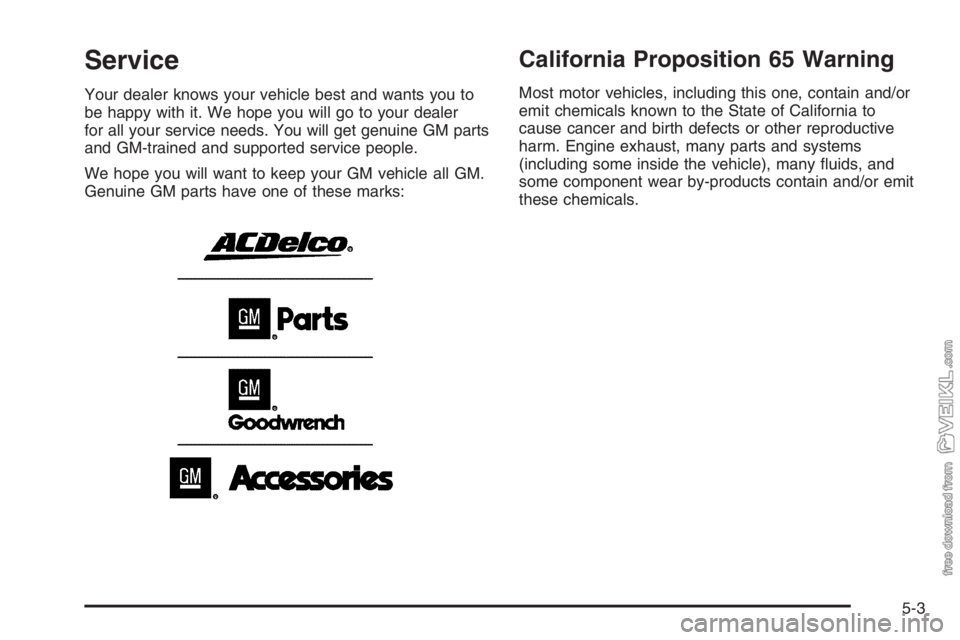
We hope you will want to keep your GM vehicle all GM.
Genuine GM parts have one of these marks:
California Proposition 65 Warning
Most motor vehicles, including this one, contain and/or
emit chemicals known to the State of California to
cause cancer and birth defects or other reproductive
harm. Engine exhaust, many parts and systems
(including some inside the vehicle), many fluids, and
some component wear by-products contain and/or emit
these chemicals.
5-3
Page 232 of 398
Doing Your Own Service Work
{CAUTION:
You can be injured and your vehicle could be
damaged if you try to do service work on a
vehicle without knowing enough about it.
Be sure you have sufficient knowledge,
experience, the proper replacement parts,
and tools before you attempt any vehicle
maintenance task.
Be sure to use the proper nuts, bolts, and
other fasteners. English and metric
fasteners can be easily confused. If you
use the wrong fasteners, parts can later
break or fall off. You could be hurt.If you want to do some of your own service work, you
will want to use the proper service manual. It tells
you much more about how to service your vehicle than
this manual can. To order the proper service manual,
seeService Publications Ordering Information on
page 7-11.
Your vehicle has an airbag system. Before attempting to
do your own service work, seeServicing Your
Airbag-Equipped Vehicle on page 1-61.
You should keep a record with all parts receipts and list
the mileage and the date of any service work you
perform. SeePart D: Maintenance Record on page 6-35.
5-4
Page 233 of 398
Engine Fan Breakage
{CAUTION:
Changing the Fan Drive Ratio or Engine
Governed Speed:
If you change the fan drive ratio or increase
the governed speed of the engine, you may
increase stress and the fan could eventually
fail. If the fan breaks apart while it is
rotating, pieces can cause severe injury to
anyone — such as a service technician — who
is nearby. And, of course, the pieces can
severely damage the vehicle. Do not change
the fan drive ratio or increase the governed
speed of the vehicle without getting the
necessary information from your dealer.
CAUTION: (Continued)
CAUTION: (Continued)
Winter Fronts, Grille Covers or Obstructions:
Winter Fronts, grille covers or other add-on
equipment causing obstructions in front or
behind the fan should not be used on this
vehicle. If this causes the fan to eventually
break apart while it is rotating, the pieces can
cause severe injury to anyone nearby, such as
a service technician working on the engine,
and of course the pieces can severely damage
the vehicle.
5-5
Page 234 of 398
Fuel
If your vehicle has a diesel engine, seeDiesel Engine
Fuel on page 5-7.
For vehicles with gasoline engines, please read this.
Gasoline Octane
Use regular unleaded gasoline with a posted octane
rating of 87 or higher. If the octane rating is less than 87,
you may notice an audible knocking noise when you
drive, commonly referred to as spark knock. If this
occurs, use a gasoline rated at 87 octane or higher as
soon as possible. If you are using gasoline rated at
87 octane or higher and you hear heavy knocking, your
engine needs service.
Gasoline Specications
At a minimum, gasoline should meet ASTM
specification D 4814 in the United States or
CAN/CGSB-3.5 in Canada. Some gasolines may
contain an octane-enhancing additive called
methylcyclopentadienyl manganese tricarbonyl (MMT).
General Motors recommends against the use of
gasolines containing MMT. SeeAdditives on page 5-6
for additional information.
Additives
To provide cleaner air, all gasolines in the United States
are now required to contain additives that will help
prevent engine and fuel system deposits from forming,
allowing your emission control system to work
properly. In most cases, you should not have to add
anything to your fuel. However, some gasolines contain
only the minimum amount of additive required to
meet U.S. Environmental Protection Agency regulations.
To help keep fuel injectors and intake valves clean,
or if your vehicle experiences problems due to
dirty injectors or valves, look for gasoline that is
advertised as TOP TIER Detergent Gasoline. Also, your
GM dealer has additives that will help correct and
prevent most deposit-related problems.
Gasolines containing oxygenates, such as ethers and
ethanol, and reformulated gasolines may be available in
your area. General Motors recommends that you use
these gasolines if they comply with the specifications
described earlier. However, E85 (85% ethanol)
and other fuels containing more than 10% ethanol must
not be used in vehicles that were not designed for
those fuels.
5-6
Page 235 of 398
Notice:Your vehicle was not designed for fuel that
contains methanol. Do not use fuel containing
methanol. It can corrode metal parts in your fuel
system and also damage the plastic and rubber
parts. That damage would not be covered under
your warranty.
Some gasolines that are not reformulated for low
emissions may contain an octane-enhancing additive
called methylcyclopentadienyl manganese tricarbonyl
(MMT); ask the attendant where you buy gasoline
whether the fuel contains MMT. General Motors
recommends against the use of such gasolines. Fuels
containing MMT can reduce the life of spark plugs
and the performance of the emission control system may
be affected. The malfunction indicator lamp may turn
on. If this occurs, return to your authorized GM dealer for
service.Diesel Engine Fuel
For the Caterpillar®diesel, see the Caterpillar®
Operation & Maintenance Manual for information
concerning fuel usage.
Notice:Diesel fuel or fuel additives not
recommended in this manual could damage your
fuel system and engine. Your warranty would
not cover this damage. And:
Diesel fuel that has been mixed with engine oil
or automatic transmission uid could damage
your engine and emission controls.
Aftermarket diesel fuel additives are not tested
by General Motors. Some additives, particularly
those which contain alcohol or water
emulsiers, may damage your fuel system. If
you believe that unique circumstances call for a
fuel additive to be used, consult your dealer
for advice.
If you ever run out of diesel fuel, it can be
difficult to restart your engine. To avoid
this, never let your tank get empty.
If gasoline is ever accidentally added to the fuel
tank, to avoid severe engine damage, do not run the
engine until the fuel tank can be drained.
If you run out of fuel,Running Out of Fuel on page 5-17
tells you how to restart your engine.
5-7
Page 238 of 398
Very Cold Weather Operation
Follow the instructions listed previously under the
heading “What Fuel to Use.”
Notice:Never use home heating oil or gasoline in
your diesel engine. They can cause engine
damage.
In cold weather, your fuel filter may become clogged
(waxed). To unclog it, move the vehicle to a warm
garage area and warm the filter to between 32°F and
50°F (0°C to 10°C). You will not need to replace it.
Additional information on the fuel filter follows.
Water in Fuel
{CAUTION:
Diesel fuel containing water is still ammable.
You could be burned. If you ever try to drain
water from your fuel, keep sparks, ames and
smoking materials away from the mixture.Notice:If there is water in your diesel fuel and the
weather is warm or humid, fungus and bacteria
can grow in the fuel. They can damage your
fuel system. A diesel fuel biocide can be used to
sterilize your fuel system. However, your fuel system
may still need to be cleaned. Your dealer can
advise you of the appropriate solution.
If your fuel tank needs to be purged to remove
water, see your dealer or a qualied technician.
Improper purging can damage your fuel system.
Sometimes, water can be pumped into your fuel
tank along with your diesel fuel. This can happen if a
service station does not regularly inspect and clean
its fuel tanks, or if it gets contaminated fuel from
its suppliers.
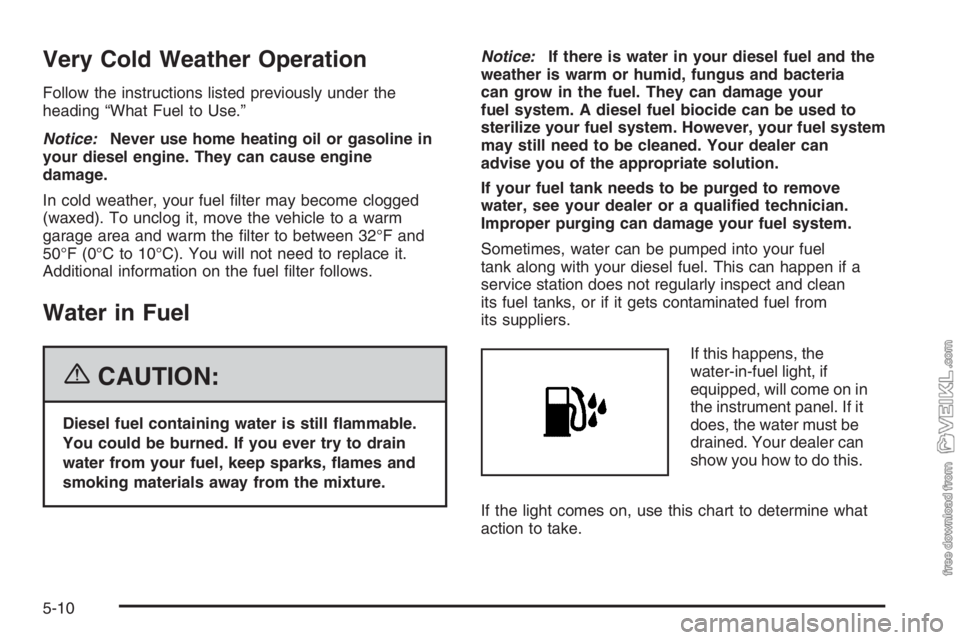
If this happens, the
water-in-fuel light, if
equipped, will come on in
the instrument panel. If it
does, the water must be
drained. Your dealer can
show you how to do this.
If the light comes on, use this chart to determine what
action to take.
5-10
Page 255 of 398
•SAE 15W-40
As shown in the viscosity chart, SAE 15W-40 is
best for your vehicle. However, you can use
SAE 10W-30 at temperatures above 0°F (−18°C).
When it is very cold, below 0°F (−18°C), you should
use SAE 5W-40 to improve cold starting. 5W-40
is not recommended for use at high temperatures,
above 100°F (38°C).
These numbers on the oil container show its
viscosity, or thickness. Do not use other viscosity
oils such as SAE 10W-40 or SAE 20W-50.
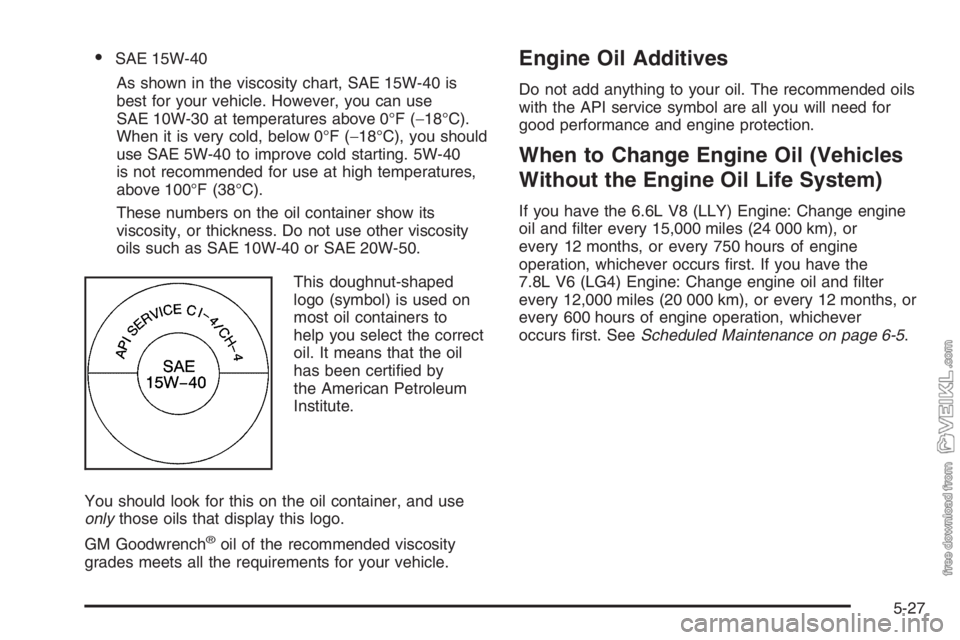
This doughnut-shaped
logo (symbol) is used on
most oil containers to
help you select the correct
oil. It means that the oil
has been certified by
the American Petroleum
Institute.
You should look for this on the oil container, and use
onlythose oils that display this logo.
GM Goodwrench
®oil of the recommended viscosity
grades meets all the requirements for your vehicle.
Engine Oil Additives
Do not add anything to your oil. The recommended oils
with the API service symbol are all you will need for
good performance and engine protection.
When to Change Engine Oil (Vehicles
Without the Engine Oil Life System)
If you have the 6.6L V8 (LLY) Engine: Change engine
oil and filter every 15,000 miles (24 000 km), or
every 12 months, or every 750 hours of engine
operation, whichever occurs first. If you have the
7.8L V6 (LG4) Engine: Change engine oil and filter
every 12,000 miles (20 000 km), or every 12 months, or
every 600 hours of engine operation, whichever
occurs first. SeeScheduled Maintenance on page 6-5.
5-27
Page 259 of 398
If you are in an area of extreme cold, where the
temperature falls below−20°F (−29°C), it is
recommended that you use either an SAE 5W-30
synthetic oil or an SAE 0W-30 oil. Both will provide
easier cold starting and better protection for your engine
at extremely low temperatures.
Engine Oil Additives
Do not add anything to your oil. The recommended oils
with the API service symbol are all you will need for
good performance and engine protection.
Engine Oil Life System
(Gasoline Engine)
When to Change Engine Oil
Your vehicle has a computer system that lets you know
when to change the engine oil and filter. This is
based on engine revolutions and engine temperature,
and not on mileage. Based on driving conditions,
the mileage at which an oil change will be indicated can
vary considerably. For the oil life system to work
properly, you must reset the system every time the oil is
changed.When the system has calculated that oil life has been
diminished, it will indicate that an oil change is
necessary. A change engine oil light will come on. See
Change Engine Oil Light on page 3-40. Change your
oil as soon as possible within the next 600 miles
(1 000 km). It is possible that, if you are driving under
the best conditions, the oil life system may not indicate
that an oil change is necessary for over a year.
However, your engine oil and filter must be changed at
least once a year and at this time the system must
be reset. Your dealer has GM-trained service people
who will perform this work using genuine GM parts and
reset the system. It is also important to check your
oil regularly and keep it at the proper level.
If the system is ever reset accidentally, you must
change your oil at 3,000 miles (5 000 km) since your
last oil change. Remember to reset the oil life system
whenever the oil is changed.
5-31