service CHEVROLET KODIAK 2006 Workshop Manual
[x] Cancel search | Manufacturer: CHEVROLET, Model Year: 2006, Model line: KODIAK, Model: CHEVROLET KODIAK 2006Pages: 398, PDF Size: 5.72 MB
Page 302 of 398
Air Conditioning System
Every now and then, have your dealership check your
air conditioning system to be sure it has not lost
any cooling ability. If you think the system is not working
properly, have your GM dealer check it out as soon
as possible.
Tires
Your new vehicle comes with high-quality tires made by
a leading tire manufacturer. If you ever have questions
about your tire warranty and where to obtain service,
see your GM Warranty booklet for details. For additional
information refer to the tire manufacturer’s booklet
included with your vehicle.
{CAUTION:
Poorly maintained and improperly used tires
are dangerous.
Overloading your tires can cause
overheating as a result of too much
friction. You could have an air-out and a
serious accident. SeeLoading Your
Vehicle on page 4-34.
Underinated tires pose the same danger
as overloaded tires. The resulting accident
could cause serious injury. Check all tires
frequently to maintain the recommended
pressure. Tire pressure should be checked
when your tires are cold. SeeInflation - Tire
Pressure on page 5-75.
Overinated tires are more likely to be
cut, punctured, or broken by a sudden
impact — such as when you hit a pothole.
Keep tires at the recommended pressure.
Worn, old tires can cause accidents. If your
tread is badly worn, or if your tires have
been damaged, replace them.
5-74
Page 304 of 398
Dual Tire Operation
When the vehicle is new, check the wheel nut tightness
on all wheels with a torque wrench after your first
100 miles (160 km) and then 1,000 miles (1 600 km)
after that. Whenever a wheel, wheel bolt or wheel nut is
removed or serviced, repeat the 100 miles (160 km),
and then 1,000 mile (1 600 km) wheel nut tightness
check.
SeeTightening the Wheel Nuts on page 5-77for wheel
nut tightening information and proper torque values.
{CAUTION:
If you operate your vehicle with a tire that is
badly underinated, the tire can overheat. An
overheated tire can lose air suddenly or catch
re. You or others could be injured. Be sure all
tires (including the spare, if any) are properly
inated.
SeeTires on page 5-74andInation - Tire Pressure on
page 5-75for more information on proper tire inflation.
When It Is Time for New Tires
Replace your tires when the tread depth is down to
1/8 of an inch (3.2 mm) for the front tires, or 1/16 of an
inch (1.6 mm) for a rear tire. Also, you need a new
tire if:
•You can see cord or fabric showing through the
tire’s rubber.
•The tread or sidewall is cracked, cut or snagged
deep enough to show cord or fabric.
•The tire has a bump, bulge or split.
•The tire has a puncture, cut or other damage that
cannot be repaired well because of the size or
location of the damage.
{CAUTION:
Mixing tires could cause you to lose control
while driving. If you mix tires of different
types — like radial and bias-belted tires — the
vehicle may not handle properly, and you
could have a crash. Be sure to use the same
type of tires all around.
5-76
Page 308 of 398
{CAUTION:
If wheel studs are damaged, they can break. If
all the studs on a wheel broke, the wheel could
come off and cause a crash. If any stud is
damaged because of a loose-running wheel, it
could be that all of the studs are damaged. To
be sure, replace all studs on the wheel. If the
stud holes in a wheel have become larger, the
wheel could collapse in operation. Replace any
wheel if its stud holes have become larger or
distorted in any way. Inspect hubs and
hub-piloted wheels for damage. Because of
loose running wheels, piloting pad damage
may occur and require replacement of the
entire hub, for proper centering of the wheels.
When replacing studs, hubs, wheel nuts or
wheels, be sure to use GM original equipment
parts.
{CAUTION:
Rust or dirt on a wheel, or on the parts to
which it is fastened, can make wheel nuts
become loose after a time. The wheel could
come off and cause a crash. When you change
a wheel, remove any rust or dirt from places
where the wheel attaches to the vehicle. In an
emergency, you can use a cloth or a paper
towel to do this; but be sure to use a scraper
or wire brush later, if you need to, to get all the
rust or dirt off.
How Often to Check
Wheel tightness is so important you should have a
technician check nut tightness on all wheels with
a torque wrench after your first 100 miles (160 km), and
then 1,000 miles (1 600 km) after that. Be sure to
repeat this service whenever you have a tire removed
or serviced. SeeScheduled Maintenance on page 6-5
for further information.
5-80
Page 310 of 398
Used Replacement Wheels
{CAUTION:
Putting a used wheel on your vehicle is
dangerous. You cannot know how it has been
used or how far it has been driven. It could fail
suddenly and cause a crash. If you have to
replace a wheel, use a new GM original
equipment wheel.
If a Tire Goes Flat
It is unusual for a tire to blowout while you are driving,
especially if you maintain your tires properly. If air
goes out of a tire, it is much more likely to leak out
slowly. But if you should ever have a blowout, here are
a few tips about what to expect and what to do:
If a front tire fails, the flat tire will create a drag that
pulls the vehicle toward that side. Take your foot off the
accelerator pedal and grip the steering wheel firmly.
Steer to maintain lane position, and then gently brake to
a stop well out of the traffic lane.A rear blowout, particularly on a curve, acts much like a
skid and may require the same correction you would
use in a skid. In any rear blowout, remove your foot from
the accelerator pedal. Get the vehicle under control
by steering the way you want the vehicle to go. It may
be very bumpy and noisy, but you can still steer. Gently
brake to a stop –– well off the road if possible.
If a tire goes flat, avoid further tire and wheel damage
by driving slowly to a level place and turn on your
hazard warning flashers. SeeHazard Warning Flashers
on page 3-6.
{CAUTION:
Your vehicle, when new, did not include tire
changing equipment or a place to store a tire
in the vehicle. Special tools and procedures
are required if a tire needs to be serviced. If
these tools and procedures are not used, you
or others could be injured or killed while trying
to change or service a truck tire.
5-82
Page 319 of 398
Vehicle Care/Appearance Materials
(cont’d)
Description Usage
Cleaner WaxRemoves light scratches
and protects finish.
Foaming Tire Shine
Low GlossCleans, shines and
protects in one easy step,
no wiping necessary.
Wash Wax ConcentrateMedium foaming
shampoo. Cleans and
lightly waxes.
Biodegradable and
phosphate free.
Spot LifterQuickly and easily
removes spots and stains
from carpets, vinyl and
cloth upholstery.
Odor EliminatorOdorless spray odor
eliminator used on
fabrics, vinyl, leather and
carpet.
Vehicle Identication
Vehicle Identication Number (VIN)
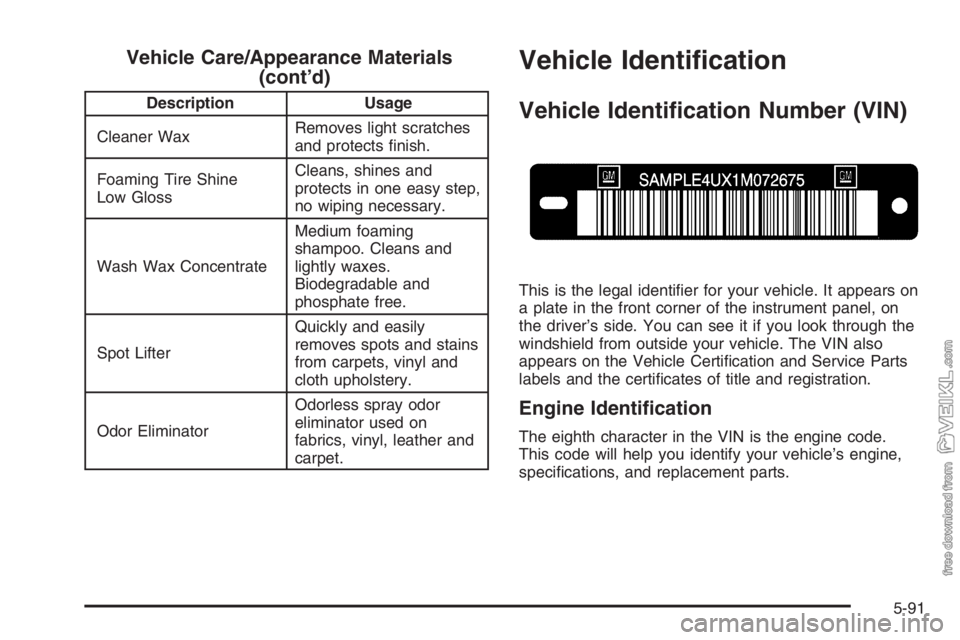
This is the legal identifier for your vehicle. It appears on
a plate in the front corner of the instrument panel, on
the driver’s side. You can see it if you look through the
windshield from outside your vehicle. The VIN also
appears on the Vehicle Certification and Service Parts
labels and the certificates of title and registration.
Engine Identication
The eighth character in the VIN is the engine code.
This code will help you identify your vehicle’s engine,
specifications, and replacement parts.
5-91
Page 320 of 398
Service Statement
One of these statements is on your GVW Rating label.
Here is what each one means.
TRUCK SERVICE:A vehicle made to carry property or
special equipment. It is made for uniform frame
loading. That includes using the vehicle to pull a full
trailer.
TRUCK-TRACTOR:A vehicle made to draw other
vehicles. It is made to carry part of the load of the trailer.
It is made for point frame loading, usually for a
semi-trailer (fifth-wheel).
MAX. VERT. CG:The highest allowable vertical center
of gravity, at the highest allowable GVWR. It is
measured from the level ground in inches.
TRUCK-CANADA:A vehicle first sold in Canada with a
non-school bus application, or cab models with regular
production option RQ2 (truck service).
TRACTOR-CANADA:A cab model first sold in Canada
with regular production option RQ3 (truck-tractor
service).
Service Parts Identication Label
You will find this label in a location determined by the
body manufacturer. It is very helpful if you ever need to
order parts. On this label, you will find the following:
•VIN
•Model designation
•Paint information
•Production options and special equipment
Do not remove this label from the vehicle.
Electrical System
Add-On Electrical Equipment
Notice:Do not add anything electrical to your
vehicle unless you check with your dealer rst.
Some electrical equipment can damage your vehicle
and the damage would not be covered by your
warranty. Some add-on electrical equipment can
keep other components from working as they
should.
5-92
Page 335 of 398
Maintenance Schedule......................................6-2
Introduction...................................................6-2
Maintenance Requirements..............................6-2
Your Vehicle and the Environment....................6-2
How This Section is Organized.........................6-3
Part A: Scheduled Maintenance Services...........6-4
Using the Maintenance Schedule......................6-4
Scheduled Maintenance Supplements................6-4Scheduled Maintenance...................................6-5
Part B: Owner Checks and Services................6-28
At Each Fuel Fill..........................................6-28
At Least Twice a Year...................................6-29
At Least Once a Year...................................6-32
Part C: Recommended Fluids and Lubricants. . . .6-33
Part D: Maintenance Record..........................6-35
Section 6 Maintenance Schedule
6-1
Page 337 of 398
How This Section is Organized
This maintenance schedule is divided into four parts:
“Part A: Scheduled Maintenance Services”explains
what to have done and how often. Some of these
services can be complex, so unless you are technically
qualified and have the necessary equipment, you
should let your GM dealer’s service department do
these jobs.
Your GM dealer has GM-trained and supported service
people that will perform the work using genuine GM parts.
{CAUTION:
Performing maintenance work on a vehicle can
be dangerous. In trying to do some jobs, you
can be seriously injured. Do your own
maintenance work only if you have the
required know-how and the proper tools and
equipment for the job. If you have any doubt,
have a qualied technician do the work. See
Doing Your Own Service Work on page 5-4.
If you want to purchase service information, seeService
Publications Ordering Information on page 7-11.“Part B: Owner Checks and Services”tells you what
should be checked and when. It also explains what
you can easily do to keep your vehicle in good condition.
“Part C: Recommended Fluids and Lubricants”
lists some recommended products necessary to help
keep your vehicle properly maintained. These products,
or their equivalents, should be used whether you do
the work yourself or have it done.
“Part D: Maintenance Record”is a place for you to
record and keep track of the maintenance performed on
your vehicle. Keep your maintenance receipts. They
may be needed to qualify your vehicle for warranty
repairs.
6-3
Page 338 of 398
Part A: Scheduled Maintenance
Services
In this part are scheduled maintenance services which
are to be performed at the mileage intervals specified.
Using the Maintenance Schedule
We at General Motors want to help keep your vehicle in
good working condition. But we do not know exactly
how you will drive it. You may drive very short distances
only a few times a week. Or you may drive long
distances all the time in very hot, dusty weather. You
may use your vehicle in making deliveries or in
many other ways.
Because of all the different ways people use their
vehicles, maintenance needs vary. You may need more
frequent checks and replacements. So please read
the following and note how you drive. If you have any
questions on how to keep your vehicle in good condition,
see your dealer.
This part tells you the maintenance services you should
have done and when to schedule them.
When you go to your dealer for your service needs, you
will know that GM-trained and supported service
people will perform the work using genuine GM parts.The proper fluids and lubricants to use are listed in
Part C. Make sure whoever services your vehicle uses
these. All parts should be replaced and all necessary
repairs done before you or anyone else drives the
vehicle.
This schedule is for vehicles that:
•carry passengers and cargo within recommended
limits. You will find limits on your vehicle’s GVW
Rating label. SeeLoading Your Vehicle on
page 4-34.
•are driven on reasonable road surfaces within legal
driving limits.
•use the recommended fuel. SeeGasoline Octane
on page 5-6for gasoline engine vehicles orWhat
Fuel to Use on page 5-8for diesel engine vehicles.
Scheduled Maintenance
Supplements
If your vehicle has a Caterpillar®diesel engine, your
owner’s manual is supplemented by the Caterpillar®
Diesel Engine Operation & Maintenance Manual. If your
vehicle has an Allison Transmission®, your owner’s
manual is supplemented by an Allison Transmission®
Operator’s Manual. Always refer to these manuals
for related maintenance services.
6-4
Page 339 of 398
Scheduled Maintenance
The services shown in this schedule up to 100,000 miles
(166 000 km) should be repeated after 100,000 miles
(166 000 km) at the same intervals for the life of
this vehicle. The services shown after 100,000 miles
(166 000 km) should be repeated at the same miles (km)
after those intervals for the life of this vehicle.
Gasoline engine vehicles and some DURAMAX
®diesel
engine vehicles have a computer that lets you know
when to change your engine oil. This is not based
on mileage, but on engine operation and engine
temperature. When the computer has calculated that the
oil needs changing, the Engine Oil Life System will
indicate that a change is necessary. SeeEngine Oil Life
System (Gasoline Engine) on page 5-31orEngine Oil
Life System (DURAMAX
®Diesel) on page 5-33or
Engine Oil Life System (Caterpillar®Diesel Engine) on
page 5-34.
The “Footnotes” at the end of this Maintenance
Schedule further explain maintenance services.
SeeService Publications Ordering Information on
page 7-11.
100 Miles (160 km)
❑Wheel stud nut service.(36)
1,000 Miles (1 600 km)
❑Wheel stud nut service.(36)
❑Rear axle air shift motor service.(10)
7,500 Miles (12 000 km)
❑Gasoline Engine Only: Check engine oil life system.
If engine oil and filter are changed, reset system.
See “Engine Oil (Gasoline Engine)” in the
Index.(2) (8)
❑Check fluid levels (or every 3 months, whichever
occurs first).(1) (5)
❑Chassis lubrication service (or every 6 months,
whichever occurs first).(11)
❑Wheels and tires service.(14)
❑Hydraulic brake service (or every 6 months,
whichever occurs first).(6) (36)
❑Parking brake service (or every 6 months, whichever
occurs first).(21)
6-5