light CHEVROLET KODIAK 2007 Owners Manual
[x] Cancel search | Manufacturer: CHEVROLET, Model Year: 2007, Model line: KODIAK, Model: CHEVROLET KODIAK 2007Pages: 430, PDF Size: 6.06 MB
Page 278 of 430
Engine Oil Life System
(DURAMAX
®Diesel)
When to Change Engine Oil
If your vehicle has the Engine Oil Life System, it
has a computer system that lets you know when to
change the engine oil and filter. This is based
on injection timing, engine load and engine
temperature, and not on mileage. Based on driving
conditions, the mileage at which an oil change
will be indicated can vary considerably. For the oil
life system to work properly, you must reset the
system every time the oil is changed.
When the system has calculated that oil life has
been diminished, it will indicate that an oil change
is necessary. A change engine oil light will
come on. SeeChange Engine Oil Light on
page 176. Change your oil as soon as possible
within the next 600 miles (1 000 km) or 30 hours of
engine operation, whichever occurs first. It is
possible that, if you are driving under the best
conditions, the oil life system may not indicate that
an oil change is necessary for over a year.However, your engine oil and filter must be
changed at least once a year and at this time the
system must be reset. Your dealer has
GM-trained service people who will perform this
work using genuine GM parts and reset the
system. It is also important to check your oil
regularly and keep it at the proper level.
If the system is ever reset accidentally, you must
change your oil at 15,000 miles (24 000 km),
or 150 hours of engine operation, whichever
occurs first, since your last oil change. Remember
to reset the oil life system whenever the oil is
changed.
How to Reset the Engine Oil Life
System
The Engine Oil Life System calculates when to
change your engine oil and filter based on vehicle
use. Anytime your oil is changed, reset the
system so it can calculate when the next oil
change is required. If a situation occurs where you
change your oil prior to a change engine oil light
being turned on, reset the system.
278
Page 279 of 430
To reset the Engine Oil Life System, do the
following:
1. Turn the ignition key to RUN with the
engine off.
2. Fully press and release the accelerator pedal
slowly three times within 10 seconds.
If the change engine oil light flashes for
five seconds, the system is resetting.
3. Turn the key to OFF.
If the change engine oil light comes back on when
you start your vehicle, the Engine Oil Life
System has not reset. Repeat the procedure.
What to Do with Used Oil
Used engine oil contains certain elements that may
be unhealthy for your skin and could even cause
cancer. Do not let used oil stay on your skin for very
long. Clean your skin and nails with soap and
water, or a good hand cleaner. Wash or properly
dispose of clothing or rags containing used engine
oil. See the manufacturer’s warnings about the use
and disposal of oil products.Used oil can be a threat to the environment. If you
change your own oil, be sure to drain all the oil
from the filter before disposal. Never dispose of oil
by putting it in the trash, pouring it on the
ground, into sewers, or into streams or bodies of
water. Instead, recycle it by taking it to a place
that collects used oil. If you have a problem
properly disposing of your used oil, ask your
dealer, a service station, or a local recycling
center for help.
Engine Oil Life System
(Caterpillar
®Diesel Engine)
How to Reset the Engine Oil Life
System
The Engine Oil Life System calculates when to
change your engine oil and filter based on vehicle
use. Anytime your oil is changed, reset the
system so it can calculate when the next oil
change is required. If a situation occurs where you
change your oil prior to a change engine oil light
being turned on, reset the system.
279
Page 280 of 430
To reset the Engine Oil Life System, do the
following:
1. Turn the ignition key to RUN with the
engine off.
2. Fully apply and hold the brake pedal while
you fully press and release the accelerator
pedal, pausing slightly at each press and each
release, three times within five seconds.
3. Turn the key to OFF.
If the change engine oil light comes back on when
you start your vehicle, the Engine Oil Life
System has not reset. Repeat the procedure.
Engine Air Cleaner/Filter
The engine air
cleaner/filter is located
in the center of the
engine compartment.
When to Inspect the Engine Air
Cleaner/Filter
If your vehicle has an
air cleaner/filter change
indicator, inspect the
indicator at every
oil change and replace
the filter when the
indicator tells you to.
For vehicles without a change indicator, inspect
the air cleaner/filter at every oil change and
replace the filter at the first oil change after
25,000 miles (40 000 km).
How to Inspect the Engine Air
Cleaner/Filter
Locate the filter change indicator. When the
change indicator turns black or is in the red/orange
change area, replace the filter and reset the
indicator.
280
Page 281 of 430
To inspect the engine air cleaner/filter, remove the
filter from the vehicle and lightly shake the filter
to release loose dust and dirt. If the filter remains
caked with dirt, a new filter is required.
{CAUTION:
Operating the engine with the air cleaner/
lter off can cause you or others to be
burned. The air cleaner not only cleans the
air; it helps to stop ames if the engine
backres. If it is not there and the engine
backres, you could be burned. Do not
drive with it off, and be careful working on
the engine with the air cleaner/lter off.
Notice:If the air cleaner/lter is off, a backre
can cause a damaging engine re. And, dirt
can easily get into your engine, which will
damage it. Always have the air cleaner/lter in
place when you are driving.
Hood Inlet Seal
If your vehicle is being used in heavy snow
conditions or for snow plowing, there is a
possibility of snow and ice build up in the inlet to
the air cleaner, blocking airflow to the engine
and negatively impacting engine performance.
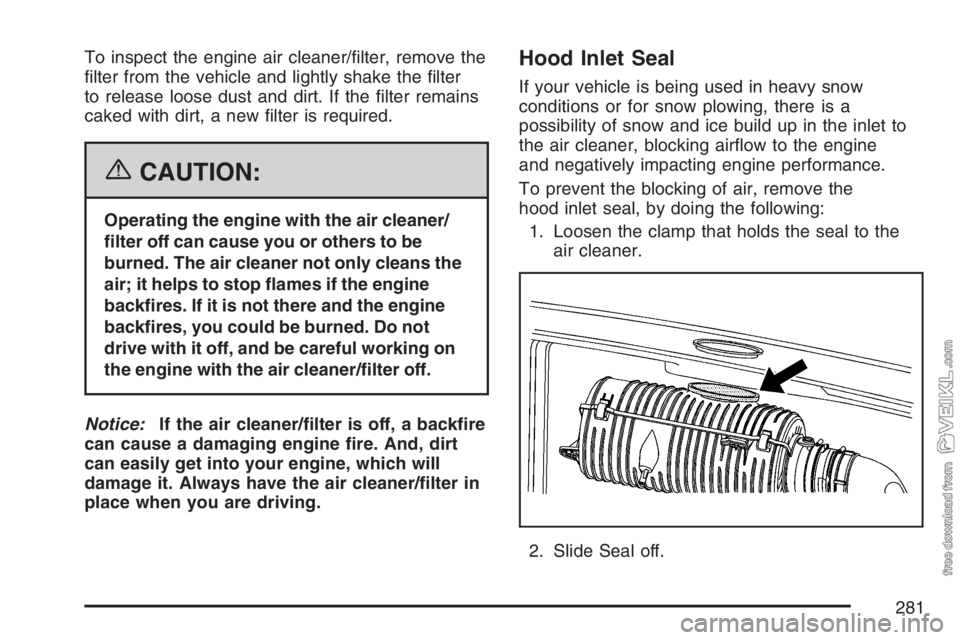
To prevent the blocking of air, remove the
hood inlet seal, by doing the following:
1. Loosen the clamp that holds the seal to the
air cleaner.
2. Slide Seal off.
281
Page 284 of 430
Engine Coolant (Gas and
DURAMAX
®/Isuzu Engines)
The cooling system in your vehicle is filled with
DEX-COOL®engine coolant. This coolant is
designed to remain in your vehicle for five years or
150,000 miles (240 000 km), whichever occurs
first, if you add only DEX-COOL
®extended
life coolant.
The following explains your cooling system and
how to add coolant when it is low. If you have
a problem with engine overheating, seeEngine
Overheating on page 288.A 50/50 mixture of clean, drinkable water and
DEX-COOL
®coolant will:
•Give freezing protection down to
−34°F (−37°C).
•Give boiling protection up to 265°F (129°C).
•Protect against rust and corrosion.
•Help keep the proper engine temperature.
•Let the warning lights and gages work as
they should.
Notice:Using coolant other than
DEX-COOL
®may cause premature engine,
heater core or radiator corrosion. In addition,
the engine coolant may require changing
sooner, at 30,000 miles (50 000 km) or
24 months, whichever occurs rst. Any
repairs would not be covered by your
warranty. Always use DEX-COOL
®
(silicate-free) coolant in your vehicle.
284
Page 287 of 430
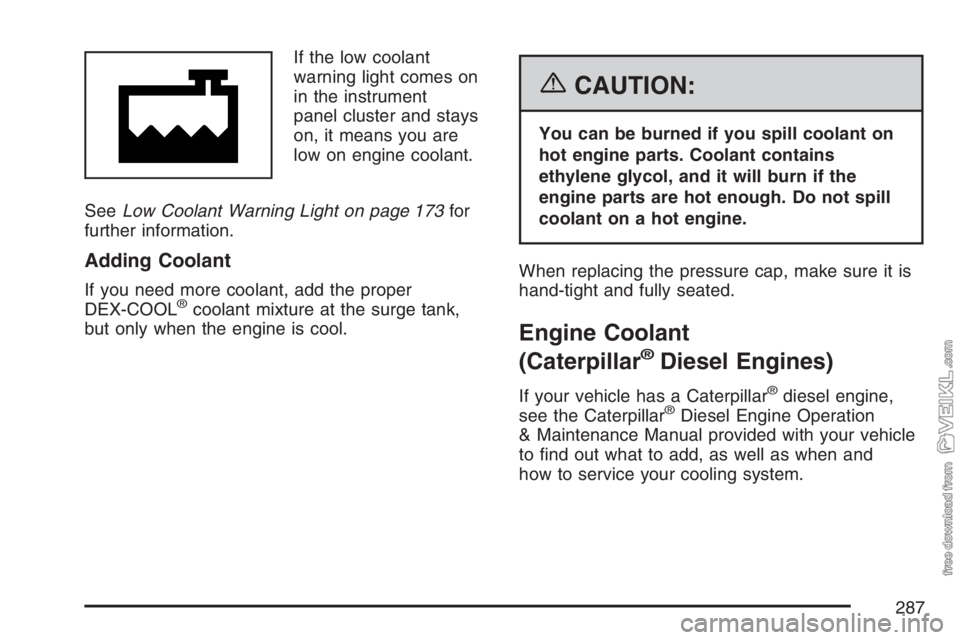
If the low coolant
warning light comes on
in the instrument
panel cluster and stays
on, it means you are
low on engine coolant.
SeeLow Coolant Warning Light on page 173for
further information.
Adding Coolant
If you need more coolant, add the proper
DEX-COOL®coolant mixture at the surge tank,
but only when the engine is cool.
{CAUTION:
You can be burned if you spill coolant on
hot engine parts. Coolant contains
ethylene glycol, and it will burn if the
engine parts are hot enough. Do not spill
coolant on a hot engine.
When replacing the pressure cap, make sure it is
hand-tight and fully seated.
Engine Coolant
(Caterpillar
®Diesel Engines)
If your vehicle has a Caterpillar®diesel engine,
see the Caterpillar®Diesel Engine Operation
& Maintenance Manual provided with your vehicle
to find out what to add, as well as when and
how to service your cooling system.
287
Page 288 of 430
Coolant Surge Tank Pressure Cap
The coolant surge tank pressure cap is located in
the engine compartment, on the driver’s side of
the vehicle.
Notice:Your vehicle’s surge tank pressure cap
is designed for use with medium-duty cooling
systems only. If the surge tank pressure cap is
not tightly installed, coolant loss and possible
engine damage may occur. Be sure the cap is
properly and tightly secured.
Engine Overheating
You will find an engine coolant temperature gage,
as well as a low coolant warning light, on your
vehicle’s instrument panel. SeeEngine Coolant
Temperature Gage on page 173andLow Coolant
Warning Light on page 173for more information.
Your vehicle also has a check gages warning light
on the instrument panel. SeeCheck Gages
Warning Light on page 180for more information.
If Steam Is Coming From Your Engine
{CAUTION:
Steam from an overheated engine can
burn you badly, even if you just open the
hood. Stay away from the engine if you
see or hear steam coming from it. Just
turn it off and get everyone away from the
vehicle until it cools down. Wait until
there is no sign of steam or coolant
before you open the hood.
If you keep driving when your engine is
overheated, the liquids in it can catch re.
You or others could be badly burned.
Stop your engine if it overheats, and get
out of the vehicle until the engine is cool.
Notice:If your engine catches re because
you keep driving with no coolant, your vehicle
can be badly damaged. The costly repairs
would not be covered by your warranty.
288
Page 289 of 430
If No Steam Is Coming From
Your Engine
An overheat warning, along with a low coolant light,
can indicate a serious problem. SeeLow Coolant
Warning Light on page 173for more information.
If you get an engine overheat warning with no low
coolant light, but see or hear no steam, the
problem may not be too serious. Sometimes the
engine can get a little too hot when you:
•Climb a long hill on a hot day.
•Stop after high-speed driving.
•Idle for long periods in traffic.
If you get the overheat warning with no sign of
steam, try this for a minute or so:
1. In heavy traffic, let the engine idle in
NEUTRAL while stopped. If it is safe to do so,
pull off the road, shift to PARK (P) or
NEUTRAL and let the engine idle.
2. Turn on your heater to full hot at the highest
fan speed and open the windows as
necessary.
3. If climbing a hill, downshift to raise engine and
fan speeds.If you no longer have the overheat warning, you
can drive. Just to be safe, drive slower for
about 10 minutes. If the warning does not come
back on, you can drive normally.
If the warning continues and you have not
stopped, pull over, stop, and park your vehicle
right away.
If there is still no sign of steam, you can push
down the accelerator until the engine speed is
about twice as fast as normal idle speed for at least
three minutes while you are parked. If you still have
the warning, turn off the engine and get everyone
out of the vehicle until it cools down.
You may decide not to lift the hood but to get
service help right away.
289
Page 294 of 430
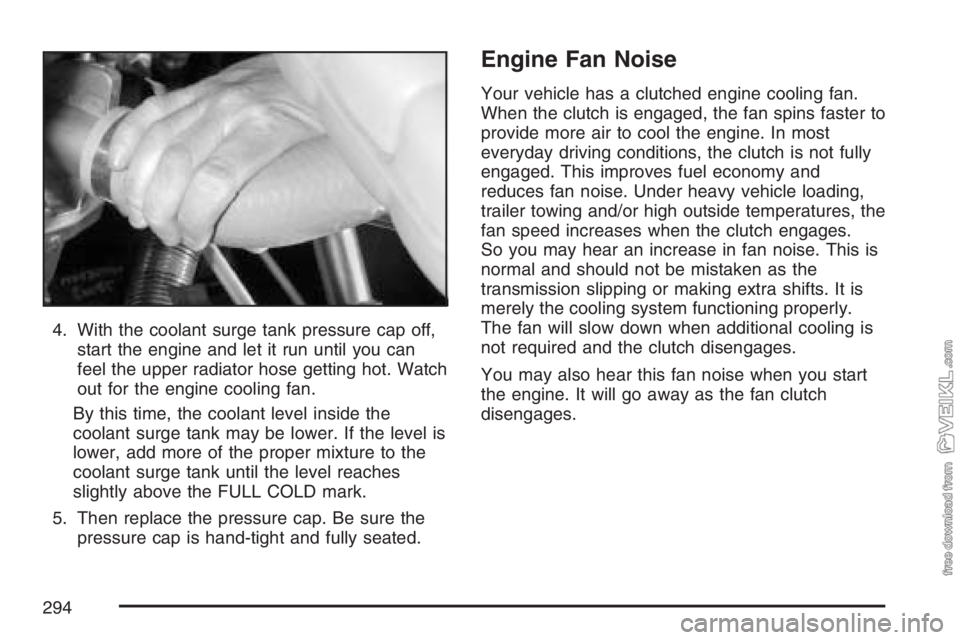
4. With the coolant surge tank pressure cap off,
start the engine and let it run until you can
feel the upper radiator hose getting hot. Watch
out for the engine cooling fan.
By this time, the coolant level inside the
coolant surge tank may be lower. If the level is
lower, add more of the proper mixture to the
coolant surge tank until the level reaches
slightly above the FULL COLD mark.
5. Then replace the pressure cap. Be sure the
pressure cap is hand-tight and fully seated.
Engine Fan Noise
Your vehicle has a clutched engine cooling fan.
When the clutch is engaged, the fan spins faster to
provide more air to cool the engine. In most
everyday driving conditions, the clutch is not fully
engaged. This improves fuel economy and
reduces fan noise. Under heavy vehicle loading,
trailer towing and/or high outside temperatures, the
fan speed increases when the clutch engages.
So you may hear an increase in fan noise. This is
normal and should not be mistaken as the
transmission slipping or making extra shifts. It is
merely the cooling system functioning properly.
The fan will slow down when additional cooling is
not required and the clutch disengages.
You may also hear this fan noise when you start
the engine. It will go away as the fan clutch
disengages.
294
Page 295 of 430
Power Steering Fluid
SeeScheduled Maintenance on page 363to
determine when to check your power steering fluid.
How To Check Power Steering Fluid
Check your power steering fluid only when the
engine is warm. If the engine is not warm, you
probably will not get an accurate reading.
If the fluid level is between the MIN (Minimum) and
MAX (Maximum) marks, you have enough. If you
need fluid, add only enough of the proper fluid to
bring it in between the MIN and MAX marks.
If your power steering fluid level is low, this can
cause the brake or service brakes soon warning
lights to come on. In addition, the steering
effort and emergency brake distance could
increase.If either light remains on after you have added
power steering fluid to the proper level, then shut
off the engine for 10 seconds. This should
reset the brake warning lights. If one or both lights
stay on, see “Hydraulic Brake System Warning
Lights” underBrake System Warning Light
on page 169for more information.
What to Use
To determine what kind of fluid to use, see
Part C: Recommended Fluids and Lubricants on
page 397.
Notice:When adding power steering uid or
making a complete uid change, always
use the proper uid. Failure to use the proper
uid can cause leaks and damage hoses
and seals.
295