light CHEVROLET KODIAK 2007 Owners Manual
[x] Cancel search | Manufacturer: CHEVROLET, Model Year: 2007, Model line: KODIAK, Model: CHEVROLET KODIAK 2007Pages: 430, PDF Size: 6.06 MB
Page 299 of 430
Four-Wheel Disc Brakes
(Hydraulic Only)
Your vehicle has four-wheel disc brakes.
Some driving conditions or climates may cause a
brake squeal when the brakes are first applied
or lightly applied. This does not mean something
is wrong with the brakes.
Brake linings should always be replaced as
complete axle sets.
Four-Wheel and Six-Wheel Drum
Brakes (Air Only)
The brake drums should be removed and
inspected each time the tires are removed for
rotation or changing. When you have the
front brakes replaced, have the rear brakes
inspected, too.
Brake linings should always be replaced as
complete axle sets.
Brake Pedal Travel
See your dealer if the brake pedal does not return
to normal height, or if there is a rapid increase in
pedal travel. This could be a sign that brake service
is needed.
Brake Adjustment
Every time you make a brake stop, the brakes
adjust for wear.
Brake Adjustment on Air Braked
Vehicles
Your vehicle has automatic slack adjusters.
Every time you make a brake stop, the brakes
automatically adjust for wear. Slack adjusters
should never be manually adjusted to correct
excessive brake chamber pushrod stroke.
Excessive brake chamber pushrod stroke means
that the brake system needs to be serviced by
a qualified service technician.
Notice:Do not manually adjust automatic slack
adjusters. Manual adjustment of the automatic
slack adjusters can result in a degradation of
the slack adjuster performance over time.
If the brake chamber pushrod stroke is out of
adjustment, the brake system needs to be
serviced by a qualied service technician.
299
Page 306 of 430
Notice:Ignoring these steps could result in
costly damage to your vehicle that would
not be covered by your warranty.
Trying to start your vehicle by pushing or
pulling it will not work, and it could damage
your vehicle.
1. Check the other vehicle. It must have a
12-volt battery (or batteries) with a negative
ground system.
Notice:If the other vehicle’s system is not a
12-volt system with a negative ground,
both vehicles can be damaged. Only use
vehicles with 12-volt systems with negative
grounds to jump start your vehicle.
If you have a diesel engine vehicle with
two batteries (or more), you should know
before you begin that, especially in cold
weather, you may not be able to get enough
power from a single battery in another
vehicle to start your diesel engine.
If your vehicle has more than one battery, use
the one closest to the starter — this will
reduce electrical resistance.2. Get the vehicles close enough so the jumper
cables can reach, but be sure the vehicles are
not touching each other. If they are, it could
cause a ground connection you do not
want. You would not be able to start your
vehicle, and the bad grounding could damage
the electrical systems.
To avoid the possibility of the vehicles rolling,
set the parking brake firmly on both vehicles
involved in the jump start procedure. Put
an automatic transmission in PARK (P) or a
manual transmission in NEUTRAL before
setting the parking brake. If you have a
four-wheel-drive vehicle, be sure the transfer
case is in a drive gear, not in NEUTRAL.
Notice:If you leave your radio or other
accessories on during the jump starting
procedure, they could be damaged. The repairs
would not be covered by your warranty.
Always turn off your radio and other
accessories when jump starting your vehicle.
3. Turn off the ignition on both vehicles. Unplug
unnecessary accessories plugged into the
cigarette lighter or accessory power outlets.
306
Page 307 of 430
Turn off the radio and all lamps that are not
needed. This will avoid sparks and help save
both batteries, and it could save the radio!
4. Open the hood on the other vehicle and
locate the positive (+) and the negative (−)
terminal locations on that vehicle.
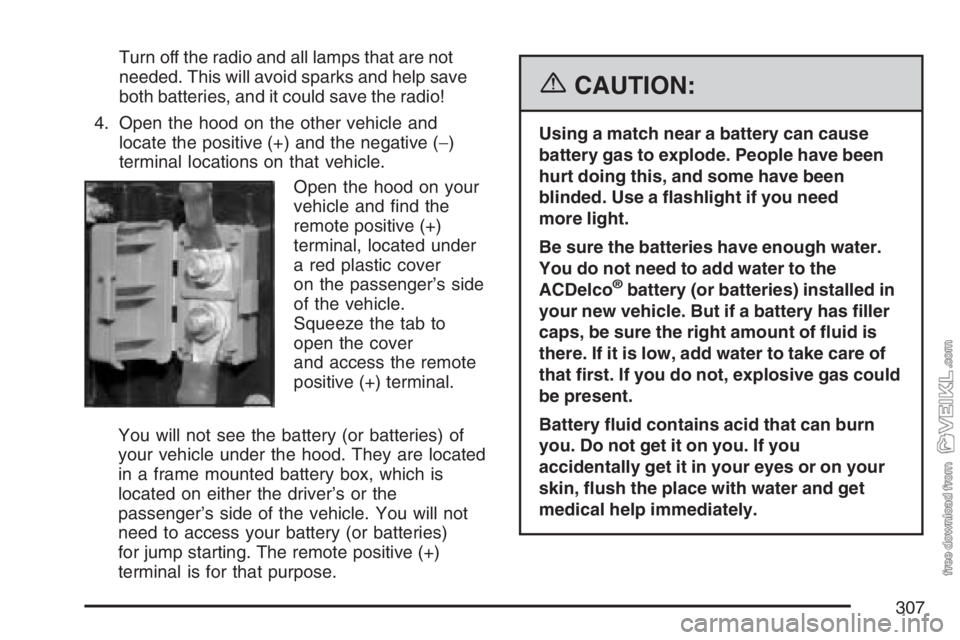
Open the hood on your
vehicle and find the
remote positive (+)
terminal, located under
a red plastic cover
on the passenger’s side
of the vehicle.
Squeeze the tab to
open the cover
and access the remote
positive (+) terminal.
You will not see the battery (or batteries) of
your vehicle under the hood. They are located
in a frame mounted battery box, which is
located on either the driver’s or the
passenger’s side of the vehicle. You will not
need to access your battery (or batteries)
for jump starting. The remote positive (+)
terminal is for that purpose.
{CAUTION:
Using a match near a battery can cause
battery gas to explode. People have been
hurt doing this, and some have been
blinded. Use a ashlight if you need
more light.
Be sure the batteries have enough water.
You do not need to add water to the
ACDelco
®battery (or batteries) installed in
your new vehicle. But if a battery has ller
caps, be sure the right amount of uid is
there. If it is low, add water to take care of
that rst. If you do not, explosive gas could
be present.
Battery uid contains acid that can burn
you. Do not get it on you. If you
accidentally get it in your eyes or on your
skin, ush the place with water and get
medical help immediately.
307
Page 319 of 430
To change an empty ether cylinder, follow
these steps.
1. Loosen the screw head on the
cylinder-to-bracket clamp.
2. Spread the clamp apart.
3. Clean any dirt from the neck of the cylinder
and the top of the valve before you take out
the cylinder.
4. Check the inside of the valve for any foreign
matter. Clean the valve as necessary.
5. Cover the valve to protect it from dirt and take
out the cylinder.
6. Install a new gasket whenever you take out
the cylinder. Use only one gasket and spread
a light film of clean oil on it before installation.
7. Put in the new cylinder. Turn it clockwise until
it just starts to contact the gasket.
8. Tighten the cylinder another half turn
(180 degrees). Don’t over-tighten.
9. Retighten the cylinder clamp.Front Wheel Bearings with
Oil-Filled Hubs
Notice:If you drive your vehicle through deep
water that is higher than the front or rear
axle, water may enter the axle housing and
cause the axle lubricant to break down.
This could damage the gears inside. Avoid
driving your vehicle through deep water.
You should avoid driving your vehicle through
deep puddles or standing water. If you must drive
through water that is higher than the front or
rear axle, see your dealer immediately afterward
to have the condition of the axle lubricant checked.
319
Page 331 of 430
Your truck, when new, did not include tire changing
equipment or a place to store a tire in the
vehicle. Few drivers of these vehicles have the
necessary equipment aboard to be able to change
a flat tire safely. For example, you would need
a truck jack that can lift several thousand pounds
and a torque wrench that can generate several
hundred foot-pounds (
Y) of twisting force.
{CAUTION:
If you try to put air back into a tire that
has run at, even a tire that was extremely
low on air, the tire can have a sudden
air-out. This could cause you to lose
control of the vehicle and have a serious
crash. Do not rell a at or very low tire
with air without rst having the tire taken
off the wheel and checked for damage.
So if you are stopped somewhere by a flat or
damaged tire or wheel, you should get expert help.
SeeRoadside Assistance Program on page 408.
Appearance Care
Cleaning the Inside of Your Vehicle
Your vehicle’s interior will continue to look its
best if it is cleaned often. Although not always
visible, dust and dirt can accumulate on your
upholstery. Dirt can damage carpet, fabric, leather,
and plastic surfaces. Regular vacuuming is
recommended to remove particles from your
upholstery. It is important to keep your upholstery
from becoming and remaining heavily soiled.
Soils should be removed as quickly as possible.
Your vehicle’s interior may experience extremes of
heat that could cause stains to set rapidly.
Lighter colored interiors may require more frequent
cleaning. Use care because newspapers and
garments that transfer color to your home
furnishings may also transfer color to your
vehicle’s interior.
331
Page 339 of 430
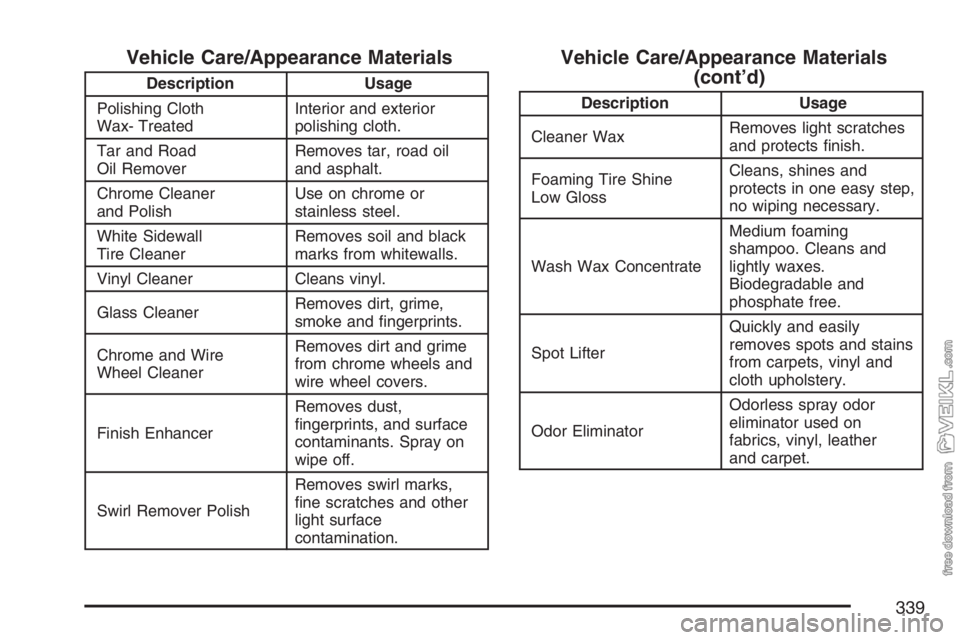
Vehicle Care/Appearance Materials
Description Usage
Polishing Cloth
Wax- TreatedInterior and exterior
polishing cloth.
Tar and Road
Oil RemoverRemoves tar, road oil
and asphalt.
Chrome Cleaner
and PolishUse on chrome or
stainless steel.
White Sidewall
Tire CleanerRemoves soil and black
marks from whitewalls.
Vinyl Cleaner Cleans vinyl.
Glass CleanerRemoves dirt, grime,
smoke and fingerprints.
Chrome and Wire
Wheel CleanerRemoves dirt and grime
from chrome wheels and
wire wheel covers.
Finish EnhancerRemoves dust,
fingerprints, and surface
contaminants. Spray on
wipe off.
Swirl Remover PolishRemoves swirl marks,
fine scratches and other
light surface
contamination.
Vehicle Care/Appearance Materials
(cont’d)
Description Usage
Cleaner WaxRemoves light scratches
and protects finish.
Foaming Tire Shine
Low GlossCleans, shines and
protects in one easy step,
no wiping necessary.
Wash Wax ConcentrateMedium foaming
shampoo. Cleans and
lightly waxes.
Biodegradable and
phosphate free.
Spot LifterQuickly and easily
removes spots and stains
from carpets, vinyl and
cloth upholstery.
Odor EliminatorOdorless spray odor
eliminator used on
fabrics, vinyl, leather
and carpet.
339
Page 341 of 430
Headlamp Wiring
The headlamp wiring is protected by a circuit
breaker in the light switch. An electrical overload
will cause the lights to go on and off, or in
some cases to remain off. If this happens, have
your headlamp wiring checked right away.
Windshield Wiper Fuses
The windshield wiper motor is protected by a
circuit breaker inside the motor and a circuit
breaker or fuse in the fuse block. If the motor
overheats, the wipers will stop until the motor
cools. If the overload is caused by an electrical
problem, be sure to get it fixed.
Fusible Links
A fusible link is a short piece of wire several gauge
sizes smaller than the circuit it protects. It will melt
in an overload situation, opening the circuit.
Your starter and other circuits have these fusible
links. The size is printed on the insulation. If the
insulation is burned beyond recognition, consult
your dealer for the proper size. Replace a fusiblelink with one of the same size and insulation type.
Fusible link insulation is a special purpose
high-temperature material.
Some examples of circuits with fusible links are
the hydraulic brake booster motor feed circuit, the
generator output circuit, and the intake heater
feed circuit in vehicles with a diesel engine.
Power Windows and Other
Power Options
Circuit breakers in the fuse panel protect the power
windows and other power accessories. When the
current load is too heavy, the circuit breaker opens.
This protects the circuit until the current load returns
to normal or the problem is fixed.
Fuses and Circuit Breakers
The wiring circuits in your vehicle are protected
from short circuits by a combination of fuses, circuit
breakers, maxi-fuses and fusible links. This greatly
reduces the chance of a fire caused by an electrical
problem. There may be a fuse taped to the wiring
harness near the hydraulic brake booster.
341
Page 343 of 430
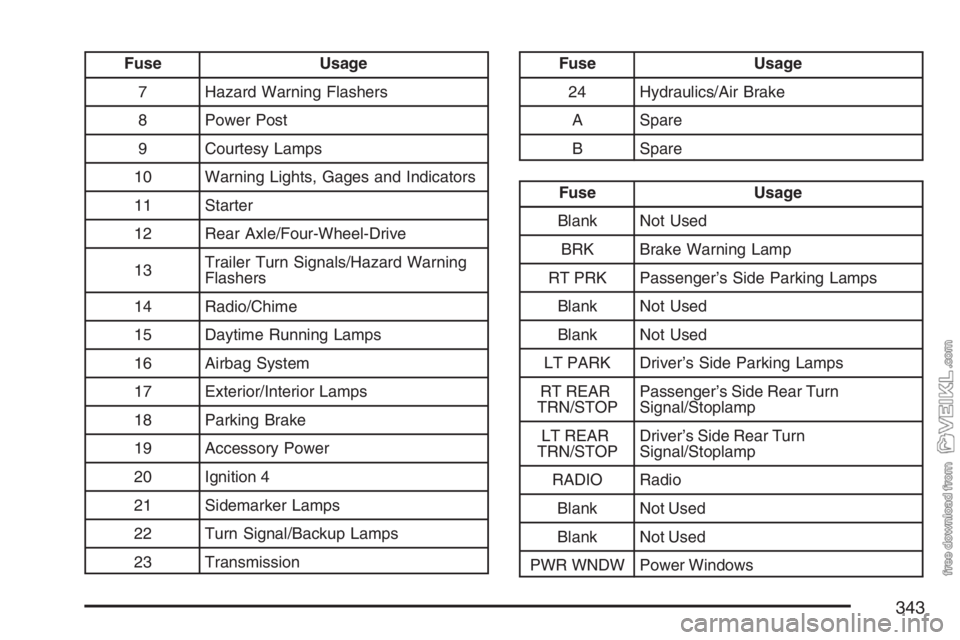
Fuse Usage
7 Hazard Warning Flashers
8 Power Post
9 Courtesy Lamps
10 Warning Lights, Gages and Indicators
11 Starter
12 Rear Axle/Four-Wheel-Drive
13Trailer Turn Signals/Hazard Warning
Flashers
14 Radio/Chime
15 Daytime Running Lamps
16 Airbag System
17 Exterior/Interior Lamps
18 Parking Brake
19 Accessory Power
20 Ignition 4
21 Sidemarker Lamps
22 Turn Signal/Backup Lamps
23 TransmissionFuse Usage
24 Hydraulics/Air Brake
A Spare
B Spare
Fuse Usage
Blank Not Used
BRK Brake Warning Lamp
RT PRK Passenger’s Side Parking Lamps
Blank Not Used
Blank Not Used
LT PARK Driver’s Side Parking Lamps
RT REAR
TRN/STOPPassenger’s Side Rear Turn
Signal/Stoplamp
LT REAR
TRN/STOPDriver’s Side Rear Turn
Signal/Stoplamp
RADIO Radio
Blank Not Used
Blank Not Used
PWR WNDW Power Windows
343
Page 346 of 430
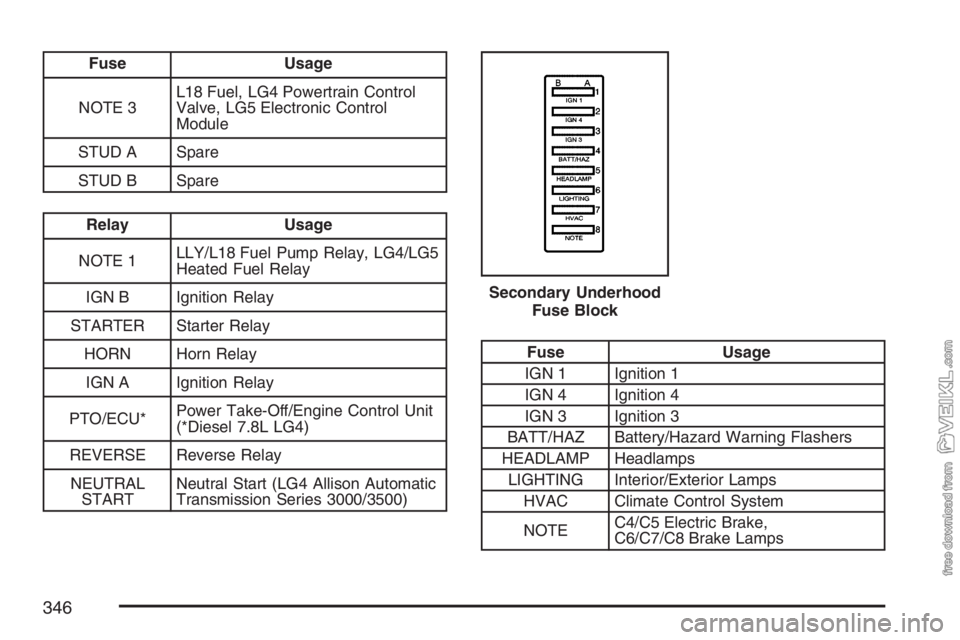
Fuse Usage
NOTE 3L18 Fuel, LG4 Powertrain Control
Valve, LG5 Electronic Control
Module
STUD A Spare
STUD B Spare
Relay Usage
NOTE 1LLY/L18 Fuel Pump Relay, LG4/LG5
Heated Fuel Relay
IGN B Ignition Relay
STARTER Starter Relay
HORN Horn Relay
IGN A Ignition Relay
PTO/ECU*Power Take-Off/Engine Control Unit
(*Diesel 7.8L LG4)
REVERSE Reverse Relay
NEUTRAL
STARTNeutral Start (LG4 Allison Automatic
Transmission Series 3000/3500)
Fuse Usage
IGN 1 Ignition 1
IGN 4 Ignition 4
IGN 3 Ignition 3
BATT/HAZ Battery/Hazard Warning Flashers
HEADLAMP Headlamps
LIGHTING Interior/Exterior Lamps
HVAC Climate Control System
NOTEC4/C5 Electric Brake,
C6/C7/C8 Brake Lamps Secondary Underhood
Fuse Block
346
Page 390 of 430
•Replace the air compressor filter element,
mounted on the air compressor. For remote
air compressor intake service, refer to engine
air cleaner filter replacement.
•Remove, disassemble, clean, and inspect the
safety valve, service brake chambers, quick
release valves, quick release/double check
valve combinations, parking brake control
valve, double check valves, pressure
protection valves, and ether injector
(if equipped).
•Remove, disassemble, and clean the
application valve; replace parts showing wear.
•Remove, disassemble, clean, and inspect
the spring brake control valve; replace
rubber parts.
(33)= Clean and lubricate air brake automatic
slack adjuster. Check pushrod travel and
auto adjustment operation. Have serviced
if needed.(34)= Air brake chamber service: Check operation,
mounting clamps, and air lines and check for leaks.
(35)= Trailer brake hand control valve service:
Check operation; lubricate cam and follower.
(36)= Tighten the wheel stud nuts to the specified
torque values at 100 miles (160 km). Thereafter,
tighten them 1,000 miles (1 600 km) after each
time the wheel is removed. SeeTightening
the Wheel Nuts on page 325.
(37)= Inspect and clean any accumulated dirt,
gravel, or other foreign objects from the valves and
valve boots as needed. Using light oil, lubricate
brake pedal to brake application valve linkage
components. Check any rubber boots for cracks,
holes, or deterioration and replace if necessary.
390