service CHEVROLET KODIAK 2007 Owners Manual
[x] Cancel search | Manufacturer: CHEVROLET, Model Year: 2007, Model line: KODIAK, Model: CHEVROLET KODIAK 2007Pages: 430, PDF Size: 6.06 MB
Page 390 of 430
•Replace the air compressor filter element,
mounted on the air compressor. For remote
air compressor intake service, refer to engine
air cleaner filter replacement.
•Remove, disassemble, clean, and inspect the
safety valve, service brake chambers, quick
release valves, quick release/double check
valve combinations, parking brake control
valve, double check valves, pressure
protection valves, and ether injector
(if equipped).
•Remove, disassemble, and clean the
application valve; replace parts showing wear.
•Remove, disassemble, clean, and inspect
the spring brake control valve; replace
rubber parts.
(33)= Clean and lubricate air brake automatic
slack adjuster. Check pushrod travel and
auto adjustment operation. Have serviced
if needed.(34)= Air brake chamber service: Check operation,
mounting clamps, and air lines and check for leaks.
(35)= Trailer brake hand control valve service:
Check operation; lubricate cam and follower.
(36)= Tighten the wheel stud nuts to the specified
torque values at 100 miles (160 km). Thereafter,
tighten them 1,000 miles (1 600 km) after each
time the wheel is removed. SeeTightening
the Wheel Nuts on page 325.
(37)= Inspect and clean any accumulated dirt,
gravel, or other foreign objects from the valves and
valve boots as needed. Using light oil, lubricate
brake pedal to brake application valve linkage
components. Check any rubber boots for cracks,
holes, or deterioration and replace if necessary.
390
Page 391 of 430
Part B: Owner Checks and Services
Listed in this part are owner checks and services
which should be performed at the intervals
specified to help ensure the safety, dependability
and emission control performance of your
vehicle.
For your safety and that of others, any of the
safety-related components that may have been
damaged in an accident should be checked
and any needed repairs made before operating
the vehicle.
At the minimum, these routine checks should be
made every 6 months or 6,000 miles (10 000 km),
whichever occurs first. Whenever repairs are
needed, have them completed before operating
the vehicle.
At Each Fuel Fill
It is important for you or a service station attendant
to perform these underhood checks at each fuel ll.
Engine Oil Level Check
Check the engine oil level and add the proper
oil if necessary. SeeEngine Oil (Caterpillar®
Diesel Engine) on page 268orEngine Oil
(Gasoline Engine) on page 268orEngine Oil
(DURAMAX
®/Isuzu Diesel Engine) on page 272.
Engine Coolant Level Check
Check the engine coolant level and add
DEX-COOL®coolant mixture if necessary. See
Engine Coolant (Gas and DURAMAX®/Isuzu
Engines) on page 284orEngine Coolant
(Caterpillar
®Diesel Engines) on page 287.
Windshield Washer Fluid Level Check
Check the windshield washer fluid level in the
windshield washer fluid reservoir and add
the proper fluid if necessary. SeeWindshield
Washer Fluid on page 296.
Tire Ination Check
Check tire inflation cold. Make sure the tires are
inflated to the correct pressures. SeeLoading Your
Vehicle on page 238andInation - Tire Pressure
on page 322.
391
Page 392 of 430
At Least Twice a Year
Restraint System Check
Make sure the safety belt reminder light (if
equipped) and all your belts, buckles, latch plates,
retractors, and anchorages are working properly.
Look for any other loose or damaged safety
belt system parts. If you see anything that might
keep a safety belt system from doing its job,
have it repaired. Have any torn or frayed safety
belts replaced.
Wiper Blade Check
Inspect wiper blades for wear or cracking. Replace
blade inserts that appear worn or damaged or
that streak or miss areas of the windshield. Also
seeWindshield and Wiper Blades on page 336.
Weatherstrip Lubrication
Silicone grease on weatherstrips will make them
last longer, seal better, and not stick or squeak.
Apply silicone grease with a clean cloth. During
very cold, damp weather more frequent application
may be required. Part C tells you what to use.
Body Lubrication Service
Lubricate all exposed surfaces such as door
checks, door lock bolts, lock strike plates, door
hinge bushings, latches, and dovetail bumper
wedges. Where oil holes are provided, a dripless
oil can be used. The seat adjusters, seat track,
door weatherstrips, and rubber cap bumpers
should also be lubricated. Part C tells you what to
use. More frequent lubrication may be required
when exposed to a corrosive environment.
Parking Brake Check
Park on a fairly steep hill and hold the vehicle with
the parking brake only. This checks holding ability.
392
Page 393 of 430
Starter Switch Check
{CAUTION:
When you are doing this inspection, the
vehicle could move suddenly. If the vehicle
moves, you or others could be injured.
1. Before you start, be sure you have enough
room around the vehicle.
2. Firmly apply both the parking brake and the
regular brakes.
Do not use the accelerator pedal, and be ready
to turn off the engine immediately if it starts.
3. On automatic transmission vehicles, try to
start the engine in each gear. The starter
should work only in PARK (P), if equipped,
or NEUTRAL (N). If the starter works in
any other position, your vehicle needs service.
On manual transmission vehicles, the starter
should work only when the clutch pedal is
all the way down.
Automatic Transmission Shift
Indicator Check
Check that the indicator points to the gear chosen.
Steering Check
Be alert for any changes in steering action,
abnormal front tire wear or steering wheel position.
An inspection or service is needed when the
steering wheel is harder to turn or has too much
free play, or if there are strange sounds when
turning or parking.
Brake System Check
Be alert to illumination of the low air warning lamp
or for the tone alarm, or changes in braking
action, such as repeated pulling to one side,
unusual sounds when braking or increased
brake pedal travel. Make sure air brake system
reservoirs are drained daily with full system
air pressure, and check system for leaks.
Any of these conditions could indicate the need
for brake system inspection and/or service.
393
Page 394 of 430
Engine Cooling System Service
Inspect the hoses and have them replaced if
they are cracked, swollen, or deteriorated.
Inspect all pipes, fittings, and clamps; replace as
needed. Clean the outside of the radiator and
air conditioning condenser. To help ensure
proper operation, a pressure test of the cooling
system and pressure cap is recommended
at least once a year.
Exhaust System Check
Be alert for any changes in the sound of the
exhaust system or any smell of fumes. These
are signs the system may be leaking. Have
it checked and/or repaired at once. Refer to
Engine Exhaust on page 131andRunning
the Engine While Parked on page 132.
Windshield Wipers and Washers Check
Check operation and condition of the wiper
blades. Check the flow of the washer spray.
Defroster Check
Move the control to the defrost symbol and the fan
to HI or the high symbol. Then check the airflow
from the ducts at the inside base of the windshield.
Mirrors and Sun Visors Check
Check that friction joints hold mirrors and sun
visors in place.
Seat Adjuster Check
When adjusting a manual seat, be sure seat
adjusters latch by attempting to move the seat
after latching.
394
Page 396 of 430
Underbody Inspection
Corrosive materials used for ice, snow removal,
and dust control can collect on the underbody.
If these materials are not removed, accelerated
corrosion (rust) can occur on underbody parts
such as fuel lines, frame, floor pan, and exhaust
system. At least every spring, flush these materials
from the underbody with plain water. Take care
to clean well any areas where mud and other
debris can collect. Sediment packed in closed
areas of the frame should be loosened before
being flushed.
Engine Cover Check
Check that the cab’s engine cover and seal
(if equipped) are not torn or damaged.
Be sure that the cover is clamped down firmly
to the floor.
At Least Once a Year
Key Lock Cylinders Service
Lubricate the key lock cylinders with the lubricant
specified in Part C.
Underbody Flushing Service
At least every spring, use plain water to flush
any corrosive materials from the underbody.
Take care to clean thoroughly any areas where
mud and other debris can collect.
Tractor Protection (Breakaway)
Valve Check
On air brake models, remove, disassemble,
clean, and inspect the tractor protection
(breakaway) valve.
396
Page 400 of 430
Part D: Maintenance Record
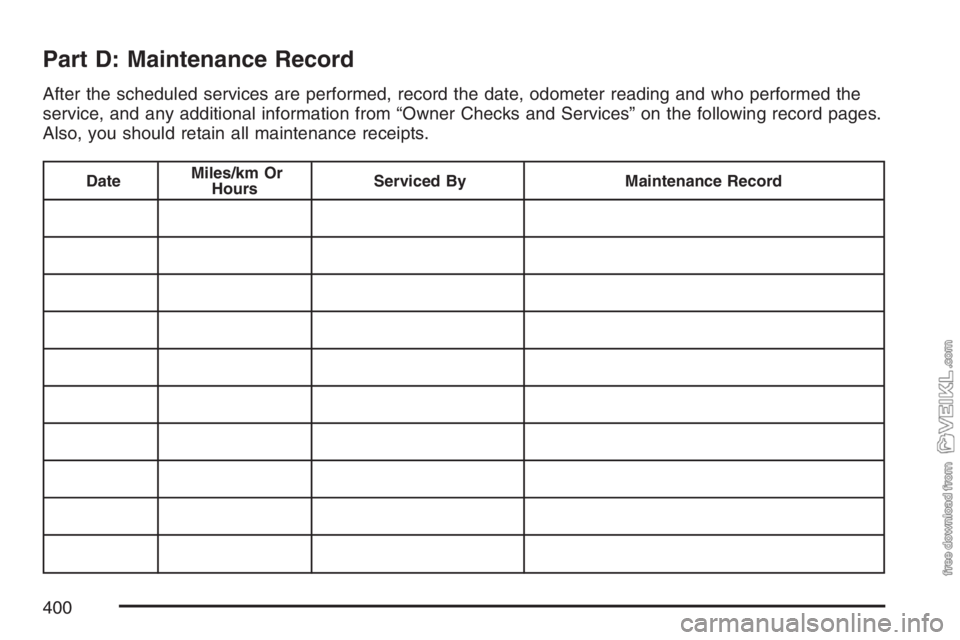
After the scheduled services are performed, record the date, odometer reading and who performed the
service, and any additional information from “Owner Checks and Services” on the following record pages.
Also, you should retain all maintenance receipts.
DateMiles/km Or
HoursServiced By Maintenance Record
400
Page 401 of 430
DateMiles/km Or
HoursServiced By Maintenance Record
401
Page 402 of 430
DateMiles/km Or
HoursServiced By Maintenance Record
402
Page 403 of 430
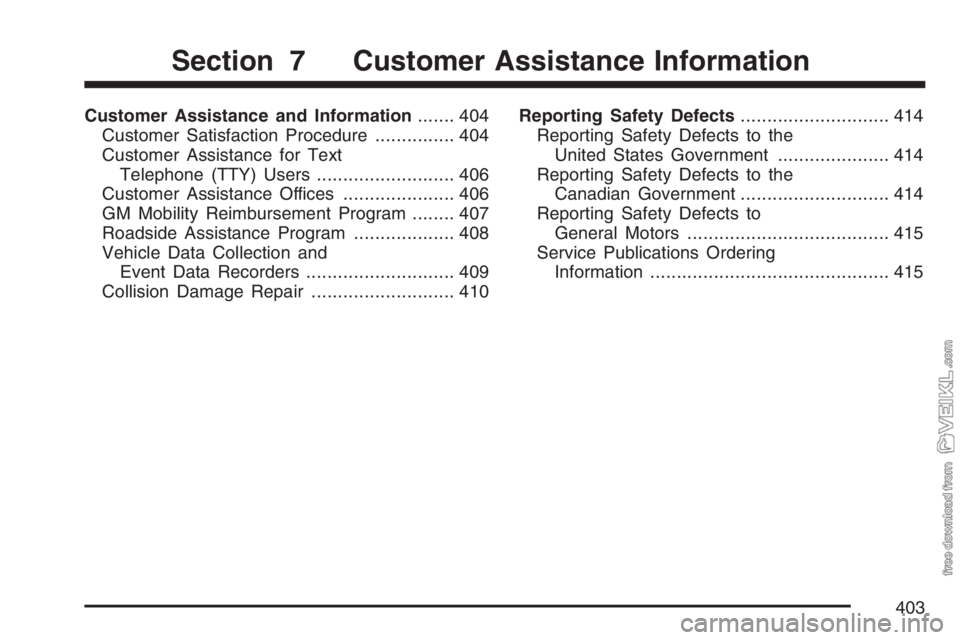
Customer Assistance and Information....... 404
Customer Satisfaction Procedure............... 404
Customer Assistance for Text
Telephone (TTY) Users.......................... 406
Customer Assistance Offices..................... 406
GM Mobility Reimbursement Program........ 407
Roadside Assistance Program................... 408
Vehicle Data Collection and
Event Data Recorders............................ 409
Collision Damage Repair........................... 410Reporting Safety Defects............................ 414
Reporting Safety Defects to the
United States Government..................... 414
Reporting Safety Defects to the
Canadian Government............................ 414
Reporting Safety Defects to
General Motors...................................... 415
Service Publications Ordering
Information............................................. 415
Section 7 Customer Assistance Information
403