service CHEVROLET KODIAK 2007 Workshop Manual
[x] Cancel search | Manufacturer: CHEVROLET, Model Year: 2007, Model line: KODIAK, Model: CHEVROLET KODIAK 2007Pages: 430, PDF Size: 6.06 MB
Page 295 of 430
Power Steering Fluid
SeeScheduled Maintenance on page 363to
determine when to check your power steering fluid.
How To Check Power Steering Fluid
Check your power steering fluid only when the
engine is warm. If the engine is not warm, you
probably will not get an accurate reading.
If the fluid level is between the MIN (Minimum) and
MAX (Maximum) marks, you have enough. If you
need fluid, add only enough of the proper fluid to
bring it in between the MIN and MAX marks.
If your power steering fluid level is low, this can
cause the brake or service brakes soon warning
lights to come on. In addition, the steering
effort and emergency brake distance could
increase.If either light remains on after you have added
power steering fluid to the proper level, then shut
off the engine for 10 seconds. This should
reset the brake warning lights. If one or both lights
stay on, see “Hydraulic Brake System Warning
Lights” underBrake System Warning Light
on page 169for more information.
What to Use
To determine what kind of fluid to use, see
Part C: Recommended Fluids and Lubricants on
page 397.
Notice:When adding power steering uid or
making a complete uid change, always
use the proper uid. Failure to use the proper
uid can cause leaks and damage hoses
and seals.
295
Page 299 of 430
Four-Wheel Disc Brakes
(Hydraulic Only)
Your vehicle has four-wheel disc brakes.
Some driving conditions or climates may cause a
brake squeal when the brakes are first applied
or lightly applied. This does not mean something
is wrong with the brakes.
Brake linings should always be replaced as
complete axle sets.
Four-Wheel and Six-Wheel Drum
Brakes (Air Only)
The brake drums should be removed and
inspected each time the tires are removed for
rotation or changing. When you have the
front brakes replaced, have the rear brakes
inspected, too.
Brake linings should always be replaced as
complete axle sets.
Brake Pedal Travel
See your dealer if the brake pedal does not return
to normal height, or if there is a rapid increase in
pedal travel. This could be a sign that brake service
is needed.
Brake Adjustment
Every time you make a brake stop, the brakes
adjust for wear.
Brake Adjustment on Air Braked
Vehicles
Your vehicle has automatic slack adjusters.
Every time you make a brake stop, the brakes
automatically adjust for wear. Slack adjusters
should never be manually adjusted to correct
excessive brake chamber pushrod stroke.
Excessive brake chamber pushrod stroke means
that the brake system needs to be serviced by
a qualified service technician.
Notice:Do not manually adjust automatic slack
adjusters. Manual adjustment of the automatic
slack adjusters can result in a degradation of
the slack adjuster performance over time.
If the brake chamber pushrod stroke is out of
adjustment, the brake system needs to be
serviced by a qualied service technician.
299
Page 301 of 430
Electric Air Compressor
Your vehicle may have an electric air compressor.
This compressor is used to run options that
require pressurized air, such as an air horn, air
seat, 7.8L engine exhaust restrictor, or 7.8L engine
exhaust brake.
The air compressor is used when vehicles do not
have an air brake system.
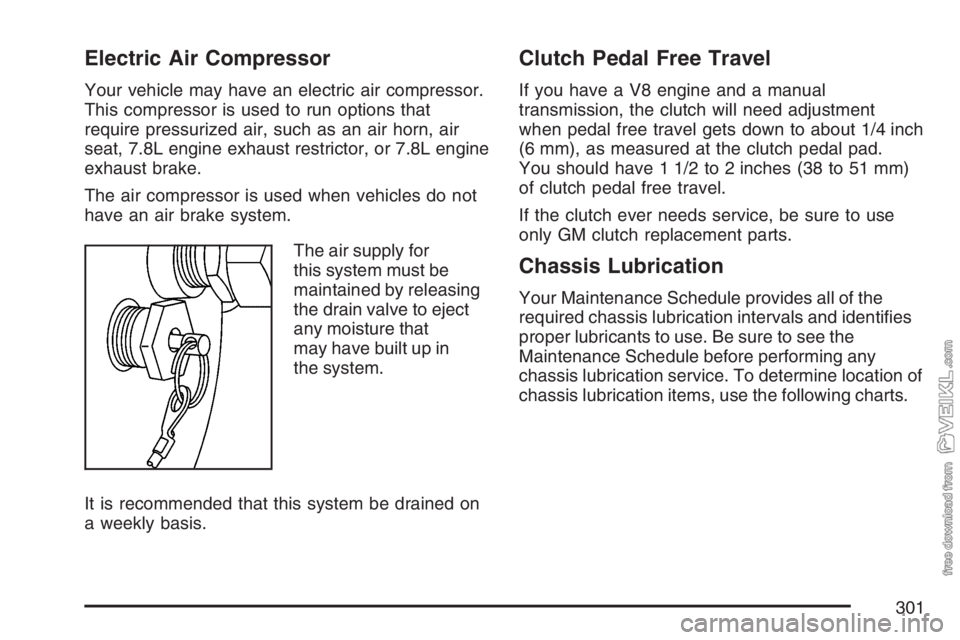
The air supply for
this system must be
maintained by releasing
the drain valve to eject
any moisture that
may have built up in
the system.
It is recommended that this system be drained on
a weekly basis.
Clutch Pedal Free Travel
If you have a V8 engine and a manual
transmission, the clutch will need adjustment
when pedal free travel gets down to about 1/4 inch
(6 mm), as measured at the clutch pedal pad.
You should have 1 1/2 to 2 inches (38 to 51 mm)
of clutch pedal free travel.
If the clutch ever needs service, be sure to use
only GM clutch replacement parts.
Chassis Lubrication
Your Maintenance Schedule provides all of the
required chassis lubrication intervals and identifies
proper lubricants to use. Be sure to see the
Maintenance Schedule before performing any
chassis lubrication service. To determine location of
chassis lubrication items, use the following charts.
301
Page 309 of 430
7. Do not let the other end touch metal. Connect
it to the positive (+) terminal of the good
battery. Use a remote positive (+) terminal if
the vehicle has one.
8. Now connect the black negative (−) cable to
the negative (−) terminal of the good battery.
Use a remote negative (−) terminal if the
vehicle has one.
Do not let the other end touch anything until
the next step. The other end of the negative (−)
cable does not go to the dead battery. It
goes to a heavy, unpainted metal engine part
or to the remote negative (−) terminal on
the vehicle with the dead battery.9. Connect the other end of the negative (−) cable
at least 18 inches (45 cm) away from the dead
battery, but not near engine parts that move.
The electrical connection is just as good there,
and the chance of sparks getting back to the
battery is much less.
10. Now start the vehicle with the good battery
and run the engine for a while. Use the high
idle option if your vehicle is equipped with it.
11. Try to start the vehicle that had the dead
battery. If it will not start after a few tries, it
probably needs service.
309
Page 317 of 430
Other Service Items
Fuel Filter
Fuel Filter/Pressure Regulator
(Gasoline Engines)
The steel fuel filter/pressure regulator is located
near the engine compartment on the driver’s
side frame rail. If your vehicle has a rear steel fuel
tank, the fuel filter/pressure regulator is located
near the rear fuel tank, on the driver’s side frame
rail. SeeScheduled Maintenance on page 363
for recommended service intervals.
If your vehicle is equipped with the optional Davco
spin-on type filter, it is located on the driver’s
side frame rail.
Fuel Filter (Diesel Engines)
If you have a diesel engine, your fuel filter is
located in the engine compartment on the driver’s
side of the vehicle, or along the driver’s side
frame rail. See “Fuel Filter Replacement” earlier in
this section for further information.
Also seeScheduled Maintenance on page 363for
recommended service intervals.
Primary Fuel Filter and Water
Separator
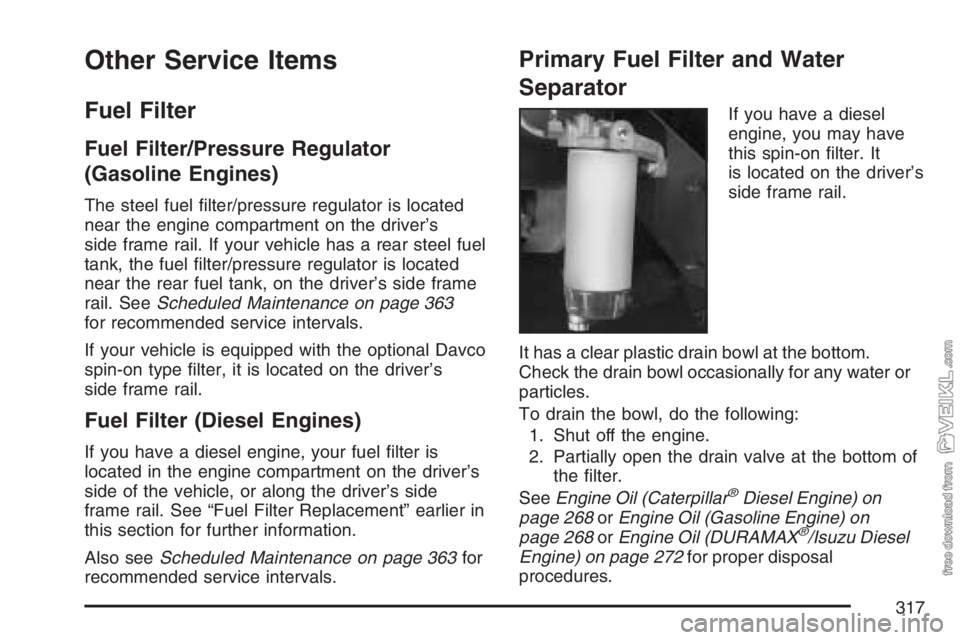
If you have a diesel
engine, you may have
this spin-on filter. It
is located on the driver’s
side frame rail.
It has a clear plastic drain bowl at the bottom.
Check the drain bowl occasionally for any water or
particles.
To drain the bowl, do the following:
1. Shut off the engine.
2. Partially open the drain valve at the bottom of
the filter.
SeeEngine Oil (Caterpillar
®Diesel Engine) on
page 268orEngine Oil (Gasoline Engine) on
page 268orEngine Oil (DURAMAX
®/Isuzu Diesel
Engine) on page 272for proper disposal
procedures.
317
Page 321 of 430
Tires
Your new vehicle comes with high-quality tires
made by a leading tire manufacturer. If you ever
have questions about your tire warranty and where
to obtain service, see your GM Warranty booklet for
details. For additional information refer to the tire
manufacturer’s booklet included with your vehicle.
{CAUTION:
Poorly maintained and improperly used
tires are dangerous.
Overloading your vehicle’s tires can
cause overheating as a result of too
much friction. You could have an
air-out and a serious accident. See
Loading Your Vehicle on page 238.
CAUTION: (Continued)
CAUTION: (Continued)
Underinated tires pose the same
danger as overloaded tires. The
resulting accident could cause serious
injury. Check all tires frequently to
maintain the recommended pressure.
Tire pressure should be checked when
your vehicle’s tires are cold. See
Inflation - Tire Pressure on page 322.
Overinated tires are more likely to be
cut, punctured, or broken by a sudden
impact — such as when you hit a
pothole. Keep tires at the
recommended pressure.
Worn, old tires can cause accidents. If
the tire’s tread is badly worn, or if
your vehicle’s tires have been
damaged, replace them.
321
Page 323 of 430
Wheel Loading
Wheels are stamped with a maximum load and
cold inflation rating. Be sure you do not exceed
these limits. If you ever think you need to exceed
these limits, first contact the rim and wheel
maker to get their advice.
Dual Tire Operation
When the vehicle is new, check the wheel nut
tightness on all wheels with a torque wrench after
your first 100 miles (160 km) and then 1,000 miles
(1 600 km) after that. Whenever a wheel, wheel
bolt or wheel nut is removed or serviced,
repeat the 100 miles (160 km), and then 1,000 mile
(1 600 km) wheel nut tightness check.SeeTightening the Wheel Nuts on page 325for
wheel nut tightening information and proper
torque values.
{CAUTION:
If you operate your vehicle with a tire that
is badly underinated, the tire can
overheat. An overheated tire can lose air
suddenly or catch re. You or others could
be injured. Be sure all tires (including the
spare, if any) are properly inated.
SeeTires on page 321andInation - Tire
Pressure on page 322for more information on
proper tire inflation.
323
Page 328 of 430
How Often to Check
Wheel tightness is so important you should have a
technician check nut tightness on all wheels with a
torque wrench after your first 100 miles (160 km),
and then 1,000 miles (1 600 km) after that. Be sure
to repeat this service whenever you have a tire
removed or serviced. SeeScheduled Maintenance
on page 363for further information.
Wheel Replacement
Replace any wheel that is bent, cracked or badly
rusted or corroded. If wheel nuts keep coming
loose, replace the wheel. If the wheel leaks
air, replace it.
Your dealer will know the kind of wheel you need.
Each new wheel should have the same
load-carrying capacity, diameter, width, offset and
be mounted the same way as the one it replaces.If you need to replace any of your wheels, wheel
bolts or wheel nuts, replace them only with
new GM original equipment parts. This way, you
will be sure to have the right wheel, wheel
bolts and wheel nuts for your vehicle.
{CAUTION:
A leaking wheel could fail without warning.
A wheel designed for tubeless tires could
be leaking because it is damaged. Do not
use an inner tube or some other thing to try
to stop the leaking. Get a new wheel of the
proper type.
328
Page 330 of 430
If a Tire Goes Flat
It is unusual for a tire to blowout while you are
driving, especially if you maintain your tires
properly. If air goes out of a tire, it is much more
likely to leak out slowly. But if you should ever
have a blowout, here are a few tips about what to
expect and what to do:
If a front tire fails, the flat tire will create a drag
that pulls the vehicle toward that side. Take your
foot off the accelerator pedal and grip the
steering wheel firmly. Steer to maintain lane
position, and then gently brake to a stop well out
of the traffic lane.
A rear blowout, particularly on a curve, acts much
like a skid and may require the same correction
you would use in a skid. In any rear blowout,
remove your foot from the accelerator pedal. Get
the vehicle under control by steering the way
you want the vehicle to go. It may be very bumpy
and noisy, but you can still steer. Gently brake
to a stop –– well off the road if possible.If a tire goes flat, avoid further tire and wheel
damage by driving slowly to a level place and turn
on your hazard warning flashers. SeeHazard
Warning Flashers on page 142.
{CAUTION:
Your vehicle, when new, did not include
tire changing equipment or a place to
store a tire in the vehicle. Special tools
and procedures are required if a tire
needs to be serviced. If these tools and
procedures are not used, you or others
could be injured or killed while trying to
change or service a truck tire.
330
Page 340 of 430
Vehicle Identication
Vehicle Identication Number (VIN)
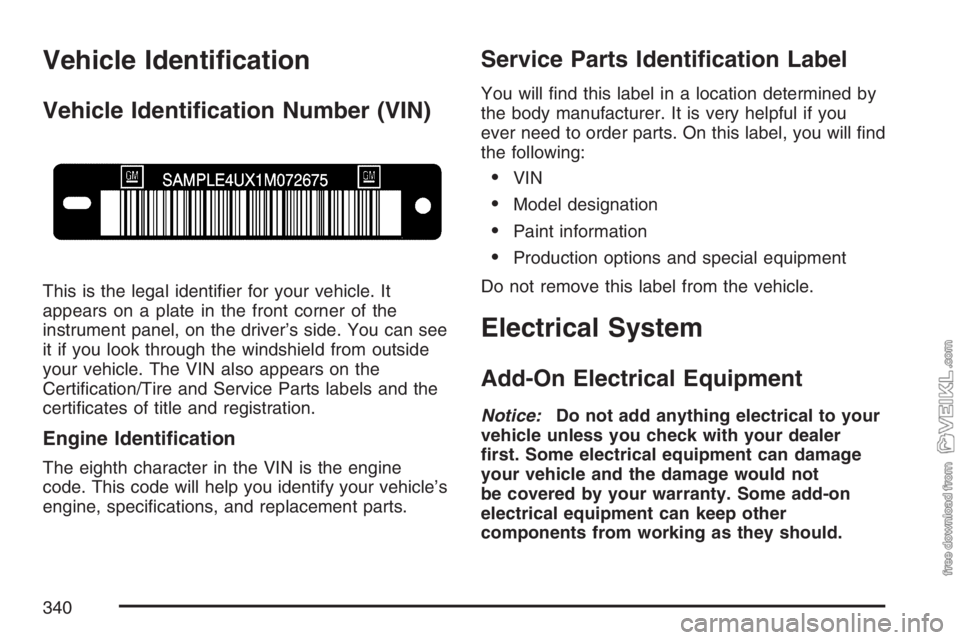
This is the legal identifier for your vehicle. It
appears on a plate in the front corner of the
instrument panel, on the driver’s side. You can see
it if you look through the windshield from outside
your vehicle. The VIN also appears on the
Certification/Tire and Service Parts labels and the
certificates of title and registration.
Engine Identication
The eighth character in the VIN is the engine
code. This code will help you identify your vehicle’s
engine, specifications, and replacement parts.
Service Parts Identication Label
You will find this label in a location determined by
the body manufacturer. It is very helpful if you
ever need to order parts. On this label, you will find
the following:
•VIN
•Model designation
•Paint information
•Production options and special equipment
Do not remove this label from the vehicle.
Electrical System
Add-On Electrical Equipment
Notice:Do not add anything electrical to your
vehicle unless you check with your dealer
rst. Some electrical equipment can damage
your vehicle and the damage would not
be covered by your warranty. Some add-on
electrical equipment can keep other
components from working as they should.
340