cooling CHEVROLET KODIAK 2007 User Guide
[x] Cancel search | Manufacturer: CHEVROLET, Model Year: 2007, Model line: KODIAK, Model: CHEVROLET KODIAK 2007Pages: 430, PDF Size: 6.06 MB
Page 291 of 430
{CAUTION:
Heater and radiator hoses, and other
engine parts, can be very hot. Do not
touch them. If you do, you can be burned.
Do not run the engine if there is a leak. If
you run the engine, it could lose all
coolant. That could cause an engine re,
and you could be burned. Get any leak
xed before you drive the vehicle.
If there seems to be no leak, start the engine
again. The engine cooling fan speed should
increase when idle speed is doubled by pushing
the accelerator pedal down. If it does not,
your vehicle needs service. Turn off the engine.
Notice:Engine damage from running your
engine without coolant is not covered by your
warranty.Notice:Using coolant other than DEX-COOL
®
may cause premature engine, heater core,
or radiator corrosion. In addition, the engine
coolant could require changing sooner, at
30,000 miles (50 000 km) or 24 months,
whichever occurs rst. Any repairs would not
be covered by your warranty. Always use
DEX-COOL
®(silicate-free) coolant in your
vehicle.
How to Add Coolant to the Coolant
Surge Tank
If you have not found a problem yet, check to see
if coolant is visible in the surge tank. If coolant
is visible but the coolant level is not at the FULL
COLD mark or higher, add a 50/50 mixture of
clean, drinkable water and DEX-COOL
®coolant at
the coolant surge tank, but be sure the cooling
system, including the coolant surge tank pressure
cap, is cool before you do it. SeeEngine
Coolant (Gas and DURAMAX
®/Isuzu Engines) on
page 284orEngine Coolant (Caterpillar®Diesel
Engines) on page 287for more information.
291
Page 292 of 430
If no coolant is visible in the surge tank, add
coolant as follows:
{CAUTION:
Steam and scalding liquids from a hot
cooling system can blow out and burn
you badly. They are under pressure, and if
you turn the coolant surge tank pressure
cap — even a little — they can come out at
high speed. Never turn the cap when the
cooling system, including the coolant
surge tank pressure cap, is hot. Wait for
the cooling system and coolant surge
tank pressure cap to cool if you ever have
to turn the pressure cap.
{CAUTION:
Adding only plain water to your cooling
system can be dangerous. Plain water, or
some other liquid such as alcohol, can
boil before the proper coolant mixture will.
Your vehicle’s coolant warning system is
set for the proper coolant mixture. With
plain water or the wrong mixture, your
engine could get too hot but you would
not get the overheat warning. Your engine
could catch re and you or others could
be burned. Use a 50/50 mixture of clean,
drinkable water and DEX-COOL
®coolant.
Notice:In cold weather, water can freeze and
crack the engine, radiator, heater core and
other parts. Use the recommended coolant and
the proper coolant mixture.
292
Page 293 of 430
{CAUTION:
You can be burned if you spill coolant on
hot engine parts. Coolant contains
ethylene glycol and it will burn if the
engine parts are hot enough. Do not spill
coolant on a hot engine.
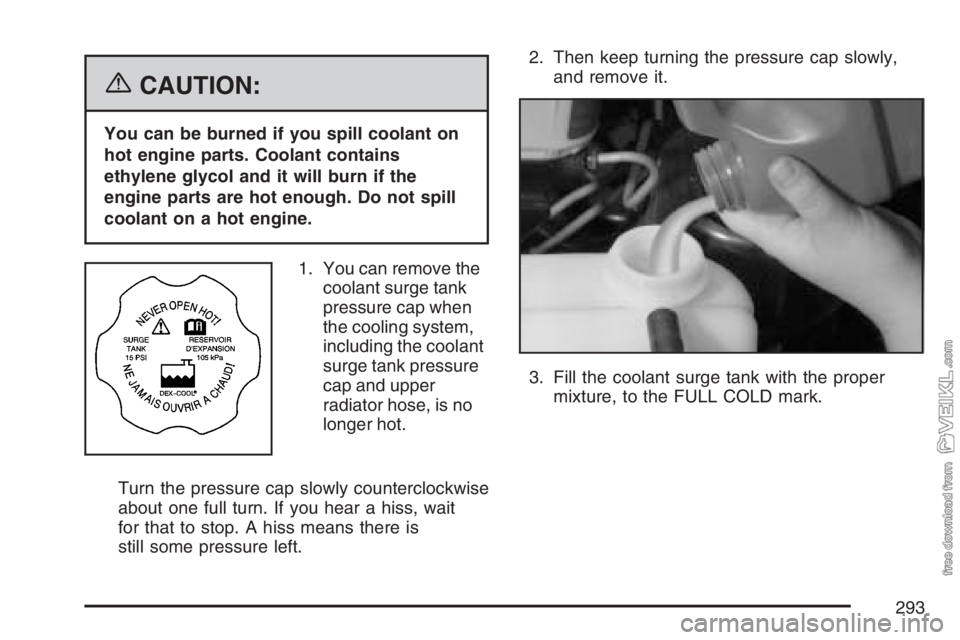
1. You can remove the
coolant surge tank
pressure cap when
the cooling system,
including the coolant
surge tank pressure
cap and upper
radiator hose, is no
longer hot.
Turn the pressure cap slowly counterclockwise
about one full turn. If you hear a hiss, wait
for that to stop. A hiss means there is
still some pressure left.2. Then keep turning the pressure cap slowly,
and remove it.
3. Fill the coolant surge tank with the proper
mixture, to the FULL COLD mark.
293
Page 294 of 430
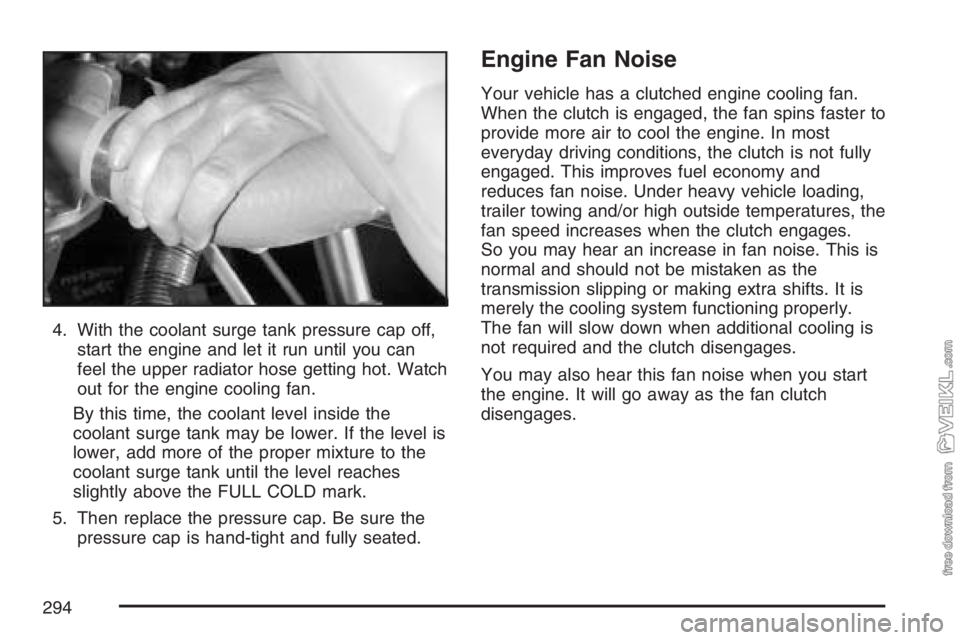
4. With the coolant surge tank pressure cap off,
start the engine and let it run until you can
feel the upper radiator hose getting hot. Watch
out for the engine cooling fan.
By this time, the coolant level inside the
coolant surge tank may be lower. If the level is
lower, add more of the proper mixture to the
coolant surge tank until the level reaches
slightly above the FULL COLD mark.
5. Then replace the pressure cap. Be sure the
pressure cap is hand-tight and fully seated.
Engine Fan Noise
Your vehicle has a clutched engine cooling fan.
When the clutch is engaged, the fan spins faster to
provide more air to cool the engine. In most
everyday driving conditions, the clutch is not fully
engaged. This improves fuel economy and
reduces fan noise. Under heavy vehicle loading,
trailer towing and/or high outside temperatures, the
fan speed increases when the clutch engages.
So you may hear an increase in fan noise. This is
normal and should not be mistaken as the
transmission slipping or making extra shifts. It is
merely the cooling system functioning properly.
The fan will slow down when additional cooling is
not required and the clutch disengages.
You may also hear this fan noise when you start
the engine. It will go away as the fan clutch
disengages.
294
Page 320 of 430
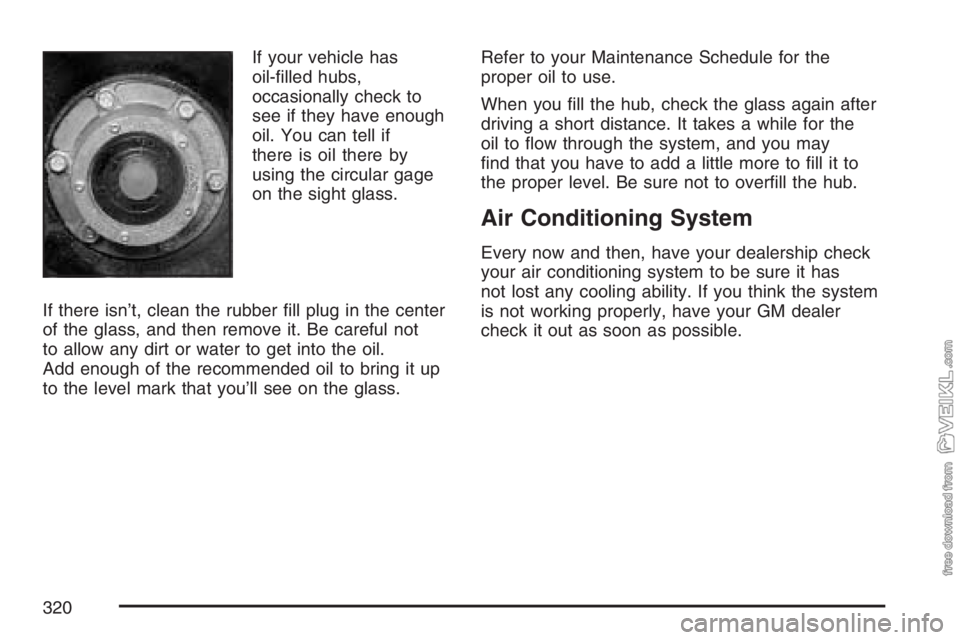
If your vehicle has
oil-filled hubs,
occasionally check to
see if they have enough
oil. You can tell if
there is oil there by
using the circular gage
on the sight glass.
If there isn’t, clean the rubber fill plug in the center
of the glass, and then remove it. Be careful not
to allow any dirt or water to get into the oil.
Add enough of the recommended oil to bring it up
to the level mark that you’ll see on the glass.Refer to your Maintenance Schedule for the
proper oil to use.
When you fill the hub, check the glass again after
driving a short distance. It takes a while for the
oil to flow through the system, and you may
find that you have to add a little more to fill it to
the proper level. Be sure not to overfill the hub.
Air Conditioning System
Every now and then, have your dealership check
your air conditioning system to be sure it has
not lost any cooling ability. If you think the system
is not working properly, have your GM dealer
check it out as soon as possible.
320
Page 329 of 430
{CAUTION:
Without the correct wheel, you may not be
able to stop properly, and you could have
other problems like a tire air-out. You
could have a collision. If you do not go to
your dealer to get a new wheel, be sure
you get the correct one. Each new wheel
should match the original wheel in
load-carrying capacity, ination pressure
capacity, diameter, width, offset and
mounting conguration.
Using wheels and tires with higher load-carrying
limits than the original wheels and tires does
not change the Gross Axle Weight Rating (GAWR)
or the Gross Vehicle Weight Rating (GVWR) of
your vehicle. SeeLoading Your Vehicle on
page 238for more information.Notice:The wrong wheel can cause trouble in
bearing life, brake cooling,
speedometer/odometer calibration, headlamp
aim, bumper height, vehicle ground clearance,
stopping distance and tire clearance to the
body and chassis. You could also have other
problems like a tire air-out.
Used Replacement Wheels
{CAUTION:
Putting a used wheel on your vehicle is
dangerous. You cannot know how it has
been used or how far it has been driven. It
could fail suddenly and cause a crash. If
you have to replace a wheel, use a new
GM original equipment wheel.
329
Page 347 of 430
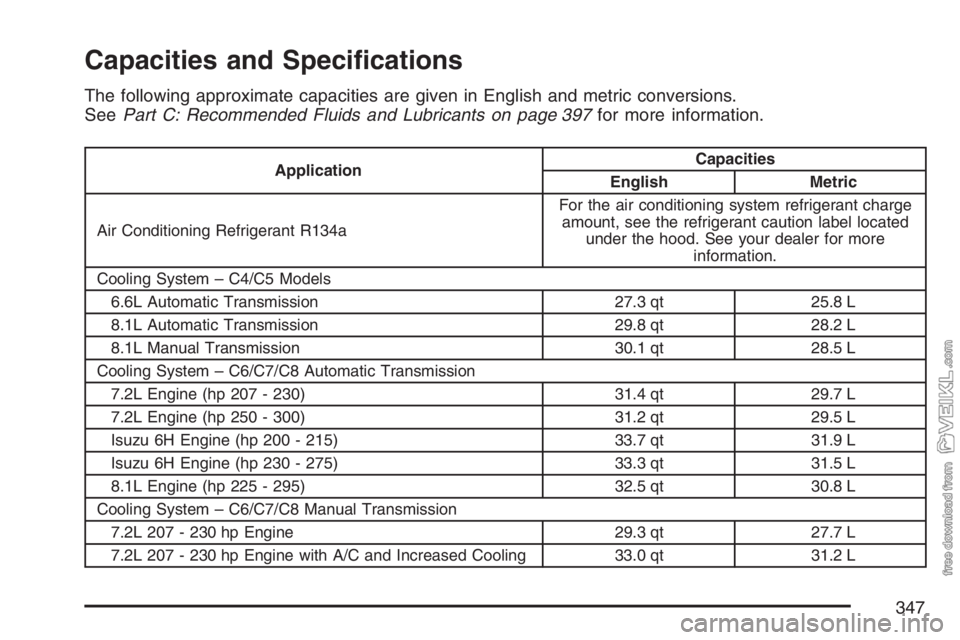
Capacities and Specications
The following approximate capacities are given in English and metric conversions.
SeePart C: Recommended Fluids and Lubricants on page 397for more information.
ApplicationCapacities
English Metric
Air Conditioning Refrigerant R134aFor the air conditioning system refrigerant charge
amount, see the refrigerant caution label located
under the hood. See your dealer for more
information.
Cooling System – C4/C5 Models
6.6L Automatic Transmission 27.3 qt 25.8 L
8.1L Automatic Transmission 29.8 qt 28.2 L
8.1L Manual Transmission 30.1 qt 28.5 L
Cooling System – C6/C7/C8 Automatic Transmission
7.2L Engine (hp 207 - 230) 31.4 qt 29.7 L
7.2L Engine (hp 250 - 300) 31.2 qt 29.5 L
Isuzu 6H Engine (hp 200 - 215) 33.7 qt 31.9 L
Isuzu 6H Engine (hp 230 - 275) 33.3 qt 31.5 L
8.1L Engine (hp 225 - 295) 32.5 qt 30.8 L
Cooling System – C6/C7/C8 Manual Transmission
7.2L 207 - 230 hp Engine 29.3 qt 27.7 L
7.2L 207 - 230 hp Engine with A/C and Increased Cooling 33.0 qt 31.2 L
347
Page 348 of 430
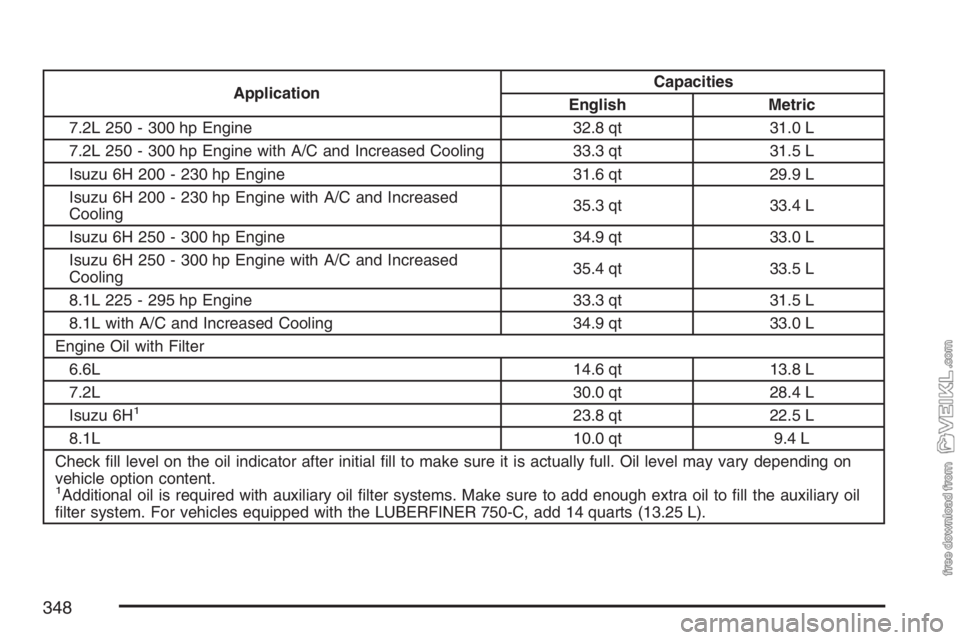
ApplicationCapacities
English Metric
7.2L 250 - 300 hp Engine 32.8 qt 31.0 L
7.2L 250 - 300 hp Engine with A/C and Increased Cooling 33.3 qt 31.5 L
Isuzu 6H 200 - 230 hp Engine 31.6 qt 29.9 L
Isuzu 6H 200 - 230 hp Engine with A/C and Increased
Cooling35.3 qt 33.4 L
Isuzu 6H 250 - 300 hp Engine 34.9 qt 33.0 L
Isuzu 6H 250 - 300 hp Engine with A/C and Increased
Cooling35.4 qt 33.5 L
8.1L 225 - 295 hp Engine 33.3 qt 31.5 L
8.1L with A/C and Increased Cooling 34.9 qt 33.0 L
Engine Oil with Filter
6.6L 14.6 qt 13.8 L
7.2L 30.0 qt 28.4 L
Isuzu 6H
123.8 qt 22.5 L
8.1L 10.0 qt 9.4 L
Check fill level on the oil indicator after initial fill to make sure it is actually full. Oil level may vary depending on
vehicle option content.
1Additional oil is required with auxiliary oil filter systems. Make sure to add enough extra oil to fill the auxiliary oil
filter system. For vehicles equipped with the LUBERFINER 750-C, add 14 quarts (13.25 L).
348
Page 366 of 430
❑Check air brake relay valve operation and
check for leaks (or every month, or every
300 hours, whichever occurs first).
❑Clean air brake application valve (or every
3 months, or every 300 hours, whichever
occurs first). Lubricate linkage.
❑Air brake chamber service (or every 2 months,
whichever occurs first).(34)
❑Thermostatically controlled engine cooling
fan service.(3) (19)
❑Shields and underhood insulation
service.(3) (4) (20)
❑Gasoline Engine: Air compressor remote
mounted air filter dry element pleated paper
air strainer service (or every 6 months or
every 1800 hours, whichever occurs first).
22,500 Miles (36 000 km)
❑Gasoline Engine Only: Check engine oil life
system. If engine oil and filter are changed,
reset system. See “Engine Oil (Gasoline
Engine)” in the Index.(2) (8)
❑Check fluid levels (or every 3 months,
whichever occurs first).(1) (5)❑Chassis lubrication service (or every 6 months,
whichever occurs first).(11)
❑Inspect door hinge pins and bushings and
replace as necessary.
❑Cooling system service. Clean the cooling
system filter cap with clean water, clean
the core, pressure test the cap and the
system for proper pressure capability, and
inspect condition of cooling and heater
hoses and clamps. Replace hoses if cracked,
swollen, or damaged.
❑Wheels and tires service.(14)
❑Hydraulic brake service (or every 6 months,
whichever occurs first).(6) (36)
❑Parking brake service (or every 6 months,
whichever occurs first).(21)
❑Air brake service (or every 6 months, whichever
occurs first).(32)
❑Air brake automatic slack adjuster service (or
every 500 hours, whichever occurs first).(33)
366
Page 369 of 430
❑Parking brake service (or every 6 months,
whichever occurs first).(21)
❑Air brake service (or every 6 months,
whichever occurs first).(32)
❑Air brake automatic slack adjuster service (or
every 500 hours, whichever occurs first).(33)
❑Check air brake relay valve operation and check
for leaks (or every month, or every 300 hours,
whichever occurs first).
❑Clean air brake application valve (or every
3 months, or every 300 hours, whichever occurs
first). Lubricate linkage.
❑Air brake chamber service (or every 2 months,
whichever occurs first).(34)
❑C600, C700, and C800 Gasoline Engines Only:
Engine drive belts service (or every 12 months,
whichever occurs first.)(17)
❑Thermostatically controlled engine cooling
fan service.(3) (19)❑Shields and underhood insulation
service.(3) (4) (20)
❑Gasoline Engine: Air compressor remote
mounted air filter dry element pleated paper
air strainer service (or every 6 months or
every 1800 hours, whichever occurs first).
36,000 Miles (55 000 km)
❑Isuzu 6H Diesel Without Engine Oil Life System
Only: Change engine oil and filter (or every
12 months, or every 600 hours of engine
operation, whichever occurs first).(2)
❑Isuzu 6H Diesel With Engine Oil Life System
Only: Check oil life system (or every 12 months,
or every 600 hours of engine operation,
whichever occurs first). If engine oil and filter
are changed, reset system. See “Engine Oil
(DURAMAX
®/Isuzu Diesel)” in the Index.(2) (7)
369