maintenance CHEVROLET KODIAK 2007 User Guide
[x] Cancel search | Manufacturer: CHEVROLET, Model Year: 2007, Model line: KODIAK, Model: CHEVROLET KODIAK 2007Pages: 430, PDF Size: 6.06 MB
Page 176 of 430
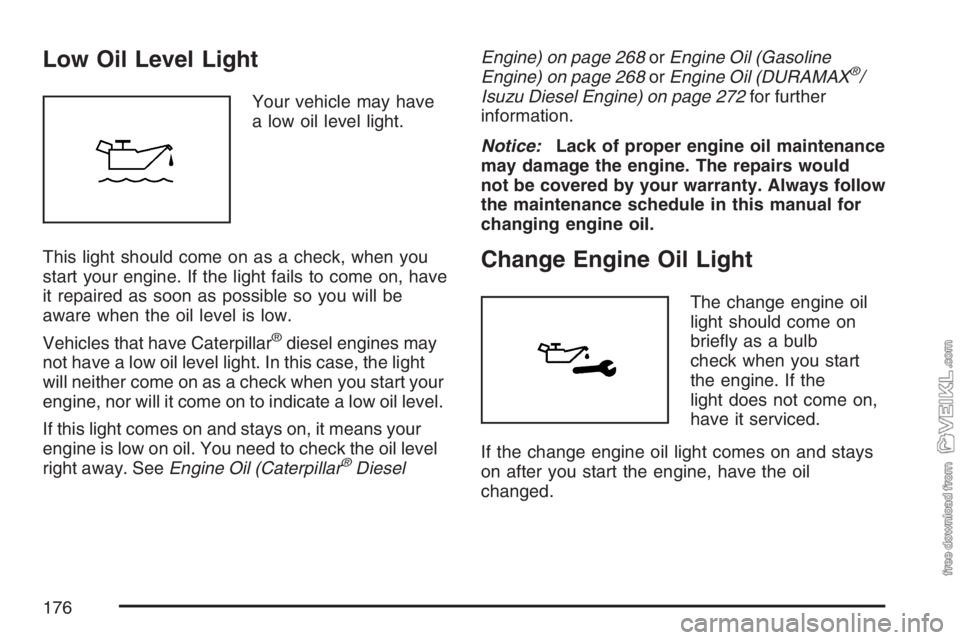
Low Oil Level Light
Your vehicle may have
a low oil level light.
This light should come on as a check, when you
start your engine. If the light fails to come on, have
it repaired as soon as possible so you will be
aware when the oil level is low.
Vehicles that have Caterpillar
®diesel engines may
not have a low oil level light. In this case, the light
will neither come on as a check when you start your
engine, nor will it come on to indicate a low oil level.
If this light comes on and stays on, it means your
engine is low on oil. You need to check the oil level
right away. SeeEngine Oil (Caterpillar
®DieselEngine) on page 268orEngine Oil (Gasoline
Engine) on page 268orEngine Oil (DURAMAX
®/
Isuzu Diesel Engine) on page 272for further
information.
Notice:Lack of proper engine oil maintenance
may damage the engine. The repairs would
not be covered by your warranty. Always follow
the maintenance schedule in this manual for
changing engine oil.
Change Engine Oil Light
The change engine oil
light should come on
briefly as a bulb
check when you start
the engine. If the
light does not come on,
have it serviced.
If the change engine oil light comes on and stays
on after you start the engine, have the oil
changed.
176
Page 177 of 430
For additional information on when to change
engine oil for gasoline engines or DURAMAX®
diesel engines, seeEngine Oil (Caterpillar®Diesel
Engine) on page 268orEngine Oil (Gasoline
Engine) on page 268orEngine Oil (DURAMAX
®/
Isuzu Diesel Engine) on page 272andScheduled
Maintenance on page 363. To reset the change
engine oil light, seeEngine Oil Life System
(Gasoline Engine) on page 276orEngine Oil Life
System (DURAMAX
®Diesel) on page 278or
Engine Oil Life System (Caterpillar®Diesel Engine)
on page 279.
Engine Overspeed Warning Light
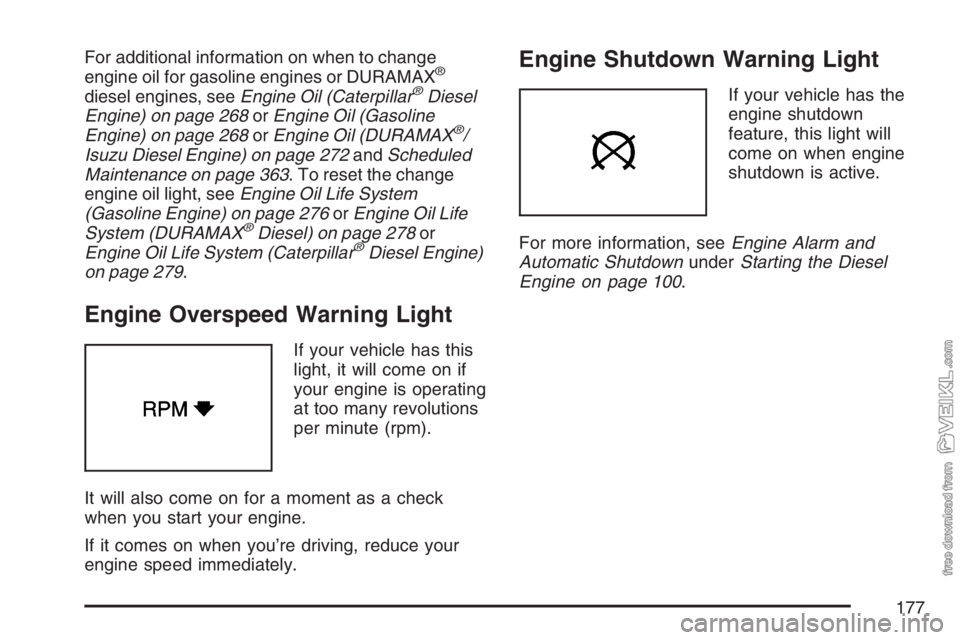
If your vehicle has this
light, it will come on if
your engine is operating
at too many revolutions
per minute (rpm).
It will also come on for a moment as a check
when you start your engine.
If it comes on when you’re driving, reduce your
engine speed immediately.
Engine Shutdown Warning Light
If your vehicle has the
engine shutdown
feature, this light will
come on when engine
shutdown is active.
For more information, seeEngine Alarm and
Automatic ShutdownunderStarting the Diesel
Engine on page 100.
177
Page 181 of 430
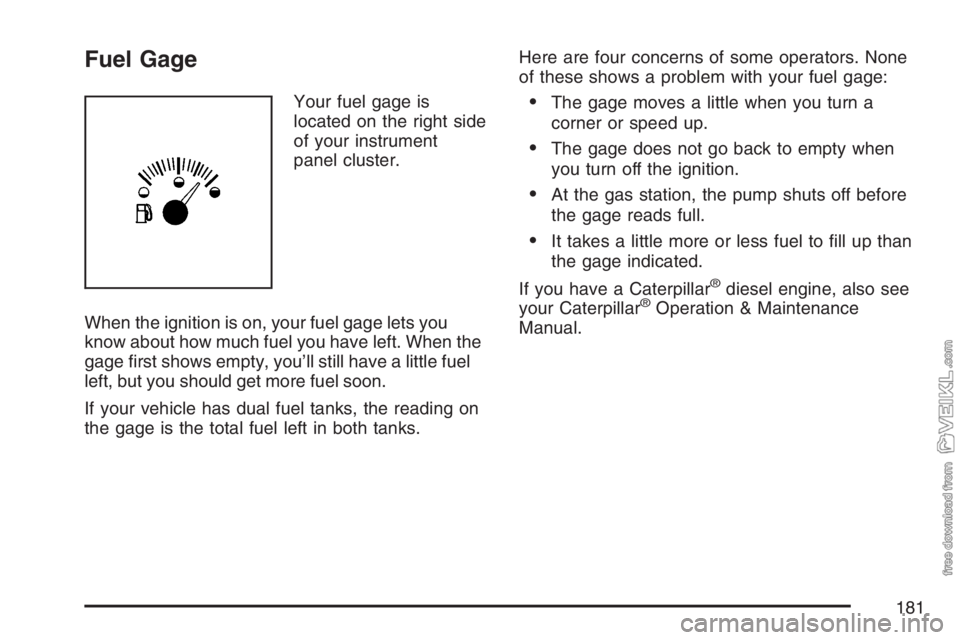
Fuel Gage
Your fuel gage is
located on the right side
of your instrument
panel cluster.
When the ignition is on, your fuel gage lets you
know about how much fuel you have left. When the
gage first shows empty, you’ll still have a little fuel
left, but you should get more fuel soon.
If your vehicle has dual fuel tanks, the reading on
the gage is the total fuel left in both tanks.Here are four concerns of some operators. None
of these shows a problem with your fuel gage:•The gage moves a little when you turn a
corner or speed up.
•The gage does not go back to empty when
you turn off the ignition.
•At the gas station, the pump shuts off before
the gage reads full.
•It takes a little more or less fuel to fill up than
the gage indicated.
If you have a Caterpillar
®diesel engine, also see
your Caterpillar®Operation & Maintenance
Manual.
181
Page 182 of 430
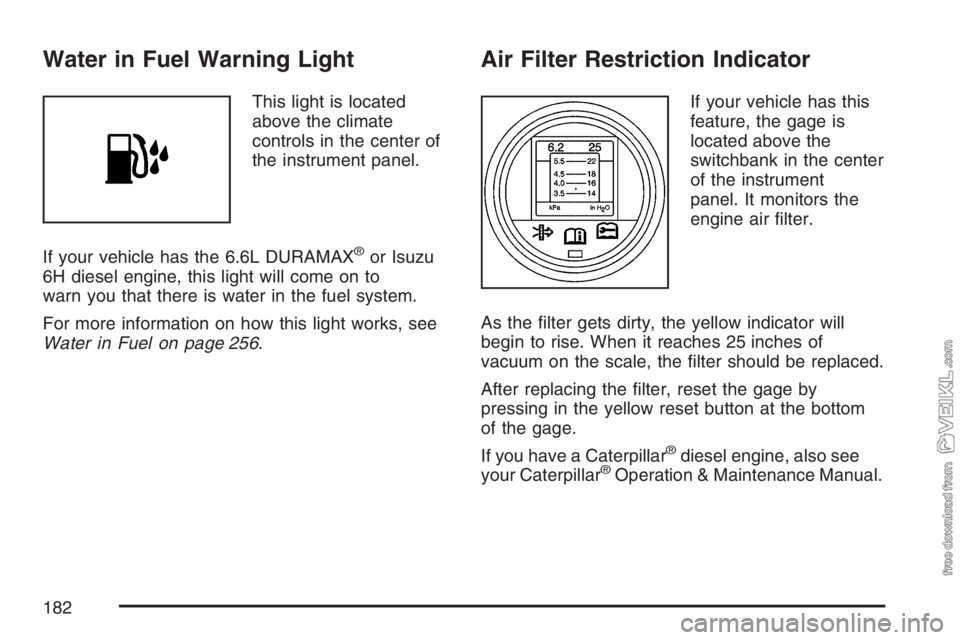
Water in Fuel Warning Light
This light is located
above the climate
controls in the center of
the instrument panel.
If your vehicle has the 6.6L DURAMAX
®or Isuzu
6H diesel engine, this light will come on to
warn you that there is water in the fuel system.
For more information on how this light works, see
Water in Fuel on page 256.
Air Filter Restriction Indicator
If your vehicle has this
feature, the gage is
located above the
switchbank in the center
of the instrument
panel. It monitors the
engine air filter.
As the filter gets dirty, the yellow indicator will
begin to rise. When it reaches 25 inches of
vacuum on the scale, the filter should be replaced.
After replacing the filter, reset the gage by
pressing in the yellow reset button at the bottom
of the gage.
If you have a Caterpillar
®diesel engine, also see
your Caterpillar®Operation & Maintenance Manual.
182
Page 247 of 430
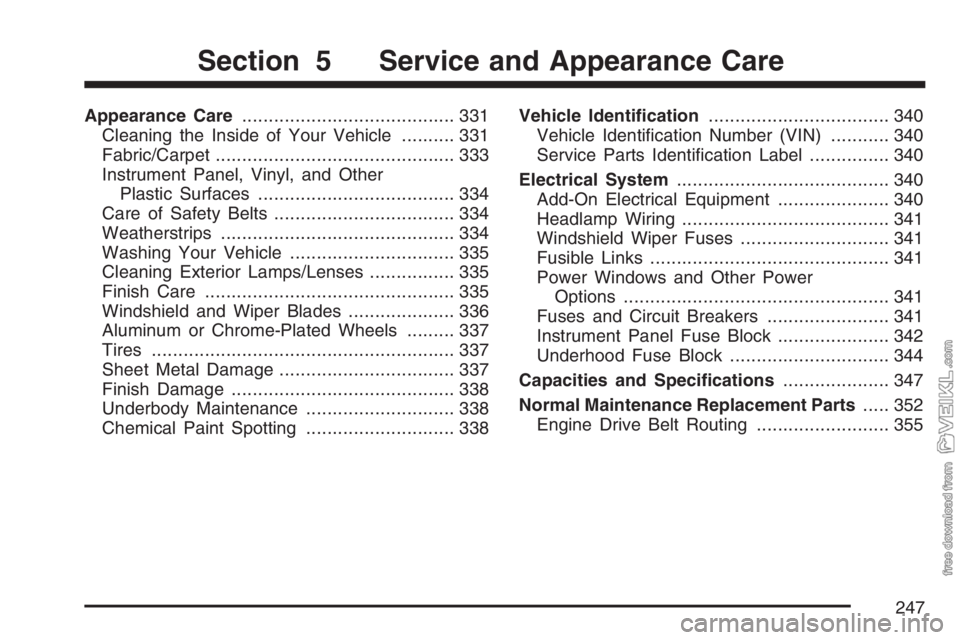
Appearance Care........................................ 331
Cleaning the Inside of Your Vehicle.......... 331
Fabric/Carpet............................................. 333
Instrument Panel, Vinyl, and Other
Plastic Surfaces..................................... 334
Care of Safety Belts.................................. 334
Weatherstrips............................................ 334
Washing Your Vehicle............................... 335
Cleaning Exterior Lamps/Lenses................ 335
Finish Care............................................... 335
Windshield and Wiper Blades.................... 336
Aluminum or Chrome-Plated Wheels......... 337
Tires......................................................... 337
Sheet Metal Damage................................. 337
Finish Damage.......................................... 338
Underbody Maintenance............................ 338
Chemical Paint Spotting............................ 338Vehicle Identication.................................. 340
Vehicle Identification Number (VIN)........... 340
Service Parts Identification Label............... 340
Electrical System........................................ 340
Add-On Electrical Equipment..................... 340
Headlamp Wiring....................................... 341
Windshield Wiper Fuses............................ 341
Fusible Links............................................. 341
Power Windows and Other Power
Options.................................................. 341
Fuses and Circuit Breakers....................... 341
Instrument Panel Fuse Block..................... 342
Underhood Fuse Block.............................. 344
Capacities and Specications.................... 347
Normal Maintenance Replacement Parts..... 352
Engine Drive Belt Routing......................... 355
Section 5 Service and Appearance Care
247
Page 249 of 430
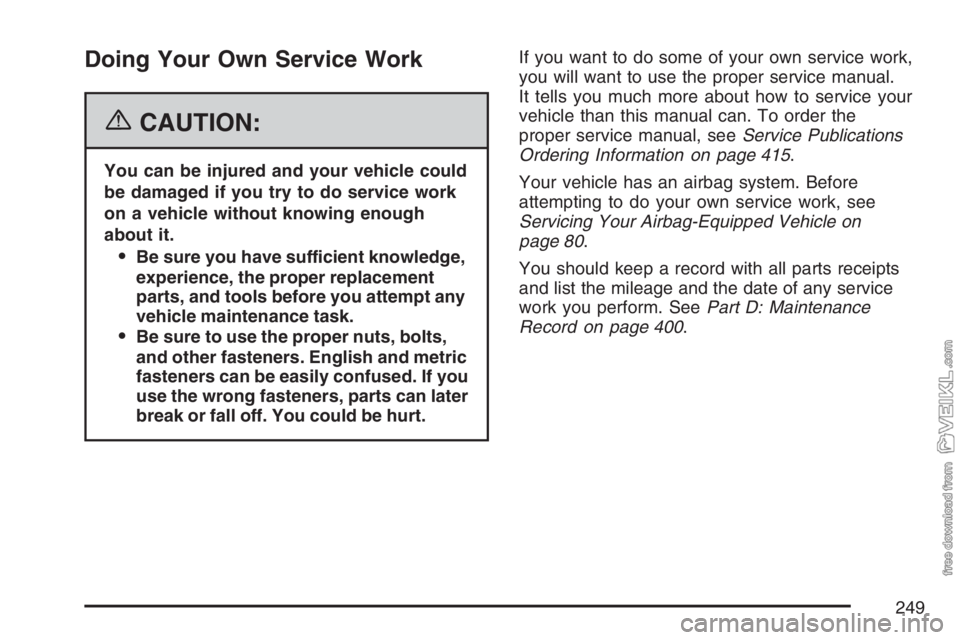
Doing Your Own Service Work
{CAUTION:
You can be injured and your vehicle could
be damaged if you try to do service work
on a vehicle without knowing enough
about it.
Be sure you have sufficient knowledge,
experience, the proper replacement
parts, and tools before you attempt any
vehicle maintenance task.
Be sure to use the proper nuts, bolts,
and other fasteners. English and metric
fasteners can be easily confused. If you
use the wrong fasteners, parts can later
break or fall off. You could be hurt.If you want to do some of your own service work,
you will want to use the proper service manual.
It tells you much more about how to service your
vehicle than this manual can. To order the
proper service manual, seeService Publications
Ordering Information on page 415.
Your vehicle has an airbag system. Before
attempting to do your own service work, see
Servicing Your Airbag-Equipped Vehicle on
page 80.
You should keep a record with all parts receipts
and list the mileage and the date of any service
work you perform. SeePart D: Maintenance
Record on page 400.
249
Page 251 of 430
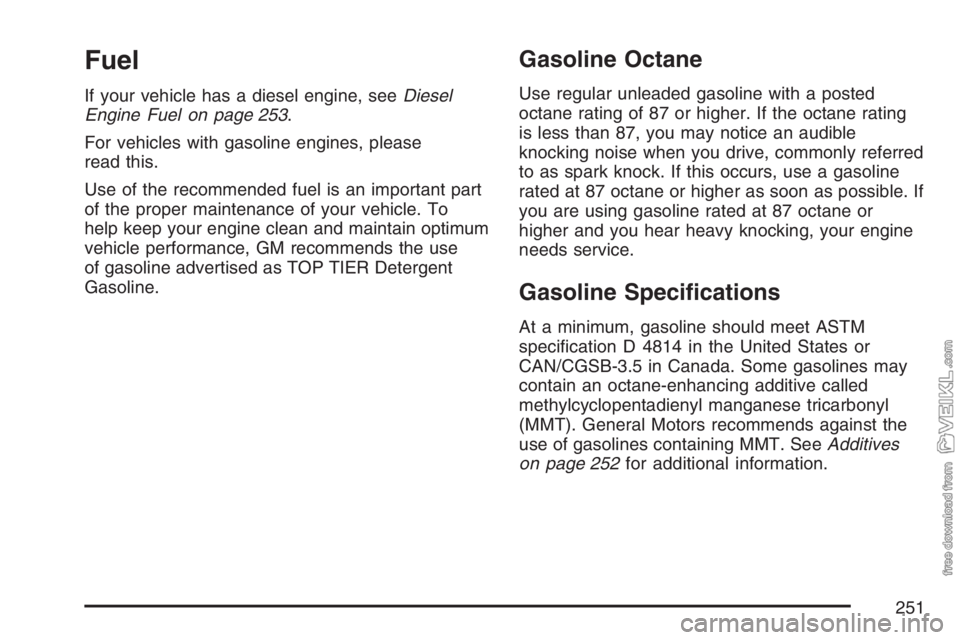
Fuel
If your vehicle has a diesel engine, seeDiesel
Engine Fuel on page 253.
For vehicles with gasoline engines, please
read this.
Use of the recommended fuel is an important part
of the proper maintenance of your vehicle. To
help keep your engine clean and maintain optimum
vehicle performance, GM recommends the use
of gasoline advertised as TOP TIER Detergent
Gasoline.
Gasoline Octane
Use regular unleaded gasoline with a posted
octane rating of 87 or higher. If the octane rating
is less than 87, you may notice an audible
knocking noise when you drive, commonly referred
to as spark knock. If this occurs, use a gasoline
rated at 87 octane or higher as soon as possible. If
you are using gasoline rated at 87 octane or
higher and you hear heavy knocking, your engine
needs service.
Gasoline Specications
At a minimum, gasoline should meet ASTM
specification D 4814 in the United States or
CAN/CGSB-3.5 in Canada. Some gasolines may
contain an octane-enhancing additive called
methylcyclopentadienyl manganese tricarbonyl
(MMT). General Motors recommends against the
use of gasolines containing MMT. SeeAdditives
on page 252for additional information.
251
Page 253 of 430
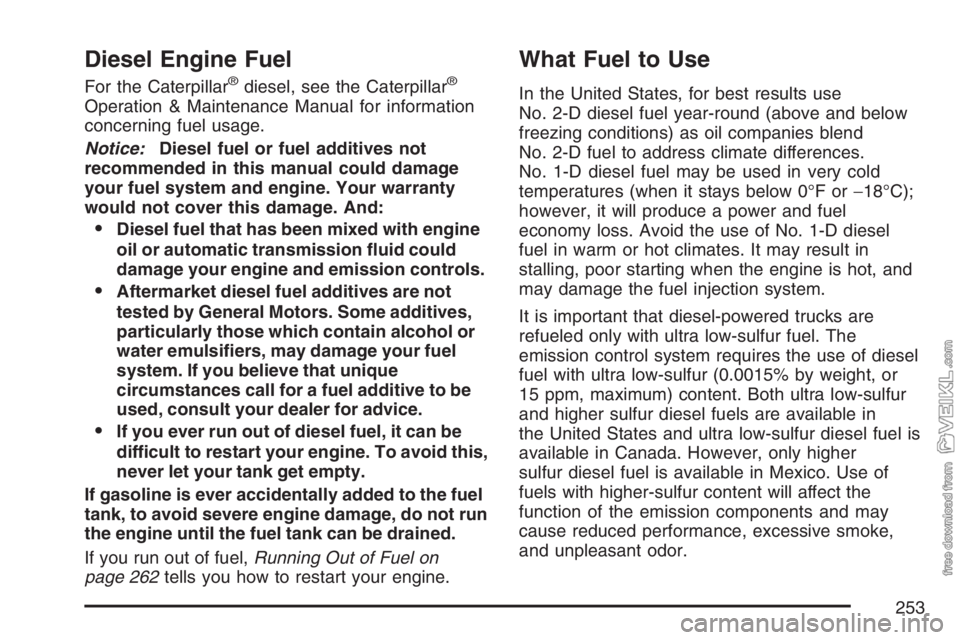
Diesel Engine Fuel
For the Caterpillar®diesel, see the Caterpillar®
Operation & Maintenance Manual for information
concerning fuel usage.
Notice:Diesel fuel or fuel additives not
recommended in this manual could damage
your fuel system and engine. Your warranty
would not cover this damage. And:
Diesel fuel that has been mixed with engine
oil or automatic transmission uid could
damage your engine and emission controls.
Aftermarket diesel fuel additives are not
tested by General Motors. Some additives,
particularly those which contain alcohol or
water emulsiers, may damage your fuel
system. If you believe that unique
circumstances call for a fuel additive to be
used, consult your dealer for advice.
If you ever run out of diesel fuel, it can be
difficult to restart your engine. To avoid this,
never let your tank get empty.
If gasoline is ever accidentally added to the fuel
tank, to avoid severe engine damage, do not run
the engine until the fuel tank can be drained.
If you run out of fuel,Running Out of Fuel on
page 262tells you how to restart your engine.
What Fuel to Use
In the United States, for best results use
No. 2-D diesel fuel year-round (above and below
freezing conditions) as oil companies blend
No. 2-D fuel to address climate differences.
No. 1-D diesel fuel may be used in very cold
temperatures (when it stays below 0°F or−18°C);
however, it will produce a power and fuel
economy loss. Avoid the use of No. 1-D diesel
fuel in warm or hot climates. It may result in
stalling, poor starting when the engine is hot, and
may damage the fuel injection system.
It is important that diesel-powered trucks are
refueled only with ultra low-sulfur fuel. The
emission control system requires the use of diesel
fuel with ultra low-sulfur (0.0015% by weight, or
15 ppm, maximum) content. Both ultra low-sulfur
and higher sulfur diesel fuels are available in
the United States and ultra low-sulfur diesel fuel is
available in Canada. However, only higher
sulfur diesel fuel is available in Mexico. Use of
fuels with higher-sulfur content will affect the
function of the emission components and may
cause reduced performance, excessive smoke,
and unpleasant odor.
253
Page 258 of 430
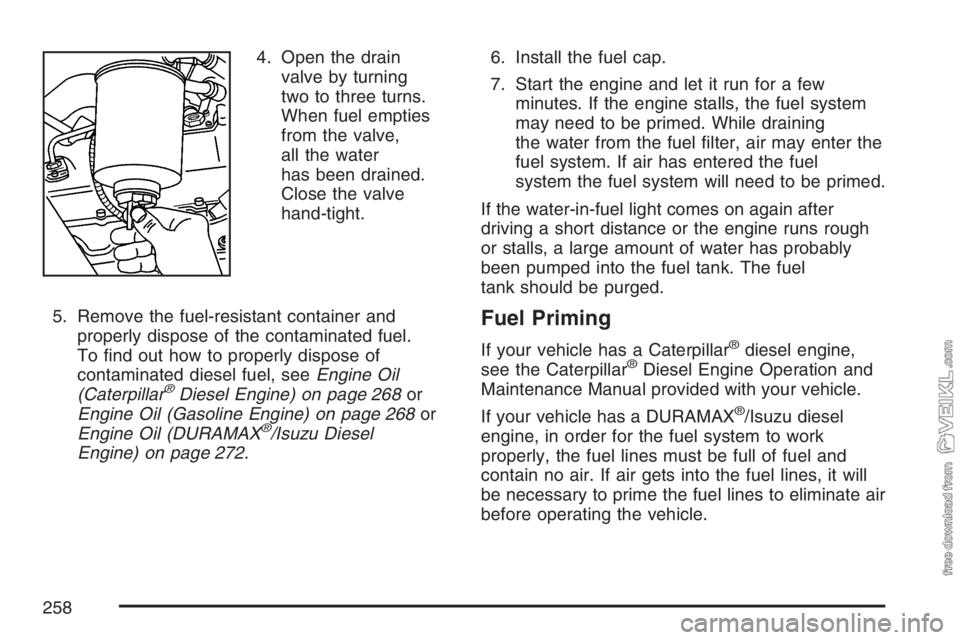
4. Open the drain
valve by turning
two to three turns.
When fuel empties
from the valve,
all the water
has been drained.
Close the valve
hand-tight.
5. Remove the fuel-resistant container and
properly dispose of the contaminated fuel.
To find out how to properly dispose of
contaminated diesel fuel, seeEngine Oil
(Caterpillar
®Diesel Engine) on page 268or
Engine Oil (Gasoline Engine) on page 268or
Engine Oil (DURAMAX
®/Isuzu Diesel
Engine) on page 272.6. Install the fuel cap.
7. Start the engine and let it run for a few
minutes. If the engine stalls, the fuel system
may need to be primed. While draining
the water from the fuel filter, air may enter the
fuel system. If air has entered the fuel
system the fuel system will need to be primed.
If the water-in-fuel light comes on again after
driving a short distance or the engine runs rough
or stalls, a large amount of water has probably
been pumped into the fuel tank. The fuel
tank should be purged.
Fuel Priming
If your vehicle has a Caterpillar®diesel engine,
see the Caterpillar®Diesel Engine Operation and
Maintenance Manual provided with your vehicle.
If your vehicle has a DURAMAX
®/Isuzu diesel
engine, in order for the fuel system to work
properly, the fuel lines must be full of fuel and
contain no air. If air gets into the fuel lines, it will
be necessary to prime the fuel lines to eliminate air
before operating the vehicle.
258
Page 268 of 430
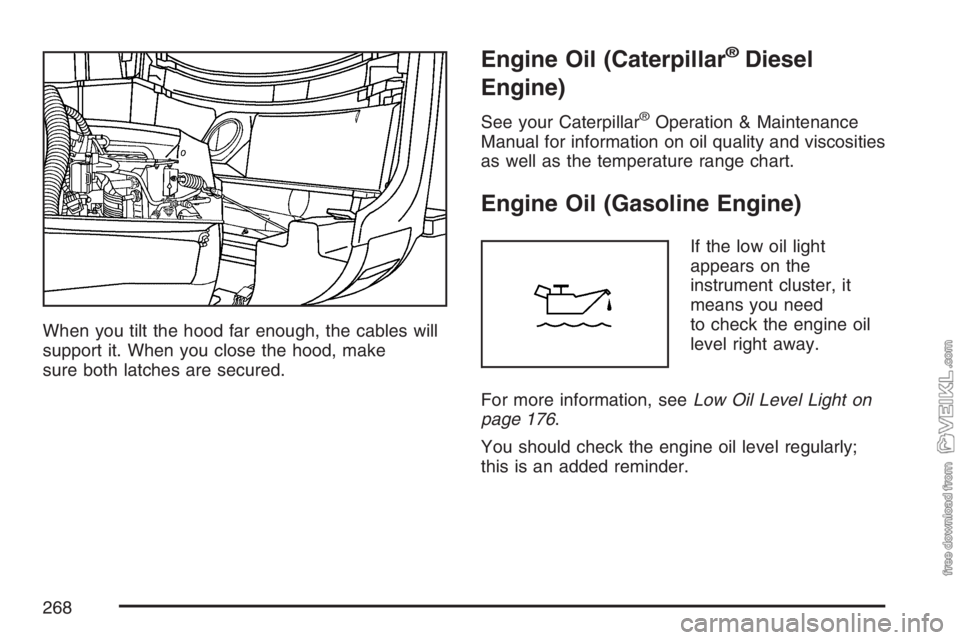
When you tilt the hood far enough, the cables will
support it. When you close the hood, make
sure both latches are secured.
Engine Oil (Caterpillar®Diesel
Engine)
See your Caterpillar®Operation & Maintenance
Manual for information on oil quality and viscosities
as well as the temperature range chart.
Engine Oil (Gasoline Engine)
If the low oil light
appears on the
instrument cluster, it
means you need
to check the engine oil
level right away.
For more information, seeLow Oil Level Light on
page 176.
You should check the engine oil level regularly;
this is an added reminder.
268