maintenance CHEVROLET KODIAK 2007 Owner's Manual
[x] Cancel search | Manufacturer: CHEVROLET, Model Year: 2007, Model line: KODIAK, Model: CHEVROLET KODIAK 2007Pages: 430, PDF Size: 6.06 MB
Page 276 of 430
GM Goodwrench®oil of the recommended
viscosity grades meets all the requirements for
your vehicle.
Engine Oil Additives
Do not add anything to the oil. The recommended
oils with the API service symbol are all you will
need for good performance and engine protection.
When to Change Engine Oil (Vehicles
Without the Engine Oil Life System)
If you have the 6.6L V8 DURAMAX®Engine:
Change engine oil and filter every 15,000 miles
(24 000 km), or every 12 months, or every
750 hours of engine operation, whichever occurs
first. If you have the Isuzu 6H Engine: Change
engine oil and filter every 12,000 miles
(20 000 km), or every 12 months, or every
600 hours of engine operation, whichever occurs
first. SeeScheduled Maintenance on page 363.
Engine Oil Life System
(Gasoline Engine)
When to Change Engine Oil
Your vehicle has a computer system that lets you
know when to change the engine oil and filter.
This is based on engine revolutions and engine
temperature, and not on mileage. Based on driving
conditions, the mileage at which an oil change
will be indicated can vary considerably. For the oil
life system to work properly, you must reset the
system every time the oil is changed.
When the system has calculated that oil life has
been diminished, it will indicate that an oil change is
necessary. A change engine oil light will come on.
SeeChange Engine Oil Light on page 176. Change
your oil as soon as possible within the next
600 miles (1 000 km). It is possible that, if you are
driving under the best conditions, the oil life system
may not indicate that an oil change is necessary for
over a year. However, your engine oil and filter
must be changed at least once a year and at this
time the system must be reset. Your dealer has
GM-trained service people who will perform this
work using genuine GM parts and reset the system.
It is also important to check your oil regularly and
keep it at the proper level.
276
Page 283 of 430
Manual Transmission Fluid
When to Check
A good time to have it checked is when the
engine oil is checked. Refer to the Maintenance
Schedule to find out when to check and change
your manual transmission fluid. SeeScheduled
Maintenance on page 363.
How to Check and What to Use
Check the fluid level only when your engine is off,
the vehicle is parked on a level place, and the
transmission is cool enough for you to rest
your fingers on the transmission case.
To check the transmission fluid level, do the
following:
1. Remove the filler plug.
2. Check to be sure that the lubricant level is up
to the bottom of the fill opening. On heavy
duty transmissions, an inch of oil level equals
about one gallon of fluid.3. If the fluid level is good, reinstall the plug and
be sure it is fully seated. If the fluid level is
low, add more fluid as described in the
next steps. Refer to the Maintenance
Schedule to determine what kind of fluid to
use. SeePart C: Recommended Fluids
and Lubricants on page 397.
How to Add Fluid
To add transmission fluid, do the following:
1. Remove the filler plug.
2. Add fluid at the filler plug hole. Add only
enough fluid to bring the fluid level up to
the bottom of the fill opening. Refer to
the Maintenance Schedule to determine the
proper fluid to use. SeePart C:
Recommended Fluids and Lubricants on
page 397.
3. Reinstall the filler plug. Be sure the plug is
fully seated.
283
Page 287 of 430
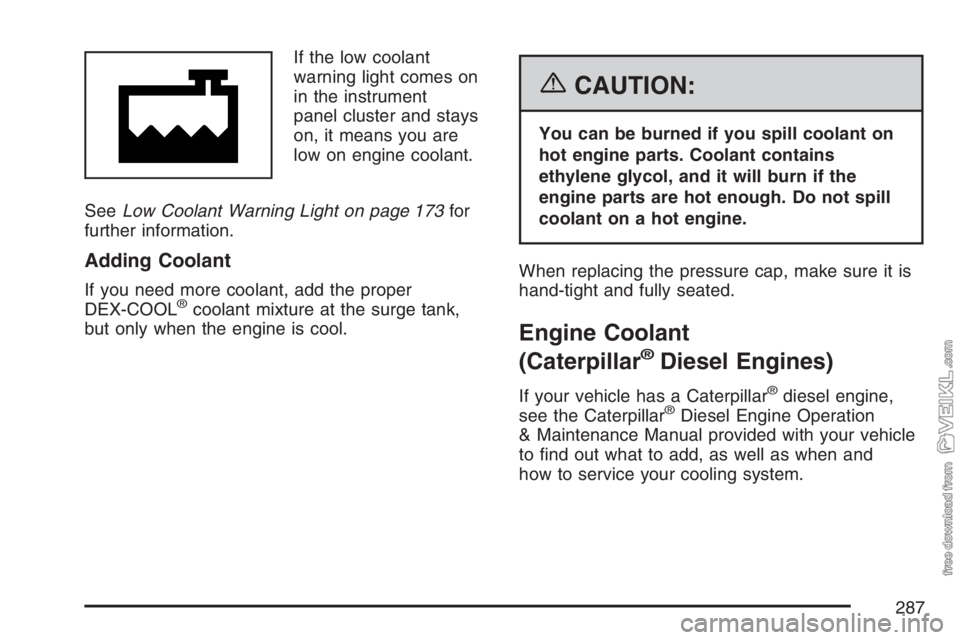
If the low coolant
warning light comes on
in the instrument
panel cluster and stays
on, it means you are
low on engine coolant.
SeeLow Coolant Warning Light on page 173for
further information.
Adding Coolant
If you need more coolant, add the proper
DEX-COOL®coolant mixture at the surge tank,
but only when the engine is cool.
{CAUTION:
You can be burned if you spill coolant on
hot engine parts. Coolant contains
ethylene glycol, and it will burn if the
engine parts are hot enough. Do not spill
coolant on a hot engine.
When replacing the pressure cap, make sure it is
hand-tight and fully seated.
Engine Coolant
(Caterpillar
®Diesel Engines)
If your vehicle has a Caterpillar®diesel engine,
see the Caterpillar®Diesel Engine Operation
& Maintenance Manual provided with your vehicle
to find out what to add, as well as when and
how to service your cooling system.
287
Page 290 of 430
Cooling System (Gas and
DURAMAX
®/Isuzu Engines)
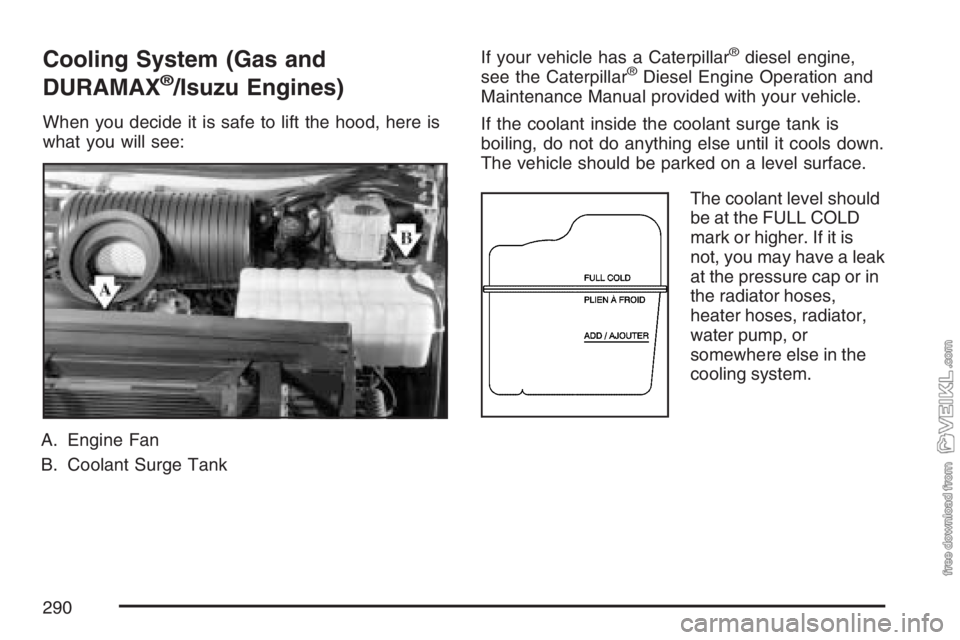
When you decide it is safe to lift the hood, here is
what you will see:
A. Engine Fan
B. Coolant Surge TankIf your vehicle has a Caterpillar
®diesel engine,
see the Caterpillar®Diesel Engine Operation and
Maintenance Manual provided with your vehicle.
If the coolant inside the coolant surge tank is
boiling, do not do anything else until it cools down.
The vehicle should be parked on a level surface.
The coolant level should
be at the FULL COLD
mark or higher. If it is
not, you may have a leak
at the pressure cap or in
the radiator hoses,
heater hoses, radiator,
water pump, or
somewhere else in the
cooling system.
290
Page 295 of 430
Power Steering Fluid
SeeScheduled Maintenance on page 363to
determine when to check your power steering fluid.
How To Check Power Steering Fluid
Check your power steering fluid only when the
engine is warm. If the engine is not warm, you
probably will not get an accurate reading.
If the fluid level is between the MIN (Minimum) and
MAX (Maximum) marks, you have enough. If you
need fluid, add only enough of the proper fluid to
bring it in between the MIN and MAX marks.
If your power steering fluid level is low, this can
cause the brake or service brakes soon warning
lights to come on. In addition, the steering
effort and emergency brake distance could
increase.If either light remains on after you have added
power steering fluid to the proper level, then shut
off the engine for 10 seconds. This should
reset the brake warning lights. If one or both lights
stay on, see “Hydraulic Brake System Warning
Lights” underBrake System Warning Light
on page 169for more information.
What to Use
To determine what kind of fluid to use, see
Part C: Recommended Fluids and Lubricants on
page 397.
Notice:When adding power steering uid or
making a complete uid change, always
use the proper uid. Failure to use the proper
uid can cause leaks and damage hoses
and seals.
295
Page 297 of 430
Brakes
Brake Fluid
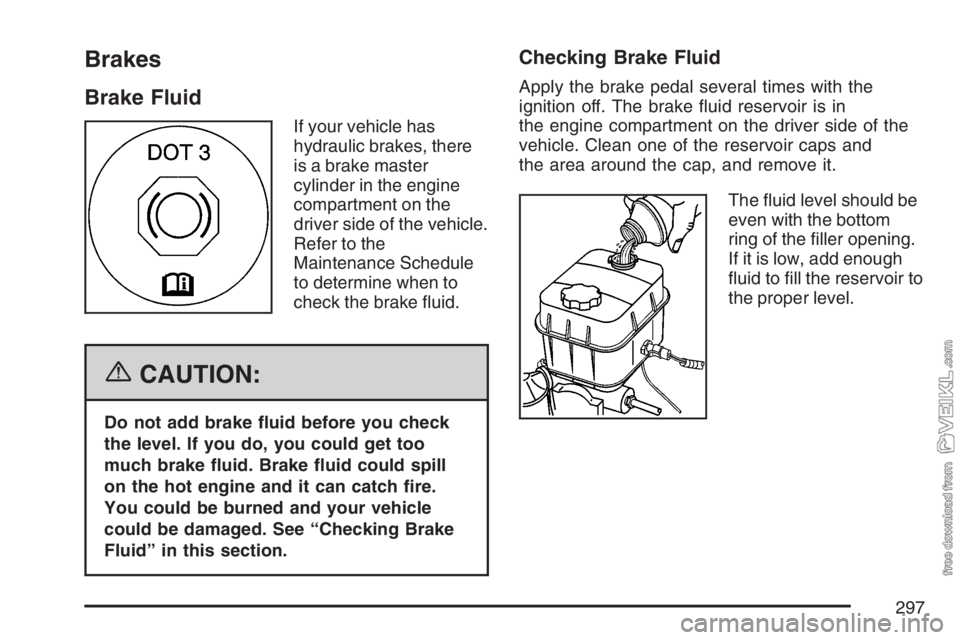
If your vehicle has
hydraulic brakes, there
is a brake master
cylinder in the engine
compartment on the
driver side of the vehicle.
Refer to the
Maintenance Schedule
to determine when to
check the brake fluid.
{CAUTION:
Do not add brake uid before you check
the level. If you do, you could get too
much brake uid. Brake uid could spill
on the hot engine and it can catch re.
You could be burned and your vehicle
could be damaged. See “Checking Brake
Fluid” in this section.
Checking Brake Fluid
Apply the brake pedal several times with the
ignition off. The brake fluid reservoir is in
the engine compartment on the driver side of the
vehicle. Clean one of the reservoir caps and
the area around the cap, and remove it.
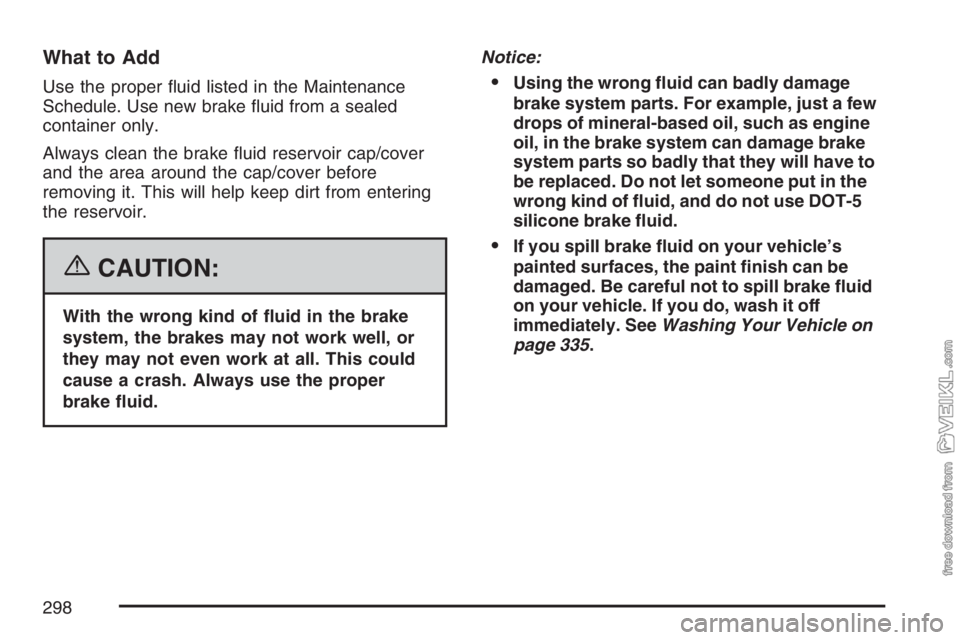
The fluid level should be
even with the bottom
ring of the filler opening.
If it is low, add enough
fluid to fill the reservoir to
the proper level.
297
Page 298 of 430
What to Add
Use the proper fluid listed in the Maintenance
Schedule. Use new brake fluid from a sealed
container only.
Always clean the brake fluid reservoir cap/cover
and the area around the cap/cover before
removing it. This will help keep dirt from entering
the reservoir.
{CAUTION:
With the wrong kind of uid in the brake
system, the brakes may not work well, or
they may not even work at all. This could
cause a crash. Always use the proper
brake uid.Notice:
Using the wrong uid can badly damage
brake system parts. For example, just a few
drops of mineral-based oil, such as engine
oil, in the brake system can damage brake
system parts so badly that they will have to
be replaced. Do not let someone put in the
wrong kind of uid, and do not use DOT-5
silicone brake uid.
If you spill brake uid on your vehicle’s
painted surfaces, the paint nish can be
damaged. Be careful not to spill brake uid
on your vehicle. If you do, wash it off
immediately. SeeWashing Your Vehicle on
page 335.
298
Page 300 of 430
Replacing Brake System Parts
The braking system on a vehicle is complex.
Its many parts have to be of top quality and work
well together if the vehicle is to have really
good braking. Your vehicle was designed and
tested with top-quality GM brake parts. When
you replace parts of the braking system — for
example, when the brake linings wear down and
you need new ones put in — be sure you get
new approved GM replacement parts. If you do
not, the brakes may no longer work properly.
For example, if someone puts in brake linings that
are wrong for your vehicle, the balance between
the front and rear brakes can change — for
the worse. The braking performance you have
come to expect can change in many other ways
if someone puts in the wrong replacement
brake parts.
Air Brake Systems
If your vehicle has air brakes, it is important to
get rid of moisture in the system. Moisture will
damage the system if it is not removed daily.There are two ways to do this. One is automatic
through the air brake vehicle’s air dryer with integral
automatic moisture ejector that purges air from the
system through a self-contained reservoir. The
other way to drain moisture from the air brake
system is to manually activate drain valves at each
reservoir. Drain the air reservoirs occasionally to be
sure the air dryer is working properly.
Drain the air brakes at full system pressure. To be
sure you are at full pressure, check the air pressure
gage. It should read at least 100 psi (692 kPa).
Air Dryer
If your vehicle has air brakes, it has an air dryer
mounted on the passenger side frame rail. This
collects and removes dirt, moisture, or other foreign
matter from the air prior to entering the brake
system. The dryer also acts as a moisture ejector.
It automatically ejects the moisture when the
compressor cycles. The purge tank has a manual
drain valve that must be drained every day. See
“Air Brake Systems” for the manual drain procedure.
The dryer has a filter that you need to change at
intervals. SeeScheduled Maintenance on page 363
for more about servicing this filter.
300
Page 301 of 430
Electric Air Compressor
Your vehicle may have an electric air compressor.
This compressor is used to run options that
require pressurized air, such as an air horn, air
seat, 7.8L engine exhaust restrictor, or 7.8L engine
exhaust brake.
The air compressor is used when vehicles do not
have an air brake system.
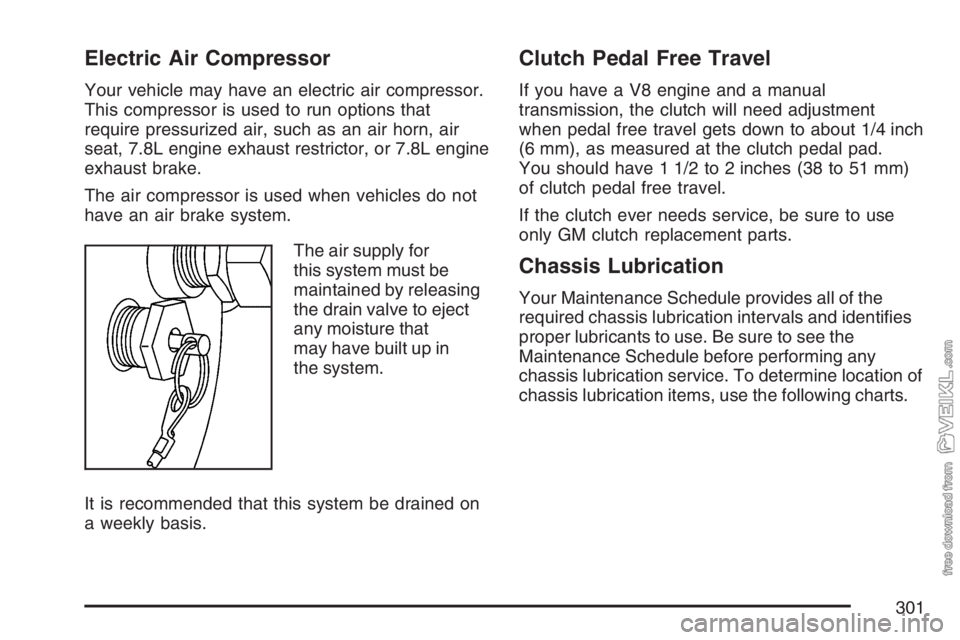
The air supply for
this system must be
maintained by releasing
the drain valve to eject
any moisture that
may have built up in
the system.
It is recommended that this system be drained on
a weekly basis.
Clutch Pedal Free Travel
If you have a V8 engine and a manual
transmission, the clutch will need adjustment
when pedal free travel gets down to about 1/4 inch
(6 mm), as measured at the clutch pedal pad.
You should have 1 1/2 to 2 inches (38 to 51 mm)
of clutch pedal free travel.
If the clutch ever needs service, be sure to use
only GM clutch replacement parts.
Chassis Lubrication
Your Maintenance Schedule provides all of the
required chassis lubrication intervals and identifies
proper lubricants to use. Be sure to see the
Maintenance Schedule before performing any
chassis lubrication service. To determine location of
chassis lubrication items, use the following charts.
301
Page 304 of 430
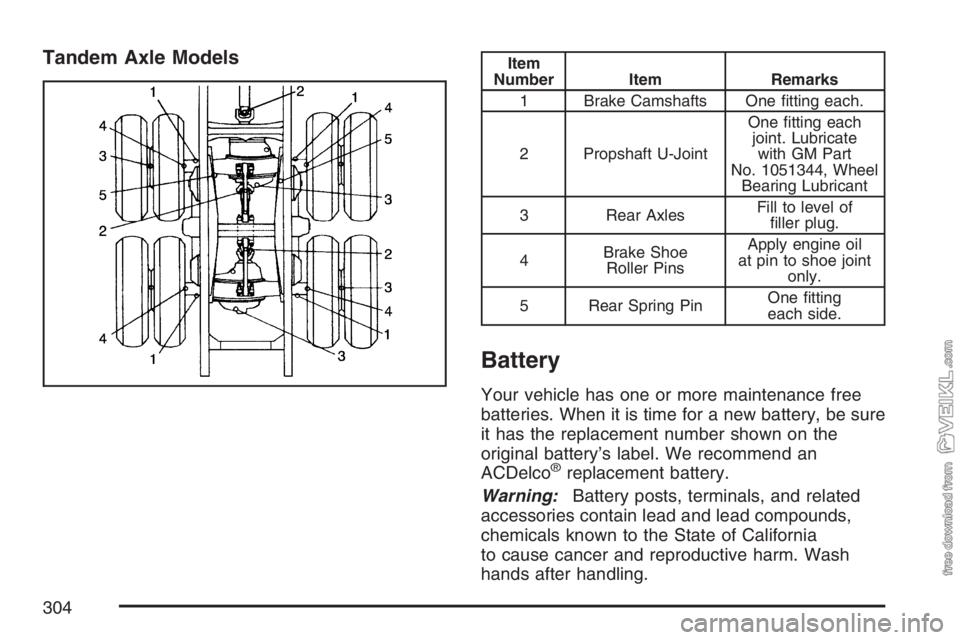
Tandem Axle ModelsItem
Number Item Remarks
1 Brake Camshafts One fitting each.
2 Propshaft U-JointOne fitting each
joint. Lubricate
with GM Part
No. 1051344, Wheel
Bearing Lubricant
3 Rear AxlesFill to level of
filler plug.
4Brake Shoe
Roller PinsApply engine oil
at pin to shoe joint
only.
5 Rear Spring PinOne fitting
each side.
Battery
Your vehicle has one or more maintenance free
batteries. When it is time for a new battery, be sure
it has the replacement number shown on the
original battery’s label. We recommend an
ACDelco
®replacement battery.
Warning:Battery posts, terminals, and related
accessories contain lead and lead compounds,
chemicals known to the State of California
to cause cancer and reproductive harm. Wash
hands after handling.
304