maintenance CHEVROLET KODIAK 2007 Owner's Guide
[x] Cancel search | Manufacturer: CHEVROLET, Model Year: 2007, Model line: KODIAK, Model: CHEVROLET KODIAK 2007Pages: 430, PDF Size: 6.06 MB
Page 311 of 430
Rear Axle
When to Check and Change Lubricant
Refer to the Maintenance Schedule to determine
how often to check the lubricant and when to
change it. SeeScheduled Maintenance on
page 363.
Notice:If you drive your vehicle through deep
water that is higher than the front or rear
axle, water may enter the axle housing and
cause the axle lubricant to break down.
This could damage the gears inside. Avoid
driving your vehicle through deep water.
You should avoid driving your vehicle through
deep puddles or standing water. If you must drive
through water that is higher than the front or
rear axle, see your dealer immediately afterward
to have the condition of the axle lubricant checked.
How to Check Lubricant
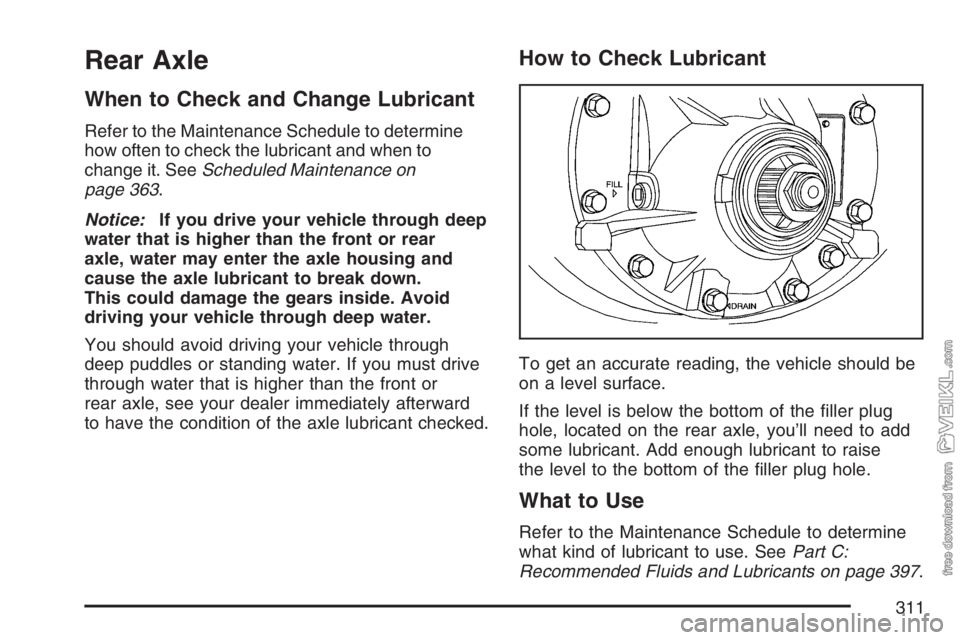
To get an accurate reading, the vehicle should be
on a level surface.
If the level is below the bottom of the filler plug
hole, located on the rear axle, you’ll need to add
some lubricant. Add enough lubricant to raise
the level to the bottom of the filler plug hole.
What to Use
Refer to the Maintenance Schedule to determine
what kind of lubricant to use. SeePart C:
Recommended Fluids and Lubricants on page 397.
311
Page 312 of 430
Rear Axle Shift Motor
When to Check and Change Fluid
If you have an optional air-shift two-speed,
controlled traction, or locking differential type rear
axle, a good time to check the fluid level in the axle
shift motor is when the rear axle lubricant is
checked.
How to Check Fluid
Remove the plug on the front plate of the axle
shift motor, add enough fluid to raise the level to
the bottom of the filler plug hole, then replace
the plug.
What to Use
Refer to your Maintenance Schedule to determine
what kind of lubricant to use. SeePart C:
Recommended Fluids and Lubricants on page 397.
Four-Wheel Drive
Transfer Case
When to Check Lubricant
It is not necessary to regularly check transfer case
fluid unless you suspect there is a leak or you
hear an unusual noise. A fluid loss could indicate
a problem. Have it inspected and repaired.
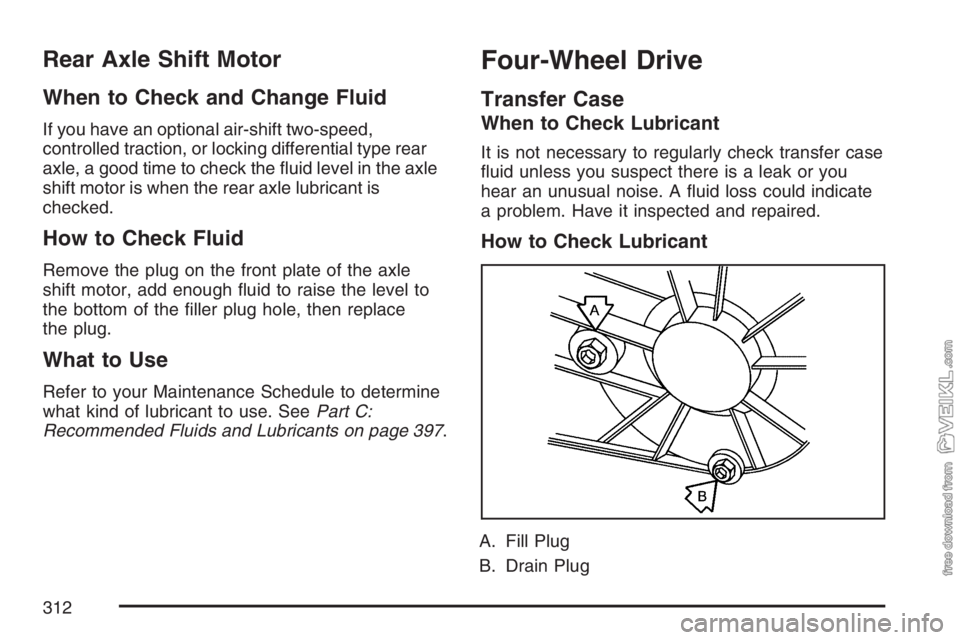
How to Check Lubricant
A. Fill Plug
B. Drain Plug
312
Page 313 of 430
To get an accurate reading, the vehicle should be
on a level surface.
If the level is below the bottom of the fill plug hole,
located on the transfer case, you’ll need to add
some lubricant. Add enough lubricant to raise the
level to the bottom of the fill plug hole. Use
care not to overtighten the plug.
When to Change Lubricant
Refer to the Maintenance Schedule to determine
how often to change the lubricant. See
Scheduled Maintenance on page 363.
What to Use
Refer to the Maintenance Schedule to determine
what kind of lubricant to use. SeePart C:
Recommended Fluids and Lubricants on page 397.
Front Axle
When to Check Lubricant
It is not necessary to regularly check front axle
fluid unless you suspect there is a leak or you hear
an unusual noise. A fluid loss could indicate a
problem. Have it inspected and repaired.
Notice:If you drive your vehicle through deep
water that is higher than the front or rear
axle, water may enter the axle housing and
cause the axle lubricant to break down.
This could damage the gears inside. Avoid
driving your vehicle through deep water.
You should avoid driving your vehicle through
deep puddles or standing water. If you must drive
through water that is higher than the front or
rear axle, see your dealer immediately afterward
to have the condition of the axle lubricant checked.
313
Page 314 of 430
How to Check Lubricant
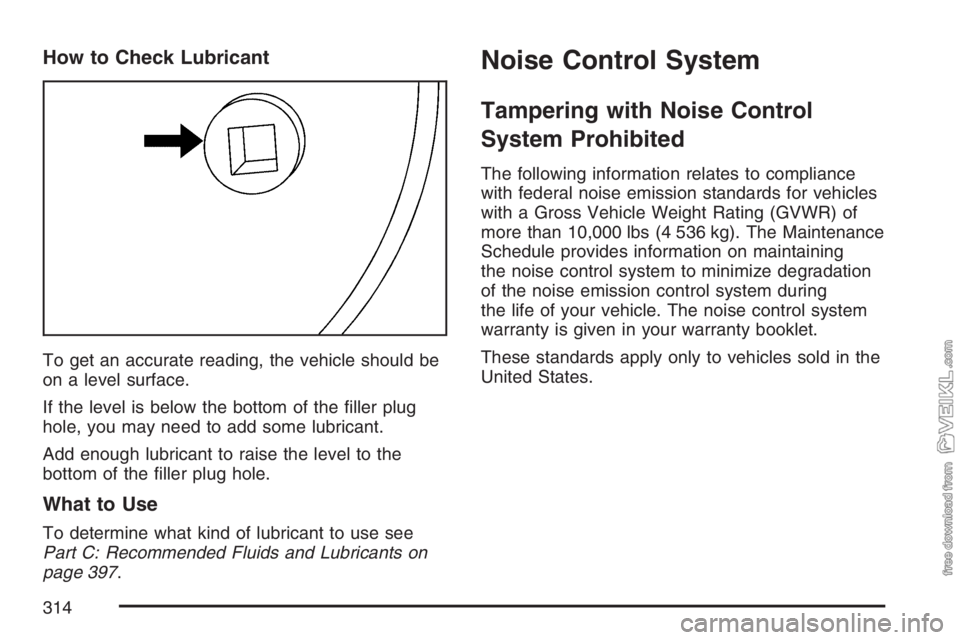
To get an accurate reading, the vehicle should be
on a level surface.
If the level is below the bottom of the filler plug
hole, you may need to add some lubricant.
Add enough lubricant to raise the level to the
bottom of the filler plug hole.
What to Use
To determine what kind of lubricant to use see
Part C: Recommended Fluids and Lubricants on
page 397.
Noise Control System
Tampering with Noise Control
System Prohibited
The following information relates to compliance
with federal noise emission standards for vehicles
with a Gross Vehicle Weight Rating (GVWR) of
more than 10,000 lbs (4 536 kg). The Maintenance
Schedule provides information on maintaining
the noise control system to minimize degradation
of the noise emission control system during
the life of your vehicle. The noise control system
warranty is given in your warranty booklet.
These standards apply only to vehicles sold in the
United States.
314
Page 315 of 430
Federal law prohibits the following acts or the
causing thereof:
1. The removal or rendering inoperative by any
person, other than for purposes of
maintenance, repair or replacement, of any
device or element of design incorporated into
any new vehicle for the purpose of noise
control, prior to its sale or delivery to
the ultimate purchaser or while it is in use; or
2. The use of the vehicle after such device or
element of design has been removed or
rendered inoperative by any person.
Among those acts presumed to constitute
tampering are the acts listed below.
Insulation:
•
Removal of the noise shields or any
underhood insulation.
Engine:
•
Removal or rendering engine speed governor,
if the vehicle has one, inoperative so as to
allow engine speed to exceed manufacturer
specifications.
Fan and Drive:
•
Removal of fan clutch, if the vehicle has one,
or rendering clutch inoperative.
•Removal of the fan shroud, if the vehicle
has one.
Air Intake:
•
Removal of the air cleaner silencer.
•Modification of the air cleaner.
Exhaust:
•
Removal of the muffler and/or resonator.
•Removal of the exhaust pipes and exhaust
pipe clamps.
Bulb Replacement
It is recommended that all bulbs be replaced by
your dealer.
315
Page 317 of 430
Other Service Items
Fuel Filter
Fuel Filter/Pressure Regulator
(Gasoline Engines)
The steel fuel filter/pressure regulator is located
near the engine compartment on the driver’s
side frame rail. If your vehicle has a rear steel fuel
tank, the fuel filter/pressure regulator is located
near the rear fuel tank, on the driver’s side frame
rail. SeeScheduled Maintenance on page 363
for recommended service intervals.
If your vehicle is equipped with the optional Davco
spin-on type filter, it is located on the driver’s
side frame rail.
Fuel Filter (Diesel Engines)
If you have a diesel engine, your fuel filter is
located in the engine compartment on the driver’s
side of the vehicle, or along the driver’s side
frame rail. See “Fuel Filter Replacement” earlier in
this section for further information.
Also seeScheduled Maintenance on page 363for
recommended service intervals.
Primary Fuel Filter and Water
Separator
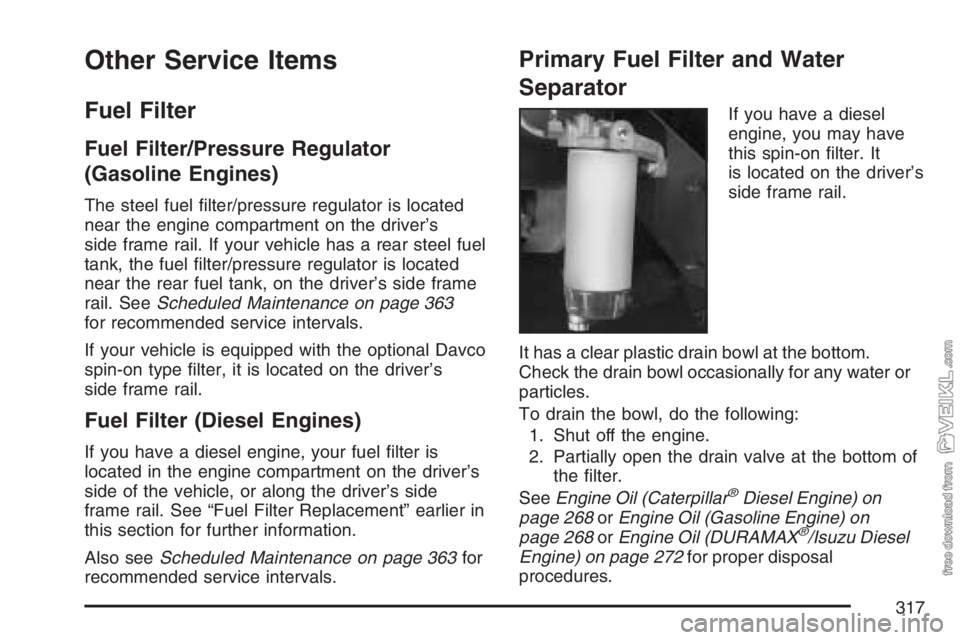
If you have a diesel
engine, you may have
this spin-on filter. It
is located on the driver’s
side frame rail.
It has a clear plastic drain bowl at the bottom.
Check the drain bowl occasionally for any water or
particles.
To drain the bowl, do the following:
1. Shut off the engine.
2. Partially open the drain valve at the bottom of
the filter.
SeeEngine Oil (Caterpillar
®Diesel Engine) on
page 268orEngine Oil (Gasoline Engine) on
page 268orEngine Oil (DURAMAX
®/Isuzu Diesel
Engine) on page 272for proper disposal
procedures.
317
Page 320 of 430
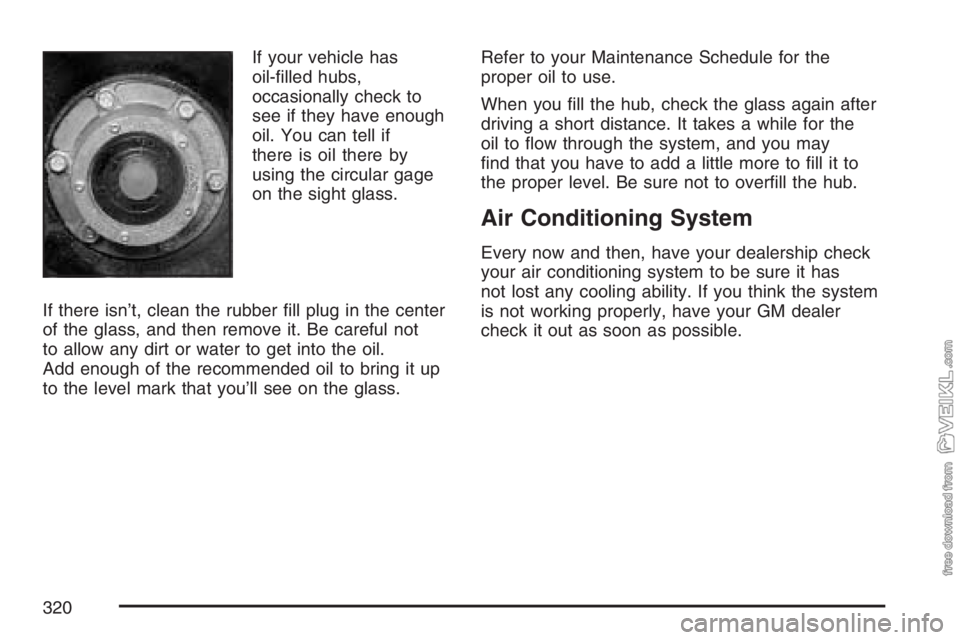
If your vehicle has
oil-filled hubs,
occasionally check to
see if they have enough
oil. You can tell if
there is oil there by
using the circular gage
on the sight glass.
If there isn’t, clean the rubber fill plug in the center
of the glass, and then remove it. Be careful not
to allow any dirt or water to get into the oil.
Add enough of the recommended oil to bring it up
to the level mark that you’ll see on the glass.Refer to your Maintenance Schedule for the
proper oil to use.
When you fill the hub, check the glass again after
driving a short distance. It takes a while for the
oil to flow through the system, and you may
find that you have to add a little more to fill it to
the proper level. Be sure not to overfill the hub.
Air Conditioning System
Every now and then, have your dealership check
your air conditioning system to be sure it has
not lost any cooling ability. If you think the system
is not working properly, have your GM dealer
check it out as soon as possible.
320
Page 328 of 430
How Often to Check
Wheel tightness is so important you should have a
technician check nut tightness on all wheels with a
torque wrench after your first 100 miles (160 km),
and then 1,000 miles (1 600 km) after that. Be sure
to repeat this service whenever you have a tire
removed or serviced. SeeScheduled Maintenance
on page 363for further information.
Wheel Replacement
Replace any wheel that is bent, cracked or badly
rusted or corroded. If wheel nuts keep coming
loose, replace the wheel. If the wheel leaks
air, replace it.
Your dealer will know the kind of wheel you need.
Each new wheel should have the same
load-carrying capacity, diameter, width, offset and
be mounted the same way as the one it replaces.If you need to replace any of your wheels, wheel
bolts or wheel nuts, replace them only with
new GM original equipment parts. This way, you
will be sure to have the right wheel, wheel
bolts and wheel nuts for your vehicle.
{CAUTION:
A leaking wheel could fail without warning.
A wheel designed for tubeless tires could
be leaking because it is damaged. Do not
use an inner tube or some other thing to try
to stop the leaking. Get a new wheel of the
proper type.
328
Page 338 of 430
Finish Damage
Any stone chips, fractures or deep scratches in
the finish should be repaired right away. Bare
metal will corrode quickly and may develop into
major repair expense.
Minor chips and scratches can be repaired with
touch-up materials available from your dealer.
Larger areas of finish damage can be corrected in
your dealer’s body and paint shop.
Underbody Maintenance
Chemicals used for ice and snow removal and
dust control can collect on the underbody. If these
are not removed, corrosion and rust can develop
on the underbody parts such as fuel lines,
frame, floor pan, and exhaust system even though
they have corrosion protection.
At least every spring, flush these materials from the
underbody with plain water. Clean any areas where
mud and debris can collect. Dirt packed in close
areas of the frame should be loosened before being
flushed. Your dealer or an underbody car washing
system can do this for you.
Chemical Paint Spotting
Some weather and atmospheric conditions can
create a chemical fallout. Airborne pollutants can
fall upon and attack painted surfaces on the
vehicle. This damage can take two forms: blotchy,
ring-shaped discolorations, and small, irregular
dark spots etched into the paint surface.
Although no defect in the paint job causes this,
GM will repair, at no charge to the owner, the
surfaces of new vehicles damaged by this fallout
condition within 12 months or 12,000 miles
(20 000 km) of purchase, whichever occurs first.
338
Page 351 of 430
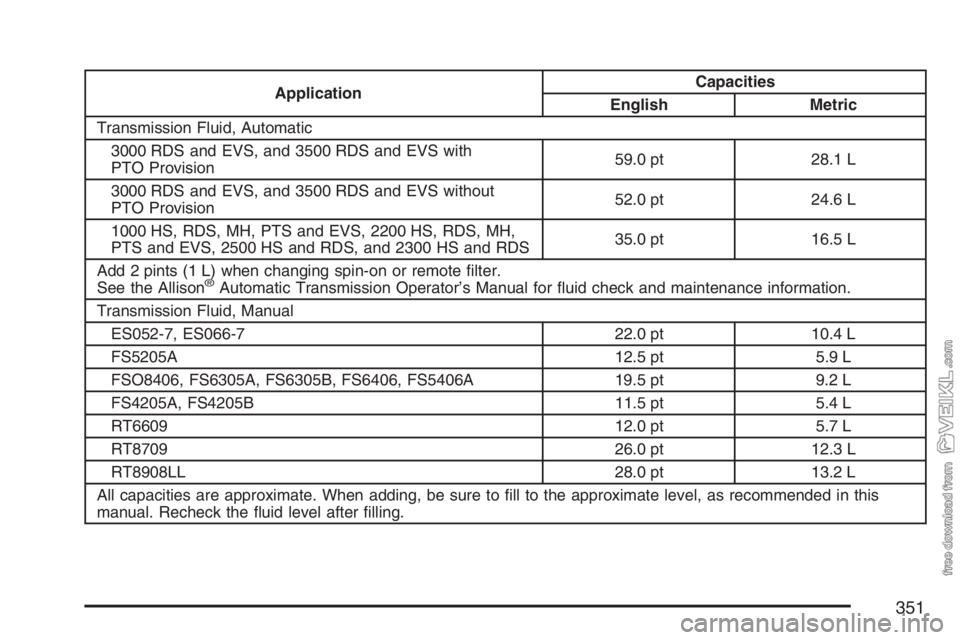
ApplicationCapacities
English Metric
Transmission Fluid, Automatic
3000 RDS and EVS, and 3500 RDS and EVS with
PTO Provision59.0 pt 28.1 L
3000 RDS and EVS, and 3500 RDS and EVS without
PTO Provision52.0 pt 24.6 L
1000 HS, RDS, MH, PTS and EVS, 2200 HS, RDS, MH,
PTS and EVS, 2500 HS and RDS, and 2300 HS and RDS35.0 pt 16.5 L
Add 2 pints (1 L) when changing spin-on or remote filter.
See the Allison
®Automatic Transmission Operator’s Manual for fluid check and maintenance information.
Transmission Fluid, Manual
ES052-7, ES066-7 22.0 pt 10.4 L
FS5205A 12.5 pt 5.9 L
FSO8406, FS6305A, FS6305B, FS6406, FS5406A 19.5 pt 9.2 L
FS4205A, FS4205B 11.5 pt 5.4 L
RT6609 12.0 pt 5.7 L
RT8709 26.0 pt 12.3 L
RT8908LL 28.0 pt 13.2 L
All capacities are approximate. When adding, be sure to fill to the approximate level, as recommended in this
manual. Recheck the fluid level after filling.
351