ignition CHEVROLET KODIAK 2007 Owner's Manual
[x] Cancel search | Manufacturer: CHEVROLET, Model Year: 2007, Model line: KODIAK, Model: CHEVROLET KODIAK 2007Pages: 430, PDF Size: 6.06 MB
Page 124 of 430
Shifting Out of NEUTRAL
To shift the transfer case out of NEUTRAL, do the
following:
1. Set the parking brake and apply the regular
brake pedal.
2. Turn the ignition to RUN with the engine off.
3. Put the transmission in NEUTRAL (N).
4. Turn the transfer case knob to the desired
shift position (Two-Wheel High, Four-Wheel
High, Four-Wheel Low).
5. After the transfer case has shifted out of
NEUTRAL, the indicator light goes out.Notice:Driving with the parking brake on can
overheat the brake system and cause
premature wear or damage to brake system
parts. Verify that the parking brake is fully
released and the brake warning light is
off before driving.
6. Release the parking brake.
7. Start the engine and shift the transmission
lever to the desired position.
Excessively shifting the transfer case into or out of
the different modes can cause the transfer case
to enter the shift protection mode. This protects the
transfer case from possible damage and only
allows the transfer case to respond to one shift per
10 seconds. The transfer case can stay in this
mode for up to three minutes.
124
Page 126 of 430
To set the foot pedal parking brake, hold the
regular brake pedal down with your right foot. Push
down the parking brake pedal with your left foot.
To set the hand lever parking brake, hold the
regular brake pedal down with your right foot. Pull
up on the handle with your right hand, until it stops.
If the ignition is on when the parking brake is set,
the brake system warning light will come on.
To release the foot pedal parking brake, hold
the regular brake pedal down. Pull the brake
release handle, located just above the parking
brake pedal, to release the parking brake.
To release the hand lever parking brake, hold the
regular brake pedal down and push down on
the handle until it stops.
If the ignition is on when the parking brake is
released, the brake system warning light will
go off.Parking Brake (with Air Brakes)
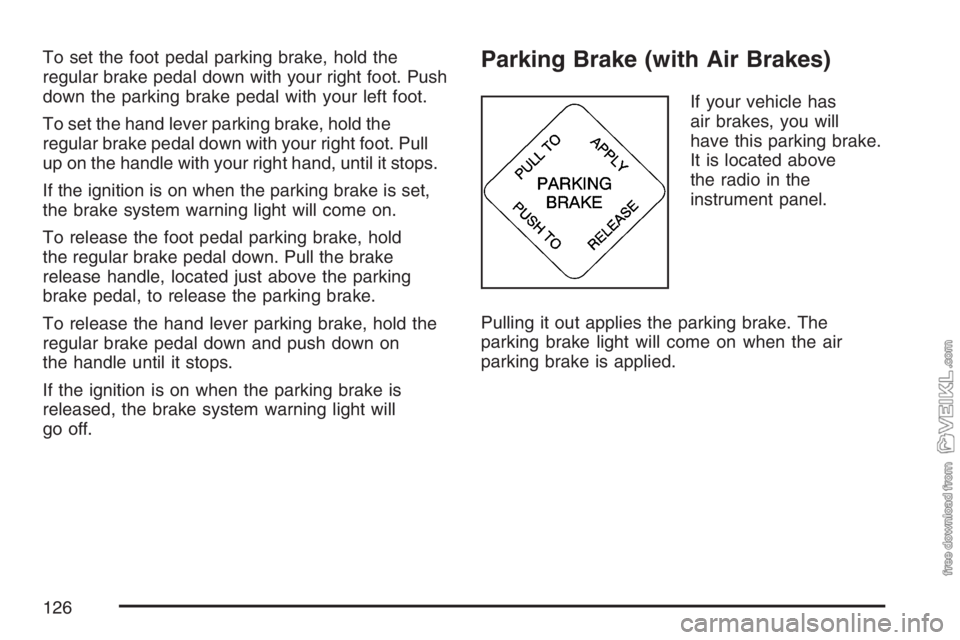
If your vehicle has
air brakes, you will
have this parking brake.
It is located above
the radio in the
instrument panel.
Pulling it out applies the parking brake. The
parking brake light will come on when the air
parking brake is applied.
126
Page 142 of 430
Hazard Warning Flashers
The hazard warning flashers warn others. They
also let police know you have a problem.
Your front and rear turn signal lamps will flash
on and off.
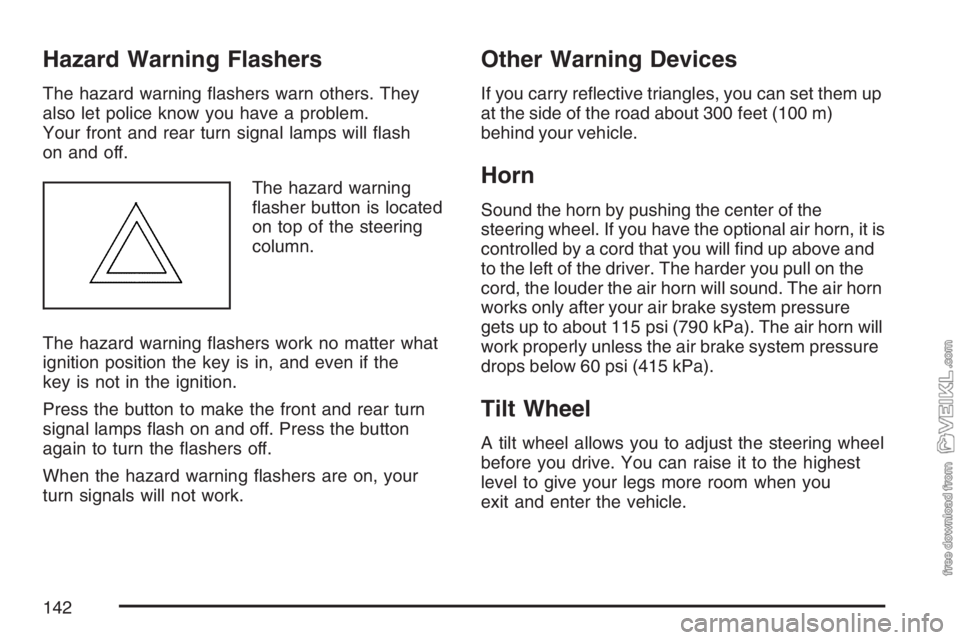
The hazard warning
flasher button is located
on top of the steering
column.
The hazard warning flashers work no matter what
ignition position the key is in, and even if the
key is not in the ignition.
Press the button to make the front and rear turn
signal lamps flash on and off. Press the button
again to turn the flashers off.
When the hazard warning flashers are on, your
turn signals will not work.
Other Warning Devices
If you carry reflective triangles, you can set them up
at the side of the road about 300 feet (100 m)
behind your vehicle.
Horn
Sound the horn by pushing the center of the
steering wheel. If you have the optional air horn, it is
controlled by a cord that you will find up above and
to the left of the driver. The harder you pull on the
cord, the louder the air horn will sound. The air horn
works only after your air brake system pressure
gets up to about 115 psi (790 kPa). The air horn will
work properly unless the air brake system pressure
drops below 60 psi (415 kPa).
Tilt Wheel
A tilt wheel allows you to adjust the steering wheel
before you drive. You can raise it to the highest
level to give your legs more room when you
exit and enter the vehicle.
142
Page 149 of 430
Passing Another Vehicle While Using
Cruise Control
Use the accelerator pedal to increase your speed.
When you take your foot off the pedal, your
vehicle will slow down to the cruise control speed
you set earlier.
Using Cruise Control on Hills
How well your cruise control will work on hills
depends upon your speed, load and the steepness
of the hills. When going up steep hills, you may
want to step on the accelerator pedal to maintain
your speed. When going downhill, you may
have to brake or shift to a lower gear to keep your
speed down. Of course, applying the brake or
clutch takes you out of cruise control. Many drivers
find this to be too much trouble and don’t use
cruise control on steep hills.
If your vehicle is equipped with the exhaust brake
option and the exhaust brake is turned on, the
exhaust brake may come on and try to slow down
the vehicle to the set cruise control speed if the
vehicle has accelerated past the set cruise control
speed while going downhill.
Ending Cruise Control
There are four different ways to turn off the
cruise control:
•Step lightly on the brake pedal (manual and
automatic transmissions).
•Press the clutch pedal to the floor (manual
transmissions).
•Move the cruise switch to off, or
•Shift the transmission to NEUTRAL (N).
Erasing Speed Memory
When you turn off the ignition, your cruise control
set speed memory is erased.
149
Page 150 of 430
Exterior Lamps
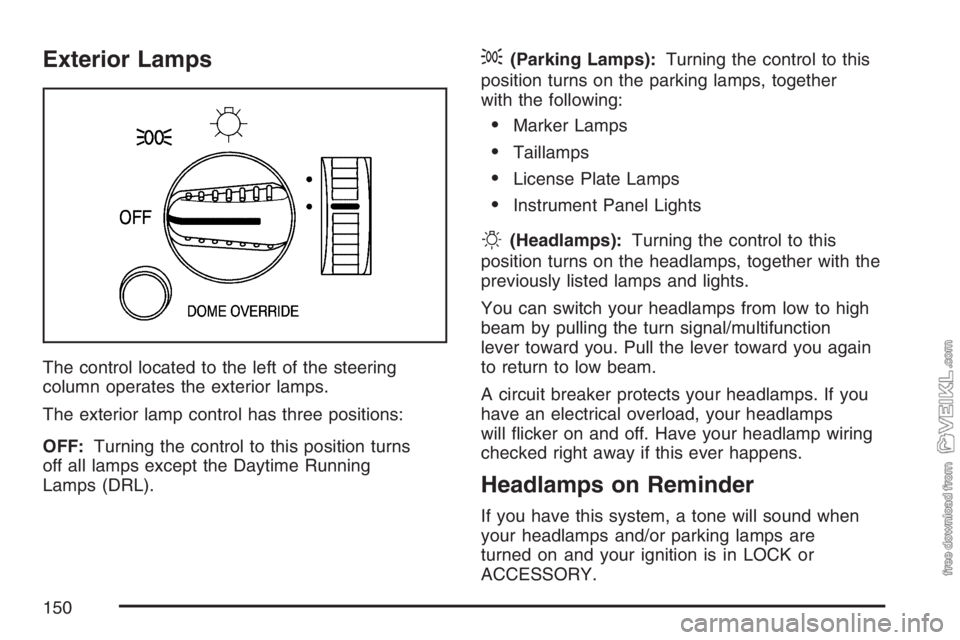
The control located to the left of the steering
column operates the exterior lamps.
The exterior lamp control has three positions:
OFF:Turning the control to this position turns
off all lamps except the Daytime Running
Lamps (DRL).
;(Parking Lamps):Turning the control to this
position turns on the parking lamps, together
with the following:
•Marker Lamps
•Taillamps
•License Plate Lamps
•Instrument Panel Lights
O(Headlamps):Turning the control to this
position turns on the headlamps, together with the
previously listed lamps and lights.
You can switch your headlamps from low to high
beam by pulling the turn signal/multifunction
lever toward you. Pull the lever toward you again
to return to low beam.
A circuit breaker protects your headlamps. If you
have an electrical overload, your headlamps
will flicker on and off. Have your headlamp wiring
checked right away if this ever happens.
Headlamps on Reminder
If you have this system, a tone will sound when
your headlamps and/or parking lamps are
turned on and your ignition is in LOCK or
ACCESSORY.
150
Page 151 of 430
Daytime Running Lamps (DRL)
Daytime Running Lamps (DRL) can make it easier
for others to see the front of your vehicle during
the day. DRL can be helpful in many different
driving conditions, but they can be especially
helpful in the short periods after dawn and before
sunset. Fully functional daytime running lamps
are required on all vehicles first sold in Canada.
The DRL system will make your headlamps come
on at reduced brightness when the following
conditions are met:
•The ignition is on,
•the exterior lamp control is off, and
•the parking brake is released.
When the DRL are on, only your headlamps will
be on. The taillamps, sidemarker and other lamps
won’t be on. Your instrument panel won’t be lit
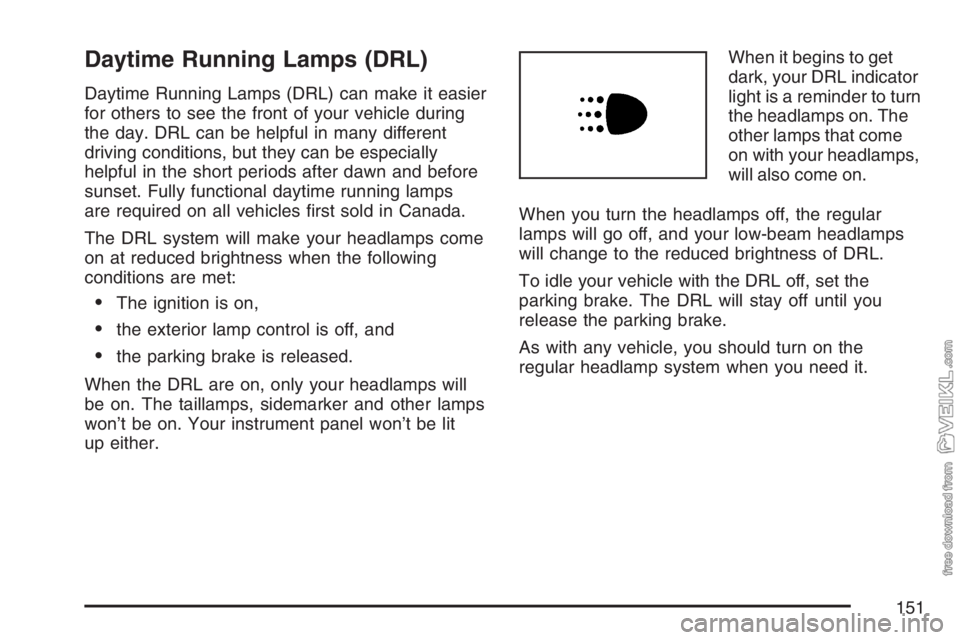
up either.When it begins to get
dark, your DRL indicator
light is a reminder to turn
the headlamps on. The
other lamps that come
on with your headlamps,
will also come on.
When you turn the headlamps off, the regular
lamps will go off, and your low-beam headlamps
will change to the reduced brightness of DRL.
To idle your vehicle with the DRL off, set the
parking brake. The DRL will stay off until you
release the parking brake.
As with any vehicle, you should turn on the
regular headlamp system when you need it.
151
Page 154 of 430
Entry Lighting
The delayed illumination feature will allow you to
enter or exit your vehicle with the lights on for
about 20 seconds, after the door is closed or the
ignition is cycled.
Reading Lamps
If your vehicle has reading lamps, press the button
next to the lamp to turn the lamp on or off.
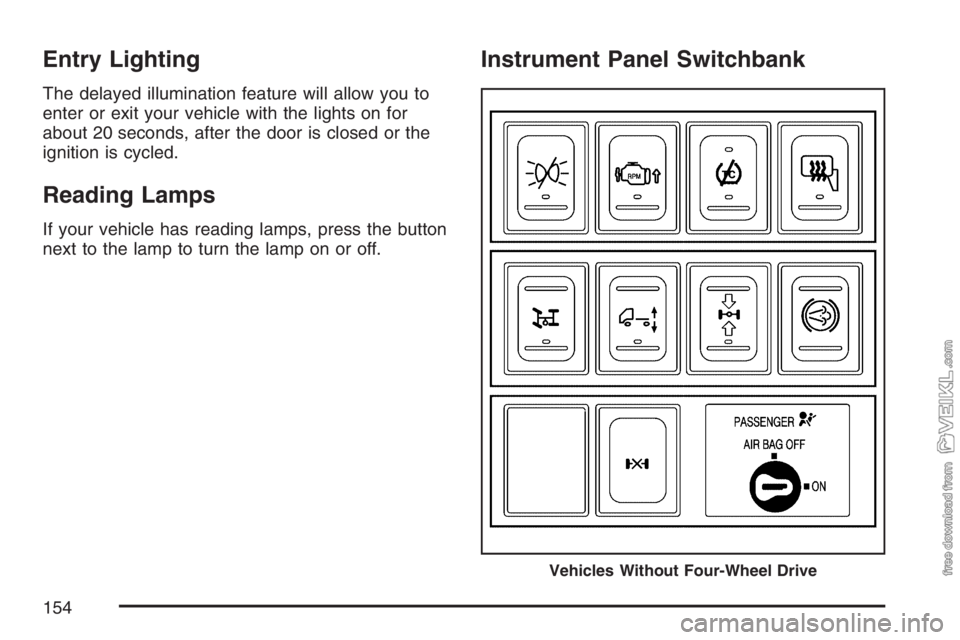
Instrument Panel Switchbank
Vehicles Without Four-Wheel Drive
154
Page 160 of 430
Rear Window Defogger
The rear window defogger uses a warming grid to
remove fog or frost from the rear window.
Be sure to clear as much snow from the rear
window as possible.
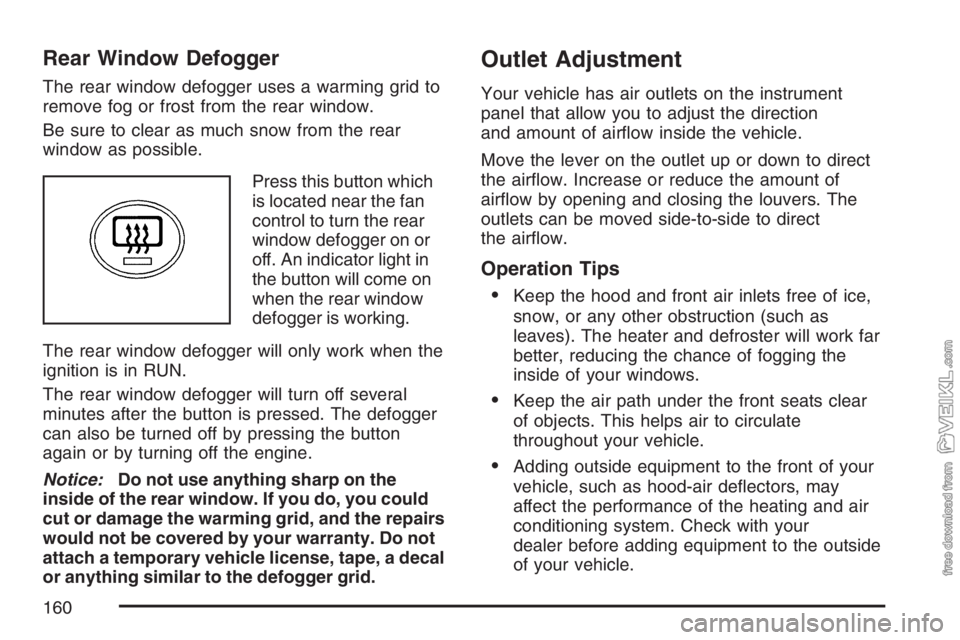
Press this button which
is located near the fan
control to turn the rear
window defogger on or
off. An indicator light in
the button will come on
when the rear window
defogger is working.
The rear window defogger will only work when the
ignition is in RUN.
The rear window defogger will turn off several
minutes after the button is pressed. The defogger
can also be turned off by pressing the button
again or by turning off the engine.
Notice:Do not use anything sharp on the
inside of the rear window. If you do, you could
cut or damage the warming grid, and the repairs
would not be covered by your warranty. Do not
attach a temporary vehicle license, tape, a decal
or anything similar to the defogger grid.
Outlet Adjustment
Your vehicle has air outlets on the instrument
panel that allow you to adjust the direction
and amount of airflow inside the vehicle.
Move the lever on the outlet up or down to direct
the airflow. Increase or reduce the amount of
airflow by opening and closing the louvers. The
outlets can be moved side-to-side to direct
the airflow.
Operation Tips
•
Keep the hood and front air inlets free of ice,
snow, or any other obstruction (such as
leaves). The heater and defroster will work far
better, reducing the chance of fogging the
inside of your windows.
•Keep the air path under the front seats clear
of objects. This helps air to circulate
throughout your vehicle.
•Adding outside equipment to the front of your
vehicle, such as hood-air deflectors, may
affect the performance of the heating and air
conditioning system. Check with your
dealer before adding equipment to the outside
of your vehicle.
160
Page 163 of 430
Speedometer and Odometer
Your speedometer lets you see your speed
in both miles per hour (mph) and kilometers per
hour (km/h).
Your odometer shows how far your vehicle
has been driven, in either miles (used in the
United States) or kilometers (used in Canada).
Trip Odometer
The trip odometer can tell you how far your
vehicle has been driven since you last set the trip
odometer to zero.
While the engine is running, press the reset
button, located to the right of the trip odometer, to
toggle between the trip odometer and the
regular odometer. Holding the reset button for
two seconds while the engine is running and the
trip odometer is displayed, will reset it.
To display the odometer reading with the ignition
off, press the reset button.
The hourmeter gage is accessed through the trip
odometer, for more information seeHourmeter
Gage on page 183.
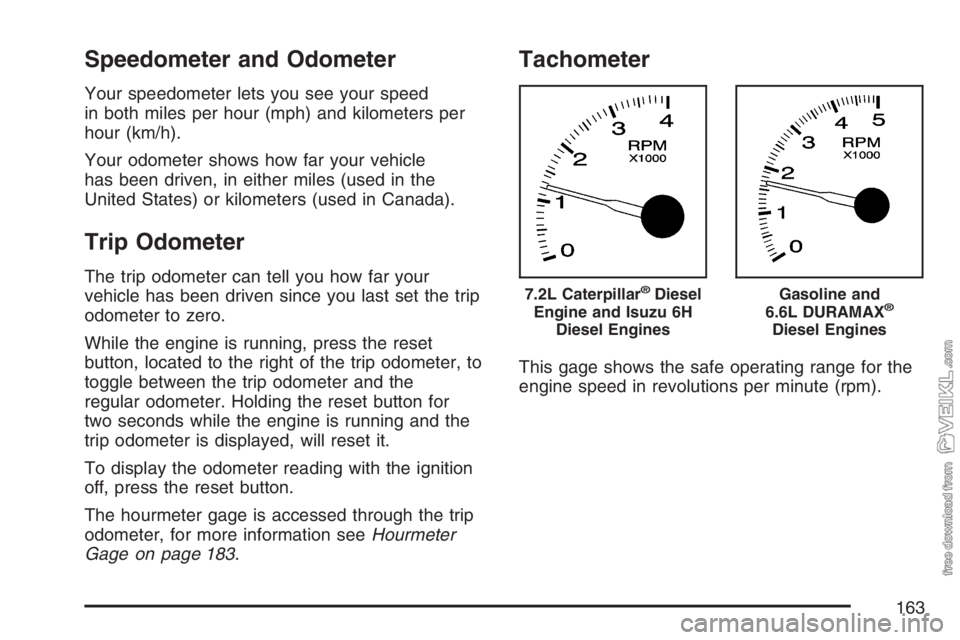
Tachometer
This gage shows the safe operating range for the
engine speed in revolutions per minute (rpm).
7.2L Caterpillar®Diesel
Engine and Isuzu 6H
Diesel EnginesGasoline and
6.6L DURAMAX®
Diesel Engines
163
Page 165 of 430
Airbag Readiness Light
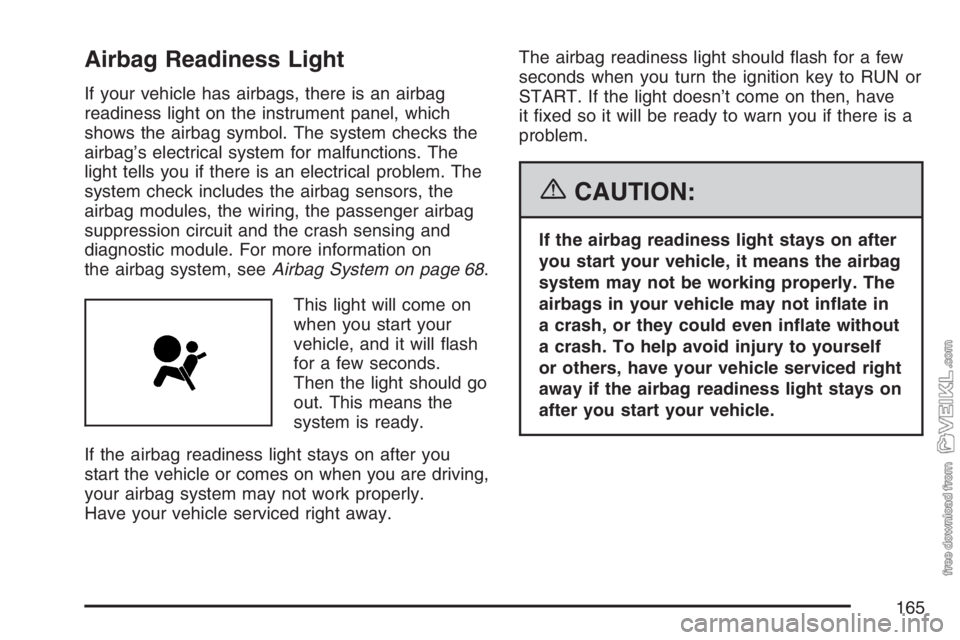
If your vehicle has airbags, there is an airbag
readiness light on the instrument panel, which
shows the airbag symbol. The system checks the
airbag’s electrical system for malfunctions. The
light tells you if there is an electrical problem. The
system check includes the airbag sensors, the
airbag modules, the wiring, the passenger airbag
suppression circuit and the crash sensing and
diagnostic module. For more information on
the airbag system, seeAirbag System on page 68.
This light will come on
when you start your
vehicle, and it will flash
for a few seconds.
Then the light should go
out. This means the
system is ready.
If the airbag readiness light stays on after you
start the vehicle or comes on when you are driving,
your airbag system may not work properly.
Have your vehicle serviced right away.The airbag readiness light should flash for a few
seconds when you turn the ignition key to RUN or
START. If the light doesn’t come on then, have
it fixed so it will be ready to warn you if there is a
problem.
{CAUTION:
If the airbag readiness light stays on after
you start your vehicle, it means the airbag
system may not be working properly. The
airbags in your vehicle may not inate in
a crash, or they could even inate without
a crash. To help avoid injury to yourself
or others, have your vehicle serviced right
away if the airbag readiness light stays on
after you start your vehicle.
165